


Tashkent Metro
We spent our first night in Tashkent lazing about in our hotel. The Hotel Uzbekistan was the sort of place that at some point in the 80s or 90s would have been the best hotel in the country. The flagship as it were. But somewhere along the way standards slipped a little and newer, nicer places were built. So it was still a pleasant place to stay, and much fancier than our usual accommodation. But it wasn’t anything tremendously special.
On our first night there we did some research and planning and concluded that in order to make the rest of our time in Uzbekistan flow smoothly we could only afford two nights and one day in Tashkent. So we set out the following morning to make the most of it.
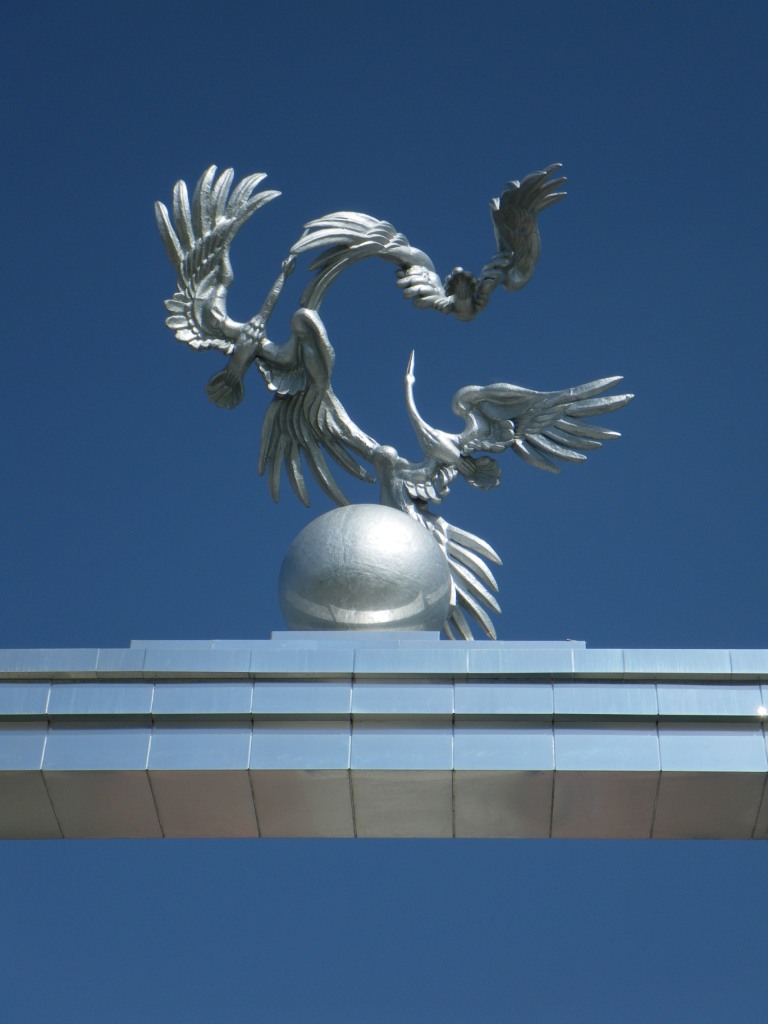
Three Khumo (mythical birds that are a national symbol of Uzbekistan. I thought they were supposed to be storks or cranes at first given the number of those we’d seen in Fergana. These three sit atop an arch at the entrance to Mustaqillik square which is the government nominated, if not the popularly recognized, centre of Uzbekistan
Step one was the train station to purchase the tickets that would take care of all our remaining long-distance transport in the country. The ticket office was oddly located well away from the station and around the corner. And the ticket agent told us that our planned Samarkand-Urgench route didn’t exist and was only demystified when we explained that the Tashkent-Urgench train stopped there. But all in all buying the tickets was a pretty simple process. And as it turned out it was a good thing, as we later met many others who’d found that tickets for some of their desired trips were sold out when they tried to buy them.
Step two was to take the metro up to the north end of the city to check out the main bazaar. Now I generally make a point of using public transport in general and subways wherever they’re available. But in Tashkent our motivation for using the metro went beyond that. The Tashkent metro was built in Soviet times and was an impressive piece of engineering (it was designed to double up as a nuclear bunker) and an even more impressive piece of architecture and interior design. The stations were fabulously decorated. Lots had art deco interiors, with brass light fittings, neoclassical columns and lovely mosaic tiled walls. Others took had a central Asian style, the platform area being formed from a matrix of domes and pointed-topped arches with turquoise glazed tile accents. Others had very individual themes, such as the incredible Kosmonavtlar station with its dark blue tiled walls and ceiling featuring mosaics of the moon, galaxies and Yuri Gagarin in the foreground. In fact I don’t think it would be an exaggeration to say that the metro was actually the best thing about Tashkent (especially since the police have calmed down somewhat in their overzealous inspections of/requests for bribes from foreign visitors using the system. We were only stopped by police once, and all they wanted was a quick look in our backpack and to check that we had valid visas.)

For some reason Uzbek authorities don’t allow photos in the Tashkent Metro, though it’s unclear why. Especially when there are already plenty floating about, like this one from wikipedia
While it didn’t have the same friendly, welcoming atmosphere of the Fergana valley bazaars, Tashkent’s Chorsu bazaar was well worth the visit, and probably was number two on our short list of things to do in Tashkent. The place was laid out like a wheel, with produce-lined spokes that radiated out from the centre. The centre itself was a huge turquoise dome that looked like a cross between a 15th century mosque and an alien spaceship from a 1970s science fiction movie. This comparison proved valid for the inside of the dome as well. Leaving aside the rows and rows of tables filled with pickled salads, dried fruit and fermented milk products, the vast hall could have been a set from Logan’s Run.
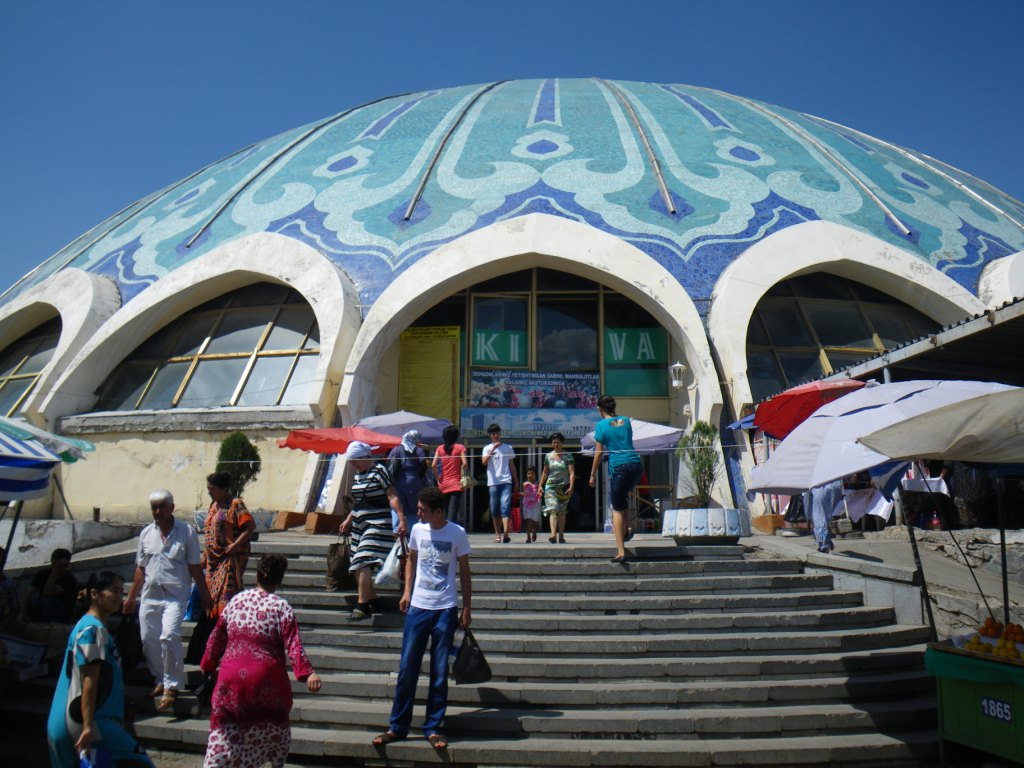
The main dome of the Chorsu Bazaar from the outside
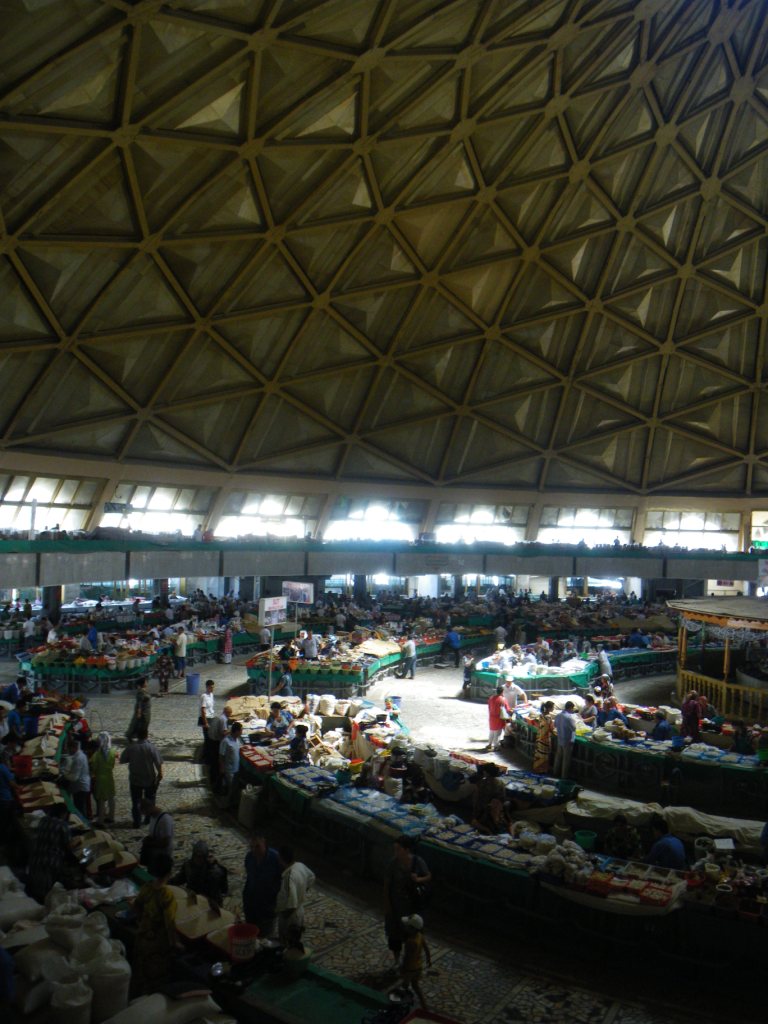
And inside. Compared to many other Asian markets, Chorsu was very orderly. Each section of the long ceramic counter was numbered, and there were even permanent signs on posts high above the market stalls telling shoppers what type of goods were for sale in that section.
Around the corner from Chorsu bazaar was a beautiful 16th century Medressa. In classical central Asian style it was built of sandy coloured brick and brilliant teal coloured tiles. More of the same was found a short walk away at the Khost Imam complex, the focal point of Islam in Uzbekistan. (Though in fact we didn’t actually walk there. Tashkent was a rather difficult city to navigate, as street signs were almost entirely absent, street directions were pretty much random rather than a nice grid, and I’d forgotten our compass back at the hotel.) Khast Imom was made up of several mausoleums, medressas and mosques, varying in age from about 600 to 10 years old. The big courtyard in between these was clear and clean, having been obviously constructed (or renovated at least) very recently. We dashed from one building to the next, trying to keep ahead of two big Indian tour groups (I’m unsure how their came to be so many Indians there… It’s true that the Moghul dynasty of Indian emperors originated in what is now Uzbekistan, but this doesn’t strike me as the kind of historical connection that would be a major draw card.)
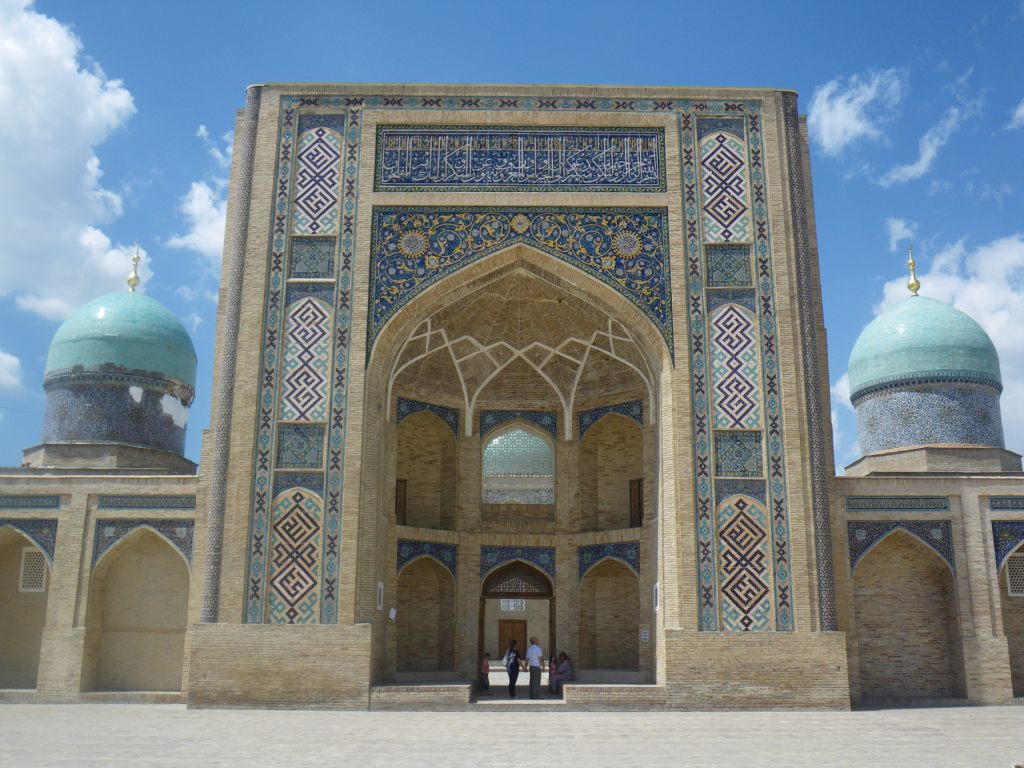
Barakhon medressa, the oldest building in Khast Imom. It’s illustrative of the government’s (and, indeed, many Uzbek people’s) attitude toward religion that here, in the supposed spiritual centre of the country, the medressa was being used as a coppersmith’s workshop and sales centre rather than as a place for religious scholarship
As impressive as Khast Imom was, it paled in comparison to what we’d see in Bukhara (and later Samarkand and Khiva.) The one thing it DID have over these other magical ancient cities was a small former (and I suppose present as well) library which housed the world’s oldest Quran. This Quran was made in around 700AD, and brought to Uzbekistan by local son Amir Timur (known to the west as Tamerlane [intriguingly my text editor’s spell check know’s Tamerlane, but not Ghengis Khan!]) almost 700 years later when his empire was briefly the richest and most powerful in the Muslim world. The book was huge, with pages of wrinkled silk paper almost 1m square. The experience rather reminded me of going to see the Book of Kells in Dublin (which, incidentally is almost exactly the same age as the Uthman Quran.)
After Khost Imom we took another Metro trip to the centre of modern Tashkent, the area around Mustaqillik Maydoni (square.) To be entirely honest I didn’t really like this part of town. You were virtually never out of sight of a police officer (not to mention a security camera.) It was all new and shiny, with lots of white marble, gilding, manicured lawns and elaborate water fountains. Of course there’s nothing wrong with these things in and of themselves. But somehow the overall feel was of a place that had been built at great expense to show off how wealthy, powerful and modern the country was, rather than for people to use and enjoy, the builders having perhaps missed the point that wealth, power and modernity are not ends in themselves but means to make life good for people. The square reminded me a bit of a central Asian version of Tiananmen, but where the government hadn’t been as successful in convincing the people that it was the centre of their universe, leaving only the government themselves believing it.

Some older, Soviet era buildings in central Tashkent that haven’t quite been replaced yet
To one degree or another this feel was present in a lot of modern Tashkent. I feel kind of bad bagging the place after having spent less than 48 hours there, but, well, that was the feeling I got.
Our final stop of the day was the grandly named Museum of the History of the People of Uzbekistan. The museum wasn’t actually all that fascinating. The artifacts weren’t awe-inspiring enough to stand on their own, and the interpretation was pretty much all in Uzbek and Russian. I wish we’d been able to read more of what they had to say, especially the sections dealing with problems faced by the country in its recent history and future (e.g. the violence between ethnic Uzbeks and Kyrgyz in the Fergana Valley and the destruction of the Aral Sea.) That said, the value of the experience was improved immensely by the fact that we joined up with a group consisting of two young men (German and Uzbek), an older Englishman and their museum tour guide. Not so much because they helped us understand the museum collection, but because it was interesting to hear their commentary on it, especially in the “modern Uzbekistan” section on the second floor. I’m still not quite sure if they really were entirely reverent, or were gently poking fun when we reached the case full of photos of the Uzbek president with various heads of state, including multiple US and German ones. “One of the great things about our country,” the young man said, smiling, “these other leaders are constantly changing, but our president is always the same!”
We walked back through our hotel through more modern, sanitary parkland. Here at least there were chaikhanas (tea houses) with people in them, a painter’s market with hundreds of canvasses and quite a number of people out for walks with their families. This went a fair way to improving my feelings about modern Tashkent. That night we watched the lead-up to the Olympic opening ceremonies as we ate our usual dinner of bread and watermelon.

Hotel Uzbekistan

We hadn’t really planned on spending much time outside during exploration Tashkent, but ended up walking for a good chunk of the burniest part of the day. We’d also forgotten to bring sunscreen which left poor Sarah with this entertainingly shaped tan line
The next morning we woke up early and headed down to the hotel lobby for breakfast (I was slipping somewhat in my adherence to the Ramadan fast… If we were staying in a place where breakfast was provided, I’d eat it as early as possible, but if that was before the first light hit the morning sky, so be it.) Before leaving we had a lengthy debate about payment for our room with the hotel staff. The room was priced in Uzbek Somoni, but they insisted that because we’d made an online booking we were obligated to pay by credit card. This meant the price would be converted to NZ dollars at the official rate, meaning that A. It cost about 35% more than we’d been expecting and B. We had several big bricks of Som that we’d planned to use to pay for the room left in our bag.
This left a sour taste in my mouth about Tashkent, but this faded quickly enough. Another trip on the fabulous Metro to the railway station took care of most of it, and the very comfy (air conditioned thank goodness!) Sharq Express to Bukhara did the rest.
The train trip took about 8 hours, and while the scenery was nothing to write home about (it was a mixture of farms, small towns, low hills, flat plains [which did occasionally take on pretty golden colour] and flat brown desert) the trip was comfortable and went by quickly.
On arriving in Bukhara we were met by several hotel touts. I’m often kind of irritated by touts, but these all used a pretty soft-sell approach, and were entirely happy to simply give us their cards, show us the way to the Marshrutka to the old town, and let us make a decision on our own. This was a good beginning, for our visit to Bukhara, and indeed proved to be typical of the way things went in that magical town.

Me and the Sharq (East) express
Tags: Chorsu Bazaar, Khost Imam, Llew Bardecki, Tajikistan, Tashkent, Travel, Uzbekistan
 llewtravel
Leave a Reply