


Welcome Back
You’d be forgiven for A. having given up on ever finding a new entry here and/or B. wondering how on earth we ended up in Luxembourg. After all, the last entry posted here was about five months ago and had us in Bolivia.
The short answer to our dash through space-time is laziness. When we got back to Canada at the end of April we spent a good lot of our time doing not much of anything and this general spirit of lackadaisicalness extended to me not writing any new ‘blog entries for several months.
Not to worry though. Now that we’re on the road again I plan to keep up with the entries, and even post (abbreviated) accounts of what we got up to in the Americas during the five months you’ve missed out on.
So. To Luxembourg.
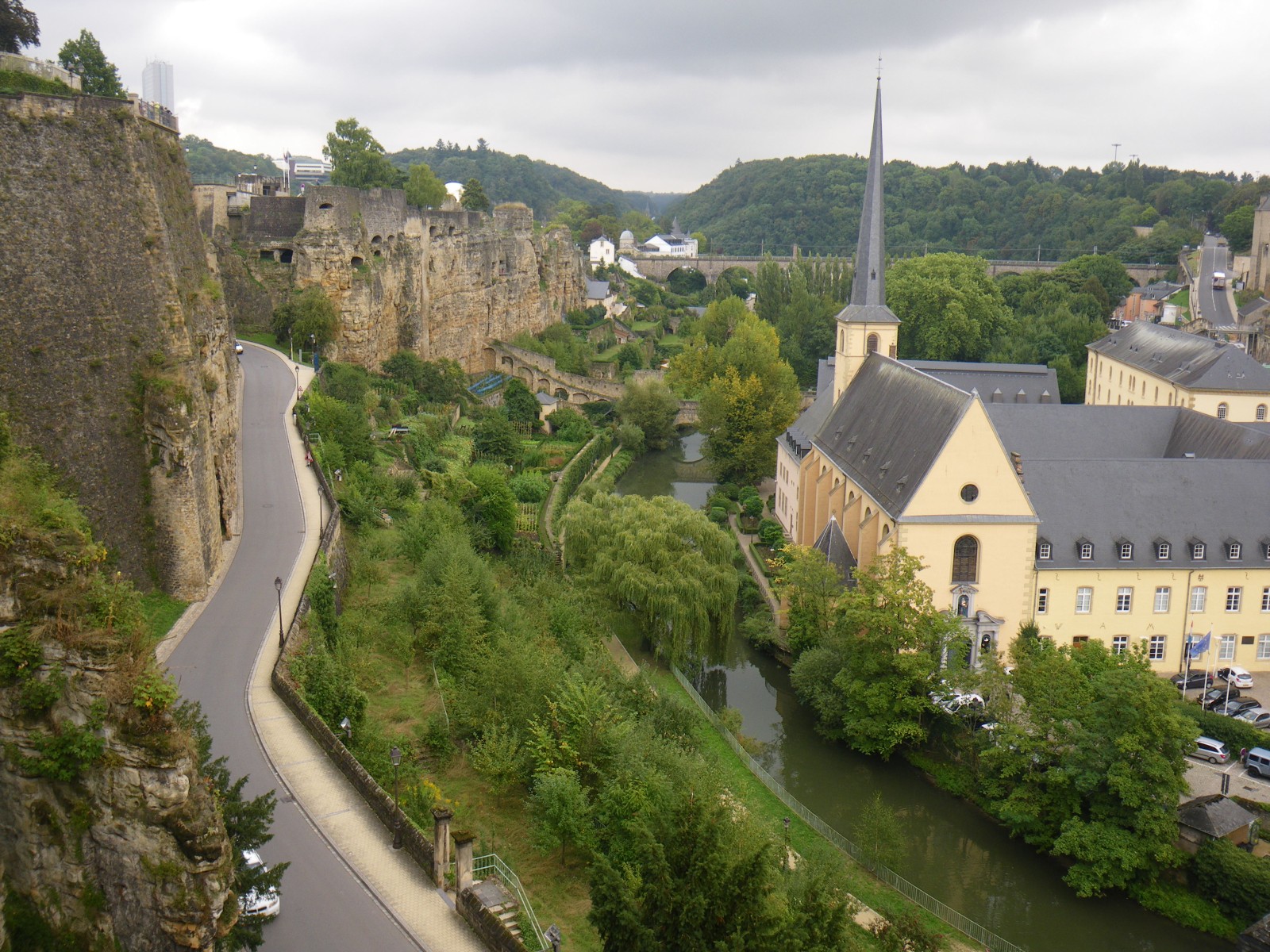
Part of the fortifications of old Luxembourg City
Or at least on our way there. We actually arrived in Europe at Frankfurt airport where we caught a pre-booked series of trains west and a touch north. The last segment of our 4-hour trip was through the Mosel Valley. I’ve never really heard it talked about as a tourist detination before, though I can’t understand why not… The valley is formed by steep hillsides, most of which are livened up with centuries-old vineyards. And up above the valley, virtually every rocky hill or prominence was topped with a medieval castle or a slightly newer residential palace. To the point that you probably saw one every ten minutes or less.

Our trip to Luxembourg took us from Toronto to New York City, then across the Atlantic on a Singapore Airlines A380. My first time ever on the big double-decker plane. It was fun to look at but really not all that exciting during the trip…

Some of the aforementioned vinyards, towns and castles. To my mind a castle must be A. a military fortification and B. a residential structure. It bugs me when people confuse palaces (not fortified) or (more rarely) fortresses (not residential) with castles
Once we arrived in Luxembourg we waited for our host Audrey (this time met through the non-profit, democratically goverened bewelcome.org instead of the Couchsurfing.com site, which has recently gone through a lot of changes I don’t really like.) Audrey originally hails from France, and our first couple of hours with her and her flatmate Anne-Marie illustrated how terribly my French has deteriorated. We could- sort of- have a conversation, but only because they were patient and willing to help me out with the odd translation of a word here or there. Sarah fared noticeably better, but I don’t think it was entirely a coincidence that our hosts had pretty much switched to English by the following evening.
Anyhow, all of our chatting was conducted over a few Luxembourgish beers (unexciting, but entirely drinkable pilsners) before Audrey, Sarah and I headed out for what must be the quintisentially Luxembourgish evening: a visit to the final night of the Schueberfouer, the country’s annual fall fair. It looked and sounded a lot like the midway at the CNE (for those of you who that means anything to…) but was probably 3 or 4 times the size. And while the food and drink on offer at the stalls had a lot in common with Canadian fair fare (deep fried and sugary goods featuring heavily) there were subtle differences. For example it was no problem to buy a beer to sip as you strolled amongst the flashing lights of the rides, the screams of the riders and the semi-rigged carnival games. And food-wise, one traded in a hot dog and fries for a notably yummier (though bread-deprived to my mouth) sausage on a bun and a gromperekichelchen (love that name!) which is very similar to a fried (kind of halfway between deep and shallow fried) potato pancake or latke. Good, with lots of black pepper and onion in the mix, but also greasy enough that one apiece was clearly enough.
As for the rides, there were even fewer dissimilarities there. The three of us went on one, which, now that I think about it, was actually done BEFORE our dinner; it was fun, but being spun around two different axes at once, while being translated along a third did get my stomach rolling a bit when I made the mistake of looking up at the stationary rocket at the top of the tower.
The evening concluded with a good sized fireworks show (though I think other fireworks may have been forever spoiled for me by Chinese New Year in Hangzhou…)

The big ferris wheel at the Schueberfouer

Audrey and I with dinner. You see what I mean about it being a bit short on the bread!
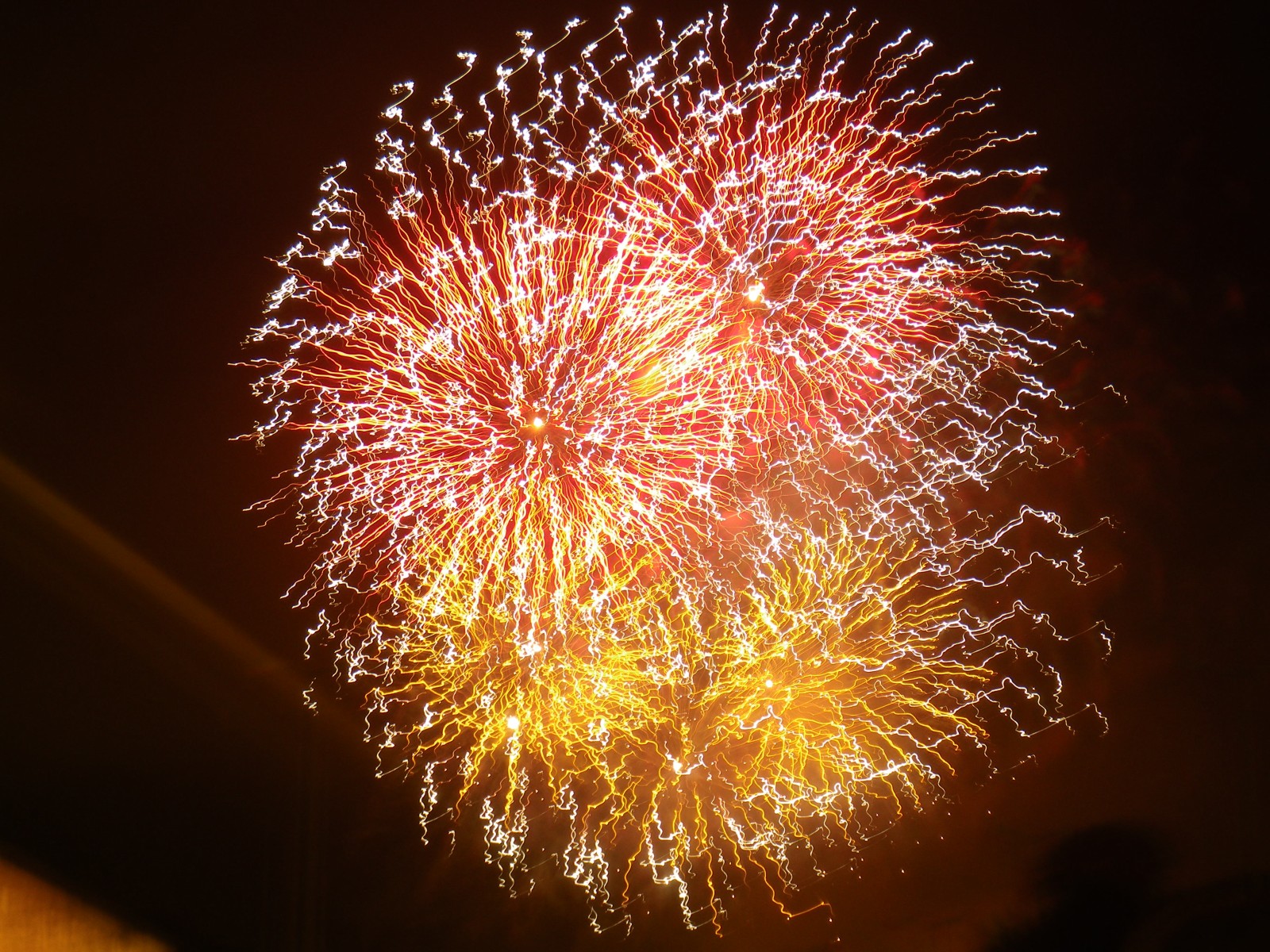
Kind of a fun photo from the fireworks display. My hands shaking during the second or two exposure are what make the trails so wiggly.
The bus back home was free, which was good as when we boarded on our way out, Audrey informed us that it was entirely unneccesary to pay for the buses in Luxembourg. Tickets were on a 100% honour system with not even occasional ticket checkers around to keep riders honest. When I hemmed and hawed over this a bit Audrey said that my positivist respect for rules made me sound like a German 🙂
Next day Audrey was working so Sarah and I did a bit of sightseeing on our own. We headed out to the town of Vianden by a combination of train and bus (paying for both this time… there are inspectors on the trains and besides, at 4 euros for an all-day, all-transport modes ticket that covers the entire country, there’s hardly any reason not to!)
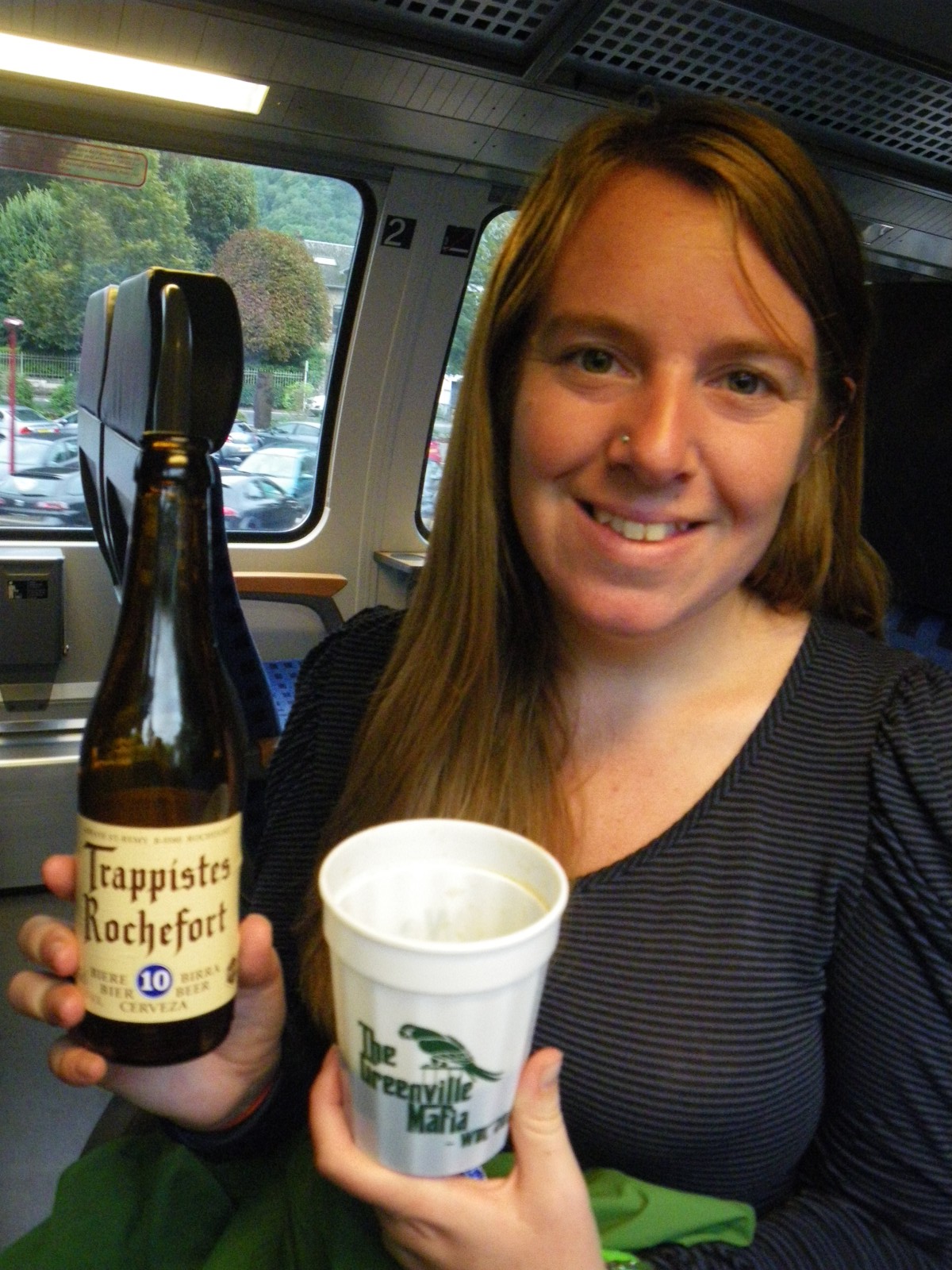
Brekkie on the train. Sarah and I have, almost by accident, developed a tradition of having Rochefort #10 for breakfast.
Vianden is one of the tourist highlights of Luxembourg. The kind of town that people call charming, with the added bonus of a truly ancient castle looming above it. But unlike many such places in Europe it was, at first anyway, pretty much empty. Our visit included a walk along the slowly crumbling old town walls, where we picked up freshly fallen apples and wild blackberries to snack on as we explored.
The walk eventually brought us to the schloss. Schloss is the Luxembourgish word for castle, which is just the same as the German one. I’d always sort of assumed Luxembourgish was closely related to Dutch/Flemish, but no, it’s a close cousin of German (though not such a close one that native speakers of each wouldn’t have a tough time being mutually intelligible.) Although that said, a large proportion of the country’s population speak at least three of Luxembourgish, French, German and English anyway.
As for the castle/schloss/chateau, call it what you will, (leaving aside my pedantry) it’s almost irrelevant. At some time or other just about everyone’s owned it from Gauls through Romans, Franks, Prussians and eventually the Counts of Vianden, relations of both the Dutch House of Orange and the Grand Dukes of Luxembourg. The Counts kind of gave up on the place at one point, however, and it eventually fell into ruin. By now it’s been heavily restored. A bit too heavily for my taste in fact. Adding electric lights, modern bathrooms and fancy stainless steel and glass visitor centres just take away too much of the feeling of history. All in all I’d rather just have the old ruins to explore.

The town of Vianden from above
And the schloss from below. Which kind of implies (correctly) that these two photos were actually taken in reverse order.

Part of the (over) restored interior of the castle.
The rest of the day was spent bussing around the rest of the northern Ardennes region and poking our noses into towns famous for brewing beer, ancient bascilicas, and “hosting” skirmishes during the WW2 Battle of the Bulge. That said, they all looked rather similar. The aforementioned battle meant that many settlements in the area took heavy damage and were rebuilt in a sort of pleasant, if undramatic, central European style. Sarah and I searched for places to compare it to and eventually came up with Slovenia. The two small nations share a certain prosperous tidyness, as well as a surprising green-ness; despite its tiny size, its equally tiny population means that large swathes of Luxembourg remain semi-wilderness, or at least sparsely populated and rural-ish.

This skip was in front of a building being re-roofed in the town of Diekirch. As this illustrates, almost all buildings in the centres of Luxembourgish towns had genuine slate roofs. Super cool!

Also in Diekirch was this inexplicable (to us) statue of a donkey that appeared to be pooing coins. We later learned that there are multiple different European fairy tales and fables that involve gold pooing donkeys (The Wishing-Table, the Gold-Donkey, and the Cudgel-in-the-Sack; and Donkeyskin being two of the better known ones.)
Sightseeing in the countryside duly completed we bid farewell to Audrey and met up with Michael, Sarah’s brother for some sightseeing in Luxembourg city. Michael along with his wife Carmen and Sarah’s new niece Melinda, had come up from Munich, where they all live, to meet us.
From our day of walking around we can conclude that Luxembourg was a rather small, but still pretty darn cool city. From the shiny new Euro (as in European Union) quarter where our equally shiny hotel was located, to the far side of the old town was not much more than a half hour’s walk. But you saw some pretty cool stuff on the way.
Our day of sightseeing finished off with Sarah, Carmen and I taking a walk to a big-boxy supermarket, which wouldn’t rate a mention except for the fact that many of the staff got around the store on roller skates.)

A fine illustration of the kind of place Luxembourg is: 18th century Austrian Fort Thüngen with part of the the ultra-modern Place d’Europe complex just peering over its shoulder

The old town of Luxembourg was surrounded by a huge and, at times, bewlidering set of fortifications. I spent quite a while being befuddled as to how all the fortififications worked to form a coherent whole. Eventually I learned that they don’t. In 1867 the majority of the city’s fortifications were destroyed as part of the Treaty of London. That said, there’re still an awful lot of them!

Rapelling gardeners! Extreme gardening! Perhaps this is how the drummer from Spinal Tap died?

Michael and Melinda in the Bock Casements. The casements (casements are underground tunnels carved into rock beneath a fortress to add to its defensive value… you knew that, right?) along a spit of land that jutted out toward the confluence of Luxembourg’s two rivers are some of the most impressive remnants of the old city’s military history.

The headland into which the casements were carved was separated from the rest of the town by this narrow defile. Not only that, but a tunnel was built into the casements directly underneath the causeway pictured here in case it was ever destroyed!

Flashy new gold skyscrapers behind our hotel
Our final day in Luxembourg was actually spent primarily in other countries. But we did have some important business to attend to before we left. As mentioned before, we approached Luxembourg city via the Mosel valley, which was absolutely packed with v‌ineyards. And Luxembourg has its own chunk of the valley and its own wine region as well. So of course we couldn’t pass up an opportunity to try some of their produce. At Michael and Carmen’s suggestion we visited a tasting room near Schengen (of Schengen Visa fame) run by a co-op of local wineries. The wine was right up my alley… Crisp, aromatic whitfees of all sorts. Yum! (Though I was a little surprised to find people smoking in the cafe adjacent to the tasting room… Luxembourg is apparently one of the few countries in Europe that still permits smoking in bars and cafes!)

Sarah in front of the tasting room
During our 2008 trip I posted a blog entry titled “Three Countries, 24 Hours.” After the winery we absolutely demolished that timescale, driving through Luxembourg, then ducking into Germany for no more than 5 minutes before finding our way into France. We stopped for Lunch at a restaurant in the shadow of a hilltop castle (proper French food too… lots of butter, cheese, garlic… I had blood sausage!)

Lunch in France! Sarah’s first time in the country
After lunch we headed back towards Germany (pausing only to buy a fresh baguette from a roadside “automated bakery.” Put your coins in the slot, wait a couple of minutes and out comes a fresh baked baguette.)
It was actually quite a long drive back to Munich in the family’s rented 5-series BMW station wagon. Traffic delays near the city stretched this out still further, but high speeds on the autobahn clawed a lot of this back (at one point we got up to 182km/h… the fastest I’d ever been in a car at that point I think!) Even so we arrived home in the Munich suburb of Germering around 22:00, not too late for an evening meal. Which meant that we’d had breakfast in one country, lunch in a second and dinner in a third 🙂


Elephants on parade. While painted fibreglass animals posed throughout a city has been done many times before, I quite liked Luxembourg’s elephants. The elephant parade moves from city to city (each of which has its own brand new elephants that are eventually auctioned off, proceeds going to Asian elephant conservation organizations.)
Tags: Diekirch, Llew Bardecki, Luxembourg, Travel, Vianden
 llewtravel
Leave a Reply