The primary reason for our visit to Munich was, of course, to visit Sarah’s family. Her brother Michael, his wife Carmen and their six-month old daughter Melinda (Sarah’s first niece) live there.
We got to check out their lovely new house in a suburb of Munich (Michael lamented the fact that having moved out of town before registering a car, he’d be stuck with a “country bumpkin” license plate… The first 1-3 letters in a German plate indicate where the car was registered.)
And country bumpkins though they may now be, access to the city centre is still quite easy. A ten minute walk down to the S-Bahn (suburban train) station, then half an hour or so on the train and you’re in the centre of Munich. Either that or you can zip into town on the Autobahn and be there quicker still. Of course other problems come with this… Little did we know that the Sunday we headed into town was both the day of the Munich “Street Life” festival AND the monthly free museum day. All of which meant that we spent ages looking for a car park and had a good long walk to our destination afterwards. On the positive side, this also meant that the two museums we were headed for were free. Melinda made loads of friends in the galleries (one of the security ladies, having seen lots of people frustrated with the business and crowds on free day saw her smiling and commented “at least someone’s having fun today!”)

Melinda the kunst-fan
Of course, a visit to Michael and Carmen also invariably means visit to Carmen’s family. Which is invariably most welcome. Carmen’s immediate family are all lovely folks, as was roundly demonstrated on our second night in Munich when we went over to their place for dinner. Full Bavarian style on this occaision: beer and weisswurst (veal sausages, traditionally served with weissbier and sweet grainy mustard… yum!
And this time the family trip went well beyond the close relatives and immediate environs of Munich… We were all invited to Carmen’s cousin Moni’s brithday party in the city of Chemnitz. Carmen’s family originally hails from the eastern part of the country, and many of them still call the area home. We made the four hour trip up the autobahn to Carmen’s aunt and uncle’s home in Chemnitz. When we arrived we got a welcome so warm it almost felt silly… A huge dinner was waiting for us, complete with the local specialty, Thuringer sausages, and a large selection of east German beers. When dinner was at last done we went back to the apartment they’d arranged for us, complete with a parking spot right out front… Uncle Misha had gone and parked their car their earlier to ensure that there’d be a spot waiting for us when we arrived. Inside there were platters of fruit, several more beers, juices, chocolates… we were utterly spoiled.
This sort of thing continued through the whole weekend and when breakfast came I inevitably found myself still stuffed from the previous dinner. Likewise dinner and lunch, lunch and breakfast.

Misha, Sarah and I with glasses of “Medicine,” as Carmen’s family call the Saxon digestive herbal liqeur. Note Sarah and I’s XL sized glasses!
The hospitality went beyond filling our bellies and extended to Misha driving us to the next large city down the road, Dresden, and giving us a personal tour.
As many readers will know, Dresden was a city long recognized for its beautiful architecture and cultural institutions (and clearly NOT recognized for any military, industrial or strategic importance.) Then it was firebombed by the allies towards the end of WW2, destroying pretty much the entire city centre and much of the outlying areas to boot. I’m going to leave aside discussion of whether this was a legitimate military decision, and just say that we were delighted to find that the city centre has been largely rebuilt and Dresden has returned to its place as the jewel of eastern Germany. This has ensured that central Dresden has turned into something of a tourist hotbed. Certainly more than just about anywhere else we’d seen in Germany (Neuschwanstein is pretty solid competition) and I’ve no doubt moreso than anywhere in the eastern half of the country. The area around the central square was just packed with souvenir shops and tourist restaurants with signs in English and Russian outside (including one that advertised itself as being a “Canadian restaurant.” I certainly believe that there is such a thing as a Canadian national identity, but Canadian cuisine? Unless they’re serving nothing but poutine, bannock and maple syrup, I don’t think so…)

This is part of a huge (perhaps 150m long?) mosaic documenting the lords (kings of Saxony and Prince Electors of the Holy Roman Empire) of Dresden

Carvings above the gate to one of the Royal Palaces (it could also have been one of the Imperial Electoral palaces. I never quite got when the transition took place)

Further carving on the other side of the gate. Are those BABIES strangling and being strangled!?

Melinda and I at a former palace of the Kings of Saxony. Given the number of photos of me with Melinda here you might think she was MY niece. But given that Sarah changed a diaper and I didn’t gives a clearer picture of who the ACTUAL blood relative is 🙂
All that said, tourist restaurants or not, they’ve done a fabulous job of the reconstruction… Most of the buildings are indistinguishable from how I imagine they probably looked pre-war. Except for the fact that a number of them had pieces that were irretrievably damaged or lost and had to be replaced. These are the ones NOT coloured entirely black from the fires that followed the bombing.

The Frauenkirche at the centre of Dresden’s main square. The reconstruction of the church (almost entirely according to the original plans) was only completed in 2005. As you can see from this view, despite every block having its position in the rubble precisely marked to help figure out where it should go, there was an awful lot of it that had to be rebuilt with new stones.

Not everything in central Dresden was a re-construction. This large communist-era building occupies a central location as well. There has recently been much debate as to whether it should be kept as a memorial to that period in the city’s history or torn down as an ugly eyesore. Leaving aside any memorial valueAmpelmann, I actually rather like some socialist classical/realist art and architecture, so I’d vote for keeping it.

Speaking of the communist era, Ampelmann makes his second appearance in the ‘blog. As explained last time, this distinctive fellow was featured in the pedestrian traffic signals in East Germany. When plans were made to standardize all the signals to use the western “man” after re-unification public outcry ensued and Ampelmann was spared.
We spent the better part of the day strolling around and soaking up the architecture and atmosphere before heading back towards Chemnitz for (surprise!) another big and yummy dinner.
As great as the trip to Dresden was, the best was saved for last. Moni’s birthday party was a smash hit. It began with a visit to the Chemnitz tram museum. An odd place to start out a birthday party? Yes. But not when it continues with a city tour for all the guests aboard a vintage tram, complete with guide and crates of soft drinks and beer. We were a bit worried about spending a long weekend in Chemnitz and not really seeing any of the city. Problem solved!

Our chariot stopped in the middle of a large communist-era housing development. I wish I’d taken more photos of the old precast concrete apartment buildings. A few were still grey, grim and soulless in finest communist tradition. But most had actually been renovated and turned into colourful, pleasant, almost CHEERFUL places to live.

Me on the tram sporting a bier-stache.
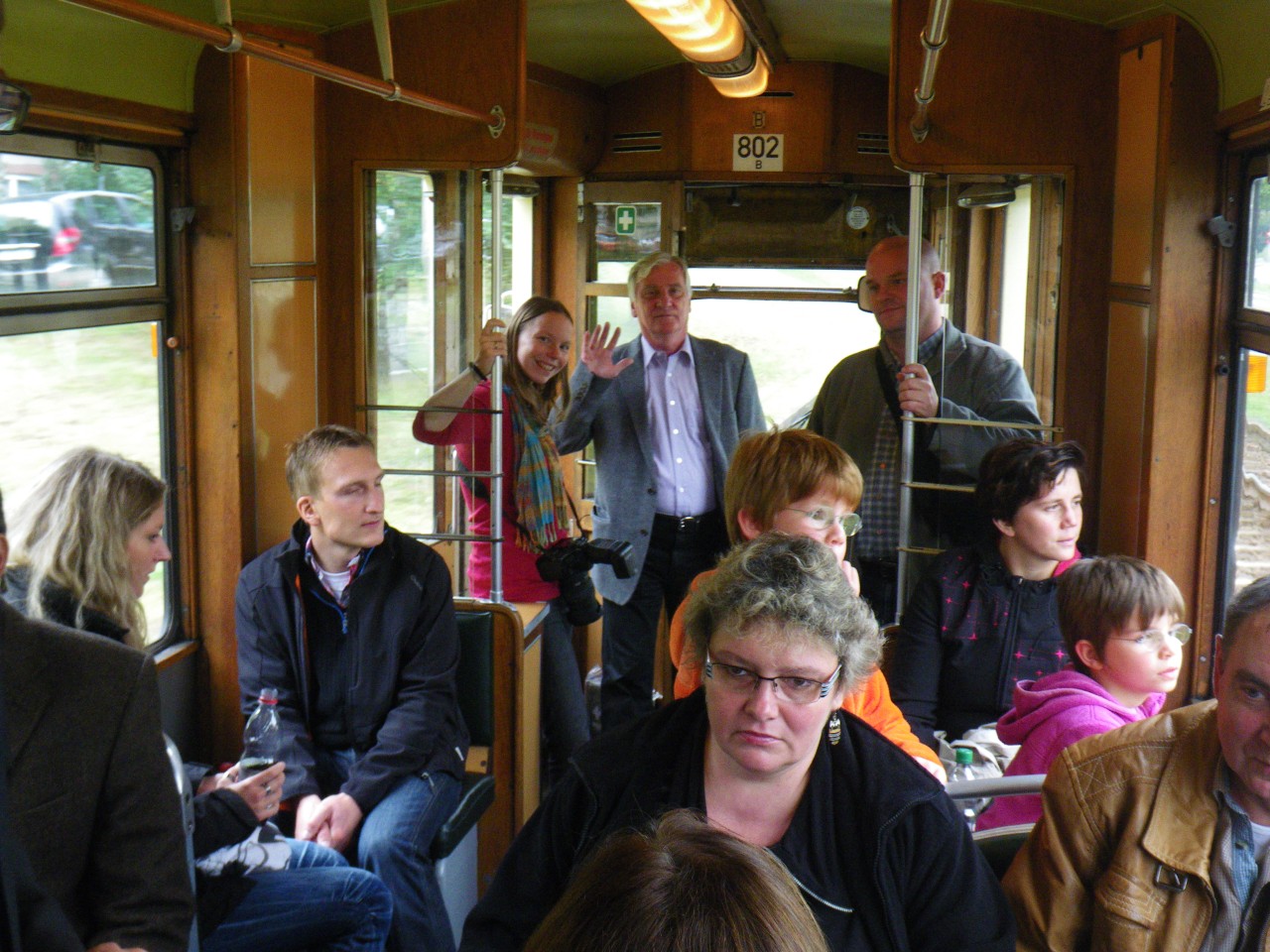
The brithday party party riding the rails.
The coolness continued when we headed to the restaurant outside of town where the party was actually being held. It looked like a farmhouse from the outside and inside had a rustic German feel belied by the dozens of single malt scotch bottles lining the walls near ceiling level. Not to mention the spectacular array of cakes, tarts, meringues and other sweet delights on the table in our party room.
Between filling up on cafe und kochen all of the guests took a tour of the 18th century vintage mine next door (yes, you did read that right. But it really was fun, even though we grasped only the very broadest idea of what was going on as the tour was entirely in German.)
The general theme of eating a lot reached its climax with dinner that night, which left us barely capable of participating in the dancing that followed. Eventually I was coaxed off my rapidly expanding butt and onto the dancefloor, where I actually managed to have a fun time. A lot of the other dancers were doing dances with set steps, a la “La Macarena.” In keeping with this I thought I ought to do something similar and made one of my own up on the spot. It was called Der Fischer, and its steps/motions went something like this: Overhand Cast. Overhand Cast. Sidearm Cast. Sidearm Cast. Wait wait wait wait. Got a bite! Got a Bite! Reel it in. Reel it in. Grill the fish. Grill the fish. Now eat the fish. Eat the fish. (Sarah contributed the last couple of steps, but has kind of reconsidered her fondness for Der Fischer and refuses to help me produce a demonstration video to put up on Youtube…)

All of the places at the party dinner had their own slate place cards. They’d even gone to the trouble of writing ours in English (the only ones, of course!)

Going underground for some hard work in the mines, thus to earn our dinner!

Though no record exists of Der Fischer I can still provide a photo of Melinda and I doing “The Strompel.” A wonderful German word, Strompel describes the motion of an otherwise imobile baby kicking his or her legs in the air in a joyful kind of jig. I reckon it’s the next big dance craze. Everybody to the Strompel!
Spending time with Michael, Carmen and their family (especially Melinda) was absolutely wonderful. Genuniely the number one highlight of our time in Germany. Though not the ONLY one, as we’ll see in the next entry.

On the one day we DIDN’T have a massive breakfast at Misha and Vena’s place we went to buy some food and discovered this weird and wonderful store that specialized in goods from the former Soviet union. They had a whole shelf devoted to kvass, and we bought some of the Korean via central Asian carrot salad that we’d so enjoyed in Tajikistan and Uzbekistan.

The whole crew looking lovely and smiling big.



 llewtravel