


Time for a Rest in Bolivia’s White City
The trip to Sucre was one of the nicest overnight bus trips I’ve ever taken. We both slept like babies! Having woken up at 04:30 that morning and taken a dramamine before departing doubtless had something to do with it.
We arrived in Sucre at around 04:30 but, though I thought I’d been mistaken when the ticket lady told me so in Spanish, we were permitted to stay in the bus resting for a couple more hours after we arrived (indeed, after the few people who wanted to venture out into the city before sunrise were let out, we were pretty much locked IN the bus.)
When the sun came up we were turfed out of the bus and left to find our way into town. People were happy to point us in the right direction, and in about 20 minutes we were at the hostel where we’d booked a single night, just because we didn’t want to have to deal with finding any place to sleep that early in the morning when we would (presumably) already be very tired. It took about 15 minutes for someone to answer the door, but we eventually found our way in.

As mentioned in the last entry, Bolivia loves a marching band
Sucre was the country’s capital immediately after it gained independence from Spain (though the government has long since moved to La Paz, the supreme court still sits there.) It is reputed to be particularly beautiful, all painted in white and full of colonial charm. Sucre was nice enough, but I have to admit that its lovliness largely in comparison to the few other Bolvian cities we’d seen thusfar. But we had a pleasant and cheap place to stay, near to the market with its tasty and inexpensive food, and a good kitchen of ours. So we actually ended up staying in Sucre for an astonishing 8 days (the longest period we’ve spent in any one place over our entire trip.)
Part of this was because we just needed a rest. But there were a couple of other reasons as well. First of all we had some pleasant company in Sucre. We spent most evenings chattering away with our fellow guests over a beer or, more likely for us a Singani (Bolivian beer isn’t anything to write home about and Singani, the Bolivian version of grappa or pisco, was a lot cheaper.) One night we even arranged a pizza night for everyone where Sarah made the dough, I did the baking (in the hellishly hot gas oven) and everyone just chipped in a bit of money for the ingredients. Rave reviews all around for the pizza!
It was actually quite impressive that people were happy to pay 10 or 20 Bolivianos for small pizzas given the tremendously low cost of food in restaurants and, most especially, at the mercado. The second floor of almost every local market in Bolivia was basically a food court with stalls run by “mamacitas” (old-school Bolivian women who dressed in the traditional pleated skirts and colouful tops) who spent all morning and afternoon cooking up simple, hearty, filling dishes for their customers. Typical items included lomitos, milanesas (pork or chicken schnitzels), chicken soup, fried sausages, or mondongo, a bright orange meat stew. All invariably accompanied by a mountain of rice, salad and chips.

Pizza night! As mentioned, the pizza was great. And the Bolivian wine wasn’t half bad either. A touch on the sweet side, but not so much so that it tasted unpleasant and/or entirely unfamiliar

Cheese for sale in the market. Most of it was fairly fresh, fairly mild in flavour, but with a slight sour, “home-made” twinge, rather like some of the peasant yak cheese we’d tried in Tibet. Rather typically of the friendly-but-shy national character, the seller said it was fine to take a photo, but then did her best to hide while we took it 🙂

Jello desserts, many even more elaborate than these, were very popular all over the country

Me in my beloved second floor market food court
Though Sucre itself isn’t big on sightseeing opportunities, we found plenty to occupy ourselves. One day pretty much the whole crew from the hostel headed out to the edge of town to visit a series of waterfalls and swimming holes in the river. The bus headed out of town was more than half filled with foreign tourists, doubtless a rather unusual occurrence. We spent the afternoon swimming and diving off the waterfalls into the deep pools below (or the others dove. As you couldn’t see the bottom it took me a good couple of hours watching others make increasingly higher and more reckless looking jumps before I was convinced enough of the depth and safety of the pool to have a go at a simple one myself.)
The whole day reminded me of my times in Pai, Thailand eight years previous. When I was younger and foolisher and wilder and went tubing, drinking many beers as I floated down the river with the crowd from the hostel before returning home for a huge communal shower and a night out at the town’s only late night bar. Though I often look on that kind of behaviour as silly now, I still felt a bit nostalgic for that sort of silliness.

Marching downhill towards the bottom of the valley with its river, falls and swimming holes
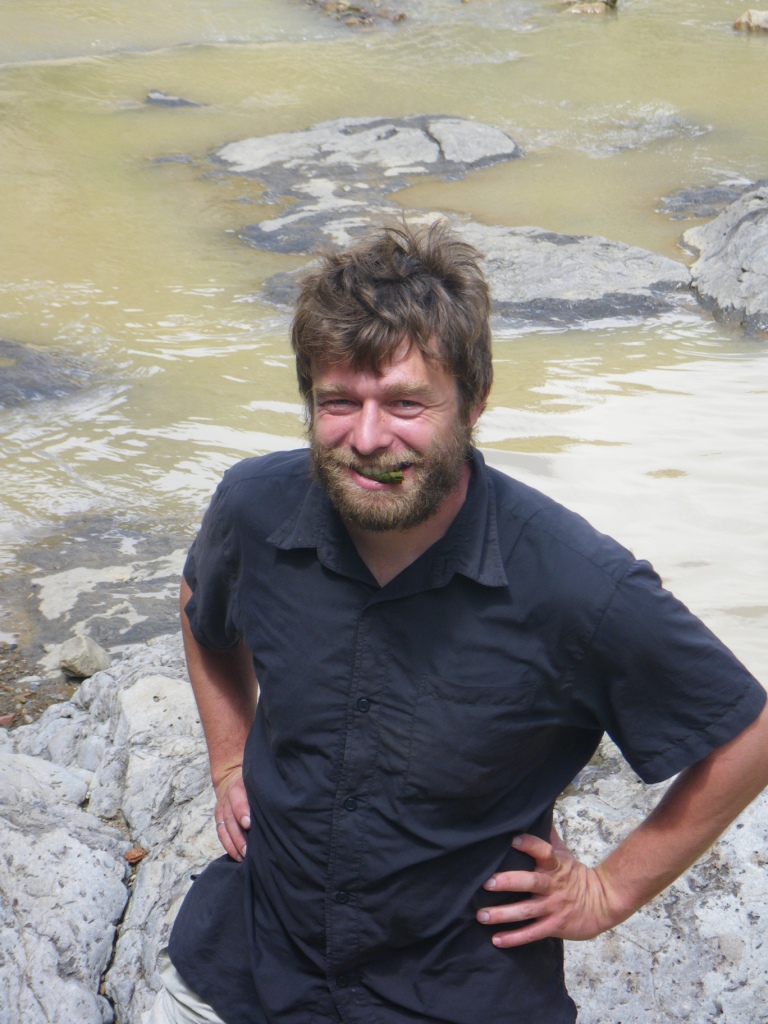
Me with a mouthful of coca leaves on the way down. Chewing coca is supposed to help with altitude sickness. Given that we’d just come down from ~4000m to 2700m we had no need of them for that purpose, but it was fun to try anyway. They tasted kind of like very old, over-steeped tea and had little obvious effect except for maybe a slight numbing of the gums and lips.

At one point all the lads climbed up the falls and headed up the valley to the next two waterfalls. Some of the route took actual rock climbing (or large bouldering at least) to get up. Before headed back down (including the jump off the falls at the bottom which was the only real way down) we were fortified with a little Dutch (Mexican? Bolivian???) courage

One of the nutters we were with jumping into the pool in a way that made me cringe to watch (when I finally got in I found it to be at least 6m deep, but I still wasn’t about to do anything but the simplest, safest feet first jumps)
On a more cultural note, part of the reason we ended up staying in Sucre for so long was because the time was rapidly approaching for the anniversary of the battle of Jumbate. It originally took place on March 12, 1816 near the town of Tarabuco, about 45 minutes drive away from Sucre. On Tuesday, the actual anniversary of the battle I joined some others to take a minibus out to the battleground itself. The celebrations weren’t huge, but they certainly managed to pack a good crowd into the relatively small area of flat ground in the vicinity. The area had been turned into something of a fairground, with the usual assortment of food, drink and other stalls, these ones with very much a local target audience. In the dusty area in the centre, large groups of indigenous men danced, chanted, played instruments and shook their fabulous platform sandals which were adorned with combination spurs/mini-cymbals.
We stopped and had a fabulous lunch of pan fried chicken with chips and salad and a cold beer for less than $3 (of which more than half was for the beer!) while our guide (one of the employees of the hostel who hailed from Tarabuco) went off to visit her friends and family who’d come to the festival as well.

The crowd at the fiesta. The big, guyed pole/plank on the left was festooned with meat, beer, soft drinks, balloons and other goodies, all artfully arranged. I never quite managed to understand what it was or how it was used in the festivities…

The fabulous dancers. Each village in the area sent its own troupe. Check out those shoes!
The festivities continued on Saturday in preparation for the main festival on Sunday, which is actually Battle of Jumbate Anniversary Day (observed.) That evening I headed back to Tarabuco, this time with Sarah, several other guests and Roxana the lively hostel owner for company. We were headed to the big Bolivian pop/folk concert being held to celebrate the holiday at the town arena. On the way there Sarah and I shared some of our pre-mixed Sprite and Singani with a young Bolivian man who’d filled in an extra seat in our minibus. In return he offered us some of his own cocktail which was made from a red kool-aid-like drink and the 96% drinkable ethanol that was sold in plastic containers from 50ml up to 10L in many shops and market stalls around the country.
Unfortunately we’d left it a bit late and discovered that, not only were there no tickets available, there were large crowds of people outside, many who actually HAD tickets already, waiting to get in. The carnival atmosphere from the earlier festival was very much in evidence here too, which meant that we just hung around outside and enjoyed the festivities, eating these weird pre-made pizzas and fried egg burgers and drinking a beverage made with Singani and something like sweet, hot, lemon tea. It really was actually quite fun, if occasionally worrying. The worry came from the crowd which now and then (usually when one of the police officers guarding the place) briefly opened a door to get out of the arena. At these moments the crowd surged forward trying to get in sometimes threatened to get crush-y or at least more unruly. In one such incident the police sprayed mace/tear gas/pepper spray or some such thing into the air above the crowd. I was on the edge and only caught the tiniest whiff, but it was enough to make me cough and splutter for a couple of minutes. The parts of the crowd nearer the door got it rather worse, despite having rapidly backed away as soon as the spray can came out.

The crowd waiting to get in. That’s just condensation in the air, not tear gas 🙂
At one point Roxana took Sarah and I aside and, along with her daughter crept around the side of the arena where it appeared one of the employees was prepared to let a few people inside, provided they stay calm and not attract the attention of the crowd out front. I’m not sure why the two of us were selected instead any of the other guests, but it certainly made us feel special. In the end it didn’t work out, but that didn’t really matter because moments after we’d left the side door the main gates opened and we joined the flood inside.
The crowd was big, lively and in a cheerful mood and we spent the rest of the night smiling and dancing along to the music. Most of it was poppy in style, but played with traditional Bolivian instruments (e.g. pan flutes) by indigenous Bolivians in traditional outfits. There were a fair few tourists there, but it still felt like a fabulous chance to see a bit of 100% real Bolivian modern culture.

Finally inside!

Sarah dancing the night away
By the time 02:00 came I was pretty worn out and happy to find Roxana and the rest of the crew and thence the minibus which navigated the traffic of Tarabuco’s streets and took us back to Sucre for the night.
We’d had ambitious plans of heading back to Tarabuco for the Sunday festival but between our exhaustion from the previous day and the fact that Roxana’s bus driver friend had been up even later (he made ANOTHER return trip to Tarabuco after he dropped us off around 03:00!) we never quite made it.
No matter. Though it wasn’t as glamorous or pretty as it had been made out to be, there was still plenty to see in town. The cemetery, a fine example of the South American style. The Plaza Principal (main square) a palm and statue studded park full of nice park benches and pigeons. The elaborate, bright white colonial/early republic buildings in the area immediately around the square.
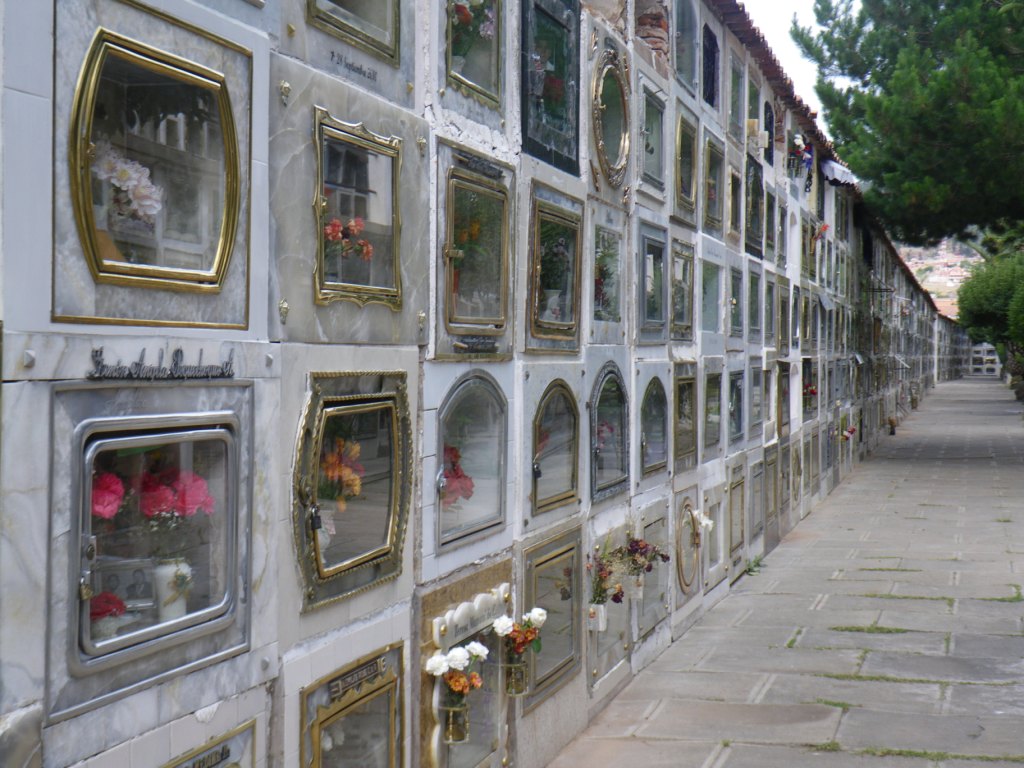
A row of tombs in Sucre’s main cemetery

More of the pretty, manicured cemetery grounds

The main cathedral and, right to its left, the central market

Though the central city was mostly flat, Sucre IS in the Andes, and this is the view of the city from the Mirador up to the east of the city centre
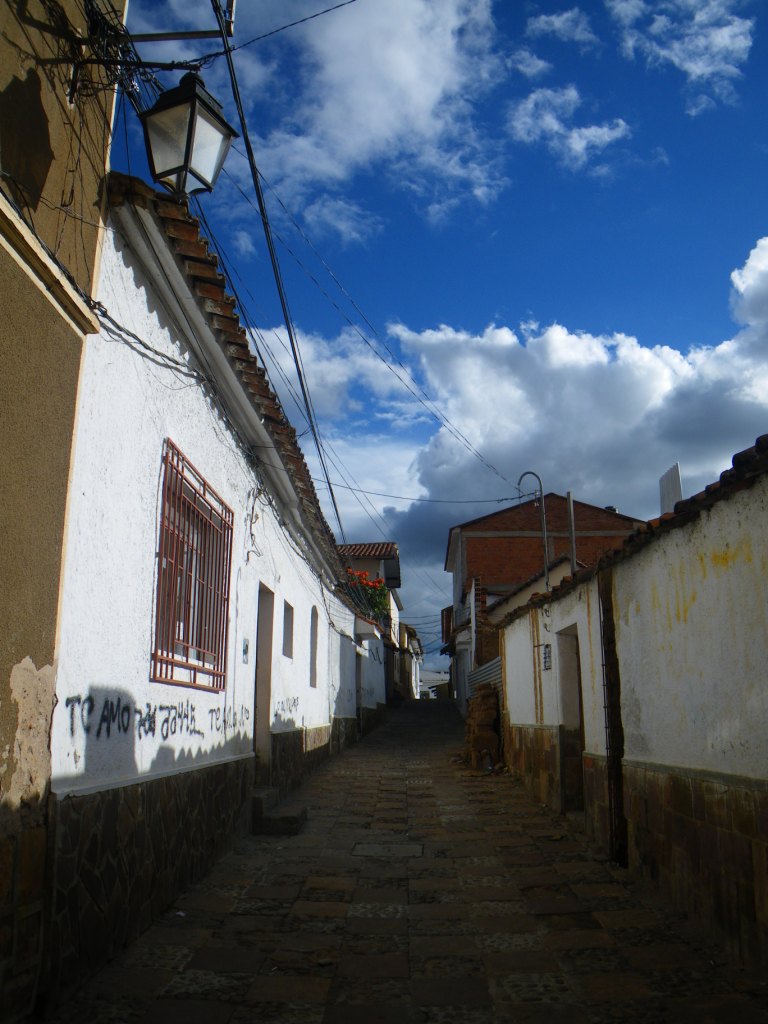
Typical of the small, whitewashed central city streets that give Sucre the name “ciudad blanco”
And, of course, there was Sucre’s own Jumbate celebration, which was a very entertaining affair. The main event was a parade that featured multiple marching bands, each seperated by large groups of dancers decked out in what appeared to be their matching Sunday best… Brightly coloured pleated skirts, shawls and hats for the ladies, more subdued but still very suave-looking suits and hats for the men. We followed the parade, along with the traffic which simply had to put up with going 3km/h for several blocks. At one point we dashed up to the second floor of the market for a view from above, then for big bowls of $0.40 corn and chicken soup.

Dancers and (of course!) marching bands

The women’s dance involved lots of twirling and swirling, which made quite the spectacle of their long, coloured, pleated skirts

Paraders beating on the big bass drums
All in all, Sucre did what we’d hoped it to. Provided a pleasant, inexpensive place to rest, with just enough to keep us entertained but not busy.
But a week is a long time when you’re travelling, even in the course of a 2 year long trip. So we woke up on day number 8 in Sucre and, after a confusing walk around the centre, eventually got a taxi to the bus station (despite my double worries about overcharging AND personal safety when picking a taxi off the street, the driver turned out to be one of the friendliest and most talkative Bolivians we met during our time in the country.) At the bus station we wandered from one kiosk to another comparing prices and departure times, and soon had tickets for a Potosi bound coach. One more stop to pay the token terminal tax (a common practice in Bolivia… you paid for a sticker on the back of your ticket that was needed to get out to the departure gates) and we were soon after on our way.

Herbs and medicinal flowers for sale in the mercado central

A supermarket makes amusing re-use of an advertisement for pre-mixed rum and coke. “Please leave your bag here!”

Some of the multiple quarries around Sucre are well known in Bolivia for dinosaur footprints found there. Presumably this is the reason for the fabulously designed phone booths in the city?

“Respect the Zebra Crossing.” A noble sentiment. More on this to come a few entries hence in La Paz!
Tags: Bolivia, Jumbate, Llew Bardecki, Sucre, Tarabuco, Travel
 llewtravel
Leave a Reply