“Your new life begins tomorrow,” the Professor said.
We were in the bar, listening to the briefing he gave us about the tour.
“Seeing a dugong brings luck. Your life will change. Things are not the same afterwards…”
We were about to ask him what he meant with this mysterious statement when one of the children shrieked. I leaned across from my table to be confronted with an enormous cockroach scuttling past the half-empty dinner plates. The Professor shoo-ed it away.
“I’m sorry. Those creatures are completely harmless, but I’m afraid there are everywhere around the villages.”
“I think we could do with some luck,” the mother said, letting out a deep breath. I admired her fortitude; had the table not separated me from the roach, I’d have run screaming out of the door, arms flailing in the air.
The Professor suppressed a smile. “Perhaps. But back to the tour. Don’t worry if you don’t see any dugongs. There are no guarantees, but it doesn’t mean bad luck. It just means that your time hasn’t come yet.”
*
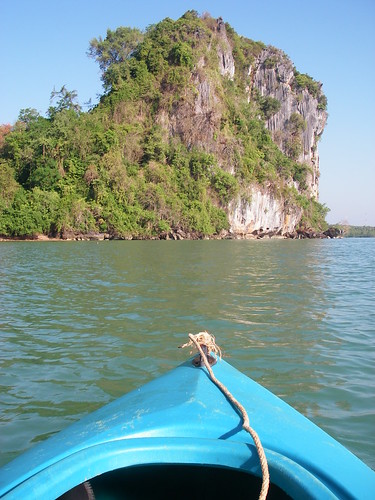
The longtail floated in the calm sea, illuminated by soft morning light. All three kayaks were tied to its stern. I felt a pang of guilt because I hadn’t helped to clean up the mess I’d made yesterday (I had literally been unable to lift the damn thing out of the water, and by the time I had recovered it was dark).
Today would be so much easier!
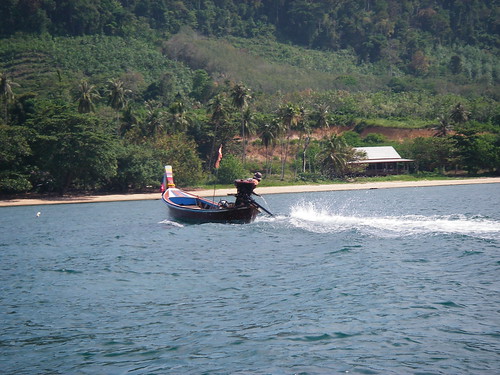
We climbed on board and sat down in the shade of the awning while our Chao Ley skipper cast off and agilely stepped along the gunwale to take the steering wheel.
The sea started to pick up, its surface rippling gently, just as it had done yesterday. Five minutes after we’d set out I saw another dolphin-sized splash. By now I was convinced that it was a fish, but what a fish!
It took us just over ten minutes to get to Stationary Beach, which the map labels as Laem Muda. The boat slowed just before we turned into the eastern bay. I squinted into the glare, but saw nothing.
Within a few minutes, another longtail arrived. It had farang on board but no kayaks. We all stared out to sea, but saw nothing apart from the gently rippling waves and small splashing fish.
“There,” The skipper shouted.
Three more minutes passed and the sea had calmed slightly, with fewer fish splashing. Both engines were silent as we continued to stare in vain.
“There!”
I took out my binoculars and started to sweep but still I saw nothing while our skipper made one call after another. As if that wasn’t bad enough, I lost vision in the left lens. I don’t know whether it was smudged or something was lodged inside, but it wouldn’t budge.
*
“The Chao Ley are the best stewards for the marine environment,” the Professor said. “They grow up with the sea. They can see underwater. Not like us. They can grab a fish with their bare hands!”
Until recently, the Chao Ley—or Sea Gypsies—have led a nomadic life, travelling across the Pacific and Indian Ocean in their wooden boats as many of them still do in Indonesia. But more and more are settling down as they are forced to assimilate into a country.
“Otherwise they’ll be kicked out,” the Professor said. “But they belong to the sea. They’re international, from here all the way to Africa. It’s reflected in their music and their songs.”
“Do they really see differently underwater—I mean, do they have different vision from us?” the Swedish Engineer asked, still contemplating the first statement.
“No they don’t have different vision. They’re trained to see things that you’d never notice.”
[read on]