July 30, 2006
Well you're in luck!
As of this writing (July 30, 2006) I'm just about to head out on another extended period of travel. I'll be spending the first year or so in New Zealand and then perhaps spending another year on the road, taking the long, slow route home.
Check out my brand spankin' new 'blog Further Wanderings to learn more!
November 08, 2005
My trip from Delft to Schiphol Airport was about as eventful an airport run as I had in my entire trip. I woke early, early in the morning and wrote a quick thank you note for Eric and Diane before departing.
I'd tried to book a treintaxi ticket the previous night, but had left my call too late. (The treintaxis are a wonderful component of the Dutch rail system: discount rate taxis that provide direct service from anywhere in the city to the train station.) As I had lots of time and few Euros left, I decided to retrace my steps and walk back to the station. With all of the bags I had it was actually a far from easy walk, but the beautiful sunrise over Delft and the city coming to life all around me made it a little easier to take.
Things didn't get any easier when I arrived at the train station. It was still FAR before the ticket office opened, and the ticket vending machines only took coins. I eventually managed to find someone who could make change for me, only to discover that I didn't have quite enough for a ticket to Schiphol.
I bought a ticket to the Hague and spent the remainder of the morning stopping at various stations to see if the ticket office was open and explaining my situation to various railway employees in an attempt to get to the airport. In the end I simply hopped on the train sans-ticket and rode to Schiphol hoping that I wouldn't be asked for one.
I was lucky and made it there with no trouble, save for cutting it a bit close with the time. But before long I'd made it on my flight and was saying farewell to the Netherlands and on my way to London.
London marked the briefest "official" stop on my trip. I only had about two hours before my flight to Toronto, which allowed me just enough time to go through British customs and then right back through security (I'd wanted to get one more stamp in my passport :)
For a while it looked as though the remainder of my trip home would be smooth and simple. The flight er... flew... by, the lineup at immigration was short and to my utter astonishment the customs people hardly blinked at the fact that I'd been away for almost a year and had claimed under $800 on my customs form. I would have breezed right through, save for the fact that I practically insisted they look at the tulip bulbs I'd brought home for my parents.
Through immigration and customs, I headed outside to meet my parents who were coming to pick me up. I'd been looking forward to seeing my mom and dad, and taking a quick ride home, followed by a nice long sleep. It wasn't to be. Of all the days I'd picked for my return, I had to choose the one where Toronto taxis were showing their displeasure at new licensing practices by blockading the airport.
I waited for perhaps 90 minutes, slowly learning what was going on, and finally my dad appeared on foot, explaining that my mom was parked outside the airport. He grabbed a couple of my bags and we wandered out past the jammed entrance roads and (after a bit of confusion about where she'd gone) met up with my mom for the ride home.
The return to my parents’ house and, indeed, the next few weeks were something of an anticlimax. I'd expected to be instantly and powerfully struck by well... by something or other... upon my return. In fact, being back in Toronto felt like the most natural thing in the world. There were just a few oddities that made it feel like I'd returned from something more than a long weekend in Montreal.
First was the fact that I had a strange compulsion to continually wear the same outfits over and over again. Before departing many people had told me that I'd never want to see my travel clothes again once the trip was done, but I felt just the opposite. I never wanted to wear anything ELSE. Probably a function of my attitude towards clothing and fashion generally.
Second was an odd impulse that would come over me now and then. The second day back I went out grocery shopping with my dad and felt the strongest urge pull my camera out and take photos of everything as we wandered through the aisles.
Finally, though it didn't come often, there was a feeling similar to what had often struck me on the road. A big smile would spread over my face and I'd be filled with almost indescribable joy to simply be THERE.
And so I was. While I may not have learned anything particularly deep or profound while I was away, one thing I'd realized was that no matter how much I loved travelling to exciting and exotic locales, no matter how much I felt the call of the road, this would always be home, and that eventually I'd always need to return home, to its familiar places, smiling faces, and most importantly, to my friends and family.
October 06, 2005
I can't believe this is my final entry! It's probably going to be a pretty short one too, because A. I didn't make notes for this portion of the trip, B. My memories of this weekend are pretty hazy and C. I'm writing it almost three months after the fact. Anyway, as fun as it was for me, you don't want to spend THAT long reading about me playing rugby and drinking beer in the Netherlands, do you? It couldn't possibly be THAT interesting, at least not without more pictures than I have to go with it...
The last stop on my trip was to be a return to the Netherlands. I'd already decided while in Turkey that it was time to go home, but I had some unfinished business to take care of in the Low Countries.
When I'd been there earlier for my friend Eric's wedding, he'd invited me back in June to come and play with his club in the annual Ameland Beach Rugby Tournament.
My return to the country started early, early in the morning with my arrival at Eindhoven airport. Unlike Schiphol in Amsterdam, there was no train station nearby, but a quick bus ride (with no fear of being overcharged for a change) took me to Eindhoven central station. From there it was a quick train trip/nap to Delft, home of Eric and his wife Diane.
When I arrived it was still WAAAAY early for Diane and Eric to be home from work, so I decided that, despite my load, I'd take the 5km or so walk to their place. On the way there I was overcome by a craving for Stroopwaffels. Thankfully, the Netherlands is pretty much the one place on Earth where the thin, caramel filled waffles are available pretty much anywhere. I stopped in at a grocery store and had one of the unhealthiest breakfasts every in the form of two packages of the things.
Eventually I got to Eric and Diane's neighbourhood (a pretty new one, with an interesting pattern of street names... All the streets were named after countries and prominent historical figures from the developing world, so you could walk down Bikolaan, then take a right on Nigeriastraat, then another right on Ivorkust.) I spent the late morning and afternoon just sitting out in the sun and reading and enjoying still more stroopwaffels (I suspect I'll never crave the things again) and wandering about the parks and canals that crisscrossed the neighbourhood.
When Eric got home from work we did the minimal catching up that was necessary and headed upstairs to relax a bit (or a bit more depending on whose perspective you're taking) before heading out to rugby practice with the Hoek van Holland Hookers.
We were among the first to arrive, though unsurprisingly everyone was very friendly and happy to meet me as they trickled in. One of the things I love most about playing rugby is the great sense of community among its players. One who plays rugby can go almost anywhere in the world, look up the local club and instantly have 20 or more friends.
The practice consisted of a run down to the nearest beach (I'd been really worried about my physical condition, but it wasn't as bad as I'd feared) and a long game of touch rugby on the sand. The mix of Dutch and a few foreign players were generally pretty skilled, almost uniformly physically impressive, but were amongst the quietest bunch I'd ever seen on the pitch. And I haven't had a history of playing with communicative clubs.
It was probably because of my constant talk and penchant for quick play (okay, okay, and maybe a desire to be nice to the new guy and a shortage of experienced players too) that by the end of practice I'd been on the first team for the weekend.
Eric and I drove home and met Diane who'd returned from work in our absence. We had a fun evening playing Carcassone (an obscure boardgame of exactly the type that entertains me) followed by (after Diane went to bed) a game of Trivial Pursuit accompanied by several beers (with old school SR4 rules... In the centre, you had to answer five of six questions on the card to win, if you spilled pie pieces out of your holder you lost them, and if you spilled your drink on the board you had to drink The Brandy.)
The next morning I went into town to pick up my final gifts and souveniers, along with some ingredients for dinner. Between a late rise, my wander around old Delft and cooking, I managed to occupy pretty much the entire day. When Eric arrived home from work we reprised much of the previous evening's activity, this time sans-Diane, who was away working.
My final morning in Delft was spent working hard on my 'blog (more or less the last time I'd do so for several months.) By the time I was done Eric had returned (early) from work and we were ready to hit the road.
Since it was still early in the day the traffic was minimal as we headed north past The Hague, then Amsterdam, and finally off into the Dutch countryside. Our ride took us over canals, under tunnels and finally across the dyke that separates the North Sea from the IJsselmeer (interestingly, that ISN'T a typo. The Dutch language has a single vowel written with the combination of characters "ij" and when it begins a sentence or proper noun, both characters are capitalized.) The dyke is over 30km long, and took us more than 20 minutes to cross.
Once on the far side we entered Friesland, a section of the country formerly separated from the remainder of the Netherlands to the point that it has its own distinct language. We were nearing our destination and before long had arrived at the ferry docks that would take us to the island of Ameland and its annual beach rugby tournament. There were already hordes of people getting ready to board the ferry, and it was clear that Eric's warnings about the long, long waits for ferries later in the day weren't empty.
As it was, there were just enough people making the trip to make the ride entertaining. We boarded the ferry and headed straight down to the bar to get started on the weekend's (primary? secondary? I'm not sure how beer drinking compared to rugby, but it's clear that those activities were the big two, clearly well ahead of sleeping) activity.
The trip took about 30 minutes, after which a shared taxi ride took us to our weekend abode. Several of Eric's teammates who had arrived the previous day and acted as the advance party. The whole affair was astonishingly well organized, and for many of the teams it was a family affair, with fathers, mothers, children and even family friends showing up. This was due to the friendly nature of the tournament, as well as the fact that so many of the Hookers were related by blood, marriage or often both.
They'd already set up the impressive team area of the campsite, which included several picnic tables, a barbecue, a big tent housing the supplies and even a generator for powering essential items (e.g. the beer fridge.)
We spent the afternoon helping to make space in the fridge for the Grolschs and Heinekens that had been left out in the heat of the afternoon, so sadly far from their ideal, natural condition. Throughout the afternoon more and more of the Hookers appeared, joining in on the quest.
Once most of the team had arrived, it was time to get started on the most impressive dinner.
With dinner behind us we headed down to the party tent and the evening stretched on into oblivion. The party tent had space for 3000 and was pretty much jammed with people Notable recollections include:
-The predictable womens' team collecting signatures on random body parts.
-Laying out on the beach staring up at the stars with the thumping music from the party tent in the distance.
-Introducing myself to Eric's South African teammate and asking where in the country he was from. I was stunned when he said he was from Durban and that I had an attractive female friend from there. Apparently I'd told him that the first two times I introduced myself.
Nothing like a late night of drinking and dancing to prepare you for a day of rugby. No, I'm serious!
The Ameland beach rugby tournament is an annual event, and has been running since 2000. Since its inception, it's grown astonishingly, and the 2005 edition had 116 teams, and 4800 attendees. The game is like regular rugby union, but with a few variations. First, the field is much smaller. It's perhaps 30m by 15m and is laid out on the sand with plastic tape. Next, the in-goal area is divided into 5 sections. A try scored in the centre one is worth five points, in either of the middle ones, four, and in the corners, three. Finally, there are only seven players on the field, but to make up for this, free and open substitutions are allowed, both at play stoppages, and even "on the fly."
Along the beach there were more than a dozen fields laid out and everywhere one looked were rugby jerseys, balls being tossed around, and teams warming up. It was far and away the largest tournament I'd ever been to.
The day's play didn't get off to a spectacular start. Unsurprising, really given the condition of most of our players. I spent the morning alternately stepping on the field with the Hookers' first team, where we took a beating, and laying in the sand beside the field where it felt scarcely better. My play in particular was really lacking. I choose to ascribe this to the fact that I hadn't played in a year, rather than the possibility that I just wasn't very good.
Meanwhile, the second team was faring much better, perhaps because they were composed mostly of the Hookers' juniors and were thus much better suited to a day of physical exertion with next to no sleep and Hellish hangovers. While the first team struggled in the open division, they roundly thumped each opponent they faced in the recreational group. Most of us observed that they probably would have roundly thumped us as well, but thankfully that was never put to the test.
Following the rugby, the afternoon proceeded in similar fashion to the previous one, with the exception of long naps in our tents before things really got going at dinner. In fact, in my case it was more than a little nap. I slept away the vast majority of the evening, and while this may have made it rather less fun than the previous one, it left me in infinitely better shape for playing rugby the following morning. Apparently I wasn't the only one. It seemed as though there we were an entirely different team as we won our first game with little difficulty.
The second game was even better. The hookers ran roughshod over our opponents, and even I managed to put one down in the in goal. Meanwhile, the second team hadn't lost a step and were clobbering their way through the recreational division and despite their youth it looked as though they might even put in a challenge for the championship.
As it turned out, I never got to find out how things finished. Eric had a flight departing for France that evening, and I wanted to make certain I'd get at least a little sleep before my early morning departure the next day. This being the case, we played our final game (another victory) and all but sprinted back to the camp to pick up our bags which we'd packed earlier.
I've since learned that the Hookers' first team won the consolation championship (in fact they officially finished ninth, but in many more generously minded tournaments the more impressive descriptor would have been used.)
Back at camp we grabbed our packs and (with only a little difficulty) phoned for a taxi to take us to the ferry docks. While we waited we even managed a quick shower to get rid of (at least a bit of) the sand and sweat that are a unique part of Beach Rugby. The taxi got us to the ferry terminal with a few minutes to spare, and forty minutes later we were back on the road home to Delft (or, in my case, the longer road home to Toronto.)
By the time we got back to Delft there wasn't long for Eric and I to say our goodbyes. Not that it really mattered. As Bill pointed out when we were together earlier he and Eric and I can be separated for months, years at a time, only occasionally e-mailing or phoning one another. Nonetheless once we're together again it always seems as though nothing has changed. It's the same with all of my best friends, I suppose, but I'll still be happy to get back to the Netherlands to visit Eric and again Diane soon.
August 14, 2005
I arrived in Istanbul tired on a dreary grey morning. And while this made my first day there a bit blah, the remainder of my stay was anything but.
The bus from Gallipoli arrived at 05:30 and despite the fact that I was the only passenger headed to the tourist centre of Sultanamhet, the free "servis" shuttle still made its appointed trip. On my arrival at 06:00 Sultanamhet was astonishingly quiet, especially in comparison with its previous appearance the day after the Champion's League final.
My second arrival in Istanbul was a bit simpler, as I'd already found a hostel. This allowed me to head straight there and, almost immediately upon arriving, fall asleep.
By the time I woke, it was past noon, and though much of the day was gone I was keen to get something interesting, or at least useful, done that day.
My destination that afternoon was the covered bazaar. I'd been there briefly on my first stint in Constantinople (from now on, just for fun, I'm going to use the names Istanbul and Constantinople interchangeably, since that's more or less how it works in my head anyway [I'm not 100% sure WHY this is so, but I suppose it has something to do with my fondness for medieval history.])
My first trip to the bazaar had been fairly brief, but this time I got to explore its nooks and crannies in a bit more depth. While there were loads of tourist shops amongst the 3000 or so within the bazaar, there were also places that cater primarily to Turks, making it a lively, interesting place to window shop for gifts for friends and family back home.
I wandered through the maze of hallways that made up the covered bazaar and was eventually spit out on its western edge near one of the smaller of the Ottoman era mosques whose domes and minarets dot the Istanbul skyline. I headed into one (guests were more than welcome in the mosques, so long as they observed proper etiquette [which consisted mostly of staying in the designated areas, dressing appropriately and removing one's shoes]) then another of these and marvelled at their beauty and serenity.
Leaving the mosques behind I continued my walk west and into an entirely different tourist district. The area I entered catered primarily to Russians from across the Black Sea.
I carried on walking past Istanbul University and arrived at yet another one of the historical legacies of Constantinople: The ancient Byzantine aqueduct. It rose perhaps 20m above the modern arterial road that passed through its arches. I walked through myself and into yet another fascinating Istanbul neighbourhood.
The street just past the aqueduct was lined with small shops (in fact they verged on being stalls) where meat, fruits, vegetables and most importantly, cups of Turkish tea and coffee were on offer. I wandered around for a bit and was on the verge of leaving when I spotted a cafe with several backgammon games underway. I followed my usual procedure of standing around looking interested, and as in the past, was soon invited to sit down for a cup of tea and a match. As it turned out, it wasn't much of a match (I won 7-1) but the guys who'd invited remained very friendly and seemed delighted to have my company.
The afternoon was wearing on, so I decided to head back towards Sultanahmet. I did this in a rather roundabout route, and was pleased to have done so. My path took me past the main Istanbul firehall where I (unsuccessfully) attempted to procure a hat or something as a souvenir for my firefighter uncle back in Toronto. It also took me through several shopping areas that showed some of Istanbul's Asian character. All through Asia I'd been intrigued by the practice of all of a given type of merchant congregating in one small area of a market or of town. On my way home I passed by the cloth district, the glassware district and oddest of the lot, the bicycle district. Calling it a district is a bit misleading, as in fact it was a collection of a few large shops, but the way they were all crammed into a single underpass beneath a main road was very odd.
Next my walk took me down towards the coast of the Sea of Marmara (the small sea in between the Black and the Mediterranean.) The coastline featured a ferry terminal, loads of seafood restaurants and finally a pretty park that was full of Turkish families spending their afternoon sunbathing, swimming and most of all, fishing along the shore. Several young boys did their best to entice me into the water with them, but given the reputation of the waters around Istanbul (as well as the fact that I would've been swimming in my clothes) I decided to just continue my walk back to Sultanahmet.
Finally I returned to Sultanahmet near sundown. Just before arriving at my hostel I was accosted by a carpet salesman (not an unusual event in Istanbul) and spent an hour or so in his shop having the basics of Turkish carpets explained to me (as well as drinking delicious fresh orange juice.) He was very keen on getting me to buy something that evening, offering free gifts and compliments, and even suggesting that if I agreed to buy something that night that he'd give me his "best price." Which, of course, raised the question of what price I'd be given if I returned the next day.
I spent a quiet evening back at the hostel (I was the only one in my dorm room) and the next morning ate a huge Turkish breakfast (tomato and cucumber slices, olives, bread and jam) before heading into town to do some serious sightseeing.
There were loads of destinations I had planned in Istanbul, and after some careful consideration I decided to head to the Topkapi palace. I hoped I'd arrive before the morning crowds, though by the time I'd arrived there, the tour bus crew was starting to appear as well. Add to this the fact that admission to the palace was 10 million lira, followed by an additional 10 million for further admission fees WITHIN the palace and I was ready to reconsider my plans.
Instead of heading into the palace itself, I wandered around the outer palace grounds. Eventually I found myself the f in a courtyard just off the main square. It was entirely empty, and despite the fact that the gates had been open I got the distinct impression that this wasn't really an area meant to be open to the public. Nevertheless, it was a very pleasant place, and I spent quite a while lounging around, occasionally picking small yellow fruits from the trees in the courtyard. (I'd seen these fruits on sale in markets but hadn't purchased any yet. They were quite tart and looked vaguely like figs.)
Following my sojourn in Topkapi, I headed out into the park that surrounded the palace and headed, at a leisurely pace, towards The Bosporus. The park was shady and filled with towering trees that formed a natural nave over the main walkway that I followed.
Eventually I reached the water and followed the roadway and train tracks as they headed north alongside. Just before reaching my destination I reached a destination of another sort: Sirkeci Station, terminus of the legendary Orient Express. It was far removed from its former glory, and in fact the nearby commuter ferry terminal that I was headed for looked more luxurious (not that it WAS particularly luxurious. It just didn't take much.)
Though Sultanahmet was a spectacular historical area of the city, I wanted to see a bit of the "real" Istanbul. To this end, I climbed on a commuter ferry, picking my destination almost at random.
The trip across the water was nice, and the breeze did much to deal with the smoke from dozens of cigarettes that were lit up almost as soon as the ferry departed. The journey across the Bosporus took about 15 minutes, and when it was over I was on a different continent. It was a very different city too. The seashore in the suburb of Kadekoy was busy with families and couples out strolling, picnicking and generally enjoying themselves... and not another (obvious) tourist in sight.
To my surprise many of the side streets I turned up reminded me of parts of Toronto, with their canopies of trees overhanging pleasant residential streets, and local corner stores spotted here and there.
I headed uphill, further inland and wandered around the neighbourhood and through tiny winding alleys, up steep hills and staircases between the residential streets where people were hanging their laundry out, slapping their carpets, bathing their dogs, and doing normal sunny afternoon things.
The interesting part of my Asiatic amble ended when I wandered through out onto a major road, which led down to the Ataturk bridge leading over the Bosporus and back to European Istanbul. Crossing was rather more difficult than I'd planned, as after about 10 minutes of trying different routes I finally realized that pedestrians weren't allowed to cross the bridge at all. In the end I had to climb aboard a bus for the ride across. Adding insult to injury was the fact that the driver charged me double the normal fare :(. As grumpy as I was about this, it was still pretty cool to note that this trip marked the seventh time in a month I had changed continents.
I disembarked and started to walk back towards Sultanahmet, but on the way found myself in the middle of a crowd all headed in the same direction. I followed along and found myself outside the Galatasaray football stadium. Galatasaray is renowned for its rabid fans, and I would have loved to join them to watch the game, but sadly (if unsurprisingly) it was sold out. I sat around and soaked up the atmosphere for a while before heading back towards home.
My walk back took me through the trendy Taksim district, then down a steep hill lined with music shops until I reached the Golden Horn. The Golden Horn is an inlet off the Bosporus that once served to divide Constantinople's Turkish and foreign populations. Prior to that, a monstrous chain stretched across the horn protected the city from invasion by sea. Though the threat of invading barbarians is more or less gone, it still serves as a dividing line between the ancient and new(er) Istanbul.
I crossed the bridge over the horn, making use of the small width of sidewalk not occupied by the hundreds of Turks who set out fishing lines from the bridge. I peered into the buckets to see what they were trying to catch with their monstrous poles, but could only seem to see bait fish, perhaps 10 or 15cm long at most. I was surprised to learn later that these scrawny specimens WERE the catch. It seemed a lot of trouble to go through for such meagre reward.
To the south of the golden horn, leading up and away from the water was the Spice Bazaar (the spice trade had mostly moved elsewhere, but more or less anything else one might want could be found in its jam packed streets.) Tucked away inside the bustling market, its entrance scarcely noticeable was the Rustem Pasha mosque. It was constructed by one of the richest citizens of the Ottoman Empire, Rustem Pasha, the grand Vizer of Suleyman the Magnificent. The mosque is renowned for its decoration of Iznik tiles. These blue ceramic adornments are spectacular enough simply to look at, but when one considers that each one of them was hand painted the splendour of the place seems even more miraculous.
In the evening I headed out into Sultanahmet to see the mosques lit up at night. Far and away the most impressive was the Sultanahmet Camii, the "blue mosque." Which was still abuzz with activity well after dark. I wasn't able to go inside that evening, but looked forward to another visit later.
My next day in Istanbul was exciting and disappointing both. First thing in the morning I headed back to the Blue Mosque in hopes of arriving before the tourist throngs did. I managed this, but unfortunately it wasn't open to visitors until 08:00, almost two hours after my arrival. I headed back to the hostel, pausing for a chat with a group of Turkish men who were friendly, but whose purpose for sitting in a small park at 06:30 wasn't clearly discernable.
Following breakfast I returned to the Blue Mosque and was pleased to discover that I was still one of the first few visitors.
The inside of the mosque was spectacular, almost equalling its beauty from the exterior. The blue Iznik tiles that gave the place its nickname were lit by the morning sun streaming through the stained glass. Dozens (hundreds?) of lamps hung just above head height from the ceiling high above almost seemed like stars hanging in the vast firmament of the dome above.
It was wonderful to see the place at its peaceful, early morning best, but before long the inevitable crowds started to appear. This had its positives as well, since, as in other Turkish tourist attractions I had my choice of English speaking tour guides to listen to.
Upon leaving I made a small donation at the exit (though there were no admission fees, most of the popular mosques in Istanbul had well managed donation programs) hoping that by doing so I was helping to keep that glorious place from turning into a "real" tourist attraction, purely motivated by profit.
After my visit to the mosque I went out for a wander around town. I didn't have any particular plans, and so was happy to sit down at a cafe with a Turkish man I met for a couple glasses of tea. At first I was a bit wary of him, but with time, I warmed to the fellow and started to enjoy his company. We spent the rest of the morning talking and drinking tea, and in the early afternoon he offered to take me to a restaurant/bar in a "real Turkish" part of town. We hopped in a taxi and before long were far, far away (figuratively, if not entirely literally) from the tourist hubbub of Sultanahmet.
We sat down at a table near the front of the restaurant, and my new friend ordered two beers for us. We continued talking, with him providing translation for the staff and the few customers who had questions for me.
Throughout the day, my companion had been on the phone with his girlfriend in Spain. At one point during our sojourn in the restaurant he asked if he could borrow 40million lira (about $40) to buy a new phone card for, since his previous one had run out and he needed to talk to her again. We'd been splitting our expenditures to this point, and I figured that if he hadn't been anxious to take money from me previously I could trust him to not do so now. I dug the notes out of my wallet and an a few minutes he'd gone and returned, promising to pay me back later when we were nearer his hotel.
Leaving the restaurant we wandered back towards the centre of the city and came to Taksim where we turned down an alley and sat at a cafe for a few games of backgammon. We played for a long time, with me winning all three of the seven point matches. By the time we were done it was mid-afternoon, and I was ready to get back to meet some of my fellow hostellers for dinner.
Before heading back I asked if we could return to my new friend's hotel and pick up the money he owed me. It was, of course, at this point, that the day went from exciting to disappointing. At first he seemed okay with this, but as we wandered off away from Taksim he started to seem nervous and eventually asked that I just wait for him at a cafe. I replied that I was quite happy to walk with him and after a bit of this he agreed. We carried on, but after a bit more walking he asked me to wait at another cafe that was (presumably) nearer to the hotel. By now I was, of course, growing wary, and asked him why this was all necessary. He explained that he was worried about what the people at his hotel would think of him if he went up to his room with another man. I offered to simply wait outside. This wouldn't fly either. By now I was certain that the guy simply wanted to run off without paying me back, but after ten minutes or more of him badgering me to let him go get the money alone, even offering to leave his watch with me, I finally relented. This was odd, given that I was more convinced than ever that he was going to disappear, but it was almost as though I let him go simply so I wouldn't have to listen to him ask any more.
I stood outside the cafe, and after about 40 seconds regretted having waited and headed down to the corner he'd disappeared around. Of course he was gone. And of course he didn't reappear again, despite my waiting 10, 15, 20, 25 minutes for him. By that point it was no surprise, but still left me feeling irritable and depressed. This guy, along with a couple of dishonest bus drivers almost ruining the wonderfully warm and friendly impression I'd been given by dozens of other Turks throughout the country. They'd left me feeling that in this country you could trust almost everyone, bus still could trust no one.
Thankfully this feeling subsided. I joined Bob, Amber, Jesse and Mar back at the hostel where we all lounged around and recounted our days' activities over a few Efes Pilsens before we headed out for dinner. We had very little idea of our destination, and so just started looking at the menus of every place we passed.
The whole evening was one of great mirth and merriment. First there was one of the oddest menu items I'd ever seen. Then as we were walking past an eatery in the tourist restaurant street, I heard the closing bars of "The Weather" by Built to Spill floating out onto the street (this would have been unusual at a restaurant in North America, but in Istanbul!?) and finally there was the dinner itself. We were finally persuaded to settle down at one of the tourist kebap houses by its proprietor. We took a look at the menu and thought it a bit expensive. Just as we were about to move along, the owner addressed us and asked us to name our own price and he'd prepare a menu for us! After a bit of haggling (yes, in a restaurant. This shows just how prevalent the practice is in Turkey) we settled down. As we ate we were kept company by a pair of cute and obviously well fed (doubtless by others like us) cats and kittens. In addition to the kittens, the dinner's memorable moments included the pair of sales-kids who were almost as persistent as the ones at Angkor in Cambodia (though with much more limited geographical knowledge) and a long and very involved conversation about wild donkeys. Picture beautiful rolling, emerald green hills, spotted all over with the last of the wild donkeys. Then suddenly all of them pause in their cropping to raise their heads and stare straight at you... It's a scary thought. I think the restaurant staff thought we were insane.
Back at the hostel we all sat out on the deck and watched the lights from the ships on the Sea of Marmara while Amber told us stories about her job as a teacher. They were spectacularly entertaining, but too long to repeat here (to give you some idea, one of them involved a third grader explaining during an oral presentation "Zeus raped Aphrodite and she got Hermes.")
The next morning was the start of my last day in Constantinople. I've reverted to its ancient name because my first two stops came for the day came from that era.
The first had an unassuming entrance beside the door to the Eminonu (the suburb that Sultanahmet is located in) Town Hall. Unassuming though the entrance may have been, a few steps in and down brought me to a magical, yet eerie place. The earth under Constantinople’s mosques, palaces and rambling alleyways is far from solid. Beneath it lies dozens of grand vaulted chambers. In their day, most of them would have been invisible, as they were used as massive water reservoirs for the city. The one I was visiting was the Theodosius Cistern. Though it was far from the largest, its emptiness made it perhaps the most impressive of those open to the public. When I arrived there was not another soul inside, and only a few dim bulbs illuminated its corridors. I carefully made my way down the slimy steps, and skirted the puddles as I wandered under the archways high above. The only sounds were the echo of my footsteps, and the sound of dripping water somewhere in the distance.
After a bit more wandering around the cistern I heard voices above. I was no longer alone, and the new visitors had come with a tour guide who knew where the light switch was. To tell the truth I actually preferred the gloomier, more mysterious atmosphere. I weaved my way back past the puddles, carefully up the stone stairway and back out onto the streets of modern Istanbul.
But it wasn't long before I returned to Constantinople. My next stop was one I'd been saving, as it was perhaps the most famous sight in the entire city: the Hagia Sophia (or Aya Sofia depending on which language you're speaking.) Constructed in 537, Aya Sofia has served as a church, a mosque and finally, as a secularized museum. For over 1000 years, its dome was the largest in the world before it was finally eclipsed by St. Peter's Basilica in Rome.
I arrived at the main gate and purchased my (bar coded, machine readable, hologramed, forgery proof) ticket and made my way through the church grounds to the entrance.
The crowds inside were impressive, but they could not come close to filling the massive central chamber of Aya Sofia. Even the presence of a massive scaffolding system (in place for over 12 years during the ongoing restoration of the mosaics on the main dome) served only to highlight the astonishing size of the place. So high was the main dome that the scaffolding system contained an elevator to ferry restorers up to working height.
I don't recall ever having been somewhere that gives such a stunning sense of SPACE. It was hard to fathom that all of this was inside a building. Throughout my visit I found myself wandering around, head tilted back, mouth open, in awe of the place. When I occasionally managed to draw my eyes back down to earth, I invariably saw many others in similar poses.
When I'd finally had enough of staring heavenward (staring heavenward being, of course, the whole point of the dome) I made my way up the dimly lit cobbled ramps to the upper gallery. The mosaics located on that level were the artistic highlight of the church. It was, in fact, very fortunate that they had survived. When the city was finally captured by the Ottomans in 1452, it seemed certain that they were doomed, due to the Muslim ban on worship of icons. Fortunately, Mehmet II, the Ottoman conqueror couldn't bear to destroy such beauty and ordered that they be plastered over, rather than destroyed outright. Now, over 500 years later, small portions of the mosaics have been restored to their former glories.
I sat in the upper gallery and gazed alternately out over the floor far below, then to the dome, still high above. The crowds of fellow tourists couldn't come close to filling the massive space. As I walked back down to the main floor, then out to the majestic, ancient dome above, I reflected that this place would have been impressive had it been constructed two weeks before, using tower cranes, and prestressed, reinforced concrete. But to consider that is was, in fact almost 1500 years old boggled the mind. If our modern minds, already full as they were of domed stadiums, skyscrapers and monstrous suspension bridges could be so captivated by the place, the effect on the medieval minds could scarcely be imagined.
I'd started my day late, so by the time my visit to Aya Sofia concluded, it was almost closing. I still had time to hurry to my final sightseeing stop of the day: The Sulymaniye Camii. Outside the Sulymaniye mosque was a cemetery, with the tomb of Mimar Sinan as its focus. The cemetery was well preserved and provided perhaps the best examples of the unique Ottoman tombstones I'd yet seen.
The mosque itself would likely have been unforgettably spectacular at almost any other time. Unfortunately I'd just been to Aya Sofia. The dome of Sulymaniye was almost as large as that of the former church, but it didn't convey quite the same astonishing sense of space. As wonderful as this, the largest of the Ottoman Imperial mosques was, it still couldn't quite compare to Aya Sofia, despite the fact that the latter was almost 1000 years older.
I meandered slowly back to Sultanahmet, trying, along the way trying to find my final Turkish experience: A Turkish Bath. I wandered far and wide first visiting the fancy, tourist oriented baths, then, with a bit of advice solicited from passersby on the street, to the more "local" ones. At each I was horrified (okay, maybe horrified is a BIT strong... I was, let's say disappointed) to discover that the entry fee was up around 15 million Lira, which was far more than I was willing, or even really able, to spend.
Finally I returned bathless to Sultanahmet, and began to pack up for my departure. I spent the remainder of the evening sitting waiting for the ridiculously priced shuttle to distant Sabhia Gokchen airport to arrive. (I'll explain once more that this airport should be avoided at all costs... It's about 60km away from central Istanbul, and there is virtually NO public transport, or at least no reasonably priced public transport, between the two. I was particularly irked at paying 15 Euros for a shuttle bus to catch my 19 Euro flight.)
I spent the evening saying farewell to my new friends before, finally, at 01:00, the shuttle arrived. It was a long drive to the airport, with the three drivers (particularly inexplicable, since there were only two passengers) taking turns at the wheel, and even inviting the two of us to have a turn (we both declined.)
At the airport I joined a few dozen others, doing their best to make themselves comfortable while waiting for the 05:00 departure of our flight. After a bit of a nap, and some postcard writing (despite the post office's being closed, the friendly woman at the check-in desk offered to mail them for me) it was finally time to go. We all boarded the aircraft and after three hours spent (understandably, I think) mostly asleep I was back in the Netherlands, for the final stop on my journey.
July 06, 2005
With more known Greek ruins than Greece and more Roman ruins than Italy, it’s unsurprising that Turkey’s Aegean coast is a history buff’s dream come true. And the region’s history isn’t all just ancient, having played host to significant events in the First World War, and the subsequent Turkish war of independence. A map of the region shows such famous names as Pergamum, Troy, Ephesus and Gallipoli whose historic significance span over 7000 years, from the beginning of civilization until modern times.
I began my visit with a trip to Selchuk, the modern town near the ancient Greek and Roman city of Ephesus. With a history dating back over 5000 years, Ephesus is home to the most spectacular ruins in the entire country.
Having taken a night bus, I once again arrived early in the morning. After checking into my pansiyon I wasn’t ready for the customary late morning nap immediately. First I did a bit of laundry, simply putting on my wet clothes and taking a walk out in the already stifling heat to dry them. Following this I headed out for a more sightseeing centred walk with a Dutch couple riding motorcycles on their way to Nepal. Our first stop was the The Cathedral of St. John. While there are doubtless many buildings around the world that share the name, this is THE St. John’s Cathedral. The bones of the Apostle John lie within the ruins of the 1500 year old building, no coincidence, given that it was to Ephesus that he moved after writing the book of Revelation on the Greek island of Patmos. Nor is the cathedral the only biblically significant site in the region (Ephesus-Ephesians… coincidence? No.) There’s a site rumoured to be the final home of the Virgin Mary, which has been recognized as a holy site, if not actually confirmed as being such by the Vatican, as well as the amphitheatre where angry pagan mobs staged the demonstrations that convinced St. Paul (yes, another apostle) to depart Turkey.
By the time our visit to the cathedral was over, I HAD become a bit sleepy, and headed back to the hostel for a rest. By the time I awoke, it was clearly too late for a visit to Ephesus, so I contented myself with a wander around town. The Pansiyon I was staying at was named the ANZ, and was one of the oldest spots for foreign tourists in town, and its success had clearly influenced others. As I wandered through Selchuk I also came across the All Blacks, Victoria, and Wallaby pansiyons, just to name a few. My wandering took me past several local cafés or chay shops, where Turkish men spend cast swathes of time drinking, talking and playing games. One of the most popular games is Backgammon (or Tavla in Turkish.) I’m something of a player myself, and so sat down at one of the cafés to watch a match in process. Before long I’d been invited to join in, and even managed to win a five point match against my (much) older opponent. (A couple of notes on Turkish backgammon: they don’t use the doubling cube, you re-roll your starting dice, so it’s possible to begin with doubles, and the player winning a game rolls first in the next match… All of these remove some of the strategy from the game, which consistently irritated me.)
After my gaming interlude my walk continued and was interrupted once more by a sit and a conversation with a guy from Vancouver and the people who owned the carpet shop where he was staying. After a long chat I headed off to purchase some tomatoes, cucumbers and bread for dinner before heading back to the hostel.
Here seems a good place to talk about Turkish food. The few restaurant meals I had were generally uninspiring and expensive, while I found the street food (lots of Doner’s and other meats served on bread) to be excellent and modestly priced. If you really wanted to eat on the cheap, however, you had to purchase your own ingredients. The lack of kitchens in most guesthouses made this problematic, but I found a way around it (and a supremely inexpensive one at that) by sticking to self-made sandwiches. Food prices in Turkey aren’t entirely dissimilar to those in Canada, save for a few staple foods whose prices are government regulated. Thus it was possible to get three loaves of delicious bread, a kilo of tomatoes and a kilo of cucumbers for a little over a dollar. Throw in 500g of soft, mild local peynir (cheese) and your food for a day could cost as little as $2.50.
I spent the evening playing a bit more backgammon (this time with an Australian guy at the hostel) before heading off to sleep and waking up nice and early for my trip to Ephesus the following morning.
The walk out to Ephesus was pleasant enough, heading down a tree lined boulevard, about 2km in total. Despite the fact that it wasn’t yet 08:00, it was already very hot out. I made it to the main entrance, passing by yet another of those annoying pay toilets (whose expensive price corresponded to the expensive admission fee to the ruins.) There I was delighted to discover that there weren’t that many people there yet. I headed in and was greeted by the main amphitheatre, which I had all to myself, save for four or five people filming something for television. Following the main road through the (former) town, I soon found myself at the library of Celsus, and while I wasn't alone, the place (perhaps the highlight of Ephesus) wasn’t too crammed with tour groups.
Immediately after the library, this changed. It suddenly became obvious that hordes of visitors HAD descended on Ephesus as soon as the gates opened, but that most of the tour groups had entered via the rear entrance. It had been nice while it lasted. In fact, it wasn’t un-nice with the crowds either. Though Ephesus was suddenly busier than an Istanbul market street, the crowds did, as my guidebook suggested, give the place a “living,” feel. And despite the fact that I was heading the opposite direction I had English speaking to listen to at almost every significant spot on the trip.
The main road turned and climbed up a hill to the centre of the old town. On the way it passed the bath house, as well as the ancient public toilets which, were the aqueduct still working would have been entirely functional. At the top of the hill the crowds were thicker still. While the ruins themselves weren’t quite as impressive as those lower down, the wild poppies growing amongst them made up in some degree.
Leaving the hordes behind, I headed back towards Selchuk by a different route, stopping for a few minutes to sample a huge, delicious peach offered by a farmer attending his roadside stand. Also on the way back I stopped at the Temple of Apollo. It wasn’t much to look at, with only a single column surviving, but in its time it was reckoned one of the seven wonders of the world, alongside the pyramids, the hanging gardens of Babylon and others.
Arriving back at the hostel in the late morning, I made arrangements to head on up the coast to my next destination, the town of Ayvalek. I wasn’t altogether sure what I’d find there, but it received only a couple of sentences in my guidebook, so I’d figured it would be a relatively un-touristed place. The countryside along the way was every bit what I’d imagined Turkey to look like: dry brown hills, olive groves, with the occasional spartan pine forest. In addition to “typical” Turkish countryside, I had lunch in the town of Edremir where I learned that once again I’d been overcharged for my bus ticket. Grumble. But for all that, the friendly folks at the bus station in the VERY untouristed town left me feeling cheerful, with their willing conversation and their constant offers of chay.
Just before arriving in Ayvalek the bus passed by a large lagoon. It wasn’t exactly NEAR to the road, but was still close enough that I recognized the hundreds of pink birds wading within as flamingos. Wild pink flamingos! Cool!
Ayvalek itself wasn’t anything like what I’d imagined. True, there were very few foreign tourists there, and little in the way of facilities specifically designed for them. Nonetheless, it was clear that Ayvalek WAS a major tourist centre, only for Greeks and Turks who would begin flocking to its seaside in a few weeks once the school holidays began. I wandered through the town a bit in search of a specific pansiyon, but was having some trouble finding it. Finally I asked a friendly young shopkeeper who explained that the place had formerly been immediately across the street from his shop (at least I’d been looking in the right area) but had closed down a couple of years before. He grabbed a friend of his who was working at a nearby chay shop and asked him to take me over to another pansiyon a few minutes walk away.
The fellow did this, and I returned to the shop to sit and have some tea with the men and their friends. We sat outside his shop in the cool(er) afternoon watching the women headed in and out of the beauty parlour across the road, the drivers with their horse carts across the square, looking for customers with goods to carry, and talked (insofar as our language incompatibility allowed) and drank our tea. This provided a fine example of how retail business works in Turkey. Everyone sitting with us was the proprietor of a shop that remained open. The men just sat and enjoyed their tea, and if anyone happened to notice a customer walking into his shop, he’d quickly hop up and get to work serving them. I wholly approved of this attitude towards business.
The other people I met in the town were also very pleasant. In the evening I sat with the pansiyon owners, chatting with them and their cousin who was visiting from New York. I watched their two children dance, and listened to them sing. I saw about half of The Fellowship of the Ring in Turkish. It was a fun evening.
The next morning I set about seeing some of the town. Ayvalek is best known for its 19th century Greek architecture. This may sound a bit odd, given that there’s not a Greek to be found living there (except of course for the ones on holiday who came on the ferry) but at one time Ayvalek was an almost entirely Greek town. Then, after the founding of the Turkish republic, they all vanished. This isn’t nearly as mysterious as I made it sound. In fact, before that time, there were many Greeks living in what is now Turkey and vice versa. With the founding of the republic, a massive exchange of population took place, and incoming Turks were settled in former Greek towns, often taking them over buildings and all, as in the case of many of Ayvalek’s homes, and two of its churches which were converted to mosques in the new, Turkish town.
The bus carried on up the coast in typically comfortable Turkish fashion. Before I knew it we’d arrived in Chanakkale, and before I’d thought about it for a minute I was aboard the ferry across the Dardanelles (or the Hellespont if you like [as I do.]) This was a little unfortunate, as it put me on the wrong side of the straits for a visit to Troy, which I’d planned on making the following day. All in all I wasn’t that crushed. I’d heard from several sources that Troy itself was much less impressive than Ephesus (which, in truth, hadn’t excited me tremendously.)
That said, as far as unexciting places go, the town of Ejeabat where the ferry discharged me was really first (or last) rate. It was a place of drab two and three story concrete buildings, and save for the town square near the ferry dock, not much seemed to be happening. I wandered around the town for a bit, but didn’t manage to find anything even vaguely interesting. In the end I resorted to sitting in my hostel’s rooftop restaurant talking with a kiwi fellow guest and then reading until dark came and it was time for bed.
The next morning was another matter entirely. I was up and ready to go early in the morning and caught the first dolmus out of town towards Kabatepe.
It was no surprise that I’d met a New Zealander the previous night. Indeed, the Gallipoli peninsula on which the town sits is almost a pilgrimage site for Aussies and Kiwis. On April 25, 1915 a large force of ANZAC (Australia and New Zealand Army Corps) troops were landed at (what later became known as) ANZAC Cove in an attempt to capture the Gallipoli Peninsula allowing the allies to drive towards Istanbul and knock the Turks out of the war.
Things didn’t go according to plan, and while the ANZACs fought bravely, making some initial gains the Turkish resistance was fierce and they were driven back towards the sea. Despite the addition of more and more men, the breakthrough was never achieved and in December 1915 the offensive was called off and the allied troops withdrawn leaving behind 160 000 allied and 86 000 Turkish dead.
Today relations between citizens of the former combatant nations are in an interesting state. Antipodean tourists are a very important part of the area’s economy, and far from separating them, their former enmity has brought the Turks, Aussies and Kiwis closer together.
My visit to Gallipoli started with the official war museum. As with similar places I’d visited on the trip, it was the personal, the human that was most striking. The letters home from soldiers, the pictures on the front lines.
Leaving the museum, I walked north up the peninsula to the first of the allied cemeteries. Compared to those in western Europe, there were fewer graves in each, but for all that they were no less affecting than the larger ones I’d visited elsewhere.
As I carried up the peninsula I passed by the steep hills, the cliffs and the short rough beaches that the ANZACs had landed on and got perhaps the tiniest idea of how hard their task must have been. I sat and ate my lunch near one cemetery where, after a lonely morning, I met an Australian who was cycling around the peninsula.
Shortly thereafter, I came to another cemetery, this one with a large monument nearby. The monument displayed words I’d read before, but they were even more poignant located right above ANZAC Cove as they were. The words on the monument came from a speech by Mustafa Kemal Ataturk, who, In addition to being the Turkish republic’s founding father, was also one of the foremost generals during the first world war.
As the afternoon wore on, the solitude of the peninsula was broken as several tour buses appeared, crowds surrounding the monuments and cemeteries as I approached them. Before long, however, the crowds had gone and I carried on up the road towards the Hill 60 cemetery. The light from the setting sun turned the white stone of the monuments golden as I sat and stared out at the surrounding beautifully fertile farmland, and the ocean in the distance trying to imagine what it must have been like 90 years before.
The following morning I woke before sunrise and hit the trail again, this time with an aim to visit the largest of the monuments on top of the peninsula’s spine. As I walked, I was passed by many tractors loaded with people on their way out to work in the fields. Later in the morning I passed through a small Turkish village, complete with its own war graves and monuments. It was probably roughly here that I lost my way, and instead of visiting the hilltop monuments, I found myself wandering through the beautiful countryside of Gallipoli. While my feet were growing tired, I was still enjoying the walk, picking stalks of wheat from the fields beside the road, and passing the time by husking and eating them one grain at a time. I didn’t even feel the need to accept a ride in the milk truck, which was an ordinary pickup laden with old fashioned milk cans picked up at the roadside where they’d been left by local farmers.
My return to Ejeabat had me there in time for a late lunch. I pondered what I should do with respect to travel. Eventually the unexciting nature of the town convinced me that I should head out for Istanbul that evening. I spent the afternoon and evening sitting in the town square, watching the ferry passengers come and go, and making new friends at the café at the square’s centre. Over the next few hours, I chatted with a retired horticulturalist, several young boys (this “chatting” consisted almost entirely of hand gestures… My Turkish still wasn’t very comprehensive,) and finally with a Turkish family who invited me to sit down and join them for a coffee, which turned out to be several coffees, only interrupted by the rain that forced them back home and me into the office of the bus company.
At 01:45 (considerably later than had been promised) the ferry arrived disgorging several buses, and sending the representatives of each company running across the road to meet them. One of the fellows was in such a rush that he was actually hit (softly thank goodness) by a car that had left the ferries just before the buses.
It was rather later than I’d planned, but before 02:00 I was aboard my bus, bound for Istanbul and for my last days in Turkey.
July 05, 2005
Despite the very comfortable Turkish night bus, the trip from Ankara to Cappadocia wasn't everything I'd dreamt of in the rest department, mostly because I arrived in the town of Neveshehir at 05:45 after a 0:00 departure.
Upon arriving I was greeted by a young man who explained that he worked for the tourist information office. I must admit that I was pretty impressed that they'd got someone out of bed at that time for a single backpacker arriving from Ankara. That said, the guy could have used some work on selling his region. When I explained that I planned to spend five to seven days in Cappadocia he replied, "oh no, that is too much. You can see everything in three days."
After a couple of minutes talking with the lad, I picked up my 20 minute connecting bus ride to the town of Goereme, the tourist heart of Cappadocia.
When I arrived, it didn't seem as though much was up. The only people who seemed to be awake were the ones up in hot air ballons who had woken before dawn to make their sunrise trip. I did find one other fellow, who worked at a tour company, but who seemed genuinely interested in helping me find a good place to stay. I chatted with him for a bit, then headed to one of the guesthouses (or Pansiyons as inexpensive hotels were called in Turkey) that he reccomended.
The place had a friendly owner, a kitchen that I could use to cook for myself and a great view of the town. Sold. After checking in, I managed to stay awake just long enough to eat a quick breakfast before collapsing into bed and catching up on a bit of the sleep I'd missed the night before.
Waking up, I headed downstairs to set myself up for my remaining days in Cappadocia. At the suggestion of the pansiyon's only other guest (an Argentine hippie type guy who was always getting in arguments with the manager) I headed back to Nevshehir to do my grocery shopping. I have to admit to being pretty pleased at my ability to catch the Dolmus, purchase goods at a grocery store, a fruit and vegetable stand, and a bakery, and then catch the Dolmus back to Goereme, while conducting all of the necessary conversation in Turkish.
I arrived back in Goereme with just enough time left in the day to take a walk around town and explore some of the wonders of Cappadocia.
The region has two main tourist draws, and both of them are impressive. The first is the spectacular valleys and rock formations, which were formed by the eruption of three nearby volcanoes and the subsequent erosion of the tuff rock they left behind. Within the valleys lies the second attraction: the cave dwellings and churches. The soft, easily workable nature of the tuff that led to its erosion into such spectacular landscapes also made it simple to carve dwellings into the cliffsides. Indeed, so simple was it that whole churches were carved (many with beautiful frescoes inside) and in some cases entire TOWNS were built entirely below ground.
Goereme itself provided some fine examples of the cliff dwellings. Only a few of them were still in use by the Turks themselves, but many had been converted to other uses. Dozens were transformed into hotels or guesthouses, while this one had been turned into what I'm sure is one of the world's oldest cellular equipment room.
The town itself was quite pretty (if spoiled a little by the prevalence of hotels and the microwave/cellular tower that, um, towered over it.)
I arrived back at my guesthouse just before a powerful rainstorm began. With the weather being so miserable, I was happy to just sit on the (covered) rooftop patio watching the storm and reading, until the sun made one final appearance just before bedtime.
I was determined to make better use of my second day in Goereme, and succeeded in fine fashion. After eating breakfast and packing a lunch for the day, I headed through the town and then up into one of the valleys behind it, ready for a pleasant day's walk. I headed on up the valley and was surprised and delighted by what I saw. The rugged rock formations were just what I'd expected, but given that the area LOOKED kind of like the Alberta badlands, I'd expected it to be similarly devoid of plant life. I must have hit Cappadocia at JUST the right time, as the valley was packed full of beautiful wildflowers (most notably wild roses) as well as fruit orchards and gardens tended by the townsfolk. So prevalent were the flowers that there were a few times that I worried about walking through them for fear of being stung by one of the dozens of bees attending to them.
I wandered up this valley for an hour or so before coming to what was clearly its end. Apparently I'd taken a wrong turn somewhere (I later realized that it was right at the beginning) since there was supposed to be a path leading out of the valley I'd meant to explore. It took a lot of work, several tough tries, and a couple of almost-sliding-down-steep-loose-tuff-slopes before I managed to haul myself up to the top of the valley. Climbing up the tuff was astonishingly difficult. While it appeared to have a nice, rough surface, this surface was so soft and loose that it just slid out from under you whenever any real pressure was put on it.
My walk next took me up the Goereme-Nevshehir road, and then across it into a second valley. For the first while I thought my direction sense had improved, but before long I realized that once again, I'd picked the wrong valley. No matter. I carried on, walking through a brief rain shower and soaking my feet and ankles on the way. There weren't any spectacular rock formations in this valley, nor were there as many wildflowers, but it was still a lovely peaceful walk far away from the crowds.
When the valley spilled out onto a paved road, I sat down and enjoyed my lunch beside a nearby vineyard and then headed along the road towards (I thought) Goereme. I'd picked right, and even managed to find the way into the valley I'd MEANT to pick earlier. This one had perhaps the best rock formations of them all, and was relatively busy with fellow tourists (I ran into 8 or 10 on my way back.) The walk took me back through many deeply eroded channels (this gave me pause… with the amount of rain that had fallen the possibility of flash floods wasn’t entirely remote from my mind) and past dozens of rock pillars.
The end of this valley found me back to near my starting point, and to the town of Uchisar. Uchisar was a pretty town, probably even moreso than Goereme. While the old town in Goereme seemed simply run down, much of old Uchisar was outright rruined, making it look better than its nearby neighbour. In an entirely appropriate ending to my day's ramble, I found the very first valley (the "Pigeon Valley," so called because of the pigeon roosts carved out of its rocke) whose entrance I'd missed in the morning and took it back to Goereme, with a brief pause on the way to have a picnic and a couple bottles of wine with a group of Turkish gardeners who were occupied trying to fix a mobile phone, and who thoughtfully prevented their (friendly once you got to know them) dogs from eating me.
The next day was just as full, and provided just as much wear on my feet as the first. This time I began with a walk out to the northeast of Goereme. My first valley of the day was loaded with cave dwellings, and was an exciting if not particularly scenic walk. During the trip up the valley I hauled myself up dry waterfalls, navigated short sections of pitch-black drainage tunnels (interesting in their own right: they're carved out of the rock to prevent the villagers gardens from being flooded or swept away after rainfalls) and finally emerged far away from my starting point on the top of a mesa.
I carried on along the top of the plateau first through meadows of beautiful poppies and other wildflowers and then through lemon and olive groves. I reached the end of a finger on the plateau and headed down into yet a another valley where I visited my first decorated church in Cappadocia before (as was becoming habit at this point) getting slightly lost in the maze of side-valleys as I made my way back up to the plateau again. Aside from the loss of direction (which really wasn't that bad) my walk was made particularly unpleasant by the rain that began to fall. There were light and heavy spells. I managed to find shelter in cave dwellings or drainage tunnels for the worst of them, continuing my walk during lighter periods. Unfortunately I miscalculated once, and ended up stuck out in a true downpour that left me cold, wet and grumpy as I ate my lunch in yet another cave carved into the valley walls.
As I approached the end of the valley the sun miraculously appeared and before too long I'd more or less dried out. I found a paved road on top of the plateau and followed it to the lookout over the rose and red valleys, perhaps the prettiest of them all. I walked down through the Rose valley, quickly separating myself from the tour group that I'd met at the top. Along the way there were the usual gardens (many of which seemed terribly inaccessible from the villages below) several cave dwellings and churches, and even a winery.
My walk carried on down the valley, then up and over the ridge that separated the rose and red valleys. The climb over the ridge wasn't perfectly straightforward, but in the red valley the trail was well marked, which was fortunate as it allowed me to head back to Goereme speedily, arriving just before the rain started again.
After a quick meal in the kitchen I headed up to the rooftop at the exact right moment. From there I could see the plateau I'd spent the day walking over, under and around. It was a pretty sight at any time, but with the rain having ended recently and a rainbow shining above it, it was better still. I heard some new arrivals downstairs and headed down to greet the long-haired bunch, and to suggest that they hurry up to the roof to catch a look at the rainbow. "Far out man!" one of them exclaimed upon hearing my suggestion, "we just came from the Rainbow Gathering." I wasn't entirely sure what this meant, but the folks were all nice enough, and I wasn't unhappy for the company at the guesthouse.
My final day in Goereme was the one where I got to see the very best of its historical (as opposed to geological) attractions. The Goereme open air museum consists of about a dozen rock carved churches, and many other buildings constructed by a monastic community that lived in the area between the 9th and 11th centuries. The frescoes in these churches have been particularly well preserved, and the Goereme Open Air Museum is one of the highlights of a visit to Cappadocia.
I headed to the museum early in hopes that I might be admitted before the gates officially opened and could thus beat out the hordes of tour groups that stop there. As it turned out, I was only permitted in at official opening time and not a minute sooner. All the same, I did manage to get a few of the museum's dozen churches to myself for a few minutes. This gave me an opportunity to take a few photos inside (I wasn't sure I was technically allowed to do this, as there was a sign showing a camera with a red line through it outside several of the churches. As it turned out this was meant to indicate that FLASH photography wasn't allowed.) Not only did many of the churches contain beautiful frescoes (though not all of them, since the churches spanned the period of the iconoclastic controversy where worship of images was banned) but many contained the tombs of the monks who had prayed there.
Before long, the crowds in the museum did get to be a bit much (though the huge hordes meant I could pick and choose which guided tours I wanted to listen to for a few minutes) and I was about ready to go. Before departing, I had to use the bathroom pretty desperately and was terribly galled by the fact that after having paid a $15 entry fee, they wanted an additional $0.25 to use the toilet. I didn’t feel particularly guilty about taking advantage of the toilet-guardian’s absence to slip in and out without paying. I suppose it is simply a cultural difference, but I have a feeling it’s one that will get on my nerves more or less forever.
I departed the museum after a couple of hours there, and it was only by chance that I happened across one final church set outside of the museum area, but still part of it. As it turned out, this one, the Buckle Church, had the most impressive frescoes of the lot. Not only that, it was one of the largest, and had virtually no one inside! Lucky me!
After taking dozens of photos inside the Buckle Church I returned to Goereme and packed up, getting ready to depart for the town of Selime and the nearby Ilhara Valley. I took a Dolmus to Nevshehir and after doing a bit of food shopping climbed aboard a bus headed for Ankara, which would let me off at the road junction for Selime. Though it rained for most of the bus ride, I was dropped off at the intersection under the sole surviving patch of blue sky. The rain held off as I set out down the road. I’d planned on catching a dolmus to Selime, but I knew that they were few in number and decided to try my luck hitching a ride there.
A few cars went zipping by, but after a few tries, a minivan pulled over ahead of me. The van was already nearing its capacity, with three passengers in the front and a cargo bay full of olive oil, but the occupants made room for me and my pack and I climbed aboard. The driver Ali, as well as his brother and their Kurdish companion were some of the nicest folks I met in Turkey. Not only did they take me to Selime, but when they stopped for lunch halfway there (the trip was only 25km in total) they invited me in to the restaurant with them and insisted on picking up my lunch as well!
When we arrived in Selime, I bid my benefactors farewell, but not before they’d positively insisted on leaving me with a gift of a set of worry beads. (The use of the beads provided an interesting commentary on the differences between Islam in Pakistan and Turkey. In Pakistan they were used as a sort of rosary, while in Turkey they were simply something that the men played with as they sat and drank their cay.)
Selime itself was a bit dreary (it hadn’t started raining yet, but the sunshine finally gave way to clouds) but it did have the spectacular Selime cathedral going for it. A mountain overlooking the town was positively riddled with interconnected carved out caves. The largest of them, including the cathedral itself were far, far bigger than anything in the Goereme area, 20m or more in length and 10m wide, though their internal decoration (if there had been any) hadn’t survived the years.
I explored the caverns for a while, sharing it with a couple small tour groups who stared at me in amazement as I climbed up the mountain with my full pack on. Before long the tour groups departed and I had the place to myself for a while before I climbed back down to the village and began to make my way down the canyon.
The walk through the valley was pleasant, if not really spectacular. It followed the Ilhara River, making its way first through farm fields and vineyards, and later through poplar forests, all the while kept company by caves and churches carved into the cliffs above.
I’d really wanted to sleep in one of the caves at Goereme, but had just been too comfortable at my guesthouse, but here was an ideal chance. While there were some great looking camping spots, sleeping in a cave would be still better because, A. If it rained I wouldn’t have to worry about packing up a wet tent in the morning and B. Sleeping in a cave is cool.
I saw a few promising ones, but the best of all appeared to be in use by the villagers, and in fact several of them were working away outside its entrance. I suspected that no one would mind my sleeping plans, but after a lot of waffling I finally decided that I’d carry on just a bit further and see if I could find a nice looking cave or church to sleep in. From perhaps 500m away I spotted one with a beautiful looking entrance and decided that if I could reach it (many of the caves had entrances well above ground level) that it would be my sleeping spot for the night.
I climbed up the hill at the base of the cliffs and examined a few of the caves lower down. Some of them looked like very pleasant spots to rest, but I remembered my earlier vow and carried on up the hill to the one I’d seen earlier which proved to be the best of them all. It consisted of a few carved steps leading up to the doorway, inside which was a 4x3m front room, with a 5x5m main chamber behind it. In the main chamber, there was an arch carved into each wall, and above was a perfect hemispherical dome. While there were no paintings or frescoes, this was probably the most beautifully carved of any of the Cliffside churches I’d yet seen. And I hade the place all to myself! (well, except for the family of swallows that lived in a corner of the front room.)
I quickly unpacked and set about making dinner with the remaining light. I spent the rest of the evening having a bit of a read and marvelling at the supreme coolness of the place where I’d be spending the night. I later learned that the church where I’d slept was probably about 800 years old!
The next morning I packed up and hit the trail again, bound for Ilhara, at the south end of the valley. Along the way I passed a small village and then the first of the many decorated churches that are the valley’s main attraction. As it turned out this first one, St. George’s Church was the most impressive of the bunch. It was set well away from the main access points to the valley, but sadly had still been badly damaged by vandals who had scratched their names into the plaster of the frescoes. It was kind of depressing to see this, and I left wondering what kind of person it was that walked into such a beautiful historic building and thought “you know, this is pretty nice, but it would be a lot better if I carved my name into it.” Thankfully the vandals were lazy enough to leave the ones on the ceiling more or less intact.
The valley continued to be pretty, but as noted, the first church was the best of the lot. This made it especially surprising that the only tour groups I encountered were right near the valley’s south end, well away from St. George’s, looking at the less splendid examples of the its monastic interior design.
After a nice sit out in the sun in front of one of the less accessible churches, I followed one of the tour groups up and out the canyon to the village of Ilhara. I backtracked a bit to see some of the canyon from above, and to have lunch at the visitor’s centre north of the village, but by early afternoon I’d returned to Ilhara, courtesy of a ride from Ismail, a young man who worked at a hotel in town. He’d obviously been trying to draw me in as a customer, but when it became plain that I would be leaving his hospitality didn’t let up at all. We sat and drank a few cups of tea as I waited for the bus to Aksaray. During this time, I listened to his horror stories about an obsessive ex-girlfriend (she called his mobile 10 or 12 times during our conversations) and met a few of his friends and co-workers. One of these fellows exemplified the spirit of Turkish hospitality and insisted that he be allowed to pay for my bus ticket, as he was headed to Aksaray as well. This despite the fact that we could scarcely even speak to one another given our abysmal skills in one anothers’ languages.
I arrived in Aksaray at about 17:00, and set about trying to find a night bus headed to my next destination, Eyirdir in Turkey’s Lake District. It took quite a bit of work to find what I was looking for, despite the fact that I knew there were at least two buses that met my needs. Nonetheless, I managed, and was left with a few hours to have a look around Aksaray before departure.
Before I’d even left the bus station, I met the first of the many friendly folks I’d meet in Aksaray. A pair of fruit vendors beckoned me to sit down by their carts for a cup of tea. Throughout our drinks we talked as best we could manage, and my hosts kept feeding me fruit. Before I headed off I picked up a kilo of cherries, which I had to work hard to pay half price for… The vendor had wanted desperately to give me them for free!
I spent the remainder of the early evening walking around the bus station area chatting with whomever seemed interested (which was almost everyone) and doing my best to limit the gifts of food and drink that I accepted, not for lack of desire, but for fear that I was being offered more than some of them could really afford to give.
Finally departure time came for my bus, and I climbed aboard, headed for Eyirdir.
I had hoped to sleep for most of the bus ride, but I didn’t really manage it. Instead, I found myself sitting up and thinking for a good chunk of the trip. I’m not sure exactly what prompted it, but it was during this bus ride when I decided I’d be heading home a bit earlier than planned. I wasn’t feeling homesick just yet, nor was I really starting to run out of money. I suppose it boiled down to the fact that I was starting to miss my friends and family, and that I wanted some time to spend with them back home before returning to work.
I was wide awake when the bus arrived in Eyirdir at 04:02, and hopped off to find… Well, very little. There were one or two people out on the main street of the town, but short of going and waking up someone at a guesthouse, there wasn’t much for me to do. My walk down the street to the lakeside park was one of the most surreal moments of the trip… Here I was in a strange Turkish town at four o’clock in the morning. All around there was a deafening chorus of very odd sounding frogs, and to top it off when I looked down at the sidewalk in front of me I was greeted by the stalk-perched eyes of a large crab staring back up at me. Perhaps you had to be there, but it was a truly bizarre feeling experience.
I sat around in the park for a while, before moving to a sunnier spot after sunrise, and then finally making my way up to my chosen guesthouse at 07:00. I checked in and, as before, immediately fell asleep. While my plan to take night buses and save on accommodation WAS saving me money, it was also costing me time that could have better spent awake and about.
On the positive side, I did manage to get up and start planning my time in Eyirdir before the day had advanced too far. I’d very much hoped to do some hiking in the mountains nearby, and set about sorting out potential destinations. The tail end of the 350km long St. Paul’s trail sounded like an ideal trek, but I eventually had to give up on it due to limited food supplies on the track, and a slightly-too-long six day time requirement.
In the end I decided to take a shorter walk to nearby Davraz Peak, for which I’d do some provisioning during the day. I headed into town and picked up a few days worth of food, and then set about seeing what sights Eyirdir itself had to offer.
The very best of these was Lake Eyirdir itself. I’m not sure if it’s the light, or some minerals in the water or what, but the colour of the water in the lake had that gorgeous Mediterranean turquoise colour that is so common in advertisements for Greek and Turkish beach resorts. I followed the shoreline out across the causeway to Yeshilada, a former island, which houses most of the more upscale tourist hotels. All along the way I was offered boat rides, fishing trips and meals at pretty lakeside restaurants.
After my walk, I headed back into town and spent a while writing at an internet café before heading to bed in preparation for my Davraz trek the next day.
The first portion of the walk was up a steep and winding road to the village of Apkenar. While it wasn’t terribly difficult it was clear that my fitness wasn’t at quite the same level as it was during my treks in Nepal, and I was already a bit hot and tired despite an early start.
After Apkenar the slope settled down a bit, but the trail became rougher, first taking the form of a tractor path, then a footpath as it wound its way through the high pastures above Lake Eyirdir. The lake below was exhibiting its colour even more wonderfully than before, and the mountains above were beautiful and rugged (that said, I think I HAD been spoiled a bit by the Himalaya and Karakoram. After visiting ranges of giants like those, any other group of mountains on Earth seem like mere hillocks.)
I’d seen one sign directing me to Davraz near the village, but when the footpath came to a T-intersection at a gravel road I had no idea which way I ought to be going. I had only the vaguest idea of what direction to head in, and was at a loss for what to do. Fortunately (or so I thought) I met a shepherd woman just down the road and asked her for directions (in Turkish, but it wasn’t THAT hard to do.) I took her advice and headed on down the road. I would have thought that with only two possible directions, the odds of going the right way were pretty good. Whatever the odds may have been, the result didn’t turn out in my favour, and soon even my vaguest idea of Davraz’ location was enough to make it clear that I was headed the wrong way.
By this point I was a bit irritable in addition to being tired, and these factors combined with a bit of innate laziness to convince me to scrap the trip to Davraz and head back to Sivri Dayi, a lower peak much nearer to Eyirdir. The walk up to the summit was still far from easy, but when I arrived I was greeted with a beautiful view out over the lake as well as a flat grassy area perfect for pitching my tent.
I spent the entire afternoon sitting in the grass below the summit reading and feasting on my now far-beyond adequate food supplies. Every now and then (especially as the sunset drew nearer) I’d climb up to the summit itself for the very best views of the town, lake and the valleys beyond.
As night approached, I stared out over the pastures I’d walked earlier, watching the shepherds heading back to their temporary homes, and listening to the distant bleating of their flocks.
The next morning my alarm woke me in what I predicted would be good time to watch the sunrise over the lake. In fact I was well early, and despite my tiredness I still loved watching the warm coloured sky over the cool blue of the lake and the darkness of Eyirdir on the peninsula below. My enjoyment of the sunrise wasn’t so wonderful, however that it prevented me from heading straight back into the tent for some more sleep once it was over.
The remainder of the day was spent in similar fashion to the previous afternoon: sitting, eating, and admiring the views from my elevated vantage point. I so enjoyed these lazy days that I even considered staying for another night, but finally the lack of a water source convinced me that I should head down for the evening.
The walk down was pleasantly lazy, with a long stop by a fresh, sweet water spring for another meal and a read, as well as a visit with a Turkish family who invited me in for some Turkish coffee. It was my first experience with the beverage, and while I’m not generally a big coffee fan, the strong, sweet beverage complete with grounds still in the cup was actually quite tasty.
I finally arrived back in Eyirdir in the late afternoon and had a decision to make: should I spend the night there or try to get yet another night bus to my next stop, Selchuk. I decided that I’d give nocturnal travel one more shot, and purchased my ticket before returning to the guesthouse to collect the items I’d left behind in order to lighten my pack.
I spent the early evening at the guesthouse showing off my photos from the summit (while many guests hiked up to the top, I was the first who had spent the night) as well as eating more of the cucumber, cheese and tomato sandwiches, which were rapidly becoming my staple food in Turkey.
Later at night I headed back to the very centre of town where I boarded the bus bound for the Aegean coast.
The bus first headed to the town of Isparta, a local centre famous for its annual rose harvest. I spent the ten minute break wandering around shops near the station, each of which offered a bewildering array of products produced from local roses, ranging from skin creams, to perfumes, to jelly.
Once back on board there were no more major stops until our arrival at Izmir, Turkey’s third largest city, and the major transportation hub on the Aegean Coast. For once I got a good sleep.
At Izmir I changed buses once more (and was later very irritated to discover that I’d been overcharged for this leg of the journey) and continued my restful ride until arrival at my final destination, the historic town of Selchuk.
Hey! An update! :-)
Yes, Llew, there are people out here reading..
Posted by: ewan on July 6, 2005 10:54 AMJune 07, 2005
I'd had some difficult with my flight to Istanbul on the Bruxelles end, and unfortunately it didn't end there. The flight touched down not at Istanbul's main, Ataturk airport, but at Sabhia Gocken, a different one some 50km east of the city, which catered mostly to package tours and which was newer than my guidebook (this is what you get when you try to find an English-language guidebook to Turkey in Brussels in two hours.) I'd expected this might be the case, but having expected it didn't help me to deal with the eventuality.
I'd arrived in the middle of nowhere, at an airport where most arrivals are whisked away to hotels on pre-booked buses, and with no idea of how to get into the city.
Thankfully a group of young people (two Turks and a Bosnian who lived in Istanbul) saw me doing my lost puppy dog impression and explained that while there was an infrequent airport bus, it would cost only slightly more to be the fourth person in their taxi to the centre of Istanbul. Done.
It was certainly a long ride into town. The one small benefit of this was that I got to see a bit of Istanbul sprawling out over the hills valleys and waterways that cover the locale. It was odd being in a city with such strong relief after the flat (or at most gently sloping) low countries. Even better was the trip over the Bosphorus (the narrow channel that separates the Marmara and Black seas, which marks the boundary between Europe and Asia.)
The taxi dropped us off near the heart of new Istanbul, Taksim square. My Turkish companions gave me a quick introduction to Turkish hospitality by taking me into a restaurant for lunch. While we ate they drew me a map explaining how to get to the main tourist area of Sultanahmet, and also gave a bit of advice about finding a place to stay.
My walk through new Istanbul was an eye-opener for me, in a couple of ways. First, it was abundantly clear that despite the crowds of football spectators at the airport, the European Champions League fans had NOT all gone home yet. Indeed, Istanbul was fairly awash in the red proudly displayed by jubilant Liverpool supporters.
In addition to being surprised by the current state of the city, I was surprised by the city ITSELF. I'd always heard that Turkey was a blend of the European and Asian, but if Taksim was anything to go by, Istanbul leaned a LOT more towards the European. Indeed, when looking through my photos, I examined the ones of Taksim and it took me several minutes of confusion to realize that they weren't pictures of Brussels.
Things started looking a bit more historical as I made my way towards Sultanahmet, and by the time I'd crossed the Galata Bridge and climbed up into the district, ancient Constantinople was showing its colours bright and clear. As I climbed up the hill into the heart of the old city, huge domes and towering minarets could be seen everywhere. I walked around Sultanahmet trying to find the hotels that my friends had recommended, but the only one I could locate was already full. With a bit of anti-help from the city's touts, I managed to find a place to stay that wasn't outrageously expensive and was still well placed.
After getting checked in I talked with the hotel manager for a bit about possible itineraries. Between his advice and what I'd seen walking through the streets of Istanbul (i.e. a city jam packed with football fans who hadn't headed home yet) I quickly decided that I'd be best off to leave Istanbul the following morning and save my main exploration of the city for when I returned at the end of my travels in Turkey.
Even so, this left me with a whole afternoon to get a first taste of Turkey's largest city before I headed out. Unfortunately the night before had taken its toll on me and I spent a good chunk of that time sleeping.
Eventually I did get out to have a look about Sultanahmet, and despite the crowds was amazed by the neighbourhood. Sultanahmet is very, very heavily touristed even at the best of times, but for good reason.
I spent a lot more time at most of these places on my later visit to Istanbul, so I'll just give a quick summary of my day there in this entry. My walk through Sultanahmet first took me along the "main drag" past mosques, quiet tea gardens and Ottoman cemeteries before I arrived at the Istanbul Grand Bazaar. The place was like a giant shopping mall, but less sterile, and more exciting (if heavily touristed.)
After a wander through the bazaar I headed back out into the Istanbul streets for the opposite end of Sultanahmet and its "main attractions" the Aya (Hagia) Sofia and the Blue Mosque. While I didn't venture inside either of them
Later on in the evening I went out looking for a bite to eat and was a bit distressed by what I found. Things clearly weren't as expensive as in western Europe, but Turkey (or Istanbul at least) didn't look as though it would be quite as wallet friendly as I'd hoped. In the end I did find a very reasonable priced meal: two chicken Doner sandwiches for about a dollar a piece.
I walked around the neighbourhood for a while longer, but soon the sun was starting to set and I was ready to rest up for the following day's journey to Ankara.
The following morning I joined thousands of other late rush hour commuters on the tram, then the Istanbul Metro and found my way to the Aksaray bus terminal. To say the place was confounding would be an understatement. There were over 100 different bus companies at the terminal, each with its own office, and none giving much of an outward indication of why I ought to pick them, or, indeed, if they even went where I wanted to go.
After a few minutes of standing around looking bewildered, a friendly fellow walked up and asked where I was going and directed me to the nearest office that offered service to Ankara. I purchased my ticket and was on board less than ten minutes later.
I’d been a bit distressed by the cost of the ticker (once again, Turkey was proving pricier than I’d hoped) but I had to admit that the vehicle itself, not to mention the service, was commensurate with the price. Pretty much every bus I’d seen at the terminal (including the one I boarded) looked brand new. Once on board, the conductor made regular trips up and down the aisle offering passengers alcohol based handwash/cologne, drinks or small snacks. The seats were large and each was occupied by no more than a single passenger. Luggage was stored in locked compartments underneath the coach. Furthermore, the bus actually left ON TIME. This was NOT one of the buses I’d come to know, love and loathe during my travels in other parts of Asia.
Almost as surprising as the quality of the bus service were the landscapes we passed during the drive. I’d always had an image of Turkey as being a dry country, primarily brown and olive coloured, with sparse or even bare mountainsides. Contrary to this image, most of the trip passed through richly forested green hills. The dark clouds above and rain falling from the sky detracted further from it. As we approached Ankara the rain stopped and the countryside started to change from exposed grey rock and trees into golden grain, farm fields and tile-roofed houses.
The Ankara bus station was almost as large and difficult to navigate as the one in Istanbul, and perhaps even more outwardly impressive. It s two horseshoe shaped levels (one for arrivals, one for departures) gave it a very strong resemblance to an airport terminal building. Somehow I managed to find the entrance to the Ankara metro in all of this (it was situated, incomprehensibly, halfway between the two floors off a large stair landing.)
Like the Istanbul Metro, the Ankara train system was modern and tidy. While it didn’t appear QUITE so modern as the ones in Singapore or Kuala Lumpur, I was still very impressed with the clean and efficient subways in Turkish cities. I disembarked at the Ulus station, the one nearest the old city and many of the less expensive hotels. I set out on foot, hoping to find a hotel in my guidebook, but immediately ran into trouble. With no street signs, I had to guess which was the north-south and which was the east-west thoroughfare. Even after a while spent wandering and sorting this out, I still couldn’t seem to find the place I was looking for. It was only after considerably more time spent bumbling around Ankara that I finally realized the problem: The location of the metro station had been mislabelled on the map in my guidebook and I my starting point was two blocks away from where I thought it was.
At long last, I located my desired hotel, and tried to get a room. Ankara is not a tourist city. In fact, it has very little tourist accommodation and exactly ZERO budget tourist beds. Fortunately it IS a business centre, and as such had many inexpensive hotels used by Turkish businessmen. This meant that while I DID find a place to stay, I had some trouble communicating with the staff at the hotel, who spoke only Turkish and German. Using a lot of hand signals and the little Turkish I’d picked up, I managed to get myself a bed (though not to get a discounted rate, or to convey that I’d prefer a cheaper room without an ensuite.) Even so, it was already late enough in the afternoon that I was pleased to have managed this.
I spent the remainder of the daylight hours out for a walk around old Ankara. I’d been told that Ankara was a boring place, and that I shouldn’t bother visiting. My impression of the place on arrival could hardly have been more different. The old city castle on a hilltop above the old city was a beautiful sight, and the squatter houses on the hillsides were perhaps even more interesting (their Turkish name translates to “built at night,” which they were, as a result of an old law protecting structures constructed after dark from demolition.) My walk also helped me to locate some dinner. I picked up some delicious crusty bred for 0.15 per loaf, and also found myself a bustling food market that, save for the preponderance of cucumbers, tomatoes and olives, and the Turkish language in the air, could almost have been part of Toronto’s St. Lawrence market. Throughout my whole walk, I hadn’t seen a single other foreign face. The contrast with Sultanahmet couldn’t have been greater, and the feeling of being the only tourist in town was really cool.
Picked up from a street vendor near the end of my walk, the final piece of my dinner was an absolutely delicious pita sandwich filled with a spicy red mixture. The filling looked a little like uncooked falafel balls and was supplemented with fresh coriander, tomato and onions. It was only after I returned to my hotel and checked it out in my guidebook that I learned what I’d eaten: a mixture of raw minced lamb and bulgur. It was probably for the best that I enjoyed the food BEFORE learning what was in it.
The next day would be my sightseeing time in Ankara. I packed up and left my bag down at reception, allowing me to wander through the light rain down to the bakery for breakfast. Bread in hand and mouth I climbed up the hill towards the castle and arrived at Ankara’s prime tourist attraction: the Museum of Anatolian Civilization. I was far from alone inside, with loads of school groups already flooding the place. The children were all friendly and curious, with many of them excitedly trying out their few English words on me and one (in direct contrast to children of many other countries I’d visited) even offering ME a sweet from her pocket.
The museum itself, housed in two 500 year old Ottoman buildings, was very impressive, especially its Bronze Age section. This collection contained dozens of pieces that would be the highlights of bronze age collections of most other museums. They ranged from beautiful metal staff-headpieces to clay tablets covered in intricate cuneiform writing to huge stone carvings transported from sites across the country. The Phrygian, Lydian, Hittite and many other vast ancient empires that had once occupied Turkey were all well represented.
The classical sections in the basement were also interesting, containing many beautiful works from Greek and Roman times, but weren’t nearly as extensive as the older collections upstairs.
By the time I was done I’d spent about three hours in the museum, during which time the rain had stopped allowing me to climb up to the very top of the hill and the castle itself. The castle was old and crumbling, with houses pushed right up against its walls, both outside and inside the old structure. The residents of these were quite friendly, with the few souvenir salespeople seeming happy to take their sales as they came without pressing passersby to buy things, and the children happily interrupting their football games to point me to the open sections of the castle.
At one of these I climbed up to the top and admired the spectacular views out over sprawling Ankara. As I dangled my feet over the castle walls, the early afternoon call to prayer began from the city’s many mosques. Soon there were ten or more of them ringing out, echoing and swirling in and out of one another.
After my clothes had dried out from the morning’s rain, I headed out through the busy streets of old Ankara and into the newer parts of the city.
While nowhere near as ancient as Istanbul, Ankara was very important in Turkey’s more recent history. The city featured prominently in Turkey’s war of independence, which was led by the legendary Mustafa Kemal Ataturk following the first world war, which left the country controlled by Britain, France and the despised Greek occupying army. Ataturk fled Istanbul and organized the military resistance in Ankara, driving the occupiers out of the country, then negotiating a settlement that gave the Turks control of Anatolia, the land mass that makes up almost all of modern-day Turkey. This led to Ankara’s establishment as the capital of the Turkish Republic. It was also the beginning of the cult of Ataturk (meaning “Father of the Turks” the name was conferred on him by the Turkish parliament.) Almost everywhere I went in Turkey, an image of Ataturk, painted, photographic or statuesque was visible. The people still revere him as the man who created modern Turkey, and as an almost god-like figure. Thus it was unsurprising that his mausoleum was one of the most significant places in Ankara.
Located on a hill away from the centre of town, it wasn’t too hard to see the mausoleum from a distance and make my way towards it. When I arrived, I checked my bag at the entrance, walked through a metal detector, read the long list of rules intended to maintain the solemnity of the site and then followed the long, winding road through the gardens that led to the mausoleum itself.
I arrived and found positive hordes of visitors. Many were school groups, but many others were ordinary Turks, intent on making the near-pilgrimage to the resting place of their nation’s founder.
The sky had been darkening all afternoon, and even though it was filled with the chatter of school children, the echo of thunder-booms inside the mausoleum near Ataturk’s sarcophagus was awesome.
I didn’t have that much time to stay at the monument, as I’d promised to be back at the hotel to pick up my bags by 16:00. I realized that the time was drawing near and rushed back down the road, only slowing to listen to scoldings directed at children climbing on lion statues and tourists walking on the grass.
My walk back to the hotel followed much of the same route as I’d taken there, but also took me through a large park filled with beer gardens where the live bands were warming up for their evening sets, and where young children were beginning to flow towards the amusement park at the centre.
I arrived back at the hotel and picked up my bag. After a good chunk of writing at the internet café across the road, I picked up some bread and vegetables for that night’s dinner and headed back to the metro and then to the bus terminal where I’d be catching a night bus for the next leg of my trip through Turkey.
Since the bus didn’t leave until midnight I had a long wait, during which I read, ate dinner, and grew very sleepy which allowed me to drift off almost as soon as I hit my seat. The bus headed off into the night, bound for Goereme, the tourist centre of the famous Cappadocia region.
June 03, 2005
I'll begin by apologizing for the title. But I just couldn't resist.
When we last left our heroes, they were standing on the platform at Delft station waiting for a train that would take them in the direction of Maastricht.
Eric had printed out a nice routing guide for us that listed which trains to take, where to make connections, the times of the trains, and even gave several different options for how to get there. It all looked so easy. LOOKED.
I don't even know if I have the energy to write about the trip to Maastricht... It took us about seven hours (as opposed to the four it was supposed to.) We took... I think six different trains. Due to scheduling problems, un-announced track maintenance work and general confusion (not least stemming from Dutch announcements on board) we visited the same station three times before finally getting to our destination. On the whole, it was fortunate that we had plenty of beer and stroopwaffels. They almost made the trip tolerable, but at one brief, terrible moment (when the near empty train stopped ten minutes out of the station in the middle of nowhere then reversed directions and returned to the station) we had to resort to the genever.
We did, of course, finally make it to Maastricht, though the journey was such that it called for a stop at an Irish pub for a pint of Guinness on the way to our hotel from the railway station. Thus fortified, we made our way to the Botel, a (and I'm sure you could have figured this out by yourselves) floating hotel on the river Maas that's been converted from a barge.
Our first night in Maastricht wasn't a terribly exciting one. We had a bit of a wander about, catching the local fair in the town's main square, and enjoyed a couple of kebabs (the best food to be had in the Netherlands. It's a depressing commentary on the state of Dutch cooking that the two best cuisines to be had in the country are Turkish and Indonesian.)
The next morning Bill and I set out to explore some of Maastricht. The town is just lovely, with almost all of its buildings maintaining their medieval character. This is only slightly spoiled by the huge numbers of designer clothing shops, jewelry boutiques and expensive restaurants that occupy the buildings. One way or another it's a nice place.
Perhaps the most impressive features of Maastricht are its romanesque and gothic cathedrals. Each one of them is an impressive sight, but their concentration (you can see three of them from the central square alone!) makes them an even more wonderful sight.
We hadn't done an awful lot of planning for the remainder of our trip, and this situation didn't really improve as the day went on. We were headed to Belgium the next morning, but save for a fruitless attempt to find a guidebook to the country (the only bookshop to be found amongst the designer clothing shops, jewelry boutiques and expensive restaurants was curiously missing two countries from its BeNeLux travel book section) we didn't do much.
Most of the early afternoon was spent laying about in a lovely park just outside the remains of the city walls, sleeping and watching all the others who were doing more or less the same thing (id est, nothing) as we were.
Towards the end of the day we headed to a local supermarket to procure some dinner for ourselves. The decisions about food didn't take too long, but the beer choice was problematic. We could go for the usual cheap but poor tasting Bavaria Lager. Or we could get something REALLY good. OR, we could go mid-range and buy the Grolsch that was on sale at a great price, the only problem with that being that you had to buy 16 large bottles. Eventually we decided that the Grolsch deal was too good to turn down.
That evening, as the sun set over Maastricht, we sat on the top deck of the Botel with a great dinner of cheese sandwiches, fresh salad and stroopwaffels. I taught Bill how to play backgammon (he was a natural) and over the course of the evening the Grolsch wasn't FINISHED, but enough of it was drunk to make it clear that we'd made the right choice.
The next morning we woke up, packed our bags and, after a brief stop to return the empty bottles and the plastic crate they came in, headed to the train station.
Thankfully our trip to Bruxelles (I much prefer the spelling with an "x" in it, don't you?) was much simpler than the one to Maastricht. We did have one train change to make, but that went fine, and the border crossing was smooth, even by European standards (which is to say that we didn't even realize we'd crossed.)
Our arrival in Bruxelles was only mildly confused. We had no idea where we were going, or where we'd stay, or, indeed, where anything was, but by dint of following street signs we made our way to the main square.
Bruxelles main square is absolutely stunning, a mixture of gothic and baroque buildings, there's not a single building on the perimeter of the 300m square area that doesn't grab you and say "Look at me!"
Aside from the aesthetics, the square also had the benefit of housing the tourist information office, where they kindly booked a room for us at a Hostelling International place not far away.
We headed over through Bruxelles beautiful streets and discovered, to our surprise, that it was closed. I've always had mixed opinions about HI hostels. They're invariably clean, but they're also often very institutional, sometimes to the point of being authoritarian. This particular one was a fine specimen of the type, int hat it locked its doors for the night at 23:00 and, far, far worse, between 10:00 and 14:00, supposedly for cleaning. This wouldn't have been that bad, except for the fact that everyone was expected to be out of the hostel at this time. Forget sleeping in, no matter how late a night you had...
Anyhow, complaining aside, it was actually not entirely bad as we sat in the park across the road waiting for 14:00 we met a nice Indian-American fellow who helped us deal with the last of the Grolschs and accompanied us on the afternoon's outing: the Cantillon Brewery.
As many of you may be aware, Belgium is renowned for its beer. But there's beer and then there's BEER. Cantillon produces the latter. It's one of the very few breweries left in the world to produce genuine lambic beers. For those not familiar with lambics I'll do my (probably not entirely adequate) best to enlighten you:
There are three broad categories of beer. FAR and away the most common are lagers (which ferment at cooler temperatures after having been injected with yeast that sinks to the bottom of the fermenting vessel) and alse (which ferment at warmer temperatures after having been injected with yeast that rises to the top of the vessel.) Then there are lambics, which were the ORIGINIAL style of beer, and aren't injected with any yeast at all. They begin fermentation after being left in a wide pan, open to the air, into which the natural yeast spores floating about fall. Since the specific yeast used for fermentation is so important to the final brew, each lambic brewery does its best to maintain the exact same conditions in its innoculation areas year after year so that the same yeasts happen to float into the vat.
Lambic beers are aged for a long time (usually 1-3 years), have a distinctively tart flavour, are bottle conditioned (fermentation continues inside after bottling) and are often flavoured with fresh fruits. After a look around the very traditional brewery (including the wonderfully scented aging cellar) we got to try a few of their brews (gueuze, a blend of 1, 2 and 3 year old lambics), kriek (cherry flavoured lambic) and framboise (rasberry flavoured lambic) as well as to talk a bit with the brewmaster and an old Belgian man who recounted what the country's beer culture was like in the old days. The whole tour was very interesting, all the moreso because you were more or less free to wander around the brewery on your own. This would have been utterly impossible, in North America, where saftey goggles, bans on open toed shoes and strict rules preventing one from touching anything are the norm on brewery tours.
Following the brewery tour, we took a long and circuitoous route back to the central square. After munching on some frites (perhaps the most typically Belgian food) and watching the world go by in the square, and dicovering that we were a few minutes late to be admitted to the town hall, we headed back to the hostel.
On the way there, we stopped by perhaps the most famous of Bruxelles' sights: The Manakin Pis. I must admit, I've no idea why the sculpture is so famous. Its story is entertaining. It was comissioned by a man who, having lost his son in Bruxelles, found him two days later urinating in the very spot now occupied by the statue. For all that, I still didn't see the attraction. Apparently a lot of others did though. In many ways I think that showing it surrounded by a horde of Asian tourists is actually the NATURAL state of the statue, and much better than an unobstructed photo.
That evening Bill and I occupied first the hostel's basement bar, then the courtyard upstairs, then, briefly the bar again. You might think that while in the courtyard we were taking a break from the riotousness and alcohol heavy atmosphere of the bar, but you'd be wrong. You see, there was still the little matter of a bottle of genever that hadn't been dealt with. Down in the bar when happy hour ended we discussed our options and came to a conclusion regarding the genever that can be summed up in a single sentence: it's not going to drink itself. Thus we headed up to the courtyard, played a game of scrabble and put ourselves into a state that made it difficult to leave the hostel by the 10:00 lockout time the next morning.
A bit belatedly, we DID leave the place, and immediately set about taking care of some pressing business. I was enjoying the low countries, but I had come to the conclusion that I just couldn't stay there much longer. Things were just too draining on my wallet. Thus it was that we headed to an internet cafe where I set about finding a less expensive place to be.
Ninety minutes later we walked out, Bill having accomplished... well, I actually don't know what exactly, and me having purchased a plane ticket to Turkey for early the following morning. Having done this we went for a bit more of a wander, through perhaps the prettiest shopping mall in the world, as well as a number of other Bruxelles streets, in search of a guidebook for me. Showing up in Amsterdam or Bruxelles with no idea about the city is one thing, but I had a feeling that Istanbul would be a different matter entirely.
Having found my book we could get on with a bit of sightseeing. First stop was the Belgian chocolate and cacao museum. It was a reasonably interesting place, and the biscuit dipped in still warm liquid chocolate that we received at the start of our visit was almost worth the price of admission in itself.
Later in the day we headed to the cathedral of Saints Michael and Goedele. It was a beautiful gothic cathedral, though I was a bit disappointed by how clean and bright it was, having been restored and thoroughly cleaned uprecently. I suppose that this really was the point of the style, but I still like my gothic buildings dark and gloomy. The cleaning certainly had done some good for the stained glass though.
After the cathedral we headed back towards the restaurant quarter. This was an amazing area of town that consisted of NOTHING but restaurants, each advertising their dishes and set meals outside on large sidewalk boards. It was a great looking place, and gave Bill and I a chance to complete our Belgian food triumverate: Beer, chocolate and... Waffles. It actually took a bit of work to find a place that made fresh Belgian waffles (leading me to wonder if Belgians actually did eat them, or if it was just a tourist thing) but they were definitely worth the wait!
We spent a good chunk of time sitting around in the afternoon sun at Bruxelles' largest park before our final sightseeing stop, the Palais de Justice. I'd really wanted to visit the building, primarily because of its age and sheer size. I wasn't exactly disappointed by it... It was very memorable, and quite a sight to see. Just not an entirely GOOD one. In fact, the building was really hideously ugly. I wish I'd got a photo that illustrated this, but you'll just have to take my word as to its gaudy, tacky, poorly conceived architecture.
Just before our return to the hostel we stopped for some more frites (about the only reasonably priced food to be had in Bruxelles) where I amused Bill (and myself) by trying a couple of times to order "des frites grosse." My first attempt was met simply by a confused look. My second by one of comprehension and the proprietor saying "ah! We close 21 o' clock." After that I just asked for a large fries.
We'd spent much of the day in search of a venue at which to watch an event we'd eagerly anticipated: the final of football (soccer)'s European Champions' League. Under almost any other circumstance, I'd be all for the removal of TVs from bars (they so easily distract people from social interaction, which is, in my view, the point of a bar) but on this one occaison their scarcity at Bruxelles' public houses was a bit of an annoyance. In the end we headed back to the hostel to watch it.
The match was to be played between AC Milan (the clear favourite) and Liverpool. Bill had always been a footy fan, and I was something of a Liverpool supporter myself (had been ever since my dad brought me a Liverpool scarf back from England when I was... seven maybe?) so we were both eagerly anticipating the match.
It didn't get off to a good start. Milan scored a quick goal, and by the end of the first half, Liverpool were down 3-0. Then somehow, miraculously, around the 54th minute the game took a radical change. Within six minutes, Liverpool had scored thrice, and tied the game! At the end of regulation time the score remained 3-3.
This presented me with something of a problem. I really wanted to see the end of the match, but my flight to Istanbul left Bruxelles airport at 05:45 the following morning. The first train left for the airport at 04:50, meaning that really I needed to catch the last one of the night to be on time for my flight.
Reluctantly, I said a quick goodbye to Bill and ran out the door, pack on my back, intent on reaching the airport in time to catch the end of the match there. Somehow or other I managed it. The airport was all but empty when I arrived, but I heard noise coming from one corner and arrived at the cafe (closed, but with the TV still on) just in time to see the final four penalty kicks which decided the match in Liverpool's favour. What a finish!
I was very happy with the result, but grew a bit less happy when I scanned the departures board on the wall. My flight was nowhere to be seen. Had I made some kind of mistake (I must admit, this was a possibility, given that the airline website where I'd made my reservation was entirely in Dutch) did Brussels have more than one airport? Had my flight been cancelled?
I wandered about aimlessly, eventually deciding that there was nothing to do but wait until the information desk opened in the morning. During the night, I was at least mildly relieved to meet others in a similar quandry about the same flight. If I'd screwed up somehow, at least I wasn't alone. I passed a restless night, laying on the hard floor of the airport with my pack as a pillow.
Come morning, there was still no sign of the flight on the board. I met several other people, Belgians, Dutch and Turks alike hanging around the airline's unattended desk similarly concerned. Finally some kindly soul approached us. Apparently the flight was replacing one that had been cancelled the previous afternoon, and while it hadn't made it on the departures list, was being checked in at that moment. WHEW.
In the end, the flight departed a couple of hours late (grumble... I could have watched the rest of the match at the bar and caught the 04:50 train) but I was off, on my way to a country that was entirely unexpected, and almost entirely unknown to me.
Many thanks this time to Bill. He was, as I knew he'd be, a very fun travelling companion. We had a great few days together wandering around the low countries. Yes, perhaps I saw less than I might have and drank more than I should have, but travel with a good friend was something I'd missed on this journey, and it was great to share a bit of it with one of my best ones.
June 02, 2005
Just in case you're wondering, the title of this entry comes from the invitation to my friends Eric and Diane's wedding, which was the prime reason for my stop in Holland.
My longest air trip since crossing the Pacific in August had got off to a wonderful start. I'd made friends with a Lufthansa gate agent and got myself upgraded to business class for the eight-hour flight to Frankfurt from where I'd be heading on to Amsterdam. Despite leaving at 02:25, I still managed to stay awake for almost all of the flight to fully enjoy the fruits of my upgrad seat. The wide selection of movies were all pretty poor, but the Gin! and tonics flowed freely and it ended up being an okay trip.
After a confusing time (and I swear, it was confusing because of the odd location of the departure gate and the weird immigration setup, not the Gin! and tonics) navigating Frankfurt airport I got myself aboard my second, much shorter flight.
I'd been asleep for the approach to Frankfurt, but was awake for this one. Seeing Holland's flat, bright green farm fields and its busy motorways came as something of a shock after six months in the brown-coloured chaos that was pre-monsoon Asia.
I disembarked, found my bag and set out to tackle the unfamiliar jungle of an urban area in the developed world.
Amsterdam's Schiphol airport is wonderfully connected by public transport, so getting into the city's centre was no problem (though the cost of the ticket was the first of many "price shocks" that awaited me in Europe following my 6 month Asian stint.)
Once in town I took a quick look at my e-mail to see if my friend Bill had written me and said where he was staying. He hadn't, so I just found myself a hostel near the station andst about the important task of having a rest. My rest was only slightly unsettled by a second, much grander price shock. The cost of a bed in a 4-bed dorm in Amsterdam could have got me about ten days accomodation in Pakistan. True, the standard of cleanliness was more than a bit higher but, not for the last time, I found myself wishing I could have a cheap dirty room with a filthy, toilet-paper-less, cold water bathroom for one tenth the price. I think must have been getting used to Asia.
After my nice nap was complete, I woke up, showered, dressed and headed out to the first event of the wedding schedule. Eric's parents were hosting a dinner that evening in Amesterdam in honour of the couple, and I was very excited to attend.
I walked through Amsterdam's beautiful streets, along canals, past flower markets and after perhaps 20 minutes arrived at the appointed restaurant. I was rather early, so just stood around outside for a bit. As I did, I realized that a group of people on the patio in front of the place looked pretty familiar. I walked by once, trying to get a closer look at their faces, but couldn't reach a conclusion. On my second pass the young lady at the table said "Llew?" Ah. SO I guess it WAS Eric's sister mom and mom's partner. In my defence, I hadn't seen any of them for years.
I sat down and helped myself to my first Dutch beer, a delicious Wit (white) beer. As we sat on the patio sipping away and catching up, further guests began to arrive. My good friend Bill wasn't too long in appearing, and the moment I saw him I jumped up and threw myself at him, giving him a hug and a head butt in the nose all at once. He was happy to see me anyhow.
After a bit we all headed inside and sat down for dinner. The guests of honour were a bit late arriving, but it was worth the wait to see Diane again, and especially to have the old SR4 (if you don't know, don't bother asking) roomates together once again. (Yes, it's an unflattering picture, but given the three people involved managing a pic that flattered all of us would be well nigh impossible.)
With the soon-to-be bride and groom there, the party finally got into full swing. Round after round of beverages was produced, and before long the place had run out of "large" beer glasses. It is a curiosity that the Dutch most commonly drink their draft brew in the form of biertjies, 200ml glasses which come poured with lots of head. Thus when the waiter asked any of the Canadians in the party whether they'd prefer a normal beer or a large one, the response would be "a normal, by which I mean large, one."
The dinner was lots of fun but not near enough for most in attendance. The rowdy crowd headed out into the streets of an Amsterdam Wednesday night and were soon confronted with a distressing reality: almost all of the bars were closed. Thankfully we did manage to find one place that would take us. The dance club even offered everyone a free shooter if we went inside.
The rest of the evening proceeded in a hazily entertaining fashion. Key recollections were Eric's 13 year old cousin being chatted up by unwitting Dutch men twice her age (at least I hope they were unwitting) and the fact that the DJ played Paradise By the Dashboard Light by Meatloaf.
The party broke up at perhaps 03:00. Bill headed off to his hostel in the park, while I headed back to the station area with Eric's brother, sister and sister-in-law, intent on getting at least a little sleep before being woken by Bill the next morning for our departure to the wedding site.
Much to my surprise Bill actually DID show up at the appointed time and place, and we headed down to the station in surprisingly good shape. We ran into some of Eric's family there and the lot of us headed to the pre-booked hotel in the town of Gorencheim. The pronunciation of Gorencheim was a cause for much confusion and amusement; It's actually pronounced (and I don't even know why I'm bothering to try): Gchoringhem.
Once at the hotel, the previous night's festivities were resumed. Everyone took trips to a nearby supermarket (Bill came back with 2kg of oranges, spice cookies and a bottle of Genever [Dutch Gin!]) while I joined Eric's family on my run and shared a sense of awe with his brother Chris over the availability of 12 Bavaria Lager for 2.69 Euros plus deposit.
The evening continued as you'd probably expect. Or at the very least as people who know Eric, Bill, myself and Eric's family would expect. We sat out on the patio occaisionally returning to our room to re-fill the hotel glasses with store-bought beers, only heading inside when dinner time came. At dinner I was delighted to debut the gorgeous silk smoking jacket I'd hade made for myself in Thailand, but sadly neglected to take a photo (you'll have to wait for that one.) After dinner everyone retired to various hotel rooms not for sleep, but for further revelry. Bill and I joined Eric along with several family members for a long game of Poker in the Bridal Suite (Diane would be showing up the next day... If she'd been there that night I doubt if even we would have had the gall to keep her fiance up playing poker and drinking on the night before their wedding.) After Eric's sister Meghan delivered a thorough thrashing to all of the men at the card table we figured it was time for bed and retired for the night.
The next day was the big one. It took Bill and I a while to get ready, but I must say that we cleaned up pretty good. We headed outside and waited with the rest of Eric's family as the bride's side began to arrive. Once the crowd was gathered, a bus showed up to take us to the site of the wedding itself:
Castle Lowenstein.
Yeah, you read that right. They got married in a castle! How cool is that?
The bus trip didn't take too long. When we showed up the last of the normal visitors were departing (Lowenstein is actually somewhat significant in Dutch history, and plays host to tourists and school outings when it's not hosting my friends' weddings.) Everyone stood outside the entrance to the keep and anxiously awaited the arrival of the bride, who hadn't taken the bus but would be arriving separately a bit later. Most anxious of all was (I assume) the groom. I really don't like brown suits, but somehow Eric managed to make his look good. As I noted at the time, he hardly looked goofy at all.
Finally the bride arrived and everyone filed inside, climbing the steep stairs up to the chapel where the ceremony would take place. It was actually a pretty tight squeeze inside. This was partly due to the fact that it wasn't a big room, but also to the fact that, with 50 or so guests, this was a very large wedding by Dutch standards. Dutch weddings are usually civil ceremonies attended only by close family and a few very good friends. They're informal affairs (this was reflected in the dress of the guests: the Canadians in their suits, ties and evening dresses, the Dutch in their khakis and polo shirts.)
The ceremony was conducted by a wonderful old justice of the peace, who did her best to do all but the most official portions of it in English for the benefit of the overseas guests. It was short, but very, very sweet, both because of the beautiful location and the wonderfully, blissfully, happily obvious love of the bride and groom.
After the ceremony the guests were invited on a tour of the castle, or to go have a drink in the cellar. You'll doubtless be surprised to learn that Bill and I opted for the tour, during which we saw the whole interior of Lowenstein and learned about its history as a prison (Hugo De Groot, a Dutch constitutionalist was imprisoned there and eventually smuggled himself out in a wooden box used to transport books in and out of the prison.)
The reception was, as you'd expect given the attendees, a great party. Bill and I were ceated at a table with other friends of the bride and groom, and had a nice time talking with them during the delicious buffet dinner. Unlike a traditional wedding, there were only a couple of VERY brief speeches before the meal, leaving everyone to get down to the serious business of enjoying themselves.
After dinner was complete, Bill and I could get down to the most important part of any SR4 reunion: the beer die game. We'd spotted a promising table outside the banquet hall near the bar, and had managed to convince a couple of Eric's rugby teammates to join us for the game. It was a very, very, sloppy affair with a lot of terrible missed catches and bad throws showing how rusty we were. Nonetheless, everyone had fun and really got into the spirit of the game, with Bob and Bill quite properly obeying the pants rule at game's end.
There was a brief interval between games when we headed back into the ballroom for the evening's entertainment. Instead of speeches, the Dutch have a wonderful tradition of songs and skits being presented during the dance portion of the reception. They were an entertaining bunch of artistic endeavours, and they even convinced me to sing along to the story of Eric and Diane, presented in Dutch to the tune of Mambo Number Five (a song that, under normal circumstances, I wouldn't have anything to do with.)
The evening carried on with a second game of beer-die, this time involving a pair of Diane's cousins. They were, perhaps, a bit young for the game, being 15 and 16, but this was Europe after all. And besides that, they played at least as well as the vetrans. Much better, in fact, than Bill, who (shame of shames) dropped out of the game near its end. Actually, the true shame of shames arises from the fact that he was replaced by yet another one of Diane's cousins, 14 year old Martje. I have to admit to being happy she only had less than one beertjie before the game ended, both because I felt guilty about corrupting youth (though no one else at the party seemed worried about this) and also because she was just too good, making the only sink of the evening and shattering my little Warsteiner flute in the process.
Bill and I finished off the evening with a little dancing. Somehow he managed to remain upright for this (in this instance by holding on to Diane's mother, who was a very amused by it all) though couldn't quite repeat the task for the walk back out to the waiting bus. I'd told him to take it easy on the wine during dinner.
At this point, I'll apologize to Bill for the number of embarassing (to anyone with a sense of shame, his possession of which is doubtful) stories and photos of him that have been and will be presented. I'd happily provide some about myself, but I'm hardly an impartial observor, so I'll inivite master Dolan to have a turn as a guest writer and even the accounts if he so desires.
Carrying on:
Everyone was pretty worn out by the three straight days of celebration, to things were surprisingly subdued back at the hotel, with pretty much the whole crew heading straight to bed.
The next day, Bill and I packed ourselves up, said our goodbyes to Eric's family and headed down to the train station, destined for Delft, and a reunion with our third roommate and his new bride (now THAT is a good friend, not to mention a good wife... A pair who take the time to visit with old friends on the DAY AFTER THEIR WEDDING.)
We arrived in Delft and wandered through it's pretty streets to the central square, where we checked into a hotel. After a bit of wandering around town, we gave Eric a call and sat down in one of the town's gorgeous public squares (the unromantically named Beestenmarkt [livestock market]) to await the arrival of he and Diane. As we waited we enjoyed a pair of stroopwaffels (a Dutch specialty, delicious thin waffle-pancak-like-things filled with sweet thick syrup) as well the Netherlands' liberated public drinking laws that allowed us to wash them down with a few Albrecht Heijn (a Dutch supermarket chain) Witbiers.
Eric and Diane arrived and we removed ourselves to one of the patio areas of the square, where we had some actual GOOD beer for a change (note the smoking jacket making its belated photographic appearance) before decamping and heading to a restaurant alongside one of the canals for dinner.
After dinner Diane decided to head home and left her new husband to the mercies of his former co-habitants. We had a very entertaining evening on the town, though I won't go into to many details. We spent a good chunk of the time playing penny hockey at a typical Dutch establishment (typical, of course, save for the young Canadian men playing penny hockey) and then playing darts at an Irish pub (Bill looks MUCH more sober in this photo than he actually was.) Somewhere near the end of the evening Bill disappeared, only to re-join us as we arrived at our hotel and found him sitting on the ground outside being questioned by the police who apparently refused to believe that he was staying there but didn't have a key. I have a feeling that the officers were relieved to let us take him inside and thus not have to deal with him themselves.
The next morning Bill and I weren't a pretty sight. I was happy enough though, having found a slice of pizza in my pocket from dinner the previous night.
We managed to drag ourselves out of bed, and out into Delft's lovely central square (the hotel that we stayed at was located right on the square, and was still reasonably priced, despite having doubled its rates since I stayed there a few years back.) From the square we headed to the tram station and thence to Eric and Diane's apartment. We found the happy couple in the process of making smoothies for breakfast, an absolutely delightful discovery in that we were invited to come in and join them.
After a bit of a visit, and the unpacking of some luggage (I planned to be back, and thus took the opportunity to store some of my less useful items at there place) it was time for Bill and I to head out. We'd made plans to head down to the southern Dutch town of Maastricht, and then on to Belgium, and it was already getting late in the day.
Eric very kindly drove us to the train station, even stopping at a grocery store on the way, giving us the chance to pick up some refreshments for the upcoming journey (just for the record, this is a posed photo. Our refreshments included neither the Scotch nor any of the obscure Dutch liqeurs offered for sale at this vending machine.)
We arrived at the train station just after noon, where Bill and I said our (temporary) goodbyes to our former roomy, leaving him an understandably very happy man, and leaving us feeling very lucky to have such a wonderful friend, AND such a wonderful and understanding friend-in-law.
Thanks to.. Oh.. Um... How about Eric and Diane Quinlan. It's not every day you get to see one of your best friends get married, and I'm really really happy that they chose to share their special day with Bill and I, especially since they certainly knew what sharing it with us would entail :)
Hi Llew,
I was catching up on reading your travels and I wanted to say hi.
Daphne.
Wow!! The smoking jackets just blows me away.
Posted by: nancy on June 5, 2005 11:56 AMMay 28, 2005
My return to India snapped me right back into the differences between that country and Pakistan. I had to bargain for several minutes for the rickshaw ride back to the bus stop, and fend off several taxi drivers at the same time.
I caught the bus back into Amritsar and headed to the train station to try and book a ticket to Delhi that night. (My extra night in Peshawar had meant that I needed to cut out a day somewhere, and I decided that it had to be Amritsar, since I needed to get my plane tickets replaced and didn't want to limit the available time to do that in Delhi.) After waiting in line for the better part of an hour, I learned that the trains were all jam-packed-full and my chances of getting a ticket were poor.
From that point on, however, things took a big positive turn. I managed to book a seat on an overnight bus with little difficulty, and even got a good enough feel from the booking agent that I was willing to leave my pack in his shop while I made my quick tour of Amritsar.
My previous visit to Amritsar had been confined to a single night, and some of you may remember that the only photo I included of it was of a garbage pile near the railway station. I'll attempt to redress that here.
Amritsar is the largest city in the Indian state of Punjab, and the holiest city for the Sikh religion. This is due to the presence of the Golden Temple, which is the centre of the Sikh faith and reputed to be one of the most beautiful religious buildings in the world. The Golden Temple was to be my first stop.
I walked through the streets of Amritsar, and followed the signs pointing to my destination, reaching the Golden Temple's entrance with little trouble. I picked up a headscarf from one of the many nearby vendors (as with many other places I'd been in India, this was a big tourist site, though primarily for domestic tourists.) After washing my feet (and belatedly realizing that there were headscarfs available to be borrowed) I headed inside.
While the Golden Temple might not have been the most impressive building from the exterior, it made up for it in spades on the inside. The main portion of the temple consisted of a large pond, surrounded by a marble walkway, and ornnate whitewashed walls and towers. In the centre of the pond was the real highlight, the golden inner sanctum. Around this central area were several subsidiary ones, such as the pilgrims' hostel, where anyone who wishes can stay free of charge (or at a very reasonable rate if you wanted a private room.) Then there was the kitchen and dining hall. Every day, thousands of meals are served up by temple volunteers, once again, free of charge for anyone who wants to partake. I figured that since this was an essential part of the Golden Temple experience I would have to join in.
I joined the line in front of the kitchen and picked up my tray and utensils. The line snaked up the stairs and into the dining hall. Once inside, we were directed to an empty row and sat down with trays in front. A few minutes later the chapatti man came by, delivering the unleavened bread to us, followed by another with drinking water and still another who portioned out dal onto our trays. Everyone sat cross legged on the ground, eating their meals, then picked up utensils and tray before walking down to the exit where they were all handed back to the atendants, soon to be washed and used once again. (except for me, who, unthinking, handed my utensils to a woman who I later realized was collecting them for use at home or perhaps re-sale.) It was a remarkably efficient process, and given the number of people fed at the temple every day, it had to be.
My meal complete, I returned to the central area of the temple for a walk around. All around the borders of the pond, faithful Sikhs bathed themselves in the waters of the pond. At each corner there was a stand providing huge volumes of purified water, yet again free of charge. This was fortunate, as it was a very hot day and I hadn't been drinking enough recently.
Hot as it was, it was the PERFECT time to be visiting the golden temple. The sun shone brilliantly off the inner sanctum, and even the whitewashed sections seemed positively to glow.
I continued my walk around, past the long, long line of adherents waiting to enter the sanctum and make offerings. The air was alive with their voices and with the readings from the Guru Granth Sahib (the Sikh holy scripture) that are continued in the temple continuously.
Just before leaving the sanctuary, I had to step quickly aside for one of the many squeegee men at work. Not THAT kind of squeegee man, of course. These fellows spent their days pushing giant versions of the devices around the marble floors of the outer walkway, keeping it dry and safe for visitors. An essential task, when you consider how slippery wet polished marble is, and how many people bathe in the pond each day.
My visit to the golden temple complete, I decided to spend the remainder of the day wandering around the town a bit. I headed back in the general direction of the railway station, taking turns more or less randomly. The first of these led me into a narrow street where the dropping sun shone strikingly on some of the city's old (and/or old looking) buildings.
Soon after, I was walking down another similar street when I was invited in for tea by a young man at work in a motor repair shop. I sat talking with him and his brothers, uncles and fathers, all of whom were hard at work keeping the family business going. Taking my leave of them I carried on through busy shopping districts, and streetside bazaars, taking a few minutes at one of these to size up and price the variety of mangos for sale (mangos are immensely popular in India, and there are dozens of different varieties to choose from.)
After a brief stop to chow down on my purchases (they were delicious!) I returned to the train station. I was still fairly early, and took the time to head up the road to a typical Indian bar (there aren't many of them) and enjoy my first beer in well over a month. (This was partly a celebration of my return to India, and partly a warmup for my upcoming trip to the Netherlands which I feared might involve more beer drinking than I was presently able to handle.)
I spent my last hour in Amritsar hanging around the bus stop chatting with the fellows who worked there. Every now and then they'd pluck a handful of rice snacks (either cooked, pressed and dried grains, or puffed rice-crispy-like things) from a nearby vendor's cart and hand them to me. They were very amused when I purchased a 500g bag of the crisps to take with me on the bus journey (and if you consider the volume occupied by a half kilo of rice crispies you'll probably be amused as well.)
I was sad to be leaving Amritsar so soon. Its beauty, and the friendliness of its residents had made it my favourite Indian city, despite only a few hours within its confines. But I did have to press on to Delhi.
The trip wasn't particularly restful and I was quite tired upon arriving in Delhi at 06:00 or so. As with my arrival in Lahore, a few days earlier, I was put in a difficult situation. This time, I knew where I wanted to go, and how much rickshaws should cost for most trips, but I had no idea where I WAS. Once again, I climbed aboard and did my best to bargain like I knew what I was doing.
I was dropped off in the Paharganj Main Bazaar. This area is the budget accomodation centre of Delhi, and while not quite as flashy, bears a number of similarities to Khao San Road in Bangkok. Checking into a hotel I'd had reccomended to me, I took a nice long rest until 10:00.
At that point I had business to attend to. I headed down across town through the gigantic roundabout of Connaught Place. Consisting of two concentric circles, CP is the heart of Delhi's shopping district, and, in some ways, the heart of New Delhi itself. My business, however, was on the far side. I made my way to the Lufthansa office where I hoped to have my airline tickets replaced (my flight was about 90 hours away at this point) and was very distraught to find it closed. It was Sunday.
I headed back to the hotel and spent the rest of the day resting, catching up on my sleep and trying to keep cool. I spent the night up on the roof of the hotel, eating dinner with a pair of young men who owned a carpet shop nearby, and despite the bad reputation salespeople in Paharganj have, actually found it very pleasant. They were both wonderfully friendly, and I had a long discussion about the situation in Kashmir with them (one was from Kashmir, the other from Pakistan.)
The next morning I headed out to Connaught Place once again. The office didn't open until 10:30, so the sun was already pretty high in the sky once I departed.
The heat in Amritsar and Lahore had been a shock after the mountains in Pakistan, but it had nothing on Delhi. Those places had been hot, but they were hot in a way that could be described as "hot weather." The only appropriate words for Delhi were ones like "sauna" and "furnace." On my last two days in the city, the mercury climbed to 44C!
Similar to the weather, traffic in Lahore and Amritsar had been a bit chaotic, but once again, they had nothing on Delhi. Delhi was the epitome of subcontinent driving, and a perfect illustration of the difference between crossing the street in southeast Asia and the subcontinent. In both cases, no one really paid any attention to the road rules. In SEA, however, people at least paid attention to YOU. So long as your intentions are clear, drivers would swerve around you. Un-nervingly late, sometimes, true, but they'd get out of your way. Not so in India and Pakistan. There, the pedestrian's life was his own responsibility, and if you didn't get out of the way of bicycycles, rickshaws, cars, and buses, they were simply going to run you down. This made my repeated trips back and forth from Paharganj to the far side of Connaught Place difficult. The only saving grace were the frequent underpasses and the fact that CP was under construction, limiting traffic somewhat.
When I finally made my way through the traffic and climate, the Lufthansa office had just opened. When I finally got to see the agent I was informed that even though it was a Lufthansa flight, I had to have the tickets replaced by Air New Zealand, since they'd issued them originally. Very well. It was fortunate that the ANZ offize was not far away.
Once there, I was informed that they needed a police report (this struck me as a bit futile since, for all I knew, the tickets could be in any one of five different countries) as well as some additional information from the ticket issuer in Toronto.
I gave her the info for my travel agent and went out in search of my police report. I managed to find a station not to far away, and was quickly directed to the place where reports were issued. Unfortunately I wasn't quite fast enough on my feet when they asked where I had lost the tickets. I knew enough NOT to say "well maybe it was in Nepal, or maybe Pakistan, or perhaps in India, but theoretically it could even have been in Thailand or Bhutan." But I did make the mistake of mentioning somewhere outside their patrol area. My efforts to make up for this, saying that I MIGHT have actually lost them on the street right out in front of the station didn't quite work. Though it did get a smile out of the officer (I think he was amused by how quickly I'd worked out how to deal wihth hthe bureaucracy of the police service.) The officer asked someone to take me over to the nearby Connaught Place station, and advised me to tell them that I'd lost my tickets right in CP.
This worked a trick, and within a few minutes I had my police report which I had copied and walked back to the ANZ office. The walk back to Paharganj took a bit more time off the day, and when I finally arrived I concluded that there really wasn't much daylight left for sightseeing, so I sat down and caught up with my writing. In addition, I sent a very desparate e-mail to my travel agent requesting that they forward the info as soon as possible, and even went so far as phoning them, and was assured that it would be done.
The next morning I headed out to the ANZ office once more. When I arrived, they told me that they just needed a few more details from their office in Toronto, but that they'd only be a few hours and that I should come back at 13:00. It was now 10:30. T-minus 16 hours for my flight departure.
Trying to make the best of the situation, I took a walk back to Connaught Place and did some shopping. I'd already had clothes made for the wedding I'd (hopefully) soon be attending in the Netherlands, but was missing some accessories such as shoes and suspenders (I harbour an Ideological dislike of belts.)
I returned to the ANZ office at the appointed time and lo, the tickets were there, ready and waiting. I paid the penalty fee with a smile (due partly to the fact that I now knew I hadn't bought travel insurance for nothing) and rushed back to CP to catch a rickshaw, hoping to get at least a BIT of sightseeing in before departure that night.
The trip to old Delhi was a fascinating one. It was so incredibly different from Connaught Place, yet still not disimilar. The age and appearance of the buildings were different, but both shared a crowded and bustling nature that made them exciting places to be. This crowdedness went a bit too far, I'm sad to say. The traffic was SO bad in Old Delhi that I had to give up on my hopes of visiting the city's famed Red Fort and climb out of the rickshaw when we were still immobile several kilometres away. On the bright side, this allowed me to have a bit more of a wander through Old Delhi as I walked back to Paharganj. In the end, I was delighted with the choice I'd had forced upon me. The markets, streets and alleys of Old Delhi were swarming with activity, and despite its ancient and run-down appearance was perhaps the most ALIVE place I'd ever been. Anything a person could want was for sale, and from a dozen different retailers, so long as you knew the right alley to dive down. Perhaps best of all were the shops selling dried fruit and spices. They were delicious to smell, and almost just as pleasing to the eyes.
On the way back to Paharganj I picked up a few more fresh mangos that the great kitchen staff at the Star Paradise turned into delicious mango shakes for me. I spent the evening sitting on the rooftop, enjoying the sounds, atmosphere and yes, even the heat of Delhi.
I took a taxi out to the airport and was soon confronted with a problem. I'd arrived at 20:30. Passengers weren't allowed inside the terminal building until 3 hours before their flight, and weren't even allowed in the exterior waiting room until five hours before. My flight wasn't until 02:25. I had some time to kill.
I decided to head to the airline offices and see if anyone was around. This would serve the dual function of giving me an air conditioned place to wait and letting me make reservations for the final legs of my journey.
Thankfully (for me, and in this particular context at least) flights leave and arrive from Indira Gandhi Internation Airport at ridiculous hours. Thus the folks at the Air Canada office were around to make a reservation for me, and even to offer me a cup of tea and some biscuits as we sat chatting about their training trips to Toronto and Montreal.
The same went for the folks at the Lufthansa office. Indeed, they were even more engaging. We sat and talked for several hours about my experiences in India and Pakistan, about Indian culture, the Hindu religion and all manner of other subjects. Before I'd left, they'd even told me that the flight was overbooked and they'd see if they could ensure that I was one of the economy passengers who would be bumped to business class to make room. Score!
I did finally get in the airport, which, while pleasantly cool, was a bit of a depressingly non-Indian place, made moreso by the Subway sandwich that was my last meal in the country (though at least it was a "Chicken Tikka" sub.) I usually enjoy sitting around in airports, but the lateness of the hour made this wait a bit taxing, so I was happy when my flight was called and happier still when I got to the gate and was handed my revised boarding pass confirming my upgraded seat.
It might have not been the "Indian" way to leave the country (that would have been by rickshaw, or perhaps in a crowded sleeper car on a train) but at least it was a comfortable goodbye to the Indian Subcontinent.
Thanks are due this time to the folks at the ANZ office in Delhi and at the Adventure Travel Company in Toronto who worked miracles in ensuring that my laziness in getting around to replacing my tickets didn't cause REAL problems.
They're also due to everyone in Amritsar and Delhi. My first sojurn in India hadn't been a particularly wonderful one, and I wasn't really that excited about my return, but the four days spent with the sights, sounds and people of those cities changed and I'm now very much looking forward to another, longer visit.
Hi my friend, it's us the ex-tenents from 175 in T.O. Carole and I have been following your journeys reliously. Getting excited about the arrival of the baby in August, take care. Jason and Carole
Posted by: Jason on May 30, 2005 10:58 AMDaphne and I were both disturbed to hear of your run-in with the law in Rawalpindi. No more of that, 'kay? Stay safe and have fun. We want to continue reading more of your excellent adventures!
Posted by: Susan on June 1, 2005 02:47 PMMay 16, 2005
Chitral was similar to Gilgit in that they were both the regional centres for large, remote areas of northern Pakistan. That was more or less where the similarities ended, however. Gilgit, occupying a spot on the well maintained Karakoram Highway, felt like a small but burgeoning city. Chitral, meanwhile was cut off from the rest of the country for several months a year by the closing of the Lowari and Shandur passes to vehicular traffic. During this time, the only access to the town was by air from Peshawar or on foot over one of the passes. This isolation probably had a lot to do with Chitral's appearance as a big frontier outpost rather than a modern, developing Pakistani town.
Nick and I were dropped off at the front door of our chosen guesthouse. After a checking in and resting a bit, the manager suggested that we head down to the police station and register there, as all foreigners were required to do.
Our five minute walk took us past the Chitral fort and the town's oldest mosque. Once at the police station we were invited into a dark, dusty room where three Pakistani men sat talking. As soon as they saw us at the doorway they stopped and welcomed us in. The process was painless, if slowed a bit by the number of officials that needed to look at or sign copies of our registration. As we sat waiting for the process to be completed, we learned that the Lowari Pass (at 3100m considerably lower than Shandur) was STILL not open, though likely would be in a few days time. As a result of this, there were still very few foreigners in Chitral (there had been four registered in April and Nick and I were numbers four and five in May) but they were starting to filter in.
With our presence in the town legitimized, we went out for a look at the rest of Chitral.
Our first destination was down the busy main street at the far end of town, the Pakistan International Airways office. We'd planned to fly back because A. The flights over the mountains were supposed to be nice enough to be attractions in their own right and B. If the Lowari pass wasn't open when we went to leave it would mean walking over another (albeit much easier) snowy pass top, and we'd already had enough of that.
Our reservations made, we returned to the guesthouse with a couple of stops along the way. First, we stopped in at the Chitral polo ground to see about catching a match while we were in town, and second we popped into one of the many bakeries along the main road to pick up some snacks for the afternoon (in my case pakoras [deep fried battered spicy vegetables] and home made biscuits.)
We spent the rest of the afternoon in various lazy pursuits or non-pursuits until it was time to head back to the polo ground to watch a practice match, which, to our delight, turned out to be set for that evening.
At first it looked as though it might not even happen, with the only athletes around being young cricketers on the adjacent patch of grass. One by one, however, the polo players and their mounts started to appear, as did the musicians who provide the traditional accompaniment for the game. After some work setting up the 300m long pitch and a few minutes serenade by a kazoo-like flute and medley of drums, the match was ready to get started.
Polo has been played in northern Pakistan for hundreds of years, and is still immensely popular (especially the annual Gilgit-Chitral match at Shandur Top.) The game isn't quite the same one played elsewhere thought. The primary difference is in the rules: in Pakistan there aren't really any. Save for the very basic structure of the game, pretty much anything goes. Players often lean over across their opponents horses to swing away at the ball on the far side. All of this leads to a pretty jarring game. While we watched one player caught a mallet in the face, almost undoubtedly losing some teeth in the process, while one of the horses was injured in a collision and limped off the field, barely using its fourth leg. For all of its roughness, the game was also very beautiful, with the shine of the horses' coats and muscles shining in the sun. The sheer speed and power of the animals was awe inspiring, as was the level of fitness and co-ordination required of the players to allow them to control their mounts and still take swings at the ball below. And as if all of this wasn't wonderful enough, the bursts of drum and flute music, the setting sun behind us and the Hindukush mountians in front provided a perfect setting for the sport of kings.
As exciting as the game was, it was no surprise that it attracted quite a crowd. Even for a practice match there were hundreds of spectators. As per usual, Nick and I were the only foreigners in the bunch. Everyone seemed very excited to have us there. We were even given cups of tea... Fitting for a polo match, even if there were no cucumber sandwiches.
The match concluded as the last of the light faded from the sky, leaving Nick and I to head back to the guesthouse where we met Danielle, the Australian we'd played poker with in Karimabad ten days before. One of the notable features of travel in Pakistan was that you kept seeing the same people over and over again, and even if you didn't, the new folks you did meet probably knew your old friends too. Danielle was travelling with her new "husband," an Englishman she'd taken up with after receiving one too many unwanted gropes and advances from Pakistani men.
The four of us had dinner at a good, ridiculously cheap Afghan restaurant, calling in on a chocolate shop for dessert before bed.
The following day Nick and I were headed out of town. First we had a superb morning meal of fresh nan, paratha (a sort of pan-fried nan) and milk tea with cardomom at a little stall/restaurant that became our regular breakfast spot. This was followed by still more tea at a shop across the road where Nick had gone to purchase some chai to bring home as gifts. This was in turn followed by not much of anything for several hours.
We'd picked up our bags and found a jeep headed for the Kalash valleys, our destination, but it (and we) just sat and sat and sat until finally (as we later learned) Friday prayers were completed and enough passengers arrived to fill out the vehicle's payload.
The ride to the village of Ayun, then up Bumburet valley was long. Regular jeep stops for things that could easily have been dealt with before departure, most especially fuelling up, were a regular frustration to Nick and I. The ride was also bumpy, especially after Ayun. But in compensation we were in the open air and Bumburet was a gorgeous place.
The residents of Bumburet, and the two neighbouring valleys are Kalash people, the smallest but probably best known of Pakistan's non-Muslim minorities. Their religion holds a belief in one god, and places special significance on the division of the world into things which are sacred (e.g. goats, high pastures, the hearth) and un-sacred (e.g. Muslim visitors, women.) It should be noted that this division is not one between good and bad, and that both the sacred and the un- are treated with respect and reverance by the Kalash. The Kalash are distinctive in their appearance as well as in religion. They are very pale skinned and have features reminiscent of some central-European peoples. Legend has it that they were all descended from five of Alexander The Great's generals who were left behind after his conquest of the region. In addition to their unique features/heritage, the Kalash women also distinguish themselves in their dress, which consists of long black skirts and tunics beautifully embroidered in bright colours, along with equally colourful flat-backed round hats which rest on top of their braided locks.
The Kalash village of Krakal, near the valley's end was an ideal place to settle down and set up our tents. As we sat back in our chairs we felt very lucky to be, yet again, the first foreign visitors of the year in yet another stupendously beautiful place.
Before bed we took a walk around the village. It was an idyllic little place, with several water powered mills complementing its stone and wood structures. The grandest of these was the bashali, a structure where menstruating women and recent mothers go to be segregated from the community during these particularly "un-sacred" times. The valley around the village was almost as different from the outside world as were its inhabitants. The sides were covered in trees for almost their entire height and the valley bottom was rich with crops.
As nice as the As the only two guests we were invited into our host's home for dinner. It was cold outside, but the woodstove in the communal dining/bedroom kept it very warm indeed. Much to my surprise the delicious food tasted familiar to me... It had a lot in common with Mexican cuisine, from the tortilla-like flat corn-chapatti, to the spicy kidney beans. Even the spicing of the chicken karahi was vaguely Mexican.
After dinner we headed out to the tents. With the moon still well below the valley walls, the stars were some of the most beautiful I'd seen in my travels, and the rushing of the nearby river soon lulled me to sleep.
The next morning Nick and I woke and prepared for a walk into Rumbur, the northernmost of the three Kalash valleys. After a bit of hassle from the hotel proprietor, who was intent on charging us outrageous amounts for our food and tent space (especially given that we were the only tourists in the valley) we got underway.
The walk down the valley was very nice, but sadly our forward progress didn't last for long. Rain started falling after about 20 minutes and soon after that we stopped on the wooden verandah of a shop to consider our best course of action. The rain didn't seem to be letting up, so we decided to either catch a jeep back to Chitral if one appeared, or to simply stop in Anish, the next village along. As it turned out, no jeep did appear. We spent the remainder of the afternoon perusing the different accomodation options and finally settled on one where we spent the remainder of the afternoon sitting out on the patio under cover watching and listening to the rain.
Our final day in the Kalash Valleys was bright and sunny to start. No jeeps seemed to be appearing (we'd woken up a bit late and many had passed us by) so Nick and I decided to walk down to the police checkpost and try our luck there. This portion of the walk down took us through the very last of the Kalash settlements, perched up on the of the valley walls. While I desparately wanted to get a picture of the beautiful Kalash dress to share with you all, I just couldn't bring myself to hassle any of the women in order to do so. Doubtless they had more than enough of this type of thing with me adding to it.
At the checkpost, we found ourselves waiting longer and longer, with the sky clouding over as we did so. One of the officers there gave us an optimistic estimate of our chances to getting to Ayun before the rain did, and we headed out on foot once more. This part of the valley was sparsely settled, but every now and then a few Pakistani children would appear, clearly excited by our presence (from where wasn't always obvious.)
As we neared Ayun, the population increased, and we started meeting regularly with groups of children who had an odd variation on the pen-begging routine I'd grown so familiar with across Asia. As soon as they caught sight of us, they'd begin singing "you pen, my pen, you pen, my pen!" each in the same time and tune, forming a chorus of voices. One of these groups, shouting from high up on a hillside, exhorted us to keep their cows from running away down the trail, which we did, leaving me with the feeling that if anyone owed anyone a pen, it was them.
The weather had actually cleared somewhat by the time we reached Ayun. We found an ancient minibus headed for Chitral that seemed held together by welds on top of welds. After a bit of the usual waiting, it got on the road and took us back up the Chitral river valley to Chitral Town.
Upon returning, we had a nice rest at our guesthouse before an insanely inexpensive and tasty dinner at the Afghan restaurant we'd been to once before.
The next day continued in a similar vein. After re-confirming our seats on the flight to Peshawar the next day we spent the remainder catching up on e-mails, reading and just generally staying out of the rain that darkened the sky for most of the day. It was a great relief when the rain ended (we'd feared for our flight to Peshawar) and we could get out into the city for at least a little bit. I took a nice walk through the alleys and bazaars, finally ending in a grassy, treed area near some wheat fields by the banks of the Chitral River. Immediately above me were the Fort and the Mosque, making a fine backdrop for what I assumed would be my final Chitral sunset.
It was already well into the afternoon when we got back, but what had been a pretty boring day still held one surprise. Upon arriving back, I discovered that we may have been the first, but not the only ones to cross the icy wastes of the Shandur Pass on foot. Colin, a Vancouver man who had checked in that day had made the journey a few days afterwards in the company of a local guide. His guide had had the sense to get them started at 01:45 and so while his crossing was hard, it hadn't been the nightmare that ours had. Not only that, but we were joined by Amanda, the young woman from Vancouver whose personality had grated on my a bit when we met previosuly in Passu. This time, however, all was right. We all went out to the Afghan restaurant again. Colin, Nick and I traded stories about Shandur, and Amanda was appropriately (in my vain mind) impressed by it all. And while some of her sappiness, tackiness, fussiness and hippiness remained, I was struck by how, for all its sillyness, it was all well meant and genuine, and I couldn't help warming towards her for that.
The following morning, Nick and I were very happy men. There wasn't a cloud in the sky, and while we'd been warned that the Chitral-Peshawar flight was frequently cancelled due to bad weather we were sure it would be going that day. After breakfast at our regular spot we headed to the airport and were crushed to learn that the morning's first flight had been delayed due to high winds. After another hour's waiting, the day's flights were cancelled and that was that.
We considered waiting one more day and trying for another flight, but by that point both of our schedules were staring to close in on us, and we decided that we'd be better off with the slower but much surer jeep and bus trip across the just-opened Lowari pass. At least we wouldn't have to walk in the snow.
After heading back to the PIA office and having our money refunded with surprisingly little trouble, we found ourselves a jeep and without so much as a fuel stop were on our way.
At first the road was fine, well paved and smooth as it headed slowly along the Chitral river valley. Things changed very quickly however once we started the serious climb up over the pass. The road was bumpy and potholed and very steep. Outside the mountains rose high around us, with many snow capped peaks becoming visible. The mountainsides were all covered by evergreen trees, making the mountains resemble the rockies back in Canada.
The road went ever upwards, getting worse and worse as it did so. The final climb was a seemingly endless series of switchbacks. Every time the top seemed in view, another section of mountain above us became visible. By this point the road was made of mud, covered in rocks and boulders, and had been opened to traffic by simply cutting canyons into the deep, deep snow that still sat on the mountainside. Despite the bumpy, precarious trip, the views from the top were incredible, some of the loveliest I'd seen in Paksitan. Sadly I was in the middle of the jeep and didn't get many photos, so you'll just have ot take me at my word.
Finally we made it up and over the pass. The far side wasn't nearly as green, nor nearly as steep, but was almost as pretty. On the way down the drivers forded actual rivers (not just sreams... These things were 20 and 30m across) as they blazed down the dusty road. At times it almost seemed like they were rally car drivers. Their behaviour prompted Nick and I to note that it was fortuate that people in Paksitan were genreally so friendly and even-tempered. If there was any such thing as road rage in Pakistan, it would have been deadly, what with the driving habits and the number of guns in the country.
At about 15:30 we arrived in the town of Dir. It was pretty clear that if we carried on we wouldn't make it to Peshawar until late, so we decided to stop there for the night. I was very anxious to see my friends again, and was already quite late, having missed my flight, but I figured it wouldn't do to show up at their place at 23:45, so I phoned them again and let them know that I'd be just one more day...
The hotel we stayed at in Dir was probably the most memorable thing about the town. It was formerly a guesthouse owned by the Nawab (prince) of Dir, and it showed. The grounds were lovely, and even had peacocks and heron-like birds (whose wings had sadly been clipped) wandering around the grounds. The food at the place was perhaps the best I'd had at any restaurant in Pakistan, and the hospitality of the staff, as well as the townsfolk (most notably the fruit shake vendor across the road from the place) was as wonderful as anywhere, if a bit less familiar given the rarity of tourists in Dir.
The next morning Nick and I woke up very early to catch the first bus to Peshawar. We'd been told the previous day that it would take four to six hours, and I was keen to visit Khalda, Mubeen and the rest of my friends for as long as possible. I'd already decided that I'd have to depart Peshawar that night in order to spend a tiny bit of time in Lahore and India, while still making my flight to Delhi on the 17th.
Things never go quite as planned of course. The bus trip started out over a hideously bad road as we climbed down out of the Hindukush. The last of the snow capped peaks disappeared behind us, but that didn't help conditions any. Despite having been (as usual) put in the best seats on the bus, my lower back was still very sore from the jarring ride.
We crossed over one final low mountain pass and soon after the landscape had flattened and dried out entirely. This had some positive effect on the road conditions, though it quickly became apparent that we weren't going to make it to Peshawar in anything close to five hours. Indeed, by the Nick and I had changed buses, arrived in Peshawar, said our (temporary) goodbyes and I'd caught a rickshaw to their street in Sadr Amad Jaan colony, it was past 15:00, four hours after the time I'd said I would arrive.
Nonetheless, the whole family greeted me with big smiles when I walked in the door. The smiles faded somewhat when I explained my travel situation and that I'd be departing that night. They broadened once more, however, when I heartily attacked the lunch they brought out for me (one of Grandma's most regular comments was what joy she got from watching me eat her food!)
While I ate, everyone who was home tried to convince me to stay a bit longer, and I must say, I didn't take much convincing. I was still pretty tight on time, but decided that I'd be able to re-work my schedule somehow, and that I'd at least spend the night in Peshawar.
This brought a bit of happiness back to Khalda when she returned home. She'd resigned from her job that day, and this hadn't been well received by her boss. He'd threatened to ruin her reputation in her field and even went so far as to say "your father's sick and your brother's away now. Who will be able to speak for you?" This news left everyone in the family (and me) somewhat disspirited. Everyone cheered up a bit as the evening went on, especially me, and even more especially when dinner was ready. I don't mean to suggest that my enjoyment in staying with the Dauds came solely from their food, but it WAS probably the best I ate during my whole stay in Pakistan.
That evening I stayed up as late as I could manage, talking with everyone and discussing their upcoming English exams with Mubeen and Fozia. Finally around 24:00 I needed to head to bed. Before I did, however, Sabia, Khalda's oldest sister ran upstairs and came back with whatever gifts she could find for me. I insisted that the Shalwar Kameez they'd given me earlier was more than enough (this prompted Khalda to insist on finding me a better one, which I declined on the grounds that the original had already acquired sentimental status.) Despite all my protests, they absolutely insisted that I could not depart without at least a pair of gold bangles (for my sisters) and a bottle of cologne.
In order to catch my bus I needed to leave early, to early even to have a proper breakfast. Nonetheless, I wasn't allowed to leave without a package of home-made strawberry-apple jam sandwiches and home-grown almonds to take with me. I was sad to say goodbye, but still managed to be happy inside that I'd met such wonderful friends during my stay in Pakistan. As Mubeen and I walked down towards the rickshaw stand, I almost started crying (but still managed not to.)
Once at the bus station, I had a short wait for the vehicle that would take me to Lahore. I'd decided to splurge a bit and was taking the "super luxury" bus, which cost about double the others. This got me a comfortable seat on an A/C bus, and even hostesses who regularly came by offering complimentary towellettes and soft drinks. The trip flew by, and save for a stop at a surprisingly modern looking service centre, I hardly even realized that the time had been passing until we arrived in Lahore, some seven hours later.
Having no map, guidebook or anything else in Lahore, I was forced to more or less accept that the fare quoted by the rickshaw drivers was reasonable (I hated doing that) and headed into town. It was a great shock being back in Lahore, both due to the sweltering heat and the huge crowds of people and traffic. These had all seemed millions of miles away in the mountains of Chitral and Gilgit. The guesthouse I'd picked proved to be almost as crowded as the city itself, and it wasn't until late in the afternoon that I actually knew I had a bed (instead of a place on the floor.)
I spent most of the day wandering around Lahore, first looking for the Lufthansa office so I could replace my lost plane tickets (it had moved to the far side of the city) and then going to the General Post Office (GPO) to try and pick up the poste restante package I'd sent to myself from Peshawar (I was told to come back the next morning.)
I might have failed in my administrative duties, but my search for a bite to eat was a spectacular success. Lahore is known for its "food streets," a few pedestrianized roadways that are lined up and down with restaurants. There's good reason for this. The chicken tikka, bannana shake and strawberry shake that made up my late lunch were all fabulously delicious.
After lunch I headed back through the streets to the Regale Internet Inn, where I did some writing and prepared for a night on the town. The Regale is very well known among travellers to Pakistan, and its owner is a near legend for the trips he arranges to the weekly Lahore Sufi Nights, each Thursday. I must admit to understanding little about Sufism, so my explanation will be brief. Essentially it is Islamic mysticism, and has a strong focus on Saints and on connecting to God through art, music and dance, and by smoking charras (hashish.) It is precisely because of this that the weekly gatherings at Sufi shrines are such incredible spectacles.
A big group from the guesthouse piled into a series of autorickshaws and headed to the shrines. When we arrived the streets were already quite crowded with the faithful, as well as with vendors who had come to sell their wares. Dozens of different snacks were available, as well as jewlery, souveniers and even tatoos (for a mere 40 rupees [US$1] you could be permanently decorated with a cobra or scorpion design by the fellow with a battery powered needle set up on a blanket by the side of the road.)
We squeezed our way up into one of the shrines, and were welcomed by the big crowd that was already there. Some official-acting people even cleared spots for us to sit on the jam-packed floor. The drumming was already in progress. A pair of men stood near the front of the crowd banging away on metre long, 60cm diameter double-ended drums that they had strapped 'round their necks. They used hook-shaped drumsticks that allowed them to produce an amazing variety of tones. Their stamina as they kept drumming (not to mention holding the instruments) for several hours straight, was amazing. Meanwhile in the crowd, I'd been shifted away from the rest of the tourists into the very heart of the action. A group of young Pakistani men sat nearby smoking huge joints, regurlarly offering them to me. Back on "stage" (really, it was just an area of floor near the centre of the room) the drummers were joined by one set of accompanists after another. There was a great trumpet player, who played a sort of improvisational jazz music to the constantly morphing drum-beats. There were singers who were also very talented. There were dancers who were... devoted. They twisted and twirled and swayed in a fashion that seemed more confused than graceful (charras perhaps?) but they too were clearly appreciated by the crowd. The colour, the noise of the crowd, and above all, the drumming made for a very exciting and exotic atmosphere.
More and more people kept squeezing into the room and the resulting heat and smokiness were pretty uncomfortable. This discomfort was added to by the people who walked around handing out chai, carrying ladders or other equipment, or moving to new spots in the room. I couldn't really blame them, as they had no choice, but to be stepped on, elbowed, kneed and used as a handrest grew tiring pretty fast.
After watching a couple of hours of the performance, I decided to make my exit. Easier thought of than done. I got up at a change of accompaniests and as I approached the entrance was enveloped my a monstrous crowd of people, half coming in, half coming out. I've been in crowds before, but never in anything like this. Usually if you're willing to give up on politeness and personal space you can make your way through pretty much any mob. Not here. You were almost pinned in place and simply went where the crowd went. It took my full strength to have even the tiniest influence on my direction (an important issue when the mass approached a 3m high parapet with no railing.) Finally, those who wanted in seemed to have managed it, and those ont heir way out could safely descend the stairs.
Back outside, the streets were even more crowded. There were loads of people hoping to get inside the shrines, as well as those who had taken the party outside, drumming, dancing and chanting out on the street. Even with a lot more room, moving through this was still not easy. Finally I made it to a less congested roadway where I managed to pick up an autorickshaw back to the food street for a late night (they were open until 02:00) meal before heading to bed.
The next day's administrative tasks proved no more successful than those previous. I headed to the GPO in the morning and found the poste restante desk without too much trouble. THey only dealt with letters though, so my package was elsewhere. Where exactly? Good question. I was directed and led all over the large building, visiting the same rooms twice or occaisionally three times before finally someone told me that I'd need to go to the District Mail Office near the train station, who could at least tell me where my package was, if not give it to me straight off. Okay.
The bus trip to the train station was no trouble, but on arriving no one seemed to have heard of the District Mail Office or DMO. Finally the manager of the station was able to give me some directions. It took a lot of asking along the way, but finally I saw the sign: DMO. It was only as I got a bit closer that I realized it was, in fact, the office of the Deputy Medical Officer for the Pakistan Railway. Sigh. I asked around some more and met with no success. In the end I finally decided that my package was lost and that would have to be the end of it. So much for my brilliant plan to avoid storing it somewhere. Thankfully there wasn't too much of value in it. Just some CDs of photos (which I still had copies of elsewhere), an old pair of hiking boots (which had acquired some sentimental value), an inexpensive sandalwood backgammon set from Nepal, a hat I'd bought in Thailand for my new cousin Ben (I'm sure I can pick him up a replacement somewhere) and some old travel guidebooks.
Once again, my fortunes improved with the search for food. I went to an ice cream parlour near Regale Chowk and had trouble limiting myself to two dishes of two scoops... Their fruit flavours were sooo good and sooo cheap.
That evening's event was another great success. I'd read all about the nightly border closing ceremony at Wagah, and was quite keen to see it in person. I took the bus out there and before long had met up with an Australian couple, and (as planned) Nick, who had spent the past couple of days in Peshawar instead of Lahore, since he'd already been there. We were quickly escorted to the VIP section of the grandstand (I'd read that the Pakistani authorities do this in order to show of the fact that they have tourists too) and waited for the ceremony to start. The male half of the couple were directed to the left, while the lady headed off to the right. Even patriotic rallies were segregated by sex in Pakistan!
As we sat, the bleachers on both sides of the border filled up, and listened to the noise of the crowd on either side. The Pakistanis were serenaded by cheesy sounding patriotic songs, which they joyfully joined in with, while the Indians were led in chants by someone using the PA system over there. After a while longer, a man in green and white came out, running around the roadway before the stands, waving the Pakistani flag and doing his best to get them riled up and ready for the performance.
You might think that the ceremony itself couldn't possibly live up to all of the preparations. But you'd be wrong. It began with a bellow from above, as one of the Pakistani officers called out to get it started. Each by a Pakistani soldier was duplicated, usually at the exact same time, by his opposite number on the Indian side. The first of the Pakistani troops marched out, lifting his legs high, stamping his feet and winding his way along the road towards the border gates themselves. I couldn't help but notice very sharp parallels between his marching style and John Cleese doing his famous silly walk.
More soldiers followed, doing much the same, each ending his march by standing at attention near the gates, giving everyone a better look at their splendid uniforms. Two of the men, presumably senior officers, marched right up to the gate, and gave eachother incredibly brief salutes and handshakes (along with scowls) before quickly rejoining their comrades.
The ceremony concluded with the lowering of the flags (done slowly so that neither one is ever higher than the other.) The flags down, they were quickly folded and marched back to the barracks, completing the event.
The whole thing was an amazing spectacle, and would have been so even if it had been done only once each year, but the fact that it was done EVERY NIGHT made it all the more so. The whole thing bordered on surreal, and I can hardly believe the participants managed to get through it with straight faces!
After its completion, we all joined the crowds headed back to Lahore (I'd wanted to spend the night at Wagah, but it hadn't worked out) where I had one last meal at the food street (this time with Josh, one of the few fellow Torontonians I'd met on my travels.) A bit of bureaucracy, a bizarrely unique sight and some great food. A fitting way to spend my final day in Pakistan.
The next morning I woke and took a bus back to Wagah, where I was the first one of the day to cross the border. The process didn't take long, and before 10:30 I was back in India, ready for my last few days on the subcontinent.
Lots of thank yous this time.
A couple of duplicates: Thanks again to Nick for being such a great travelling companion (and for writing such flattering comments on my last entry.) I spent longer travelling with him than with anyone else on my travels thusfar, and very much hope we catch up with one another sometime in the future. Enjoy your travels in South America, and good luck back in Australia!
And thanks again to my friends in Peshawar. I don't know when I'll be in Pakistan again, but I know I will be some day, and I know I'll make CERTAIN to visit once more when I do. And I dearly hope that at least some of you can make it to Canada so I can return your wonderful hospitality. All of you you did so much to raise my opinion of the Pakistani people to still greater heights.
Speaking of which... Thank you to ALL the people I encountered in Pakistan. Every single one I met greeted me with a smile, a happy greeting, an invitation to tea, or some other expression of warmth and friendliness. I can't wait to return.
I was happy to be back in Gilgit, and especially happy to be back at the Madina Guesthouse, whose staff and owner made the otherwise pleasant-but-boring town a great place to be.
My first order of business was to sort out where I'd be going next and how I'd be getting there. I initially expected that I'd almost certainly be heading straight to Lahore and the border so that I'd catch Donnie, a friend from Atlanta, before he departed India. A check of my e-mail revealed that he was already gone, and gave me the flexibility to consider some more time in Pakistan.
I'd really been hoping to cross the Shandur Pass between Gilgit and Chitral, a difficult but legendary journey. In addition, this trip was the only sensible way for me to get back to Peshawar and re-visit my wonderful friends there. Earlier in the trip I'd been foiled by snow on the Shandur, as well as on the Peshawar-Chitral road. Things still sounded pretty grim for this trip; jeeps were not running across the pass, and although the Chitral-Peshawar road was supposed to open any day, it wasn't quite passable yet.
Nonetheless, I started making investigations to see if there was ANY way to make the journey. In addition to my own interest, I was also considering Nick, my friend from Karimabad and Passu who'd be arriving in Gilgit the next day. Nick had mentioned that he very much wanted to get over to Chitral as well.
I spent the afternoon wandering around town, asking advice from a number of different sources. Though the details varied a lot, there was a general consensus amongst all my advisors: Shandur WAS closed to jeep travel. Jeeps WERE running to the last towns before the pass. Walking over the pass WOULD be possible (though how long it would take and how difficult it would be was uncertain.)
I decided to wait for Nick's arrival and see what he said. If he was interested in giving the walk a try, off we'd go. If not, it would be a quick flight down to Islamabad then away into India.
I spent the rest of the day talking with a young Belgian who was trying to arrange some treks for himself and was running into the same problems I had, namely the snow line was still very low, making pass crossings difficult and limiting him to short walks up valleys and then back again without crossing any passes.
That night, I lay in bed, listening to the call to prayer from nearby mosques (a very common sound in Pakistan, of course) and feeling very, very happy and lucky to be able to have made such an incredible journey.
The next day was one I looked forward to for a couple of reasons. First, Nick would be arriving and the future of my time in Pakistan would be decided. Second, it was Sunday, the day for High Tea at the Gilgit Serena Hotel. Nick had explained this wonder to me, and I'd been salivating at the thought of it for more than a week!
I spent the morning doing a bit more research and relaxing at the Madina. In the early afternoon Nick arrived and expressed not just agreement with, but excitement at the plan of the hike over the pass. We did a bit more checking around and found ourselves a jeep that was headed to Teru (last stop before the pass) the following morning. But before setting out, we had other business to attend to.
I put on my least shabby clothes (my Shalwar Kameez.) Nick and I, along with Patrick and Marten (Swiss and Dutch respectively) shared a taxi out to the Gilgit Serena, the fanciest hotel in town, a four star establishment. We headed up to the dining room and discovered that we were early for the start of tea, but even the brief glimpse at the buffet had my intentionally deprived stomach grumbling.
A nice sit in the Serena's garden and it was 15:00, time to start. As the tables in the beautiful dining room filled, we noted lots of military names on the reservation cards (Major this, Captain that, etc.) and lots of western clothes on the men (barely a shalwar kameez in sight.) This provided some interesting insight on how one gets ahead in Pakistan.
Over the next two hours we gorged ourselves on the absolutely incredible spread put out by the hotel. The dessert table was the best of all, with each offering being replaced by something else equally wonderful as it was finished. I won't go too much further in explaining how wonderful the meal was, except to say that they had trifle, TRIFLE! and that by the time we were done, I was scarcely able to move. For a mere 150Rs (about C$3) we'd stuffed ourselves to bursting at the best hotel in town. If you're ever in Gilgit, make sure you're there on a Sunday, and don't miss the Serena's High Tea.
The next morning Nick and I made our way to the jeep stand and found our vehicle waiting, almost completely (over)loaded. Much to our surprise, the jeep left almost precisely on time, and with a mere three people in each of its wide row of seats. This was positive luxury!
And outside we had scenery to match. The Ghizer river valley was much wider and greener than the Indus, despite the Ghizer being a mere tributary of that great waterway. About an hour into our trip we stopped in a tiny village for chai and breakfast. The meal of hot nan fresh from the tandoor and delicious milk tea, along with the beautiful, idyllic, green village would have been worth the trip in its own right!
We headed on up the valley, and it just got prettier and prettier. One question remained. Why were we in a jeep? The road had actually been paved and very smooth for the entire trip. After our lunch stop in the town of Gupis we found out. Carrying on past the beautifully coloured Phandur lake, the road soon turned rougher.
The worst moment came as we crossed the spot where an avalanche had swept over the road. Most of the snow had been cleared, but as we crept past the Jeep gave a sudden lurch to the right. The snow and/or mud underneath had given way and the jeep leaned at a precarious angle out over the river, made still more worrisome because of the huge load on the vehicle's roof. All of the passengers began to disembark, ready to walk over the blockage and lighten the vehicle. Nick and I were about to join them when the driver indicated that we, as valued guests, didn't need to walk. Erm... Thanks, but really we'd rather not...
After a couple of minutes of spinning tires and pushing the jeep was dislodged and we continued on towards Teru. As we climbed higher and higher up the valley, its beautiful greenery began to disappear, and snow-capped peaks became more and more prominent around us. The road got much rougher as well, but we still arrived in Teru at the pretty decent hour of 17:00.
At Teru it seemed as though the entire town (or all of its young people at least) had come out to greet us. One of the first to greet us was the chowkidar (caretaker) of the NAPWD Inspection Bungalow. These buildings are resthouses meant for visiting officials, but they're often let out to tourists when they're unoccupied (and by the look of Teru, I didn't imagine it got much use.) The chowkidar also offered to prepare us some simple food at night, and gave some advice on how to approach the walk over Shandur (most importantly, he explained that we would need to start very early. No later than 04:00, or the snow would be melting when we arrived at the top of the pass, making walking difficult.)
Having dropped off our packs, Nick and I went out for a walk around the dozens of spread out stone buildings that made up Teru. Everywhere we went we were accompanied by loads of children and teens, eager to have more and more photos of ourselves.
When sunset came we returned to the bungalow. We'd had great luck so far, getting a jeep straight to Teru, finding a nice place to stay and getting some good advice about the trip to come, but in the evening things took a turn for the worse. My stomach had been troubling me for a while, and that night it got much worse. I felt very, very bloated and was plagued by awful stomach cramps. Concerned about my condition, Nick went out looking for the Chowkidar and/or a friendly English-speaking passenger from our Jeep ride who had insisted we call on him if we needed anything at all.
Nick was gone for a long time, and by this point I'd already taken the first of my emergency antibiotics/antiamoebics (I'd picked these up in Gilgit before departure, just in case.) I hated to resort to them so quickly, but Nick and I were now on fairly tight schedules, and couldn't afford to be sitting around in Teru for a few days to recover.
Nick returned with the Chowkidar and our dinner. They'd managed to scrounge up some medicine for me, although it turned out to be exactly what I'd brought with me. Thankfully I was beginning to feel better already, and was able to finish off half a big chapatti, if not any of the Dal. Before heading to bed, we made the decision to set our alarm for 03:00, and if my condition continued to improve, to set out for Shandur top shortly after.
Much to our relief, my condition HAD continued to better. Though I wasn't 100%, we did a bit of final packing and set out on the jeep road towards the Shandur Pass.
The road across Shandur isn't well traveled, even in the summertime, save for one special time of year. Each year, sometime in the late summer, it plays host to what has been described as "the most spectacular polo event in the world." Representative teams from Gilgit and Chitral, along with thousands and thousands of fans meet on top of the 3800m to decide who are the greatest polo players in Northern Pakistan. Polo has been played in the area for hundreds of years, but this tournament, contested for about 100 years running, is the highlight of the polo calendar. Indeed, the Shandur Polo Festival has become the place to be seen amongst Pakistan's elite, with the date frequently being changed at the last minute to allow attendance by the president or other luminaries. July, and its accompanying pleasantly warm polo weather were still a long way off, as we'd learn during the next two days.
We started walking in the dark. The moon was still just up, but it was only a crescent and there was some dust in the air. Thankfully Nick had a good headlamp, as mine (purchased in Luang Prabang, Laos) had almost given up on functioning. We walked along the roadway for half an hour or so, making only one stop to shed our boots while crossing a wide ankle deep stream of icy cold water.
We soon realized that we hadn't been walking along the road after all. We could just make out its shape, and they accompanying hydro poles perhaps 30m below us down a steep slope. In what may have been a foolish decision, we decided to head straight down the slope in the near-darkness instead of retracing our steps. I made it down okay (if ungracefully, sliding on my bum) but Nick slipped as he was climbing down the steepest, bottom part of the hill. He received a nasty bruise on his leg, but fortunately he was otherwise okay.
We reached the village of Barsat at about 04:15, just as the sky was beginning to lighten. Barsat was truly the end of the line. Jeeps would have had trouble making it there given the road conditions, and it was the last settlement of any kind until we reached the police checkpoint at Shandur Top, 23km further on.
At 05:30 we stopped for breakfast (chocolate and dried fruit) before taking the last fork in the road and heading up the valley towards the pass itself. The valley was absolutely beautiful in the early morning light, and the walking was fairly easy as well. There was a lot of mud, and some snow as well, but almost all of this was still frozen from the night's cold.
Our walk was slowed by my having to take several toilet breaks (my stomach was still feeling a bit poorly) but we made great time, reaching the end of the valley just after 08:00. We'd walked the first 18km in about five hours, including a half-hour breakfast stop. But by this point the sun was already starting to impose itself on the snows, and things would get much, much harder.
The trail had been fairly flat all morning, but at the end of the main valley it took a sharp right turn and started to climb steeply up alongside a small creek. Some of the braids of the stream were absolutely beautiful, their bright colours and vigourous plant life showing how quickly life could return to the highlands once winter had run its course. As we headed up towards the pass we saw the only fellow walkers we would encounter: 5 Pakistani men headed towards Gilgit looking for work. We bid each other good luck and carried on our ways.
The first part of the climb to the pass was the steepest part. The altitude made it a little bit difficult, but it really wasn't that hard. It was AFTER the steep climb that we really started to get bogged down. The steep slope had ensured that most of the snow had been shed already, but when we got to the flatter sections the road had been completely covered and there were some very deep drifts along its path. Worse still, we began to punch through the icy crust on top and sink deep into the soft stuff beneath. Trying to combat this, we left the trail and walked higher up along the sides of the mountains, but this scarcely seemed to help. We still had to regularly cross small valleys with snow in them, and many of these had hidden streams flowing at their centres. The walk was becoming harder and harder, and by this point our feet were soaked and freezing. In addition to my continuing toilet breaks now we needed to rest regularly just to thaw out our toes on the sun-warmed rocks.
Nearing the very end of the climb we came to the realization that however difficult the walk along the road might be, it couldn't be any harder than what we were already doing. We gave up on the hillsides and headed back down towards the road itself. For a while this worked wonderfully. There were several road cuts whose tops were free of snow. We even began to enjoy the walk and scenery for a while again.
It couldn't last. We'd decided to carry on following the road and its cuts, neglecting the footpath that led off away from them. This was a mistake. After the cuts ended, we were spit out into a vast field of snow with virtually nothing to guide us. We knew we had to follow the axis of the path, roughly parallel to the footpath off to our right, but that was all. Worse, the snow had become very soft indeed, and we punched through it up to our thighs or even waists with almost every step. A few hundred metres of walking took a seeming eternity, and Nick began to express doubts about whether we could actually make it. I'd been optimistic all morning, and still was. We had lots of time I thought, and it was only another 3 or 4km to the checkpost. As the impossibly difficult walk continued, however, even I began to wonder whether we should start trying to find a (probably non-existent) spot to pitch our tents and then continue following the next night's freeze.
Despite my concerns, I was keen to at least head over to the trail on the snow that we'd declined to take earlier, and see if the walking there was any easier. The 200m over entirely open country between the road and footpath was perhaps the hardest walking I'd ever done. Much to my relief, the packed down snow of the path was somewhat stronger than that long the road and was able to hold some of my weight.
I started moving along as quickly as I could manage. Nick had fallen behind a bit, but I knew that every minute we were out there was one more minute for the sun to melt and soften the snow. And already my feet were sinking into it every few steps. It was becoming more and more difficult to pull myself back up onto the hard surface of the trail as I sunk in up to my waist time and time again.
If I was having a hard time though, Nick was having a absolutely nightmarish one. He was falling further and further behind. His greater weight meant that he fell through the surface at almost every step, and the fact that he wasn't quite as fit or acclimatized to altitude as me made it harder and harder on him.
By the time we'd been on the snow path for forty minutes he was far, far behind me. We both stopped and yelled back and forth, trying to decide what to do. After considering all the options we decided that I should go ahead as fast as I could and try to return with some help from the checkpost. I promised that after arriving and shedding my pack, I'd come back myself to help him out if I needed to.
It was a shame that the walking was so, so difficult. It made it hard to appreciate the sublime beauty of the 10km long Shandur Pass as we headed across it. The entire pass was covered in snow, the only signs of colour coming from small, steep portions of the mountainsides and the pale green of the three lakes on the pass top, each of which had almost, but not quite, thawed out from the winter's freeze. The whole place seemed one vast, arctic wasteland with no sign of civilization, or indeed, life of any kind in sight. When we DID stop to admire the place and think about it, we felt incredibly privileged to be there. In an ordinary year, perhaps 100 people and no more than five or six foreigners would see the Shandur Pass in the state it was in during our walk.
The walk got harder and harder for me, and I fell through the top layer more and more often. On two occasions the instability of the surface and the weight of my pack combined to topple me face down into the snow. Finally, however, I saw the buildings of the checkpost in the distance. I yelled out joyfully to Nick, who could just barely hear me, but who I'm sure was even more delighted than I.
The checkpost was still a couple of kilometres off, but with a target to reach for, and some patches of shallow snow along the roadside (the trail had rejoined the road) I made somewhat better time. I moved quickest when I simply gave up on trying to stay on the surface and plowed my way through the shallower patches at top speed. This was very hard on my feet, however, dropping the temperature in my boots to near 0 over and over (for some unfathomable reason I hadn't put on my gaiters before setting out that morning. But truth be told, given the amount of snow and their low quality, I think it would have made little difference.)
Finally, I made it near the checkpost. The road was exposed here, and I blazed along, covering the last few hundred metres very quickly. I was overjoyed to see three Pakistani men standing by one of the buildings waving at me as I approached. The last few metres would be the worst of all, however. The clear section of road didn't lead all the way to the checkpost buildings, so I had to follow a small stream down. At the end of this was a large patch of mud. It looked like it MIGHT still be frozen, so I took one tentative step forward. And sunk knee deep into a muddy, slushy, frigid mess. The men at the post tried to direct me around, but the other routes were longer and little better, covered in metre deep snow as they were. I gave up and decided to just push on through the muck. It was only about 10m across, but by the end of it my shins and calves were numb and every trace of sensation had been removed from my already dulled feet.
The men on the far side pulled me up out of the mud and greeted me with a friendly smile and a "asalam aleikum." I'd promised to go back for Nick, but I couldn't bring myself to go until I'd thawed out my feet. As such I happily accepted the cup of tea I was offered and collapsed into a chair where my hosts set about removing my boots (this was just too much, but they managed to get one off before I convinced them that I could do it myself.)
After a bit of time warming my feet in the sun and by their cooking fire, I explained that I had to go back and get Nick. "My friend is sick," I said in Urdu. (I didn't know the Urdu words for "utterly exhausted and very cold," so sick was the best I could do to explain that he needed help.) I'd put my socks back on and was picking up my boots when one of them indicated that I should stay in the chair, pointing to another fellow and saying "he will go."
I'd been entirely prepared to head back into the snow myself, but I must admit that I was very very happy and relieved when they offered to do so.
The man grabbed a walking stick and set out sprinting through the miserable arctic wasteland. As he went, I changed into clean dry clothing, and started to talk with my hosts a bit more. Their English was almost as limited as my Urdu, but I learned that they were from the Chitral Scouts, a light infantry branch of the Pakistan Army. They spent the entire year upon Shandur Top and were very happy to see Nick and I, if only as some break in their routine. They also confirmed that, as we'd expected and sort of secretly hoped, we were the first foreigners to have made the crossing that year.
Before much longer, Nick arrived alongside his guide who had very, very generously carried his pack for the final 800m or so. It was 17:00. The first 18km of the walk had taken 4.5 hours, the final 10km, 9 hours. But we had made it.
The Chitral Scouts could not possibly have been better hosts. They provided us with several cups of hot tea, and kept the fire going so we could warm ourselves next to it. When we asked about a place to set up our tents, they emptied out a room and gave us not just two beds, but piles of blankets and down sleeping bags as well. They even offered us some of their dinner, but I thought we'd already taken enough from them and cooked up our full stock of instant noodles, much to their amusement (though we had plenty they stuck to the dal and chapattis that they ate twice a day, 365 days a year.) Chicken flavoured broth and oily processed noodles had never, and probably will never taste so good as it did to Nick and I that night.
Quite understandably we went to bed early, exhausted from the day's ordeal, and readying ourselves for an early start the next morning. Before we slept, we noticed light snow falling outside.
The next morning we were very happy to discover that it was only a small flurry. Our hosts/saviours had woken up at the same time as us, and while we packed, they prepared us hot, sweet tea to enjoy before departure. We thanked them very, very profusely, leaving behind all of the food we had left (a lot of dried fruit and candy, a few packs of instant noodles) in hopes that they might enjoy at least a bit of it as a variation in their diet.
We set out at 05:30 (our hosts told us we didn't need to leave QUITE so early this time, despite the fact that a 03:30 start hadn't been near early enough the previous day.) Almost immediately we ran into trouble. We could hardly find our way back up to the highway! Seeing this, one of the scouts came out to join us and, to our amazement and delight, accompanied us all the way down off the pass to Laspur.
We rejoined the highway near the sign marking the very top of the pass and started to speed along. The road itself wasn't visible, but we were able to walk along the top of a concrete retaining wall beside it at a very good pace. All good things must come to an end, however, and soon we were back on the trail of hardened snow that we'd followed the previous day. It was somewhat hardened, but despite this and our guide's prodding at it with his stick we still found soft spots and sunk into it occasionally. This happened to Nick more than the guide and I, as the guide was lighter and had no pack, and I walked behind Nick, carefully avoiding the spots that he'd punched through.
Thankfully we'd crossed most of the pass' 10km the previous day, and soon came to the start of the climb back down. The last 100m or so before this was some of the toughest walking of all, however. The snow was very soft and deep, and had several streams concealed underneath. A couple of times during this portion, one of my legs would plunge into the damp snow, followed my other as I tried to climb out. This would pack the snow all around the first leg, pinning it in place. If there hadn't been someone to give me a hand up, it's possible that I would have been stuck there for good!
Despite the difficulty of the final test, we made it. A valley full of light snow and mud has never been a prettier sight. With the completion of the pass crossing we'd moved from Gilgit District in the Northern Areas to Chitral District in Northwest Frontier Province.
Having reached the valley, we left the road behind, following the stream at its centre instead. Our guide set a blistering pace, which was very hard on the knees, but which got us down to the bottom in next to no time. Just outside the town we passed through several glades of trees that showed prime examples of the interesting methods of firewood gathering in the area. Trees are allowed to grow for a few years, then limbs are cut off for use as firewood, but the bult of the tree is left in place (presumably to help stabalize the ground and break the wind) for a few more years to re-grow its limbs.
Not long after the trees began to appear, livestock followed, and then other people. We'd arrived at Sor Laspur. Before we'd even had a chance to properly thank him our guide started sprinting up the valley again, intent on an early return to the checkpost. It wasn't even yet 10:00.
We sat out on the verandah of the town's one tiny hotel, took off our sopping boots and just basked in the sun. We were invited inside for some tea and biscuits by the owner, but quickly returned to the warmth of the sun. As we sat, waiting for some sort of transport to appear, we watched the men of the town unloading parts for a very large bandsaw into the front yard of the hotel, which was already strewn with logs. They were removing these from a trailer behind a tractor using only prybars and brute strength, and I was almost waiting for the moment when one of the massive pieces would fall, crushing a limb or worse. Thankfully it all went okay.
A jeep appeared in town and we learned that while it would be heading back to our intended destination of Mastuj, we still had a while to wait before departure. We sat around and talked with the town's school children all dressed in their school uniform of orange shalwar kameez. While they were obviously curious, they remained very polite and quiet throughout our stay.
Finally 13:00 came, and with it, the departure of our jeep. It was raining lightly by now, and we were riding in the un-covered back, but with what we'd been through over the past couple of days that was nothing more than a minor inconvenience.
The Mastuj valley was incredibly beautiful, and its people perhaps even MORE friendly than those we'd met in the Northern Areas. During the ride (and the long wait in a village chai shop along the way) we received three offers of accommodation in various villages, as well as an invitation to tea in Mastuj from several Pakistani men out visiting schools as part of the Aga Khan Education Project.
The road back to Mastuj was incredibly rugged. The jeep bounced along, making unbelievably tight turns and steep climbs down towards culverts or fords, then clawing its way back up again. There were times that it was hard to believe a vehicle could actually move along such a thoroughfare, but it did all the same. In one particularly memorable moment, we came across a bridge to a very tight set of switchbacks up a hill. Instead of making a very sharp right turn off the bridge and heading up the hill, the driver made a shallow left, put the jeep in reverse and went up the first switchback BACKWARDS. Upon arriving at the top, he put it into forward gear again and continued along in normal fashion. None of the other passengers seemed to even blink at this.
The rain had stopped, the valley was as beautiful as any I'd seen in Pakistan and the road continued to be its unbelievable self. It was a very, very memorable ride.
Upon arriving at Mastuj, the AKEP folks took us back to their office, made us tea, and even insisted on having Nick e-mail his family while they found an open hotel for us. We couldn't have got better service if we'd booked a package tour!
Tea and talk completed, we found our way through the spread out town to our hotel. The Tourist Garden was a delightful place, and we had it all to ourselves. Indeed, we had the entire town to ourselves. As at Shandur top and Laspur before, we were the first foreigners to visit in several months.
We spent a wonderful evening in the garden, talking with the owner and recounting our exploits. Indeed, the talk (as it would a few times in future) bordered on boastful, but if you can't boast about something like that, what can you boast about?
Later in the evening we, along with the owner, were astonished when his third guest of the year arrived. He was a Korean gentleman, perhaps 40 years old who had come up from Chitral town and was considering the same journey we'd just made in reverse. Nick and I did everything we could to convince him not to go, ESPECIALLY not alone. He didn't even have proper hiking boots, and didn't seem to have much in the way of warm clothing either. Furthermore, while he was very well traveled, he didn't seem like he was prepared for serious trekking. In the end he decided that he'd carry on to Laspur the next day, check out the situation there and consider hiring a guide. I can only hope that he's okay...
After watching the wonderful sunset on distant Tirich Mir, we finished off our evening with a delicious dinner and yet another well-earned sleep.
The next morning the cloud had cleared and the mountains were doing their absolute best to convince us not to leave Mastuj. Which isn't to say that there had been any landslides or avalanches or anything. The views of the mountains, with wisps of clouds floating around their coloured bulk, and the sharp contrast of shadow and light, were just incredible.
But leave we did. And things didn't disappoint from then on. The mountains we passed through on the way down to Chitral town were perhaps the most beautiful I'd seen in Pakistan. The contrasts of colour along the road
Sadly, I was stuck in the middle seat of the jeep and didn't get any good pictures of them, except when we stopped at a nice, but unremarkable spot for chai. (Only in northern Pakistan could you call a place like that "unremarkable.")
After our chai stop the road improved considerably, and the colour disappeared from the mountains. We arrived in Chitral and were dropped off at the front door of our chosen hotel. It wasn't a big town, and wasn't quite as beautifully situated as some we'd visited, but it was still something of a relief to be back in civilization.
Two big thank yous this time:
First to Nick. Without his presence I never would have even considered making the trek across Shandur, and without him alongside me, I don't know if I could have finished the immensely draining walk.
Second to the Chitral Scouts. The four men stationed at Shandur Top truly went far, far, above and beyond the call of duty when they did so, so much to help Nick and I on our journey. We both owe a permanent debt of gratitude to them.
Careful, dude. On balance, it's probably a good thing for you to make it back alive ;).
Posted by: Ewan on May 17, 2005 05:35 PMThis is great stuff. I have enjoyed reading about your adventures every week. Sean & I would like to publish a book about your travels.
Posted by: Shylesh on May 21, 2005 12:43 AMllew, reading this part of your blog has brought back some great memories - superbly written. However i just want to add that if i didn´t have you to get me through the crossing of the pass i DEFINITELY wouldn´t have made it; thanks for your unbending confidence and determination,and for helping to create one of my best travel experiences (my girlfriend clair also sends you a very big thankyou!).
Posted by: nick on May 28, 2005 08:03 AMMay 14, 2005
Passu is the farthest north I got in Pakistan, sitting barely 100km from the Khunjerab Pass and the border with China. It's a quiet little town, but has started to see some tourism activity in recent years due to the many wonderful day walks in its vicinity. I'd really wanted to do some solid trekking in Pakistan, but the fact that it was early in the season (most trekking routes open up in early June), as well as Pakistan's worst winter in forty years meant that I was pretty limited. Since I was unable to cross the still-snowbound passes, I hoped that the pleasant, low altitude day trips from Passu would give me at least a taste of what I was missing out on.
After my ordeal with the landslide on the way there, I was very pleased to arrive at Passu. I was dropped off at the only hotel near the town itself (most others were a few kilometres away on the highway.) It was fortunate I'd met some people who'd stayed there already. Had I not, I would likely have assumed the place was closed.
As it was, I sat around waiting and eventually someone appeared. Now, when I say I waited for someone to appear, I don't just mean someone from the hotel. I mean I waited for ANYONE to appear. Passu was a tiny little town, and was very, very quiet.
The young man who showed up ran into the village and alerted the hotel manager to my presence. The guy was a very quiet fellow, but he had a shy smile on his face almost permanently, and spoke excellent English.
After our chat I went out for a brief walk around town with the specific goal of finding a nice spot from which to phoitograph The Cathedral. The Cathedral was a series of incredbily jagged mountains across the valley from Passu. So rugged were they that they scarcely looked real. In fact they appeared to be more the sort of thing that you'd see in airbrushed paintings full of dragons, wizards and rainbows than part of any real landscape.
I had a short chat with him about my plans for walking, to which he listened and made a few suggestions. Shortly thereafter I went for a quick rest in my room, which turned into a several hour-long nap.
By the time I woke up it was almost dinner time and the hotel had another pair of guests. They were a couple, both Canadian, both from Vancouver, and both (I'm sad to say) very irritating. The guy was a big, muscular fellow with bleached blond hair who sat out in the hotel's front yard, shirtless, playing his guitar and singing Pearl Jam songs. The lady was a very pretty, but very precious young woman who went so far as to request that the hotel owner make her chicken pulao with breast meat only. None of this would really have bothered me much at home, but in a tiny town in northern Pakistan I found it pretty grating.
Towards the end of dinner I started to get a terrible pain on the right side of my lower back. A kidney problem? All I could do was take some painkillers and lay down in bed, hoping for sleep to come soon.
It didn't, but eventually I drifted off. The next morning I woke up early, the pain in my back almost gone. After a quick trip to the town dispensary, where they kindly provided me with antiseptic and band-aids for a foot I'd scraped walking across the landslide, I headed out on my first day walk. The hotel manager had suggested I take a trip up the jeep road along the nearby Shimshal valley.
The walk along the KKH to the mouth of the Shimshal was pleasant in its own right (indeed, pretty much the whole of the highway would have been a spectacular trekking route in its own right were there not a highway there already.) The day was clearer than the previous one, so I got a nice look at The Cathedral, as well as some of the larger, snow capped peaks that lay to the south of Passu.
Upon arriving at the entrance to Shimshal I was even more impressed. The valley was wide, but quickly narrowed into a gorge with towering rock walls on either side. The road itself was a marvel as well, if anything it was even more impressive than the Karakoram Highway. While it WAS only a jeep road, it had been squeezed into some very difficult spots. What's more, the Shimshalis constructed most of it BY HAND. They wanted a road into their village, and the government didn't seem ready to provide one, so they went ahead and built it themselves (towards the end, Islamabad did provide explosives and funds for bridge construction.)
During the early stages of my walk up the valley the jagged peaks of the Cathedral rose high above me on the left side of the road. Soon these gave way to (or were obscured by) equally rugged, if lower, mountains.
I kept going, expecting to run into the town of Juljul soon. After quite a bit more walking, however, I came to the realization that the building I'd seen earlier WAS Juljul. I hadn't been expecting much, but still, marking a single unoccupied stone edifice as a "settlement" on the map was one of the greater cartographic exaggerations I've ever seen. For all that, its shade and beautifully clear spring water running over pure white marble made it a welcome rest stop.
After some four hours of walking through the spectacular steep rock of the valley, I came to a small suspension bridge that, while it had obviously been designed to carry jeeps, was now missing so much of its deck that driving across would have been impossible. I jumped over the gaps, excited to get somewhere a bit off the beaten (or at least tire-flattened) track. The path didn't last long, soon returning to the north bank via a much better maintained bridge. As it did so, the valley showed signs of widening out. The slope of the walls had lessened somewhat, and their sharp tops had been replaced by flatter, only slightly less dramatic ones.
Shortly after returning to the river's north bank I took a look at my clock and realized it was about time to be heading back (assuming, pretty reasonably, that I didn't want to be walking in the dark.) Unfortunately, the pain in my back had returned, and the sun was setting more or less in my face as I returned, so while the valley was pretty, it didn't have quite the same magic as it had on the way in.
Thankfully, before the pain got too bad I arrived back at the mouth of the valley and crossed the wide, flat expanse that led me over to the highway and back to Passu.
As I walked along the KKH, I was invited in for tea a couple of times, but (despite feeling quite guilty about doing so) I had to decline the offers in order to get back the hotel and give the manager my dinner order before it got too too late. In the end I'd walked a total of 38km that day... A monster trek, even if I was only carrying a day pack.
Upon arriving back, I was surprised to learn that someone was looking for me! Apparently an older fellow had appeared during the day in search of a trekking partner. Apparently, when he'd come by earlier and asked the hotel manager about who was staying there, the manager had replied "a young couple and an old man." I choose to interpret this as a failing in his (otherwise very good) English. I'm sure he'd meant to say oldER.
As I was sitting outside waiting for dinner to be finished the man appeared. He was a wild looking old (perhaps 60, so I think he was genuinely near qualifying for "OLD" rather than simply oldER) fellow who I'd met briefly in Karimabad. When we first met, the fellow had told me that he was from "Yunan." I'd (I think quite reasonably) assumed that he meant the province in southern China (which, incidentally, has a high number of Muslims resident, so it would make some sense for him to be in Pakistan.) I later learned that "Yunan" is Urdu for "Greece." It's something of a testament to his odd appearance that I was entirely willing to accept that he was either Chinese or Greek. The guy had long, wild grey hair, leathery skin and few enough visible teeth that you could count them on one hand. We discovered that we'd both been planning on doing the Yunz Valley walk.
Never one to judge simply on appearances, I said I'd be happy to go for a walk with him the next day. I soon came to regret this. The pain in my back and my relative tiredness made me keen to just sit down and have a rest. My new walking companion, however, had other ideas. He ensconced himself in a chair outside my room and talked on and on and on about his views on how to cure diarrhea and his ill planned onward travel aspirations (most notably cycling through Sibera then taking a [non-existent] ferry to Alaska or [impossibly] riding across the Bering Strait on the ice.) I was relieved when it came time to eat, but still dreaded the prospect of spending eight to ten hours walking with the man... His blathering alone would drive me nuts. Before taking leave, I set up a possible excuse for the next morning by (not untruthfully) saying I wouldn't be going if my back still hurt.
The next morning I was in a much better mood and despite the previous day's trepidation was happy to set out with Nicholas at 07:30.
The Yunz Valley trip wasn't didn't have quite as much dramatic topography as the Shimshal had, but it still provided a number of memorable moments. The most obvious of these was the spectacular view of the Passu glacier as the trail headed up its lateral moraine to the top of the Yunz Valley whose mouth was perched on the cliffs above. The trail leading up the moraine wasn't easy to forget either. At times it became VERY narrow, sloping away from the walls. I was very nervous during the walk up it. One (very possible) slip and I'd be smashed on the rocks below, probably with several broken bones, if not worse. To my confusion, save for one section where there was only about 3m to fall, which had him very nervous, Nick was pretty complacent about the whole affair.
Just before we reached the tops of the cliffs, we met up with a group of women and children who were driving their goats up to the summer pastures of Yunz. We'd heard them long before seeing them, with their whistles, clicks, whoops and shouts directing the goats along the path.
The Yunz valley itself was pretty dreary. Indeed, both Nick and I were amazed that anyone would bother to bring animals there to graze, since its only vegetation was small clumps of juniper growing very low to the ground. The walk along the valley was a nice, easy break from the climb up, however. And whether it was due to lack of oxygen or some other reason, chatting with Nicholas wasn't the same exhausting experience it had been earlier.
At the far end of the valley we came across the shepherds' huts. Most were empty, but the residents of the sole occupied one invited us into the smoky, shadow filled stone dwelling for tea. The pair in residence were an old Pakistani woman and her grandson, who was actually a student in Islamabad but had come up for a visit and to bring her supplies. The young man was hoping to join the Pakistan Army (given the number of young men aspiring to it, obviously an honourable goal.)
After tea, the young man was headed down to Passu, so we followed him along, down into the valley formed by the Batura glacier (at 58km, one of the longest outside the polar regions) and then along a nearly invisible trail on the slope high above it. He explained that there were several trails back to Passu, but that this was the easiest. I had some difficulty believing this, given the number of scree slopes we had to cross or lumber down, as well as the grade of some of these, but if it really WAS the easiest, I'm very glad we had
On the way down the final hill towards the highway, our "guide" asked us whether I liked Bush or Bin-Laden. "Neither," was my answer. He seemed more or less to agree with me on this point, and also didn't seem to perturbed when, as usual, I tried to stick up for the American people, most of whom weren't in and wouldn't get to Passu explain their positions. "They aren't bad people," I tried to explain. "Most of them are very good, but many are afraid, having been mislead by their politicians and others." (Obviously the above is merely my own editorial commentary...)
All of this led to Nicholas starting up on a vast conspiracy theory of his. I couldn't let it go without comment, but it didn't take to long before I tired of trying.
Our final stop on the day was at our guide's uncle's home, in Old Passu (most of the people had relocated to the new town a few km away after several years of heavy floods washed away the good agricultural land in the old.) After a pleasant cup, as well as a look around the house (it was neat how they got hot water for themselves by running the water supply pipes through their wood stove) we headed back to town. Nick took his leave as we passed the hotel, and I foresaw a lonely afternoon back at the guesthouse.
I could scarcely have been more wrong! When I arrived it seemed that there was a little Karimabad reunion going on. There were six of us, all of whom had been staying at the Old Hunza Inn in K'bad, all of whom had spent happy (when I wasn't sick) nights at the communal dinners and walks through town afterwards. Three of the others were just up in Passu on quick jaunts, but two of them, Phil from Ireland and Nick from Australia, were staying for another day or two, so we made plans to do yet another walk the following morning. Before dinner several of us took a walk out to get still more photos of The Cathedral. (This was becoming almost a ritual for me... Twice a day, once in the morning, once at night.)
The "twin suspension bridges" walk was definitely the least strenuous of the bunch, but it was made tougher for me by the fact that I'd checked out of the hotel and brought my whole pack along, planning on carrying on after the end of the hike to a camping spot higher up in the mountains.
As with all other trips along the KKH, the walk to the bridges was quite nice. As we walked past the Glacier Breeze restaurant, a man came running down to the road and handed me a postcard. To my amusement it was from Fin and Jewel, the two Taiwanese girls I'd met in Karimabad. They'd already been there for almost two weeks when I arrived and I'd teased them several times about the fact that they seemed to have become a permanent fixture in the town and would likely never depart. Apparently they'd left the card there for me just to prove that they had, in fact moved on (if only briefly.) I have no idea how the guy from the restaurant knew who I was, and I suppose that it will have to remain one of life's mysteries.
A few minutes later, we headed down towards the river on the wrong trail and were re-directed away from a small village by an irritable woman (though I suppose I might be irritable too if I had to deal with lots of tourists accidentally wandering into my quiet little community.)
The real highlight of the trip was, unsurprisingly the bridges. My guidebook described them as "Indiana Jones" bridges. Both of them were rickety suspension-type structures, with cables stretching 200m or more across the valley. The deck of each consisted of widely spaced pieces of wood (note, pieces of wood, NOT actual boards) each connected to the main structure by friction-fitting cables running above and below. Despite their rough appearance, both are regularly used by residents of the valley.
The first bridge took us across the valley. As I crossed it, I looked down into the rushing waters below, and was a bit disoriented. It felt as though the water was more or less still, but that the bridge and I were moving along the valley. A very odd feeling, especially combined with the bouncing and swaying
On the far side, we had a long, hot walk up an alluvial fan, then across a wide, multi-channeled ravine. (During the crossing of the latter I had a scary moment when I set my pack down on a ledge to negotiate a tricky bit, only to see it tumble down the whole way end over end. Thankfully the contents were unharmed.)
After the ravine, the hard work was finished, and Nick, Phil and I had a delightful walk, chatting away as we passed through the pretty pastoral lands across the river from the village of Husseini. The walk ended with the crossing of the second bridge over to Husseini (even more rickety than the first bridge, since it was under repair when we crossed it.)
On the far side, we stopped for a cup of (salt as it turned out) tea, offered by a pair of little girls who were bringing it down to the men working on the bridge. We headed back up through Husseini to the highway, where we had a nice rest in an un-finished hotel. The owned (a Pakistani-American) yelled down to us and invited us up to have a look and to be the first people to sign his guestbook.
Rest completed, Nick headed back to Passu where he hoped to get a jeep up the Shimshal Valley. Meanwhile, Phil and I walked up to the (disappointing) Borit lake where I had a (disappointing) lunch of chicken-liver biryani. I was further (disappointed [of course it doesn't belong in parentheses, but I became habituated while writing the previous sentence]) when we looked up the Borit Valley towards my intended destination and saw dark clouds rolling in and covering the mountain tops. Disappointed, I decided to head back to Passu with Phil.
Save for a nice alternate angle view of the Passu glacier, the walk back wasn't particularly beautiful, but it was something of an adventure. This reached its height with a slide down a long (50m? 100m? more?) scree slope.
After our scree-sliding, the trail down was pretty simple, following the top of the Passu Glacier's moraine, though there were a few moments when I almost lost my step, due entirely to the incredibly vocal party of Pakistanis who were yelling, waving and doing whatever else they could to attract attention to themselves on a ridge high above us. The final portion of our walk took us through Passu itself. It was a very quiet little place, and I had the feeling that tourists were welcome around the town, but that within the village people preferred to keep to themselves.
We arrived back at the guesthouse two surprises. First, the hotel manager was surprised (though quite happy) to see ME, and second, we were surprised to see Nick. Apparently there hadn't been enough passengers, so the service to Shimshal hadn't run that day.
It was still fairly early, and we spent the rest if the afternoon and evening in the garden talking amongst ourselves and with the manager (also owner we learned) of our guesthouse about the changes in Passu over the years. He told us that he'd been running his place for 28 years, since shortly after the first jeep road came to Passu. The intervening time had brought first the KKH, then electricity, then the steady flow of summertime tourists that made up most of his business. When he was a young man, the return trip to Gilgit took ten days. We'd completed it (one way) in about three hours (save for my trouble with the landslide.)
We all sat around in the hotel dining room that evening, continuing our chat, but with a keen eye for the clock as well. We were all quite tired but, as early as we'd been sleeping recently, still couldn't bring ourselves to go to bed before 20:00. Finally the magical hour came, and we all rushed off and prepared ourselves to catch the early-departing southbound minibus the next morning.
Unlike most of its kind, the vehicle was blissfully empty of passengers (Phil was even able to lie down for a while.) The driver was right in line with Pakistani tradition, however. In fact, really went above and beyond in his efforts to uphold the wild reputation of subcontinental drivers. It takes some pretty serious effort to make oneself seem reckless by Pakistani road standards.
While it was a bit un-nerving, it DID mean that we got to Karimabad in less than an hour. I actually got my only really good, unobstructed view of Rakaposhi that morning. Nick took his leave of us there, promising to re-join me in Gilgit the next day. Another hour and a half took us through the police checkpoints and into Gilgit, where Phil jumped onto an Islamabad bound bus that was just departing the yard as we arrived.
I headed into town on the public bus (apparently the Suzuki drivers were on strike over rising fuel prices) and settled myself into the Madina Guesthouse, happy to return to something like civilization, but a bit sad to have left the very best of the Karakoram behind me.
Hi Llew,
The mountain views (and those crazy bridges) are incredible. Hope your back is ok.....I'll check it out if you are still having pain when you get home. Where are you off to next???? I can't wait to read the next update.
May 12, 2005
The title of this entry is perhaps a bit misleading. It would probably be fairer to say that Baltistan, in Pakistan's northeast corner is the TRUE heart of the Karakoram, since it contains four of the five 8000m peaks in the country, (and the fifth, Nanga Parbat is technically not part of the Karakoram range) as well as its longest glaciers. Hunza, however, has a decided advantage in the race for the title: the district is right on the Karakoram Highway, and receives plenty of visitors anxious to explore its renowned beauty. So perhaps I should have called this entry "Hunza: The Most Commonly Visited, Very Pretty and Full of 7000m Snow Capped Mountains, Part, But Still Not Quite the Exact HEART of The Karakoram." But that wouldn't have had the same ring to it, and would have been a bit verbose even for someone with a writing style as chaotically baroque as mine.
Shall we continue?
Lets:
I started the 23 or so km walk from Minapin to Karimabad at about 08:45. An entirely civilized time to be up and about.
The beginning of the trip was quite straightforward. Just follow the jeep road towards the net village. This was made a bit more difficult at one point by a small landslide. The section of the road blockage was only about 3m across, but the slope was made of far-from-solid rubble, and it was a loooong way down if I mis-stepped, or if the slope gave way. This bit of nervousness dealt with, I continued following the road, now with a young Pakistani boy at my side. He vanished near the start of the first village I came to. This was a bit of a shame, as it was the only time on the entire walk when the trail was difficult to discern. The jeep track disappeared as I wandered through the village, and it took a few minutes of wandering around near the very steep edge of the nala (gorge/canyon) nearby before I was able to spot the trail leading down into it, across the remains of an avalanche and then up the other side.
On the far side of the nala the jeep road returned, and while this made things a bit easier, it was more than offset by the monstrous climb up to the town of Feker on the next ridge. You can see the snaking, switchback-ing road as it climbs the ridge (as well as a pretty view of the town of Michir) HERE.
As miserably long and hot as the climb to Feker was, it was MORE than worth it. The out of breath view back down the road was gorgeous, but it still only got third place ordinals. The town itself was the prettiest one I'd yet seen in Pakistan, and I'd chosen (entirely by chance) THE moment to be there. The dozens upon dozens of apricot and almond trees in town were all lit up with blooms, making the place seem more a flower garden than an actual habitation.
Best of all, in my books anyhow, was look at the walk to come: The whole valley was laid out in front of me with the villages below adding just the right touch of colour to the wind-, water- and snow-scoured valley walls and peaks.
All of this lovliness was supplemented by the late morning sun, a cool breeze blowing over the ridge and the shouts of the town's children. One of these soon joined me walking along the jeep road through town. At first his company was a lot of fun, but before long he had (I'm sad to say, not least because it makes me seem like a big grump) become kind of irritating. This was due to his constant begging for biscuits only I didn't have, pens I had only two of and needed, money that I admittedly had, but didn't want to part with. He got even pushier as we walked, pulling the sunglasses out of my pocket and refusing to return them. Thankfully he eventually got tired of this sort of thing and wandered off with a friend to... Well certainly not to bug other tourists, since I was very clearly the only one anywhere near Feker.
There was no way such a minor problem could have soured me on the beautiful place, but even if it had, some other residents of the town would have redeemed it soon after. I was walking past a construction site when a greeting was shouted out in English. Before I knew it I was inside the 80% complete home of a Pakistan Army officer home on leave, sitting down for a talk and cup of chai.
The conversation was wonderful, I learned a lot about life in the Pakistani military, as well a bit more about Nagar district. Sadly the tea didn't quite meet the same high standard of enjoyability. It looked just like the milk tea I'd enjoyed in several places around the country already, but with one essential difference: it was flavoured with salt rather than sugar. While sipping away at the first cup, keeping I smile on my face, I learned that sat tea was very popular in the Northern Areas. After a few minutes I'd managed, to my relief, to finish the cup, but wasn't quick enough to forestall its refilling. I really shouldn't be complaining about this. Or at least not devoting so much space to it, since it WAS part of a great show of hospitality by the officer. Complaints about salt tea end here.
A bit further on in the town I was beckoned inside for tea once again, this time by a teacher at the town's elementary school. I was going to carry on walking, having just had two cups, but figured I might as well go in for a chat and to learn a bit about the Pakistan eduction system and the troubles of teachers in such isolated spots as Feker. As it turned out, I discovered a lot about these issues, and filled my hosts in on parallels and differences to be found in Canada. The chat lasted long enough that I was very happy to partake in more tea and some biscuits before departing.
From Feker it was all downhill. I mean that more literally than figuratively. Feker WAS the nicest place I visited all day, but the rest of the walk was delightful as well. On the way down the far side of the ridge I met a pair of young boys who followed me along with me as we headed towards their home town of Askordas. They'd been walking all day after an overnight trip to a hot spring that was rumoured to promote good health.
Askordas blended into Sumyar, and though my two young companions sid goodbye, I acquired pair of new ones: two men my age who invited me into the local chai shop for a drink. One of them had to get back to work, but the other fellow was so firmly committed to his duty as a host that he walked me all the way to Ganesh, a small village right before my destination.
On the way there he showed me a local route down the cliff to the river valley that made the descent much quicker. At the bottom we stopped for a rest, and I refilled my water bottles from the beautiful clear stream nearby. Much to my surprise, a couple of minutes after this, the stream had turned from crystal clear to muddy brown as the late afternoon glacial melt rushed down from above all at once.
We crossed the river over a very precarious looking log bridge, and then started back up towards the KKH, which would lead us to Ganesh. (I'd actually been paralleling the KKH all day though on the much more peaceful far side of the valley. Just before arriving in Ganesh we made a stop at the roadside police checkpoint. This wasn't because I, or he needed to register, or anything of the sort. Rather, the lone policeman manning the checkpoint had invited us in for some talk and yet another cup of tea. The policeman was wonderfully nice and friendly. While talking with him I learned that the Pakistanis have a Gryffon in their mythology as well (the officer's father's name translated to "lion-eagle,") saw old photos of his family, and also had a revalation regarding one of the most common questions I'd been asked in Pakistan.
In discussions about family, I was often asked how many brothers I had, how many sisters and also how many mothers. I'd put this down to a language problem, but when the police officer told me that he'd had three I suddenly realized that it was really an entirely legitimate question in this part of the world.
While on the subject of common conversation topics, I'll add a few more. The Pakistani people I'd met were very anxious to hear about the differences between their home and India. Given that I'd only been in India for 20 days, and in Pakistan for still less, I couldn't provide many answers, except that the two nations were more similar than they might think. By way of explanation, I would tell them that there WERE differences, and holding my fingers out in front of me, I'd explain that India and Pakistan were here and here:
|___|
Meanwhile, Canada was over HERE somewhere:
|___|________________________________________________________|
So perhaps I wasn't the IDEAL person to ask.
Another very common question was "What do you think of Pakistan?" Following my invariably glowing response, they would say "Please, tell your friends that it is safe here and that Pakistani people are nice." So, if you hadn't figured as much already just by reading: Almost all parts of northern Pakistan are very safe and friendly, and its people are supremely nice and hospitable.
Returning to Narrative, I parted ways with my impromptu guide at the town of Ganesh. On the Hill above Ganesh sat my destination, Karimabad, dominated (as it has been for hundreds of years) by Baltit fort. Higher still was the peak of Ultar which provides the towering backdrop to Passu.
It was actually getting rather late. My lesson for the day was, "double the amount of time you think it will take to walk anywhere to account for the time you'll spend talking with people and being invited in for tea." The day ended with a tough climb up from Ganesh to Karimabad, which had me delighted to set my pack down and head into the guesthouse dining room to join in on the communal dinner. The dinner was the first time in Pakistan I'd had a chance to really talk with fellow travellers, and it was a very nice change. Before I went to bed, at the request of a pair of Taiwanese ladies translated a description of my day's walk in the guestbook that had been written by the Frenchman who had preceded me.
As nice as the day had been, I was a bit disappointed when I started to feel a bit sick before bed.
The next morning things had degenerated, and I simply laid in bed until 15:00. It was only by great force of will that I was able to drag myself out of bed for an hour or two to see the town's main street, lined with poorly patronised souvenier shops (the tourist season in Pakistan didn't really begin until June, and it was then late April.) So unwell was I feeling that I hardly even managed to enjoy the big communal buffet dinner.
The next day was depressingly similar to the one before it, with the difference that I headed to pharmacy in the morning to procure some medicine for my continuing stomach problem (I was assuming that this was a continuation of my Minapin illness, so pharmaceutical intervention was probably justified.) I was once again amazed by the low cost of (simple) medical care on the subcontinent. A visit with the doctor, my drugs and two packets of Oral Rehydration Solution came out to under 100 rupees. On the way back I climbed up to near the top of the town to get a closer look at Baltit fort, though the building was visible from pretty much any point in town.
By dinner time I was feeling significantly better and was actually able to eat a bit. I also was even more active in conversation (not to say that I wasn't talkative on previous nights.) I learned that there was an American/Kiwi fellow who was planning on heading up to Ultar Meadow the next morning. I'd wanted to do this walk myself, and agreed to join him, provided my condition continued to improve. By the end of dinner, our party had swelled to include my new Australian friend Danielle, as well as the two Taiwanese women, Fin and Jewel. The status of the restaurant and hotel (both terms used very loosely) at the meadows was unclear. It was still very early, and while several people said they'd be open, it wasn't certain.
Thankfully I was in fine shape the next morning when we all headed out. The trail followed roads through Karimabad, up to and then past Baltit fort. Beyond the fort was the beautiful back side of the town. The rushing river and terraced fields were made still prettier by the blooming fruit trees all around.
At this point the trail departed the roadways and headed up the Nala towards Ultar Meadows. The trail followed the river and canals rushing down the gorge. The canals were spectacular feats of engineering, leading from the toe of the glacier above to the farm fields we'd passed earlier. Some sections ran along in notches cut out of the cliff face high above us!
The walk was pleasant, but not too tough. Despite my best efforts I found myself occaisionally running off ahead of the others. The ladies remarked that they were happy I'd brought a large pack with food, a tent, sleeping bag and so forth, if only to slow me down. We arriced at the toe of the glacier then carried on along its lateral moraine. Nearing the top we came across a construction party who were busy workign on a new canal to replace one that had been desttroyed by the heaving and creaking of the nearby glacier. They were all wonderfully friendly. One of the party was particularly memorable for what had to be the most impressive mustache I'd ever seen. (Just in case you can't quite make it out, it's tucked up behind his ears!)
We arrived at Ultar Meadows after about three hours. Despite the low clouds and gloomy atmosphere, the jagged peaks surrounding the meadows, and especially the Ultar Icefall were impressive sights. In some ways glaciers seem to be almost improved by that kind of weather.
Save for a couple of goats, the place seemed to be deserted. There were a few shepherds' huts, but no sign of the shepherds themselves. Finally we discovered that one of them WAS actually inhabited. Much to the dismay of my companions, this was not the hotel or restaurant. Rather, it was the shelter being used by the canal workers. Furthermore, with 15 or 20 people sleeping there, it was unlikely there'd be room for any foreign visitors, no matter how hospitible the occupants were feeling.
The two men who had been present shortly disappeared, leaving us all huddled inside their shelter to escape the cool wind outside. While debating what to do, someone suggested that we light a fire, and perhaps even make some tea using the supplies in the shack. I thought this terribly rude, given the likely limited fuel and supplies situation, and said as much, though not all that forcefully. I was relieved when they couldn't get a fire lit.
In the end my companions headed down the mountain soon after this, leaving me to set up my tent, then go for a walk. I decided to reconnoitre the trail up to Hon Pass, a trip I was considering for the following day. I started climbing through the grass and rock, getting higher and higher. Perhaps halfway up snow started to appear, so I modified my trip, turning off the main route and heading up a small side valley that promised a new angle on the icefall, and perhaps even a look behind Ultar itself. It was roughly at this point when, to my astonishment I saw another person walking around up there. It was a Pakistani man with rubber boots and a shotgun. Gven the extrordinary quiet and emnptiness of the area, this seemed quite a shock. We waved hello at one another, but never quite got close enough to talk.
I reached the high point of my walk, perhaps 3700m, at 16:00 or so, and after admiring the view across to the Nagar Valley and over to the icefall (now beside rather than above me) for a few minutes decided that I ought to head down because A. it was getting late and B. while not actually threatening, the weather didn't look like it was going to reveal much else.
I returned to my campsite bounding down the trail, reaching it at perhaps 17:30. Upon arriving I found that the canal workers were all back and sitting around prior to dinner. I sat down with them for a few minutes, and they pointed out a few distant brown spots on a cliff far away that were (apparently) ibecies (I think odds are pretty good that the proper plural of Ibex is not Ibecies, but it so amuses me that I'm going to keep calling them that.)
Not long after I returned to the tent and after a dinner of a Mars bar and some dry instant noodles I laid down for sleep. Throughout the night the glacier and icefall kept creaking and crashing. Not perfectly conducive to sleep, but exciting all the same. It also had the side benefit of getting me out of the tent at 02:00 for a look at the moonlit (the sky was almost perfectly clear at night) slopes of Ultar towering above.
Sadly the nighttime view was the best I'd get of the mountain. There were a few patches of blue sky in the morning light, but before long the clouds had returned pretty forcefully, scotching my plan of heading to Hon Pass (no point doing a hard 600m climb when there'll be nothing to see at the top.)
The canal workers were already gone, but their cooks invited me in for a cup of tea, which I gratefully accepted before heading back down the mountain. Before I left, I returned to find my tent under inspection by a clever looking goat. He probably wasn't actually THAT clever. If he was, he wouldn't have been hanging around there after having seen, as I did, one of his compatriots killed and butchered outside the shepherd's hut above. (The most interesting part of this was probably the cleaning out of the intestines. They were filled with water and then drained a few times, with the little black lumps of yet to be excreted goat droppings floating around inside the clear, stretched out tube on the intestine.
With that pleasant image behind us, I'll return to the walk down which, while quick was a bit hard on the knees. Just before returning to Passu I realized that the trail gave an entirely different view of Baltit fort than the ones I'd seen before. Without its more recent decorations and adornments visible, the fort looked ancient indeed.
I spent the remainder of the morning sitting in the sun at the guesthouse doing laundry and glancing anxiously upwards at Ultar. If the cloud cleared from it at any point I'd feel quite silly for havung walked down so early. Thankfully while the day was mostly sunny, the mountaintops themselves remained shrouded.
That afternoon I headed out to the nearby village of Altit with Danielle, Jeff and Fin. It was a wonderfully quiet and undisturbed place. We were particularly lucky to be invited into the narrow alleys and cramped laneways of the town centre. Tourists are usually not permitted in, but after being sent away by one man, several older women beckoned us to come back and encouraged us to have a look inside. We wandered through the laneways, eventually following a four year old girl (who'd appointed herself our guide) to the base of Altit fort. The fort was some 800 years old, but at the time was closed to visitors until a 5 year restoration program finishes in 2007.)
As we sat admiring it, we were greeted by a young man who invited us up onto the roof of his house for a look. Afterwards he asked us in to another one of the four homes his family owned for some tea and delicious dry apricots. We sat inside admiring the pretty, very comfortable (lots of fabric and pillows) decoration of the place. He showed us his recent artwork, as well as a selection of needlepoints done by his sister, who'd eoon be rreturning from school. We were even briefly considering hiding in the cupboards and behind columns to surprise her when she arrived. I'm sure that would have been the shock of the year for her: Four odd foreigners entirely unexpectedly jumping out at her as she stepped in the door...
Soon enough we had to be getting back to the hostel for dinner, so we thanked our host profusely and walked back through town, past the very busy local cricket ground and then along the beautiful tree lined road back to Karimabad.
The night was a particularly entertaining one. First because I abosolutely gorged myself on dinner, making up for the previous few nights minimal consumption, and secondly for the card game that took place afterwards.
Danielle, myself, Robert (an older Australian gent who'd spent TWO WEEKS in Karimabad [a lot of people seemed to get stuck there]) as well as two new arrivals, Irish Phil and Australian Nick sat around talking and laughing and playing until late in the night (this was all after our regular post-dinner chocolate/biscuit run to a nearby general store, of course.)
The first game we played was one Phil and Nick called "Dutch Knockers," since they didn't know the real name, they'd been taught it by Dutch people, and it involved knocking on the table at key points in the game. It was actually a very interesting hybrid of Euchre and Poker.
After that we switched to poker proper, or at least something like it. This was at Danielle's suggestion (she was looking for a "less aggressive, more feminine game." Huh?) Though she wasn't very familiar with the usual rules of the game, her version WAS poker, I suppose, with a few oddities. The most memorable and amusing of these was her insistence that when cards were laid down each of the players involved should lay them one on the table one at a time saying the word (or sound) "jupe" as he did so. It was actually pretty fun, especially since I got dealt ridiculosuly good cards and quickly cleaned everyone's clocks.
The next morning was my final one in Karimabad. I woke up, packed and said my farewells to the group (though by no means were these final...) and climbed on a Suzuki for the trip down to the transport centre of Aliabad. Upon arriving I received some disappointing news: the road to my destination, Passu, was blocked by a landslide, and minibuses wouldn't start departing for at least an hour. So much for an early start.
This gave me a little bit of time to look around Aliabad. The town wasn't anything particularly special, but was interesting for its status as Karimabad's "other half." Karimabad has become such a popular tourist destination (by Pakistani standards) that it's become prohibitively expensive for any non-tourist business to operate there. Thus, all of these establishments have moved down the road by a few kilometres, meaning that for ordinary, day-to-day, non-tourist needs, its the place to be. I picked up a bag of home-made biscuits and sat down to wait (I don't know why I kept buying these... While they usually tasted okay, they were invariably a bit stale, and eating too many of them wasn't entirely pleasant.)
After perhaps 1.5 hours, I was informed that the minibus was ready to go. We all piled in. As per usual, it was miserably difficult to see the beautiful valley as we drove, but I'd get a much better take on "miserable" over the coming hours.
About 40 minutes into the trip we pulled to a stop. We'd arrived at the landslide, but it was far from clear. Vehicles were, one at a time, taking a good run up to the pile of mud and rocks (the slide had been leveled out a bit) and doing their best to make it over.
I walked to the far side, across the slide, and for the first of several times that day managed to plunge my foot into one of the mucky, muddy, icy cold sections of the slide. The only way to clean it off again was in the flow of recently melted ice-water nearby. This was not shaping up pleasantly. Things took a further negative turn when the vehicle before ours in line got stuck halfway over the slide. It was a pickup truck piled high with firewood, and even the dozen or so people who pushed, pulled and dug trying to free it were of no help. I had rolled up my pants to join the "rescue party," (which comprised more than half of the young men waiting around at the slide) but was assured that they didn't need my help. I'll choose to interpret this as concern for the comfort of visitors to Pakistan rather than as a dismissal of my actual usefullness. Finally the driver gave up and started to unload the wood.
My feet were wet and icy cold now, and we didn't look to be moving any time soon. It couldn't get much more uncomfortable, could it? Of course it could! It began to rain. First softly, but it soon intensified into a near downpour. After trying to wait it out I headed back across the slide (once again having a little visit with the freezing mud in the process) and jumped, shivering, dripping and dirty into the van.
Miraculously, the rain soon stopped and the truck was freed, though we still had a bit of a wait, as a bulldozed had arrived and they wanted to do some more slide-clearing work before allowing more vehicles across. While I was waiting I did my best to dry out and warm up, and was surprisingly successful, as the had sky cleared quickly after the rain ended. I also did my best not to stare at or think condescending thoughts about the young woman who was having genuine hysterics (sobbing, moaning, hyperventalating) over having got a couple of toes in the same mud that I'd plunged ankle deep into thrice already.
The worst of the discomfort was behind me now, the one small bit remaining came when all of the male passengers had to disembark and walk over an avalanche that had blocked the road some months before and was slowly melting away.
Soon after the avalanche out journey was at an end. It was later than I'd planned, but I was in Passu, the most northerly stop on my journey up the KKH.
May 09, 2005
The Karakoram Highway was constructed in a ten year period from 1969 to 1979. It links Pakistan with western China and is one of the true engineering marvels of the world. The KKH (as it is commonly known) covers some 1300km from Hazara, just north of Islamabad, to Kashgar in Xinjiang Province, China. The route passes through the Karakoram Mountains, some of the most rugged terrain on Earth, placing it right at the centre of the collision between the Indian and Asian tectonic plates and their accompanying mountain building, earthquakes and landslides. The Karakoram contain I planned to head 723km along its length from Rawlapindi to heart of Pakistan's Northern Areas province.
As soon as I'd purchased my ticket for the long haul up into Pakistan's Northern Areas, I was shown to the VIP seat (the single seat right up near the front of the bus.) Normally this would have had lots of leg room and been quite a comfy spot, but the water cooler and (occupied) stool that had been placed immediately in front of it made it decidedly less so.
Due to this situation, I hardly slept at all as the bus sped on up the road, and I was very happy to be able to get out and stretch my legs when we made a chai (tea) stop at around 23:00. While walking around the parking lot, I started talking with a fellow passenger from the bus. He was a Pakistan Army officer on his way up to a base high in the mountains near the Indian border. Our talk gt nto the shalwar kameez that I was wearing, and I happened to mention that it was perhaps the most comfortable clothing I'd ever worn, but that people might find it a bit odd if I wore it back home. "Yes," he said with a smile, "they'd probably think you'd joined Al Qaeda." I didn't think people here were supposed to make jokes like that.
We re-boarded the bus and I took my prized if uncomfortable seat and continued to not sleep for a few more hours. At about 04:00 we pulled to a stop in another small town, though this time for more than just a chai stop. Talking with passengers from my bus (as well as the two or three others that had stopped in the town) I learned that there had been a large landslide on the road ahead, and that we'd be sitting around until it was cleared.
I spent the following hours sitting on a charpoy (a sort of rope-bed) drinking tea, chatting with the army officer and others before, finally, getting some much needed sleep.
A couple of hours later, sun rose on the town, and by 06:30 we received word that the blockage was almost cleared and we could continue. My first views of the Indus valley were striking. It's difficult to make such comparisons, but the valley we traveled through rather reminded me of the inner section of the Grand Canyon in Arizona. And if you know the Grand Canyon, this may give you some idea of the type of terrain the builders of the KKH had to work with. So tight were the confines in which the road was built there was often no possibility of placing culverts for the road to pass over streams. The waterfalls would simply cascade over cliffs above the road, onto special concrete fords in the road, then continue their downward journey over the cliffs below the road.
At 10:00 (we'd paused for another breakfast/chai stop) the bus arrived at the landslide with work there not quite complete. I spent the next three hours sitting in the beautiful clear air, high above the raging Indus, talking with the dozens of travelers also stranded (though every single one of them was Pakistani... I was the only foreigner to be seen.)
At 13:00 we received word that work was almost complete and that only one more blast was required to clear away rock that threatened a further slide and stabilize the slope. The three charges were nearly deafening, and their echoes rumbled up and down the valley several times before the air was still once again. Once the dust had cleared it became apparent that there'd been a bit of a miscalculation. Apparently the engineers of the Frontier Works Office had been a bit too liberal with the explosives and the road was one again covered by tons and tons of rubble. Sigh... At least it was a nice place to wait.
I spent the early afternoon chatting with everyone around me, most notably a Pakistani businessman who got into a somewhat heated debate with a young man sitting next to us. Not speaking Urdu I couldn't make out the details, but I got the general impression that the young man thought my friend shouldn't have been so welcoming towards a non-Muslim (I'd answered the "what religion are you question several times already) like me. I also chatted with a young Pakistani man who was interested (though not 100% surprised) to learn that professional wrestling was not real. He wasn't the first person in Asia to have asked me this.
After much prodding from my officer friend on the bus, the army engineers agree that they'll do one more blast and then we'll all be allowed to walk across the rubble and find transport on its far side (this, of course, only worked for the passengers. Truck drivers were stuck until the whole mess was cleared.) The second blast took place a 15:00 and shortly afterwards the masses began to clamber over the piano-sized boulders it left behind.
On the other side I was very, very happy to be invited into a private car by my businessman friend for the remainder of the journey. The bus hadn't been entirely unpleasant, but looking for transport on the far side of the landslide would have been difficult and chaotic, and the ride in the car gave me a much, much better chance to appreciate the majesty of the road as it rose out of the foothills and into the westernmost end of the Himalaya.
We were the first vehicle out on the road, and had no difficulty for the remainder of the day's travels. The Indus valley started to widen out as we raced along its flatter sections. It became more and more desert in its appearance. It brought back memories of looking up into Mustang from Kagbeni, Nepal, and even occasionally of the southwest US.
I decided to stop for the night in the town of Chilas, both so that I could finish the journey to Gilgit in daylight, and so I could get a look at its renowned rock carvings the following morning. My drivers were keen to get to Gilgit and so after a quick dinner (which they insisted on buying for me) they were off and I settled into my comfortable hotel for the night.
The next morning I went out for a walk in search of Chilas' renowned petroglyphs. After about an hour of walking and fruitless searching, I was about to give up when a young man waved from across the road and asked if I was looking for the Buddha. I presumed that this wasn't meant as a theological entreaty, so I replied in the affirmative, and was soon after led to the first of many rock carvings. My guide had to head off to school soon, but I was able to find more of the carvings on my own. While I hadn't spied the very best of them, at least I'd found what I was looking for.
My walk back to town was pleasantly interrupted on a couple of occasions by folks asking me to sit down with them for tea at nearby chai shops. According to my guidebook the residents of Chilas were generally unfriendly towards outsiders. Perhaps the ones I'd met had heard about their bad rep and were doing their best to turn it around?
Also on the way back I asked a few folks if Fairy Meadows (a beautifully and often easily accessible campsite nearby) was open for the season yet. The score was three yeses and two nos, so when I finally returned I decided it would be most prudent to give it a miss and head straight for Gilgit (this decision probably also had something to do with the fact that I was feeling a bit lethargic and that getting there meant an expensive jeep ride or a 25km walk with a 25kg pack on my back.)
I stood out on the edge of the highway and flagged down a passing minibus. It pulled to the side of the road and in a couple of minutes my pack was tied to the roof and I'd found a "seat." (The quotation marks here are because I was one of 15 people in the vehicle with "seats" for 10. Not as bad as Cambodia, but still not comfy.)
The scenery along the KKH continued to be absolutely spectacular, including a view of Nanga Parbat, the world's ninth highest peak at 8126m (Fairy Meadows sits at its foot.) Sadly, being crammed into a middle seat in a minibus meant that I really didn't get to enjoy it as much as I should've. Be that as it might have been, I still rather enjoyed the trip. We had to stop at police checkposts a few times (these stops were lengthened by the need for me to get out and register there) so I did get a few nice, clear looks at the countryside.
We arrived in Gilgit, the major centre in the Northern Areas, around noon, and everyone disembarked. We seemed to be a ways out of town, and though I wasn't SURE, I thought I could locate the spot on my map, so I headed down the road on foot, intent on finding a place to set down my pack. This took rather longer than I'd expected. First because I actually wasn't even in Gilgit yet, but in the nearby town of Jutial (this left me feeling a bit grumpy with the minibus driver who I already suspected of over-charging me) and second because of all the police checkpoints.
These checkpoints were different from the ones I'd been through on the KKH: these were meant primarily for locals. I'd been aware of some troubles in Gilgit, but I hadn't known that they'd been great enough to require the presence of the police and army. For some months now, tensions have been high between the Sunni and Shia Muslims in town. Some weeks before my arrival there had been even been bombings of mosques in town by rival groups, as well as a three day curfew when no one in town was allowed out on the streets. Things had calmed down by the time of my arrival, but there were still plenty of armed police and military in town, and every vehicle entering was given a thorough search at one of the many spots where barricades and barbed wire blocked the road.
Despite (or perhaps because of) the armed intervention, there didn't seem to be tension in the air. People were simply going about their business in town. And the town itself was a welcome relief from the chaos of Rawalpindi, Peshawar and Lahore. Gilgit looked like quite a modern town, and while it had a similar feel to these places, it seemed like a vastly less busy, scaled down version of them. The surroundings of the town were pretty, sitting in a bowl surrounded by mountains on all sides. While the walk to my guesthouse HAD taken a while, it was more than worth it. The folks at the Madina made me feel right at home with a cup of welcome tea, and loads of friendly questions and advice about my future plans.
Shortly after I arrived, I was joined at the Madina by two couples, once Icelandic and one Australian. These folks were notable in that they were the first fellow tourists I'd seen in Pakistan. By that point I'd been in the country for over a week, and while I had seen five or six few foreign diplomatic and NGO workers in Islamabad, it had taken a long time to find any other travelers.
I spent the afternoon wandering around Gilgit (I even ran into the fellow I'd rode to Chilas with and had a cup of tea!) and writing in the town's best internet cafe before returning to the Madina in the evening. This proved slightly more difficult than I'd planned, since a few gates hade been locked, changing the route, and there were very few lights about. There was almost no one around to ask directions of either. I'm not sure if this was because of the tension in Gilgit or just because it's a quiet place at night. Either way, I made it back to the Madina and had a tasty dinner of Dal (lentils) salad and chapattis with the owner before heading off to bed.
Though Gilgit was a pleasant break from the big cities, it still wasn't too far removed from them, and certainly wasn't what I'd come to the northern areas for. The next day, after some packing, unpacking (items to be left in Gilgit) and information gathering I headed to one of the towns many Hiace (pronounced Hee-Ass, this brand name is the generic term for mini-buses in northern Pakistan) stands and with only a little difficulty found one headed for Minapin, some 50km away. Rather conveniently dried fruit and nuts, staple trekking foods, are a specialty in northern Pakistan, so I was able to pick up a kilo or so of trail mix for a ridiculously low price before departure.
The ride to Minapin on the KKH was even better than what I'd experienced before, but the only time I was able to really enjoy much of it (crammed into the hiace as I was) was when we made a chai/lunch stop in the beautiful little town of Chalt.
Minapin itself was a wonderfully quiet place, with only one guesthouse (where the driver considerately dropped me off.) It took some time to get checked in... the manager wasn't around and the other hotel employee had a pleasantly relaxed attitude, first preparing a pot of tea, then disappearing for a while, and finally asking me if I needed a room some 40 minutes later. (This may have had something to do with the fact that I was the third guest since October, 2004) and headed off down the road to get a good look at the valley as the sun began to set. If the valley itself was stunning (and it was) then Rakaposhi (7788m) and Diran (7010m), the towering, snow capped peaks looming over the town were... um... extra-stunning. (With all of the incredible places I'm visiting I'm running into trouble with superlatives and adjectives meaning "beautiful" in this 'blog.) Sitting and listening to the simultaneous calls-to-prayer of two mosques while watching the last rays of the sun on the mountaintops was a truly incredible experience.
After sunset, I had a fine dinner of a local meat pie (essentially meat sealed between two chapattis and baked) and a talk with the owner of the place. From him and from the guestbook I learned that the walk up to Rakaposhi base camp that I hoped to attempt the next day mightn't be easy. The owner told me that there was probably 60cm or more of snow on the way up, but that the campsite 2/3 of the way there at Hapakun was probably free of snow.
During the night I felt rather ill. Perhaps it was the fact that I hadn't had any meat for some months, or perhaps it was just a typical Asian stomach bug, but I didn't get much sleep that evening, and woke up at 11:00 feeling less than 100%. Nonetheless, I felt bad about not having attempted the trip up to Fairy Meadows, and was determined to get going towards Rakaposhi Base Camp. I lightened the load in my pack and set out, using the maps in my guidebook and the rather better one in the hotel guestbook as a guide.
After a pleasant stretch along the irrigation channels in town, the walk took a turn for the harder. I'd missed a turning and had to hop across the Minapin river instead of using the bridge wooden bridge high above. Immediately thereafter the trail started up a long series of switchbacks with no respite from the afternoon sun. Every turn, and every metre climbed, however, brought more and more wonderful views of Ultar Peak and the valley I'd just left behind me, and though I wasn't feeling perfect, my pack wasn't that heavy, and I WAS in pretty decent shape.
The switchbacks did finally end (it would be something of a surprise, both to me, and most certainly to geographers/astronomers if they hadn't) and the track carried on through beautifully scented juniper forest (at one point passing some berry-heavy trees it seemed like someone was waving a gin bottle under my nose) before one more tough climb up to the pretty (snow-free) meadows at Hapakun.
Once there I weighed my options. While there was no snow at Hapakun it began not far above. This meant that the walking would be a bit tougher, and the trail impossible to see. I WAS feeling pretty healthy though, and it was still pretty early. I decided that I'd have a crack at reaching the Base Camp that afternoon.
I carried on up the valley before arriving at its end where I had to start making random guesses at the best way to make it to the ridge top above where I knew I needed to be. The climb towards the ridge was hard and steep, especially in the snowy sections. It wasn't too too bad, and by 17:30 I was nearing the crest. During this time my mind had been working just as hard as my body, and I wasn't entirely comforted by the conclusions it had reached. I had perhaps two hours of light left, and maybe one hour of walking to do. IF I could find the way to the base camp after traversing the ridge top, and IF I didn't get there to discover a useless campsite that necessitated a walk down to Hapakun.
These thoughts reluctantly forced me back down the mountain to the (still delightful) Hapakun. It was disappointing, but given that I'd started late in the day, feeling rather sick with no guide or even map, I realized that I couldn't have expected any better. I set up my tent at Hapakun, and contented myself with the sun setting on the peaks I could see (sadly both Diran and Rakaposhi were invisible from there.)
The next morning I debated whether I should give RBC another try. I did want to, but I still wasn't feeling 100% (the slightly sloping, sleep-depriving) campsite I'd chosen hadn't helped) and save for the lateness problem, the others still remained. I decided that it would be for the best if I just took a short walk around Hapakun and headed back down to Minapin. I'm very glad I decided to at least take the short walk, since the trip I took, across a small valley then scrambling up a lateral moraine gave me a wonderful look at the Minapin glacier that tumbles down from between Rakaposhi and Diran. All over its surface were seracs (ice towers) and crevasses (deep cracks in the ice) and its colour was the beautiful pale blue that only glaciers seem to be able to manage to produce.
I returned to my campsite and enjoyed having Hapakun all to myself for a bit before I started back down towards Minapin. The trip down went much, much more quickly than the one up, and I even had some company, with occasional Pakistanis out collecting firewood or grazing goats joining me along the trail. I arrived back at the guesthouse in time for a huge late lunch, during and after which I started asking questions to help me plan for the next day. The owner mentioned that a recent French visitor had decided to walk from Minapin up to the (reputedly very beautiful, though heavily touristed [by Pakistan standards, mind you] town of Karimabad.)
I spent the remainder of the afternoon just soaking up the sun, sights and mountain air before yet another huge meal, this time of local noodle soup and a sort of fired potato pancake wrapped in a chapatti (I couldn't even finish all of this and saved some of it for breakfast!)
The next morning I bid farewell to the folks at the Diran Guesthouse and set out, following the map that the owner had thoughtfully sketched out for me detailing the route I'd follow.
My thanks this time will go not to an individual or individuals, but just to all of the Pakistani folks I met on the way north that made my journey so much easier and more pleasant.
April 25, 2005
The bus trip from Peshawar to Rawalpindi was generally unexciting. One brief point of interest was the appearance of Akbar's fort, a 16th century construction that dominates the valley it sits overtop. Indeed, save for the fort, it was made pretty much entirely on the motorway through lightly rolling countryside, and just about as novel as a trip down the 401 back at home.
But there was no mistaking Rawalpindi for London, Ontario (or Toronto, for that matter.) The market area where we arrived was furiously busy. With the help of a friendly fellow from the bus (who spoke barely any English) and a shopkeeper (whose aid he enlisted) I got an autorickshaw to the part of town where I was headed. I was surprised to discvoer when we stopped for fuel that the vehicle ran on compressed natural gas, in a cylinder identical to those used in barbecues back in Canada.
Finding my guesthouse took a while of wandering around the busy streets of 'Pindi (as Rawalpindi is commonly known), first since the streets were never named, and second because the place had moved, but eventually I got there.
I checked in (to the unsurpsrisingly empty dormitory, meaning that I got a larger room for a smaller price than if I'd taken a single) and went up on the roof to survey the city.
While there, I also tried on my Shalwar Kameez, and found it to be perhaps the most comfortable clothing I'd ever worn. My hosts in Peshawar had mentioned a few times that with my beard and tan, I could pass for a Pathan (a group of Pakistanis from the west of the country that generally have pale skin) and with the Shalwar Kameez on, the effect was complete.
Ready for a wander about town, I headed out to do some sightseeing.
I followed the innkeeper's directions to Committee Chowk (a Chowk in south Asia is the same as a square or circus or intersection in the English speaking world.) On the way I found myself headed along a street which in typical Asian fashion held a concentration of a single type of business. The odd thing about it was that most of the shops on this particular road sold nothing but pet birds and fish.
The avaiary/aquarium street behind me, I found Committee Chowk and asked around to find myself a wagon (privately operated minibus) headed towards the Faisal Masjid (Masjid meaning mosque in Urdu.)
I stuffed myself in (luckily getting a seat) and we sped on up the road, soon joining the motorway for the quick trip to Islamabad.
Islamabad is everything that Rawalpindi is not. Indeed, it's everything that south Asia is not. It's green, spread out, organized, planned. It was designed and constructed for the sole purpose of being Pakistan's capital. That it was designed by European planners and that development within the city is encouraged, but rigidly controlled is very, very obvious. The commercial centres of the city look almost like suburban strip malls from back home (if tidy, upscale strip malls.)
I got a thorough look at Islamabad before the wagon stopped at Faisal Masjid, on the northern edge of town. The mosque was an attractive building, set against the backdrop of the hills beyond the city. As well as being pretty, it is also imposing. Faisal Masjid is a modern mosque, built with funds from King Faisal of Saudi Arabia, and is one of the world's largest, with a capacity of 100 000 worshippers.
Outside the mosuqe, I met three Afghans who'd also come sightseeing. They spoke limited English (and I not a word of any of their languages) but we headed inside together anyhow. We all piled our shoes into a basket and climbed the stairs up into the mosque. There were many tourists inside, dozens of them (including my central-Asian companions) snapping away with their cameras. Virtually none of these tourists were westerners though. The most exotic (by Pakistani standards) visitors were a pair of Chinese Muslims (who were scolded for taking photos inside the central prayer hall.) I wandered around the soft, smooth marble courtyards and the towering minarets for perhaps forty minutes before the call to prayer began, signalling that I ought to be going (non-Muslims weren't permitted in the mosque during prayer times.)
My next stop was to be the village of Nurpur Shahan, just outside Islamabad. It was (so I was told) the site of a shrine to a Muslim saint, and Pakistanis comgregated there on Thursday nights (it was Thursday) for prayer and musical performances.
Being unable to find a wagon headed there, but having plenty of time, I decided to walk the 8 or 10km. I turned left upon exiting the mosque and soon found myself on a street whose buildings and gardens were pretty and well tended, even by Islamabad standards. This scene, I thought, showed perfectly the contrast between Islamabad and the rest of the country. Of course I had to take a photo to document it.
I heard a shout from across the road. Something in Urdu with the word "photo" in it. A policeman stationed in front of one of the homes across the road was calling to one of his compatriots on my side of the street. After a bit of sign language communication, I discerned that I should carry on up the street. The next officer I met politely but firmly directed me towards a small building, with large windows on all four faces. Uh oh.
I entered, and was asked to sit down. A man in shalwar kameez told me that photography was not permitted in this area. This was something of a surprise. I knew enough not to photograph police or military installations, or even bridges, but this was a simple (if pretty) residential area.
Several other men, all also in shalwar kameez took the seats on either side of me and started asking questions. What was my name? Nationality? Passport Number? Visa Number and Type? Occupation? Address in Canada? Telephone Number There? Hotel in Islamabad?
This continued for some time, with several of them dutifully noting down each answer I provided. After perhaps twenty minutes of this, a new man appeared, dressed in a crisp blue dress shirt and black trousers. He was clearly the superior of my "interogators." He asked most of the same questions, as well as a few new ones. "How can you prove you're an engineer." Trying not to sound too flippant, I answered, "I have business cards back at my hotel, or you can ask me some structural design questions."
This fellow took my passport, and several other travel documents, insisting that I count them and make note of what was being taken so I could be sure they were all returned after copies were made. He then headed back out across the road.
After this, all of the men who had originally met me returned to the room. They were very friendly and re-assuring, saying "everything will be okay... This is only a formality. We just need to verify your documents," and so on. After a bit more, sitting, talking with them and waiting still another man appeared, clearly the most senior of all, accompanied by the blue shirted fellow from earlier. This new fellow was even more intent on finding something wrong with my story, excited at finding a contradiction in my story when, after having listed off where I'd gone in India, I told him I'd hadn't stayed at a hotel in Delhi, because I hadn't been there. "But you said Delhi was the first place you went in India." "No, I said Darjeeling." He was able to deal with this, but seemed disasppointed.
Further entertaining (in hindsight) exchanges with this fellow included:
HIM: "Why did you want to take a picture here?"
ME: "Because I thought it was a pretty, green, street with lots of flowers."
HIM: "There are no flowers here."
ME: Silence, because I was unsure if he'd be annoyed by my pointing out that he'd see them if he turned around.
HIM: "Did anyone brief you on this street?"
ME: "'Brief' me?! No."
HIM: "You can be perfectly frank with us. You won't be in trouble."
ME: "I am being perfectly frank. No one 'briefed' me on this street."
HIM: "Photography is not permitted on this street. You wouldn't like it if someone came along and took photos of your house."
ME: "Well actually I wouldn't mind at all, but I do understand how some other people might." This last bit was, of course, completely false. Indeed, it took a lot of restraint not to replace it with "if I saw someone taking pictures of my house I'd probably be flattered and invite them in for tea so that they could get some shots of the interior too."
This went on for ten minutes before the guy finally left. With his departure the initial crew became still nicer, having someone bring me a cup of nice milk tea, and even turning on the television and digging up some English programming for me. True, it was Friends, which some might consider torture rather than kindness, but I'm sure it was well meant.
At last, around 20:15 (some 3.5 hours after I'd sat down) the blue shirted fellow returned, confirming that everything was okay and handing back my travel documents. At this point he also (finally) explained what was so sensitive about the area. Apparently large numbers of foreigners live nearby, and the Pakistani government is very concerned about preserving their safety from terrorist attacks. In fact, he noted, the Canadian ambassador lived just two houses away.
I suppose that while this may have been annoying for me, it should have even been something of a relief that Pakistan is so keen on protecting its foreign visitors from harm.
The ordeal ended with a jeep ride back to the bus stop at Faisal Mosque, where though it was well past dark I still managed to catch a ride back to Committee Chowk and to my hotel. It was getting dark by the time I returned, so I just ate dinner at the hotel, had a great bannana-apple shake from a stall across the street, where I sat in the tiny interior with a couple other customers, slurped it down, ordered another, then whacked my head on a bunch of banannas hanging from the ceiling on my way out. Almost immideatly upon my return to the hotel I was in bed and asleep.
My next day had none of the previous one's drama, but was interesting all the same. I woke when a hotel employee stuck his head in the dorm window (I'd locked the door) and asked if I was awake yet. I quickly cklothed myself and headed outside to discover one of the men I'd met at the police post waiting for me. He said that he'd be my guide for the day, and would be able to let me know which areas were "sensitive" and which were open. With the way he phrased it I wasn't entirely sure whether this was meant to be a gift to make up for my previous troubles, or if it was a way for them to keep an eye on me, but either way I didn't really mind.
First we headed out to change some money. It took a while to walk there, and during that time I explained my day's agenda. If he was meant to be an escort rather than a guide, he was a fairly easy one to shed. After hearing what I had planned he said "that sounds good. Those are all okay places," then put me on a bus bound for my first destination and said he'd meet me at my hotel at 16:00.
My first stop was Shakarparian, a hillside park at the south end of Islamabad. The place was pleasant, if not exciting. There were a few restaurants, as well as an amusement park at the top of the hill. A few Pakistani families patronized the places, but it was (unsurprisingly for a weekday) a pretty quiet place. Its most interesting features were the (hazy) views of the twin/disparate cities of Islamabad and Rawalpindi, along with the grove of trees planted by foreign visitors. Many of these were mid-high level Chinese officials, and leaders from small muslim countries throughout the world, however there were also a number of names I recognized: George Bush, Helmut Kohl, Francois Mitterand, Robert Mugabe... No Canadian PMs or Governors General though.
After wandering through the park a bit I took a convoluted back route down towards the National Rose Garden. One really wouldn't expect Pakistan to have such a place, and certainly not one as nice as this was. I'd hit the place at the EXACT right time (uh-oh... that phrase made me sound suspiciously like a terrorist) the flowers were at the absolute height of their beauty. The landscaping of the space was very different from rose gardens back home. Except for the beds right near the entrance, the garden lacked the intensely manicured looks of most western rose gardens. With just a few constraints to guide them, the roses elsewhere in the park were allowed to grow without much interference. I wandered through the place, and almost made myself faint with the amount of deep breaths I took to enjoy the beautiful fragrence of a plucked rose given to me by some of the (very few) Pakistani visitors to the garden.
Before too long I realized I had to return to my home-area if I was to do a bit of shopping that I'd wanted and still meet my "guide" at the hotel by 16:00. I walked out from the rose garden to the main road and with a bit of local help caught a wagon headed my way. Upon returning to 'Pindi, I wandered through its busy Rajah Bazaar area for a while. I was there primarily to search for food to take trekking while up north, but the walk through the bazaar was modestly interesting in its own right. Unlike many of the Asian markets I'd visited before, this one dealt primarily in consumer goods, like TVs, small appliances, housewares and the like. All the same, it maintained a bit of the exciting feel of the more rustic markets in Peshawar and elsewhere.
My shopping completed, I returned to my hotel and checked out. I'd originally planned to stay until morning, but some thought and perusal of my guidebook during the day had convinced me that a night bus was the best option. My guide/escort still hadn't showed up by 16:30, and I wanted to get a bit of writing done, so I asked the manager if he'd mind directing the guy to a nearby internet cafe when he appeared. Apparently official worries about me must have eased, since he never appeared.
My final hours in Rawlapindi were spent in a thoroughly delightful fashion. First I stopped at a tikka (marinated barbecued meat skewers) stand for dinner. The chicken tikka was some of the first meat I'd eaten in almost two months and was absolutely delicious. It was all I could do to prevent myself ordering more and missing the bus I'd planned to catch. This delicious dinner was washed down with two more bananna shakes from across the street which were every bit as good as those I'd had the night before. Culinary needs dealt with I caught an autorickshaw to the bus stand which was still very, very busy at 20:00. I didn't have to much trouble finding a bus that would take me to the Northern Areas though, as it seemed that 30% of all the buses there were set to make that journey. I bought my ticket and after a brief wait (which allowed me to purchase snacks and drinks for the 15 or more hour journey) I settled into my seat, ready for a ride up one of the world's truly great roads: The Karakoram Highway.
Hey Lew,
Sounds like an interesting time. For pure comedic purposes (and if the situation were totally different) I would have also said that tea bit... just for the look on their faces. :) But, the potential punishment involved in such mockery would have made me suppress my comic stylings as well. I'm glad you have a good sense about you. ;)
On a side note, a friend of mine has been in Pakistan for the past two weeks as well, however he is far more south than you are. He is just outside of Karachi visiting family where he was born.
Anyway, keep on trekkin'.
Jonathan
Posted by: Jonathan on May 4, 2005 02:49 PMDude im from pakistan and reading ur blog made me miss it lreally bad.
Im waiting for ur next blog about the karakoram highway. By the way im from peshawar.
Posted by: Sohaib Hussain on May 6, 2005 04:00 AMApril 15, 2005
Pakistan has something of a bad reputation at the moment. It is an Islamic Republic, though at the time of my visit it was under military rule. In addition to these factors (which many westerners would find disturbing enough) is the fact that several foreigners have been kidnapped and ransomed or killed in the southern city of Karachi.
Despite all of this, my research had led me to the conclusion that it WOULD be safe to visit, so long as I knew where I was going. The Islamic fundamentalist terrorists were confined to the southern parts of the country, and while there were many areas of the north prone to banditry and outside government control, the extents of these were well known and avoiding them wouldn't be a problem.
So, I was all set, and very excited to visit the culturally fascinating (in addition to the Islamic nature of the state, Pakistan has long been the meeting point of south and central Asia), topographically spectacular (12 of the worlds top 30 peaks, and 5 of the 14 8000m summits are in northern Pakistan) and extraordinarily welcoming (from what I'd heard) country.
I woke up and headed down the street towards the bus park. It promised to be a bit of a hike, but 1/2 way there, I heard a bus conductor shouting "Attari! Attari!" which happened to be my destination. I hauled myself aboard the bus (which, in typical Indian fashion never slowed down.)
Instead of the "thump on the side of the bus" method of navigation employed elsewhere in the country this conductor actually had a whistle to indicate things to the driver (though as with the thump on the side of the bus method, the a single whistle could indicate stop, go, turn, or any one of several other commands.
The ride to Attari, the final Indian town before the border, took about one hour. Upon arriving I had a quick breakfast and then grabbed a rickshaw (there were so many unoccupied that the drivers only requested 50% over the standard price, instead of the usual two or three hundred percent.) The air was just a bit warm, and the trees lining the road on the way to the border made it a very pleasant trip.
Upon arriving I had little trouble signing myself out at the Indian immigration office (though I wonder what would have happened if I hadn't gone back to Raniganj to pick up my departure card.) I walked towards the Pakistan border post, along with dozens of blue-clad porters who were also making the journey. The porters weren't just there to help out lazy tourists, but also because the Indian and Pakistani border posts are 1000m apart, and vehciles that haven't cleared customs aren't allowed to drive between them. Due to this, most goods being trucked between the two countries are carried on human backs for that one kilometre.
Between the two borders is a bizarre sort of grandstand, with one half on each side. These seats are used by tourists (both sub-continental and foreign) who come to watch the nightly border closing ceremony. I was far too early for it then, and I plan to watch it on my return to India, so I'll leave the further explanation of the ceremony and its popularity for that time.
My first official contact in Pakistan was with a policeman who copied down my document details and chatted with me very amiably, only seeming a bit disappointed when I explained I couldn't stay for the full two months of my visa. After a few more similar interactions at the immigration and customs buildings, I was sent on my way, ready to explore an exciting new country.
There wasn't much on the Pakistan side of the border, just a few snack and (soft, of course) drink shops and a bus stand. I confirmed that the bus waiting there would take me to Lahore, and climbed aboard.
The bus trip gave me a very clear sign that I was not in Canada, or, indeed, even India anymore. At the front of the bus was a separate section, split off by a sheet metal barrier for unaccompanied women. Another small, odd addition was the fact that the horns of buses in Lahore seemed designed to mimic human whistles.
The bus was empty to start, but quickly picked up more and more passengers and soon I had to hoist my heavy pack rather uncomfortably up onto my lap. As a result I didn't see too much on the ride in, save for the fact that it didn't take long to reach the edge of busy, sprawling Lahore.
Upon arriving at the bus station (we travelled almost all the way through town) I climbed down and was immediately faced with something of a dilemma. I'd read about a great budget hotel in Lahore, but knew it only by name. The taxi drivers all seemed a bit confused about this, but finally I found one who said he knew where it was. I climbed in and we set off, but before long it became clear that he'd not been entirely honest. On a couple of occaisions we stopped so that he could ask other drivers where it was. It soon became clear that he had no hope of finding the place on his own, so I suggested I run into an internet cafe and try to find the adress. Somehow I managed, and though it had taken a while, he delivered me there.
Unfortunately, all I found was a series of doors being repainted hand having room numbers removed from their frames. Apparently the place had closed up or at least moved. No matter. I still had a second choice. With the help of a nearby shopkeeper, I grabbed a rickshaw and tried to make my way there. The driver claimed to know the location (and this time the shopkeeper even confirmed it) but once again, the hotel was nowhere to be found.
By this time, I was getting frustrated with the situation, and with busy, polluted Lahore in general. As such, I did what I'd done in other situations when I'd arrived in a town I didn't take an immediate shine to. I left. The rickshaw dropped me at the train station, and I confirmed that I could get a ticket to Peshawar for that night (though I'd have to come back at 19:00 to pick it up.)
Good enough. My plan settled, I went to grab a bite to eat, as well as a couple of big glasses of freshly squeezed orange juice (5 rupees ($C0.10) with ice or 10 without.) Although it tasted a bit salty (despite assurances that there was no salt added) it was still really good.
I spent the rest of the afternoon in a nearby bazaar, and it was there my opinion of Pakistan started its metioric rise. I spent a while trying to order some battered french fry like things from a street cart, and when the vendor finally realized that I wanted to actually try some, he gave a big smile, presented me with a bagful and positively refused payment.
I wandered a bit further into the market and sat down in a PCO (public call office, basically a pay phone-shop) where I'd been beckoned in and invited to tea. The two young men inside were wonderfully friendly, and kept introducing me to more and more of their relatives who wandered past. One of them explained to me that he, his father and grandfather had all been born in that bazaar. In turn I told him that I, my father and grandfather had all been born in different countries! One of the people they introduced me to was a young gay Pakistani. At first I thought they were simply teasing him when they'd said he was gay (especially given Pakistan's status as an Islamic nation) but no, it turned out to be entirely true and I had to spend a couple of minutes politely declining his advances before he went back to simple conversation. By the time I headed back to the train station, I'd met perhaps a dozen family members and had two cups of tea, two soft drinks, a plate of rice pulao, some biscuits and a piece of cake. I practically rolled over to the station!
I was there a bit early and sat down on top of my pack. After a few minutes a very dark skinned man (he turned out to be Nigerian) approached me, and we started to talk. He asked a bit about me, and when I said I was in Pakistan simply as a tourist he replied "oh... Are you sure you aren't LOOKING for SOMETHING here?" I almost expected him to follow this up with "nudge nudge, wink wink, knowhatimean?" He said he was in the country "on business" but refused to elaborate. Given Pakistan's reputation as a centre for drugs and weapons manufacture I couldn't help but wonder what sort of business he was up to...
I went to the window to pick up my ticket at 18:58 but was informed that I'd need to come back at 21:00. Okay...
While I'd been in line, I'd started chatting with a young Pakistani man named Mubeen, who invited me back to have a seat with he and his family. He introduced me to his mother (Sabia), cousin (Jamil), and aunt (Khalda), all of whom seemed genuinely delighted to make my acquaintance. They were all quite pleased that I was headed to Peshawar (their home) and within a few minutes Khalda suggested (indeed, practically insisted) that I be their guest while I was in town. After a second or two of internal debate, I happily accepted.
Their hospitality began even before we reached Peshawar, as they insisted that they pay for my train ticket as well! Tickets in hand, we all moved out on the platform (they'd been in Lahore shopping, and while they had tons to carry it took a lot of convincing for them to let me take anything for them.)
The Lahore train station was quite different from the Indian ones I'd visited, in that it was enclosed, instead of open air, and immaculately tidy, instead of generally grubby (also, much to my surprise, it had a McDonalds inside.)
There was a bit of excitement when the train arrived and it was realized that we had tickets, but not reserved seats. Somehow or other we managed to get ourselves and the voluminous cargo aboard, and sat down wherever we could. This situation wasn't very comfortable, especially for the first hour until a lot of people got off, though by then I'd experienced far, far worse, and handled it pretty well.
Even after the departure of many passengers, it was still crowded, and I didn't get much sleep. I talked with everyone nearby, all of them seeming fascinated to meet me, especially one man who asked such broad questions about Canadian, Indian and Pakistani society that I eventually had to say that if I really knew the FULL answers I'd have PhDs in history, sociology, anthropology, languages and a host of other studies besides.
Finally, around 03:45 enough people had cleared out that I was able to get a bed (there were only 2 for every ten or twelve seated passengers [and my hosts made sure I got one as soon as it became available.]) I got about 1.5 hours sleep before finally the train arrived in Peshawar. It had been a long night, but if I'd been alone the same problems would have arisen and I'd have been in a much worse position to deal with them.
We were the last ones off, taking several minutes to unload the baggage, but we still managed to find transport outside (firts a horse cart, then, after we realized we wouldn't all fit in it, a small truck.) I was put up in the front seat, and did my best to memorize the twisting, turning path to their home.
We arrived, unloaded the truck and knocked on the door were we were gleefully received by the remainder of the family. Everyone was up and very busy, despite it still being before 07:00. After introductions and apologies were made (they had just moved into the house and were in the middle of renovations) I was sat down in the kitchen and treated to a fabulous breakfast of sweetened hot milk with cardamom, omlette and fresh roti (flat bread.) The food we ate during my stay was all wonderful, but particularly memorable were the supremely flavourful chutney (described below), the delicious hot from the oven/grill rotis (breads), and the hot drinks (milk tea, green tea, hot milk, all served warm and sweet with delicious spicing.)
After breakfast I was getting quite tired. This was noticed and at 09:30 I ended up laying down for a quick nap. Unsurprisingly, given the events of the precious night, the big meal and the hot milk, I didn't wake up until 14:00. When we finally awoke (I'd been joined in my snooze by Mubeen and Jamil) it was time to see a bit of the city.
Jamil, Mubeen and I headed out into the city on foot (though not before Khalda warned me to tell anyone who asked that I was "a guest of Mubeen" and nothing more, for fear of arousing gossip amongst disapproving neighbours who might wonder what a strange western man was doing staying in a Muslim household contianing seven women.
Our walk took us through narrow, winding laneways, then into wider streets with canals beside, and finally to Shahi Bagh (King's Park) the meeting place of Peshawar. I was fortunate to have arrived on a Sunday so I could see the place at its best. I was surprised that Sunday should be the weekly holiday, and not Friday, the usual Muslim holy day, but so it was (instituted, I was told, by the last civillian president of Pakistan.)
Shahi Bagh was crammed with people socializing, walking, but more than anything else playing games. And more than any other game, they were playing cricket. There were dozens of games going on at any time, with the wickets lined up just 15m or so away from one another, and fielders from any game allowed to participate in any other whose ball came their way. It was really exciting to see such a truly public space. This really was where the city came to meet. There were no organized leagues, no government sponsored events, just a place where the people of Peshawar all got together on a Sunday afternoon.
After Shahi Bagh we stopped briefly at the nearby fun park (which featured most of the same rides and very similar food to those in Canada) before heading into the Old City. On the way there we headed along several major streets, all choked with traffic and exhaust fumes. The air wasn't a pretty sight, but the vehicles themselves, especially the trucks were spectacularly decorated.
We walked under the railway bridge and beside the Peshawar fort before turning into the maze of the bazaars. At one of these we came to the Mahabat Khan mosque, a beautiful 500 year old structure with lovely multicoloured tilework on the entrance archway. We couldn't go past the courtyard, since prayer time was approaching, but another young man showed us the way up to a nearby rooftop from which we got a lovely view of the place. I couldn't politely declne the fellow's offer of tea which, as it turned out, led to us spending 40 minutes sitting in his souvenier shop looking at (my guides told me later) fake antiques.
After finally extricating ourselves, we carried on through the bazaars. While they were interesting, they still didn't strike me as being quite as wonderful as some others I'd seen. Perhaps I'd been spoiled by southeast asia, and, especially, by Kathmandu?
It was getting dark, so we returned home via a few more, slightly busier bazaars, and then by Shahi Bagh. Upon arriving we were sat down to dinner. I'd been asked what I wanted to eat, and it took a bit of work to convince my hosts that I really would be happiest with "whatever you normally have." What they normally had turned out to be absolutely delicious: fried vegetables, with okra, tomatoes and onion, spicy mutton curry, absolutley wonderuful homemade roti, and best of all, a "chutney" made from curd (yogurt) mint, garlic, chillies, and other spices. Such was my delight at this last that it was produced for almost every meal I ate at their home from then on.
We sat, ate and talked for most of the evening and to my complete lack of surprise, I did have to answer the expected "what is your religon," question (for the first of many, many times in Pakistan.) I thought that it would be sensible to say I was Christian, which, while not really TRUE, is no more un-true than most other answers. It's a good answer because, while Christians have failed to recognize Muhammed as a true prophet of Allah, at least they recognize that "there is no God but God." This puts them in agreement with half of the Muslim creed anyway, and makes them "people of the book," and worthy of some respect in Islamic eyes.
During our late dinner that evening sharp cracks could be heard from outside, some coming in rapid succession. "Someone has just had a baby... A son," explaind Khalda, "they don't shoot when it's a daughter." I was pleased that we were inside a concrete building with nice thick walls.
As it got still later, I was led downstairs to my bed, where, despite my earlier nap I had a nice long rest. I ended up feeling guiltily lazy when I woke the next morning at 08:45 when everyone else had already been up for hours! Despite this, in a pattern that would be repeated in later days, a delicious breakfast somehow appeared for me, complete with fresh roti and tea. (Somehow or other I never did end up eating breakfast with the family... Every single other meal, yes, but not even one breakfast.)
That day Mubeen and Jamil were planning on studying for their upcoming exams, so I happily set about some administrative work and exploration of my own. Mubeen walked out to a main road with me and put me in a rickshaw bound for the General Post Office.
After a bit of milling about with the rest of the crowd, I found the window I wanted. Unfortunately I also found that it would be no cheaper to mail my package home from Peshawar than from India. I really wanted to be rid of it for a while, but I certainly wasn't going to spend $50 mailing $40 worth of goods home.
As I left the post office I met a young man who invited me up to his shop for tea. I happily complied, but found the combination tour company/NGO (grandly named the World Welfare Organization) a bit odd, verging on creepy. My sit with him did, however, give me time to think up an idea of how to deal with my package. It wasn't so much that I needed the stuff to be back in Canada. Rather I just didn't want to carry it around Pakistan with me. Thus, I mailed it to myself Poste Restante (i.e. to be picked up at the post office) in Lahore, where I'd be stopping just before leaving the country. (This makes it sound easier than it was really... It took quite a bit of explaining, and finally the helpful guy who had packed my parcel for me took me around behind the counter where I finally found an official who knew what "poste restante" meant, and didn't just tell me that the address was incomplete.)
Following my post office adventures, I headed through the busy commercial centre of Peshawar, Sadar Bazaar to the nearby Pakistan Tourism Development Office. Once there, I had my plans for my visit to the country more or less trashed. I'd planned on heading from Peshawar to Chitral by bus (no dice... the pass was closed by snow) or perhaps by plane (still possible) and then taking the rough jeep road to Gilgit (not possible. Snow again, much to everyone's surprise.) Before heading there, I'd wanted to spend a day at Darra Adam Khel, a town famous for its inhabitants who manufacture all types of firearms from automatic rifles to pen-guns using only simple machine tools. This was impossible too, as Darra was currently closed to foreigners.
After a short shopping trip to pick up a few ingrdients for the dinner I'd promised my hosts, I spent the remainder of the afternoon at an internet cafe before grabbing a rickshaw back to their place at the north end of town to get started with my cooking. I was attempting to make a Thai green curry, along with a Mango salad. Due to the limited availability of some things in Peshawar, I'd had to make a few subsitutions: mint for basil, lime zest for lime leaves, and guava for mango.
By the time I'd arrived back, Khalda had completed the shopping, and I'd getted started with cooking, it was already getting a little late. Thankfully the family were habitually late eaters. In addition to the ingredient substitutions, I also had to make my coconut cream by hand! This was very labour intensive and time consuming, but it actually turned out really well. It was fortunate that all of the younger members of the household took on the role of sous chefs, and helped with the preparatory work. Even with all this, the late start, labour intensive preparation and some confusion about who was cooking rice meant that we didn't eat until 23:00.
When it was all ready, everyone praised both dishes (save for the three vegetarians that I hadn't known about, who praised only one.) I wasn't thrilled myself, with the curry being too salty and except for the coconut flavour, rather bland. Thankfully the salad worked out well and was enjoyed by all (the guava was a fine substitute for mango.)
On my third day in peshawar I did exactly the same thing as almost everyone else in Pakistan: sat around and watched cricket. Pakistanis are mad for the game (perhaps even moreso than Indians) and when a series with their neighbours comes along, it's a BIG deal. I watched almost every minute of the one day match from 08:30 to 16:00, missing only a few minutes at the start. Throughout the day I was joined by various memebers of the family. They ranged from the children, sitting and watching excitedly, singing along with the commercials; to grandfather, dozing off in the bed nearby; to grandmother, slapping dough for roti back and forth and paying little attention to the match; to the young men, who were probably be the biggest fans of all. Since not much else went on that day, I'll pause to add that it was an INCREDIBLY exciting match. India set a massive, seemingly unreachable target of 316 runs when they batted first. Pakistan's opening pair bashed out runs at an amazing rate, getting them off to a wonderful start, which was follwoed by careful, methodical batting by the rest of the Pakistan team. All of this lead to the final ball of the match, with Pakistan having 315 runs on the board. Pakistan's captain, Inzamam smacked it for a 4, giving my host nation a three wicket victory (though as I observed, saying they won by three wickets when they had zero balls left doesn't make much sense.)
In the evening Mubeen and I went out to Shahi Bagh once again. He to study, me to just get out of the house. I wandered around with his little brother Bilal for a while, stopping to watch still more cricket (live, this time) before meeting up with Mubeen and returning home.
Later on that night, as on a few other occaisions, I walked into an upstairs room and find someone in the middle of prayers (unsurprising, of course, in Pakistan.) When this occurred, it always left me wondering how I ought to behave, or what I should be doing at prayer times. Usually I just tried to make myself inconspicuous in some quiet part of the house.
My final day in Peshawar was perhaps the most memorable of them all. Iwoke up a bit later than I'd planned, but still in reasonable time to join Jamilfor a schedule of sightseeing that Khalda had suggested/mandated for us that day.
Our trip first took us to the fruit bazaar, which sprawled over an astonishingly large area of the city. As we wandered through the maze of crowded passageways and courtyards, Jamil kept warning me to keep my hands in my pockets and be sure of the location of my wallet. "There are many bad people here," he added, by way of explanation.
Our fruit shopping completed, we paused for a super-delicious bananna shake, and then hopped on a local bus for the ride through town and to the Khybar Teaching Hospital. The buses were decorated almost as garishly as the trucks were, and much to my astonishment, this didn't end with the door. The inside of the bus was almost as bright and colourful and was almost a distraction from the sights of the city (which wasn't THAT bad a thing, since most of them consisted of little shops, and half of THESE seemed to be selling auto parts.)
We arrived at the hospital, which seemed crowded, though well run. After a short visit with Jamil's cousin, who, I'm pleased to say, seemed to be recovering well from a stomach ailment.
After the hospital we headed across the road via an underpass (which was jammed from end to end on both sides with pharmacies) and to Peshawar University. The university was pleasant enough, and looked like a good place to sit and relax (as universities in many cities do) though it was fairly modern and nothing entirely special. Just before leaving, I was struck by the school's "office of examinations and secrecy" which looked more like the headquarters of a secret police organization than a university administration building. We walked back out through the gates and had some delicious freshly made seasoned french fries from a vendor just outside.
After the university we walked around a bit more, in search of Islamia College (the school system in Pakistan is similar to that in Quebec... Ten years of school, two of college, then perhaps further studies at a university.) We seemed to have some trouble finding the place, and I started to wonder if Jamil actually knew where it was... I was about to say that I didn't REALLY need to see it, but thank goodness I didn't.
Islamia college may well have been the most beautiful school I'd ever seen. It was constructed in (so I read) "Mughal Gothic" style. Whatever that might mean in specific, in general it meant that the buildings were very pretty and exotic looking. Even better than the buildings, however, were the gardens. Throughout the school there were quiet little laneways lined with gorgeous flowering plants. Among the best of these were the flowering peas which not only looked beautiful, but provided tasty munchables as we walked through the grounds. Every time we turned a corner we were faced with yet another beautiful building and its lush, accompanying garden. The beauty of the gardens was such that I suspected Islamia college must have had more gardeners on staff than teachers!
It was beginning to get late, and while I could have stayed at Islamia college all afternoon, I'd promise to meet Mubeen back at home for a shopping trip.
We returned by bus, with one quick stop to pick up a couple of bottles of Mecca Cola. (For those that have trouble reading the label, it notes that Mecca Cola is "The Taste of Freedom" and that 10% of all profits go to "Palistinian Childhood." Connections with Palistine and with Islam were popular marketing ideas in Pakistan, and was used by several brands of soft drink, including "Islam-Up".
After a quick tea break back home, Mubeen and I headed out on his bike for the bazaar. We were going in search of a shalwar kameez for me. The S-K is the national garment of Pakistan, worn by men and women alike (though the womens' are much more brightly coloured and fancy.) It consists of a pair of loose trousers held up with a string and a long, shirt-like tunic.
On the way to our destination we passed several bazaars, all buzzing with activity (yes, the one above is a series of shops facing out onto the train tracks... There aren't that many trains a day through Peshawar, and I suppose it is efficient, if not entirely safe, use of land.)
The first market we visited was the cloth and tailor's bazaar. Had we been there a few days earlier, it would have been just fine, as I could have had an outfit custom made for myself, but I was leaving the following morning and no one seemed to have anything ready made. We headed through the town seeing a few more historic sights along the way, to a second bazaar. We found off-the-rack shalwar kameezes (shalwars kameez?) there, but the prices were all pretty steep, and Mubeen said he was sure he could find one for much less outside of town near to his home.
I ended up returning home mission not accomplished, but happy all the same. The bazaars we'd passed through were wonderfully exciting. When we'd visited them previously on Sunday, they'd been only shadows of their full, buzzing selves. I would have been quite disappointed had I left Peshawar having not seen them at their best!
Before dinner I sat around with Mubeen and Fozia, looking over their studies and trying to coax some explanations or practice problems for them out of the depths of my memory.
When supper was ready, we all sat down around the eating mat. (I'd tried to come up with a translation for this for everyone, but the best I could do was tablecloth... close, but given that its on the floor, not quite true.) Clockwise from bottom left we have: Rabia, Khalda, Mubeen, me, Maria, Jamil, grandma, Sabia and Bilal.
Khalda had prepared a special meal for this, my last dinner with everyone. She'd said earlier that she felt bad that they'd had such ordinary food for the whole time I'd been there (not quite believing my claims that "ordinary Pashto food" was really what I wanted to eat.) This night she'd prepared a huge tray full of Uzbek Pulao, a rice dish with a few kinds of meat (including beef that just fell apart in my hands) and delicious, delicate seasonings.
After dinner all of the younger folk (yes, that did include me for any smart-alecks out there who make note of the fact that my 30th birthday is rapidly approaching) went out for a walk. I headed out with Mubeen and Jamil ahead of the ladies (once again to avoid questions from the neighbours.) The girls and women caught up with us once we were out ofthe neighbourhood, and we headed through the dark streets everyone chattering away as we did. We first stopped at Shhi Bagh. Save for oneclub cricket match there wasn't much going on. The fun park was completelyempty and shut down (Khalda told me that even a year ago when they'd live nearby it was active and lively every night.)
We wandered a bit more, the air much cleaner in the night when all the vehicles were off the streets. We were near returning home when Khalda went and knocked at a door and was greeted with a happy shout from above. We all cimbed up the stairs and were warmly greeted by the aunt, uncle and cousins of my hosts. We sat around in their sitting room (sensibly enough) enjoying first soft drinks, then delicious green tea. As we sat, Rabia gave us a brief poetic, sung recitation from the Qu'ran. Rabia was Khalda's niece, and her memorization of the entire Qu'ran was made still more impressiveby the fact that she was perhaps 11 years old.
After a bit more talking (which I was generally left out of, [but not in an unpleasant way] since it was in Pashto) my hosts began to insist that I must be bored. Thus we moved totheother communal room where we sat and watched one of the cousins at his work as a jewler. The intricately detailed pieces he produced in 24K gold were very impressive. Itwas begining to get late, but before we set out the jewler cousin presented me with a simple silver band that just fit on my left pinkie (a match to my Iron Ring on the right hand.) The design was very simple, but I was touched yet again by the kindness and hospitality of the Pakistanis. I'd met thisyoung man less than an hour ago, and hardly spoken a word to him (I had very limited Urdu and he, English) but he still wanted to send me away witha gift to remember he and his family by.
We arrived back home quite late, and everyone was about ready for bed. We headed off to sleep, this time with Jamil and Mubeen in my room (I think by this point they'd become more comfortable having me around and so didn't mind sleeping in the same room.)
The next morning we had a quick breakfast and said final goodbyes. Before Mubeen walked me down to the bus park, khalda dug out an old shalwar kameez of her brother's and, after assuring me that no one else would have worn it again, I happily accepted it as a parting gift.
Mubeen and I headed down through town to the bus park, where he put me on a minibus bound for Rawalpindi. Several times already members of the family had asked me anxiously "you won't forget us, will you." I replied that morning as I had every other time. There's not even the smallest chance of that. I could not even if I tried my very hardest (which, of course I never would.)
My deepest thanks go out to Sabia, Khalda, Jamil, Fozia, Sakina, Mubeen, Rabia, Bilal, Maria and their parents/grandparents. They were absolutely perfect hosts (indeed, the only discomfort I ever felt came from the fact that they were working TOO hard to see that Ienjoyed my visit) and my stay with them was the absolute perfect beginning to my stay in Pakistan.
Special thanks to Mubeen and Jamil, who, by virtue of their youngness and maleness were my guides for most of the time I spent in Peshawar. It was wonderful to have people who knew their way about to show me around town. I especially appreciated their efforts given that they had to take time away from exam preparations to do so.
An extra special thank you to Khalda who was always fussing over me and doing everything possible to ensure I was comfortable and happy. It seemed to me that she was truly the boss of the house. Khalda's exceptionally friendly nature, religious devoutness, hard work (both at home and at the college where she taught) and clear intelligence make her a role model for women in Islamic countries, and, indeed, everywhere else.
Llewy,
Thanks for the birthday call, sorry I missed you. We had a great time, and we were thinking about you. I am always amazed with the unbelievably gracious people and families that you meet on your travels.
Love Chris
Wow, I have to say I never thought that there were still people and families like that out there.
Well, let's see a picture of Llew in his new S-K
Posted by: charlie on April 28, 2005 11:10 AMApril 11, 2005
The train trip from Varanasi to Agra was actually fairly boring. For once there were many other tourists on the train (this trip was the only one of my five train journeys in India where I saw even ONE other foreigner on the train.) Given that we left Varanasi Station at 17:30, almost all of the 13hr trip was made in the dark. We had light for about one hour, during which we passed more of the flat, dry farmland I'd seen elsewhere in the country, though in this case, things were brightened by occaisional patches of marigolds being grown for use in religious garlands. The rest of the trip was spent fast asleep.
I'd heard really, really terrible stories about Agra from many different sources. From what I'd heard, every single person in Agra was out to steal from, cheat, or at least irritate visitors. The non-tourist portions of Agra were reputed to be dirty industrial areas. Several people told me that I should go to Agra, visit the Taj Mahal and then leave as soon as possible. As such, I hopped off the train at the Agra City station at 09:00, adjusted my ticket so I could leave that night, and then climbed back on for the trip to Agra Cantonment Station.
At Agra Cantonment, I dropped my big pack off at the left luggage office, then headed into town on foot.
Given the stories I'd heard about the place, I was so, so ready to use the puns "Agra-phobia" or "Agra-vating" somewhere in this entry, but as it turned out, my short time in Agra was actually pretty much Agra-eeable (which is even better, since the first two were stolen from other sources, but Agra-eeable was my own invention.)
As with Varanasi, I arrived in Agra planning on not encouraging the touts and predatory rickshaw drivers. An Indian fellow I'd met on the train had said to me "they'll follow you for five minutes no matter what you do. If you look at them, it'll be 15 minutes. If you talk to them, 1/2 an hour." (He'd actually said this about people annoying HIM, a northerner, when he visited southern India.)
I walked along the (very pleasant wide, tree lined) streets headed into Agra. I put on my sunglasses, not even turning my head whenever a rickshaw driver called to me. After a bit of searching, I found an internet cafe in town and sat down to write for a bit before starting out again for the Taj Mahal itself in time for sunset.
I followed the signs pointing to the Taj, but somehow or other lost my way, and found myself on the road out of town. It was at this point when my relationship with rickshaw drivers took a dramatic change. I hadn't wanted to take rides anywhere, since I was short on Indian Rupees, but didn't want to buy more as I'd soon be leaving the country. Lost, hot and tired as I was (it was about 8km from the station to the Taj Mahal) I finally relented and spoke to a driver, explaining my situation, and why I couldn't take a ride from him. "Oh, no problem," said he. "Just come with me and look at three shops, and I'll take you there for free." He did just that. And while I had no interest in actually BUYING anything in these shops, the goods on sale at some of them were very pretty, and almost as good as a walk through a museum.
When he dropped me off he even walked over to a cold drinks cart and bought me a soft drink to sip as I walked through the park that surrounds the Taj Mahal.
The Taj Mahal was constructed by the Mughal king, Shah Jahan as a tomb for his favourite wife, Mumtaz. It was completed six months after her death (while delivering her 14th child!) in 1631. For many years the Taj was well looked after, but as India began to industrialize it fell on hard times. Agra became a very dirty industrial city, and the air pollution and acid rain this caused began to take its toll on the old marble structure.
In an effort to preserve the famous land mark, large tracts of Agra have been cleared of industrial development and now no pollution sources of any kind (cars, motorcycles, even cigarettes) are permitted within a kilometre or so of the structure. It's still possible to grab a cycle rickshaw, or an electric "tempo" for the km or so through the gardens, but anything with an internal combustion engine is a no-no.
I walked through the gardens and arrived at the main tourist entrance to the Taj, near its eastern gate. I have to admit that here, the profusion of people pestering visitors to hire them as guides DID begin to irritate me a bit. Also particularly irritating was the fact that it cost foreigners 750 rupees (C$21) to enter the Taj. The rate for Indians was 20 rupees. I actually genrally don't mind differential pricing like this. It's only fair that wealthier tourists pay a higher rate than the citizens of the country to whom a montument "belongs." But my understanding ends when foreigners are expected to pay almost FORTY TIMES as much. Grumble.
Before I entered I also had to deposit my swiss army knife and mp3 player in a locker (not only are cigarettes and food not allowed inside, but anything that might be used for "terrorist" purposes is also banned. I'm not sure why they thought it's possible to use an mp3 player for terrorist purposes, but not a digital camera. As usual, I restrained myself from asking, as this sort of thing never helps.)
Having entered the complex I first filled up my water bottle at the drinking station (one positive of the exorbitant entry fee was that as with many tourist sights in India, there was free purified water available inside.)
The eastern gate itself was spectacular enough, its red sandstone bulk towering above the people in the courtyard below. Even if the Taj hadn't been there, this would have been an attraction in its own right. The first view of the Taj Mahal itself, through the darkened archway of the gate was even more wonderful (aside from one quick glimpse of it on the train, I actually hadn't seen the Taj from anywhere during my walk up to it!)
I walked out into the beautiful gardens that surround the Taj and saw the full majesty of the tomb with all of its surroundings.
I wandered around the complex for almost three hours, stopping for quite a while at the mosque which occupies the subsidiary building to the south of the tomb. Here I sat and watched the colour of the stone change as the sun slipped lower and lower in the sky. I also listened to the irritable shouts of the officials who had to continually tell people not to dip their feet or splash around in the ritual bathing pool nearby. I can understand their irritation at having to put up with this day after day after day.
I continued meandering about the outside of the structure, saying hello to the monkeys that inhabit it, as well as the thousands of tourists that are less permanent residents. Visitors can walk anywhere they please inside the compound, including right up to the base of the towering (entirely ornamental) minarets, or to the walls of the platform that the tomb rests on.
At the northeast corner of the complex is a small air quality monitoring station where daily readings are made in an attempt to judge the success of the preservation program (the Sulfur Dioxide, Nitrogen Oxides and Suspended Particulate measurements shown are 3, 17 and 58.3, meaning that they're doing just fine.)
From the outlying building on the northern side (a mirror image of the mosque to the south) the sun was directly behind the Taj Mahal itself, leading to some beautiful silhouetted views of the structure. I headed back to the southern side for one more look at the suns rays shining off the face of the tomb before climbing up the platform to the building proper. Before doing this, I had to remove my shoes in order to reduce wear on this most popular part of the structure.
Right up close to the tomb is where the prettiest details of the building reveal themselves. The reliefs and other carving on the marble are very pretty, but the real masterpieces are the pietra dura inlays. To create these, pieces of coloured stone are shaped, then set into precisely fitted openings in the white marble substrate. The multicoloured flowers seen above are lovely, but perhaps the most impressive are the black marble verses from the Qu'ran. Both of these, however, pale when compared to the work inside the tomb on the screen surrounding Mumtaz' resting place. The detail on this screen is spectacular, and in the fading light many guides placed flashlights directly on the stone, showing how, under the right circumstances, the white marble's translucent nature can give a beautiful backlit appearance to the coloured stone.
The pietra dura is lovely in its own right, but in several areas it was used to additional effect, producing optical illusions such as the one seen on this (actually hexagonal) column.
Back outside the Taj the colour of the marble had turned an even deeper gold, and although the sun was almost down the crowds hadn't abated one bit. This was perhaps the time when the Taj was at its prettiest (though I imagine at sunrise could possible be still better.)
I walked down off the platform and back through the gardens towards the eastern gate. About halfway there, sat a large, white marble platform, the point from which visitors take THE photo of the Taj Mahal.
My visit to the Taj complete, I set about finding some food, as well as my way back to the railway station. I picked up a rickshaw driver who agreed to take me where I needed to go in return for a few minutes of feigned interest at souvenier shops. I actually ended up spending quite a while at some of these, partly because their wares were genuinely pretty (especially the gorgeously colourful and intricate pietra dura marble) and partly because everyone in the shops kept offering me soft drinks, tea and so forth. I still had no intention of buying anything, but they never asked, and given my rupees situation I was quite happy to take advantage of these offers.
My last stop was at a mall in the centre of the bazaar area. There wasn't a tourist to be seen here, but it was still buzzing with loads of Indians out and about in the warm evening. I asked around and found a delicious Punjabi restaurant to eat at before heading out (on foot once again) for the station. The walk back was different in a few ways. First, throughout the day my manner had softened, and I was quite happy to say hello (or at least a polite "no thanks") to the people I passed on the way. Second, there were many fewer people about, and it was quite dark out. This had me feeling a little nervous, both at the thought of being robbed, attacked whatever (small chance) and at the thought of meeting one of the many vehicles cruising around with no headlights on (soemewhat larger chance.) Even so, I made it to the station in one piece, and spent the next three hours reading and occaisionally chatting with people while waiting for my trains 00:18 departure.
The trip was nice, and the countryside of Punjab state was perhaps the prettiest I'd yet seen in India. The buildings looked tideir, and the fields more organized and prosperous (though a fellow passenger told me that even in Punjab most farms are still only about 1 acre in size.) Punjab is India's richest state, and it showed. Apparently most of the farms are owned by Punjabis, but actually worked by residents of nearby Uttar Pradesh or Bihar states.
While the ride WAS nice, I couldn't help feeling more and more irritable as it went on. The train trip was supposed to take 13.5 hours, which would allow me plenty of time to arrive in Amritsar, take a bus to the border and be in Pakistan before nightfall. In the end, however, it took almost 18 hours to make the journey, with a final 40 minute stop just outside Amritsar station sealing my fate. (I know that it's not entirely fair to have my only photo of Amritsar be one of an impromptu garbage dump [which I watched people sift through in search of saleable metal items] but I WILL be returning, and promise to give a nicer accounting of this beautiful city then.)
After finding myself a guesthouse midway between the train and bus stations, I went out to see a bit of the town. I changed some money (my final reserves of Indian rupees hadn't held out, and I wanted a few Pakistani rupees on arrival, so I got US$5 worth of each) and ate an absolutely delicious dinner at an unimposing, but busy restaurant on my way back to the hotel. A potato-pea curry, as well as a gobi-aloo (potatos and cauliflower) much spicier than those at home, were combined with delicious fresh baked naan (flat bread made in a clay oven called a tandoor.)
I headed back to my guesthouse past some surprising (both for their presence and their beauty) "light sculptures" and wrote a bit more at a nearby internet cafe. I headed to bed, and managed a good sleep (despite the train tracks behind the hotel) in preparation for my journey to Pakistan the next morning...
Hi Llew! Thanks for the call yesterday. We miss you tonnes and are looking forward to your return (even if you aren't). I can't wait to hear even more about your travels. The pics are incredible!!!! I really wish KH and I could have met up with you, but alas....work seems to be getting in the way. Talk to you soon. Love,
Mel
Ditto on pics. Truly breathtaking. Hope all is well. Loui
Posted by: Loui on April 14, 2005 10:01 AMApril 07, 2005
My first train trip in India began in pleasant fashion. I climbed aboard the Capital Express (all of the major trains in India [and there are hundreds of them] have names) at New Jalpaiguri Station and found my seat. I was in plain, non air conditioned "sleeper class," second from the bottom, with 3rd, 2nd and 1st class AC sleeper all above me and plain wooden benches with no bed below. It was still plenty comfortable, with lots of room available in the sitting configuration and narrow, but passable bunks when arranged for sleeping.
The bunks were arranged into "pods" with each pod having two stacks of three bunks perpendicular to the train on one side, and two bunks parallel to the train on the other. My pod was shared with a friendly Indian family on their way home from a vacation in Darjeeling. I talked with them for a while, and ran back out onto the platform to grab a snack from one of the many vendors before we departed.
The train in India takes the mild shopping experience of southeast Asian train travel and cranks it up about four notches. Pretty much any portable good or service a consumer might be interested in purchasing (and many, many I was not) were on offer by people wandering up and down the aisle shouting out what they had to offer. If I'd so desired I could have picked up a variety of toys, peanuts, seasoned puffed rice, various fried snacks, a comb, or even a pen with my name custom engraved by a man with a chisel, all within the first three hours of the train trip. Later on a kid came aboard and began sweeping the aisles. At first I thought it was very tidy and efficient of Indian Railways until I realized that he to was an onboard capitalist, soliciting monetary contributions in return for his cleaning.
Far and away the most numerous vendors, however, were the chai wallahs ("chai! coffee! chai! coffee! chai! chai! coffee!") Many used plastic cups, but several others still used the disposable clay variety that could be finished then tossed out the window to break on the tracks (not that the disposal method of these was somehow special... My fellow passengers threw any and everything out the windows without giving it a second thought.) (For those unaware, "wallah" means man or salesman, while chai is delicious Indian sweet, spicy milk tea.)
As dark fell the ticket inspector came around and I discovered I had something of a problem. I'd booked my ticket on the 29th of March, planning on a single day in Phuentsholing, followed by a trip back to Siliguri the next day to catch the train on April 1. Unfortunately I'd somehow not realized that March had 31 days, so I was on the train a day early. The conductor was very nice about it, and with some help from the family I was travelling with he ensured I had a place to sleep anyway. In the late evening a chai-wallah was walking town the aisle and slipped, spilling some of his tea on a woman nearby. In response to this a man walking down the aisle (entirely unrelated to said woman) shouted at the chai wallah, smacking him on the side of the head (and not softly) and then thumping a fist against his back twice more as he apologetically fled the car. I had no idea if this was a caste issue, or an unrelated cultural difference, but it came as a shock to me.
I didn't sleep well that night, with my continuing stomach troubles keeping me up through much of it. Despite the illness, I did manage a few hours rest, and wasn't at all unhappy that the train had arrived late, bringing me to the city of Patna at 04:15 instead of 02:50. The Patna station was exactly what I expected an Indian train station at night to be. It was grubby but functional and there were people sitting or sleeping everywhere. The largest concentration was in the ticket hall where I went to arrange my ride to Gaya later that morning.
The train to Gaya didn't have a name. It was a local train with one seating option: general admission. I was there very early, so thankfully I got a seat on one of the hard wooden benches, but was still squeezed by the one-beyond-design-capacity occupancy of the bench and the hordes of people crammed into the train standing up. At least I was sitting near a window and could enjoy the breeze as well as the sun rising on the golden farm fields and villages during the two hour ride. Many of the walls seemed to be decorated with round tiles perhaps 200mm in diameter featuring a handprint in their centre. Later it dawned on me that these were not, of course, decorations, but patties of straw-reinforced buffalo dung that had been slapped onto the walls to dry for later use as cooking fuel.
I arrived in Gaya and before heading into town reserved my ticket for the next day. I hadn't been able to get a confirmed reservation, but the friendly Indian who had been in line behind me and had helped fill out the reservation form assured me that being number 78 on the waiting list meant I was almost certain to get a seat.
I left the station with him and we stopped for a cool drink before he dropped me off at a hotel and headed on to work himself. The hotel was a bit untidy, and the dirty sheet they put on the bed didn't help too much. I was somewhat galled by the request for "help money" that the guy who fitted the new sheet made. After repeated refusals I finally thought better of it and gave him 10R as I left the hotel, headed for the town of Bodhgaya, 13km away.
Gaya was busy, dusty and crowded. THIS was how I envisioned an Indian city. As I walked through the streets to find a shared autorickshaw (similar to a tuk tuk in SEA) I had to physically remove the hands of two people who had grabbed my arm in an attempt to drag me into a shop, a conversation, a rickshaw or whatever.
I was happy when I got to the shared autorickshaw stand and got a ride to Bodhgaya at a reasonable price with no hassles. True, at one point during the trip there were 15 people in the vehicle that could MAYBE be said to be designed for seven, but it got us there.
Bodhgaya is the most important pilgrimage site in the world for Buddhists, as it was the place where Siddartha Gautama sat under the Bodhi tree meditating and found enlightenment. On the exact spot of the event sits a tall spired temple, whose architecture doesn't belong to one particular Buddhist style. All around it are beautiful gardens and ponds, making it a blissful relief after the chaos of Gaya. Amongst the gardens there is even a descendant of the original Bodhi Tree (the tree itself died some years ago, but its replacement was taken from a tree in Sri Lanka which, in turn, grew from a cutting of the original.)
I wandered about the temple complex, occaisionally sitting down for a read, more often wandering and admiring the gardens. When I headed down the steps towards the main temple itself I was loudly "chhhh!!"ed at by an Indian who pointed at the shoes in my hands and said "no here!" In accordance with the signs outside I'd removed my footwear, but apparently this fellow (a tourist, not even a pilgrim) was not satisfied. This put me in an irritated mood, but a bit more wandering through the serene gardens got it out of me.
Bodhgaya WAS full of tourists, but not western ones (indeed, I only saw one of them during the day.) The large majority aren't even Buddhists, but Indian Hindus, some of whom come for similar reasons to me, while others visit to worship Buddha as the 8th incarnation of the Hindu god Vishnu. My grumpiness even managed to make me annoyed with them for appropriating this most holy of Buddhist sites for their own, admittedly also holy, but not AS holy uses (yes, I recognize that this is very silly, but I was poorly rested and grumpy already.)
In addition to the main temple and the large numbers of souvenier stalls, restaurants and hotels, Bodhgaya also boasts a sort of United Nations of Buddhist Architecture. Most countries with large Buddhist populations have constructed a temple in their own style in Bodhgaya, so it's possible to visit small pieces of Bhutan, Burma, Cambodia (under construction), China, Japan, Korea, Nepal, Sri Lanka, Tibet, Thailand and Viet Nam all within a few hours. Many of these temples even offer accomodation within their walls (usually for pilgrims, but during "low periods" like this one, anyone could stay there.) I would have loved to have slept at one, but the fact that my train left at 05:00 the next morning meant I needed to be near the station.
I spent the remainder of the day wandering around the international temples, being harassed by small children asking me to buy school books and pens at exorbitant prices so they could return them for a cut of the profit. The persistance of them was actually quite spectacular, with one kid following me for a good half hour, twenty minutes of which I spent making amusing (to me) refusals and explanations and ten minutes of which I spent ingoring him outright. At least the kids at Siem Reap in Cambodia had some charm and more than one pitch line... These ones were simply annoying.
By the time my visit to Bodhgaya I was in a decidedly un-enlightened frame of mind. I'd taken to telling anyone who asked that I was "tired and irritable," because A. It wasn't encouraging and B. It was true. I realize now that it was because of my illness and lack of sleep, but at the time I was thinking I'd started to grow tired of, even dislike India after only a few days there.
I returned to my hotel where I sat and enjoyed a nice thali and a (only very slightly successful) attempt at washing my colour stained clotes from Holi before getting off to a very early sleep.
The next morning I woke up and headed to the station. I was amazed by the level of activity there at 04:30. Already people were up and about, buying and selling, waiting for trains. There was even a camp-fire going in the station parking lot. I found a list of confirmed reservations posted on the wall amongst the people asleep inside and discovered that yes, I did have a seat for the trip to Varanasi that morning.
My train arrived on time and once again I found myself seated with a pleasant Indian family as well as a pair of young men. This trip was much shorter than my previous one, though the train still managed to arrive almost two hours late, clacking its way past the bridge on the river Ganga (Ganges) and into Varanasi Station.
Varanasi is one of the holiest sites in Hinduism. It is said that any Hindu who dies and is cremated here automatically ends the cycle of death and reincarnation and ascends immediately to Nirvana. The Ganga, which flows through the city, is said to have the power to wash away sins, and is at its most powerful at Varanasi.
I'd heard horror stories about touts and rickshaw drivers in Varanasi who were both incredibly persistant and incredibly dishonest, as well as various others about the difficulty of finding a hotel room without paying extra to give the driver a commission and still others about foreign tourists simply disappearing in the city's maze of streets.
With all of this running through my mind I vowed that I wouldn't say a word to anyone until I reached the pre-paid autorickshaw stand outside the station. I had to break my vow when I was approached by a tourist police officer who invited me to their office for a quick briefing about Varanasi and an unbiased rundown on places I might like to stay. I must say that the Uttar Pradesh (the state where Varanasi's located) tourist police are spectacularly well organized and do their very best to ensure that visitors to their city don't get ripped off or worse.
I picked up my prepaid rickshaw ticket and was surprised to find that conincidentally (or not?) my driver was one who had approached me inside the station. Also stuck in the vehicle was a hotel owner (the moment he started to propose I stay at his place I told him that I never buy or use any product or service that is offered to me unsolicited) and one other fellow whose purpose I couldn't discern.
When we got near my destination we stopped briefly for traffic and I climbed out, saying that I'd walk the rest of the way. This elicited protest from the driver, who obviously thought that he might be able to drag a commission out of the owners even though I'd picked the place on my own. Nonetheless, I made it, and checked into the wonderful (if unfortunately named) Elvis Guesthouse. The co-owner, a Swedish lady named Seidi, confirmed that I had, indeed been followed by the third member of the rickshaw "gang" who had demanded that they be given a comission for bringing me there. In order to secure me a decent rate for my room she said she'd tell them that I was only eating lunch there, not staying, since the room cost too much.
I wasn't feeling very well, so I spent most of the remainder of the day on the beautiful rooftop or in my room. One exception was about 2 hours after arrival I opened my door, and headed downstairs, only to see the rickshaw gangster standing at the bottom. Apparently he'd been waiting around to check out my story! I climbed back up, grabbed my pack and headed downstairs, explaining to Seidi that I'd seen him and thought I should look like I was leaving and that I'd be back in a few minutes.
My continued cold and stomach ailment meant that wandering around in the hot afternoon sun with a big pack on was no problem, but at least I did get a look at the streets surrounding my new home before returning for the remainder of a lazy relaxing day.
It may have been relaxing, but in light of my frantic pace and little sleep in previous days it wasn't enough. The next morning I woke up feeling terrible. Both the cold and the stomach problems that I'd been nursing since Darjeeling were at their worst yet. I walked the few steps to the reception and told them I wanted to see a doctor. It wasn't really THAT serious, but my mild diarrhea hadn't stopped for six days, and the cold compounded matters. Besides, I'd paid for travel medical insurance and as such felt compelled to use it.
I fell back asleep and was woken by a knock at my door a few hours later. It was Seidi, who suggested that I would be better off walking to the hospital down the road, since it would be much less expensive and I was, after all, still mobile. I agreed and she kindly led me there. They hospital was semi-shut, but I still managed to see a doctor who wrote down a list of three medicines for me that I procured and returned with so he could confirm their suitability. I lumbered back to the hotel and fell into bed for the remainder of the day. By the evening I felt much better, though I still had to work hard to convince Nandu, the chef at the Elvis, that it was okay to make me even a mildly spicy dish for dinner.
The following morning I woke up feeling wonderfully rested (unsurprising given that I'd slept for about 18 hours the previous day) and ready to see something of the city.
I headed out into the streets of Varanasi, walking down the main road near my hotel towards the centre of the old town. On the way I stopped for a cup of chai at one of many streetside stalls where Indian men sat sipping away and reading their morning papers.
The road I was walking on was busy, chaotic, and even at 09:30 was becoming quite hot. Thankfully the old town offered some respite. While many of its narrow alleys were STILL busy and chaotic, they were so on a scale that wouldn't admit much (if any traffic) and their very narrowness kept the sun off for most of the day and left them pleasantly cool. I wandered through the twisting, turning corridors taking a general direction towards the river. Many of the places I found myself were active commerce centres, with food, sweets, cloth or other goods changing hands, but others were actually very quiet. Many of the buildings fronting onto the alleys featured murals, almost all of which featured one or more Hindu deities.
My wanderings took me briefly back out onto a major street lined with shacks and shanties before I headed back into the labyrinth and found my way down to the river Ganga.
Varanasi meets the Ganga at a series of Ghats, or stairways leading down into the river. During the wet season these are almost completely submerged and buildings block the spaces between them, but during the dry when I was visiting, it was possible to walk the length of the city along them. While it was still fiercely hot, the breeze off the river and the pleasant intrigue of life along the ghats made it bearable.
Many temples and mosques are located at the tops of the ghats. People head down to the river to bathe or do laundry. The nearest Ghat is probably the most useful part of an address in crowded, winding Varanasi. At some of the wider ghats, children play cricket and men get shaves or massages. Boats used for transport up and down the river are located at their bases. Generally the ghats are just where Varanasi residents go about daily life. But perhaps the most famous of the ghats are those that deal with death.
Manikarnika Ghat is near the centre of the city, and I knew I was approaching it both from the smell of smoke and the piles of wood that started to appear along the alleys I'd briefly detoured into. Most Hindus are cremated when they die, and Manikarnika Ghat is one of the most auspicious places for this ceremony. This fact, along with its prominent location have also turned it into something of a tourist attraction. Several balconies have been built over the ghats. When visitors walked out onto one they first received an admonition from many bystanders not to take photos (entirely understandable) and soon after were greeted by one of a few men who say they're from local hospices which undertake to house the poor and homeless elderly until their deaths and then provide a cremation for them by the river. These fellows explained all manner of details about the ceremonies and conclude with a request for a donation of a few kilos of wood (which they say costs 150 rupees/kg) which could be made to them or directly to hospice residents sitting on the steps outside. I did make such a donation, though looking back on it, I began to wonder if they were really on the level. Though I have my doubts I'll choose to believe that they were honest, first because I dislike the thought of them profaning such a sacred spot and second because I don't like thinking of myself as being so foolish.
I carried on walking south along the river, past Dasaswamedh Ghat, the heart of the city and consequently the one with the most irritating salespeople and scam artists. I'd already read that there were many palm readers there, so after the first man shook my hand and tried to twist it over to start his reading uninvited, instead of shaking offered hands simply pressed my palms together and said "namaste," in traditional Indian style. The remainder of the offers weren't quite so blunt and were easily turned aside with a polite "no thank you."
Indeed, Varanasi was proving to be neither as good nor as bad as I'd been led to believe. Given the stories I'd heard, I expected that I'd find myself somehow moved by the deep spiritual significance of the place, and that I'd possibly "never see the world the same way again." While Varanasi was an interesting city, its effects were nowhere near that profound. At the same time I'd expected to be CONSTANLY hassled and harassed by touts and con-men, but aside from several rickshaw drivers and the folks at Dasaswamedh Ghat, the people of Varanasi seemed to have relatively little interest in me, and were just going about their lives. Indeed, I was almost embarassed at my first day's stony silence and refusal to look at those who adressed me. Almost all of the people who said hello were just being genuinely friendly.
My walk along the Ghats finished, I returned to the Elvis for a bit of reading, and later a bit of writing at a nearby internet cafe (there were a lot of terrible, expensive ones in town, but thankfully Gautam the other co-owner of Elvis directed me to a good one.)
The following day was my busiest of all in Varanasi. I had to make up for the time I'd spent nursing my illness which was by then long gone. I woke unaided around 05:30, which gave me time to get dressed and head down to the river for a boat ride along the Ganga at sunrise. On the way down I met a boat pilot who (again, much against my expectations) readily agreed to the standard government-set price for an hour long trip on the river.
Sunrise was the perfect time to be out on the river. It just a bit warm with a beautiful breeze blowing. People were heading down to the Ghats for their ritual baths in the Ganga. The quality of light was just fabulous, with the large vistas along the banks, as well as the individual buildings alike benefiting from it.
Better still, most of the town was just beginning to wake, so there was little sound other than the rippling or splashing of water. Some of this came from the bathers, some from the oars of the boat pushing us through the water, and some... well I suppose the smack of the dobhi-wallahs (laundry people) slapping dirty clothes down on the rocks wasn't actually peaceful in a traditional sense, but it still added to the atmosphere.
The morning boat trip was definitely a highlight of my time in Varanasi. Many others had noted that they'd seen human body parts (unburned remains from the burning ghats,) dead buffalo and undentifiable lumps of sludge in the river, but my trip was all about the peace and the beauty of the holiest of Hindu cities rising for another day.
I climbed up from the river and, predictably, I suppose, fell back asleep for a couple of hours. When I rose I wandered back out onto the busy streets headed for Benares (another name for Varanasi) Hindu University. The streets leading to the scool were, unsurprisingly, just as busy and chaotic as elsewhere, but there was a tremendous shift upon walking through the main gates.
The traffic eased, trees appeared (I never thought a simple tree-lined street could be a tourist attraction, but given the paucity of green space in India, it felt like it) and things just generally appeared to calm down.
I wandered along the street, having a lovely time just walking in the shade, occaisionally pausing for a cup of chai at one of the (much less frequent, but still present) stalls along the side of the road.
Entirely by chance I walked past a building whose purpose held special interest for me: the Department of Civil Engineering! As I was admiring it (actually it was as I was chasing after a peacock trying to get a photo AFTER admiring it) I met a professor of computer science to whom I explained my interest in the buildings. He was delighted to have me as a visitor, especially since he'd been to Toronto and Montreal himself, and invited me to the faculty lounge for a cup of tea. While there I chatted with a half dozen or so professors of engineering and mathematics, hopefully managing to be polite and charming to them al (though when the math fellow told me something about how his thesis supervisor from McMaster had been the first one to solve the suchand-such-something-or-other-node problem back in the 1960s I had to admit that he was going a bit over my head.)
The architecture of BHU was genuinely beautiful. The school was constructed in 1917, with a common (and very pretty) architectural style throughout. While the STYLE is the same for all, each building retains a unique design, making it a wonderful place to simply wander around. I did this for a quite some time, with a long break spent talking to a 4th year mechanical engineering student who was, in turn, taking a break from studying for exams. He was quite happy to hear that it wasn't only Indian students who often left studying until a few days before.
My final stop at the university was the large Shiva temple at its centre. Most Hindu temples are off limits to non-Hindus, but this one was special, being open to all. The temple itself was nice, but nothing particularly impressive (though the picture of Shiva inside accented by blinking red LEDs inside was memorable.) The best part of the area was the temple grounds which were probably the prettiest and most relaxing places in all the university grounds.
On the way back to the guesthouse I wandewred around the streets, stopping for an occaisional snack and observing the just slightly odd advertisements that appear in many Indian cities. Some of the ones that struck me in particular were those for huge arrays of branded cement and rebar, as well as this poster for a film that, despite being produced outside the US must almost certainly be in terribly bad taste (at the VERY best.)
After my visit to the temple I returned to the guesthouse and spent the remainder of the afternoon engaged in a typically Indian activity: watching cricket. India and Pakistan had just finished a series of three test matches and now were playing the second of six one-day matches as a follow-up. I started to enjoy cricket when I spent two days in South Africa in my friend Nick's hotel room recovering from jet lag and watching the 1999 World Cup. Ever since I've had something of a fondness for the game. Not a fixation as some (e.g. about a billion people in India) have but just a general enjoyment of having a game on in the background somewhere. I quite enjoyed spending the early evening watching the replay of the match (they started the replay LESS THAN AN HOUR AFTER IT FINISHED) and trying to explain the rules to Andre and Eve, a couple from Quebec who had humoured me on the previous evening by allowing me to inflict my abysmal French on them.
My final day in Varanasi wasn't spent in Varanasi at all, rather, in the town of Sarnath, some 15km to the north.
I hired a cycle rickshaw and negotiated the price and off we went. (When looking for a rickshaw I vowed that I'd refuse to hire anyone who called out to me, but this proved an impossibility since 95% of the drivers did, and the other 5% didn't speak English.)
The streets were, as always, busy, and it was a long way out to Sarnath, especially by pedal power. This wasn't helped by the fact that the driver took a longer, less direct route than was necessary and had to stop for directions a couple of times. Our trip took us through the outer areas of Sarnath which, it seemed, housed some of the poorest residents of the already poor city.
Sarnath itself, when we arrived, was a beautiful place and reminded me a lot of Bodhgaya. Which it should have, because Sarnath is the SECOND most significant Buddhist pilgrimage site. It was here that Buddha delivered his first sermon following enlightenment, leading the place to be called "the birthplace of Buddhism."
It really was remarkably similar to Bodhgaya, with the central temple at the site of the sermon, the loads of souvenier shops and the multiplcity of temples constructed by individual Buddhist nations. Of special note is Ashoka's Pillar, a brick tower constructed as a monument by the famed Buddhist emperor Ashoka in the 7th century. Also notable was the Thai temple, which was much less ornate than any other Thai Buddhist temple I'd yet seen. It also had the most relaxingly pleasant gardens, and was preparing for the erection of a huge standing Buddha image. The platform and feet had already been constructed, while the head sat smiling peacefully, already covered in gold leaf by pilgrims, and waiting for its day to come.
My walk through Sarnath also led me to a couple of pleasant chats with Sri Lankan Buddhist monks. Presumably their presence in Sarnath was so strong since the Mahabodhi Society, responsible for the construction and upkeep of the temples at Bodghaya, was founded by Angarika Dharmapala, a Sri Lankan who was appaled at the poor condition of the cities when he visited. After spending his life working there, Dharmapala died at Sarnath in 1933.
In additon to Buddhists, Jains also regard Sarnath as a holy site, since it was the birthplace of the 11th of their 24 great teachers. The Jains had one large temple on the site, which was attended by a very friendly young man who explained to me some of the tenets of their religion and its similarities and differences to Buddhism.
Before returning to Varanasi, I went back to the main temple once more, this time taking a look inside. The interior was covered in beautiful frescoes by a Japanese artist, each showing a different scene from the life of the Buddha (it's unfortunate how they've put the ugly plastic signs on the doors immediately below them, but I suppose you can't have everything.)
The trip back to Varanasi was just insane. I'd thought I'd seen bad traffic before in Varanasi, but it had NOTHING on that afternoon's mess. We wound our way through street after street (which were interesting for the way single types of businsses concentrated themselves) towards the centre of town. By the time we got to our destination at Gai Ghat nearly an hour had passed, and I felt that my rickshaw driver had probably worked harder than he'd expected for the 100 rupee return fare. That said in my experience to date, rickshaw drivers had invariably been the worst offendors when it came to cheating and hassling tourists, so I didn't feel THAT bad for him.
I concluded my stay in Varanasi with a walk back along the ghats to the Elvis. During the heat of the day, it was much less pleasant. This was likely due to the fact that most Indians had the good sense to stay indoors during the worst of it (though the monkeys were still out and about it seemed.) It doubtless also had something to do with a ridiculously persistant fellow from one of the burning ghats who followed me for perhaps 1500m soliciting still further donations and later even threatening to have the film removed from my camera if I didn't comply (an odd threat since A. I hadn't taken any photos NEAR Manikarnika Ghat that day and B. It was a digital camera.)
Also on the way back, I was stopped by a man who asked if I wanted to come to his "government bhang lassi shop." A bhang lassi is a basically a marijuana smoothie (common, but still clearly illegal in India.) I was so busy laughing at the idea of such a shop run by the government I hardly had time to say no thanks.
I spent the remainder of the afternoon at Elvis chatting with Nandu (their superb cook), Gautam and Seidi. My only small break was a quick visit to Gautam's cousin's silk shop (and though this may ring alarm bells, the guy really was Gautam's cousin) where I had a very inexpensive silk sleeping bag liner made.
I ended my time in Varanasi crammed into the back of an autorickshaw with two other passengers headed for the train station and out 17:20 departure for Agra, home of the Taj Mahal.
BIG BIG BIG thanks to everyone at the Elvis Guesthouse in Varanasi. They were spectacularly friendly, scrupulously honest, and provided the best room and food in Varanasi at a reasonable price. Anyone who's planning on a visit to Varanasi, STAY AT THE ELVIS GUESTHOUSE, B3/39 Shivala Ghat, Varanasi-1, phone no. (0542) 2276290. You won't be disappointed.
April 02, 2005
Yes, the title is correct. I spent just over three hours in Bhutan. Even with the inclusion of the day's journey through India that took me to the border, it still won't be a long entry, but A. My 'blog entries are generally way to long anyway; B. I really wanted to have "Bhutan" as one of the categories in my blog; and C. I think it's just so cool that I actually got to go there that I had to give it its own entry.
The Kingdom of Bhutan is a tiny Buddhist monarchy sandwiched between two giants, China and India. Save for a few small sections around the edges, virtually all of the nation is mountainous, with several 7000m Himalayan peaks within its borders. Bhutan has something of a reputation for mystery, both because of its location and its official attitudes towards outsiders. Historically and, indeed, today, Bhutan has been a difficult place to visit. Even now that its borders are opened, strict controls are put on the number of tourists each year, and every one of them MUST be part of a government approved tour, all of which cost US$200/day or more. This insularity, as well as its beautiful mountain setting mean that its one of the most untouched, unspoilt corners of the himalayas, and indeed, the world.
All of this, of course, makes it an almost irresistable travel destination.
My trip towards Bhutan began with a bus ride down from the hills of Darjeeling. The trip down was just as steep and winding as the climb up (duh) but was managed surprisingly well by the bus. Also a surprise was how built up the area around the road was. Somehow there was room for lots of villages and reoadside tea shops amongst all the steepness, the windingness and the toy train tracks (the narrow gauge railway ran parellel to the road crossing it many times on the way down as it cut corners we took a bit tighter.)
I'd woken that day with a bit of a cold and a mild stomach upset. On the way down from Darjeeling the latter upgraded itself to "moderate." I was very happy when we took our first bathroom stop, but it wasn't truly feeling like a desperate situation just yet.
We came to the end of our descent and headed across the flats to the outskirts of the town of Siliguri (I'd been there on my way to Darjeeling from Nepal) before heading off on a different road towards the Indian town of Jaigon, on the border of Phuentsholing, Bhutan.
The bus passed through country not at all disimilar to Nepal's Terai, though perhaps a bit more tropical. The land was very flat with regular wide, dry riverbeds. Agriculture of some sort or another occupied most of it, though they were interupted by patches of palm and bamboo. The clear agricultural king of the area was tea. I was surprised to find tea growing down there. Given that these plains were almost 2000m below Darjeeling, tea must have a great tolerance for altitude and temprature. (I later learned that while tea does grow down on the plains, the stuff from the hills is of much higher quality.)
When we did finally arrive in Jaigon, seven hours after departure, it was something of an anticlimax. The bus grumbled through busy traffic (the main road through town was being upgraded) with people slowly emptying out as we came closer and closer to the border. When we finally arrived at the last stop there were only about three people aboard.
I climbed off the bus and walked down to the Indian immigration checkpost, which the conductor had told me I needed to visit immediately. The checkpost was a single story building set back from the road, perhaps 200m from the actual border. There certainly wasn't anything FORCING me to go in, but I still stuck my head in and asked if they'd mind if I found a hotel first. Not a problem.
After comparing a couple of places and discovering that the filthy local hotel cost the same as the more upmarket one (which seemed to cater mostly to Indian businessmen) I checked in and headed straight back out, not even bothering to unpack. I didn't have a lot of time left in the day and wanted to spend as much of possible of it in Bhutan.
As explained earlier, the border at Phuentsholing was supposed to be open to foriegners without a visa. I still needed to formally exit India, however and this is where the problems started. I entered the office amongst a large group of Germans coming from Bhutan, and presented my passport. There appeared to be some trouble, but I had to wait until the teutonic horde had passed through to learn more about what it was. Apparently they wouldn't issue me a departure stamp without a stamped, signed form from my entry point. Funny that. One of the English ladies I'd entered India with had SPECIFICALLY asked if there was was anything we needed to take with us when we departed the post there. After much begging and pleading, it became clear that there was nothing to be done. The official said the only thing for it was to return to Panatanki and ask for a form from the officials who had processed my entry. He also noted, however, that I was welcome to walk down to the Bhutanese border and see if they'd let me in without the exit stamp.
I headed a couple of hundred metres down the main street of Jaigon to the gateway to the Royal Kingdom of Bhutan.
This was where I met my second problem. Apparently I'd been ill informed. I'd read guidebooks, I'd read websites, I'd even posted to the Lonely Planet forums, all in an attempt to confirm that, yes, it really was officially possible to enter Phuentsholing (if briefly) without a visa. Everything I'd read said yes. Everything I'd read was wrong.
The uniformed border guards took a look at my passport, seemed a bit troubled and then summoned an immigration official. To my surprise, he was a young man wearing shorts, sandals and a "World Cup of Cricket 2003" T-shirt. I explained my understanding of the situation to him and he explained that the "free city" policy had been revoked in January, 2005 as a result of security concerns in India. Indians and Bhutanese were still welcome to cross the border freely, but foreigners needed a visa. I wasn't entirely sure how this particular policy helped deal with security in India, but certainly wasn't going to press the issue. Instead, I smiled a lot, explained how I had made a special trip simply to visit Phuentsholing, and that I desparately wanted to visit his country, even if only for a few minutes (appeals to national pride are almost always helpful.) After a little bit of this, the fellow said, "you REALLY want to visit Bhutan... Okay. I give you one hour, and you do not go past that road," (perhaps 300m away.)
I left my passport with him and walked under the beautiful and imposing gateway and into The Kingdom of the Thunder Dragon (how dramatic does THAT sound!?)
My very first task was to try and find some postcards and stamps. I'd promised Kate, the friend who was renting my house while I was away (and since I mention it, a big thank you to her) that I'd send her a postcard from every country I visited, and I was keen to not let her down here, even if I wasn't "officially" in Bhutan. Sadly the post office was closed and the few people I asked said that it was the only place to find stamps.
Phuentcholing looked like the kind of place (and Bhutan had a reputation as the kind of place) where that might be true. The moment I crossed the border things were very, very different. Much of the grubbiness and all of the chaos from the Indian side were gone. In their place were orderly streets and tidy (if occaisionally mouldy) shops. Adding to the effect was the fact that marketing seemed to be a pretty simple practice in Bhutan. Almost every shop bore a single sign outside, green with white lettering stating its name, its business and its address. Many of these businesses were places that took advantage of the proximity of the border, specializing in imported goods.
While the advertisements for the shops weren't up to much the physical structures that contained them were often quite pretty. The best of these were decorated with traditional Bhutanese motifs, bright in colour and intricate in design (there was even a gas station so adorned!)
I wandered around inside the permitted borders, and found the one notable tourist attraction, a pretty Buthanese style Buddhist temple, featuring a pair of enormous prayer wheels. The park it sat in was a popular spot, and dozens of Bhutanese walked clockwise around the temple while spinning hand-held prayer wheels and repeating mantras.
My time was running short and I had one more task: find myself a Bhutanese beer for my Beer Tasting List. As I walked in search of my beverage I was delighted to see a shop selling "Bhutanese Philatelic Stamps and Postcards." I ran inside and grabbed a few of each, delighted that I'd be able to fulfill my promise after all. The transaction was made simpler by the fact that the Bhutanese Ngultrum is pegged to the Indian Rupee at a 1:1 exchange rate, and Indian rupees are freely accepted in Phuentsholing.
Following this I made my way to a bar (they pretty much all seemed to be attached to hotels for some reason, despite the fact that they all had primarily Indian and Bhutanese clients) and attempted to find a beer made in Bhutan. Sadly it appeared that there was no such thing. I had to content myself with a Bhutanese whisky and Coke.
I finished off my drink, and with my last minutes ticking down, I headed back to the gateway, having spent 52 minutes in Bhutan, but fully satisfied with the experience. Even if it was only an atypical border town and lacked the charm and beauty of the interior I had been in Bhutan!
When I returned the friendly immigration fellow was (thankfully) still there. He thanked me for returning promptly and as promised. He also asked if I'd been able to try any Bhutanese food. I disappointedly replied that I hadn't. Well, he couldn't let me leave his country with an empty stomach... Plus a large group of tourists had just arrived, so I'd be taken for one of them if anyone saw me. He pointed out a nearby restaurant that he said served the best Bhutanese dishes in town and said I was welcome to head over there for dinner if I wanted. Cool! Bonus time!
I went and sat down in the restaurant, asking which the waiter thought was the best of the Bhutanese Vegetarian dishes on offer. "Oh, Ema Datsi, with Bhutanese red rice," he replied, and I happily sent him away with that order. A few minutes later he reappeared and said thoughtfully that Ema Datsi was awfully spicy... was I okay with that? I most certainly was.
While waiting I also managed to procure myself a Golden Eagle lager. It wasn't made in Bhutan (it was brewed in the Indian mountain state of Sikkim) but was labelled "for sale in Bhutan only." This was good enough for me.
When the food appeared, I took a taste of the red rice. It was delicious, larger grained and somewhat more flavourful than plain white rice. The Ema Datsi looked good as well, but... those can't possible ALL be chillies in it, can they? As it turned out they were. Ema Datsi is a creamy curry made up almost entirely of green chillies. It was a good thing I liked spicy food!
Following my very pleasant meal I headed back to the border and retrieved my passport. Before I headed back across, however, I spent a good long time sitting under the gateway, just out of the rain, with the immigration official. We talked for ages about one another's countries.
A few interesting things I learned about his country during our conversation: Bhutan has a population of just 600 000, but huge hydroelectric capacity. At the time, there were a pair of dams under construction with combined 2000MW capacity. This explains why Bhutan has the highest per capita income in south Asia. There is a 0.5 hour time difference between Bhutan and India (though this still isn't as odd as the 15 minute difference between Nepal and India.) The Jaigon-Phuensholing border is crossed by thousands of people every day, most of the Bhutanese looking for foreign products in Jaigon and most of the Indians going to work as nannys, cleaners or similar workers in Phuentsholing. Bhutan is currently trying to develop a social security system. The immigration official himself was only 21!
Finally, his shift ended. He headed back towards home and I towards my hotel, but not without thanking him for the zillionth time for his kindness in allowing me entry to the country.
I climbed up to my room, and was greeted by a friendly pair of Indian accountants who had the room across the hall. They invited me to sit down with them for a talk and a snack (masala dosa-a vegetable and potato filled lentil flour crepe.) Before I was gone I'd learned all I'd ever wanted to know about the Indian banking system and tax laws (this may suggest that our conversation bored me, but that would be untrue. I actually DID [for reasons unknown even to me] have some questions about those subjects, so was happy to chat have run into them.)
The next morning I packed up and headed down to the Jaigon bus station as early as I could. I had a train to catch back in Siliguri at 14:50, but I still wanted to make it to Panatanki to pick up the immigration form that had been so mysteriously denied me and then head back to the New Jalpaiguri train station with plenty of time.
The bus trip back followed more or less the same route I'd covered the previous day, and was just about as pleasant, since my cold and stomach problems still hadn't resolved themselves. A small plus was that as I was disembarking in Siliguri, preparing to catch a jeep to the broder, I discovered that the bus actually carried on to Panatanki itself, obviating the need for a bus change and saving me a few rupees to boot.
In Panatanki I returned to the border station I'd visited a just a few days previously. Before I even said a word, the man produced the form I required and handed it to me. I supposed that he'd had a few other people return to correct his oversight as well, and had remembered me. Soon enough it became apparent that this was not so. He'd actually not remembered me and had simply given me a departure form on the assumption that I was leaving India for Nepal. When my situation became clear he took the form back and said: Ah... okay. What you need to do is go to Nepal now, then I can give you the form.
Me: Um... Okay. But my Nepali visa is expired.
Him: Oh, then I can't give you the form.
Me: But I will NEED the form when I try to leave the country. They told me so in Jaigon.
Him: Oh, no, they'll give you one of these to fill out when you're ready to leave from Delhi.
Me: No, I'm afraid they won't. I tried in Jaigon and they absolutely refused.
The above is actually a very brief summary of the conversation. Most of the points contained therein were actually repeated five or six times over its course.
After a while, the fellow at the desk finally fetched one of his superiors, with whom most of the previous discussion was repeated. Now THIS was the Indian bureaucracy that I'd read about and feared.
Finally I noticed, and pointed out that there was even a spot on the form labelled "Immigration Stamp: Arrival," and that I would clearly not be able to get this in Delhi, even if they DID issue me the form there. This gave them pause. After much consultation they (three immigration officials now) finally agreed that, yes, this did make some sense. After a few more minutes hesitation they stamped my form and sent me on my way, asking (with clearly kind and concerned intention) if I was happy now, and if my problem had been solved. "Yes, very happy. Thank you," I replied, only slightly exaspirated by the process.
The trip back to Siliguri took about an hour on an incredibly bumpy bus, but this still gave me plenty of time to catch a shared autorickshaw through the busy, bumpy, dusty streets to New Jalpaiguri train station, 13km south of town. I arrived with less time to spare than I hoped, but still lots to ask around and find where to board my train.
Finally the time came and I climbed aboard, headed for my next destination, the city of Patna, 13 hours away in India's Bihar state.
BIG, HUGE, TREMENDOUS thanks are, of course, due to the Bhutanese immigration official who let me in the country. I'd love to thank him by name, but just in case any of his superiors read this, I won't, for fear of getting him in trouble. Without his kind assent the whole stomach-upset-ridden 12 hour Darjeeling-Jaigon-Siliguri bus ride would have been for nothing and I would have been very sad to have missed out on (admittedly only the tiny least attractive corner of) his pretty and interesting home. Perhaps some day when I'm rich and famous (or at least rich) I'll be able to head back and see all The Kingdom of the Thunder Dragon has to offer.
Llew:
I am envious of your travels, my name is Michael Bardecki, I live in St. Petersburg Florida. Are you the son of Michael at Ryerson? What do you know of your family's ancestry? I have recently been trying to piece it together and given the limited number of Bardecki's you must some how be related. My grandfather was Michael and came from Poland after escaping the Russians. He, as I have been told worked against the Russians who had killed his family when he was a small boy, he stowed away on a ship and jumped in New Jersey and settled in Michigan. Any information you could provide would be helpful.
God, to be younger and traveling. Have a great time! Drop me a line when you can.
Regards,
Michael Bardecki
Hey Llew
I'm finally all caught up. You can start writing again. I'm very envious of the mountain climb in Nepal. The pictures were fascinating. Had me at the edge of my seat when I was reading all about it.
Did you hook up with Ronnie of MH in India.
Posted by: Charlie on April 5, 2005 08:51 AMMarch 29, 2005
I crossed the border from Karkhabitta Nepal to Panatanki India at about 4:15 in the afternoon, and while there wasn't any major physical boundary (just a medium sized river, smaller than several I'd crossed in Nepal) it was quickly clear that I was in a different country. Things were much busier, the population was obviously denser (and this in a part of India that isn't that heavily populated!) but somehow it seemed to be prettier. Tea plantations had actually started about 10km from the border, but on the Indian side they were everywhere... as far as the eye could see (past the haze and light forest) in in some places.
It took us about an hour to reach the city of Siliguri. It was a busy, busy place, but I didn't have much time to look at it. I bought a jeep ticket from one of the tourists I'd come from Karkhabitta with, and climbed aboard with the other two (Jana and Maren, a pair of girls from Germany), as well as nine more Indian folk, all on our way up to Darjeeling.
The ride took us through a sprawling military base that was (surprisingly) very pretty before starting up into the hills where Darjeeling lay. We'd hoped that we'd arrive in Darjeeling before sundown, but there was clearly not a hope of that. The jeep flew up the narrow winding (though well paved) road, through a very surprising amount of traffic (it was already dark by this time, but there were still dozens of vehicles on the road.) I was very thankful for the probably-just-high-enough concrete barriers on the side of the road, which allayed my fear of plunging over the edge at least a bit. The skill of the drivers on the road was evident, as they pulled their vehicles aside just enough to let one another past. Only once in the three hour trip did we have to stop and back up to let another vehicle pass.
We arrived in Darjeeling at about 08:30, and I was, to say the least surprised by what we found. It was not at all what I'd been expecting of India. Hardly even in the tiniest way. To begin with there was the weather. It was misty and cool verging on cold. Then there was the emptiness of the place. All of the Indians had got out before the central bus/jeep park which left us three tourists standing entirely alone in the middle of the town. There were no people milling about. No touts trying to drag us to their hotels. No one offering rickshaw rides. There was scarcely even any light!
A few people did materialize, and were all wonderfully friendly and (trying to be at least) helpful. By asking one after another for directions up to a hotel we'd picked from a guidebook we eventually made it there, though it was a fairly lengthy climb through the cool night. Our chosen hotel was full, but we simply walked next door and had no trouble finding rooms (though mine was a bit odd in that the bathroom was about the same size as the cramped living/sleeping space.)
I was very hungry, and disappointed to learn that pretty much every restaurant in town was closed (this should have been obvious by the dark, unlit streets we'd walked through.) Thankfully the hotel manager managed to get their kitchen opened up and procured me some buttered toast and an omlette. It wasn't spectacular, but was just what I needed before snuggling up into my sleeping bag and drifting off to sleep.
The next morning I woke up feeling a little Bleah, with a scratchy throat. Through the day this turned into a genuine cold. Boo! It was quite misty (cloudy perhaps?) outside, but much of Darjeeling was still visible from my hotel's position near a high point on the ridge.
My first order of business on the day was to find the main post office, where I hoped to ship some of the contents of my overflowing pack back home. Darjeeling is a difficult place to navigate, as it sits atop a ridge and its streets are steep and tangled and are often augmented by narrow laneways and staircases. Very often a road will undergo two or more 180 degree changes in direction between intersections, and while two spots may be separated by only 100m laterally, there could be 100m vertical and 600m walking distance between them. With a bit of perseverence and directions from friendly townsfolk I did make my way there. I handed my items over to be packed, then went out in search of a money changer so I could actually PAY for the shipment.
The bank was right around the corner, but since it only opened at 10:00 and then took a further 1/2 hour to find out the day's exchange rate, it took a while. Finally, I headed back only to discover that my shipment would cost about 2000 rupees, (about C$57!) and would take two or three months to arrive. Err... I think I'll just pay the packing fee and hold onto my goods.
Failed attempts at administrative work complete, I wandered around town for a while, hoping to see a bit of Darjeeling and sort out my plans for the city in the process. Darjeeling is a fascinating place it sits abot 2100m above sea level, surrounded by tea plantations. It was these plantations (or, rather, the promise of the first tea planted in the area) that led to the city's founding by the British in the late 1800s. As a result of this, almost all of central Darjeeling's architecture comes from the late 19th or early 20th century, and while much of it has been modified or deteriorated, it all retains some of its original character, and several beautifully preserved examples still remain as well.
I wandered through the busy streets of Darjeeling (and although they were deserted at 20:30 the previous night, they WERE busy now.) While doing so, I observed the faces on the streets and noted that they didn't look like most "Indian" people I knew. Indeed, they looked a lot more like the Nepalis I'd met in the mountain areas, with strong North Asian influences in their appearances.
I found myself in the main square of the town, sitting atop the ridge. Even if it was still a bit misty about, its wide open space was a relief after the cramped streets I'd been walking on. Indeed, so cramped and hilly are the streets that taxis are pretty much unknown in Darjeeling, and the idea of a pedal powered rickshaw is laughable. From there, I wandered around the pretty area surrounding the square before heading back into the hustle of the market. Now THIS was a bit more like my preconceptions of India. Its streets were positively crammed with people. There were fading, peeling painted signs everywhere, and businesses, including fairly official looking places like the marriage registrar's office were jammed into little holes in the wall.
During my walk I had made a plan for myself, deciding to skip camping on Tiger Hill to see the sunrise on the Indian Himalaya (I'd seen more than my fair share of mountains in the past few weeks) and focus on the sights in and near Darjeeling itself. My plan almost immediately ran into problems, however. I went to the train station and booked my train ticket from Siliguri to Patna to be used in a few days time, but was unable to book a ticket on the "Toy Train" (a narrow [0.5m or so] gauge historic hill railway that's actually a World Heritage Site.) I'd finished my first reservation at 13:59, and since the reservations office closed at 14:00 hadn't had time to make the second. I'd planned to take the train to Ghum, 8km distant and walk back past its many Buddhist Monastaries (though India is mostly Hindu, Darjeeling is still firmly in Buddhist country.)
After leaving the train station I ran into a Sadhu (a Hindu wandering holy man) who I'd already seen three times during the day. He convinced me that it was fate calling to us and we should have a cup of tea together (or rather he convinced me that we should have a cup of tea together by saying that it was fate calling to us [a subtle difference, but one I feel compelled to point out.]) I had a chai (Indian Chai is a delicious mix of milk, sugar and various spices) and he a coffee. As we left he asked if I'd mind taking a photo of him and several of "his" children from the neighbourhood. I promised to do so. Since I already needed to develop and mail a bunch to Jalum in Janakpur, I figured one more wouldn't matter.
I spent the remainder of the day sitting in Darjeeling's botanical gardens. They weren't anything spectacular (the abundent barbed wire fences throughout did detract from their appeal) but were a nice place to sit in the afternoon sun and bask and read. The wander back through town was interesting in its own right, as I passed kids playing cricket in the park, an old cable car station and more and more and more people.
That night I had a nice vegetarian (though I'd lapsed briefly in defference to being a good guest during Holi in Janakpur, I'd decided to keep up my vegetarian diet anyway) Thali at my guesthouse. All meals there were served as room service, not in some attempt at luxury, but since the hotel had a kitchen but no room large enough to use as a restaurant.
As with each of my nights in Darjeeling, the night's sleep was coooold. I'm not sure if I'd been spoiled by a few days, or what it was, but the nighttime climate there seemed chillier and damper than even the 4000m high tea houses I'd stayed at in the Annapurna Region.
After forcing myself out from under my toasty sleeping bag, I headed down to the railway station in plenty of time to catch the 09:15 toy train, but was disappointed once again. I arrived at 08:00, when the ticket office supposedly opened, but no one appeared until 08:30. By the time I arrived at the front of the queue, it was 09:10 and the last three tickets were sold to an Indian in front of me. This made me especially bitter towards the queue-jumping guide who had procured a pair for his tourist guests earlier.
Ah well. This just meant that I headed to the Happy Valley Tea Estate earlier. The estate was a nice 40 minute walk outside of town, and while central Darjeeling was interestingly busy, the outskirts were pleasantly placid. I'd read in my guidebook that plucking and processing of tea leaves began in April, and had figured that March 29 would be soon enough to catch them in action. Wrong. My guide around the factory informed me that they started each year promptly on April 1.
Despite the factory being out of operation, seeing the machinery and facilities involved in tea processing was still modestly interesting. (You wouldn't think there was that much to it, but each estate produces hundreds of grade-size combinations of tea leaves.) Even better than the tour were the views of the tea laden hills above the factory (the factories are always near the bottom of hilly tea estates so that the wet leaves are carried downhill after plucking) and Darjeeling itself sprawling on the ridge in the distance. (Though I will admit that these views were partially spoiled by the power lines from the nearby sub-station.) I even sat around on the dirt road leading down to the estate and read for a while on the way back up.
I headed further out of town through the steadily thinning urbanity and passed by the road up to the zoo and the Himalayan Mountaineering Institute. The HMI sounded somewhat interesting, and admission was (according to my guidebook) only 5R, so I headed on up. On arriving I was dissapointed to discover that differential pricing was now in effect, and foreigners paid 100R for a (mandatory) combined ticket to the zoo and HMI. Sigh... It didn't sound THAT interesting.
I headed back into town along this higher, tree lined roadway. It was a very pleasant walk, with the birds chirping and insects buzzing. I stopped at a little roadside stand for a cup of chai and plate of momo (steamed Tibetan dumplings just as popular in Darjeeling as in Nepal) and a chat with fellow customers. Everyone wanted to know what I thought of Darjeeling and India. While I hadn't been there long I could honestly answer that I was quite enjoying myself.
Approaching the Central Square I sat down on a sort of terrace-promenade that, had it not been so hazy, would have had a gorgeous view out over the surrounding hills. While there I met Jana and Maren and we all set out down the hill for the Tibetan Refugee Self Help Centre. We were stopped just after beginning by an Englishman who informed us that it was closed that day. Never mind... The ladies carried on to the zoo and the HMI, while the English fellow and I walked back into town, chatting about travel in Asia as we did so.
We parted ways and I headed to the bus/jeep park in Chowk Bazaar, the central market area of Darjeeling-- A momentary pause here-- You may be wondering what all of these references to jeeps are about. In many parts of the Indian Himalaya, most public transport actually does take the form of share jeeps. People are crammed into the (generally fairly new and comfortable) vehicles, and they take off for the destination noted on a placard in the windscreen. They occaisionally drop off or pick up passengers along the way, but on the whole it's about as quick and comfortable local public transit option as I've yet met in Asia.
As I was saying before I so rudely interrupted myself... I headed to the jeep/bus park and picked up a ticket on the bus (not jeep) to the town of Jaigon for the following morning.
Once again the evening was spent at my hotel having a room service thali and going to sleep early (as noted before, Darjeeling shut its doors and turned out the lights early, so there really was never much else to do.)
My last morning in Darjeeling I woke up not feeling great. Not only was my cold still with me, my stomach was grumbling and large quantities of of paneer (Indian soft cheese) scented gases issued from various my body. I ought to have paid more attention to what I was eating the previous night... I recalled that some of it wasn't particularly hot...
Shrugging off my minor health issues, I packed and headed down to the front gate of the hotel. Once again (though this time at 06:40 instead of 03:50 as in Janakpur, Nepal) I had to round up someone to unlock the front gate so that I could leave the hotel and catch my bus.
As I walked down towards Chowk Bazaar, I caught sight of snow capped peaks off in the distance. The hazy, cloudy days up til then meant that I hadn't seen anything of the town's renowned Himalayan views, but as in Pokhara, Nepal, it seemed that the mountains had come out to see me off on the morning of my departure. The peak in the centre of the image is Kangchenjunga (or Kangtsendzonga if you prefer a different transliteration) the third tallest mountain in the world, 8586m, which sits astride the India-Nepal border.
I'd actually developed reasonable Darjeeling direction sense by this point, and didn't have TOO much trouble getting down to my bus, which (differing widely from buses I'd taken in southeast Asia) actually left more or less on time and headed down the road out of Darjeeling.
Despite the fact that more or less every plan I made in Darjeeling seemed to go wrong somehow, I still enjoyed the place. Perhaps going to a place known primarily for its mountain views after a 2.5 week trek around Annapurna wasn't the most obvious direction to take, but it did gave me a fairly peaceable start to my time in India, and entirely aside from this, was a nice place to visit.
Coming up: Bhutan! Yes, BHUTAN!!! (Okay, maybe I'm overhyping it a little.)
March 28, 2005
My day in Pokhara, and the days to follow in Kathmandu would be fairly un-energetic ones (though the above-mentioned Holi on the Terai was anything but.) This lack of activity was, of course, to be expected after the 17 days of hard walking I’d put in just before.
I spent the morning at the internet café catching up with friends and family. In doing so I also discovered what day it was: Sunday. I’d very much been hoping to return to Kathmandu on a Sunday or Monday, giving the folks at the Pakistan embassy three uninterrupted business days to process my visa application. On my way back into town I stopped at my hotel and arranged a bus ticket to Kathmandu the following morning.
Transport arranged, I walked into the centre of town and visited the Kathmandu Environmental Education Project to say hello and to use their water refill service. A bit more wandering set me down in a tiny restaurant (Café Asia was its name) in an alleyway off the main Lakeside tourist street where I had a big, delicious meal of Dal Bhat (as you may have gathered, I’d grown to love Dal Bhat over the course of my trek.) After brunch (most Nepalis eat two large meals per day, one at 10:00, one around 19:00) I wandered back to the Hotel Mount Kaliash where I met Bijay, the manager who had been so friendly towards me during my earlier stay. I had plans for the early afternoon, but we made arrangements to meet up at his wife’s restaurant at 18:00 or so.
I spent the afternoon in blissfully lazy fashion, watching the last game of the Six Nations rugby tournament (England beat a brave underdog Scotland, and I was delighted to learn that earlier in the day Wales had beat Ireland to complete a Grand Slam [winning all five of their games in the tournament.])
I walked back to the True Love Tea House, past Phewa Tal, the lake that Pokhara sits on, and a beautifully setting sun behind it.
I spent a couple of hours talking with Bijay at the True Love (I didn’t see too much of his wife, Mira, since she was a bit sick.) We had a delicious meal of vegetable curry, soup and rice, as well as the one (I was very insistent… ONE) glass of Rakshi that Bijay convinced me to join him for. We parted ways, though not for long, since it turned out that he was headed to Kathmandu the next day as well.
The next morning I was a bit disappointed to realize that I’d left one of my beloved Nalgene water bottles behind at the place I’d watched the rugby match the previous afternoon. Sadly it hadn’t opened yet, and though the bottle had cost about twice as much as the bus ticket I headed to the station without it.
I managed to find my bus (always a challenge among the poorly marked Nepali buses, but a challenge that locals are happy to help with.) I also managed to find Bijay, and split a large noodle soup with him for breakfast before we headed off. It was nice that on my last morning in Pokhara I finally got a good look at its fabulous mountain backdrop. Almost as if the Annapurna range had come out that morning to say goodbye and see me off.
Having taken this trip already, I didn’t spend quite so long staring out the windows at the scenery as it passed, but I looked up from my book often enough to catch occasional glimpses of the pretty valley that the road wandered along. The burnt out buses that I’d seen on the way to Pokhara were gone, and even a few damaged sections of road had been repaired. This and (more importantly) the smaller amounts of traffic meant that the 200km trip to Kathmandu took a mere 7.5 hours, as opposed to the 10.5 it had in the reverse direction.
We arrived in Kathmandu and I accompanied Bijay and a Japanese backpacker to a couple of guesthouses. Bijay had come to make contacts with them and to try and bring tourists to his place in Pokhara, and he was hoping to build some goodwill by bringing them a couple of customers himself as he arrived. Though I had to spend at least ONE day at my previous lodgings I assured them that I’d be back.
The folks at the Pilgrims Guesthouse remembered me and happily greeted my return. I was even lucky enough to get the rooftop room, which was very inexpensive and had the best location in the place from which to look out over the Kathmandu valley.
After a bit of writing (the beginnings of my massive Annapurna Trek weblog entry) I set my alarm (though I’d broken yet another alarm clock, I’d FINALLY realized that my digital camera included one) in anticipation of heading to the Pakistan embassy early the next morning.
That night there was a BIG thunderstorm, (this photo is from it's little brother the next day) with huge cracks of thunder that were followed by long, rolling rumbles. The sound of this, and especially of the rain pattering down on the thin roof was great to go to sleep with.
I woke before my alarm, and I dressed neatly (insofar as this was possible given my clothing selection) and walked downstairs where I grabbed a taxi to the embassy. It actually wasn’t all that far, and I certainly hadn’t needed a taxi. I’d arrived at 09:25, and they didn’t even start taking visa applications until 10:30.
Looking for some way to fill my time, I headed across the street to a small, but very busy restaurant. I was a bit hungry, so I ordered their “full diet” (a Thali, or re-fillable metal plate that included a mountain of rice, two kinds of vegetable curry, lentil soup, a papadum, yogurt and pickle.) So busy was the place that I had to share a table with two (as always) friendly Nepalis while I ate the delicious food.
I’d read several horror stories about getting visas at the Indian embassy in Kathmandu (I’d got mine in Chiang Mai, Thailand) and given Pakistan’s reputation as something of an isolationist state, I’d expected the same or worse there. As it turned out I was very pleasantly surprised. I sat in the visa hall with several others (there were about a dozen of us there, but the hall was quite big so it wasn’t crowded) and perused a rather one-sided pamphlet about the situation in Kashmir while waiting for 10:30 and the visa officer to arrive.
He appeared and duly handed out visas for those who had applied for them earlier, checked through and took my documentation (application form, passport, photocopy thereof, and 2 passport photos) upstairs. Ten minutes later he returned, and asked me to follow him. I went upstairs and had a very brief, informal, friendly meeting with a more senior official who wrote “OK” on the top corner of my application and asked me to return “tomorrow… Or no, wait, that’s our National Day… the day after tomorrow,” to pick up my visa.
I walked back to Thamel in light rain, actually rather enjoying it. It was also nice to get to see some different parts of the city. I’ve often found that it’s quite interesting and pleasant to visit areas of a city (or country) where there is no obvious reason to go. You don’t see any spectacular tourist highlights, but you do get to see parts of town that few other tourists do, and you get to witness the locals going about their everyday lives.
Upon arriving back I looked for the guesthouse I’d visited with Bijay on the previous day, but couldn’t find it for the life of me (though I’ll admit that while I felt guilty for letting him down I wasn’t too disappointed, given that the place I was staying was nicer and cheaper.)
I spent the afternoon wandering back and forth from my guesthouse to a nearby internet café to the shop where I’d bought my comfortable, though somewhat shoddy hiking boots. I was attempting to get my money refunded or at least a replacement pair. Though the shopkeepers seemed genuinely concerned and apologetic, they said they couldn’t do it themselves, but if I left the boots they’d find their supplier and have a word with him.
Also during my wanderings I was approached by yet another a gem shop owner (I’d met several during my first stint in Kathmandu, most, if not all of whom eventually got around to proposing fraudulent gem export deals) who asked me a common question: Why are foreigners so suspicious? I wanted to ask him, in turn, “why is it that in Thamel only gem shop owners want to have extended chats with me?”
My third day back in Kathmandu found me still waking up early without an alarm clock. I headed down to a place inside a Hindu temple on the Tridevi Marg that provided mineral water refills for 7R/litre, and also took the time to visit the KEEP office in Thamel across the road (during my previous visit I’d been searching for it EVERYWHERE, since they offer impartial trekking advice [and in Thamel, impartial anything is hard to come by.])
I spent the remainder of the morning shopping for a few blank CDs, and for a travel guide to Pakistan (now that I knew my visa would be forthcoming.) I found the former at a small local shop just outside Thamel (for ½ the price of the inferior ones sold inside the tourist district) and the latter in a bookshop which didn’t even stock the one I was looking for. Nonetheless, the proprietor made good on his promise to have it for me in 15 minutes, and for less than his competitors.
For my morning meal I had a big piece of Yak cheesefrom the Nepal Dairy Development Corporation shop (did I mention how good Yak cheese was? I know I did, but I felt a need to say it again) and three delicious fluffy chapattis from a restaurant near my guesthouse. After a delightful munch and read on the rooftop outside my room, I went for a further wander around Thamel (I’d wanted to do some writing, but the power was out at my internet café.)
During my wandering, I ran into Raja, a youngish gem merchant who I’d met and spent a fair bit of time with on my previous trip to Kathmandu. I’d been studiously avoiding him and his shop for the past few days, as despite his outward friendliness, I’d never got a good vibe from the guy. However, I couldn’t politely refuse his offer of a glass of tea in his shop. Very quickly the subject turned to the inevitable gem export deal which I firmly declined. After this, it seemed that both of us had to work hard to carry on a conversation. Before I left he made one more entreaty, this time for a loan of 2000 rupees so he could visit a doctor and have his fever attended to. By the end he was practically pleading, saying “it is good karma for you. Look at my face! You can tell I’m sick! Feel my forehead!” When I made my blunt final refusal he said something like “Now I see what kind of person you are. I pray to the God for you. Things happen to each of us every day. Today me, maybe tomorrow you. Maybe you’re f**king bag gets stolen.” None of this was threatening or really angry, but it was all very unhappy. I still felt like an absolute cad as I walked away.
I took a circuitous route back to my hotel, and after checking the power situation (still down) I walked across the road to the restaurant to pick up a couple more chapattis to enjoy with my cheese. There, sitting at a table in the place was Raja. Once again, he was all smiles, offering to buy me lunch on credit (a genuinely nice and forgiving person, or a con-artist who’d put his façade back on after a brief slip?) I extricated myself as quickly and politely as possible, and was happy to discover that the power was back on and I could spend the afternoon in the seclusion writing still more of my ‘blog entry.
That evening when I returned to the guesthouse I had a happy surprise waiting for me. Emily, one of my trekking companions was there (it wasn’t too surprising, given that this was where I’d first met her.) We talked a bit, catching up on things, but since I was tired and ready for bed, let most of it wait until the next day when Ilana, the third of our group of three would be there.
Having learned my lesson on my previous visit, I walked to the Pakistan Embassy the next morning. I even left nice and early to give me a chance to eat at the wonderful little restaurant across the road from the embassy before picking up my visa!
In keeping with their earlier performance the folks at the embassy were very friendly and returned my visa, (along with $2 change they owed me) within a few minutes of my arrival. The embassy staff gave me a wonderful first impression of their country, and left me very excited about my upcoming visit.
Instead of walking straight back to Thamel, I headed west towards the Kathmandu central bus park, where I hoped to obtain a ticket for my upcoming journey to Janakpur and then India. The ring road itself was quite unpleasant, and exactly what one expects from a major subcontinent city. The air was dirty to the point that you could feel the grime in your mouth from breathing it in, garbage was strewn all about the shoulders, and busy businesses were jammed into run-down buildings along either side.
This provided fine motivation to take a detour through a new residential area of the city. It wasn't the most direct route, but led me through some more "typical" areas that not many tourists visit. The commercial street leading into the residential area itself was busy, but much cleaner and more pleasant than the ring road. Walking between the homes themselves was very nice (though it did serve to prove the assertion of someone I'd met that there is no such thing as urban planning in kathmandu. Buildings seem to be constructed wherever people like. Paths develop between them, which become roads, and then the gaps between the buildings along the roads are filled in.)
A couple of highlights of this area were the undeveloped hilltop that provided a clear view out over the sprawl of Kathmandu, the small local temple that sat on a raised concrete platform and the children who were getting an early start on Holi (more on Holi later) festivities by tossing plastic bags full of water at one another (a few came my way, but it didn't really matter as it was already raining lightly and I had my raincoat on.)
Back on the ring road as I neared the bus park a market of tents started to appear by the roadside. A peek at them answered the question of where all the Britney Spears, Pantera, Liverpool and other western-branded clothing I'd seen throughout Nepal was purchased.
The bus park itself was much quieter than I'd expected. It was fairly large, but there wasn't an awful lot going on. Perhaps this had something to do with the fact that it was early afternoon and most intercity buses leave either early morning or early evening. I couldn't read the Nepali signs indicating which ticket counters served which destinations but the infallibly helpful locals pointed me to the right one. I picked up my ticket and then headed back to Thamel on foot wandering up a narrow (but apparently major) commercial street.
I spent the rest of the day talking with Emily and Ilana (they were in the middle of a marathon breakfast when I arrived back at 13:30) and finishing off my own marathon, that of the Annapurna Trek 'blog entry. I paid my hotel bill that evening, readying me for an early departure the next day.
I grabbed a taxi to the bus park (though to my dismay Kathmandu taxi rates are doubled before 06:00) and attempted to find my bus. This proved to be rather difficult. A long series of Nepalis looked at my ticket and then pointed me in one direction or another, or walked around the park for a few minutes with me looking for my bus. No luck.
I eventually returned to the ticket counter I'd visited the previous day and while there was no one at the desk, several men outside told me I just needed to wait there for my bus. I greeted this with some skepticism, but it was early, and I got same reply from several different individuals as I asked again and again while waiting. At 06:20 I began to get concerned. My bus was scheduled to leave at 06:30, and I was supposed to have reported (somewhere) for it at 06:00. No need to have worried. At 06:25 one of the men approached me and said "okay, bus coming now. Follow me." I did, and it did.
The trip began in a very familiar fashion... The same old climb out of the Kathmandu valley I'd already seen twice on the way to and from Pokhara. The bus headed along that road (which I began to feel almost proprietory towards, given that I'd done the trip three times in quick succession) for about three hours, taking us distressingly far west given that Janakpur was almost due east of Kathmandu.
I read for most of this portion of the journey, but popped my head up occasionally, getting a photo almost accidentally of a lammergier (huge carrion eating bird) spreading its wings, as well as some nice views of the valley during rest stops. The one real incident of note on this leg of the journey was the bus crash (I'm being a bit overdramatic in calling it that.) My bus was coming around a corner and was confronted with two more buses side by side. The driver slammed on the brakes (I'd later see two thick black streaks of rubber on the road) but it wasn't quite enough. The other bus clipped ours as it slid past. Everyone duly got out to have a look at the damage, which proved to be minimal to both vehicles, and soon we were moving again. I have to admit that given the driving habits of people in Asia, if I get through my trip with only this one tiny fender bender I'll have been very lucky...
We turned south at Mugling, riding for a couple of hours on an absolutely terrible road (on par with the very worst southeast Asia offered) down a side valley before we were spilled out onto the Terai.
The Terai is the name for the broad plain that covers much of southern Nepal. Its flat, fertile fields and (relatively) tidy spread out towns are almost the antithesis of typical images of the country, but they're an important part of it. A large proportion of the Nepal's population lives on the Terai, and an even larger proportion of its crops are grown there.
The trip carried on past the broad, dry stony beds of several large rivers, and made a few stops along the way. At a couple of these young men climbed aboard and... Okay, I really don't think I can finish this sentence without a proper explanation of Holi, so now will be the time.
Many readers might have thought that by Holi-Day I meant simply holiday. Yes and no. Holi is a major Hindu festival that takes place over one or two days (one in the Kathmandu valley, two on the Terai and in northern India.) It marks the end of winter, as well as the slaying of the evil Demon (is there ever another kind?) Holika. The celebration involves everyone (though especially children) dousing one another with water (very often dyed) and smearing friends and strangers alike with brightly coloured powder. It also traditionally involves (as I'd learn in Janakpur) an awful lot of alcohol consumption.
So. Those boys who climbed aboard the bus. I was travelling on the first (lesser) day of Holi on the Terai, and the single day of the celebration in Kathmandu, so it was unsurprising that, standing out as I did (I saw precisely two foreigners between departing Kathmandu and arriving in India three days later, and they were at a lunch stop early in the bus trip) I was targeted for a good smearing of bright red powder all over my face. The powder is entirely benign, and it was actually lots of fun, so I bore it with a smile. It didn't hurt that I was clearly not alone. A few others on the bus got the same treatment, as had (obviously) many people we saw walking alongside the road.
After several more hours on the bus (the whole trip from Kathmandu to Janakpur took 11.5 hours) and several police checkpoints we finally arrived. As I disembarked, a friendly Nepali grabbed me a rickshaw driver and asked him to take me to a hotel. The first one was quite expensive, and my driver hardly even needed a word from me before grabbing my bag, putting it on the rickshaw and taking me somewhere cheaper (there he even went in first and asked for a room for himself to ensure that I got the local rate!)
I climbed up to my room, did my best to wash my face and was about ready to climb into bed. It was my driver. Apparently I'd misunderstood him and he'd sat outside waiting to take me somewhere to eat. I didn't really feel like it, but in the end was very glad I accepted. The nighttime trip through Janakpur's streets was magical, and one of my most memorable urban experiences in Nepal. Many of the streets seemed to specialize in one particular good or service. The spice street was particularly memorable for its beautifully scented air, as was the central market square, where each vendor lit his potatoes and onions (there didn't really seem to be anything else on offer) with a single candle or ghee lamp, giving a beautiful atmosphere to the place. Several areas of town were alive with lovely Nepali and Hindi music playing from loudspeakers set up especially for Holi.
Things were much quieter on the way back from the restaurant, but still very nice. Before I headed to bed Jamul, the rickshaw driver said that he and his friend (who had sat beside me for much of the ride) would be back for me at 09:00. I explained that I had almost no Nepali rupees left, but he waved away my concerns saying "no, no, we walk. No rickshaw. We celebrate Holi." Cool!
The night was peaceful, save for the absolutely ridiculous number of mosquitos in the room (thank goodness for mosquito nets) and one odd incident. I was almost ready to go to sleep when there was a knock at my door. I took some time answering it, and was greeted by three young men wearing jeans and t-shirts who said "police check" and stepped into the room as far as they could, since I quickly put myself in front of them, repeatedly saying "who is police?" I never really got an answer, but I saw no more of them and saw no sign that they'd been up to any ill, so presumably they'd been telling the truth.
The next morning I puttered about my room before emerging at 08:40 and finding the pair waiting for me downstairs. As we headed through the streets and alleys of Janakpur I got my first taste of Holi on the day. A group of kids shot coloured water at me from sort of plunger type water guns. Jamul started to chastise them, but I soon made it clear that I didn't mind at all and wanted to get into the spirit of the celebration. Everywhere we walked there were dyed, powdered faces and shouts of "Holi Hay!"
Our first stop was the tiny alley they called home. The two of them were neighbours, and I sat down outside Jamul's house while his friend disappeared into his own. The interiors of both places were tiny... Room for a double bed, with 1m to spare on one side, but no more. I could hardly believe that Jamul, his wife, son and baby daughter lived there. Even more incredible was the fact that he had three OTHER children no longer at home living with relatives in Mumbai.
Jamul's family and I sat out front of the house and ate breakfast together. They presented me with a plate of rice and a small bowl of a meat curry. I declined the meat as politely as possible. Ever since the start of my Annapurna trek I'd been eating a vegetarian diet and had decided to continue for the next month or so. I have to admit being happy that I had a good reason to decline the goat arteries, testicles and so on that were contained in the bowl.
After breakfast we rejoined Jamul's buddy and started out of town. As we walked along the road the two of them gave my face its first good dusting of the day, a magenta colour that seemed very popular in Janakpur. A bit further along we paused at a small wood and thatch building which turned out to be a bar. Inside we each had a glass of Tari, a very sour slightly alcoholic drink made from (fermented? I'm not sure... presumably it was) palm sap.
We carried on away from town and were met by more of Jamul's friends. We followed them to a small collection of clay and thatch buildings (while it was separate from Janakpur town, it was too nearby for me to really think of it as a village) where we found the celebration already in full swing. Nepali music played from the radio (many of the songs featuring the word "Holi") and people danced along with it. We sat down on a mat outside a home and I was presented with a glass of Rakshi (Nepali rice whisky) and a small bowl of meat (which Jamul informed me I'd have to eat SOME of in order to be polite.)
I sat around in a circle drinking rakshi, eating and being smeared with powder for some time before getting up and joining the dancing for a bit. Before we left a few people asked that I take photos of them, which I didn't really mind doing.
Our next stop of the day was another friend's house. By the time we arrived, just before noon more than half of the men from 15-60 were pissed as newts (what a wonderful expression that is) and 25% more were well on their way. The few who remained somewhat sober went to great pains to protect me from drinking too much rakshi (which I was in no danger of... I seemed to be handling it much better than the Nepalis) and from overenthusiastic celebrations on the part of the first 75%. We sat and celebrated with more of the same... Meat to eat, lots of rakshi, dyed water and coloured powder. Instead of a radio the music this time was provided by people taking turns beating on a bongo-like drum and singing along. Before departing came another request that I take a few photos of friends and family members together... It seemed that I'd turned into Janakpur's official Holi portrait photographer.
On the way to the next family/friend home we stopped at a bar where celebrations had taken a rowdy (though still friendly) turn. I was already very, very colourful but this didn't stop the patrons from further smearing my face with powder and then dumping several litres of dyed water over my head!
We visited a few more homes, the procedure similar at each. While I ended up taking portraits at each of them I did manage to get just a few unposed photos as well...
We wandered back into the city, then out once again in a different direction to our final home stop of the day, which was at Jamul's uncle's place. This was perhaps the rowdiest of all, and featured a big crowd, absolutely delicious food and even a five or six piece band! I was invited (for a few minutes) to join in, playing the elatalam, a pair of small hand-held cymbals. During the festivities I was positively COVERED in magenta powder, and then by a small but very strong pot of dye.
Towards the end of my visit there an argument of some kind erupted, with unhappy tones of voice and even a bit of shoving occurring. I suppose that anywhere in the world where lots of alcohol and foolishness like the colours mix this is bound to happen, but it was still a bit sad to see the darker side of this otherwise jubilant festival.
On the way back into town someone bid us to make one final stop. I sat down, but Jamul dragged me away, for reasons I didn't understand. At first I thought that it was because they'd asked for money for their food (fair enough... I hadn't paid for a thing all day, save for a 100 rupee gift for a newborn baby at the first house) but it seemed later that he was trying to suggest that they drugged their food and then robbed the passed out diners (though this may not have been the case... Jamul's limited English was very tough to understand to begin, and had deteriorated as he drank more and more throughout the day.)
Near the start of town we met, much to my surprise, Jamul's five year old son wandering around unaccompanied. It made a bit more sense when we delivered him back to his grandmother's home nearby with a big package of biscuits I'd procured for him to aid in his continued celebrations.
We headed back into town passing, singly and in rowdy groups dozens upon dozens of brilliantly coloured faces. Just as it seemed that there was NO ONE in the town who hadn’t been celebrating in a chromatic fashion, we walked into a neighbourhood where there were many that hadn't. I hadn't realized that there was much of a Muslim community in Nepal, but we'd apparently found their enclave in Janakpur (Jamul later told me that he was Muslim himself, but the excitement and fun of Holi seem to have turned it into the sort of near-secular holiday that Christmas has become in Canada.)
We carried on through town, past the remnants of what had clearly been an even rowdier and more boisterous celebration than the ones we'd been part of. Our last stops on the day were purely for my benefit, brief sightseeing trips to the town's most important temples. Janakpur is actually a major pilgrimage centre for Hindus, being the site of Rama's (of the Hindu epic Ramayana) wedding to his wife Sita, as well as her birthplace. The most important of these temples is the Janaki temple, supposedly built on the spot where Sita's father, Janak found her abandoned in a furrow in a farm field.
After this we headed back to my guesthouse, shedding people along the way, and by the time we arrived back at my hotel it was just the two of us. Before saying goodbye, Jamul asked me if I could give him 100 rupees to help defray his expenses on the day. I would very happily have done so, but given that I had 550 left, and I knew it would cost me at least 500 to get to India, I was very reluctant (in addition despite the fact that it was a tiny bit of money, I have to admit, I was a bit annoyed that he'd not said a word about it all day and sprung it on me after the fact.)
I explained my rupees situation to him, even opening my wallet and counting out the notes as I did so. He continued to plead and after 10 minutes was almost in tears. I finally relented, offering him the 50 rupees I'd planned on feeding myself with the next day, but now he wouldn't hear of taking it. He finally departed, leaving me alone in my room feeling terrible about how I'd behaved.
I cleaned myself up as best I could (removing perhaps 90% of the colour, but leaving quite a bit) and then went to sleep as quickly as I could, given that I was hoping to catch a bus at 04:00 or 05:00 the next morning.
I was very happy when I rose and (after rousing a young man sleeping nearby to unlock the gate and let me out) I found Jamul waiting for me outside the hotel. As well as giving me the chance to redeem myself for my previous behaviour by giving him a $10 bill I'd dug out of my money belt before going to bed, it gave me one final, shining example of the supremely kind spirit of the Nepali people.
Jamul gave me a ride to the bus station and made a few inquiries on my behalf. People had told me that buses to Karkhabitta, my destination on the Indian border, ran hourly from 04:00 every day. Unfortunately it seemed that most passengers (and bus drivers) were expected to be recovering from Holi celebrations, and there was only one bus scheduled that day, at 08:00. Jamul and I said fond farewells to one another, and I assured him that I'd had a wonderful Holi and that I'd definitely send him pictures of himself and his friends.
I waited around, first in the dark, then in the sunrise, then in daylight, as the bus park slowly came to life. I regularly questioned people about which would be my bus, but was unable to make much sense of their replies. Finally I found a couple of men who spoke good English and pointed me to the correct vehicle. I loaded my pack, and after a bit of walking around (I'd be sitting for long enough) climbed aboard and awaited our departure.
The trip to Karkhabitta was similar to the drive through the Terai I'd already experienced, though the villages became bigger and busier as we approached the Indian border. We also passed through the huge floodplain of the Sapt Kosi, where I saw dozens of herons and egrets, as well as a single solitary crane.
The bus made many passenger stops on the way, seeming to pick up anyone looking for a ride, even if there were already people standing in the aisles, and even if the prospective passenger was only going 10km down the road. This and the lunch stop (where I had my final delicious Dal Bhat [and the cheapest one yet at only 30R!]) had us pulling into Karkhabitta at 03:30, 7.5 hours after departure.
Thankfully things there worked out fairly simply. Karkhabitta was a busy border town, so I had little trouble finding somewhere to mail my final Nepali postcard and to spend my last 20 Nepali rupees on snacks before officially removing myself from the country at the Nepali immigration office.
In the office I'd met a few people who had bought through-tickets from Kathmandu to Darjeeling, India (my final destination for the day) and as it turned out the woman who had offered me a spot in a shared vehicle to the Indian town of Siliguri 1 hour past the border was their agent, and we ended up travelling together.
We climbed into the shared jeep, 16 of us managing not too badly in the vehicle designed for 12, and made the quick 1km hop across the (un-imposing) river that formed the border and to the Indian border post. My visa was all in order, and while the process wasn't the most efficient ever (it involved the immigration officer transferring a lot of data to a big log-book by hand) we all were processed in due time, and re-boarded our jeep for the trip on into India...
Many thanks this time to each and every one of the Nepalis I met on my travels who greeted me with a smile and a friendly "namaste" or some helpful advice. Despite the current troubled state of the nation, every effort is made to make life pleasant for guests, both by officials and most especially by the wonderfully warm and friendly people of the Nepal.
llew, it looks like you had a great time at the holi celebration. i loved the picture of you covered in the dye. i sure would like to try some yak cheese someday. all is well here. i just got back from germany a couple of days ago.
have fun in india and pakistan.
love chris
mmmm... curried testicles.
And Llew, good karma is priceless. Ya cheap bastard!
Miss you - come back soon! Love Juliana
Posted by: Juliana on April 1, 2005 02:39 PMMarch 24, 2005
The day after Tatopani was a long, long day of hiking. I'd dropped down to 1100m elevation, and had a lot to gain back before reaching Annapurna Base Camp. My departure from Tatopani marked the end of my time on the standard Annapurna Circuit route (normally circuiters head down to Beni, one or two days walk south of Tatopani) and the start of my transit over to the trail up to Annapurna Base Camp. The day's walk started at 06:15, with a stroll through the beautiful outskirts of Tatopani, but soon got tougher. Almost immediately the trail started up again, climbing steeply up the wall of a side valley that led off from the Kali Ghandaki.
The area I was walking through struck me as being a truly "rural" area, rather than a "wilderness with villages" that the rest of the walk had led me through. Terraced fields were common, and villages were fairly frequent. This fact, in combination with the climbing had me feeling less than entirely happy. At every village I passed, children would pop their heads up and say one of two things: "Hello. Sweet?" or "Hello. Schoolpen?" often not even bothering with a hello or namaste before the request. This had earlier struck me as rather rude, and that morning it began to get thoroughly annoying. Perhaps my irritation had been building up for a while, but there was one moment (my heart thawed almost immeadiately after this nasty thought) that the next child who said "Hellosweet?" was going to get rapped on the top of the head with my walking stick. Instead, I reverted to my old response, which was to simply say "no sweet. And anyway, sweets are bad for you."
The climbing continued, my mood somehow improving despite it. At the top of the first big climb of the day (there would be several) I received at once an inspiring view and a warning. After a stop for breakfast I arrived in Ghara, and was about to breeze through the town when I was stopped by a scruffily attired Nepali man who warned me that the Maoists were "just past here outside the village." He suggested that I go back to the town and wait for 45 minutes or so until they disappeared. The fact that he owned a guesthouse and restaurant and suggested I wait there raised my suspicions, but he didn't press me to buy anything, so I figured it was likely true. I talked with the man for a while and learned that the Maoists in the area had a set schedule of fees. Nepalis walking the trail were required to pay 100Rs per person. For foreigners trekking it was a one time payment of 1200Rs. Guesthouse owners were supposed to fork over 1000Rs per month, while teachers (who the Maoists apparently have an ideological beef with) are expected to hand over half of their 7000Rs monthly salary.
I talked with the man for a while, as he rolled up a joint (which I declined, before realizing he wasn't even offering it to me) and then disappeared. I talked with his ten year old son for a while. The boy was a pretty decent artist for his age, so I donated most of my remaining pens to him. He was preparing for his Nepali language exam later that morning, having completed English the previous day and astounded me with the fact that he new the word "pitchblende" (a slightly enriched form of Uranium) a term of which most English speakers are probably unaware.
The guesthouse owner reappeared with the boys teacher, and began sobbing about his dead wife, the difficulty of his life and his troubles with the Maoists. My tone may suggest I was unsympathetic, which is untrue, though I had to agree with the teacher who suggested after a while that the man had a mental problem of some sort. The fellow disappeared again, abd reappeared, much more composed, and explained that he'd gone and checked and that the Maoists were gone now.
He followed me out of town and just before we left, spoke to a couple of nepali girls. With this, he dragged me into his sister-in-law's house, and suggested I might like to purchase another cup of tea (I'd had one at his restaurant) since apparently not ALL of the Maoists were gone yet. I demurred, though I was beginning to become suspicious. Before much longer, I explained that I had really to depart. He insisted that he check up ahead once more. Thankfully this time he came back with news that, yes, all of them were gone now. The man followed me along the trail to a small Shiva shrine outside town (he said that his grandfather had built it) where he prayed briefly and wished me well as I headed on my way. All in all it was an odd and interesting (if perhaps unnecessary) 1.5 hour break.
After my break I continued through the lush, terraced fields and villages at an even quicker pace. Until, that is, I arrived at the next big hill. I marched my way slowly up (though, I liked to think, not quite as slowly as I would have without ten days of walking behind me) passing several Nepali porters on their ways up and several trekking groups on their ways down. Earlier in the day I'd assumed that not many trekkers would use this trail, since it was part of neither the Annapurna Circuit, nor Base Camp treks, and since it seemed to me Maoist-infested. That had obviously been due to the earliness of the hour. I learned that most of the groups I met were part of organized treks doing shorter loop routes that didn't take them so far from Pokhara.
While the climb was tough, it rewarded me with some beautiful views of flora and fauna. On one flatter portion I saw several fabulous birds, with bright orange beaks, blue-grey plumage and long, long tail feathers that stretched out behind them as they flew. Near the top of the hill I caught sight of my first rhododendron tree.
The rhododendron is Nepal's national flower, and I'd timed my trek almost perfectly, as the trees were in bloom during it. There were none to be seen on the Annapurna Circuit, but both on this transitional walk, and on the trek up to ABC, they abounded. The blooms could be found in pink, cherry red and a brilliant blood red colour that was my favourite of all.
The very peak of the climb was the town of Chitre. I stopped there for lunch, which I enjoyed with a British-Swiss couple and an older man who said he was Canadian, and from "the Southern Province." At first I didn't get it, but then he explained that he was in fact from San Francisco, but the maple leaf on his hat and his claims of Canuckitude were meant for the Maoists, who have a particular dislike of Americans.
At lunch I learned that the shorter, secondary route towards Tadapani (my intended destination) that branched off at Chitre was definitely viable. I'd been given varying adivce about it, but the American man said he'd walked it himself, and the restaurant owner said yes, it was definitely the better choice. I headed off towards the intersection, planning on bypassing Ghorapani and Poon Hill (known for their spectacular mountain views [I'd already had lots of them though]) on my way to Deurali and Tadapani.
The first portion of the back route was a delight: a long, moderately graded descent into a river valley. It went downhill, or, rather, uphill from there, however. The trail (which was faint at times, but never hard to find) led slowly up through a sparsely wooded valley. Many of the trees were Rhododendrons, though for some reason most of them were pink rather than the red ones I really loved. The trees of the forest, rhododendron and otherwise were gnarled, mossy things, which gave the forest something of a spooky air as the sky clouded and the sun sunk. There was very little growing on the forest floor, but what was there was delightful. The majority of undergrowth was beautiful flowering shrubs that perfumed the air with their sweet smell. Their scent was something like Lily of the Valley. Or was it Lilac? With no comparison at hand I couldn't be sure, but the flowers looked quite a bit like lilacs, so perhaps that was it.
Save for the forest, the trail that led through the woods was virtually empty. In the three hours it took me to traverse it I met just two Nepalis and one sheep dog, who took his job quite seriously. When I came across it and the flock, the dog sat in the middle of the trail, barking, barking and growling. I stared at it, not knowing what to do. I stood as tall as I could and fixed my eyes on the dog. After about five minutes more of barking, it stopped and I carried on up the trail. As I approached, it slunk away, leaving me to walk through the flock alone.
Shortly after my canine encounter, I met a much more difficult foe: a monstrous hill leading up through the forest. The trail was steep the whole way up, and the walking surface was often loose dirt. The sky had grown quite darkm and I'd even felt a few raindrops. This, in combination with the spooky forest and earlier stories I'd heard of (several years in the past) robberies on this trail made me feel nervous indeed.
I climbed and climbed, the hill seeming never to end. Later, looking at my map, I learned why. The climb was almost 900m vertical! Understandably I was very, very happy when I reached the town of Deurali at the top. In Deurali a woman encouraged me to stop for the night, but I was certain I'd have no trouble making it to the next village, if not all the way to Tadapani.
Departing Deurali, once again down a steep hill, I found myself in similar forest, walking on an almost equally deserted trail. It ran through a tall, narrow gorge, seemingly devoid of life. On this leg, I met a flock of sheep, this time with an actual shepherd, instead of just a dog, and a young Nepali man smoking marijuana who almost scared the wits out of me when he whistled a few times and then appeared, seemingly from nowhere when I was taking a photo of the small hydro installation that provided power for nearby towns.
Along its length, the gorge hosted one small town, Banthanti. The American fellow at lunch had said it was terribly boring, but I actually thought it was a nice little place. The residents were very friendly as well. Even those who owned guesthouses seemed primarily concerned that I not get caught out in the dark. Instead of insisting that I shoudl stop there, they gave me (what seemed to be) very reasonable estimates of walking times, and noted that there were a couple of solitary guesthouses between Banthanti and Tadapani that I could stop at if I needed to.
Soon after the narrow gorge ended, with the river at its centre dropping sharply into a wide valley below. The trail followed the top of the valley, then joined the rim of a still larger valley that was a beautiful sight. Both sides of the valley were covered from top to bottom with pink rhododendron trees. It was quite dark by this point, but the thousands of pink spots of the rhododendron flowers were still quite visible.
Before long the trail threw down its last challenge of the day, which I met ably. It dropped down into the main valley, climbing steeply down the wall, before rising equally steeply up the other side. I'd been climbing for perhaps 25 minutes when I met a Nepali man on his way down (the first fellow walker I'd seen in perhaps five hours) who told me that Tadapani was a mere five mintues further.
I was overjoyed to emerge from the dark of the forest into the ridge-top town, where I had a pick of several guesthouses. I searched around until I found one that appeared to have other English speaking guests (I'd done this a few times on the trip. Due to the fact that it was very early in the season, and the general lack of tourists, I often ended up as the sole guest in a hotel) and found a delightful one at the top of the hill.
That night I had a very pleasant chat with the English and Scots who were staying there, and amazed them with the fact that I put away three huge plates of Dal Bhat. I was quite physically tired from the day's walk, but still managed to stay up until 23:30 so that I could finish the book I was reading (I'd actually brought four with me, but had been giving them away when finished to lighten my pack) and trade it in at the exchange. They had a book exchange! Admittedly, there were only two English books there, but one of them was one I'd wanted to read.
As with the day before I left Tadapani early in the morning, before 07:00. In the clearer (though still hazy) morning sky, I got my first look at the Annapurna range from a southern vantage point.
The day began with a long, steep climb down through a beautiful sweet smelling (more of those lilac-like things) rhododendron forest. The trail flattended out into a clearing where I had breakfast and admired the flowering trees that covered the hills above.
The flattening out was short-lived, as almost immediately afterwards the trail started down an even longer, steep slope covered in houses and terraced fields. I wasn't looking forward to the climb back up from all this descent. Thankfully it wasn't as bad as I'd feared, as the climb back up was a long, slow one that took me through first more terraced fields, then through a sort of hillside brush that included bamboo, other grasses and rhododendron trees. I was so enjoying the walk, that I even took a high route (which involved at least 100m of extra climbing) for no particular reason.
The path returned to the terraced fields shortly before the town of Chommrong. I got ever so slightly lost and found myself walking along the maintenance paths through people's farms, but as usual the friendly Nepalis pointed me in the right direction with a minimum of fuss.
My arrival in Chommrong marked the end of my "transit" walk. There I joined the usual Annapurna Base Camp route, which I'd follow in one direction or another for the remainder of my trek. My arrival at Chommorng also marked the end of the blue skies I'd been enjoying all morning. Clouds had appeared above and wouldn't disappear for any length of time until well after my arrival at ABC the next day. After picking up a few supplies and relaxing with a soft drink (a great luxury, given the price) I started to descend through the sprawling town. As I passed the school I stopped to drop the remainder of my pens in the donation box, and was immediately surrounded by a group of children. Despite stern words from their teacher which I suspected were something along the lines of "stop bothering tourists who are trying to make donations to the school," a large number of them followed me down the flagstone steps. A few of them grabbed onto and held my hands (fine) or my walking stick (irritating, but I was feeling cheerful so I didn't really mind) as we descended.
One by one my companions disappeared until there was only one left, a young boy of... five maybe? carrying a black and white shoulder bag and wearing a pink tuque. He grabbed my hand, and as we carried on down the steps I'd occaisionally lift him up by one arm and swing him down the stairs alongside me. He so clearly enjoyed this that I couldn't resist picking him up and carrying him over my shoulder for a while as well. His laughter and smiles suggested he liked this equally well :)
We eventually reached the bottom of the steps and started on up the far side of the valley, still hand in hand, which got us big smiles from everyone walking in the opposite direction, Nepalis and foreiginers alike. I began to worry a little about where exactly I was taking the young man, but he seemed to respond affirmatively when I asked if he was going home, and this was confirmed by a brief chat with a couple of Nepali men we met on the way.
As we climbed we carried on a conversation. It might be truer to say that we carried on two monologues, as we both spoke little of each others' language. I had enough Nepali, however, to know that he was looking for a drink when he said "pani." We made several pani stops, during which he not only enjoyed a drink from my bottle (which was far to big for him) but also an exploration of my pockets. He was fascinated by all they contained, especially the camera and sunglasses, but he was always very careful with them and made sure to return them to the proper pocket when he was done.
Finally, after a long, long, walk we arrived at Sinuwa, his village. The boy was a stout little trooper, obviously, as he had to make this hour long walk up and down steep hills every single school day!
When I left the boy and his village behind, I was also leaving the last permanent settlements on the route as well. From there on in, there were no villages, only a few little collections of villages whose locations had been selected by the Annapurna Conservation Area Project, who managed the ABC trekking route very carefully. Aside from the restrictions on guesthouse locations, the ACAP people also insist that all cooking in the area be done with kerosene (no firewood can be cut along the route) and that no water or beer bottles are sold anywhere along the way.
After Sinuwa, the path climbed into a rhododendron forest that looked much more lush and green than those I'd seen previously. I walked through this for a long, long time (this was one of the few instances where time estimates proved to be un-conservative) before arriving at the bamboo forest that marked the gateway to the Bamboo guesthouse group. The walk to Bamboo had been annoying not lonly because of the length, but because it was mostly DOWN hill. I would have seen this if I'd looked at the map, but I hadn't been expecting it on a walk UP to a Himalayan base camp, and it was very hard on my knees.
Fate seemed determined to ruin the good mood that I'd started the day with. I really wanted to make it to at least Himalaya that day, so my walk to ABC wouldn't be too too long, and given how long food preparation took, I figured I would have to forgo lunch and just have some chocolate and water on the trail.
Thankfully things improved after Bamboo. I met a group of large Langur monkeys about twenty minutes after the guesthouses, and while they kept their distance, seeing them cheered me. Better still, I reached the next guesthouses at Dovan far quicker than anticipated, and also ran into a Scots couple who I'd met on the bus to Pokhara. They let me know that the walking went very quickly from this point on, and I could almost certainly make it not only to Himalaya, but all the way up to Deruali that day! Good news, especially given that they would have been a bit slower due to the presence of their 9 or 10 year old son.
It started raining shortly after my departure from Dovan. Although it was clold, the rain was light, and didn't detract much from the walk, since visibility had been poor even before it began. As the rain started, I passed a porter sitting down near the small shrine to Goddess Annapurna that was located at the trailside. Shortly afterwards he started walking again, making odd noises behind me as he did so. This made me oddly nervous, and I tried to keep ahead of him, but to no avail. As it turned out, he was a friendly enough fellow, and there had been no cause for concern.
I headed off into the forest with a new sense of purpose. As promised, I made it to Himalaya early, at 16:30, leaving, it seemed, loads of time to make it up to Deurali.
As I carried on up from Himalaya (and now it was almost entirely uphill. The last downward slopes were left behind at Bamboo) the trees started to disappear from the valley. Before long the most prominent colours had changed from rich green to yellow and brown. The only green vegetation came in the form of a few small wildflowers and large downy light green plants that bore a vague resemblance to cabbages.
The rain was harder now, and my ascent had taken me up into the clouds, and my spirits had clouded in turn. In the rain I came across a 30m wide snow field (thankfully well compacted enough that my sandal-clad feet didn't sink in) and then an unbridged stream that was a bit tricky to cross. The cloud had darkened the sky significantly, even though it was still well before the usual sunset. I was getting anxious to reach my destination, which, happily appeared not long after the stream crossing.
I lumbered into the first of Deurali's four guesthouses and plunked myself down, only moving from the warm dining room, which I shared with a pair of Germans and their guide, once bedtime came.
It was the first time in several days that I hadn't set my alarm. The day's walk planned to be nice and short, and there was no real need to (it amused me to think that by this point in my trek, an 800m ascent, starting at 3300m and continuing up for four hours seemed like an EASY day's walk.) Under normal circumstances this section of the ABC trek was under threat from avalanche and needed to be crossed early (the only common trekking route in Nepal that faced such threats) but I'd asked several people and they assured me that there wasn't nearly enough snow about to make avalanches a concern.
Even without my alarm, I was on the trail by 08:00 in the cloudy morning, following in the footsteps of the German pair I'd shared the hotel with. This was fortunate, as a landslide had closed the usual trail, and the new path, which veered onto the east side of the valley after crossing an improvised wooden bridge, was not easy to follow. I lost track of the pair and their guide briefly, during which I managed to lose the trail for a few minutes, but before long I'd found it and them once more.
Just after the trail re-joined the usual path on the west side of the valley. I came across the first obvious avalanche chute, with a pile of snow at its bottom, and with water running down the slope above.
The clouds made the valley look dark and foreboding as I headed up towards Machhupuchhre Base Camp, the last stop before ABC (many people stop at MBC for a day to acclimatize to the altitude, but since I'd recently been 1300m higher than ABC, I had no such need.) As I approached MBC, the skies (briefly) showed their favour, and I actually got to see a few of the mountains around me as I ate breakfast with a few other trekkers outside one of the MBC lodges.
The clearing didn't last long. Just before I set out for the last leg of my walk, the clouds came back thicker than before. Snow had started to cover the trail just before MBC, and it continued without break all the way up to ABC. While the clouds made for very poor visibility, and the walk was uphill all the way, it was still NOTHING compared to the climb over Thorong La. The trail had already been walked that day by people headed down from ABC, and there hadn't been any recent snow, so there was no danger of losing the path. While the snow was deep, the trail was compacted enough that I only sunk into it a few times on the walk up.
I was very surprised on the way up when I saw a few insects flitting about the cloud, and even heard some bird songs from off in the distance. I couldn't imagin them possibly finding anything to eat up there... had they been blown up accidentally or something? Also surprising was how HOT I was while climbing up. The sun was deadened by the clouds, I wasn't wearing heavy clothes, and snow was all around, but I still had to pause regularly to wipe the sweat from my brow, lest it drip into my eyes. Indeed, I later learned that a pair of Englishmen managed to get quite badly sunburned on the way up, despite the overcast conditions.
I'd been walking in the heat up from MBC for about 1.5 hours when all of a sudden, seemingly out of nowhere, the ABC collection of lodges materialized out of the cloud in front of me. I was delighted to step into the dining hall of my guesthouse and find it very cosy, despite the fact that the heater wasn't yet turned on.
I spent most of the day sitting in the dining room reading, as with the cloud about there was absolutely nothing to see or do outside. Apparently the weather had been like this at ABC for the past two days, and the camp was particularly crowded, as many people were waiting around for a view of the mountains before heading back down. Also adding to the busyness of the place was a group of about a dozen German mountaineers who were camping nearby, hoping to ascent one of the lower peaks in the area, a plan which had so far been stalled by bad weather.
There was one brief moment of excitement during the afternoon when the clouds lifted for a period of about twenty minutes. It began with a patch of blue sky near Machhupuchhre, and at various times almost every section of the skyline became visible, at least partially and briefly. Before long, however, the clouds returned, and left me to spend the afternoon pondering whether I'd spend another night at ABC if they didn't clear by morning.
Thankfully it didn't come to that. The next morning, when I woke at 05:30 there wasn't a cloud to be seen anywhere. I seemed to be the first one up and about, and walked up the moraine that formed the high point at the base camp all by myself.
On this morning, it was finally easy to see why the area around ABC has been called The Annapurna Sanctuary. For 360 degrees around, the skyline was covered with towering snow capped peaks, ridges and glaciers. The entrance we'd walked up was hidden from view, and aside from it the lowest entrance to the sanctuary would be well over 5000m.
Up on the moraine I saw Annapurna I for the first time in the very first light of the day. As the sun rose higher and higher it lit each of the mountains in the sanctuary more and more brightly before finally its first direct rays hit Annapurna I, then Annapurna South, Tent Peak and then Hiunchuli. As I saw watching this beautiful panorama slowly coming to life, and listening to the snow crunch underfoot, the opening lines of the Rheostatics Midwinternight's Dream ran through my head... Sweet sweet silence... In the winter's time...
The peace of the early morning and the giant peaks surrounding me made this the most memorable mountain vista of the entire trek. And on a walk like this, that's saying something.
By 07:30, the whole of the sanctuary was lit, and most everyone was satisfied to start heading down, having experienced what they had come for. We marched down towards MBC, small groups forming and disolving as we walked. I kept looking back at the incredible sight of the Sanctuary behind me, and was actually reather pleased that it had been revealed to me all at once than bit by bit as it would have been if my climb up were clear.
At first the snow was frozen on top, and it was easy to walk on the smooth ground away from the trail, but before long the suns rays had started to go to work and I began punching through regularly.
As I turned the corner at MBC and left the sanctuary behind, I was greeted by a view down the Modi Khola valley that, at almost any other time would have been the prettiest thing I could dream of seeing in the day. As I walked down the valley, clouds started to roll up it, and before long I was walking in them once again (though before I was completely surrounded, I had managed to walk down a bit and see what I'd missed on the climb up.) I'd passed the pair of friendly Germans and their guide as we entered the valley and was unsurprised when as I neared Deurali I realized I'd lost my way. I'd passed the bridge leading from the new trail back to the main one and walked on the wrong side of the river for five or ten minutes before a friendly Nepali who was chopping wood (I didn't think they were supposed to do that there...) pointed out my error.
Once I'd got back on the correct trail, I sped down towards Chommrong, pausing briefly after Deurali for breakfast under some towering rocky slopes that were revealed by a break in the clouds. At this point, having left the last of the snow behind, I also took off my boots, pants and gaiters and was happy to be walking in shorts and sandals again. Shortly thereafter, I met a big family group of fellow Canadians walking up the trail. There were nine of them in total, ranging in age from eight to forty seven.
I won't bother explaining the further details of the walk down through the forest, as they were similar to those on the way up, especially since the clouds thickened on the way down. As I entered Sinuwa, I spotted my young friend from a couple of days before. He hardly seemed to recognize me. It also started to rain at Sinuwa, and by the time I'd climbed down and then up the valley into Chommrong, the precipatation had become heavy. Thankfully I came across a guesthouse whose apple rolls (basically a fried apple pie) had been highly reccomended, so I ducked in for a very late lunch and to get out of the wet.
While eating, an air ambulance landed just uphill from me, perhaps to help a group of Australians I'd heard about, one of whom had severe Acute Mountain Sickness symptoms at MBC, but headed on up to ABC anyway...
Also as I sat around at lunch, I spoke with an Englishman who was quite experienced in Himalayan trekking (he'd gone over Thorong La in JANUARY!) and his guide. They suggested a route back to Pokhara that was even more direct than the one I'd already planned, a piece of information I was quite happy to have.
I'd been givng thought to stopping in Chommrong, but the rain seemed to have stopped, so I hoisted my pack and continued on. From Chommrong the trail headed down an incredibly long and steep staircase to the town of Jhinu. I'd planned on stopping there and enjoying its hot springs, but when I discovered that they were a 15 minute walk away down and then back up a steep hill, my already sore knees thought better of it.
Illogically, I decided to carry on walking still further down from Jhinu, across a couple of small rivers, then back up. As I did so, thunder boomed in the distance. The first time I heard it I wasn't altogether certain that it wasn't a huge landslide, or perhaps even artillery fire off in the distance, but its regularity and frequency convinced me of its atmospheric origins.
I ended my day's walk at the town of New Bridge, elevation 1340m, having descended almost 3000m over the course of my day's walk. I discovered that I was the only guest in any of the three guesthouses in town, and later learned that the economy of the place had been suffering since both the new AND the old bridges there had been washed away in a flood.
I sat around in the outdoor dining area watching the rain (which started positively pelting down after my arrival) and trying to fend off the attentions of a very drunk middle aged Nepali woman. She'd originally caught me looking at the large map and table of walking distances on the outside wall (most guesthouses in the region had these) and had grabbed on to my hand. At one point she even wrapped her arms around me and buried her face in my chest, making kissing sounds (and presumably actions) while doing so. I later learned that she was visiting from a neighbouring village and had started drinking at noon that day and was, of course, unable to walk home. The residents of New Bridge were understandably embarassed by her presence.
Later that night I went inside and chatted with the owner of the guesthouse and his neighbour. I have to admit that by this point I was quite enjoying the looks of astonishment I got, both from trekkers and Nepalis when I explained where I'd walked from each day. I had yet another meal of Dal Bhat (not so big this time, since with only one customer they couldn't make too huge an amount, in case I DIDN'T request lots of refills) and had my first night's warm sleep in quite some time.
The next day--my last on the trail--proved to be something of an anticlimax unsurprising, really, given that it was essentially the walk OUT of the mountain wilderness. I departed New Bridge, saying goodbye to my last close view of the mountains, and started towards Naya Pul. (Interestingly, Naya Pul means "New Bridge" in Nepali, so I would spend the day walking from New Bridge to New Bridge.)
The trail was fairly flat at to begin, but soon started uphill. This left me wondering if it could really be the supposedly smooth path by the riverside that I was meant to be following. I decided it couldn't be and walked down towards the river, and the barely visible walking trail along its bank. Soon the trail faded even further, and it became necessary to climb up and over some large riverside boulders to carry on near the banks. The first set of rocks wasn't so bad, but the second was a bit slippery, and the presence of the powerfully rushing river just below had me a bit nervous. Stubborn fellow that I was, it wasn't until after I'd clambered up the third set of boulders (painfully crunching two of my toes between head-sized stones in the process) that I finally admitted that this WASN'T the real trail. I retraced my steps and headed on up the hill that had sent me on the wild goose chase to begin with.
There was quite a bit of up and down on this portion of the trail, but it was soon evident that it WAS following the west bank of the river, and was obviously the correct path. It was very obvious that I was on my way out of the wilderness, and the distant rural areas as well. Farms started to appear regularly, and soon the entire slopes of the valley were under cultivation.
After one final big downhill, across the river from the town of Landruk, the path turned into what I'd been expecting: a wide, flat, smooth trail with fairly heavyu traffic. The nature of the foot traffic provided further signs that I was on my way out. I passed several organized trekking groups, doubtless on their way up to Poon Hill, as well as porters carrying "urban" type products such as reinforcing steel for concrete and molded plastic chairs.
Once I hit the town of Surali Bazaar, with its well organized fields, the urbanization really began to speed. The trail became still wider (it could have passed for a road at this point) and more garbage started to appear around its edges.
Five hours of walking put me in the town of Birethanti, last stop before Naya Pul. From there it was ja very short walk up to the road end, and it showed in the buildings, which were made mostly of corrugated steel or concrete, rather than the wood and stone that had dominated the more distant villages.
Naya Pul itself was almost depressingly normal. Shops selling watches, radios, cosmetics and the like, filled the streets. There were cars, trucks and motorcycles throughout the small town. Indeed, the only things that really identified it as the start (or end) of a great walkway were the mules standing about, ready to be loaded up for the climb into the hills.
I walked through the hard dirt streets of Naya Pul, then up a steep slope which led to the main highway to Pokhara. My first glimpse of the road was as I came over the top, leaving my eyes level with the blacktop. I sat down at one of the several roadside restaurants and munched on a couple of Samusas while waiting for a Pokhara bound bus to come along. It didn't take long, and I climbed aboard, plunking myself down in the front seat of the bus, with my pack on the seat beside me, as suggested by the conductor (one interesting thing I'd noticed about travelling on local buses in Nepal is that the ever-hospitible Nepalis always insist on foreigners [or me at least] taking the largest, most comfortable seat near the front of the bus, and that they insist on giving your bag a seat as well, even if it means that they themselves have to stand in the aisle. Eventually I convinced them that I didn't mind carrying my pack on my lap.)
The bus ride to Pokhara was fine, passing through small villages and terraced fields, with occaisional views of pretty hills or mountains, but I'd been spoiled for these sorts of sights by the trek I'd just finished. For most of the trip I read or talked with the school teacher who sat next to me, and I was very happy to arrive back in "civilized" Pokhara. The conductor pointed out the best spot for me to disembark and I climbed off the bus, and just a moment later climbed on a local city bus that took me to the tourist centre of Lakeside. I was at the opposite end of the district from my guesthouse, but twenty minutes of walking along a city street, even with my pack, seemed positively breezy.
I returned to the Mount Kaliash Hotel (and once again, I'll reccomend the place to anyone heading for Pokhara) and was met with smiles and warm greetings by the ladies at work there.
That evening I revelled in a warm shower, put on the nicest, cleanest clothes I could manage and headed out for the big dinner that I'd been promising myself as a reward for completing the trek.
I decided to give Asia one more chance to do western food, and this time it wasn't bad... I had a tasty bruschetta, quattro stagionni pizza and home made chocolate mint gelato for dessert (the fresh mint was sooooo good.)
The delicious meal, along with the blissful sleep in a warm, soft bed that night seemed to draw my Annapura Odyssey to a close, and so it shall do with this narrative.
In the end my trek took me 17 days, instead of the 25 I planned (I was quite pleased with this... 17 days is pretty quick for the circuit alone, not even considering ABC as well.) I didn't feel that I missed out on much because of my quick pace. Along the trail, I experienced most of the same things that any walker would, and perhaps some they would not, as a result of to the ridiculously early starts I had some mornings. Due to late arrivals and early starts I may have missed out a bit on life in the villages, but I still had a nice sampling of it on short walk/rest days.
Pretty much nothing went wrong on the whole trip. My knees were sore for a couple of days, but physically that was it. No AMS, no sprains or twists, not even so much as a blister. I wasn't robbed, even though I took some infrequently used back trails through the forests. I didn't even run into any of the Maoists who often demanded money from trekkers.
I'd highly reccomend this walk to anyone. Combining the Circuit and ABC lets you see many aspects of the Nepal Himalaya that you'd miss out on if you did only one of the two. Given that I did the entire thing at a quick pace with a 15 or 16kg pack, I'm quite confident that anyone in even moderate shape would be able to manage just fine with the aid of a porter.
Thanks once again to everyone I walked with, stayed with or even exchanged a "namaste" with on the trail. All of you made what was already a walk of a lifetime even more memorable.
llew! long time no talk, although i can't say that i don't know what you've been doing every second of the day since you came through atl. we'll be in india (arriving in mumbai) on march 30, just wanted to see where you're headed next. we'd love to meet up with you if possible.
ronnie and his girl
Posted by: Donovan (Ronnie) Kroeker on March 25, 2005 10:42 AMMarch 23, 2005
After the exhausting glimb over Thorong La, Muktinath, snowy, muddy and visually unappealing as it may have been was still a welcome relief. I followed Dr. Alex and Jo to their guesthouse (which proved to be the one where most of the pass-party was staying) and did my best to dig some clean, dry clothes out of my pack.
Despite the fact that my gaiters had come undone and become repositories for rather than barriers to snow, I was in surprisingly good shape. My knees were a bit sore from times when I'd cracked them on invisible rocks on the way down, my muscles were all stiff and a bit sore, and I was ravenous after having walked so long with minimal nourishment, but generally I was in pretty good condition.
That evening I dealt with the hunger issue in fine fashion by ordering a dinner that consisted of: a vanilla milkshake, a plate of french fries, a vegetable omelette, apple crumble and delicious mushroom cheese and tomato spaghetti. Normally I wouldn't have been nearly so extravagant with my meals, but I figured I deserved it after the day's hard work.
While we're on the subject, a few more notes about food on the trek: The guesthouses along the trail had done their best to avoid the negative price pressures that competition can bring. Each town or region along the way had a central tourism committee that approved the menus of all restaurants in the area. These menus (as you may have gathered from my order in Muktinath) were often fairly expansive, though at higher altitudes you paid heavily for the privilege of eating. Far from the trailhead almost everything had to be brought in by mule, or sometimes even by human porter. This led to such astonishing tariffs as 450 rupees (C$8) for a large pot of coffee or 250 rupees (C$4.50) for Dal Bhat, the simplest of simple Nepali staple foods. And this in a country where, in major cities it's possible to manage lodging and food for less than C$5 per day!
Expenses aside (and prices Muktinath wasn't as outrageous as those cited above) the dinner was absolutely wonderful, but, unsurprisingly, as nice as the company was, almost everyone went straight to bed after eating.
The temptation to have an all out rest day the following morning was exceeding great, but it seemed that most people (like me) had managed to resist it and opted for the short, downhill walk to the town of Kagbeni, about three hours distant.
Before departing, however, I took some time to look around Muktinath. Though at first sight the place wasn't really enthralling, it is one of the holiest cities in Nepal, both for Buddhists and Hindus. Most of the town's temples are located in a walled, tree filled enclosure that I'd passed on the way into town (the trees in this area were pretty much the only ones around, as we were still well above the
"natural" treeline.) While many of the temples weren't all that awe-inspiring, the natural surroundings most certainly were. Indeed, it is nature that makes Muktinath such a holy place. In one of the compound's many temples a natural gas jet rises up through the ground and the springs, providing the fuel for a natural eternal flame that has been burning for hundreds of years. This actually wasn't nearly as impressive as it sounds, but the Buddhist prayer flags all around, the pretty Shiva temple at the centre of the complex, and especially the 108 water spouts surrounding it upped the attractiveness quotient significantly.
Once my wander through the temples was finished (I'd met almost all of my fellow pass walkers during it) I returned to the hotel, grabbed my already packed bag and hit the trail once again.
Now that I didn't need to be focussing all my efforts on simple forward progress, I could spend longer looking at my surroundings. My surroundings were almost entirely different since crossing Thorong La. The rough, wooded landscapes of Manang district had given way to a dry, desertlike environment on this side of the pass. And it wasn't just the land that had changed. As I walked I met small sparrows and pigeons, both of which were nowhere to be seen on the other side.
The first town I came to in this new environment was Jharkot, a fortress-like town perched on a finger of land that jutted into the Kali Ghandaki valley. Knowing I had plenty of time to reach my destination, I spent a while wandering around the muddy streets of Jharkot, several of which doubled as drains. From the far side of Jharkot it was possible to look back up the valley and see one my final views of the exit to Thorong La. I looked back at the pass, which had so tormented me the previous day and tried to think of rude gestures to make to it, but couldn't come up with anything harsh enough.
Past Jharkot the lower altitude and shining sun meant that the valley was empty of snow. It was here that I got my first good looks at the arid landscape that was to be my companion for the next few days. I also met the first of the horses that drew their name from the district I'd recently entered: Mustang.
Throughout the walk, I met several people walking in the opposite direction, something that would have been a rarity on the Manang side of the circuit. This portion of trail, however, was also part of the popular Jomsom trek, which involves flying one way to the town of Jomsom, a walk up to Muktinath, then a walk back down to Pokhara. I felt very relieved for the people I met that none of them were planning on crossing Thorong La. Along the way I also met a canine that I named (in my head) rasta dog. Perhaps he'd escaped from the Bob Marley cafe in Muktinath? (Yes, there really was a restaurant in Muktinath called the Bob Marley Cafe.)After a very pleasant, slow downhill walk through the valley I finally came to the steep path leading down into Kagbeni. From afar it was a beautiful sight, perched on the edge of the river below, surrounded by green fields and blossoming apple trees. Up close it was even more wonderful. The guesthouse where everyone had decided to meet was almost luxurious. The places I stayed thus far had ranged from barely four walls and a bed to this positively palatial place in Kagbeni. In addition to their pleasant nature, Kagbeni's hotels and restaurants also featured some of the most amusing copyright infringements it's been my pleasure to encounter.
I spent the early afternoon walking around the town, wandering in and out of the medieval alleys, tunnels and passageways that were the streets of Kagbeni. I would periodically run into children playing hide and seek, and I thought to myself that this was the absolute perfect place for it. Tiny doors were stuck into walls, ladders led up through the roofs of tunnels. Where any one of them led was anyone's guess... Sometimes it was a courtyard, sometimes a private home, sometimes a tiny animal pen. On the outskirts, the town wasn't nearly as cramped and featured pretty, peaceful apple orchards and lovely little waterways running in and around its periphery.
From the edge of town, it was possible to gaze up the gorgeous valley into Upper Mustang. For myself and most others, this is the closest it was possible to get, given the monstrous US$700 per week fee that is required to enter the legendary region. (I was informed by some locals that the steep price is mandated by the King of Upper Mustang who is still semi-independent of Kathmandu.) Before finishing my tour I attempted to visit the town's Buddhist monastery, but couldn't find anyone to let me in, and had to content myself with a walk around the exterior.
I spent the rest of the afternoon sitting in the guesthouse's sunroom, reading Michael's guidebook and planning the rest of my walk. That evening I enjoyed a HUGE dinner of Dal Bhat (three big platesfull) and a couple of tiny sips of the local apple brandy and cider. That evening I also took my leave of the group who had been my trekking companions for several days. I was planning on speeding up my progress markedly on the way down, and this would probably be the last I'd see of them.
The next morning I got off to a very early start, having a pot of (at last again reasonably priced) ginger tea for breakfast. As I left town I got a beautiful view of the peaks of Nilgiri to the south, and also passed by an old Tibetan man chanting pacing around the roof of a house, dressed in a traditional costume, clutching the shoulder blade of a goat and chanting along to the simple music coming from within.
As I headed away from Kagbeni I felt that my early start was giving me a wonderfully privileged view of the place. The trail to Jomsom led down the wide, stony bottom of the valley. On the way down I passed a shepherd bringing a huge herd of long haired goats across a suspension bridge, then down the valley ahead of me. As I passed by them, I attempted to take a shortcut along the riverbed, and much to my dismay discovered that my (supposedly gore-tex mined) boots leaked as I stepped into the stream. Grr.
My early start meant that I arrived in the large town of Jomsom as students were gathering in front of the town's boarding school. The town also featured many guesthouses, restaurants and shops (for once, the majority of them seemed to cater to Nepalis rather than trekkers) and even an airport. The main road through the town was tidily paved with flagstones, and I was disappointed to see that there were even (at least) four motorcycles that drove around on it. I followed the road out of Jomsom, past the ACAP and police checkpoints and the Nepali Army's mountain warfare training centre. With Jomsom behind me, I sat down by the riverside and enjoyed a breakfast of the muesli I'd purchased there, with the towering Niligris watching me from above. Throughout my walk I'd been amazed by the scale of the land around me, and it was perhaps most pronounced while walking down this valley. So often I'd find myself thinking: ahh, the next town, the next view, the next whatever, is only just around this bend or that hill, only to discover that this bend or that hill took two or three or more hours to walk around. It was difficult to fathom the true size of the mountains that I was walking through, but this helped to bring it home, at least a bit.
As I headed on down the valley trees started to reappear, mostly small cedars, and mostly on the other side of the valley, but they were there. The trail carried on down the valley towards Marpha, "Nepal's Delightful Apple Capital." I had to agree that at this time of year, with the trees blossoming, the tidy little town really was delightful. Though it was a bit over-run with souvenir shops (only the MOST developed towns on the Manang side had so much as a souvenir stand, much less actual shops) Marpha was a very pleasant place. Had Kagbeni not been so lovely I would have regretted not spending the night in Marpha.
Even before noon, the wind had been blowing down the valley, but by the time I passed Tukuche, the next town along, it was doing it's best to howl. Given that it had switched directions and was now blowing into my face it made walking rather difficult. Thankfully this was countered by the fact that the river level was low in this, the dry season, making it possible to forgo the bumpy trail and walk along the straight, flat riverbed.
By Tukuche, the architecture had very clearly changed from the simple flat roofed stone buildings I'd seen higher up into something more reminiscent of the Newari style of Kathmandu (though the piles of firewood on top of many buildings was definitely something NOT seen in the capital.) The faces of the towns' residents had changed as well. Gone were most of the rosy-cheeked Tibetans who had been the inhabited most villages I'd passed through. In their place were the more Caucasoid peoples that seemed to dominate the lower altitudes in Nepal.
Shortly after Tukuche, the Nilgiris began to disappear on my left, but XXX reappeared on the other side of the valley. In the town of Larjung, I stopped for lunch, which I took sitting on the rooftop of a guesthouse, basking in the breeze and the sun, while admiring the view of XXX that had started to unfold on the right hand side of the trail.
The path crossed the river at this point, and after a climb up to a hill, a small, steep side path led down to the valley floor. I took it, and was relieved to find that yes, it did lead to a shortcut. Had it not, I wasn't sure if I could have made it back up. This shortcut across the valley floor cut out a huge chunk of walking time, and put me at the start of Kalopani by 04:30, leaving me plenty of time to make it to Ghasa, my intended destination.
At Kalopani, I saw my fifth passenger vehicle of the day, a sort of bus that consisted of a large tractor pulling a trailer jammed with people. Kalopani was much more open and spread out than the other towns I'd so far passed through, and walking through it took a long time. I was sorely tempted to stop there, since I had caught occasional tantalizing glimpses of Dhaulagiri (at 8167m, the seventh tallest mountain in the world) but I'd only really be able to get a good in the morning, once the afternoon cloud had cleared away. I was unwilling to waver from my stated plan and soldiered on.
As I was just about to leave the next small town, Lete (in fact it had almost been continuous with Kalopani) I was beckoned over by a guesthouse owner who, in conjunction with my inmost desires convinced me to stop there for the night. I sat outside reading, and listening to the laughter of the local children as they played and argued over the pens and chalk I'd given them (even going upstairs to grab an extra to ensure they got one pen apiece.)
The next morning I woke and started out very early. No one really seemed to be about, so I handed my money to a Nepali man sleeping on one of the dining room benches and wandered out to take a few photos of the mountains. As I'd hoped, the view of Dhaulagiri towering over the town was spectacular in the early morning light.
I was passing by my hotel on the way out of town when the proprietor rushed out, speaking rather loudly. Apparently I'd actually paid another guest that morning! We went inside and sorted the whole mess out, and I was soon on my way.
As I suspected, it took just over an hour to reach Ghasa, not 2 hours as the man from the guesthouse had suggested the previous night. It seemed that time estimates to the next town were always very conservative. Perhaps this was to ensure that no one got stuck out on the trail. A more cynical view would be that it was done to try and ensure that people stopped in the town where the estimate was given or printed instead of heading on down the trail...
On the walk down to Ghasa, deciduous trees began to reappear. There were a surprising number of others on the trail, given how early it was. Many of them were wearing faded uniforms and carrying guns. They didn't look quite like the police or army I'd seen earlier, and I began to suspect that they were the Maoists I'd heard so much about. They were all very friendly, and none of them asked for "donations," but I figured it was only a matter of time. When I took a small side trail down to a bridge, and was yelled at to come back around to a checkpoint via the main trail, I was certain that my time had come, especially since one of the men at the checkpoint wore no uniform at all. But no, it was just another standard police checkpoint and after filling in their logbook I carried on unmolested.
Most of the trail for the past few days had been rather quiet, but that morning there was a positive symphony of noise. Birds tweeting and twittering, the roar of the river (which had narrowed and steepened at Kalopani) and the miscellaneous shouts, whistles and hisses of the mule train drivers.
As I stopped for breakfast I was passed by a large group of Japanese walkers, whom I passed a bit further down the trail.
The views of snow-capped peaks had more or less disappeared by this point, but the valley itself was still very pretty. And even though the mountains weren't visible, they still weren't that far distant. I was reminded of this when I passed a sign noting that I was walking through the world's deepest gorge. It might not look like much, since the edges are some 35km apart, but its scale really is spectacular, as its cut by the Kali Gandaki between Annapurna I and Dhaulagiri, each almost 6000m above.
As I headed down the gorge, I couldn't help but note that the Nepalis I met along the way didn't seem quite as friendly as those I'd met on previous days. Almost no one said "Namaste" (hello) unprompted, and several people didn't even respond when I greeted them (and here I'm not talking about porters hard at work carrying massive loads, but ordinary folks walking along the path.) Some of the mule train drivers seemed to verge on surliness.
Perhaps some of this was due to the fact that it had grown quite hot, especially to be walking out in the sun. It was hard to believe that in less than 72 hours I had gone from 4 layers of clothing to shorts and sandals; from waist deep snow to slightly too hot for walking; from yaks to water buffalo and from a few scraggly lichens to lush orange trees and cacti by the side of the trail. Despite the warmth, every now and then I would receive a glimpse of a snow covered peak rising high above the valley. The sight of snow did little to cool me, however.
Thankfully, my very long walk the previous day allowed me to reach my destination, Tatopani, in the early afternoon, and limit the amount of walking in the hot sun I had to do.
Tatopani was a beautiful little town, squeezed between the valley wall and the river. Its name literally means "hot water," a moniker it received as a result of the hot springs just below the town by the riverside. I spent the afternoon in Tatopani lazing about in the absolutely wonderful garden at the Trekker's Lodge guesthouse, taking a walk through town where I chatted with several fellow trekkers and Nepalis, and finally heading down to the hot springs. I spent a thoroughly rejuvinating hour soaking in the springs with the Japanese group I'd met opn the trail, who were also staying at the Trekker's Lodge. Bathing complete, I climbed back up to the guesthouse and enjoyed a delicious sandwich (with chips and salad) for dinner.
Once again, a break in the narrative to allow both readers and author to catch our breath. I do hope you're all (or perhaps the implication of multiple readers in "you're all" is a bit optimistic) enjoying this... One more entry to go before the trek is all wrapped up.
March 22, 2005
The end of the last entry left me in Yak Kharka at 4018m above sea level. Due to a good dump of snow that had taken place overnight, I'd been worried about the prospects for walking the next morning, but lo and behold, the snow had once again ended during the night and the morning was bright and sunny.
The whole morning's walk was spent tramping through snow. I was the first to leave Yak Kharka (rising early had become a habit since I'd been walking with the girls [and since I'd started going to bed no later than 21:30]), so until I arrived at Letdar, the next group of guesthouses, there was a layer of untouched fresh stuff on top of the harder crust below. Despite my early start, I wasn't ENTIRELY alone. As I walked, I passed by several small groups of yaks, snuffling through the freshly fallen snow looking for a bite to eat.
While I'd left the hugeness of the Annapurnas behind when I turned off the main valley the previous day, the higher elevation and recent snow still led to some beautiful mountain views looking in either direction along this sub-valley's length. Despite the heavy dump, not everything had even been covered in snow. Some of the steeper, more jagged peaks received only a dusting on small flat sections of their faces.
At Letdar, I sat down and enjoyed a breakfast of muesli (which I'd purchased in Manang) and listened to a Dutch couple trying to work out their grievances with their guide. I'd met some groups who loved their wonderful guides, and others like this pair. On the balance, I was pleased to be doing the walk on my own. While hiring guides and/or porters to carry my pack would have supported the local economy, the satisfaction of and physical sensations that came with completing a hard walk were among the aspects of trekking that I most enjoyed.
As I sat at Letdar, a large group arrived, and shortly after I'd departed, I passed another getting ready to depart from a guesthouse. It appeared there were many people on the trail that day. There was even one woman coming down from the other side of Thorong La (unusual for reasons that will become clear later) and I was happy to hear from her that there was only 20 or 25cm of snow at the top, and that my gaiters would be more than sufficient, not forcing me to resort to the sweaty, sticky rubber lined pants I had with me.
This day's walk was even shorter than the previous one's. I arrived at Thorong Phedi (literally meaning the base or foot of Thorong) altitude 4450m, at 09:40. At that point I had to admit that I was definitely feeling the effects of the altitude. I'd been walking very hard, almost all uphill, and when I finally arrived I felt dazed, my head a bit fuzzy. I was the first to arrive at Phedi that day, so I had the place to myself as I sat down for a rest and a bite to eat. To my great relief my head cleared after about twenty minutes and I felt just fine once again. After eating, I decided that in light of my better health and the early time I'd walk just a bit further.
At Thorong Phedi, the river valleys ended. From there on, it was up, up, and over Thorong La. La means "pass" in Nepali, and what a pass it is. At 5416m, Thorong La is probably the highest regularly used pass in the world. Even the Throng Phedi High camp that I headed up to next is at an astonishing 4700m. The walk up to the high camp was far from easy. It was 250m of steep climbs and switchbacks, though thankfully the slope was steep enough, and the sun had been shining long enough that much of it was out of the snow.
By the time I arrived at High Camp, I was huffing and puffing, and the dizzy, dazed feeling had returned. I went inside and sat down and was once again relieved when the feeling passed after I'd taken a rest from the hard work. Inside, I met Rob, Vicky and Steve, a group of three Scots who had planned to head over the pass the following day and said they'd be happy to have my company. This was a great relief, as the heady heights of the pass were the one area of the trek where it was HIGHLY recommended that one not walk alone (due to the danger of AMS occurring with no help nearby.)
Throughout the afternoon the weather worsened, but more people kept appearing at the high camp, including the English crew, and Jo and Dr. Alex. It was nice to have most of the same crew together again to while away the blustery, snowy afternoon. We played cards and chatted all day, pausing only briefly when, to our astonishment a large group came over the pass in the opposite direction through the harsh wind and blowing snow.
A jolly atmosphere was present throughout the evening. Everyone squeezed in around the one table with a heater under it (many of the high altitude guesthouses had these, and I firmly believe that they're one of the great inventions in history) continuing to play cards and laugh throughout the evening.
I went to bed nice and early, with my alarm set for 04:45, so I could get a very early start on the long walk over the pass, but couldn't help but worry a bit about the nasty weather outside. Would we be able to walk the next day?
I didn't sleep well at all, waking several times throughout the night, and then for good at 03:18. At that time it was snowing fairly heavily, but nonetheless I packed up and headed over to the dining hall. There was much debate amongst the several Nepali guides present over whether it was prudent to leave or not. I was very anxious to go, but until at least one group with a guide left, I wasn't ready to head out myself, and the Rob, Steve and Vick seemed to be of a similar mind.
Finally, by 07:00 the snow had stopped, and several of the groups were ready to head out. It had been decided that we'd all make the journey as one large party, primarily for safety reasons, since, while it looked nice for the moment, the weather was still unpredictable.
Altogether, the group that departed from Thorong Phedi high camp that day consisted of 18 trekkers, 10 Nepali guides or porters, and two Nepalis who owned tea houses along the route who joined us to open them up and do a bit of business.
We headed on up the hill, thankfully nowhere near as steep as the climb from Thorong Phedi to the high camp. Nonetheless, it was slow going. Near the back of the line, the Scots and I were beginning to get a bit frustrated with the slow progress. It was understandable, given that someone in the front had the hard task of breaking a trail through the snow, and that every time one person stopped, the whole line behind them did too.
I walked through the snow just to the uphill side of the trail in order to make a bit of faster ground, but soon found myself stuck in the line once again. I was beginning to thing that, despite the altitude, the slow pace would make this the easiest day of walking yet. We arrived at the first teahouse after about an hour's walk, and most people went inside for a drink. I, on the other hand, saw it as an ideal opportunity to get to the front of the line. Surely I could make better pace than whoever had been breaking the trail before...
I was a bit nervous about starting out, but Dilip, Dr. Alex and Jo's guide encouraged me to give it a shot. The physical work of plowing through the 30 or 40cm deep snow wasn't easy, but it wasn't that tough either. The main difficulty with the walk was the nervous feeling I got that I was leading people on a more difficult than necessary route. The usual trail was entirely invisible, obscured by the night's snowfall and by the flakes that had started to fall since our departure, but I managed to do reasonably well.
As I pushed out ahead for longer and longer, the work did start to become hard, but I was having fun doing it. I was pleasantly surprised that despite the steep hills, deep snow and heavy pack the dizzy feeling from the previous day did not return. Perhaps I was just too focused on the task at hand to notice anything else, but I managed to keep pushing forward through the grounded and the still-falling snow for most of the remaining trip up the pass. Often it was possible to "feel" the trail under the masses of snow. There was sometimes a base of hard packed snow, and a small ledge of the stuff nearby that was obviously a well used route, and by pressing against this ledge with my feet I was able to keep us on the right path for much of the way up. Where this wasn't possible, there were tall steel posts every few hundred metres that marked the way, and if we weren't following the easiest or that usual route, at least following the posts got us where we needed to go.
At many points I was well ahead of everyone, even the Nepali guides and porters following my trail, and managed to take pictures of the snow obscured peaks around me and the string of people following my path up the hill.
As we approached the pass I had to admit that I was getting quite tired, and was so quite pleased when Steven the Englishman (in fact I've been doing him a dis-service.... He's actually Irish though he'd lived in England for many years, and has a mostly English accent) took over. I was amazed that a man of his age (well into his 50s, and probably over 60) could carry on with what I'd grown to learn was very hard work.
Thus it was that Steven, Gary and myself were the first three to arrive at the high point of Thorong La that day. Despite the fact that we were all quite tired, we all cheered, smiled and hugged. We stopped to take a few photos by the official marker before heading into the teahouse (the owner was the fourth person to arrive) to escape the biting wind that blows over the pass in the late morning, and only gets work as the day passes.
Inside, Steven very kindly bought me a cup of some of the most expensive tea in Nepal (understandable, since not only did the tea have to be carried up, the proprietor had to walk up to the pass each day!) and we were quickly joined by Vick, Rob and Steve. After a drink and some chocolate, the four of us were anxious to start down the far side of the pass. We left our regrets with Steven and Gary who were waiting for the rest of our party and lit out.
I'd thought that, despite the 1600m drop we had to come (and this is why it's very hard to climb the pass in the other direction... going that way it's a 1600m CLIMB then a 700m descent) that the worst was over. I couldn't have been more wrong. The wind had really begun to howl as we started our descent. The snow was falling heavier, and was already much thicker on the ground. I started out leading, and managed to keep it up for an hour or so, but soon was thoroughly exhausted. The snow was well over a metre deep in places, and there wasn't even the vaguest sign of the trail. Worse still, the blowing snow meant that the steel posts were often difficult to see.
Throughout the afternoon, various people took turns leading, and we wandered, almost blindly, save for the posts, down the mountain. I'd hoped that some of the Nepali guides would be able to steer us in the proper direction, along the actual trail, and while a couple of them did take over the very hard work of leading for good stretches, they seemed to be just as lost as the trekkers in terms of what direction to take.
I got back in front for a while, and found it almost impossibly difficult work. The blowing snow and lack of almost any non-snow-covered reference points meant that depth perception was essentially non-existent. All you could do was walk towards the next pole and keep tapping the ground in front of you to ensure that there wasn't a radical drop-off ahead. One positive point about the deep snow was that almost any slope became navigable. There was enough snow about that it would hold my weight as I clambered down hills that would have been impossible under dry conditions.
As I continued to lead I grew very, very tired. Pushing through snow above my waist was, as I have said, incredibly hard work. Often it would be necessary to take a step, stop and rest for five or six seconds and then haul myself forwards with one great lurch, aided by my walking stick for the next step.
After four hours or so of walking, with different people in front I finally gave up leading for good, but it still wasn't easy. Until the trail was well compacted the walking was still very tough, so anyone in the front five or so had a very hard time of it as well. As we carried on down the mountain there was occasional disagreement about what route to take, especially at one point when there were no marker posts visible at all. Rob wanted to head left while Gary headed off to the right. After waiting a while with the Scots to see if they returned I followed Gary's path which twisted us down a steep slope. Apparently Rob had had the right idea, as he appeared to the left, waltzing along just as I was nearing the bottom of the tortuous descent.
Shortly thereafter we caught sight of an area below us without so much snow. And as the sky cleared for a while we spied of something even better. A town. We were almost there!
The remained of the descent wasn't easy, nor was the long walk through the snowy valley we'd descended into, but it was made much easier knowing that our destination was in sight (even when the cloud came back and re-obscured it.)
Finally, some ten hours after we'd set out we arrived in the town of Muktinath. It wasn't much to look at, but to my eyes, after the exhausting, Hellish (or perhaps Hadean is a better adjective since it was, after all, cold) march through the snows of Thorong La, it was the most beautiful place on Earth. As we walked into town, I met up with Dr. Alex, Jo and their Nepali guide Dilip. I've said earlier that the hard work and accomplishment of a tough trek is its own reward, but I have to admit to having been delighted when Dilip said, "you're the man! Without you our walk would have been much longer today." (Yeah, so I'm boasting a bit. You would too, believe me. Smile :)
This entry ends here, but in order to save you from nervous tension (which is now a serious social problem in all parts of the galaxy) I will reveal that everyone made it over the pass safe and unharmed, save for the breakage of a coffee cup, the bruising of somebody's upper arm and a pair of burnt retina that recovered just fine (and actually, now that I come to think of it, the bashing up of my knees which took quite a beating on the way down.)
Thanks are also, very naturally, due to everyone I crossed Thorong La with, especially to all the people who took turns at the difficult, difficult work of leading through the deep, miserable snow: Rob, Gary, Steven, Dilip, as well as a two Nepalis and a Frenchman whose names I don't know. Congratulations to all of them, and, indeed, to everyone who made it over Thorong La on that long, draining day.
Hey Llew. Glad to have you back online - and especially for the photo in the previous installment of the *spectacular* mountain sunset. I'll have to grab a copy of that one from you, if you're willing.
Posted by: Ewan on March 23, 2005 01:38 PMI was just reading your books list and shaking my head. How on earth do you manage to find all those Robertson Davies books on your travels? But it sounds like fun.
Posted by: Susan on March 29, 2005 10:44 PMMarch 21, 2005
It seems like an eternity since I woke up in Pokhara, headed towards Besisahar the startinbg point for my Trek in the Annapurna region of Nepal. In fact it's only been 19 days, but that's long enough that I'm happy I took lots of photos and notes to jog my memory while writing about it.
I planned on walking the famous Annapurna Circuit and then up to the base camp used by mountaineering expiditions intent on reaching the summit of Annapurna I. I'd figured that this would take me about 25 days. The route I'd be following was quite heavily travelled by both Nepalis and foreign trekkers, so accomodation and food in the form of simple guesthouses and restaurants would be readily available.
For anyone who'd like to follow along spatially as you read the next four entries, here's a map that might help. Some of the names are different due to different transliterations from Nepali, and some of the smaller town's aren't shown, but you ought to be able to get some idea from it.
The first day of my trek began in a relaxed fashion, with breakfast at the True Love Tea Shop (owned by Bijay [the manager of my hotel, the Mount Kalisah] and his wife.) After this, I walked to the offices of the Annapurna Conservation Area Project and with a payment of 2000 rupees (C$36) and little other hassle, obtained my entry permit to the conservation area.
On the way back to my hotel for final packing I also picked up 25 chocolate bars (one per day), the only food I'd be taking with me, and one of the few luxuries I'd allowed for the trek. Half an hour later, I was finished packing (with 2l of water my pack weighed in at about 15kg) and ready to go. Before departing, the wonderful folks at the hotel stopped me and gave me a wonderful straight, strong, light walking stick that I christened Berserker on the Bridge, in keeping with my practice of naming my walking sticks after significant figures from the Battle of Stamford Bridge.
I walked out to the main road and hailed a city bus, which took me to the intercity bus park. I'd had no difficulty getting on and findign a seat, but by the time we arrived the bus had become so crowded that getting my self, large pack, stick and boots off was something of a challenge. Somehow I managed it before the bus pulled away and walked down to the bus park.
In keeping with the typically friendly nature of Nepalis, I was quickly directed to the (not at all obvious) ticket counter where I arranged my seat on a bus leaving for Besisahar in just a few minutes. I hauled myself and my belongings aboard, and very soon we were on the road!
For an hour or so the bus headed along the highway towards Kathmandu before turning off towards Besisahar at the town of Dumre. This secondary road was very winding and hilly, but surprisingly well paved. As we drove, we passed a long line of soldiers walking in the opposite direction, as well as several villages that, as we headed away from Dumre, were constructed of more and more stone and less and less concrete.
Before reaching Besi, we also stopped at a fairly serious looking police checkpoint, where all of the Nepalis on the bus (i.e. everyone except me) had to disembark and walk through. I also climbed off for a minute to use the er... rustic... toilet, which consisted of a screen made of bamboo and leaves that one urinated against. Its smell left a lot to be desired.
After about five hours of total travel time, the bus arrived in Besisahar, and I climbed off with my bag and stepped into the nearest decent looking guesthouse. After setting down my pack, I walked out into town for a look. Besisahar was a large town, but even so it didn't take much walking off of the main street to get one onto dirt paths that were shared with Nepalis washing in the river and ponies waiting for their next day's work.
Before returning to my guesthouse I picked up a couple of packages of coloured felt pens and a box of chalk to give out as gifts to children along the trail (I wanted to bring SOMETHING to give them, but candy is bad for them, and balloons quickly turn into garbage, and my choices had at least some redeeming social value.) I also grabbed a packet of ground chillies, as the food along the trail had a reputation for being somewhat bland.
Upon return to my guesthouse, I sat and chatted with the proprietor while I ate. He informed me, among other things, that I would be able to minimize donations to the Maoist guerillas (who often appear on the trail and ask for "donations" from trekkers) by claiming that I would only be trekking for a few days (untrue) that I was very poor (true in some senses) and that I was not American (entirely true.) He also talked for a bit about the way guesthouses on the trail worked: they use very low room rates as an incentive to bring in guests who will eat at their restaurants where their real (if meagre) profits are made. He also spent a good 45 minutes railing against young Israeli tourists who, he claimed, entirely failed to understand and respect this system. I could see both points of view and did my best to be diplomatic.
Everyone went to bed early (in no small part due to a 19:30 curfew in the town and the fact that the electricity went off at 21:30) and I was happy to join them in preparation for my first day's walking.
The first REAL day of my trek, the first day of walking, was bright and sunny. I set out from Besisahar with almost no other trekkers visible (I'd been told that normally at this time of year 50 or 60 people per day would depart from Besi, but I learned that only six others had departed along with me.)
The first leg of my walk too me through Besisahar, then down a set of steep stairs and across a small river before rejoining the roadway. I could actually have stayed on the bus until the small town of Kundi, perhaps 5km further along, but I'd had enough of buses. From Besi to Kundi I walked with a local teacher, and enjoyed talking with him along the way. At Kundi he headed to the school while I carried on across a bridge and through the pretty little town, leaving the road behind and setting out on a real walking path.
Shortly after passing Kundi, I rounded a corner and got my first real look at a Himalaya (in Nepali, Himalaya translates to "home of snows.") The image of Himalchuli was a bit hazy, but I was still delighted to see it. Not too far after Kundi came the town of Bulbhule. I entered it by crossing a bridge and walked through its main (indeed, only) street that was paved with flagstones and lined with guesthouses.
Ever since I'd left Pokhara the previous day my stomach had been feeling just a bit off. Not anything terrible, but enough to convince me to have only a small lunch in the town of Taranche. I had a large pot of ginger tea and a chocolate bar as I talked with the Dutch family of four who were some of the few others that had set out from Besisahar that morning. I wasn't sure if it was the ginger tea or the rest, but I felt much better after lunch and hopped back out onto the trail.
I was a bit disappointed to see two large backhoes along the trail, digging earth in preparation for the construction of a bridge across the Ngadi Khola (a tributary of the Marsyandgi) that would allow the road to extend further along. Though the town didn't bring all disappointment. I followed a group of schoolkids down and took a shortcut by wading across the river and also made my first writing implement gifts.
Throughout the day I'd been sharing the trail with many Nepali people, including several porters carrying absolutely huge loads from straps running across their foreheads and around their backs. One man in particular caught my attention as I came up behind and passed him. Though he was probably 20 or 30 years older than I he carried probably three times as much weight and had the most toned calf muscles I'd ever seen.
I didn't have much in the way of trail guides (just a 1:125 000 scale map and four or so pages describing the trek in my Nepal guidebook, but what I had did manage to accurately characterize the climb that finished my day's walk. It went past several hills covered in terraced farm fields, and was hot and dusty all the way up. I was quite pleased when I arrived at the town of Bahundanda which sat atop the ridge I'd just climbed. Though I didn't want to walk any further, I was so charmed by the Superb View Hotel's sign that I managed to drag myself up sixty more steps so I could stay there.
At this point I was tired, and thoroughly enjoyed the solar heated hot shower at my guesthouse. I wasn't SO tired, however, that I couldn't explore the town a bit. There wasn't all that much to explore, but I did enjoy what I saw. Everyone I met was very friendly, especially the kids at the local school, who smiled, laughed and pulled each other around the dirt schoolyard on a sheet of thick plastic that they'd turned into a sort of sled.
My explorations complete, I sat and enjoyed some ginger tea (which re-settled my re-unsettled stomach) and chatted with the few fellow residents of the hotel. There were a pair of Germans (the sixth and seventh of seven who had left Besisahar that morning) and three French folks, who had hoped to walk the circuit, but had had their plans ruined when one of them pulled a hamstring on the first day of their walk. They hadn't even managed to get any paragliding in (one of them had brought his paragliding rig with him!) because although the location was perfect, the high winds made it too dangerous (and if a paraglider says something is dangerous, you know it really must be truly DANGEROUS.)
That night at dinner I enjoyed some yummy Dal Bhat and some music, provided by the paragliding Frenchman who pulled a small accordion out of his porter's bag (was there anything he HADN'T brought?!) I went to bed early (as I would do for almost every night of the trek) and snuggled up in my comfortable, if spare, room.
The next morning I was a bit late heading out on the trail, starting at 08:40, even though I took my breakfast of two plain chapattis with me to eat on the way. As with the previous day, my walk began with a long downhill from the ridge that Bahundanda sat atop, which was trying, if not actually painful on my knees.
My attempts to make up for the late start by walking fast amounted to little when I got stuck behind a man carrying large sheets of corrugated steel and a pony train on the narrow trail. This was probably all for the best, however, as it moderated my pace a bit and kept me from getting too tired too early. All around me in the Marsyandgi Khola valley (Khola means river in Nepali) were villages perched high up on the hillsides. I couldn't help but wonder who on Earth had decided to build them in those seemingly nonsensical locations.
I spent the morning walking up the east side of the valley before crossing over the roaring river at the town of Syange where I took a quick rest and enjoyed an (already expensive, even this close to the road-end) soft drink before starting up the long, hard climb to Jagat.
On the way up I passed several patches of oddly familiar looking "weeds" by the side of the trail. I also ran into (not literally, they were up in the trees, and I down on the trail) a troupe of large monkeys playing about.
I'd been feeling a very light nausea all morning, and was relieved at the opportunity to stop for a rest and enjoy some ginger tea for lunch. As before it settled my stomach, but I still felt as though I'd been plodding along all day. I was only mildly reassured by the Dutch and German folks who I ate lunch with and who assured me that I was making quite reasonable time.
Towards the end of lunch, I realized that I'd received several nasty bites from some sort of fly on my ankles and lower legs. Given the fact that these bites were actually bleeding, it was hard to believe that I hadn't felt a thing while it was happening! Still alive, if bloodied, I went to pay, and was invited into the kitchen to have a look by the lady who had made my tea. The interior of the guesthouse kitchens was invariably fascinating (and often very welcoming, since at higher altitudes they were the only warm places to be found.) The array of metal dishes, pots and pans on the shelves, it was explained to me are either part of a dowry or a semi-mandatory wedding gift (I couldn't quite tell which.)
After lunch I made my way through the town of Jagat (notable for having been built in amongst a field of gigantic boulders) and back out into the Marsyandgi valley. It was here, just after Jagat that I got my first really spectacular views up the valley. While there weren't any snow capped peaks just yet (I hadn't seen any since glimpsing Himalchuli the previous day) the narrow, towering sides of the valley and the occasional towering peak intruding into it were spectacular enough. The distant, but surely huge, waterfalls I kept walking past only added to the wonder of the place.
In the mid afternoon paused to consider my options. I could stop at Chamje, or push on to the larger Tal, considerably further along. The rest and the cup of ginger tea I had while pondering convinced me. I felt good and strong, and ready to walk some more, and while the Tibetan woman who had served me the tea at her guesthouse was charming, she said that her daughter ran a guesthouse in Tal as well.
I headed on up the valley, and crossed the river to where yet another long hard climb began. While I was waiting for two older Nepali men to pass, I leaned to the side to give them room, putting my hand out to support myself against a large rock while doing so. Unfortunately I got a handful not of rock but of the stinging nettles that I'd seen along the trailside all day. I yelped in pain, and the Nepalis yelped in (not unkind) laughter.
I'm not sure if it was the adrenaline rush from being zapped by the nettles, or if I really was in good strong shape, but the first part of the climb flew past with almost no difficulty. I even passed a group of Nepalis who were carrying smaller loads than me (admittedly, some of them were old women and children, but it still felt like a small victory.) Up, up, up I went. The sky was starting to grow dark and the wonderful feelings of strength and determination I'd had earlier were fading.
Ahead of me I spotted a wall that seemed to cut off the lower part of the valley. As I approached closer, I realized that it was the remains of a huge landslide, and that I'd have to climb up it. It was a very draining climb, but the view when I reached the top was worth it. For two days I'd been walking through a deep, relatively narrow valley, and the wide plain with the river meandering through it that greeted me was a delightful change. Better still was the fact that Tal, my destination wasn't at all far away.
I trudged into Tal, feeling emotionally, if not physically re-energized. Tal was a beautiful place, and felt almost like a town from the American Wild West. This had something to do with the architecture of the low wood buildings and the one long, narrow main street, and perhaps even more to do with the many young men riding ponies back and forth along the main drag.
Happy to be there, I found the guesthouse I'd been searching for (while Tal was busier than Bahundanda, I was still the only one there) and set about having a nice hot shower. As it turned out it was merely tepid, but it sufficed.
Before dinner, I walked down to the ACAP safe water station. At several points along the circuit, ACAP has set up water purification stations where ozonated water (the treatment units are run by solar power) can be purchased at cost. This was wonderful for people (like me) who had already grown tired of drinking yucky tasting chemically treated H20.
At dinner I sat and talked with the guesthouse proprietor (the Tibetan lady from Chamje's son) by candlelight (while there was, to my surprise, electricity in Tal, it had gone off early in the evening.) To my surprise he, like the fellow in Besisahar went off on a rant against young Israeli travellers. While there are a lot of unpleasant stereotypes about them (noisy, impolite, tight fisted, etc. etc.) and some of these are even borne out pretty regularly, I had no idea what sort of experiences would lead to this kind of attitude from usually friendly Nepalis. I asked, but a few vague stories were all that could be provided.
As with the past couple of nights, I was lulled to sleep by the sound of rushing water from the Marsyandgi River nearby.
I woke the next morning with my hand still stinging a bit from the nettles (I could now see that I'd got nine stingers in a small patch of my palm) but feeling otherwise good. I headed out of Tal and on up the valley. Before too long the valley had narrowed again, and I was back in familiar terrain.
About thirty minutes out of Tal, rain started falling. While it wouldn't have been entirely unwelcome on either of the previous days, I was already 2 600m up, and it was quite cool. And to tell the truth, it probably wouldn't have been welcome even if it were warmer, because I just generally hate walking in the rain. Grrr.
The weather had a decidedly negative impact on my mood, and before long I was (in my mind at least) cursing almost everything I saw along the trail: mud, ponies, pony dung, the flies on the pony dung. Grrr. My mood wasn't helped by the fact that I seemed to be doing nothing but climbing that morning (though in truth, it was still better than the constant up and down of previous days which meant that I had to keep working to gain the same altitude over and over again.)
The trip up the river actually was very pretty, but I only started to appreciate it after noon when the rain had stopped and the cloud began to clear. Shortly after this point, I passed through the town of Danaque, where, much to my surprise, I saw a familiar face. At a guesthouse near the end of town sat Emily, an Australian I'd met in Kathmandu. With her was Ilana, her Israeli walking partner. I sat down with the two of them and (since my stomach had started feeling better) enjoyed some actual food for lunch for a change.
When we were all done eating, we headed out of town together, with me feeling much more cheerful than before I'd stopped. This cheer was increased still further by the three little girls who followed us out of town. They talked and laughed, taking great pleasure in saying our (I'm sure to them) odd sounding names, especially "Ilana." The girls walked abreast of and between us, grabbing on to our hands as they did so. Every now and then we'd pick them up and swing them along the path between a pair of us, which was clearly a source of great fun and laughter for them.
After a while the girls parted ways with us and climbed up on a large smooth rock, sliding down it several times, sometimes individually, sometimes as a group.
With the entertainment of our young companions behind us, the walk took on a harder face. The walk up seemed never to end, though, as noted earlier, it wasn't exactly walking uphill that I minded, but rather walking up, then down, then up AGAIN.
On the positive side, however, the valley began to change. Trees started to envelope the trail around us, and before long we were walking in a full fledged coniferous forest. The effect on the valley was beautiful, and between the forest and the snow dusted peaks that had begun to appear around us, it reminded me a lot of the Rocky Mountains in western Canada.
In the late afternoon we arrived at the tiny village of Lata Marang. I'd already decided that this would be my stopping point for the evening (only reasonable, given the long walk of the day before) and to my pleasure the ladies decided to stop there as well. We set our packs down at the guesthouse, changed clothes, then wandered down the valley slopes to the riverbank and Lata Marang's main attraction, the small hot spring by the river. We were led by the daughter of our guesthouse proprietor, a charming little girl who first pointed us to the rickety bridge across the river (I might not have believed we were actually supposed to cross the roaring torrent on it, had she not pointed it out very clearly) and then directed us to the springs, a couple of hundred metres further on.
While the pool wasn't deep, it was wonderfully warm. The three of us barely fit in, and we had to lay down side by side to ensure only our heads were left out in the cold, but after the day's walk (indeed, I'm sure at any time) sitting in the warm water while admiring the jagged mountains visible down the valley was an almost irreproducible experience. Even the idea of it was so wonderful that I smiled broadly and felt like giggling the whole way down from the village.
After soaking in the spring for about half an hour (Emily had suggested jumping in the undoubtedly frigid river nearby, and I would happily have done so were it a placid stream rather than a raging torrent) we climbed out, soaked a few sets of sweat-impregnated clothes, re-dressed and returned to our guesthouse for dinner.
Upon our return I dug out some chalk and pens for the girl who had led us down, and she was very pleased. As we ate, the sky cleared entirely and gave us a beautiful view of the mountains at sunset. Following dinner, I sat alone eating one of my chocolate bars when the guesthouse owner's daughter appeared. She smiled and pointed at my last remaining square. "Oh... you're asking a lot now," I said to her, gravely, followed by a few similar things. Finally she grabbed it off the table and gobbled it up. I couldn't help but smile.
The stars in the clear sky were very nice. Not quite up to the standard of the Cook Islands, or Northern Laos, but beautiful nonetheless. Before my early bedtime, I still managed to see a meteor and a couple of satellites overhead.
The next morning I was woken by the Emily and Ilana rising in the next room (Emily was one of those detestable early-riser types, though I'll admit if it hadn't been her, the children and radio downstairs would have had me up soon after.) I packed and stepped outside into the beautifully clear (if a bit chilly, at 2400m) morning. It appeared that the clouds and rain had pulled some of the dust out of the air, and for this I thanked them. The early morning light made the tall, stony peaks around Lata Marang even prettier than they'd been when we arrived.
As Ilana, Emily and I started walking, the forest continued around us, and soon was very thick on all sides. The soil had changed along with the vegetation. Now it was a greyish clay, often covered by pine needles. At this higher altitude the mule and pony dung and their attendant flies were, mercifully long gone. Instead, the smell of the pine trees was wonderful as we carried on up the trail.
Still in the early morning, we rounded a corner and caught a glimpse of a towering snow-capped peak between two nearer hills. Half an hour later, more of its group had come into view, and by the time we reached Koto, site of an ACAP checkpoint, at 09:30 a long line of mountains was visible in front of us. The girls went and sat on a hilltop at Koto, while I sat nearer the ACAP office, watching the world go by, including a Tibetan lady who said/sang a Buddhist mantra to herself as she drove her cattle past. After a nice long rest, we went into the ACAP offices and presented them with our permits and carried on still further up the trail. At this point we still weren't seeing vast panoramas of snow capped peaks, but individual mountains and small groups of them seemed to appear with every corner we rounded.
Our next stop was the town of Chamre, a major centre in Manag region (where we'd been walking ever since Tal.) At this point, several days walk from the road end, "major centre" meant rather less than it might have, but it was still clearly a busy place, with many shops and even secondary paths leading off from the main trail through town. At Chamre we signed in at a police checkpoint (doubtless meant primarily to keep the Maoists under control) and carried on, ever upwards. Just before leaving Chamre we passed a beautiful collection of stones that had been carved, then painted with Tibetan characters, which obviously had some religious significance.
The walk to the next village, Bhratang, was a tiring one. Over its course we climbed a net 170m, but this was accomplished by going about 600m up and 430m down. Throughout all of this, I was plagued by a parched, scratchy throat, the first obvious sign that the thin dry air at this altitude was affecting me a bit. Despite, that, the sights just kept getting better and better as we walked. A new view of a snow covered peak seemed to be around every corner, and even at the much, much smaller level down on the ground there were still wonders to behold.
We'd each only had a small breakfast, and despite the distraction of the sights, the hard walking had given us powerful appetites, which were only fuelled by the long conversation about foods from home that engaged us as we approached Bhratang (mmm... Feta cheese with tomatoes and a nice vinaigrette...) When we finally arrived we each ordered a Dal Bhat (as I've explained before, Dal Bhat is the staple of the Nepali diet, and consists of rice, lentil soup, and vegetables. It's usually served on a big metal plate, or Thali, and is all-you-can-eat.) Sitting in the brilliant afternoon sunshine with gorgeous mountains and traditional style Tibetan stone buildings all around made this a wonderful lunch break.
I'd actually planned to stop at Bhratang, but I was enjoying the company of Ilana and Emily, and carried on walking with them. As it turned out, the big lunch had been a big mistake. Walking was difficult as we headed back out onto the trail, which perhaps explained how I pulled well ahead of the girls. As I rounded a corner, I came across a small pile of something cold and white, if a bit dirty. It was in shade, but still sparkled somewhat. Was it? Could it be? Snow! It was the first snow I'd seen in what seemed like ages. I tossed a snowball at the girls' feet as they rounded the corner. If I'd been happy to see the snow, Ilana was delighted. It was the first snow she'd EVER seen up close. It wasn't new. It wasn't pretty, but it was still her first, and for that a commemorative photo was deserved.
In amongst the giant peaks, we came to a bridge that wasn't on my map. There was clearly no other way to go, so I carried on across it with the girls following along. Emily had zipped on ahead of Ilana and I, and by the time we got to the top of the steep hill after the bridge I had begun to worry a bit. Were we on the right track? There hadn't been some other path that I'd missed, had there? Had I led everyone astray? The lack of traffic on the trail suggested I might have... But then the one recently constructed building we saw and the small, but noticeable amount of garbage on the trail suggested that I hadn't. Thankfully we caught up with Emily and her "fairy of the wood" impression was amusing enough that I began to forget about it. And anything that hadn't been cured by that was surely forgotten in light of the stunning mountain panoramas that we saw whenever the trees broke blew any other thoughts out of my mind. Most of the big snow covered summits had gone, but the lower, rocky peaks were still astonishing. Especially wonderful was the long, gently curved slope of solid rock with snow at its top. The low-angled sunlight shone off it, reflecting on the water that ran down the rock from the melting snow above.
By this point we were walking on snow most of the time (I was pleased I'd decided to wear my boots for the first time on the trek today -- previously I'd been wearing sandals) and it was starting to get dark. Despite the wonder of the scenery, I was quite relieved when a couple of Nepalis leading mules passed us and said that yes, we were on the right track and no, it wasn't far to Dukare Pokhari.
As they'd said, it wasn't much longer before we arrived. After stopping we sat out on the deck of the guesthouse while the sun went down behind the mountains. Emily played her tin flute as the stars began to appear above us. I've no idea how she managed to play for so long, as it grew cold very quickly once the sun had disappeared. Finally, however, we all gave in and went into the kitchen where our dinner was being prepared over a wood fire. We all sat around the fire, warming ourselves (hands especially, and Ilana's hands most especially) and talking with the owner of the guesthouse. It seemed that he had arrived not long ago from his winter home in Kathmandu. Apparently many of the guesthouse owners, especially the distant, high altitude ones, close up shop for the winter (when few trekkers brave the cold and snow) and move to warmer climes. Another interesting part of our talk with him was when he informed us that they had to import cheese from Kathmandu. "We used to have cheese here, but last year many yaks were killed in an avalanche." This struck me as a spectacularly Himalayan quote, and I doubt I'll ever forget it.
That night it was very cold in our unheated (as all of them along the trail were) rooms. We were at 3100m, and still, aside from a scratchy throat I wasn't feeling any ill effects from the altitude. I suppose that I must have been feeling some fatigue, indeed, I'm sure some of the walking I'd been doing, which was rather hard work, would have been simple at sea level. This was hard to notice in action though, since the effect had been coming on so slowly as I walked a bit higher each day.
Despite my well being, I'd vowed to be careful from that point on. The effects of Acute Mountain Sickness, which can be unpleasant on its own and can turn into deadly pulmonary or cerebral edemas can start to manifest themselves in most people at 2500 or 3000m. At these altitudes, it becomes very important to drink lots of water, sleep no more than 500m higher each night and pay careful attention to symptoms such as headaches or dizziness.
From this point on the trail there were two possible routes to follow to the town of Manang: the easier, low altitude route, or a harder, less travelled but more spectacular high altitude route. Right from the start I'd planned on taking the high route, and I was happy that Emily and Ilana decided to join me. We set out from Dukure Pokhari, bound for the town of Ghyaru. Early in the morning we walked up the valley and then through the village of Upper Pisang. Pisang is a fairly sizeable centre, though relatively few trekkers get to the upper portion, some 200m above the lower town. From there it was another half hour or so to the base of the climb up to Ghyaru. During this walk, the REALLY spectacular mountains began to unfold themselves above Lower Pisang, on our left hand side.
We crossed over a bridge and then came to the daunting trail that we'd been waiting for all morning. It was almost 600m up to Ghyaru, along a trail of steep switchbacks with no breaks the whole way up. We started grimly out, marching up the slope. At this point I was grateful for the experience I'd already gained that had taught me that A. I needed to walk slow, but steady, and B. The size of my steps should be inversely proportional to the slope of the hill I was climbing. By following these lessons, I plodded up the hill, just behind Emily the whole way. We arrived at the top forty five minutes after we'd started, very tired and sore-throated but happy to be there.
We'd seen some of the mountain views as we climbed, but it was only at the top that we really had a chance to stop and appreciate them. And if anything, anywhere, has ever been worth appreciating the view of the Annapurna Massif from Ghyaru was. Annapurna isn't just a single mountain (though the highest peak in the area, Annapurna I, is often referred to as simply "Annapurna.") In fact it's a huge upthrust block of rock that features many towering peaks. Indeed, in the Annapurna range there are no less than TWELVE peaks over 7000m (but only one, Annapurna I is over 8000.) The peaks in the photo above (if I managed to sort them out properly on my map) are, from left to right, Annapurna II (7939m), Annapurna IV (7525m), Annapurna III (7555m) and Gangapurna (7454m). These may sound large to some of you without further embellishment, but to add to it, I'll just note that there isn't a single mountain outside of the Himalaya (and its nearby sister ranges such as the Karakoram) that is over 7000m.
At the top of the hill Emily and I gratefully sat down at the first (and very pleasant) guesthouse we came to. As it turned out, there was a large group already there, featuring four Englishmen, a Kiwi couple and their respective guides and porters. Emily and Ilana had actually started the walk with them, and were very pleased to be re-united.
We sat and admired the sights (the crowd had left shortly after we arrived) and Emily, thoughtful trekking partner that she was, ordered a cup of tea and some biscuits so that they'd be ready and hot when Ilana arrived at the top of the hill. They were, and Ilana was a very happy lady upon completing the climb.
Lazing about Ghyaru for a bit, we enjoyed a leisurely lunch. A huge flock of crows drifted above the town, having more and more difficulty controlling their flight as the afternoon winds started to pick up (almost every day to this point, the transition from AM to PM was marked by an increase in the strength of the breeze. At lower altitudes, where the walking was hot, it was lovely, but at 3700m, it put a bit of a chill into one.)
The town of Ghyaru itself was quite a sight as well. The entire place seemed to be constructed of light brown stone, and bits of wood. All of it was well above the tree-line, but a lone tough old deciduous tree of some kind stood fast near the top of the hill we'd climbed to get there. All over the town were small very cute long haired goats that scampered to and fro. Not as numerous, but also scampering and equally cute were the children who resided in the village. I passed out a couple of pens, which meant that the recipients were quite pleased to pose for a photo (normally I feel uncomfortable taking pictures of people, but when I've already bought them off with writing implements, somehow that makes it okay.)
Before the narrative leaves Ghyaru, I'll say one more time how awesome the views of the Annapurnas were from there. As incredible as the photos are, they still don't come close to doing it justice.
I'd actually planned to stay in Ghyaru, but somehow or other with no one really pressing to do so, we departed from Ghyaru, headed for Manang, a ways down the trail. After lunch the trail headed further and further up. I wondered how high we were. Might we have been approaching 4000m? Every so often along the trailside, we'd come across a Tibetan Buddhist monument of one sort or another. It almost seemed odd seeing them on this (clearly) sparsely travelled trail.
I struck off quickly, and before long was well ahead of the two ladies. I stopped to wait for a bit, but then picked up and carried on, anxious to find a spot out of the wind. I finally did so when I arrived at the town of Ngawal. This was an odd place. Save for a few yak and goats, the sizeable town seemed almost uninhabited. There were people there, but it was only after Emily and Ilana had caught me up and we'd walked well into the town that we met any of them. Also intriguing were the regularly spaced piles of manure in the stony fields around the town. Presumably they'd later be spread around, but at this point in the agricultural cycle they looked decidedly odd.
Carrying on from Ghyaru we (mercifully) started down towards the floor of the valley again. By the time Emily and I arrived, Ilana was well behind, and for a few minutes we began to worry we'd lost here in a muddy area of poorly marked trail. Eventually we were re-united and carried on towards Manang.
By this time, Ilana was decidedly unhappy. We'd started off in the morning planning on a nice, short day, but it had turned into a marathon. She was very tired and sore from her ill-fitting pack, but gamely agreed to soldier on to Manang, in an attempt to catch up with some of their earlier walking partners, rather than stop at one of the small villages along the way. A snack of some dried fruit and chocolate rejuvinated all of us and we pushed ahead.
At the bottom of the valley the wind wasn't nearly so strong, but the sky, which had been threatening all afternoon began to look very menacing indeed. Around the time we re-joined the main trail it began to snow, thankfully very lightly. The walk remained very pretty, but I think everyone was happy (and I KNOW Ilana was) when we finally arrived at Manang, elevation 3500m.
Emily had arrived before Ilana and I, and had already found their friend Chris at the Yeti Hotel. Displaying her stereotypically Israeli bargaining skill (though this was about the only way in which she fit the stereotypes) Ilana procured us a triple room with attached bath for a mere 100 rupees (on previous nights we'd actually often had free rooms in return for agreeing to eat our meals at the guesthouses, but Manang was a tougher place to bargain.)
That night we all headed upstairs and gathered around the woodstove with the other guests (who included the large group of Englishmen and their Nepali crew) and enjoyed a lively, warm evening. Especially given that it had started snowing rather hard since our arrival, this was MORE than welcome.
The next morning, I managed to sleep in for a bit. I hadn't slept terribly well (a common occurrence at high altitudes) but fortunately we had (as recommended by most guide books and itineraries) planned to spend a day resting and acclimatizing to the altitude in Manang (of course the phrase "acclimatizing to the altitude" doesn't really make sense. You acclimatize to climate, so really you ought to aaltitize or some such thing to altitude.)
After finally dragging ourselves out of bed, we went out into the freshly fallen snow to a nearby bakery and enjoyed an absolutely splendid breakfast of cinnamon rolls, fresh bread and yak cheese. (Lest you get the wrong idea, there hadn't been such culinary delights anywhere else along the trail. Since Manang is so often used for a rest day, it has become very heavily developed for trekkers, sporting souvenir shops, dry goods stores, and even a small English language movie theatre.)
After breakfast I went back to bed for a few more hours, making up for lost sleep, before finally dragging myself out for a walk around town. I wandered up the main street and visited the ACAP office. There I was happy to learn that they were quite certain that Throng La (the high point on the trek) would be passable, even given the snow that had recently fallen in Manang (by this time it had abated, and much of it had begun to melt in the sunlight.)
It was recommended that during your acclimatization day you take a day-walk up to a higher altitude in order to prepare you for what was to come. I'd left it rather late, but still managed to haul myself up to the glacier viewpoint well above the town at 3900m elevation. The walk up wasn't too hard, and on the way there I met Alex and Jo, the Kiwi couple from the day before, and their Nepali guide.
I'd hoped to spend a while at the top, breathing in some of the thinner air, but shortly after I arrived, the sky started to cloud again, and I saw a few snowflakes falling. The glacier was pretty despite the dark sky, perhaps it was this that made its ice appear more grey and less of that icy blue colour that most glaciers seem to have. I stayed around for a few more minutes to enjoy the sight of Old Manang from above (the newer part of town with all the guesthouses is to the right of the frame) and views on up the valley, but wanted to get down soon in case it started to snow hard.
Down at the bottom I met Emily and an (apparently drunk on Rakshi [Nepali rice whisky]) Chris headed up. By now the sky had cleared a bit more, and I wasn't too worried for them, but I was still happy to be back down near Manang. Before heading back to town I made one last quick trip to the shore of a beautiful, small glacier fed lake. Sadly, it was mostly covered by ice and/or snow, but the few patches of its water that were visible were the same gorgeous aquamarine colour as Lake Louise and others like it in the Canadian Rockies.
On the way back into town I procured yet more bread and Yak cheese (it was very tasty, a bit like a milder parmesan, and unlike Yak's milk [which is pink] it was an appetizing light yellow colour.)
I returned to our guesthouse for a light dinner and a bit more socializing. The English group's guide said that, despite the day's snow, he was quite certain that we'd be able to walk on the next day. This was given some credence by the fact that the sky began to clear as the sun dropped, giving us an absolutely beautiful mountain sunset.
Despite the fact that I'd slept a huge amount during the day, I had no trouble drifting off at night, and slept wonderfully, without any interruptions.
The Nepali guides proved right, as the next morning was incredibly bright and clear. I was very happy that I'd got to see some of the gorgeous mountain views that Manang had to offer before setting out. Upon waking, I chatted with Emily and Ilana for a bit. They were planning on spending at least on spending at least one further day in Manang, while I was keen on pressing on. I'd originally been planning on taking a nice slow walk, but the speedy pace of the past few days, in combination with my ever-evolving travel plans for the coming months had started to convince me otherwise.
I joined the two of them for a pleasant sunny breakfast in the upstairs dining room of our guesthouse before finally saying farewell. They'd been wonderful walking partners, and I was sad to leave them behind, though I'd also started to become fond of some of the others who were leaving that day, so I knew I wouldn't be TOO lonely as I carried on.
That day's walk proved to be a quick, though beautiful one. I headed away from Manang, looking back up the valley towards it. Manang was the last settlement of any size I'd see for several days. I passed Gunsang, the very last village on that side of Throng La an hour or so later. As I did, another large flock of crows floated over the town, with a beautiful mountain backdrop behind them. I was now well above the treeline, and from this point on life of any kind would be scarce.
I left Gunsang behind. I headed on up the beautiful valley knowing that ahead of me there were no more permanent settlements, just a few collections of guesthouses that would be my home for at least two nights to come.
Halfway through my short walk, I paused for a rest and to enjoy the cinnamon roll I'd brought with me from Manang. This had to have been one of the prettiest settings where baked goods have ever been consumed.
A mere three hours after starting, I arrived at my destination, Yak Kharka. I would happily have walked further, but Yak Kharka was 518m above Manang, and so further gains in altitude that day would have been unwise. I spent the afternoon chatting with (medical) Dr. Alex and Jo, Chris, and the party of Englishmen, who I will now, finally, introduce as Michael, Gary, Angus and Steven. I had the slightest of slight headaches during the afternoon, unsurprising, as I was now above 4000m. As we sat talking, snow started to fall outside, and by nightfall was coming down very heavily. It was bitterly cold outside as well, but thankfully my -7C sleeping bag was more than up to the challenge, as it had been all the way up.
We'll break our entry here, as A. It's becoming unmanagbly large and B. It will allow me to include all of the suspense, action and drama of the crossing of Thorong La in its own, singular entry.
Thanks this time are due to Emily and Ilana, who made the middle part of my walk up to Thorong La much more fun, interesting and sociable, as well as to all of the other wonderful trekkers and Nepalis I met along the way who made the experience such a wonderful one.
March 01, 2005
At the "tourist" bus station there were a dozen or more buses waiting to pick up passengers. I identified the correct one and climbed aboard.
The phrase "tourist bus" probably conjuors up images of new upholstry,reclining seats, air conditioning, passengers with cameras and Hawaiian shirts, a toilet at the back and so on. Not so in Nepal. It seemed that I was probably the only foreigner on the bus, which looked to be twenty or thirty years old. While the seats were fairly comfortable and did recline they were quite close together and a bit ratty. Thankfully the bus was almost empty and I got a seat near the front with loads of leg room.
Before leaving Kathmandu, the bus pulled up at a gas station and sat there for a few minutes. While we were waiting, a man boarded the bus and explained that since this one was so empty (perhaps eight out of the forty or so seats were full) we were being transferred on to a different bus.
I grumbled to myself, but after making sure my pack had been transferred, I walked over to the one he'd indicated and took my (less comfortable and roomy, but still not terrible) seat.
The bus pulled out of the gas station and onto the road. Soon we were out of the heart of Kathmandu and into the suburban areas, but our forward progress took a turn for the worse at this point. A long line of stopped vehicles appeared ahead of us, and we joined it, inching along until we came to a police barracade. An officer climbed aboard, took a look at the passengers and a few of their ID cards, and we were off again. For a very short time, unfortunately. A few minutes later we joined an even longer row of buses and trucks stretching up and around a hill in the distance) that were waiting for no apparent reason. It must simply have been a traffic volume problem, caused by the fact that this was only the roads had only been re-opened the day before after two weeks of closure proclaimed and enforced by Maoist guerillas.
Occaisionally our bus or another would pull out into the lane for oncoming traffic and make a bit of quick progress, but the climb up the hill was very slow going for quite a while. Finally the traffic seemed to thin out and we got moving at something better than a walking pace.
Up and up we climbed, leaving the Kathmandu valley behind us. Suddenly we turned a corner and there, spread out in front of us was another beautiful, huge river valley. How far down was it? 500m? 600? 1000? I had no way of knowing, and didn't even have a chance to photograph the view from the top, as the bus sped down the road to the side of the river at the valley's bottom.
I'd been warned that the entire bus trip from Kathmandu to Pokhara would be one long near-death experience, with hairpin bends taken at high speeds, blind passing and wheels riding mere centimetres from sickening dropoffs. I suppose the driver was a touch reckless, but I never really felt unsafe during the journey. Perhaps my experiences riding buses in southeast Asia had primed me for this?
We followed the river for almost all of the trip, passing by beautiful terraced fields similar to those I'd seen in Bungamati, as well as other local industries. Gravel manufacturing was very common. At many spots along the way, I looked down towards the river and saw Nepalis hefting large rocks into the backs of trucks which climbed up away from the river and to the rock crushers that dotted the roadside. At these the largest rocks were broken up by hand with sledges before being thrown into the hopper and crunched into gravel for use in the construction industry in Kathmandu.
After some five hours on the bus, we stopped for lunch at the pretty Blue Heaven restaurant, which had a lovely view of the river stretching out ahead of us. I lined up with the Nepalis from my bus and piled a plate high with Dal Bhat (Dal Bhat being the plate of rice, lentil curry and vegetables that is the staple food of Nepal) from steam trays that seemed to have been laid out in anticipation of our arrival. After my meal (which I could just barely finish) I reboarded the bus and we were off again.
The journey continued up the valley, with only occaisional reminders that the trip wasn't entirely safe (in the mornign I'd seen one bus rolled onto its side near the road, and just after lunch I spotted one laying upside down on the bank of the river, some 30m below the road.) Throughout the day there were also regular long periods of stopped traffic due to police checkpoints, simple volume of traffic or minor accidents.
The river valley was quite pretty, especially as the river itself grew in size. The water was a beautiful green colour. At any given moment large birds of prey could be seen circling above the river and up the hillsides. All around terraced fields rose up onto the hillsides, and while no snow-capped peaks were visible above the walls of the valley, Nepal's mountainous character was always evident.
Later on, we passed by the most graphic sign yet of Nepal's internal turmoil: the burnt out shells of several trucks still sitting on the road. These were vehicles that had tried (or perhaps been forced by the government) to make the journey despite the Maoist declared transport strike. We had to weave in and out of the hulks, and through my open window I could still smell the odour of their burning, which had clearly happened very recently. One of the buses still contained its cargo of blackened bananas. I'd heard that drivers and passengers on these vehicles had been asked to stand aside while the Maoists burned them, but I'd also heard rumours that the drivers had had their hands cut off or been killed as punishment for disobeying the strike orders. While all evidence suggested that tourists were at most inconvenienced by Nepal's turmoil, it was clearly not a happy time for Nepalis outside the safety of the Kathmandu valley.
In the early afternoon we passed the sizeable town of Mugling, the turn-off for buses headed to India. At this point much of the traffic disappeared and our speed of travel increased correspondingly.
We made a second stop about 50km away from our destination at a small restaurant with a splendid flower garden. I didn't need to eat or use the toilet, and would rather have kept on the road and arrived that much sooner, but it was a very nice place for a rest.
As we approached Pokhara, the towns became larger and more frequent, as did the police checkpoints. Finally after passing one particularly large one, we pulled into town, driving through its streets for a few minutes before arriving at the station.
As I disembarked, a swarm of touts surrounded me. Their voices were a cacaphony, reccommending this guesthouse or that one. Offering free taxi rides to such and such a hotel, or saying that I ought to pay for my own taxi (theirs of course) and choose a place to stay for myself. Perhaps a dozen times I said firmly that I was walking into town, but they continued to follow me as I walked out of the bus park. At times I had to (gently) shove my way through the crowd to make any forward progress.
I walked down the streets and was approached by a pleasantly soft-spoken Nepali man. We chatted for a bit, and he asked if I'd like to have a look at his guesthouse, and that he had rooms for as little as 100 rupees per night. The contrast between him and the agressive touts at the bus station was such that I happily went with him for a look.
I'd planned on looking at his place and then checking out a few others, but given its quiet, but still semi-central location, the pleasant rooms and the price (he later confided that he'd made a mistake in quoting 100 rupees and that usually tourists had to bargain pretty hard to get a room for that) I decided to stay.
Bijay (that was his name) and I sat out in the guestshouse garden, drank tea and talked for a little while. This was not really a problem for him, as he
He was a very pleasant fellow, and as we talked I learned that he was 24, and had come from Chitwan, some 200km distant (in Nepali terms, 200km is a vast distance) with his wife to work in Pokhara. At first it had been hard, but now he had his job managing the guetshouse, and his wife, Mira, worked in a small restaurant/bar they owned not far away.
As the sun set, we walked over to the restaurant, (named The True Love Tea Shop) where Bijay offered me a bit of Rakshi (Nepali rice whisky.) I accepted and we sat drinking one glass after another (a total of three, or was it four?) accompanied by pata, a mixture of crunchy corn, onions, chillis and garlic. It didn't do much my breath the next morning, but tasted good. As nice as Bijay was, I couldn't help but be disturbed by the fact that he discussed sleeping with other women, including prostitutes, after his marriage in direct earshot of his wife. He wasn't the first Nepali I'd met who'd made such comments, so I wasn't sure if it's a cultural thing, or just a peculiarity of a few of the men I'd met.
As we talked, customers kept appearing and purchasing bottles of Rakshi for themselves (at 35 or 40 rupees, it's not too expensive, even for the locals who patronized the restaurant.) The bottles were re-used 650ml beer bottles, and were filled from plastic jugs whose original contents were now a mystery. We talked for a while longer, eating little bits of the delicious sour and salty curry Mira had prepared. Finally I headed back to the guesthouse accompanied by the remains of a bottle of Rakshi, which I finished off while reading before falling asleep.
The next morning I woke up surprisingly early and headed onto the roof. I'd been disappointed with ow hazy it was upon my arrival, and this morning provided only a marginal improvement. The view of the towering, snow capped Himalaya not far from Pokhara was non-existant the previous afternoon. The mountains were visible this morning, but even the giant Fishtail Mountain(actually "only" 6997m tall, but the nearest of the big ones to Pokhara) was only a ghost in the haze.
I climbed back down off the roof, and headed back to the True Love Tea Shop (that was the name of Bijay and Mira's restaurant) where I returned my rakshi bottle and had a couple of cups of tea. I sat and talked with Bijay some more, explaining some specifics of the work I did back home, and then wandered across the road with him where he played Carom-board, a popular game in Nepal. The square board, perhaps 1.2m on a side, has four round holes in the corner, and is covered in powder which allows two colours of plastic disc (nine of each) to be flicked on its surface by competitors. It's really a lot like pool, as the first one to "sink" all of his discs wins the game.
I sat and watched, chewing the betel nut Bijay had given me earlier and felt almost like a real Nepali! (Betel is a very mildly narcotic nut, whose taste and immediate effects [I didn't feel anything beyond a vague numbing of the lips] reminded me a bit of Fijian kava.)
In the early afternoon I sent some e-mails (likely the last in a while, if I was to leave on my trek the following day. The search for Bijay's reccomended internet cafe took me through several of Pokhara's beautiful, quiet residental/guesthouse neighbourhoods. Communications complete, I guesthouse for a shower before heading back onto the street for some exploration and provisioning for my trek.
My first task was to get one of my sandals fixed. One half of its velcro fastener had become unstitched. As I'd expected, the streetside shoe-shine/repair men made a sturdy inexpensive job of it. The whole process took about ten minutes (during which I sat on his toolbox, one foot shod, one bare) and cost 20 rupees.
I walked along the lakeside (Phewa Tal is the second largest lake in Nepal and is the geographical feature that dominates Pokhara) and towards the centre of town.
I stopped in at a few trekking gear stores as there were a few items I hadn't picked up in Kathmandu. The fact that I didn't have a shopping list and kept remembering items as I walked along meant that I spread my business around, probably a good thing given how the tourist industry is suffering (and doubly so, both from the general lack of tourists in Nepal AND from the lack of buses from Kathmandu.)
I ended up with a tuque, a pair of fleece gloves, a pair of nice gaiters, a good map of the Annapurna region, a sun hat and a pair of sun glasses. All of this came to 1300 rupees, or about US$18.50.
I also picked up a new swiss army knife (I'd lost my old one in a river earlier :( ) and while it was expensive at 2300 rupees, that was still 30% less than it would have been in Canada.
Shopping completed, I wandered up and down the main street of Pokhara for a bit, and stopped in at the KEEP (Kathmandu Environmental Education Program) office. There I refilled my water bottles and had a nice chat with the (I think) German gentleman who was on duty at the time. He gave me a bit more information about the trek I'd soon undertake, and also allowed me to fill out a form to register my trek with the Canadian embassy (the KEEP people even deliver them free of charge!)
After this I walked down the road in search of a bite to eat. I was having no luck deciding where to go or what I wanted when I spotted a restaurant playing the England-Ireland rugby match. Decision made. I sat down and enjoyed the (taped) match and did my best to enjoy a very mediocre pizza (it seems that the Asians just can't do pizza right.)
The match completed (including a re-wind for an Irish lady who wanted to watch Brian O'Driscoll's game winning try again) I sauntered back towards my guesthouse. On the way I stopped and chatted with a very friendly barber from India (he hasn't been home for 11 months, and has thus not even seen his 3 month old son yet!) As we chatted he offered me a soft drink from the shop next door and also gave a few biscuits to two young hungry (and as far as I could tell mute but not deaf) beggar boys.
After I went on my way, they followed me (they'd seemed to like my haircut) and were quite pleased when I took them into a shop and bought a couple of packages of instant noodles that they'd selected (though they still wanted a cola to go with them... demanding little fellows.)
My final stop on the way back was this internet cafe. Shortly I'll
Quick thanks to Bijay at the Mount Kaliash Hotel and all of the super-friendly people of Pokhara. Pretty much everyone was willing to offer advice about my trek, or just have a pleasant talk whether they stood to gain business out of it or not.
It will likely be a while until my next entry, as tomorrow morning I'll be heading off on the famed Annapurna Circuit trekking route, and then climbing up to the Annapurna base camp. (Annapurna is one of the Earth's fourteen 8000m peaks, and the region is reputed to be one of, if not THE best trekking area in the world.)
Good luck at Annapurna!!!
Posted by: Christi on March 8, 2005 10:52 AMFebruary 27, 2005
(I didn't realize that title rhymed when I thought of it. Really, I mean it.)
I almost didn't make it to Nepal. When King Gyanendra dismissed the parliament and took direct control of the government on February 1, he also shut down the airport and lines of communication out of the country. Between this and the ongoing Maoist insurgency in the kingdom, I started to question the safety (indeed, event he feasibility) of travel there. Before too long, however, things had quietened down a bit, and while all was not back to normal in Nepal, the airport had re-opened, and travel there seemed relatively safe and catching my Thai Airways flight to Kathmandu once again seemed like a reasonable option.
After finishing my writing in Bangkok, I had a quietly pleasant evening, enjoying my last Thai curry and watching a movie at my guesthouse before turning in. (That got done slower than I'd thought, since I stayed up watching Allison play with the Thai kids staying there for a good hour.)
The next morning I woke up nice and early and set about finding my way to the airport. I couldn't find any private minibuses headed there (they all need to be booked in advance) so I had to settle on the government bus which, while more expensive, was almost empty and had really good air-conditioning (which was desparately needed, even at 07:30.)
This left me with 17 baht for breakfast, making the only option a cheap pad Thai. After gobbling this down I climbed aboard and we were off for the airport. Traffic was horrible for a little while, but we got there without too much trouble. I had a bit of time so I went to the Lufthansa office and changed a couple of my flight dates (I'll mention again how pleased I am with the Star Alliance RTW ticket. I've now changed one of these flights three times and had no hassles at all.)
At 9:45 I boarded the Thai Airways 777 (it was about half empty) and was on my way to Nepal. The flight was uneventful, except, perhaps for the fact that the Thai airways staff seem intent on getting their passengers thoroughly soused on their flights. Over the course of my three hour flight I was presented with two gin and tonics, three glasses of wine and two Singha beers.
It was cloudy for most of the flight, and so I didn't see much of the himalayas, but the ceiling was high, so I got a couple fo wonderful views of the
Kathmandu valley, then of the sprawling city itself. From the air it looked as though the buildings are packed shoulder to shoulder over the entire area of the city with not a single road separating them. While this wasn't entirely true I'd soon learn why the city looked that way.
Thankfully I'd started refusing drink refills well before landing and had no trouble obtaining my Nepal tourist visa and collecting my bags.
I'd sworn to myself that I would find my own way into the city and pick a guesthouse without the aid of touts, but when I was offered a free taxi ride into the city (normally 250 rupees, or about US$3.50) for simply looking at a place, I couldn't help myself.
We wound our way through Kathmandu's streets. I was delighted and amazed by what I saw. We passed by the big royal palace compound, past ancient looking houses and a long row of barbers plying their trade out on the street near the palace walls.
We turned into what appeared to be a narrow laneway (though I later learned that it was the main street of the tourist area of Thamel) and then into an even more narrow driveway. As it turned out, the guesthouse we arrived at was reasonably priced and very pleasant, so I was happy to set my pack down in a room then head out into the streets of Thamel, Kathmandu.
Before I left the guesthouse I was invited to sit down for a cup of Nepali tea with a couple fo the workers. The fellows I sat with were very friendly and the tea tasted wonderful (a chai-like blend of tea leaves, cloves, cinammon, black pepper and goat's milk.) I asked them where I could find a shop to buy new trekking boots and they replied "more or less anywhere."
I hadn't even made it out of the guesthouse courtyard when I ran into my second novel Nepali experience: rain. As noted before, a few tiny drops on my last day in Bangkok was the first rain I'd felt in almost three months. So excited was I to feel the drops on my head again that I wandered out into the street without even putting up the hood on my raincoat. The rain stopped before too long, leaving the streets bright and clear, but it was still wonderfully refreshing while it lasted.
The seemingly flippant response about where to find outdoor gear shops turned out to be entirely serious. In Thamel, about every fourth shop is a mini-Mountain Equipment Co-op (the others are trekking/travel agencies, little hole-in-the-wall restaurants and handicraft shops.) I headed down the narrow, winding main street, amazed at the almost frenzied pace. It was hard to believe that traffic could move at all here!
I tried out a few shops, and discovered that while most types of gear is readily available, boots are one of the harder items to come by. Many of the shops had only second hand or low quality pairs, but I finally found what I was looking for. I was convinced I'd found the pair I wanted, but wanted to do a bit of comparison shopping first. This proved tricky, as I had to spend a couple of hours wandering around to find even one more shop that had the same pair for sale. Finally I did discover one, and armed with my new knowledge wne tback to the first shop and (after a large amount of indecisiveness on my part about the exact size and the colour of the boots) left the shop with what I wanted for about half the price I'd have paid in Canada.
New boots in hand (or rather on feet--I'd purchased immediately on arrival so I could break them in a bit before wearing them on a trek) I headed back towards the guesthouse. On the way there I was stopped by a young Nepali man who beckoned me into his uncle's gem shop. As I'd walked around the streets of Thamel, the invitations to look at handicrafts, book treks or purchase trekking gear had been pretty much constant. This fellow, however seemed genuinely friendly and made it very clear that he just wanted to chat and wasn't looking for a sale.
Raja (that was his name) and I sat and talked for quite a while about Canada, Nepal, his western friends, and about the differences Nepal and southeast Asia. As we chatted, a constant flow of sweet spiced Nepali tea was provided by a young woman who brought in trays full of the stuff from the tea shop next door.
By the time we parted the two of us were getting along pretty well and we'd made arrangements to meet later in the evening for food and/or drinks.
I continued to explore Thamel, winding my way through the bustling, narrow streets, staring at the beautiful buildings whose ancient age was belied by the lighted signs that seemed to cover every inch of their fronts.
As I wandered, a couple of young boys approached me and started chatting. After talking with me a bit they challenged me to give them countries whose capitals they'd then name. While they missed the Cook Islands and Uzbekistan, they did me one better by pointing out that Georgia's capital was no longer Tblisi, but Abkhazeti.
After a bit more walking and recitation of platitudes about the wonders of friendship, their true intentions became clear. They began asking for money, and then for some milk and biscuits. This would have been all well and good, except for the fact that when we entered a shop, the powdered milk supposedly cost 550 rupees (about $9 Canadian) while the biscuits were a mere 350. They got quite upset about my refusal to pay these fraudulently marked up prices, continuing to badger me, even after I'd given them a 25 rupee note, which they were lucky to have received given the scam they'd tried to pull on me.
After a rest at my guesthouse I returned to Raja's shop, and while he wasn't there, I sat and chatted with his uncle for a while, drinking still more tea, then went and sat outside on the steps across from the shop with a couple of his younger friends. One of them played the guitar, and we sat and talked and sang for a while, drinking yet more tea. The offering of tea to guests is deeply ingrained in the Nepali culture, and while I was clearly more able to afford it, they steadfastly refused to let me pay for any, even when we were on the third round of glasses.
Finally it became clear that Raja wasn't coming back. I was getting a bit hungry, and happened to mention this to my companions. Suphin, the guitar player took me down to his brother's sandwich shop, where I procured a pair of salami sandwiches on baguettes, one for each of us. I had wanted to have typical Nepali food for my first meal in Kathmandu, but didn't want to disappoing Suphin. And as it turned out the sandwich was really, really good, so it worked out okay.
As I walked back to my guesthouse the rain began once more. As I laid down to sleep, it really began to pour, and thunder filled the air with huge cracks followed by low rolling rumbles that would last thirty seconds or more afterwards. Given the tense situation in Nepal, the first of these caused me to wonder if a bomb had exploded somewhere in the city, but I discerned their true source soon enough.
The next morning there was no sign of the previous night's storms, save for a bit of dampness on the ground. The sky was clear, the air clean and it seemed like a great day to head out into Kathmandu's streets for further exploration of this city that had already fascinated me. My first explorations took me around Thamel looking for a less expensive guesthouse. While the place that I was staying was nice, the room had been marked up a bit in order to pay for my free taxi from the airport. After a bit of searching I found a place I liked, but in the end a bit of negotiating allowed me to stay at my original spot (albeit in a less fancy room) for the same price.
Business taken care of I went east, towards the royal palace. On my way I saw one piece after another of typical Kathmandu life. On one corner was a school with its uniformed students out playing at recess. On another was a shoe repair shop, the owner hard at work on the latest pair. On yet another were a group of women washing and drying the laundry for some large hotel or other.
I headed past the closed off palace compound and into a series of alleys and laneways typical of the city. It seemed that every turn brought another surprise, whether it be a busy thoroughfare or a huge ancient water tank with the neighbourhood's residents all gathered around. I continued rambling around this district for a while, but eventually decided to return to more familiar ground.
I headed back along a major thoroughfare past the main gates of the palace. The police and military weren't in one's face, but they were very clearly there. Despite this, some of the historical traditions were clearly still in place, such as the mounted royal guards who rode past amongst the masses of cars, bikes and motorcycles.
Within a few minutes I was in thronging Thamel once again. As I wandered down one of Thamel's secondary streets, I was invited into another gem shop. We sat down for a cup of tea and talked for a bit before he finally got around to asking me if I would like to make some money by exporting gems for them. This is a common scam throughout Asia, so I wasn't terribly surprised, or indeed even that disappointed. So long as you're firm in your conviction that you aren't going to get involved, it's actually a pleasant enough way to enjoy a chat and a few cups of tea.
I changed directions then and headed north of Thamel. I'd been thinking for a while that I needed a haircut, though had decided to wait until arrival in Nepal, as I thought it would likely be cheaper than in Thailand. I'd been unable to find the open-air barbers that I'd seen on my way into town, so ducked into one of the dozens of tiny hair-dressers shops (as they call themselves) that can be found on seemingly any Kathmandu street. I had to bargain for the price a bit, but fifteen minutes later I was back out on the street, sporting a freshly shorn scalp.
I continued my wandering and managed to get myself thoroughly lost. This isn't particularly difficult in Kathmandu, as the entire city is a maze of narrow, twisting streets, small courtyards with entrances from several different streets, and alleys that frequently lead nowhere. For all that, however, I didn't mind. I loved wandering through the streets, ducking under the low entrances to the courtyards, and taking random turns to see where I'd end up. Several times I wandered into a courtyard and was greeted by the happy, if surprised, faces of the residents of the homes that formed its walls. Equally interesting were the times where I'd enter a courtyard to find it deserted, save for a small shrine or monument that looked as ancient as the city itself.
Kathmandu has often been called a medieval city, and it wasn't not at all hard to see why. In the central part of town especially, almost every building was constructed of ancient brick and has ornately carved wooden windows or shutters facing out onto the narrow, alley-like streets. Kathmandu seemed composed of two to five story brick buildings of random height and random floor area placed randomly throughout the city. Shrines, temples, stupas and other religious monuments were found everywhere I went, from major intersections to small alleys to quiet courtyards. Most of these looked as though they were hundreds of years old, and save for the occaisional small gesture of prayer, many of them were taken for granted, almost ignored by Kathmandu's residents as they went about their lives. Even the simplest of businesses were housed in hundreds of years old brick structures that would be tourist attractions in many other parts of the world.
Aside from experiencing more of the wonders of the Kathmandu streets, getting lost had a secondary benefit. It got me thinking about food and eventually into a tiny restaurant where I had a couple of absolutely delicious samusas. So good were they that I grabbed two more from a young man with a pushcart, also taking the opportunity to ask for directions back to Thamel.
As I entered the district I received one more reminder (as if I needed one) that it was very clearly a tourist district, and at least a bit isolated from the "real" Kathmandu. I returned through the masses of travel agencies and souvenier shops, pausing at the occaisional trekking gear outlet to look for a couple other items I needed. I'm sure the folks at Mountain Equipment Co-op will be (in some way at least) pleased to know that their branding has been successful enough to motivate knockoff merchandise as far away as Kathmandu.
At night I ventured out of my guesthouse once more for a meal. This time I got the traditional Nepali Dal Bhat that I was looking for. I was pleased and relieved (relieved because other food is hard to come by on treks) that I quite liked it. The vegetables were especially good and reminded me of the Polish sauerkraut that was served at Mazurka, one of my favourite restaurants in Montreal. As I ate, I chatted with the friendly Nepali family that ran the tiny establishment, and everyone was smiling by the time I left.
Back at the guesthouse, I chatted with fellow guests, most of whom had already been in Nepal for some time, as well as a couple of Nepali men who ran an educational consulting business nearby and regularly came by after work.
My third day in Kathmandu was the first for which I had an actual plan and destination. One of the tourist highlights of the city is Durbar (Nepali for Royal Palace) Square. I checked out my map and was certain I'd be able to find my way there. I headed down the narrow streets (did I mention that the streets were narrow?) and before long was approached by a young Nepali teenager who started chatting with me. I quite enjoyed talking with him and we wandered through alleyways and courtyards together. Occaisionally he'd suggest we make a turn, and these invariably led us to some interesting shrine, temple or merchant area. At each of these he'd explain a bit about the temple and . It was fairly obvious by this point that he'd attached himself to me as a tour guide and would likely expect payment. In this case, I actually didn't mind, as I was quite enjoying his company.
Eventually we reached Durbar Square, I paid my admission fee and we headed into the square area where he continued with his explanations and stories. Finally, after having visited each of the temples in the square he asked what I'd like to do next. I said, as politely as I could, that I was enjoying his company (and I truly was) but that I'd like to explore the square on my own for a bit. Without being asked, I offered him 50 rupees for his services. He made a bit of effort to squeeze some more money out of me (saying "people usually give me 1000 rupees! My school books are very expensive.") and while I felt a bit guilty, he could hardly demand more out of what was really an entirely voluntary transaction.
After bidding the young man farewell I wandered back out into the streets of Kathmandu to continue my previous day's explorations of the city. The area I found myself in this time wasn't as old or eerily pretty as on the previous day, but I still enjoyed my walk, the friendly people I met and the four samusas I sampled from different shops along the way. Particularly memorable were the views of the river and houses climbing up the banks and the nearby recycling depot where dozens of people sorted and separated everything from newspapers to bottles to plastic bags.
Finally I returned to the square to obtain my long-term visitor's pass (Durbar Square is actually fairly central to Kathmandu, so even if you aren't planning on visiting the temples more than once you'll likely need to walk through it again) from the site office. As it turned out I needed a smaller photo to go on my ID card, so I went out to procure one. I finally determined that my best bet would be to take a photo of myself and then have it printed, rather than to pay for an actual passport sized shot. I headed back along the busy New Road (the old road leading to Durbar Square was destroyed in a 1934 earthquake.) Across New Road on the way between the photo shop and the square hung a banner that served as another small reminder of the political situation in Nepal.
Back at Durbar Square I met Hans, an older Dutch man I knew from my guesthouse. Together we climbed up the steps of Maju Deval (also known as the Hippie temple, since it was a popular hangout for western overland visitors in the 1960s) and sat down on the top level to watch the world go by in the square below.
As we sat, we watched Sadhus (wandering holy men) pose for photos, then extract money from tourists, we watched ordinary Nepalis walking through the square carrying huge loads on straps running across their foreheads. After a while we were approached by a Nepali teenager (yet another one) asking to work as a tour guide. We politely declined and then watched him climb down the steps to try his luck with other visitors to the square.
Finally the time came for me to pick up my photos. On the way back to the shop I was approached by perhaps the most persistant salesman I'd met so far. Or perhaps his persistance was due to the fact that I'd actually expressed some interest at his offers instead of (as I usually did) saying "No thanks. I don't need one. Even if you gave it to me for free I'd return it to you." He was offering a small sandalwood backgammon set that I liked, though I wasn't planning on buying that day. He finally convinced me when, with no effort on my part, he worked himself down from 2000 rupees to 300 for it.
After picking up my photos and getting my ID card made, I took the opportunity to re-visit many of the sites I'd been to earlier in the day with my tour guide. For some reason I've always been terribly self-conscious about taking photos when there are others present, but I definitely wanted a few shots of some of these things.
Durbar Square is a mass of temples, ranging from the tiny (but very holy) Ashok Binayak Ganesh shrine (whose open roof is said never to admit any rain) to the huge Kathmandasap (which gave the city its name, and serves as a home for many of Kathmandu's homeless. The largest structure in the square, however, is not a temple at all, but the former royal palace, known as Hanuman Dhoka, after the Hindu monkey god. I didn't venture inside (the admission fee was pretty steep) but even the main gate was quite pretty.
Several of the medium sized temples are equally, if not more pretty than those at the extremes. The octagonal Krishna temple is beautiful in its simplicity, while the Mahendreshwar temple near the north end of the square is equally appealing in its ornateness.
Perhaps the prettiest temple of all is that of Kumari Devi, the living goddess of Kathmandu. A young girl is chosen for this role through a series of rigorous tests, and fulfils it until puberty when she renounces her divine status and returns to the world of the mortals. During that time she resides in a beautiful three storey house, whose interior houses a courtyard full of some of the finest of fine Newari woodcarving (the Newaris are the race of people that are the historical inhabitants of the Kathmandu Valley.)
My re-visitation of Durbar Square complete, I headed back by the same route I'd used in the morning, walking back through the potter's square, where almost anything made of fired clay can be had, and then re-visiting the Seto Machendranath (the Nepali rain god) temple, which is revered by both Hindus and Buddhists alike. The temple itself was quite a sight, but perhaps the most memorable thing about the place was the pigeons. They were everywhere! I've never heard a sound quite like the cooing of hundreds (thousands?) of pigeons at once. Pigeons are encouraged to stay at many of Kathmandu's temples, as they act as messengers bringing prayers from the temple to the gods above. There weren't quite as many of the birds there in the afternoon, but that still meant that I constantly felt as though I'd trip over one.
I walked back to Thamel through the intense rush-hour traffic of Kathmandu's Streets, past the usual crowds of rickshaws and pedestrians and settled in for another quiet evening at the Pilgrim's guesthouse.
First thing in the morning I headed out on foot for Swayambunath, colloquially (and easier to pronounced-ly) known as The Monkey Temple. On the way there I passed one of the rivers that ran through Kathmandu and was at once saddened and revolted. I could smell the river before I saw it, and even after I did catch a glimpse almost wished I hadn't. Garbage was everywhere, on the banks, floating down the stream and piling up in the middle of the water.
As I wandered down nearer to the banks to take a photo, a group of four young Nepali men invited me to join their game of cricket. I'd never played before, but they were still happy to mess around for a few minutes for my benefit. The friendly lads let me bowl five balls (I didn't get a single one on target, but one of them did get caught) and bat for a bit (I performed still worse at this.) I took a few photos of them playing and promised to send copies by e-mail.
After my brief sporting interlude I carried on down the street past still more medival looking shops and homes and finally came to the base of the hill on which the Monkey Temple sat. Around the base were a wide variety of vendors, and restaurants, as well as quite a few (I assumed) Nepali visitors to the place just milling about.
I climbed up past the main gate, reaching the summit a few hundred steps later. The climb up the stairs was beautiful, with small statues and prayer flags (coloured squares of cloth with Buddhist mantras printed on them) all around, but the stupa at the summit was even prettier. The views out over Kathmandu and other sections of the valley were also just lovely (though they would have been better if the air wasn't so thick with pollution.)
As I sat and stared out over the valley a Nepali man asked me to take a photo of him and his Nephew. We had a wonderful chat about Nepal and Kathmandu. He was so warm and friendly and so eager to offer whatever advice he could that I hardly noticed the time passing as we chatted.
A few minutes later, I stopped and talked with a man who turned out to be a teacher, taking his students on a day trip to the temple (apparently that day was something of a holiday. The students didn't have to attend classes, but there were still many school-organized activities taking place.)
I was somewhat surprised by the profusion of souvenier stands in the temple area itself, but while there were many of them, the proprieters seemed much more relaxed than elsewhere in the city. Indeed, I sat and talked with one of them for a good half hour before he even mentioned that he sold things. Further, he even said that I ought not to buy anything from him that day, since I'd just have to carry it around for the rest of my time in Nepal. This, along with stories he told me and the demonstration of his wares (with no sales pitch) endeared me to the man and ensured that if I ever wanted anything he sold I'd be buying it from him.
All of these wonderful Nepali people were a welcome relief from the touts and scam artists in Thamel, and were much more like what I'd been expecting.
The souvenier salesman had given me rough directions for to my next destination, and I headed down the back stairs of the temple as he'd suggested. On the way down there were still more beautiful prayer flags, including some incredibly long strings that stretched on and on in front of me as I looked out over the valley once more.
Back down on level ground, I headed down the street, past the natural history museum where a group of schoolkids were busy participating in some sort of sports day. I watched them go through sack races, egg and spoon races and run-then-drink-a-glass-of-cola-races (this last brought back unpleasant memories of the snowshoe beer mile from E-Week at McGill University. If you don't know what the SSBM is, it's probably for the best.) As I sat watching, many other schoolchildren on their way down from the temple passed. Quite a few said hello, or asked me my name or where I was from, while one particularly bold fellow came up and chatted for a few seconds before noting "you look like Stone Cold from wrestling." I suppose, given my skin colour, new haircut and old goatee that there might have been some resemblence. Everyone watching was also terribly amused when I explained what I was doing while putting sunscreen on my head which had already suffered a bit of a sunburn that morning.
I carried on down the suburban Kathmandu streets, past shops, homes and schools. I'd read in the paper that some schools (presumeably those occupied by the children of Nepal's rich and privleged) had come under Maoist attack. The heavy military presence outside one school I passed provided more evidence of this.
It was around lunch time, and I was happy to come across a place that, while it looked very rustic and "Nepali" had a big English sign outside reading "Pure Veg Mo Mo, R20 Only!." Mo Mos are a Tibetan food that, over the past ten years or so have grown into something of a craze among Kathmandu residents, (to the point that many restaurants call themselves "Mo Mo Centres." They're actually very similar to perogies, and can be filled with anything from minced vegetables to buff (buffalo meat.) My Mo Mos (and so far as I can tell, all of them) were served with a yummy curry sauce and made a fine, inexpensive snack or light meal.
Lunch concluded I walked a little further and on to a big, busy road. I'd been wondering where the real urban blight of Kathmandu was, and it appeared that I'd found it. The traffic and air pollution were both particularly thick, and when I passed by the national stadium and over the bridge on the Baghmati River (the main river in Kathmandu) the smell was even worse than at the creek earlier in the day.
Thankfully I left all of this behind before too long as I headed into the second city of the Kathmandu Valley, Patan. Patan is located on the south bank of the Baghmati, and was one of three city states that historically ruled the area (Kathmandu and Bhaktapur were the others.)
Quieter as it was, Patan was still very much a city, and was more or less continuous with Kathmandu. It didn't take long, however, to find my way off the main roads and on to a local government-developed walking tour of the old town. My walk took me through still more tiny streets, alleys and courtyards. Many of the buildings here didn't seem quite as old as those in central Kathmandu, and most of the streets weren't quite so narrow, but overall Patan was probably even prettier.
I lost the walking trail for a while, but as before, this was no problem, as it led me to pretty little neighbourhoods that I wouldn't have found otherwise. One of these actually had the oldest looking buildings I saw anywhere in the city. Its small water tank was quite a hub of activity!
Having found the trail again, I carried on. The courtyards it took me through were absolutely beautiful, especially the big one containing Pim Bahal Pokhari, a large pond surrounded by temples and stupas. Given that this walking tour was sponsored by the local tourism authority and was listed in the Lonely Planet guidebook (I've taken great pains to avoid referencing specific guidbook brands to this point, but the fact that it's the most popular one is relevant to this discussion) I'd expected to run into at least a few other tourists as I walked, but it wasn't until the end of the trip at the Kumbeshawar Shiva temple that I saw a couple of others. Much to my surprise, I also saw a couple of faces I recognized: the two Nepali businessmen who I'd met at my guesthouse a couple of nights previous. They recognized me as well, and we sat and talked for a few minutes. Apparently they were there for the wedding of one of their partner's brothers. They had to hurry off, but before leaving i nvited me to the wedding party later that night.
This gave me just enough time to visit Patan's Durbar Square before heading back to Kathmandu. Since Patan was once a city state in its own right, on an equal footing with Kathmandu, it's unsurprising that its Palace Square is just as impressive. Further, the late afternoon light was perfect for viewing all of its temples, as it accentuated their earthy colours. One notable, and very pretty difference from the square in Kathmandu were the figures raised up above the square on columns or pedestals. This one is a Garuda (man-bird) facing a Vishnu temple (Often Hindu temples [in Nepal at least] have a statue of the god to whom the temple is dedicated's traditional animal mount outside, but facing the temple itself.)
After my quick tour of the square I headed back to Thamel on foot. On the way I met a very pleasant young Nepali man named Suraj, who invited me to visit a school where he was a volunteer teacher in a couple of days time. I gladly accepted the invitation and hurried back across the bridge into the mess of Kathmandu's rush hour traffic.
I arrived back at my guesthouse a bit late, and threw on my only presentable set of clothes before rushing out the door and grabbing a taxi for the restaurant where the reception was to be held. As it turned out, I wasn't particularly late, arriving in about the fiftieth percentile of the guests.
There was only one face I recognized (and none that I actually knew) present, but I was still welcomed in and given a seat. I was embarassed to realize that the face I knew was the groom, and I hadn't even congratulated him when I met him at first (though I made sure to rectify that as soon as I realized.)
The Nepalis around me were all very friendly and did their best to ensure I was comfortable and entertained until the people I knew arrived. We sat and ate delicious appetizers (my favourite was a mix of sweet red onion, fresh coriander, chillis and peanuts served with rice flakes, and there was another that tasted a lot like spicy general Tso chicken) while drinking first Rakshi (Nepali rice whisky) and then more standard western beverages.
By the time those I knew had arrived, I was already feeling quite at home, and spent a good long time chatting with Babu, an English professor who had some interesting ideas about "World Standard English," that being the slowed down, simplified language that one uses when communicating with someone who speaks a different dialect.
It was far from a traditional Nepali wedding, as the bride was Japanese, but it was being held at a restaurant that featured traditional Nepali dancing and music. It was all quite pretty, but my clear favourite was the Yeti dance, which featured a dancer covered in a costume made of what looked like mop strings. He jumped around the stage in time to the music (presumeably) mimicing the motions of the legendary Abominable Snowman.
As the evening continued I moved from one part of the table to another chatting with a few different groups, and even sharing plates of delicious Newari food with a couple of different people.
The evening ended with Nepali traditional and pop music played for everyone to dance along with. I wasn't willing to be the first one on the floor, as some of my companions had hoped, but I was more than happy to join in the festivities once a few others were out there.
The festivities concluded fairly early (21:30 perhaps?) I shared a taxi back to Thamel with a couple of my new friends, and stayed up just long enough to catch sight of one of the bride's relatives, Taka, returening to the guesthouse. We'd been staying at the same place for several days and hadn't even noticed!
The next morning I woke up to my alarm clock, which I'd set to ensure I made a rendezvous with one of my friends from the wedding. He hadn't appeared by 09:40, forty minutes after the appointed time. I wasn't entirely surprised at this, given how much he'd had to drink, and decided to make the best of it.
I walked out of the guesthouse and down a small road across from it to what had become my regular breakfast spot, a small Indian restaurant where I'd been having a couple of Chapatis (delicious round un-leavened bread) each morning for the past few days. By this point the proprieters knew me and smiled as I approached. Chapatis in hand, I carried on down the road and past a monstrous line of people waiting for... something. I asked someone in line and was told that they were waiting to re-register for telephone lines. Apparently most accounts been cancelled as part of the king's power grab, and everyone had to sign up anew. I, for one, would find that very, very irritating, but I suppose if irritation is the worst result of a coup (maybe that isn't QUITE the right word for it) in your country you aren't doing to badly.
I carried on down the street, turning onto Tredevi Marg, and refilling my water bottles (I was delighted to have discovered the re-filling station, as I loathed buying a new bottle every time I needed water.) I carried merrily on my way, shrugging off the usual collection of flute floggers and map merchants, but couldn't seem to rid myself of one small beggar boy. He kept saying "very hungry," and apparently he must have been, since he seemed delighted to receive 3/4 of my remaining chapati. I carried on down the road past the royal palace, feeling delighted with my good deed.
This was a good long walk and took me into what I presumed was an area typical of the newer sections of Kathmandu. The streets were similarly twisting and random, though not quite as narrow, and while the proportions of the buildings were similar they were constructed of painted concrete rather than brick and wood.
My first destination was Pashupatinath, a large Hindu temple. If I do say so myself, I'd done an admirable job of navigating using a map of dubious quality, and had headed through several major streets (though, as you can see, a major street in Kathmandu bears little resemblance to such thoroughfares in North America.) I was amazed at how unbroken the development of Kathmandu was. I'd walked almost 6km out of town, and the density seemed to have waned only very briefly before returning to near its city-centre highs. As I wandered along I couldn't help but be amused by some particularly prosaic business names of the sort that I'd seen on earlier walks. Two favourites were: Photo Concern and Key Concern. Note that these aren't simply explanations of or advertisements for the establishments, but their actual names.
Many of the streets I'd walked were busy, but as I approached my destination I turned on to the busiest yet. As I walked along the side of the road (sidewalks/footpaths are more or less non-existant in Kathmandu except on the biggest few streets) a van pulled up along side and the window rolled down. Much to my astonishment it was the brother of the groom from the previous night's wedding! He said he was headed towards Bodhanath, my next intended stop. It really didn't matter what order I visited the temples in, so I climbed aboard and sat chatting with him for a few minutes as we navigated the abysmal traffic (I think the worst of Kathmandu's traffic was just as bad as Bangkoks, but the misery wasn't quite as widespread there.)
After some deft navigation through sidestreets my friends dropped me off and pointed the way to Bodhanath. Bodhanath, also known as Boudha (pronounced Boh-dah) is the largest stupa in Nepal and one of the largest in the world. I carried on up the street and soon saw the spire of the stupa above the buildings.
I paid my entrance fee and headed into the compound. As with the Monkey Temple, I was surprised by how much commercial activity was going on in the immediate area of Bouhda. Not only were there souvenier and food stands here, but actual restaurants, shops and even guesthouses! These could do nothing to detract from the majesty of the huge stupa that towered above them all. People walked around on its middle tiers, and all around masses of prayer flags fluttered in the breeze their bright colours made all the brighter .
I walked clockwise (as one is supposed to do) around the stupa. The low wall surrounding it had prayer wheels (cylinders on an axle with mantras written on them that are believed to be "said" whenever the wheel is spun) and people praying. At the rear of the stupa mounted the steps up to the second tier, walked clockwise around once more and climbed to the third level. At this point I was in amongst the masses of prayer flags and had to duck once or twice to avoid them. During my walk I was greeted by a pair of small tweleve year old Nepali boys named Rajesh and Tashi who followed me around asking many of the usual questions about me, my family and my home. I was a bit wary of them, and so when they asked about my plans I said I was going to sit down and read for a bit. A bit more talking with them and I began to believe that they really were just genuinely nice kids. They asked where I was planning on going after my read. When I said Pashupatinath, they were delighted, saying that one of their mothers was there at that moment.
The three of us set out along a dirt and rock road that passed through the first signs of undeveloped land I'd yet seen. On one side were large farm fields, and on the other were smaller, more diffuse than usual dwellings. As we walked a few other young boys joined us and began asking the usual questions. I asked their names in return, but my original companions later informed me that they'd responded with impolite Nepali words, hoping that I'd amuse them by repeating. "They were naughty boys," said one of my companions.
Much to my surprise, as we were walking along this dirt road yet another of the few Nepalis I knew walked off of a side street and almost ran into me. Tenzig Sherpa was a trekking guide who had been with a few guys from my hostel recently, and both of us remembered one another. Apparently he was out near Boudha to visit his brother. As big a city as Kathmandu was I seemed to have no difficulty finding familiar faces amongst its millions of residents.
We said goodbye to Tenzig and carried on towards Pashupatinath, reaching it maybe 15 minutes later. Once again I declined to actually go inside the temple on the grounds that it didn't look particularly striking and that once again it had a fairly hefty admission fee (I did start to wonder, however, if I was missing out on really spectacular places for the sake of a few $5 admission fees.)
As we walked along the front of the temple, we passed a big troop of monkeys that were snacking away on bucketsfull of halved banannas that had been thrown out by them. We walked along the very pretty (and not unpleasant smelling even) river, where people were busy bathing and washing clothes near a group of shrines on the far bank.
As we followed the banks we were joined by yet another group of young boys, and the original pair's proprietarial attitude towards me continued. The group kept following us despite some stern words in Nepali from my protectors. They told me, quietly and in English, that these boys weren't nice and wanted to get money from me. We climbed up some steps, followed by the group and the larger of my two said something that sounded quite angry, which was met by an angry reply from one of the others. In a moment they were standing chest to chest staring almost viciously into one another's eyes. I was sure that a fight was going to break out any moment, but all I could think to do was say, rather lamely, "fighting isn't good." Thankfully, nothing really came of it and the group slunk away leaving us alone again.
My boys didn't really know what to do with me, and kept suggesting different things: We can go to my uncle's house! We should go back to Boudha! Are you hungry?
Finally we did walk back to near Boudha and I let them know I'd have to be going soon, in order to make it back to Thamel and meet yet another friend I'd met at the wedding. As is so often the case, I really wanted to do something for them, even though they hadn't asked. It took me a great deal of effort to convice them to sit down for lunch with me, where, at their suggestion, we had Thukpa (a sort of spicy noodle soup.)
While we ate, they played with my digital camera, taking snaps of each other and of the street outside. I took a couple of photos of them, including one that captured a little bit of the essence of Rajesh.
After this I made my way home, and while I'd planned on taking the same oute back, this didn't quite work out, as I took a wrong turn somewhere or other. Nonetheless, I had a pleasant walk back. I walked through several distinct neighbourhoods, including one where I saw this Gin! advertisement painted on a wall. Later I passed a quieter residential area, with dirt and rock covered alleys running between the newer concrete houses. I also wandered through a bustling market area where everything from soap to toys to fabric to spices were laid out for sale in front of the shops.
It took a while for me to get back to Thamel, and on the way I met Babu, who I was supposed to be seeing at my guesthouse. He told me he had to go see someone about some translation work, and that he'd be there in forty minutes or so.
He showed up as promised and we took a walk out to a cafe where we sat on an upstairs terrace drinking coffee and talking. We chatted for an hour or so, then headed back onto the street and wandered around Thamel a bit. We tried to find the travel agency owned by yet another wedding guest, but eventually gave up and went into one at random. On the spur of the moment I decided that I'd leave Kathmandu in two days time. The Maoists had ordered a transport strike and had effectively closed most of the country's roads to any vehicles without a military escort, but the strike had just ended so it was possible to buy a bus ticket for Pokhara instead of a plane ticket as I thought I might have to.
Travel arrangements made, we went to a nearby restaurant for dinner. The place was cozy, in the basement of a building and, to my surprise, we found yet more people I knew sitting playing cards there. Babu and I sat down on cushions at a table nearby and ate a very nice Newari meal before finally heading back out and saying goodnight.
The next morning it was time to keep an appointment I'd made previously to visit Suraj and his school in the village of Bungamati. I'd been told that it was a very typical Newari village, and comfortably removed from the bustle of Kathmandu.
I walked down to the main bus station, where several very helpful people pointed out the mini-bus that I needed. Were it not for them I wouldn't have had a hope of identifying the correct one, as some of them had destinations only in Nepali, and the others had no identifying marks at all.
After changing buses in the suburb of Jawalkhalel (again with the assistance of helpful Nepalis) I began to see the end of the bustle of Kathmandu. The roads we drove on towards Bngamati left a lot to be desired, though they were still better than the old ones in Cambodia, and scenery was absolutely gorgeous. The terraced fields outside of the city were thick with their dry season crops of garlic, green onion and, prettiest of all, mustard.
Not long after the appearance of these fields, the bus stopped in a small square in a dusty looking (but actually very pleasant) town, and everyone disembarked. Apparently we were in Bungamati.
I asked around for the location of the Tri Ratna school (even in this small village most people spoke enough English to understand me and reply) but the first few people didn't seem to know where it was. I wandered around the streets of Bungamati for a bit, hoping to find the place, but with no success. Finally I returned to the bus park square and asked a shopkeeper. He simply pointed at a large sign across the road, which read "Tri Ratna Co-operative School," and left me feeling a bit silly.
In truth the school still wasn't easy to find, it took a short walk through an alley and past some vegetable gardens, but one way or another I made it there.
Upon arriving, I was greeted by friendly staff members, but my explanations of how I'd found my way there were met by blank stares and further questions. Apparently no one new my friend Suraj. I was invited into the principal's office where we sat down and he explained a bit about the school.
The Tri Ratna school was a co-operative, run by a group of local citizens. The students ranged in age from 3 to 16, and were from Bungamati and surrounding villages. In addition to the regular school, there was also a vocational institute for the re-training of child labourers who had been taken out of carpet factories, but had no family or friends or other means of support.
We walked outside and found Suraj standing in the courtyard. It turned out that the principal knew very well who he was. I had simply been mispronouncing his name. Suraj took me on a tour of the school. We had a long stop in a class full of nine year olds. They were all very talkative, friendly and exciteable. I couldn't imagine being able to keep them quietly working away at their desks, but perhaps my presence exagerated their rowdy tendancies a bit. I told them about my family and life and a bit about Canada, and asked them similar questions about themselves. While we were talking I took a look at their workbooks. They were currently in "General Knowledge" class, and I was amazed at the difficulty of some of the questions they were expected to answer. After about half an hour in the class Suraj and I bid them farewell, and carried on with a tour of the rest of the school.
We took a look at the vocational training centre and then stopped off in the library and science lab, where the laboratory equipment and experiements the students did brought back memories of my own high school science classes.
Our tour of the school complete, Suraj asked if I'd seen Bungamati yet. I replied that I'd seen a little while looking for the school, but not really. He took me on a walking tour around the town, through the typical simple streets, through the main square with its famous Machendranath Temple.
We carried on walking out of the town, to several small picnic spots with beautiful views of the surrounding countryside, and eventually to a small restaurant where we sat down in a private booth and each had a plate fo vegetable mo mos.
The whole time we were together Suraj and I talked about many and varied subjects, and by the time I climbed on to the bus back to Kathmandu I happily promised to visit him again when I returned from Pokhara.
The rest of my last evening in Kathmandu was spent fairly sedately, working onthis 'blog entry with one quick break for a huge meal of Dal Bhat, during which every item on the Thali (large metal serving plate) was re-filled at least once.
The next morning my alarm woke me at 05:50, a few minutes before the wakeup knock from the hotel staff. I shouldered my pack and headed out into the (surprisingly busy) Kathmandu streets to the tourist bus stop where I boarded my bus for Nepal's second city, Pokhara.
Thanks this time are due to the wonderfully friendly people of Kathmandu. Thamel got a bit frustrating now and then with its persistant salespeople and vendors, and its occaisional con-man, but outside of that one sm
I loved the garuda
Posted by: nancy on March 3, 2005 02:45 PMFebruary 20, 2005
So... I made my way into Ayuthaya iself on the back of a motorcycle with my big pack on my back to boot. This was much more harrowing than the motorcycle taxis in Cambodia since in Thailand the roads were good enough that they could actually drive fast. But, all the same, I was there.
I stopped in at my first choice guesthouse and much to my surprise ran into two of the Czechs I'd arrived in Sukhothai with. Sadly, there were no single rooms available there, so I was directed next door. They had one remaining 100 baht/night room, and while it wasn't much in the spaciousness department it was clean and had a comfortable bed in it. Sold.
I spent most of the rest of the afternoon writing, before heading off to dinner where I ran into the whole Czech crew. They invited me to sit down with them and we managed to have an entertaining chat despite the fact that only a few of them spoke English.
I made an early night of it in hopes that I could get an early start on my explorations of Ayuthaya the next morning. While the room was hot and sticky (being on the second floor as it was) the fan provided adequate ventilation and I managed a pretty good sleep.
The next morning I woke and rented a bicycle first thing and began my tour of the city.
Ayuthaya was the capital of Siam from 1350 to 1767. It's located at the confluence of three rivers, and with the addition of a canal is actually an island. Though it has grown in the times since, it still bears many reminders of its former status, most particularly the ruined wats that abound within its walls.
My first stop, after a brief cycle along the ring road that traces the outer perimeter of the island was a small market for breakfast. For the past several days I'd been ordering breakfast simply by finding a spot with several Thais eating, pointing and saying "I'll have that." As in previous occaisions it worked out well (this time I had fried vegetables with barbecued chicken on rice.)
Morning meal completed I moved along the ring road to the Chantharakasem National Museum. I'd sort of assumed that I'd be amongst throngs of tourists while there, but couldn't be more wrong. I locked my bike up near the entrance, paid the 30 baht entrance fee and discovered that not only were there no tourists, I was pretty much the only visitor in the place. At one point I did see a pair of monks wandering about, but that was it.
The museum occupied a former royal palace and featured effects of several former Thai kings, as well as some of the furniture that had once filled its buildings. The final exhibit dealt with weapons used by the Thai military in their historic battles with the Burmese and other enemies. The museum was nice enough, but was probably most memorable for the buildings, and for the fact that there were chicken coops on the grounds.
After my tour of Chantharakasem I headed for the wats. It took me a while to find the ones I was looking for, but that was all for the best. It allowed me to visit several of the smaller ruined temples within the city. While many of the larger ones are located in major public parks, there are several smaller ancient wats scattered about the town almost at random, appearing in residential or commercial neighbourhoods as though they belong quite naturally beside shoe stores and 7-11s. This distribution of centuries old ruins throughout the modern, bustling town seemed very strange to a Canadian, but was actually probably not THAT disimilar to the profusion of ancient churches in major European cities.
The first major wat that I found my way to was Wat Mahatat. Although it was severely damaged when the Burmese conqured the city in 1765. Nonetheless, it was an impressive sight. Featuring a mixture of Khmer style Prangs and Ayuthaya style chedis. Wat Mahatat also featured what may be the most beautiful and memorable sight in Ayuthaya: overgrown by the roots of a boddhi tree, the head of a sandstone Buddha figure sitting on the ground, dis-incorporated from its body, but still maintaining the serene features that I'd grown to know so well while in Southeast Asia.
Across the road from Mahatat was Wat Ratchaburana. It too had suffered some damage at the hands of the Burmese but was in far better condition. Its primary Prang was a very impressive sight, framed by the main gateway to the temple. The stucco garuda (Hindu bird-man) and various other Hindu deities on the sides of the prang had also survived remarkably intact. Better still was the fact that one could climb perhaps halfway up its height, giving a splendid view of the bending but not broken brick vihara (main hall.) Indeed, the whole of Ratchaburana could be seen laid out in front of one from the prang, as well as the chedis of Wat Mahatat nearby.
At this point I took a break from the temples and went for a ride in the park (not that that's REALLY possible in Ayuthaya. There are so many that you're almost never out of sight of one, and perhaps the greatest concentration of all was in the park where I took my "break.")
Shortly thereafter I stopped and had lunch at a small restaurant near one of the canals in the park. The Tam Som (pappaya salad) and Khao Niaw (sticky rice) made for a deliciously refreshing meal in the hot afternoon.
Following lunch I rode past a few more impressive wats, including Wat Phra Ram, but didn't go inside, since the 30 baht entry fees were begining to add up. As I rode on, I was astonished with how easy it was. While the traffic may have been a bit chaotic, it was actually very light, even in the very heart of Ayuthaya. I did have to share the road with cars, motorcycles and many of Ayuthayas uniquely desgned tuktuks, but never did I feel endangered by them. I wouldn't have been keen on trying the same thing in, say, Bangkok, but I was quite certain that a bike would be the ideal method of exploring most of the Asian cities and towns I'd so far visited.
Wat Sisanphet was visible from far in the distance, unsurprising given that it's the largest in the city. It was also clearly the most crowded. While the other wats weren't AS empty as the museum had been, I'd still been surprised by the small number of visitors there. Without being too crowded, Wat Sisanphet certainly did have more than its share. Apparently, from the extra-specific temple etiquette sign near a ruined Buddha statue with a missing head, not all of these visitors had a full understanding of proper behavious at religious sites.
Between Sukhothai two days before and the many wats that morning, I was begining to tire of visiting ancient Thai temples, and so didn't spend that long in Wat Si Sanphet. I did, however, stay long enough to take in one of the most famous sights in Thailand: the three main chedis at Si Sanphet (stucco covering still completely intact) all lined up in a row with beautiful frangiapani growing at their bases.
Right next door to Wat Si Sanphet was a modern temple, housing one of the largest bronze Buddha images in the country (some 19m tall.) It was crowded with visitors, and if the amount of gold leaf on the smaller Buddha statue outside was any indication they were all more than happy to make donations as well.
I decided to make one more stop, a more distant one this time, before heading home. I rode across the river and out of town, bringing me to the monument to King... er... um... King Someonewhosenameescapesme. The marble monument was very pretty, and the huge relief sculptures around its base were entertaining (they showed him doing everything from leading an army to working with the peasants to wrestling crocodiles) the most memorable thing about the place was the roosters. Very clearly roosters have some connection with the Thai royal family that I'm not aware of. Sculpted, painted roosters, perhaps 1.5m tall stood around the perimeter of the monument, as if sentries for the departed king. Even odder was the collection of smaller roosters that stood under umbrellas placed as though they were admiring, awestruck, the king's exploits featured on the main relief sculpture.
Avian oddities behind me, I carried on to my final temple of the day, Wat Phu Khao Thong. The wat itself is rather small, and still in operation. The main attraction, however is the gigantic whitewashed central chedi. After a walk around, then a climb up it, I was full to bursting with wats, and was ready to head back.
I planned on one final stop, the royal elephant kraal (thr origin of the word corral perhaps?) but never made it. I rode along the appropriate road, but kept getting waylaid. First, it was a small muslim neighborhood that attracted my attention. I'd always believed that Thai muslims were almost entirely concentrated in the south, but apparently that isn't completely true. All of the men wore sarongs and skull caps, while the women sported headscarves. I chatted briefly with some of the men, and they invited me to (nay, insisted that I) take a walk around their mosque (though not before adminishing me "No photographs.") I'd actually never been inside a mosque before, but was interested by what I saw. The whole community was beginning to assemble for evening prayers, so I saw the place full to capacity. Outside, there appeared to be a cemetary, with headstones that bore a striking resemblance to the thin, leaf shaped demarcation stones placed around some Buddhist temples.
After exploring the neighbourhood a bit further, I carried on down the road, crossing a very pretty small river as I did. A few minutes later I passed by a neighbourhood/village market in full swing. I climbed off my bike and wandered around for a bit. There wasn't a single other foreigner present, and I loved the feel of the place. I continued wandering, picking up a very salty orange juice (most southeast Asians like salt with their fruit) and a couple of delicious barbequed squid sticks to accompany me. There were all sorts of vendors, but clearly food was the main attraction. Perhaps the most interesting stall was the fried chicken stand operated by a muslim woman and (I presume) her Buddhist counterpart. They'd dip big pieces of chicken into a reddish batter, then splash the lot into a huge wok full of hot oil. They came out a delicious looking crispy orange.
The sun was already low in the sky, and I'd neglected to note what time the bike rental shop closed, so I headed on back into town (somehow entirely missing the kraal.) I got a little bit lost, but all in all didn't have too much trouble navigateing Ayuthaya's streets on my way home.
After returning I walked down to the nearby market for a bite to eat. At a cart in the street I picked up still more Tam Som and Khao Niaw. As I walked down the main road, the suns last direct rays shining on the buildings, I swung the bag in my hand and smiled broadly. This was the first time since returning to Thailand that I'd felt that wonderful, bursting-with-happiness-at-the-joy-of-travelling sensation that I'd experienced so often in Cambodia and Laos. I was happy to have it back.
As I wandered along, I saw many young Thai women returning from school. Many foreigners come to Thailand and leave raving about the spectacular beauty of Thai women. However, I'll here admit that in my travels through The Land of Smiles (as Thailand is known) I'd yet to see much that led me to agree. This afternoon, however, all of the young ladies seemed stunningly pretty. Perhaps it had something to do with the uniform of black skirts cut just above the knee and very tightly buttoned white shirts. It seems odd that all around the world, the school uniforms of young women, perhaps more than any other attire make them attractive to men. There's a sociology thesis for someone...
I spent most of the night sitting and chatting with random people I met at restaurants and guesthouses along the street, and sorting out my plans for the next day. As I sat and chatted, one monstrous tour bus after another passed by. These buses were meant primarily for Thai visitors and had decoration that (I presume) appealed to them. They were all brightly coloured. Oranges, pinks, scarlets and bright greens abounded. Many of the double decker tour coaches were splashed with cartoon figures (including pretty much the whole Disney pantheon) and one of them even had those neon lights underneath that lit the road as it drove.
I took one brief foray out to the market before bed, in search of another bite to eat. By that time (22:00 or so) most everything there was closed. The people were gone, and only the market's less savoury inhabitants remained. As I walked I saw numerous large rats digging through the remains of the day's trading. While they were big-ish (30cm long from snout to tail maybe?) they were very clearly intent on other things and scattered whenever I walked near. I did finally find a laneway with several open outdoor restaurants and had a delicious meal. My enjoyement was hardly hampered when one of my rodent friends from earlier went scurrying across the floor. It was clear I was getting used to Asia.
The next morning I managed to wake up on time, as I'd hoped. This was nothing short of stunning given that "on time" meant about 04:30, in time to catch the first bus headed out of town towards Kanchanaburi. For once I'd beat the early-rising Thais out of bed, and caught the fairly empty bus with no trouble.
It was misty out, which caused me concern during the early portion of our journey as we hurtled on down the road with little (as far as I could see) knowledge of what lay 100m ahead. Before long, however the mist had cleared, and I'd arrived at my first destination. I hopped off the bus in Suphanburi, and before my feet hit the ground I was being hustled off to meet my connecting bus that was already on its way out of the station. Talk about precise timing!
The second bus took rather longer than the first. The sky was now light enough to see the sights, as we passed by one bustling town after another. If I'd been distressed by the pace of northern Thailand after returning from Laos, I would have been utterly unable to cope with the heart of the country.
Finally, at 08:30 we pulled into Kanchanaburi station and I disembarked.
Kanchanaburi is a popular tourist destination for a few reasons. First, it's less than 140km west of Bangkok. Second, it boasts a wonderfull hilly jungle setting with lots of waterfalls. Finally, and perhaps most imprtantly from the forieginer's point of view (Kan'buri gets lots of Thai tourists too) Kanchanburi is the site of the legendary Bridge on the River Kwai.
I'd planned on walking to the guesthouse area of town, but a rickshaw (bicycle taxi) driver convinced me to give him the fare (While it was only about 2km to my destination, I was having a bit of trouble orienting myself, plus I hadn't taken a rickshaw yet.) We rode (or rather I rode and the driver pedalled) through the obviously busy, but still not-fully-awake town. We pulled up outside the guesthouse that had been reccomended me and, unsurprisingly, given that it was only 08:45, I had no trouble getting a room.
After a breakfast of fried noodles with chicken and basil leaves at the guesthosue restaurant I went out and rented yet another bicycle. Surprisingly I was not tired at all, and was keen on making the most of my two days in Kan'buri. My first destination was The Bridge itself.
The Bridge on the River Kwai, as imortalized in the film of the same name, was part of the "Death Railway" constructed by the Japanese Army during the Second World War to join existing lines in Thailand and Burma. It was built by the forced labour of tens of thousands of Allied prisoners of war, and hundreds of thousands of citizens of occupied countries. Over 16 000 POWs and over 100 000 Asian labourers died during its construction due to malnutrition, beatings and other terribly inhumane treatment at the hands of their captors. This forced labour completed the railway in less than 16 months, as compared to the original estimates of five to six years to finish it.
The river the bridge crosses is more properly called the Khwa Yai, or "large tributary" (of the Mae Klong) in Thai. (Nearby is the Khwa Noi, or "small tributary.") It was built as a part of the railway project, but only used once before being bombed by the Allies in 1945, and then finally being repaired and handed over to the Thai government following the war. Today, the repaired bridge, along with a small section of the Death Railway line is still in use.
I rode from the guesthouse section of town north towards the bridge. I suppose I shouldn't have been surprised by what I saw when I arrived, but nonetheless I was. It seemed more a theme park than a war memorial. Huge numbers of souvenier shops, tacky museums and food stalls surrounded the eastern end of the bridge. While there were solemn reminders of the suffering that went into its construction, they were far overshadowed by the mercenary and tasteless.
I wandered about for a bit, looking at the displays of locomotives used during the war and the monuments to the fallen (including, astonishingly, one built by the Japanese during the war to commemorate the very men they'd worked to death.) After this I unlocked my bike and doubtless contributed to the touristic frenzy in some small way by walking it across the bridge.
The other side was much quieter (though it still had a few souvenier stalls and one place that offered elephant rides) and I spent a while looking out over the water to the far side. After this I climbed back on my bike and headed out into the countryside to see more of Kan'buri province.
I rode out along the well maintained road with a poor map and a (I think) good sense of direction. As I'd observed many times before, rural southeast Asia is, to me at least, far more pleasant than the urban areas. As I carried on down the road I was surprised to notice that every third house seemed to be a restaurant! Obviously, being well out of town and not near major tourist sites, their clientelle was mostly Thai. I rode past houses and farm fields (most of them, surpsisingly, growing corn.) Occaisionally I turned down a smaller roadway. Many of these were very pretty and quiet, with bougainvalia and galdiolii lining their shoulders.
After about an hours ride, I arrived at an intersection, turned right and then headed on up a hill. The hill was steep enough that it forced me to dismount and walk my (single speed) bike up to the top. At which lay my destination: Wat Tham Kao Pun.
As I put on the bottoms of my pants (it's impolite to visit a Buddhist Wat with one's knees uncovered) I met a couple of swiss ladies who had also bicycled out to the Wat. We wandered around the grounds for a bit. They were similar to so many other wats I'd visited, but I still couldn't help but admire them, especially the golden statue of Buddha protected by a naga at the front door to one of the buildings.
Next we headed down to the "feature attraction" of the wat: the cave. Throughout Thailand, many Buddhist wats are located near caves, and most of these have expanded their scope of operations into the caves themselves.
After giving a donation to the Wat (I was very happy that they took donations instead of selling tickets. I'm always happy to voluntarily give a donation, but selling tickets seems too mercenary for a religious institution) we headed down into the cave. It was... interesting. If a bit disappointing. It was very clear that at one point it had been an exceedingly beautiful place. Flowing cave formations covered large sections of the walls throughout its 300m length. Most of these were broken, or at least removed of their greatest beauty by centuries of human interference. The floor, too had suffered from the hand of man and was almost entirely covered in concrete.
The small bright side to all this was the images and artifacts withing the cave. They weren't actually pretty. More than anything they looked like (and I hesitate to say this for fear of commiting sacrilege) the sort of thing one would find at a roadside tourist trap in the southern US. It's impossible for one single photo to convey the amount of stuff that was in the cave, ranging from genuinely beautiful Buddha images, to masses of unusual Hindu sculptures to odd broken sculptures of cobras riding on top of crocodiles and the like.
After completing my wander through the cave and thoroughly enjoyed the ride down the hill that had so pained me earlier, the wind providing a welcome relief from the heat of the day. Near the bottom I stopped at a roadside restaurant for (I'd been making a habit of this, but for good reason, it tastes good) Tam Som and Khao Niaw. It seemed as though the people there were a bit surprised and interested to see me, but that they were all happy to have me there all the same. This felt much more like what I'd remembered and so loved in Cambodia and Laos. Perhaps I'd been unfair in my harsh internal criticism of Thailand...
After lunch I started back towards town, making one stop on the way. This one stop was the Chung Kai war cemetary, where many of the POWs who died working on the Death Railway are buried. I wanted to take a rest before visiting the cemetary itself, and so carried down the road to a wonderfully shady, peaceful place by the river. When I first arrived there were several Thai children swimming there, but soon I had the beautiful spot to myself for a read and some music. As I sat, several barges passed by, some full of Thais on disco cruises (blaring music, lots of drink) and others full of foreign tourists. As one of these passed a table full of older ladies pointed at me and chatted back and forth between themselves as if I was somehow a sight to be seen. I liked it.
My rest complete, I returned to the cemetary. Like other war cemetaries I'd visited, it was at once a beautiful and sombre place. You can't help but be touched by the sadness that surrounds these sites. This sadness was made deeper still by the plaques at the head of each grave. All of them bore the name and military details of the man buried there. Many had short messages from their families as well. This gave a much more obviously human feel to the thousands of men buried there, and reminded me that every single one of them had families who had suffered almost as much from the loss as these men had themselves. Such places always bring shivers to my back and tears to my eyes, and in this respect Chung Kai was no different.
I was very happy to have visited this cemetary rather than the slightly larger one in the centre of town. The one in town had become a popular tourist attraction and was pretty much always playing host to one group or another. At Chung Kai I had the place to myself to wander quietly, reflecting on the losses of all of those left behind, and wondering how, or indeed if, I could possibly deal with playing any part at all in such a tragedy.
Despite its relative solitude a group of six or so foreingers appeared just as I was leaving. It really bothered me that they were talking, smiling, even laughing occaisionally in such a sad and solemn place. I suppose I shouldn't be critical... Were I there with a group of my friends, perhaps my mind would have been on different things and I might have behaved similarly.
My visit to the cemetary complete, I rode back into town, stopping on the road bridge over the Khwa Yai to stare out at the scarcely credible number of barges, raft guesthouses, floating bars and the like that populated its banks. I turned the corner and saw the land faces of these places. It certainly looked as though the vast majority of them catered to Thais, providing further evidence of Kan'buri's popularity as a spot for locals on holiday.
My final stop of the day was the JEATH museum. A museum of the Death Railway, its name is an acronym for the major countries involved: Japan, England, Australia/America, Thailand, Holland. The museum itself is not incredible in terms of its layout or its collection (it consists mostly of photos and letters from the work camps) but the spirit in which it was built by a Buddhist monk is still clearly evident, and made it a worthwhile visit. (It's this good spirit that makes the theft of the name JEATH by tackier commercial museums near the bridge even more galling.)
After JEATH I headed back to the guesthouse through the streets of Kan'buri and did a bit of writing, as well as (as much as I hated to do it) watched a movie in the restaurant while eating dinner. After dinner I did a bit more writing and did my best to find some drinking water that didn't come in small, unrefillable bottles of from a 7-11. I failed on both counts. Given that all drinking water in southeast Asia must be of the filtered or bottled varieties, it's a real shame that no obvious recycling program exists for the bottles, and that it's very difficult to find large containers from which to fill one's own bottles.
Eventually I gave in and bought two 1L bottles at the 7-11 if only to stave off dehydration.
The next morning I woke with a mission on my mind. After breakfast I walked up the road and climbed aboard a songthaew headed for the central bus station. I stopped and picked up a bagged lunch (guess what... Tam Som and Khao Niaw) before boarding a bus that would drop me off at the infamous Hellfire Pass.
The ride went by quickly as we climbed up into the hills that surround Kanburi, along the edge of the Nam Khwa valley, the air hazy, almost opaque from the dust and smoke of the dry season. While I had to stand for most of the ride, I had lots of room, and so I didn't mind. The bus stopped at the side of the road near my destination and I climbed off.
Hellfire pass is the largest of a series of rock cuts on the Death Railway that were some of the hardest sections to complete. 25m deep and about 110m long, the rock of Hellfire Pass was excavated almost entirely by hand. It received its name because of its appearance under lamp light (something the POWs saw regularly, as they worked 16 to 18 hour days during its construction.) In 1998 the Australian government sponsored the construction of a monument and museum at the site and the clearance of 3.5 km of railroad bed to form a walking trail along the former route of the railway.
I asked the woman attending to the museum a bit about return transport options (I'd hoped to take the train back to Kan'buri. This ride would take me over the only section of the Death Railway still in use.) After this I headed down through the bamboo forest to the trail. I walked along the railbed, ballast and occaisionally even the original sleepers from the 1940s. As I walked I passed several of the smaller cuts, and the few remnants of some of the bridges (all that was visible were their foundations.) After walking for an hour or so, I turned back in order to make the last train.
On the walk back I came to Hellfire Pass itself. After the war cemetary the previous day the impact of the monument wasn't as great as it might have been, but nonetheless I still felt something.
The walk through the pass was made more memorable by the cicadas. They'd been buzzing away, loudly throughout the entire walk, but in the pass itself they were incredibly loud, perhaps as high as 100dB.
I walked back up the steps and past the museum outto the road. I sat down with a few other people, and a bus appeared for us (much less crowded than on the way there to boot.) On boarding I asked them in English and (my attempt at) Thai to let me of at the Nam Tok railway station. Fifteeen minutes later I climbed off the bus, then up the stairs near the roadside. At the top there was a very small station platform and, to my delight, a short path leading down to the Soi Yok waterfall! SinceI had half an hour before the train wasset to depart I walked down and joined the Thai kids (and a few other people) for a swim in the pool at the bottom of the falls. This was a far from natural pool, with concrete verges and a walkway around it, but it was still wonderful to have a dip after my hot and sticky day.
After I'd been in for a bit, I climbed back out and went in search of the train ticket office. To my disappointment I discovered that someone or other had made a mistake. The train station was actually 3km outside of town, and this platform was seldom, if ever used. Ah well. At least the buses were still running. I headed back down to the road, disappointed, but refreshed at least and caught the next bus back to Kan'buri. Besides, I'd be taking a train the next morning, as long as I could wake up on time.
I could have signalled the driver to stop and climbed off the bus just outside my guesthouse, but it was still early, so I rode it all the way into town.
I was happy I'd given myself a chance for this walk, as I got to see a bit more of the busy Thai town winding down for the day. Along the way I saw a vetrinary office with an utterly ridiculous poodle outside, as well as a clear differentiation in electrical safety rules between the west and Thailand. I also sat down and talked with an older Thai man who was really up on his world geography, and even more especially that of Canada and the US.
As I walked back towards the guesthouse, I thought a bit about Kan'buri and its tourist area. The city itself felt like a very typically Thai place until you got to the north end. Here, the guesthouses started taking over, along with 7-11s and bars that (in my mind at least) ranged from irritating to downright obnoxious. While the areas around Kan'buri were lovely, the part of town where I was staying was as over-run with tourist spots as the worst parts of Chiang Mai, and it didn't have the charm of that venerable old town.
Despite all this, I still managed to enjoy my evening, wandering around a bit, writing a bit, then sitting and chatting with random people in the guesthouse restaurant while we ate.
Before heading off to bed I re-confirmed the 06:00 wakeup call I'd asked for.
Much to my surprise I woke up at 05:40, entirely unaided. Which was a good thing, too, since by the time I'd left at 06:20 there was still no sign of a wakeup call. I walked the short distance to the train station, arriving there almost an hour early for the train to Bangkok. I passed the time by having breakfast and admiring the enjoyably odd topiary around the station.
At 07:15 I climbed aboard the train, and sat down near Rosie and Joey, a pair of Englishwomen I'd met at Hellfire pass and who also happened to be on the train. Despite the fact that the train had only third class carriages with hard wooden seats (note the spaces reserved for monks) I still had a wonderful ride. The windows were open wide the whole way and the breeze kept everyone wonerfully cool. We passed by small towns, with their pretty little stations, then small cities, then the almost constant development of Bangkok's suburbs.
We pulled into Thonburi Station, and everyone climbd down onto the platform. I'd meant to spend some of the trip sorting out where I'd be staying, but instead had spent it reading and staring out the window. No matter, I followed an American couple, Joseph and Nancy to Banglamphu, the budget accomodation Mecca of Bangkok. On my previous visit to Bangkok, I'd vowed that I wouldn't stay in Banglamphu, but as I discovered, it could be relatively nice, as long as you stayed away from its loud, abraisive heart on Khao San Road, which I did, being a few minutes away near the old Phra Sumen fort.
My first order of business, after finding a guesthouse was to see to my tailoring needs. Yes, you read that right. Thailand's a wonderfully inexpensive place to get custom made clothing, and before departing my mom and dad had several items each made in Bangkok. Though the tailor they'd used was more expensive than some, everything had turned out beautifully, so I gave him a call.
He sent someone to pick me up, and I have to admit enjoying the ride in the back of an air conditioned taxi, which I never would have paid for myself. Upon arriving, I happily accepted a beer, and got down to business. Having seen my parents go through the selection and fitting process, I more or less knew the process and it all went fairly quickly and smoothly. In the end I got two suits, (a two piece and a three piece) an extra set of pants for one of them, three shirts, a couple of ties and a silk smoking jacket for a bit less than the price of a nice off the rack suit in Canada.
Enjoying, once again, the luxury of an a/c taxi ride, I was returned to my guesthouse and spent the afternoon wandering about. The most obvious place to head was Khao San Road, the, as mentioned earlier, abraisive backpacker heart of Banglamphu. On one corner of the street were metre upon metre of photocopied sheets with the names and pictures of people missing from the recent tsunami that devastated southern Thailand. The fact that it took me a minute to figure out what it was all about is illustrative of how far removed northern Thailand is from the south. I'd scarcely heard a word about the aftermath of the tsunami in my three weeks up north.
Khao San Road itself, and all of the Sois (laneways) leading off were hives of activity, and everything the stereotypical budget traveller could want was on offer (except, of course, peace and quiet.) There were people selling hair extensions, handicrafts, fake ID cards, mediocre pad thai for 15 baht, t-shirts, books and on and on and on. The neon signs of guesthouses lit up the early evening. Music blared from the bars and restaurants. Khao San Road was an exciting place to be, but I was very happy to be staying a good few minutes walk away.
After wandering, I wrote for a bit, then headed back out onto the street where I ran into Rosie and Joey again and sat down beside them and four exchange students on vacation from their exchange school in Singapore. We ate and talked for a few hours before they headed to bed in anticipation of a very early rise the next morning.
Before too much longer I headed back to my guesthouse, anticipating a quiet early evening. It didn't quite work out that way, as I got talking to a couple of women from Washington state, Amy and Allison, both of whom played backgammon. Well, I couldn't turn that down. I hadn't played with an actual face to face opponent in months. We all headed up to the roof where we were shortly joined by the rest of the guesthouse regulars (many of these people had been staying there for weeks and months.) It was only a few tiny prickles, but while sitting up there I felt the first drops of rain I'd experienced since December 8 in Singapore. Was this some kind of a sign?
The rain didn't get any harder (in any case, it probably would have been welcome given Bangokok's heat, even at night.) We all stayed up until about 05:00, which put a bit of a dent in my next days activities.
Fortunately I didn't have an awful lot planned. In fact, as I've noted before, I really didn't like Bangkok much and was more or less just waiting until I could leave. After getting out of bed and calling to re-confirm my flight to Kathmandu I hopped on a ferry boat down the river bound for Wat Phrae Khaew, a royal palace and the home of the emerald Buddha. I joined the crowds headed towards the main entrance. Huge numbers of them were Thai children on school trips. They were lots of fun to talk to.
In Buddhist temples, it is considered inappropriate for visitors to have uncoveres shoulders or knees. At most of the touristy ones I'd been to before, the authorities just let it slide, or were simply too polite to mention it. At Wat Phrae Khaew, however, this was clearly not the case. I was acceptably attired, but many others had to line up at a booth near the entrance to borrow long pants or shirts with sleeves before being admitted.
In the end, I didn't even make it as far as some of those folks. Before entering the inner section of the palace, I discovered that the admission fee was 250 baht. This wouldn't do. Not only was it inordinately expensive, it would use pretty much all of my remaining baht, leaving me to choose between a ride to the airport and food for the next 20 hours. Ah well.
The trip did have an upside in that I walked past the hordes of tour buses, taxis and tuktuks waiting outside and through an interesting part of town. First, I headed past the "amulet market," a few square blocks of street devoted entirely to the sale and purchase of Buddha amulets and other religious artifacts. Unlike any of the other markets I'd been to, it was quite common to see Buddhist monks browsing the aisles in this one (surprising because they're suppooed to have very limited personal possessions, unsurprising because of the nature of the merchandise.)
After the amulet market I walked through one of the many universities in Bangkok and was surprised at how much in common institutes of higher learning the world over have in common, at least in terms of their physical appearances.
At the far end of the university, I was surprised to discover that I was already back in Banglamphu.
I spent the remainder of the day wandering around the neigbourhood, munching on delicious, incredibly cheap fresh pineapple, exchanging books, spending my last few baht on things like yet another alarm clock, and just generally puttering about. My wanderings took me all around the Banglamphu neighbourhood, and much to my surprise, I found several wonderfully quiet little alleys and streets tucked away just seconds from the bustle of the tourist centre of Bangkok. Perhaps, I'd underestimated this city... Or perhaps not. My wanderings also took me past a number of irritable merchants and slightly pushy salespeople on Khao San itself... I suppose like any place Bangkok has its good and its bad.
All of this now leaves me here, in an internet cafe typing away and preparing to head back to my guesthouse in anticipation of my 10:30 flight to Kathmandu tomorrow morning. I'm not sure if I genuinely feel this way, or if my mind knows I'm leaving and has been unconsciously preparing me for it, but now seems like the right time to be departing southeast Asia. I just loved my time in the region generally and despite my earlier misgivings had come to enjoy being back in Thailand as well. Even so, I feel ready for a change...
A big, broad, sweeping thank you to everyone in Thailand, Cambodia and Laos who made my time in this fascinating, friendly and beautiful part of the world so unforgettable. I don't think I met a single dishonest or unfriendly person in my entire time in the region, and that's as good a testament as any to how wonderful the people are here.
I hope I'll be back soon.
February 16, 2005
With the length of time I spent in Sukhothai I (and any regular readers out there, doubtless) probably began to doubt if I'd go anywhere ELSE in Thailand. Though I did spend a lot of time there, it left me feeling re-generated (odd, given that the majority of my stay was spent either drunk, hungover or sleeping) and ready to hit the road again.
As discussed in my last entry, I climbed aboard the 12:00 bus from Pai to Chiang Mai. What was not discussed there was how difficult it was. The bus showed up with every single seat full (it originated in Mae Hong Son) and there were still a LOT of people who wanted to get aboard.
After hoisting my pack up to waiting hands at the back of the bus I squeezed myself in the front door and found a place to stand. I thought I'd had it bad on some of the bus trips in Cambodia and Laos, but they had nothing on this. There were 51 people on the smallish bus. It had seats for 26. I spent the entire trip standing up, usually with my legs wedged uncomfortably between people, seats or pieces of luggage. For a significant portion of the ride, one of my feet was stuck under a backpack that had someone sitting on it. Furthering the unpleasantness of the whole business were the puking baby and the fact that I was almost always out of reach of hand-holds, making it very difficult not to topple onto someone during the twisty, hilly, 4 hour ride.
It wasn't all bad, however. I had a nice chat with a pair of women from Gaspé who, while appalled at the quality of my French, were gracious enough to speak English for most of our conversation.
Finally, after what felt like (and I know I use this phrase a lot, but that's because it's felt like it a lot) an eternity we arrived in Chiang Mai and disembarked.
A quick songthaew ride into town and a short walk brought me to the faithful (cheap) old moonlight guesthouse. They even gave me my old room back. After a quick shower, I headed back out onto the streets of Chiang Mai.
At this point I should note that I've left out one detail of my last day in Pai. When I woke up, along with a note from Emma, I found a pair of sandals that I could have sworn belonged to her. The only reason I recognized them was 'cause the night before I'd held them while she raced little Thai girls on the sports field. I was certain enough to pick them up and put them in my pack so I could give them to her in Chiang Mai, but not SO certain that I didn't wonder if I was actually stealing someone else's shoes. Before leaving Pai I'd e-mailed her to let her know (this was one of the reasons I missed the 10:30 bus.) Due to my nervousness about possibly being a sandalabsconder (I'm really pleased with having invented that word. If any of you ever has occaision, please do make sure to repeat it) it was with great relief that I checked my e-mail and found a very happy, relieved note from Emma saying that yes, the sandals were hers, and would I like to join her for dinner and return them.
After a bit of writing, I met up with Emma at the appointed spot. She was already there, with a couple of men, Mhosan (a Liverpudlian) and Sven (I thinkhope that I've remembered his name right... it was definitely something distinctively Scandanavian.) After a few deep expressions of gratitude, we sat got down to business, sitting, chatting and eating. Over the course of dinner topics ranged far and wide, mostly directed by the new (to me) pair. We discussed such odd and diverse topics as public surveillance cameras (and the possibility of using television as a 2-way device to spy on people,) the negative impacts of television on the mind and urine therapy. This last led to some rather enthusiastic discussion, which may have been loud enough to discomfort others still eating... I dunno.
After dinner we headed out the door, but not before I spied, much to my amazement a boxed set of The National Dream and The Last Spike for sale in the restaurant (I almost bought it, but it was 460 baht and I already had too many books.) We wandered around the corner and into Chiang Mai's special Sunday night market. Chiang Mai's well known for it's night bazaar, but this was even better. Somehow or other, despite the amount of time I'd spent in Chiang Mai, I still hadn't been there on a Sunday. There were loads of different goods for sale, but they focussed mostly on (very beautiful) clothing, handicrafts and artwork. One of the problems with travelling in Asia is that there are so many things for sale that are so beautiful and cheap, and beg to be purchased, but that you know you (or I at least) will never have any use for at home.
Our wanderings completed, we sat down at a cafe and had the first genuinely good western food I've consumed in Asia, absolutely delicious carrot cake. While we sat, a wonderful classical guitarist played out on the street and we conversed, our topics including such gems as the conspiracy by the dairy industry to keep people drinking cow's milk, colonic irrigation and the benefits/detriments of celibacy for male and female athletes/medetatives.
It may sound as though I'm making light of what Mohsan and Sven chatted about that evening, but not so. I listened with curiosity, and Emma was downright fascinated. While I may not believed all of the things the two men said, and while in other cases I agreed with their conclusions but not the reasoning behind them, I still very much enjoyed our talk. It really opens one's eyes to discuss subjects such as these with "true believers."
At long last, we all said goodnight and I wandered back to my guesthouse to sleep.
The next morning I woke up a bit later than I'd hoped, but was packed and out the door very quickly. My first stop was a restaurant I'd first eaten at with my mom and dad over two months previously. They made the best Tom Yam (spicy lemongrass soup) that I've ever had, and I couldn't leave Chiang Mai without a bowl of it, no matter how much of a hurry I was in. I let them know I was in a ruch and the soup appeared in front of me, and then disappeared into me quickly. Before leaving I thanked the owner and let them know my thoughts about the quality of their soup. He was so gracious and friendly that I wished I could have stayed and talked with him longer. (In case anyone's in Chiang Mai and wants to try the best soup of any kind I've ever tasted, the restaurant has no english sign. It has a bunch of varnished woodern tables out front and is the second place west of Thanon Moonmuang on the south side of Thanon Ratchamankha. It also has a sign which reads (something like) "Clean food, good taste, please try.")
I now had 80 minutes to get to the Indian consulate, pick up my visa and head to the bus station to catch the last bus of the day to Sukhothai (I'd just decided on this as a destination the previous night.) No problem. I thought.
I got a tuktuk and explained where I wanted to go. I said very clearly, as I pointed to the map "I want to go here. To the NEW Indian consulate. Not the old one. It has moved. I want to go HERE." I suppose I really shouldn't have been THAT surprised when we pulled up alongside the old consulate building.
The driver chatted with some construction workers at the site, and thankfully we made it to the (very pleasant) consulate without too much delay. I went inside, and presented them with my passport. I figured it would be a simple enough operation to just stick the prepared visa in and take my money, but somehow or other they managed to take over forty minutes to accomplish this.
I ran back out, hopped into the tuk tuk, and we made it to the bus station with 15 minutes to spare. Whew. And thankfully it's possible to get tickets to Sukhothai from Chiang Mai on short notice (unlike, say, to Pai.)
The bus ride was quite comfortable and generally uneventful. We made just one stop on the way, at a roadside cafe where I had a late lunch/early supper, and debated, but eventually decided against buying some of the myriad Thai snack foods they had on display.
The bus arrived in Sukhothai just before sunset. It seemed to be one of the last buses of the day to arrive, which left me and the seven Czechs, who made up the rest of the farang presence on the bus, ripe for fleecing. Despite the fact that there was a very clear sign on the wall stating that the price for a chartered songthaew into town was 40 baht, the driver insisted that we pay 20 each, for a total of 160. I tried to argure, but it was futile. And 15 baht isn't THAT much money anyway.
We arrived at an area full of guesthouses, and the Checks czeched (I'm sorry. I fully recognize how terrible a joke that was, but couldn't resist) into one, while I headed next door looking for a cheaper rate. Shortly after arriving I wandered across the bridge and into the centre of town to observe some bizarre sort of outdoor aerobics class. Dozens of Thais were arrayed in neat rows in a public park. They were led by a single man in black on a stage in front of them all. When I arrived they were all dancing to a weird techno version of La Bamba. Huh?
After watching for a bit, and pausing to brush aside the advances of a very persistant young gay (not ladyboy!) Thai man I walked deeper into town for a look.
Sukhothai is fairly popular with tourists. The "old town," some 15km away was an ancient Thai capital and is filled with ruins from the 13th to 15th centuries. Despite this, it struck me as a very Thai town. It seemed to be constantly busy. There were wires, lights and signs everywhere, but unlike many places I'd been they weren't for restaurants or guesthouses. Rather they were for such prosaic establishments as shoe shops, cheap clothing stores of photo studios. (Especially photo studios. I've no idea how Sukhothai could support all of the photo studios it had.) I walked around a bit more and foudn the night market, where I stopped at one of the carts and got myself the cheapest Pad Thai yet (15 baht) and a pineapple shake.
I spent most of the rest of the evening in an internet cafe writing, but before going home I stopped at a stall in the street for some Laad Na (broad rice noodles with mead, vegetables and a viscous clear sauce.) This, along with the other carts in Sukhothai, was no mere pushcart. They announced their presence with multi-coloured fluroescent bars, and not only did they have tables and chairs for patrons, they had a televison to watch while you ate. If you look closely you'll notice that I was watching profressional wrestling (with commentary in Thai) while I had my late meal.
I would really have liked to explore some more of the town that night, but I was feeling very tired and was keen on being up early the next morning, so I headed off to bed.
The next morning the sun and barking dogs woke me at a reasonable hour (in fact the barking dogs had also kept me up to an unreasonable hour, but at least they sort of made up for it.)
After dropping off some laundry with the guesthouse owners (you could probably buy one load's worth of detergent in Canada for what I paid to have all my clothes cleaned, and I REALLY needed to have my clothes properly cleaned. it had been all hand washes in sinks since early January) I set out for Sukhothai Historical Park.
I had little trouble getting a Songthaew to the old city (though surprisingly, given its place as a major tourist attraction, I was the only farang on board.)
After renting a bicycle (the park covers 45 square km, so getting around on foot isn't entirely practical) I headed to the museum. The grounds were very pretty and the collection was fine (if not Earth-shatteringly intersting) but the thing that pleased me most was the well maintained free toilets. (The only others available in the park were grotty pay toilets.)
After my musings were complete I started my tour of the temples that Sukhothai is so famous for. Sukhothai was the capital of a Thai state comprised of several prince-doms that delcared their independence from the Khmer empire in the 13th century. Several of the wats in Sukhothai were constructed by the Khmers before the rise of the Sukhothai kingdom, and thus display Khmer style towers. In later examples other foreign influences are shown until finally a distinct Sukhothai style of architecture appears.
The first temple I visited was Wat Mahatat, the largest of the bunch. It wasn't an Angkor temple in scale or ornamentation, but it still managed to be impressive due to its different style. The brighter colours of the brick and stucco distinguished it from the stone work of Angkor, as did the spires of the over 200 chedis (or stupas. A chedi is a solid-spire-like structure) inside the temple walls (actually only a few of the spires remain. Most of the Chedis have been reduced to their simple square bases, but the large field of them within the walls is, nonetheless, an impressive sight.)
Several of the original Buddha images in Wat Mahatat still survive, including two massive standing Buddhas, and a beautiful grouping of them set atop a low platform near the temple entrance.
As I prepared to leave I sat and listened to the leader of an English speaking tour group. While his spiel was interesting, I didn't feel that I was missing all that much, as almost all of what he said could learned from the interpretive sign immediately outside the walls.
I hopped back on my bike and headed over to stop number two: Wat Si Sawai. The Kmher influence is very obvious in the three main prangs or towers of this temple. The stucco ornamentation on the outside of the towers is in wonderful shape, given that it's over 700 years old.
Thusfar in my visit, I'd been noticing that the tourists here were of a very different type than I'd met anywhere else in Asia thusfar. Tour groups abounded, and most were non-English speakers. I decided to try to escape from the hordes for a bit and rode out away from the main temples towards the city walls. While Sukhothai is nowhere near the size of, say, Angkor Thom, one can still escape from the crowds, since they do tend to stay very close to a few select sights. As I rode around near the exterior of Sukhothai, I couldn't help but wonder at the fact that there were people living in such close proximity to these ancient marvels. Just outside the walls laneways led off the road and past the homes of ordinary Thais, many of whom must be the descendents of the original architects of Sukhothai.
Another marked difference between Sukhothai and many other historical areas was the incredible effor that obviously went into maintaining the grounds. Even if it weren't for the ancient ruins, the parklike grounds would still be a very pleasant place for a picnic. (That picture was taken looking out over one of the ponds. The ornange bits are flowers that have fallen from a tree above onto the water lilly pads.)
After a bit of cycling around I figured it was time to return to the highlight reel. Wat Traphang Nguen was next on my list to visit. While it is small in size, its single beautiful lotus bud chedi and sitting Buddha figure are (supposedly) perfect examples of the Sukhothai style.
My next temple was Wat Sa-Si. Wat Sa-Si is set on an island in the middle of one of Sukhothai's many ponds. It features a beautiful Buddha figure seated in front of the stupa in amongst the columns that once supported the roof of the vihara or main hall. Smaller in size, but even prettier in form is the metal walking Buddha off to the side of the main temple.
At this point it was getting very hot indeed, and the sun was really beginning to beat down on me. Despite the fact that I'd been keeping pretty well hydrated I figured it would be a good idea to stop for lunch.
As I rode around the park headed towards the food concessions, I was waved over towards a Thai family who were having a picnic by the side of the road. We talked for abit and I learned that they were a father and two daughters (57, 40 and 26 respectively.) They sat me down and fed me steamed crab dumplings in half shells and Chang beer (given the heat this wasn't ideal, but I wasn't going to refuse.) The father was an interesting fellow who had spent a good chunk of his life working all over the world in the oil industry. With every beer he opened, he poured a small amount onto the ground out of respect for the ancestors who inhabited Sukhothai, thus echoing the Lao practice of pouring a small amount of lao lao on the floor before having a drink in order to placate the house spirits.
It soon became glaringly obvious that the family was trying to find a western boyfriend or husband for the younger daughter. They kept asking questions like "You think Thai madames are beautiful?" and fmaking other inquiries about my job, income and so forth. They also kept prodding the younger girl to pour me more to drink or feed me some crab. It was all very entertaining, but before long I was blushing bright red (I indicated this by pointing to their bag of red soft drink and then to my face, which caused wild hilarity.) In the end, I had to invent a girlfriend I'd left back at home. Even after this it took a bit of persuading, but they were finally convinced, and were still happy since I'd agreed to buy a couple more beers for us all.
Before taking my leave of them I did my best to repay their friendly (if ulteriorly motivated) hospitality by helping them wave down a group of Italians and trying to find out which of the men was single.
I ate lunch just outside the park at one of the many small, clean and well organized (a marked contrast to the food situation at Angkor) restaurants nearby. While eating, a parade of Thais passed by, headed for a small local Sukhothai wat. As they walked they hoisted umbrellas aloft and beat drums of various shapes and sizes. I wasn't entirely sure what it was all about, and the lady at the restaurant couldn't quite explain, but it made an entertaining spectacle nonetheless.
After lunch I headed out to the north of the city to explore a few of the less visited large wats.
Before reaching any of them, however, I ran into the historical park visitor information centre. The centre was almost a microcosm of the southeast Asian approach to government tourism projects. It was clear that a lot of effort had been put into it. The buildings and grounds were beautifully constructed and well maintained. But unfortunately it was far, far away from the main entrance to the park where few visitors go, and it had almost nothing of interest inside. At least it was a nice cool place to take a break after my ride out.
Before heading to the "main attractions" of the northern group, I visited a small wat of uknown (to me at least) name, well off the main road. There was no one, indeed not even a sign of anyone at the temple, and its decaying state was a very pretty contrast to the well restored ruins inside the walls.
Heading back to the more commonly visited sites, I came to Phra Pai Luang, a Khmer style wat, and the largest outside of the city walls. Sadly, my camera batteries were running out, and I didn't get good photos of either the wat itself, or the large group of Thais, fishing, washing and playing in the moat.
Wat Si Chum was next on the agenda. It housed a huge seated Buddha image that was in remarkably good condition. I'd almost decided not to visit that temple, but was very happy I turned off and did so.
I spent the remainder of the afternoon to the west of the city. This group of temples obiously received very few visitors indeed. I didn't see a single other tourist in the whole time I was out that way. The clear highlight of the group was Wat Saphan Hin. Located up a beautiful, rugged slate walkway on top of a 200m high hill, there were nice (if haze-obscured) views of the surrounding countryside from there.
After Saphan Hin, I carried on past many (10? 20? I'm not sure) other small wats. While they weren't impressive in and of themselves, the sheer number of them, and the fact that they were simply sitting out by the side of the road, seemingly in the middle of nowhere, gave a strong impression of the determination of the Sukhothai kingdom.
I took a circuitous route back into town, cycling down the wrong road for 15 minutes before realizing my error, thus slowing my trip home, but gaining me a very pleasant ride through rural Thailand.
I finally arrived back at Sukhothai just before sunset. It seemed to me that the temples were at their absolute best at that moment. By this point, however, I was just to hot, sticky and sun-abused to stay and enjoy it all. In addition, I wasn't quite sure what time the last bus left for the new city.
I climbed aboard the first (and for all I know last) bus back to New Sukhothai and was wonderfully relieved to crawl back into my guesthouse and have a quick, cool shower.
With night upon the town it was cooler out, so after a quick bite of some more Pad Thai from the night market I went out to do the exploring I'd missed out on the previous night. I wandered aimlessly through the streets, staring at the shops, signs, and above all the people just going about their evening's business.
My wandering paid off when I stumbled upon the entrance to... Well, I wasn't sure then and I'm still not exactly sure now what it was. But the entry was only 20 baht, and it looked like a big deal of some sort, so in I went. The first thing I saw were plant shops. Flowers, ground cover, indoor potted plants they had it all. After that were food stalls selling what sort of seemed to be the Thai equivalent of carnival food (e.g. candy floss, hot peanuts etc.) Immediately after me a group of small children came in, dressed up for a traditional dance competition. (I'm not sure if it was a bad makeup job, or them making faces at the camera or what, but some of them look pretty gruesome.)
I kept wandering and came upon what appeared to be the main avenue of what was turning out to be a sort of monstrous consumer exhibition of some sort. It wasn't nearly as crowded as the night markets I'd been to, and it was very clearly meant for Thais, not foreigners. In the hour I spent wandering about I saw thousands of people, but only four with the same coloured skin as me.
I wandered to and fro throughout this gigantic outdoor emporium. The range of things for sale was absolutely bewildering. There were shops devoted to shoes, Thai CDs, toys, underwear, fried invertebrates, mobile phone faceplates, underwear, dim sum on a stick, donuts, live (pet) fish, blown up photos of Thai monks and royalty... it went on and on. There were carnival games (including an intriguing 4x4 variant of bingo where you could win with a variety of different patterns.) Perhaps oddest of all was the cars and farm implements section. Every single exhibitor was blasting out Thai pop-rock music at what must have been 105dB or so. As I passed each section, one set of tunes would blur into and then be replaced by another. Perhaps the oddest stores of all were the two clothing shops that specialized in military and camoflauge patterned clothing, complete with life size child models. At first I thought they were real children! Even so, it's odd enough that there are Thais who shop at such places to dress their kids...
I finally departed, no closer to figuring out what was going on there except perhaps for the fact that I'd seen a bunch of red cross symbols around. A tsunami relief event perhaps?
I wrote for a bit, then went to bed still wondering (both about the fair, and about what I was going to do the next morning.)
I woke having to make some decisions. I had only one week left in Thailand, and little idea of what I'd do with it. I considered staying in Sukhothai for one more day, but eventually concluded that would be a waste. I still wasn't sure where I should head. North to Sukhothai's sister historic park Si Satchinali? Just south to the small provincial capital of Kampang Phaet? Still further south to the newer ancient capital of Ayuthaya? Southeast to the island of Ko Chang? Southwest to Kanchanaburi and the river Kwai?
After breakfast at a street stall and a wander through the market I was no further along. But I grabbed a songthaew to the bus station anyway (10B this time, instead of the 20 I'd been charged on the way in.)
I puttered around the bus station for a few minutes and finally decided on Kampang Phaet. I was second in the ticker queue when I had second thoughts. Wouldn't it be better to get a bit closer to Bangkok? I had to head there anyway. So it was that for the second time in my trip I made a decision on a coin flip. It came up heads, so I bought a ticket to Ayuthaya.
The bus trip was a completely new experience for me. I climbed aboard the blue behemoth (as I took to calling the double decker luxury coach) and settled intro my plush seat. Not only was the ride quick and in air conditioned comfort, the fare even included a meal ticket at a stop halfway along!
This bus trip passed through the heart of Thailand, past gorgeous verdant rice paddies, sugar cane fields, and city after bustling city. I reached Ayuthaya six hours later, feeling happy and refreshed.
The edge was taken off my happiness when I heard "Ayuthaya!" called and I disembarked to discover that I was in the middle of the highway, 8km outside of town. This left me at the mercy of the few motorcycle taxi drivers who were hanging around, waiting for suckers like me. I had to pay 50 baht for my ride into town, but in any case I was there and ready (after a good night's sleep of course) to continue my exploration of ancient Thailand.
February 14, 2005
As discussed previously, I arrived in Pai (the P's pronounced sort of halfway between a P and a B) and was pretty happy with what I saw. I got my bearings then took a wander down to the river to look for guesthouses. The riverine ones weren't as centrally located as others, but town centre was still only a five minute walk away and they looked far superior for chillin' out.
Which was pretty much what I did. I picked out the Darling Riverpark Guesthouse from the bunch and settled in. Annie, the owner of the Darling was a super-sweet Thai lady and it was this that tipped the balance in her favour. She called pretty much everyone she met "darling" and as I'd later learn, is probably the hardest-working woman in Thailand's tourism industry. Added to the fact that she has a special place in her heart for Canadians (she has a good friend from Canada, and one of her Bungalows is even named "Toronto") how could I have stayed anywhere else?
Annie showed me around, and invited me to sit down with guesthouse crew (consisting of herself, her uncle and her Lisu "daughter") for lunch. After a very authentically Thai meal of spicy beef and cabbage soup with rice, I climbed up onto the hammock (from which the view really was beautiful) and laid down for a read.
Despite the veritable library in my backpack at this point, I was still running a bit short on books I was keen on reading. I picked up Midnight's Children from the guesthouse library and started in. I was enjoying it just as much as the first time I'd read it and decided that I'd stick around in Pai until it was finished.
Later in the afternoon I climbed out onto the bamboo rafts that lined the sides of the river and splashed my way into the water. It was wonderfully refreshing, after the hot afternoon sun, if a bit shallow for actual swimming.
After my swim and a bit more reading, I went out for a bite to eat with Chad and Gary, a pair of Americans who were also staying at the Darling. They introduced me to Na's kitchen, a place that produced delicious Thai food, and where I'd be spending a fair bit of time during my stay in Pai. After dinner I ventured out onto the market street in search of some desert. No problem there. Pretty much any Thai food one could ask for was available (what you're looking at here is transluscent dried fish), as well as such western delights as corn on the cob, baked poatoes, hotdogs and the freshly made strawberry waffles I settled on (and enjoyed thoroughly.)
As I walked, I noted something I'd never seen anywhere else in Thailand: quite a few couples consisting of male Thais and female farangs. True, they were usually not "typical" Thai men (many of them wore rasta hats covering their dreadlocked hair) but it was still an encouraging change from the hordes of young Thai women with foreign men I'd seen elsewhere.
Upon returning to the GH, I procured a couple of Chang beers and laid back down in the hammock planning on spending my evening in a similarly literary fashion to the afternoon. My plans took a quick turn when Annie pulled the TV out into the cushion-covered bamboo-floored lounge area for some Thai entertainment.
They took an even bigger turn when Annie's friends and the Thai half of a Thai-English couple showed up. You may or may not remember the game Jenga, which involves removing wooden blocks from the middle of a tower and replacing them on its top until it collapses. It's safe to say, however, that pretty much all of Thailand does. I spent most of the night playing with the two Thai ladies. After the first warmup game, we started playing for beers. Much to my surprise, I was the pretty clear winner on the evening (though this may have had more to do with our relative alcohol tolerances than our relative jenga skills.)
After several hours of jenga (and once the Thai ladies were too drunk to play that with any skill at all, dominos) everyone succumbed to the beer and the hour and all headed off to sleep.
The next morning I woke up feeling surprisingly good, and got dressed intent on a nice Thai curry for breakfast. Before I even made it out of the guesthouse, however, I was invited to sit down with Annie's family and the other guesthouse um... guests... for a breakfast of "jungle food" prepared by Annie's uncle, Loung Cha.
Jungle food is basically food that's culled from the jungle (duh) and can include all manner of odd delicacies, but most common amongst these are insects and their larvae. The particular jungle food we all partook in was a spicy broth chock full of ant eggs and (wasps? flies? flying ants?) It was pretty tasty, and didn't require as much imagination to swallow as some of the other arthropods I've consumed in Asia.
After brekkie I went out for a wander in town. This walk took me away from the streets full of guesthouses and restaurants that cater to tourists and expats, and into very nearby but infrequently visited sections of the town. I found my way to the local market it was even more "authentic" than many markets I'd seen in that it sold virtually no tourist type goods, but was oddly foreign in that it was so organized, quiet and efficient, as epitomized by the neatly stocked shelves of one grocery stall.
My wanders also took me past a construction site where I got a look at some falsework using a non-traditional (if you're from Canada) or very traditional (if you're from Thailand) material. (For those of you who're unaware I'm a structural engineer back home, so forgive me this one nerdy reference to my profession.)
I'd hoped that getting out of the touristed areas would show me a bit of election action as well. I'd been noticing the campaign advertisements ever since I returned to Thailand, and had learned just the day before that THIS was election day. As it turned out however, there was nothing to be seen. I couldn't find a polling station, there were no people rushing out to vote, campaigning had stopped. Indeed, the only thing rthat seemed at all different was that restaurants and bars weren't allowed to serve alcohol.
This didn't seem to stop the pub I went into to watch a couple of six nations rugby matches, mind you (as an aside, I was delighted to discover that Wales had beaten England earlier in the day.) They just sent the rugby fans (all four of us) upstairs to a small room with a TV and sent our drinks up there whenever we needed them. The matches were reasonably entertaining, and much closer than anyone would have expected, so I went to bed satisfied, having got my first international rugby fix since being on the ferry from Tasmania to Melbourne back in November.
All in all my first couple of days in Pai were both fun and pretty relaxed. The fun would continue for the duration of my stay, but the energy level of the whole affair would take decided steps upward over the coming days.
Day three sarted out pretty sedately. Several of Annie's Lisu (the Lisu are an ethnic minority or "hill tribe" who live in northern Thailand) friends came by plying their wares. Ever since arriving in Pai I'd been... well, perhaps admiring isn't quite the right word... let's say I'd been looking with a mixture of wonder and confusion at the costumes of thwe Lisu women. They're obviously of a unique, probably ancient design, but the Lisu are big on colour. Fuschia, neon orange, fluorescent yellow... All of these and more find their way into the dress of the Lisu ladies. Their goods were quite pretty and I actually picked up a gift for a family member from them, but I won't say who, in order to preserve the surprise.
Another entertaining aspect of talking with the Lisu women (with Annie acting as a translator) was their enthusiasm for marrying off their daughters (or, indeed, themselves) to falang (foreign) men. This was probably due to a couple of "success stories" where Lisu women got hitched to western men and led wonderful, idyllic lives operating family businesses in Pai. They really were genuine in their desires, but much more friendly and less pushy than many ethnic Thai women seem to be in their chase after foreign men.
After a breakfast of green curry, rice and a pineapple shake from a nearby restaurant (this pattern would be repeated very regularly) I went out for another wander around town, this time focussing on the area near my guesthouse. While perambulating, I met Malin and Lien, two girls (respectively Swedish and Belgian) who were staying at my guesthouse. I followed them around for a bit, trying out some of the insanely sweet treats that Malin picked up on the market street. Between this and another lay in the hammock, and another swim in the river, it was dinner time before I knew it.
I wandered around a bit, trying to find familiar faces, or at least strangers eating solo. I eventually gave up, but on my way home I met Gary, Chad, Lien and Malin all finishing up dinner at Na's Kitchen. After joining them for a Thai herbal whisky I did a quick about face and we all headed to the Bebop, one of the (surprisingly) many bars in town with live music.
The band playing was actually really good, and were from Boulder Colorado. Bebop was just packed, but there was a little bit more room in the upstairs section where shoeless patrons sat around low tables on floor mats. Before long, however, we'd transformed that space into another dancefloor, which rapidly filled up with fellow revellers.
At the close of Bebop no one was quite ready to go home. We asked around and discovered that yes, there was one other place open: the infamous bamboo bar. (I'm applying this infamy retroactively, given my later experiences there... None of the people we asked really explained much about it.) The ladies (sensibly) chose to forgo the many offers of motorcycle rides to Bamboo from drunk Bebop patrons, while the men didn't have any offers to refuse. The walk took less than 15 minutes, but the place was already pretty packed when we arrived.
The bamboo bar is a crazy place. It's constructed entirely of (you guessed it) bamboo. There's not a spot of furniture in the place. Everyone just sits around the four or so fire pits (yes, you read that right. There are open fire pits in the bamboo stilt building) occaisionally getting up to grab another drink from the bar. There's no music, due to noise regulations (or more truthfully, due to the fact that the bar's operating past legal hours and doesn't want to draw attention to itself. In some senses this sort of sucks, but it's probably more of a plus, since it means that the only entertainment is to talk to the bewildering array of characters you meet.
That first night at the bamboo I met (aside from the Swede, Belgian and two Americans I came with,) a Bolivian, two Spaniards, hordes of British, an Irishman who carried around a set of uillean pipes (rather like small bagpipes) with him everywhere he went (he tried to play, but the staff asked him to quiet down after just one song,) A Canadian from Port Dover, and towards the end of the evening, a crowd of besotted Thais who joined us and insisted we help them finish off their multiple bottles of Song Sam rice whisky. It was fortunate that the Bamboo Bar wasn't far from our guesthouse because by the time the 04:30 closing hour came, our locomotive capabilties weren't at the top of their range.
The next day got off to an (unsurprisingly) late start. I spent most of it just laying about, reading and taking it easy. I hadn't been doing all that much reading since arrival, and if I was serious about my vow to finish Midnight's Children before departure I'd need to pick it up or spend my whole three Thailand weeks in Pai.
I can't believe I just summarised all of the daylight hours for an entire day in one paragraph. That's what staying up 'til 05:00 does to you I guess.
Anyhow, just after sunset (18:30 or so) I left my hammock and took my leave of the guesthouse for a bite. As I was leaving, I met Emma, an Irish woman who'd just arrived that day and we headed out to eat together.
Before we even got to Na's (our intended destination) Emma suggested we check out some kind of activity going on in the yard of Pai's big secondary school. Good call! We wandered in and found four Thai men playing petanque (a French game very similar to bocci or lawn bowling.) They invited us to throw a couple of balls in their game (I made a spectacularly lucky shot on my first try.) When that was over and two of them departed, the remaining two (who we later learned were named Bia and Monmung [There is NO doubt in my mind that I've butchered their names. While I feel a bit guilty about it the fact that it's a transliteration anyway and there IS no "proper" English spelling makes me feel a bit better]) invited Emma and I to team up and play against them.
And at a stake of only 10 baht per game... I had a strong feeling that it was 10 baht we'd never see again, but it wasn't much money and was worth it for the fun of playing alone. Things seemed to be going okay for a while, as we were tied 2-2 after four "ends" or rounds of play, or whatever you call them in petanque. Unfortunately it went kinda downhill from there and we ended up losing the first game 11-3.
We switched teams and carried on playing, everyone having a grand time, as evidenced by the dance moves Bia broke out whenever he made a good shot. By the end of our three games my cheeks hurt from smiling so much (and I was only down the 10 baht from the first game.)
When everyone had packed up Emma and I headed on up the road in search of refreshment. We met the Gary and Chad at Na's and had yet another delicious (if slow) dinner there. By the time we were done we were ready to head back to the guesthouse, but not without a few Changs and Singhas to keep us company. These lasted us well into the evening, though we had to obtain reinforcements partway through. We lounged around in the lounge until 12:30 came and Emma put forth the suggestion that we should decamp to the bamboo bar. To tell the truth, the place had done me enough harm the previous night, but I wasn't about to let it get the better of me.
Emma and I headed over and were joined a bit later by Gary and Chad. The night progressed in much the same fashion as the previous one (I think) and once again, 05:00 found us just tumbling into bed for a solid slumber.
The cumulative effect of the previous two nights ensured that I only actually got out of bed once before 15:00 or so, for my (by now accustomed) breakfast of green curry, rice and a pineapple shake at a nearby restaurant. (40 baht for the lot. US$1!)
When 15:00 came and I DID finally emerge, I discovered that the Usual Suspects (Gary, Chad, Devin, Emma, Malin, Lien, and Lien's new mate Shane, a kiwi who I'd met at a street food stall a couple days before) were preparing to go tubing along with a large group of mixed English speakers and one entertaining Japanese guy named Hiro, all of whom had just arrived. For those unfamiliar with the use of the word "tube" as a verb, I'll fill you in. Tubing is essentially floating down a river in an inner tube. Sounds a bit boring perhaps, but with good company and a couple of beverages (Singha for Shane, Emma and I, Song Sam for the Yanks and a mixture of whisky, rice wine and various soft drinks for all the rest) it can be great entertainment.
We all piled into the back of Annie's little pickup truck and headed down to the put-in point, a few km upriver from our guesthouse. Everyone piled onto their tubes and we floated down the river. There was the odd mildly exciting bit (some small rapids, running into the bank, or washing aground on a shallow spot) but generally everyone just had a good time, talking, laughing and floating from one group to the next all the way down.
After 1.5 hours or so we made landfall back at the Darling and climbed out onto land. Everyone was feeling a bit chilly at this point, since the sun was very near the horizon and the tempurature had started to drop. Thus there was a bit of a lineup for the only warm shower in the place. I've no idea who exactly started it, but before long someone yelled out (jokingly?) "everyone in! Everyone into the shower!" Or words to that effect. Miraculously the door opened up and all 15 of us piled into the one shower. Once inside everyone was smiling and laughing. (picture stolen from Gary's blog, since I didn't have one.) The shower head kept getting passed around so we'd all have a go at the hot water (though the fact that there were 15 or so soapy sozzled travellers certainly lent an air of figurative heat to the place too.) Some spoilsport (who shall remain nameless) was in the other shower, shooting cold water over the wall at the lot of us, but even this was part of the fun of the whole thing. It was such a bizzarre situation that even after everyone'd cleared out, dried off and re-clothed I couldn't stop thinking about it and laughing gleefully for a good few hours.
Warm, clean and dry, the whole party decamped together for dinner. We all piled into one restaurant (in fact one table.) It's a credit to the staff that they produced our orders so amazingly fast. Or perhaps it only seemed that way as a result of our very first order being four bottles of Sam Song (note the surprisingly lucid looking Irishwoman and Japanese guy in background) and a dozen Cokes. Whatever. Everyone had a great time sitting around the table laughing, drinking talking and so on. Over the course of the meal Emma introduced me to her menthol inhaler (meant for colds and sinus congestion and the like, but it feels super refreshing at any time) and I introduced Lien to the Rock Lock. (If you don't know what the rock lock is, and can't figure out the sequence of motions from the photo I'm afraid you'll just have to live with it.)
After dinner we all headed out to Bebop again. This time the entertainment on stage was an incredibly good blues guitarist (Pai is known for its live music scene, but the quality and variety of it was still starting to surprise me.) The offstage entertainment continued, with more drink, dance and erm... some word that begins with "d" and means entertaining conversation.
The end of the evening found us all at the Bamboo Bar (are you starting to see a pattern here?) I won't even bother to say that it was the same as always, since it was always the same (that's not ENTIRELY true. It did sort of seem to go in two day cycles of busy-not busy, as many people didn't feel too keen on re-visiting the place having just finished recovering from it.)
The next morning a scene of carnage greeted me in the lounge area. We'd spent next to no time there the previous day... We couldn't be responsible for this mess, could we? A bit more observation and I realized that there were actual people amongst the mess. Ah yes! I'd forgotten about the one Canadian and four English(wo)men who'd showed up at the Darling, having been unable to find a room anywhere else. Annie had set them up with blankets and they'd all slept out in the lounge. Given how chilly it gets in Pai at night it was fortunate that they'd all (I remembered at that point) been to the Bamboo Bar the previous night and probably not noticed it.
I spent a good chunk of the early afternoon (or "morning" as I'd started to think of the time between 12:00 and 14:00 over the past few days) chatting with various members of the English crowd. At its core were Chloe and Dan, a couple who'd been travelling in India for the past five months. They were joined by Chloe's mom Katharine and Dan's father, Ted, who had come out to visit them for a few weeks. Chloe and Dan had had some utterly miserable experiences in India (Chloe had caught Malaria, dysentary twice, and they'd been lost in the jungle in the Andaman islands following the tsunami) but they still had a number of fond memories and good stories about India. They had interesting relationships with their 'rents as well. Without meaning to sound at all critical, I found it odd that they all drank a lot, smoked pot and even (later) smoked opium together. And despite what many people would have one believe they still seemed like really happy functional families. It was really interesting to watch their relations.
I spent most of the following day hanging around the guesthouse, a lot of that time talking to Katherine, with occaisional forays out into town to grab some food. In the evening I went out for dinner with Dan, Chloe, Katherine and Ted. That was actually a pretty uneventful evening, except for the fact that we sat down beside an older Australian man who said something particularly offensive to Katherine, and that Na's really outdid themselves in the "long and careful food preparation" department.
Compared to some of the previous nights this one was relatively sedate. I said "relatively" mind you, and given the sort of evenings I'd been having recently, that's not saying much. We all took a trip into town to procure beverages and the whole population of the guesthouse spent the night out on the deck talking and listening to music. Most of the people had headed to bed by midnight, but before I had a chance (and I really would have gone to bed soon after. Really, I mean it!) Katherine stated that she really thought the Bamboo Bar could do with our further patronage. Ah, why not? It'd be a shame to break the streak, after all. So there was yet another long night/morning spent at the same old same old. It was actually particularly quiet that night, and they'd only lit one of the fires, which prompted some cold/rebellious patrons to start their own up with extra pieces of [admittedly, cheap and easy to make] bamboo flooring that were stored underneath the bar. This being Pai of course, no one really minded. That night I had a good long chat with Katie, the expat from Port Dover, who I continued to run into pretty much daily over the whole course of my stay in Pai.
As per usual, the day was well underway when I woke up and took the walk up the alley and around the corner for my curry and shake.
Before the "morning" was far done, a bunch of people had organized a trip to a waterfall outside town. As with the tubing, Annie piled everyone into the back of her truck and off we went.
Before we headed out of town, we stopped on the market street where Annie suggested we ought to buy some food for a group of kids who lived in a village just before the falls, and who she'd got to know reasonably well. Everyone went into the shop and picked up 20 or 30 baht worth of food (as well as some still-warm baguettes for lunch which may well have been the best bread I'd yet had in Asia.) I was kind of torn about what to buy. I wanted to get the kids something they'd like, but of course having huge quantities of candy and other junk food dropped on them all of a sudden would almost do more harm than good. In the end I picked up a few packets of salted pumpkin seeds. Hope that was a decent compromise.
On the way out to the falls we passed by Thailand's largest mango tree (it really was monstrous. The trunk was maybe 1.5m in diameter and the canopy had a diameter of 20 or 30m) as well as the Pai airport. Yes, tiny little Pai has an airport. Or, rather a runway. There weren't really any facilities in sight, and the runway itself began a scant 20m or so from the edge of the road, with no fence or barrier between them.
The falls were surprisingly distant, but about 1/2 hour of driving got us to the village. We grabbed our treats and walked down the dirt path into the town itself. This village actually looked much worse off than the hill tribe villages I'd seen in Cambodia and Laos, something of a surprise given how much wealthier Thailand is than those countries.
Before too long a group of children had appeared. They all looked thin and were raggedly clothed, but one boy in particular caught everyone's attention. He (and as we later learned, his brother) suffer from a skin disease that looks something like excema, except for the fact that it was far worse and covered all of their bodies. Everyone (well, certainly I, and I assume everyone) was very happy when he and the rest of the children smilingly collected the treats we'd brought for them. Someone asked if they'd all share the goods evenly. Annie assured us that we would and led us 'round a corner and sure enough, the kids were inside dividing up the booty between themselves.
After our trip to the village we walked the short distance to the waterfall. The falls there were pretty enough, but that wasn't their main attraction. The swimming was good (if cold) but even that was surpassed by the slide. The rock that the falls tumbled down was very smooth. So smooth, in fact that you could sit yourself down near the top, push off then slip your merry way down to a splasheriffic finish in the pool at the bottom. Shane had already been in when we arrived and he coaxed first me, then Chloe and Sarah to follow. It was a bit nerve racking at the top the first time, but not really fun thereafter.
We left the crowds at the falls behind after only an hour or two, since everyone wanted to get back in time for the next activity of the day: a tip up to the local hot springs. We wandered back past some beautiful hillside fields I'd been admiring earlier. I hadn't recognized it at the time, but after Chloe pointed it out to me, sure enough, I could smell it: they were garlic!
As we all piled into the back of the truck the Lisu women near the village approached the pickup and quietly said "kancha? opium?" Some of the other passengers were on the verge of buying some, but they couldn't work out a deal and left empty-handed.
Back in town we all went through a whirlwind of activity. Everyone purchased drinks at the shops in town, stocked up with warm clothes and then once again piled into the truck for the trip up to the springs (the gate closes at 18:00, but if you're in by then you can stay as long as you like.) When we arrived there were already dozens of people basking and/or bathing in the springs. It was actually more a "hot river" than hot springs. Thus you could move up or down to various pools in the river and be hotter or cooler depending on how far you were from the source. We all slipped into the first pool, which was (in my mind) the temperature of perfect bathwater. This marked the first chance I'd had for a bath since leaving Singapore on December 8, and only the second since leaving Melbourne in early November. I like my baths, so this was absolute heaven.
We all lounged around in the bottom pool, and before we knew it dusk was upon us. No problem. We just set up the candles that someone had thoughtfully brought. We all laid about in the pool drinking and talking as someone or other passed around a pipe. The candlelight made it all the better. We were all just about to leave when Dan and Chloe showed up and I had to admit that I'd given away their half (and indeed, almost all of my half) of the bottle of Sang Som that we'd purchased together, since I'd figured they wouldn't be able to get in after 18:00 anyway. They stayed behind, while the rest of us dried off and climbed back into the truck for the trip back to town. We all had a merry time on the way back, singing horribly out of key, but fun, renditions of American Pie, Yesterday and other such classics (I was appaled to learn that no one else knew Sweet Caroline! Only Gary had ever heard the chorus!)
While it's true that Annie did charge us for these rides, it certainly wasn't much more than the price of fuel and reinforced my idea of her as the hardest working guesthouse owner in Thailand.
After returning home we all went out for dinner (a mere two Song Sam bottle that night) and headed next door to a bar called Ting Tong (in Thai and Lao this means "crazy".) As with most of the places I'd been in Pai there was a spectacularly eclectic mix of people, from a mother with her (4 year old?) daughter, to a New Zealand TV personality (who I'd never heard of, but whom the Kiwis assured me was quite well known), to still more Canadians (including the second I'd met from tiny Salt Spring Island in Pai.)
While at Ting Tong I picked up a bucket for Lien, who had picked up my camera at the hot springs when I'd failed to notice that it had fallen out of my backpack. A more than just reward, given the value of the camera and the photos on it. (For those who are unfamiliar, a "bucket" is, unsurprisingly, a bucket, filled with 375ml of Song Sam whisky, a bottle of Red Bull, a couple bottles of Coke and lots of ice. In short, a mighty big drink.)
The day after the falls/hot springs trip was something of a relief. No one had much of anything planned as a group, which allowed me to lay about and catch up on my reading. Though it had been slow going, I was beginning to realize that I'd spent too long in Pai already, but I was bound to my self-promise that I'd finish the book before departing.
Of course it wouldn't be a day in Pai if I didn't go out somewhere or other for a beer, and on this particular night I (or rather Emma) managed to find a particularly interesting spot. As a couple of nights previous the two of us were headed out to dinner together when something caught her eye. Or rather ear. All day there'd been noise from the field in front of the school as some sort of large gathering was in progress. At night the noise continued, but from an unknown source. All that seemed to be going on in the field was a series of unorganized races between little Thai girls (Emma participated barefoot while I held her sandals.) After her little run we followed the sound until we found a big indoor theatre or community centre or something. Inside were long tables full of Thais eating and (more commonly) drinking, as well as some karaoke action up on the stage at the front.
We weren't entirely sure whether we were welcome or not, though I was a bit keener on going in than Emma (I think.) Eventually after a few cautious steps inside, a group of young men beckoned us in and offered us a couple of cans of Chang from a bag they carried. We sat there near the back of the hall drinking our beers, eating from the conveniently nearby trays of Thai snack food and watching the show (which featured a particularly pretty and flamboyant ladyboy, as well as a spectacularly drunk and rowdy Thai in ripped jeans and a football jersey who leaped around the dancefloor like it was made of hot coals and his feet were bare.)
As we sat, all sorts of Thais appeared, smiling, shaking our hands and urging us to continue munching on their snack foods. One particularly memorable fellow wanted to take our picture. I was happy to oblige, but was slightly off-put when he looked at the LCD display of his camera and laughed. "Fat!" he said. He showed the photo to us, pointed at my picture on the screen, then at me. "You fat!" he said and laughed hysterically. And I thought I'd actually looked pretty good in the picture. Clearly a case of different cultural norms.
Before too long Emma realized that, lo and behold, we knew someone there! It was Monmung, who we'd played petanque with a few nights previous. He was terribly excited to see us and insisted that we sit down and join him for whisky, beer and whatever else he had to offer. At this point we still had no idea what was actually going on, but as best we could tell from Monmung it was the high school graduation. Or maybe it was the awards ceremony for some provincial sporting tournament. Whatever it was, everyone was having a right good time. Accompanied by Emma, Monmung and two German girls who'd also found their way in to the party (as far as I could see there were a total of five farangs out of perhaps 1000 people present) I made several forays out onto the dancefloor. The western women were always a big hit, and everyone seemed to appreciate my presence, less exciting as it might have been.
We'd arrived in the later stages of the ceremony, so we probably spent only about an hour there. When the auditorium had fully cleared out we bid farewell to Monmung with hugs, handshakes and nose-sniffs (Emma pointed out to me that Thais often hold their noses to one's hand and sniff in lieu of kissing.)
When we finally emerged we walked up the street and met Dan, Chloe, Katherine and Ted and sat down to eat with them. After dinner we wandered to another of Pai's music houses, Roots Rock Reggae. My opinion of the music scene dropped at the sound of the terrible Thai reggae band playing nothing but Bob Marley songs (though to their credit, at least they were trying.) Bad as the music was we still had a fun night out, sitting around the fire and talking. The night ended with an utterly bizarre Thai reggae cover of "Creep" by Radiohead.
Miraculously, we all managed to get home without being dragged into the inescapable vortex of the bamboo bar. This, combined with the fact that I was very close to fishing my book was clearly a sign. Before heading to bed I lent Emma my sleeping bag (she'd actually checked out of her bungalow, then missed the last bus of the day, so had joined the English folks in sleeping on the deck that night) and asked her to wake me up so I could join her on the 07:00 bus out of town.
Things didn't work quite according to plan. I woke up at 08:51, clearly not in time for even the 10:00 bus back to Chiang Mai. I wandered out and found a note from Emma saying that I'd just looked so sweet sleeping that she couldn't wake me (in fact it actually said that she'd been in a really big hurry and couldn't have waited for me while I finshed packing. That first bit was just wishful thinking on my part.)
Indeed, by the time I had finished up my little bit of packing, said goodbye to Chad and Gary (they were about the only guests awake at this point) and Annie (she even gave me a Lisu woven bracelet a I departed. How nice is that?) and walked up to the bus station, I managed to miss the 10:00 bus as well. Ah well. At least I had time for one more delicious curry breakfast in Pai.
Finally I did manage to get on a bus back to Chiang Mai (this one at 12:00.) It was actually a pretty eventful trip back, but I think I'll save that story for the next entry...
I suppose some would say that my time in Pai (almost eight days of it!) was a big waste of time and money, but I'd have to disagree. It's true that I could have been seeing some of the "real" Thailand (whatever that may be) instead of spending day after day laying in a hammock reading and drinking a lot with other foreigners. But that neglects the fact that I'd been travelling on my own for six months by then, and that I hadn't stayed in the same place for more than 5 days since November. And there had been only a few occaisions since leaving home that I'd spent more than 3 or so days with the same person, much less a large group of people.
So while I didn't see the country, and I didn't absorb much truly Thai culture (really bad reggae bands excluded) I did get a bit of socialization back into my life that was desperately needed. In addition to which, of course, it was simply a lot of fun. There. Done explaining myself to myself. It feels much better.
Thanks this time to all the cool folks I met in Pai, especially Emma, Gary and Chad (check out Gary's weblog for an alternate take on Pai) and most especially Annie. If you're ever in Pai, make sure to stay at the Riverpark/Darling Guesthouse on Soi 1 Tesseban. It may be marginally more expensive than some others, but Annie's such a sweetheart that A. She deserves your business and B. You'll have a much better time in Pai because of her.
Hey Llew!
Good to meet you in Pai, buddy. How are you enjoying Sukhothai? Chad and I are at the Thai-Laos border now and are headed to Luang Prubang tomorrow morning. Hopefully, we'll catch up with you in Alberta. Later, dude.
Gary
Posted by: Gary Y. on February 18, 2005 08:50 AMFebruary 05, 2005
After crossing the Mekong (almost certainly for the final time on this trip) I climbed up the road and back into Thailand. This time my port of entry was the border town of Chiang Khong. Re-entering the country presented no problem. This border post didn't even have a posted copy of the amusing rules discouraging entry to hippies that I'd seen at the Thai-Malaysian border.
I'd read a bit and wasn't enthralled by the prospect of hanging around in Chiang Khong, though I did make a quick (and ultimately unsuccessful) search around town for a nationalist Chinese soldiers' cemetary I'd read about. Though I didn't manage to locate the cemetary, the search and the walk to the bus station allowed me to see a fair bit of the smallish town.
Chiang Khong has a prominent place on the backpacker trail. The majority of those entering Laos from Thailand do so through CK, and it shows. Guesthouses and tourist restaurants lined the main street, and they weren't nearly as subtle as those in, say, Luang Prabang. There were a couple of very pretty temples in town, but their appearance from the outside was marred by something I hadn't seen much of in a while: Electrical and telephone lines. All of this served to send me the message very quickly that I wasn't in Laos anymore.
I arrived at the bus station with a few minutes to spare and stocked up on food for the trip at the nearby market before climbing aboard bound for Chiang Rai.
While the geography of northern Thailand isn't that disimilar to some of what I'd seen in northern Laos, there were differences. The fields looked greener (during the dry season this probably meant irrigation) towns appeared much more regularly along the side of the road, and they looked busier and more crowded. All in all things appeared faster paced and rather more prosperous than in Laos. Another HUGE difference was the quality of the roads (and the driving.) In Laos you were lucky to travel 100km in less than three hours, while in Thailand we flew along at a steady 80km/h.
The bus ride to Chiang Rai wasn't that long, and soon we were deposited at the station. I took a very quick walk around and found that the place didn't really appeal. I'm sure it's entirely unfair to judge a whole city on the basis of what can be seen withiin a two minute walk of it's bus station, but, well there you go. I was actually feeling a bit let down by returning to Thailand at this point. Laos had been so incredibly peaceful, friendly and slow-moving, and I just couldn't yet deal with being confronted by so many buses, cars, billboards, power lines, people... Everything.
I remembered Chiang Mai as a very relaxed place, and figured I could re-integrate myself into Thailand there, so less than half an hour after arriving in Chiang Rai I was on my way again. All things considered this was probably a mistake. The last time I'd been in Chiang Mai was immediately following a few days in Bangkok, so it certainly SEEMED quiet and pleasant by comparison. This time, however everything seemed to be moving at breakneck speed. The traffic seemed to roar and the sidewalks were jammed with people. And in addition to the usual profusion of sound and signs that filled the city, it seemed that a Thai federal election was nearing, carrying with it the concomitant campaign billboards, placards and even mobile advertisements in the form of songthaews decked out in signage and slogan spouting loudspeakers.
It was very hard to believe that this place was about the same size as the much more pacific Lao capital of Vientiane. All the same, there I was.
I suppose I've made it sound actively unpleasant, which is a bit unfair. In truth it was very nice, but just not what I was looking for at that moment.
After heading out for breakfast my first action in Chiang Mai was to take a tuktuk to the Indian consulate. I left my passport with them while they worked on the visa. It would take four working days, six total, so it looked as though I'd be in Chiang Mai for a while. With administrative details taken care of, I set out to find a pleasant and relaxing way of spending my day. I remembered Chiang Mai's temples quite fondly and found my way to one I remembered being particularly nice. I found myself a lovely little spot under a tree and whiled away the afternoon reading and chatting with the (infrequent) other visitors.
That afternoon I headed to an internet cafe for a bit (actually a huge amount) of writing before popping back out into the street for a delicious late night meal at one of the conglomeration of food carts near my guesthouse (these stalls produce, hands down, the best pad Thai I've ever experienced.)
The next few days continued in similar fashion: wandering round the town, stopping at a wat or a quiet restaurant for a read... The exact locations varied, sometimes I explored one of the markets, sometimes it was the backstreets of the town, sometimes wandering about looking at (what I later learned, and sadly missed) were preperations for the flower festival, or occaisionally admiring the pretty ornamentation of one of the inumerable wats. No matter what the details, the overall picture was the same. One definite plus to all this lazing about, reading and eating was that the food in Chiang Mai was every bit as good as I remembered. From green curries to spicy lemongrass soup to pad Thai, absoluely everything was delicious.
As pleasant as this all was, it still didn't feel quite right. Thus it was that on my third day in Chiang Mai I decided to leave the following morning. I ended up staying awake a bit longer than I'd initially planned, finishing off 'blog writing and playing internet backgammon (perhaps the missing factor was some social interaction? It's often tough to come by in a bigger city like Chiang Mai...)
Nonetheless, I was up bright and early the next morning, intent on catching the 07:00 bus to the town of Pai, 135km away. Providence, not to mention about thirty people who were already on the bus when I got to the station at 06:45 seemed to have other ideas. I made my way through the astonishingly crowded (for that time of the morning anyway) bus station and joined one of the ticket queues (thankfully a small one... Some of them were absolutely monstrous.) Not only did I fail to get on the 07:00 bus, I also couldn't get a seat on the next one at 09:00, and just managed to squeeze on to the 10:30 bus!
Oh well. At least that left me time for breakfast, which took the form of yet more wonderful Thai food from a little restaurant near the bus station. As great as eating in Chiang Mai was, I started to consider the possibility of heading back to Laos if Pai didn't catch my fancy. The bus ride did little to cheer me. I'd gotten the second last seat which seemed to be the smallest one on the bus, right over the wheel and squished up the one in front.
Thankfully, the scenery during the trip was genuinely very pretty, and even the road was a novelty, being smooth and well paved but one of the hilly-and-twistiest pieces of asphalt I'd ever seen. Even better, when I stepped out of the bus and into Pai, I liked what I saw. It still looked faster paced than most of Laos (as well as cleaner and in better general repair). It also had such abomonations as a 7-11 store and two ATMs (I'd replenished my cash supply in Chiang Mai, so ATMs went from being desparately-sought-after back to ugly foreign intrusions.) But for all that, it looked quieter and more pleasant than anything I'd yet seen in Thailand. And while ther guesthouses and restaurants were even thicker than in Chiang Mai, they were of a less bustling, intrusive sort. All in all, it looked like I was going to enjoy Pai, and that the worst of my disappointing return to Thailand was over.
February 02, 2005
I'd thoroughly enjoyed my time in Luang Prabang, and for the first time in quite a while I felt as though I was clearly leaving a place before I really wanted to. But I had less than two weeks left on my Lao visa and other destinations in that wonderful country called.
The morning of my departure I woke early, finished packing and headed towards the house of a boat driver I'd met who was headed to north to Nong Khiaw that foggy morning.
But never made it. Said boat driver had planned to charge me 100 000 kip ($US10) but as I passed the town boat dock I found a Lao man offering a ticket on the same trip for 85 000. I headed down towards the boats with him and handed over my money. He'd just begun to walk away when I saw Sunny a Chinese woman who'd stayed in the dorm with me headed towards the boats. In no time I'd determined that she was also headed to Nong Khiaw and had paid only 65 000 for her ticket at the official ticket office which I'd somehow missed. The embarrassed Lao handed back my money and I walked up and purchased the ticket myself.
I headed back down to the mist covered boat landing where I sat and waited for my boat to depart (and since no transport in Laos goes anywhere until it's full I figured it could be a while.)
Finally after I headed back up to the road for breakfast, after some re-arranging of passengers and after two more people showed up we departed up the Mekong for our eight hour journey with the surprisingly sparse cargo of five paying fares plus the driver's wife.
The amount of waiting before departure was in almost no way a bad thing. It meant that most of the mist had lifted by the time we were away and I could enjoy the sights along the way right from the start (and since the bus to Nong Khiaw was faster and cheaper there was no other reason for taking the boat.)
The Mekong was generally pretty, though the first of the real highlights came as we turned off the Mekong itself and up onto a tributary, the Nam Ou. At their confluence are two wonderful sights. First the Pak Ou caves, filled with hundreds of antique Buddha images. While only the entrance is really visible from the river, they were still quite nice. More impressive still were the cliffs that towered above the Nam Ou just as we entered it. They were made even more spectacular by the fact that in the morning calm everything above was reflected onto the river below.
The boat carried on up the Nam Ou, pleasantly similar to my Cambodian river trips with the wind in my hair and the sun above the (covered in this case) boat. Different from most of the Cambodian Mekong, however, was the relative paucity of settlements here. Villages did appear now and again, but they were clearly the exception rather than the rule. The rule was gorgeous steep green mountain slopes, the vegetation occasionally broken when the slopes became to steep and rocky to sustain it.
Aside from the absolutely beautiful scenery (this trip was clearly the best river voyage I'd yet taken) the boat ride also provided pleasant company in the form of an Englishman named Jeff and a French couple. Jeff and I chatted during the scenery's mildly less wonderful moments, and made a vow to not let the boat leave without the other when we stopped at our boat pilot's village. By the time we stopped the sun was high and hot. We only really had time for a quick walk around, but still managed to entertain and be entertained by the local ladies who were busy spooling thread and then weaving it into cloth, all by hand.
Upon reboarding we carried on up the river, through still more lovely mountains. But the Nam Ou was saving its very best for last. We rounded a bend in the river and Nong Khiaw came into view with its bridge and (much more importantly) the towering rocky peaks dominating the valley above it.
In the late afternoon sun some areas were a dark, shadowy grey, while others were a rich almost orange colour. As we climbed of the boat I had a choice to make. There was a boat leaving straight away or Muang Ngoi, an hour further north, and reputed to be just as beautiful and still more isolated. In the end the prettiness of the view and the recommendations of my southern Laos companion Kate won me over and within five seconds of boarding the boat I changed my mind and headed up the hill into Nong Khiaw with Jeff.
We crossed over the bridge absolutely stunning views of the valley and mountains, to the far side where the nicest guesthouse was located. It was full, but we found a room at a small family run place (actually all the guesthouses there were small family run places, but this was smaller and more familial than most) and headed over to the prettier Sunset Guesthouse for dinner.
Jeff and I sat down with two women, Jyai (I hope I've spelled her name right...) an Australian and Ursula, a German. We spent the night eating the delicious food (its deliciousness was tempered by the fact that half the items on the menu were unavailable) and talking about all manner of things. The most memorable was Jyai's particularly Australian comment that something or other was "slow as batshit" which was translated into the far more entertaining "langsame fledermaus scheisse" by Ursula. I think you had to be there.
The next morning in Nong Khiaw I woke up very early and went for a walk. I met Ursula at the Sunset and we headed across the bridge to the "bus station" (a 10m sq patch of dirt with a single-room wooden ticket office and a few food vendors.) The remains of the mist made the valley look particularly serene in the early morning and so it was... Despite the fact that the Laos generally wake early no one was really up to much when we arrived in the centre of town. I left Ursula to look into her bus and carried on down a random street. I stopped and had some fried noodles that were sold out of the front of a private house for breakfast. In anticipation of going for a walk later I asked the lady when I was done where I could find some sticky rice. In fact I literally asked her "where sticky rice," but she understood well enough. She pointed me next door where I picked up a 1000 kip bag. It was only a bit later when I returned for more and was refused that I realized I'd been sold a portion of the family's breakfast. I didn't feel particularly guilty given that they could undoubtedly buy more uncooked rice and prepare it themselves for much less than the 1000 kip I'd paid.
After breakfast I wandered back to the bus station where, in keeping with Lao transport practices, Ursula was still waiting, 50 minutes after her scheduled departure time. She finally did get aboard and I stopped in at another guesthouse for a fruit shake to supplement my breakfast. There I met Sunny, the Chinese lady I knew from Luang Prabang. We sat and talked for a bit (mostly about some possible travel plans of mine involving China. If anyone has any advice about going from Tibet to China to Pakistan, please let me know) before meeting up with Jeff and heading out for a walk down the road.
This walk, 3km or so in length took us out to a series of caves near Nong Khiaw. All the way we kept seeing more and more beautiful limestone cliffs and towers surrounding us. Upon arriving at the site we climbed down from the road, through some dry rice fields and across a very pretty bridge to the first cave. While not particularly long, this one had huge chambers and was interesting historically as it was used as a command centre by (communist) Pathet Lao fighters during the revolutionary war in the 1960s and 70s. Outside the caves signs indicated the location of bomb craters while inside they pointed out the historical uses of various areas of the complex (e.g. hospital, governor's quarters, planning room etc.) It was odd to note that the bamboo ladders used to climb between levels had steps 70cm in height or more, especially in light of the fact that most Laos are shorter than us visitors were.
The second cave was different altogether. Named the bank cave because it had been a bank branch during the war (sadly, no elaboration was given on this rather odd bit of information) this one was smaller, longer and much twistier. With the aid of my new headlamp and a couple of flashlights we ventured in, finally making it to the end of the single long passageway. Only one side passage led off on the way there, and while Jeff and Sunny thought it a bit to steep to climb I couldn't resist exploring while they headed back to daylight.
I just love exploring caves and so was delighted to find that the passage led up or quite a while and a tight squeeze through a crevice led to a small chamber that featured the only cave formations (stalactites etc.) I'd yet seen. While admittedly modest they were quite pretty.
Also unique to this side passageway were the cave crickets! These insects ranged from 10 to 20mm long, if you didn't count their antennae which were about three times the length of their bodies (a necessary adaptation, given that they'd become the crickets' primary sense organs in their perpetually black habitat.)
I finally pried myself away from the wonders of the side passage, having crammed myself through another narrow vertical opening but declining to squeeze through a tiny passageway that might not afford me a way back. As I headed back along the main passageway I heard Jeff's voice calling to me. I assured him that I was okay and that they could head back to town as I planned on doing "just a bit more exploring."
With that, I returned to a spot I'd noticed earlier and by pressing my feet against the close walls managed to climb up 4m or so to a second level of the cave immediately above the main one. As it turned out there was nothing spectacular there, but I spent quite a while in the area nonetheless. This was due to the fact that it was still harder getting down than it had been to get up. After 20 minutes of trying various approaches I finally made my way down to the main level and the entrance in one piece, muscles aching, exhausted and covered in dirt and dust. I even chose to forgo the third cave, fearing it might hold some equally difficult and irresistible places to explore.
The walk back to town was hot, but still very nice. It was a pleasure to see rural Lao life in action, even if it was just small snippets like these ladies preparing edible river weed for drying.
I returned to the Sunset guesthouse and after meeting up with Jyai headed down to the river for a swim and to clean myself and my clothes off from our spelunking. The Nam Ou at Nong Khiaw may not be THE most impressive place I've ever been swimming, but it puts in a good bid. The woman nearby doing her laundry, the men fishing in boats near the centre of the current, the islets rising out of the water and the rocky peaks soaring above made it an absolutely wonderful place for a dip.
I returned to the Sunset where Jyai, Jeff and I spent another afternoon and evening talking, drinking a few Beer Lao and eating still more great Lao food. Conversation topics ranged far and wide from favourite films and authors, recommendations for things to do elsewhere, travel writing and on and on.
The next morning I woke and had a decision to make. In typical Llewish fashion I decided, for no easily explicable reason, to leave Nong Khiaw that day and head northwest towards Luang Nam Tha. It appeared that the fates agreed with this decision as when I arrived at the bus station I found Jeff, two Swedes and a songthaew waiting for one more passenger before departure to Udomxai, an intermediate city on the way there.
For the first part of the ride I sat near the back and talked with Johannes (one of the Swedes) about home and hockey. For the remainder I climbed out the back and stood on the metal platform at the rear of the songthaew with his friend Emile. The scenery was gorgeous (if not quite as overtly spectacular as on the boat trip) high, rolling hills, deep valleys, all covered in incredibly lush green trees, bamboo and vines. The sights were perhaps even eclipsed by the sounds. In contrast to many of the Asian forests I'd been through this one was loud with insect and bird songs by day, even as we drove past. But the best sensory experience of all was the feel and smell of the air as we sped along. Odours are notoriously difficult to describe, so I'll just say that I couldn't remember the last time I'd smelled such incredibly sweet and fresh smelling air. Thankfully the road was in spectacularly good shape by Lao standards, so the trip wasn't even brought down by that.
After climbing the hills in a seemingly endless series of curves we headed back down in similarly snakelike fashion and finally arrived at Udomxai around lunchtime. Jeff was headed towards Pakbeng and so stayed at the bus station while Johannes, Emile and I purchased our tickets for Luang Nam Tha and walked into town for lunch. It appeared that my decision to buy a ticket for that afternoon and not stay a night in Udomxai (once again made on the basis of whimsy) was a good one. There wasn't much to see or do there, save to climb to a pretty stupa on a hilltop which Johannes and I easily accomplished before returning to the bus station.
We climbed aboard our bus which departed an "early" twenty minutes behind schedule (30 minutes if one counted the obligatory trip to a petrol station before actually getting on the road.) The trip from Udomxai to Luang Nam Tha was similar to the one earlier in the day, though the mode of transport wasn't quite as nice and the scenery not quite as pretty with lower hills, many of them deforested.
The road remained smooth for most of the trip, and so it was with great pleasure that I saw a sign reading "Luang Nam Tha: 37km" as we passed the turnoff that led to the Chinese border, a mere 50km or so north. My pleasure must have been partly to blame for the fact that we almost immediately encountered SERIOUS road construction and the road dropped from "good" to "rural Cambodian" condition. The final 37km took perhaps 100 minutes, and put us in Luang Nam Tha after dark, but we were there.
All three of us were tired enough from our day's travel that we headed straight to the hotel that was touted to us with no argument. It actually turned out to be quite a nice place. After getting settled I went out for a walk around town to find a bite to eat. My walk led to an odd conclusion: There wasn't a Lao restaurant to be found in the entire city. A few western ones were scattered about, but the vast majority were Chinese.
I went into the most active looking of these and sat down beside a lone western woman. We talked while I examined the... interesting... menu (if featured such delights as deep fried bamboo insect and steamed dog) and I learned her name was Monique and she was from Vancouver. She'd been teaching English in China for several months. As I ate (fried rice) we chatted and consumed quite a number of Beer Lao. Before I knew it, it was 00:30, and I really needed to get back to my guesthouse... I all of a sudden had recalled a sign on the wall requesting guests to be back in their rooms by 23:00. I found my way back to discover the shopfront entrance to the place covered by locked metal shutters. I returned to the restaurant and was advised by the owner (via sign language and a bit of Lao) to pound on the shutters. I wandered back and did exactly this, receiving a response from within in no time. With all of the apologetic words I knew, both Lao and English I slinked up to my room and fell into a deep, if somewhat guilt ridden sleep.
I awoke surprisingly early the following morning and set about planning the remainder of my (ever decreasing) time in Laos. My first task was to take a look around the town and decide how much longer I planned to spend there. The results of my exploration were only slightly promising. The town had a few interesting and pretty areas, especially in the morning mist that seemed to cover northern Laos every morning. One difference between Luang Nam Tha and much of the rest of Laos was the very strong Chinese influence on the place. This had been evidencing itself since the previous day, but in the light it was even more obvious. All around town signs appeared with Chinese writing, the features of many residents were clearly different than those of the ethnic Laos and hill tribespeople I'd seen elsewhere even the repairs on the road leading into town were being conducted by a Chinese firm.
Despite these interesting facets there still wasn't too much to suggest that Luang Nam Tha would be a fascinating place to stay. I found my way to the old market (a new on was under construction nearby) and picked up a bag of sticky rice to have for breakfast while I wandered and pondered.
My main reason for coming to Luang Nam Tha was in order to travel by river down the Nam Tha to Huay Xai and the Thai border. The trip was reputed to be very beautiful and in danger of disappearance due to a planned hydro dam. Since there is no regular passenger service on this route, it can be difficult to arrange passage and I just didn't feel up to the task right then. As such I continued to wander about and very happily stumbled upon the provincial tourism office. Most official tourism offices I'd encountered in Asia were far from helpful and some verged on active discouragement. Things were different in Luang Nam Tha. The region is well known for the trekking opportunities it offers in the nearby Nam Ha conservation area and the office was spectacularly well arranged to help visitors with these.
Not only did they have information about seemingly all of the private tours of the area, they even offered maps and advice to those who wanted to arrange walks on their own without paying for a package.
The previous night I'd been thinking about walking partway down the Nam Tha to Na Lae and catching a boat from there. The availability of free, impartial advice on doing so pretty much ensured that this was the plan I'd follow.
A brief chat with the office's director confirmed that my planned route was possible to walk (indeed, I knew that there was a road there) that the distance to be covered was 82km and that I could almost certainly sleep in the many villages along the way, offering the villagers perhaps 5000 kip for the privilege. The director even pointed me to a couple of maps I could photograph with my digital camera and wrote the phrase "may I please sleep here," in Lao at the back of my guidebook.
With all of this arranged I headed back to my guesthouse to pack. Despite all my wanderings it was still before 09:00 and I was hoping to get started on my walk that day. My completed pack weighed almost 30kg, since I'd allowed it to grow considerably since my walks in Australia and New Zealand (this added weight was largely due to the fact that it now contained 13 books!)
After packing I headed down to the guesthouse restaurant and ordered a HUGE breakfast. I ate about half of it and had the other dishes packed away to carry with me for lunch on the trail.
While eating I met Johan, a doctor working for Medcines Sans Frontiers. We chatted for a while and also took a walk outside when we heard a commotion from the nearby market. Much to our astonishment we discovered that the fuss was caused by about 100 Lao schoolkids lifting up one of the old market buildings and moving it bit by bit across the grounds! Even as it moved, the building creaked, groaned and cracked, requiring repair work in between lifts. Finally the building was in its desired location and we could go back to our breakfasts. (Sadly, I couldn't get the video file of the market-moving uploaded. It was a big file, but was pretty cool.)
With all of this excitement, it was 10:30 before I finally hoisted my pack and headed down the road out of town. Coincidentally the start of this, perhaps the first REALLY REALLY REAL adventure on my trip er... coincided with the six month anniversary of my departure from home.
In the first stages of my walk that led out of the town and surroundings I met a few people, including an English teacher who taught me a few phrases that would come in handy during my walk. All through this portion of the walk I kept referring back to the maps stored on my camera until finally I crossed the Nam Tha bridge south of town and turned onto the dirt road that would take me all the way to Na Lae.
Shortly after joining the Na Lae road the last vestiges of the town disappeared behind me and I was well and truly into rural Laos. At first I was surrounded by farms on all sides, but before long even these gave way to forested hillsides. About ninety minutes further on I got to my first real out-of-the way Lao village: Ban Soptut, occupied by minority Lantan people. The old ladies and children sitting near the road seemed surprised to see me, but bade me come and sit down with them. I did so and explained (much to their surprise) that I was walking to Na Lae. Everyone present seemed delighted to have me there and they were all smiles. I did my best to chat politely, though several repetitions of all of my Lao phrases lasted about 4 minutes. Before leaving I asked how far it was to Muang (town) Na Lae. "About 10 meun" they answered. I was pleased that they'd understood the phrase I'd taken care to learn, but a bit perturbed that I'd neglected to consider that they might use different units of measurement than me...
Shortly after stopping at the village I took another break for lunch. This was particularly welcome, as by now it was afternoon and the sun was beating down heavily on me. I pulled off to the side of the road into the forest where I sat down beside a small creek. I ate and even filled my water bottle up from the bamboo spout that had been placed there.
After lunch the scenery got even more spectacular as the road entered the edge of the Nam Ha protected area. The forest was rich and green. The sun sparkled on the river below the road and the treetops and bamboo blew in the occasional light breeze.
Though the sun was beating down hard and my feet were a bit sore I was loving the walk. At this point I was quite certain that my legs and back would have no trouble finishing off the walk, though I was ever so slightly concerned about how my feet would hold up.
It seemed to take forever for the intensity of the suns rays to wane, though by 16:00 the walking was quite pleasant once again. This part of the day was absolutely blissful, and I could hardly imagine anything more pleasant. Despite all this, I was a bit worried at not having seen a settlement of any sort in a long time. My feet were quite happy when I rounded a corner and was greeted by the sights and sounds of a large village perched on a hillside by the river. I joyfully tramped down and showed the first young man I came across the request for lodging in my guidebook. He didn't seem to understand, but in a second we were joined by a large crowd that included the village's lone English speaker. This young woman was very friendly and polite but said that I'd be much better off asking for accommodation at the smaller village a further 2km down the road.
Not at all disheartened (actually happy to be covering a bit more ground to make up for my late start) I carried on. This confidence waned a bit when a large hill appeared right after the village and the ache in my feet continued to grow. Thankfully it wasn't too far to the next village.
Upon arriving I was greeted by another crowd of children. I really had no idea who I should ask for a spot to rest, but a group of older men sitting outside on a stilt house overlooking the road looked to be the best bet. After a few tries saying the magic phrase, they understood and one of them rose and beckoned me to follow to his home. I climbed up the steps and took off my shoes before heading inside and setting down my pack. Immediately upon entering I offered the man a 5000 kip note, which he gladly accepted.
The group of people inside were all smiles and responded happily to my bits of Lao. One of them, a young man who I later learned was named Kom Keo even spoke a bit of English. We spent the next hour or so looking over the language section in my guidebook and listening and looking at his bits of English speech and writing, much to his pleasure and the entertainment of all the other family members.
After this, I was offered some food which I gleefully agreed to. My glee abated slightly when a smiling older lady presented me with four huge chunks of pork fat with tiny bits of meat on them, along with a basket of sticky rice. I managed to eat two of the pieces of meat and a lot of rice before signalling that I was full and thanking the family in Lao for the "tasty food."
After dinner (the family had already eaten) we sat and had another look at the guidebook. Before too long, however, I was worried that it was getting late and I was keeping the family up well past their normal bedtime. I yawned a bit and asked when we would sleep once or twice, which led to them pointing me to my bed in the corner of the room and then, much to my surprise, blowing out the lamp and leaving me alone there.
Given how crowded it was in most Lao houses I'd seen I was astonished that I'd been given a room to my self. All of the others must have crowded into the one small room nearby! I soon realized that this was probably not the case, as it grew noisier and noisier outside. From across the road the sounds of a party of some kind came. There was a rhythmic sound that could have been the stomping of feet or perhaps beating of sticks on a bamboo floor. This was mixed with the chanting of several voices and overlaid with many shouts and laughs. After a while this gave way to gong music, not entirely dissimilar to that of the Tompuen people in northern Cambodia.
At this point despite my tiredness I still wasn't ready to sleep, and walked out to pee at the back of the village. On my way back I encountered a pair of young boys, perhaps 5 years old who turned out to speak about the best English of anyone in the village. Before I headed back to bed they let me know that the name of the village was Huiliat and that it was occupied by Khamu tribespeople.
After still more of the stomp-chanting things quietened down a bit and I was joined by a couple of young men who I shared the room with. Before long we did all manage to drift of to sleep.
Despite the fact that it was perhaps midnight before we slept the whole village woke at 6:30 or so the next morning. In no time I was packed and ready to hit the road. Before I left though, I was offered breakfast and once again happily accepted. This time the pork fat contained no meat at all, only skin. Nonetheless I managed to eat a bit and to pack some sticky rice into a bag for my lunch.
Before I finally departed the village Kom Keo said goodbye and asked me for some money. I assumed he hadn't seen my payment to his father the night before and told him so, but left a new pen behind for him to practice his English writing with.
I was a bit concerned with the state of my body when I started out on day 2 of my walk. My feet felt better but were still rather sore, and my muscles were all quite stiff despite the stretch I'd had that morning. I was able to ignore all this for most of the morning, however, as the beautiful misty river valley continued to unfold in front of me. It got even prettier as the last of the mist disappeared floating in little wreaths around the hilltops.
This trip had proved very different than my organized trek in Svannakhet. While the road I was walking was fairly well traveled (I was passed by a vehicle perhaps once per hour and by people on foot every twenty minutes or so) and the villages were more used to outsiders it seemed, somehow, to be more genuine. Perhaps it was the fact that I was doing it all on my own, or perhaps it was the fact that, while they saw a lot of outsiders these villages weren't accustomed to having them as guests. Either way, it was still very different (though I wouldn't say better than) my experience in the south of Laos.
As I walked, I'd been worrying a bit about the availability of boats at Na Lae. Despite the fact that I'd been on vessels that had proceeded up seemingly un-navigable waterways, the Nam Tha here was disturbingly shallow. My fears were allayed when just before lunch I heard a boat engine pass while I was buying a (wild!) pomelo from a woman on the trail who spoke no English and (seemingly) no Lao either.
I sat down for lunch, relishing the opportunity to free my aching feet from their sheathes (boots) and to examine them. The general soreness had continued and it felt like I had large blisters developing in a couple of spots. Much to my surprise those locations looked just fine, though I did have a couple of ugly (painless) ones on my toes where they'd been rubbing together.
After lunch I set off down the road and proceeded at a good pace due to my rest and the sight of a second boat headed down the river. Before long, however I was starting to worry a bit again. The forest and river around me were still wonderfully pretty, but since leaving a group of them in the morning I hadn't seen a village since about 09:00 where I'd stopped and talked with the locals and bought some super-sugary chewing gum at a shop.
I was becoming rather disheartened. The gum, which had briefly lifted my spirits and energy level was long gone, the soreness of my feet continued and was joined by a bit of an ache on my shoulders. While my pack was a very good one and fit quite well I hadn't carried any weight while hiking for a while, and certainly not 30kg.
I was relieved when I came to a large village, and even more relieved when I was told by two men in quick succession that it was only 30km to Na Lae. I didn't really know how fast I'd been walking, but it seemed I was making great time! I dearly hoped they'd been right... I began to think that if it was much further I'd give up the next morning and take a songthaew the rest of the way.
After this first village they started to come thick and fast. I asked almost every person I came across how far it was to Na Lae. Although I'd managed to determine (from my guidebook) that a meun was about 12km, problems were compounded by the fact that distances were now being quoted to me in "lak." Even so, I almost never seemed to get two consistent answers in a row. Between this and the fact that the hot sun was once again upon me I was growing very unhappy indeed.
I was cheered a bit by a couple of kilometres walking with a Lao man to his village, perhaps the largest I'd yet seen. I stopped at one of a few shops in the village and purchased some bottled water (the first I'd seen since leaving Luang Nam Tha. I'd been drinking smoky tasting boiled village water or chemical tasting purified water) and several small candies. I also sat and rested in the shade with my walking companion and the proprietors of the store. Before departing they explained that it was only 20km to Na Lae. Hurray!
Further estimates of the distance to my goal flowed in as I walked through the large settlement and down across the bridge. They ranged wildly, but none seemed too too far. I left the village behind still very sore and tired, but a bit happier about prospects for finishing my walk.
This happiness didn't last long as large (for this trail) hills and the last of the day's heat quickly sapped the strength I'd gained by resting. The countryside wasn't even as pretty there, as I'd left the protected area early that afternoon. I'd been taking regular rest breaks all day in order to tend to my by now very pained feet and to regain energy, but before too much longer I'd had enough walking. Despite there being about two hours of daylight remaining I stopped at the crest of a hill and started to set up my tent. I'd been almost hoping to camp that night in order to get a good look at what had appeared to be spectacular stars, and because I didn't want to subject any bathing obsessed Lao villagers to the way I smelled by this point.
I'd had to remove almost everything from my bag in order to get the tent out and got some odd looks from three children who exited the woods from a trail near the hilltop. Nonetheless I finished setting up and sat down to read for a bit before heading to bed. I'd barely got started when a lone boy emerged from the same trail. Astonishingly, given his non-existent English, my tiny, tiny bits of Lao and a lot of sign language he managed to say to me: "What do you think you're doing? It's silly to camp here. There's a village, like, 1 lak down the road, why don't you go sleep there?"
After obtaining his reassurance that "ban mai kai" (village not far) I began taking down my tent and packing up. This, along with the variety of possessions strewn about were very entertaining to the many Laos who had since left the bush and gathered around us. They, like many of the others I'd met seemed particularly interested in the pictures in my guidebooks and in the material that my pack was made from. They were also fascinated by my air mattress and the fact that my tent folded away so small and conveniently.
As it turned out the village wasn't quite as close I'd hoped, but my long rest ensured that I got there without too much trouble. It was very nearly dark when I arrived, and the first woman I met seemed distressed to see me, but soon I met a young man who showed me to a house I could sleep in. At my request he also took me down to the river for a quick (and desperately needed) bath before returning to the house for dinner. In this village there wasn't a soul who spoke even one word of English, but I got by okay. Everyone was fascinated by my headlamp, and despite not understanding the English they still got a bit of a kick out of the guidebook.
Dinner was a welcome relief after the previous night's food. Indeed, it was a delight. As before everyone had already eaten, so I everyone watched while I tucked into purple sticky rice accompanying a delicious mixture of tiny boiled crayfish, served whole and deliciously seasoned (you ate them shell and all) as well as an even more delicious fish laap (it too was a bit crunchy due to the presence of many small bones, but these were easily chewed up and swallowed.)
This night my hosts even set up a mosquito net for me. My delight was tempered by the fact that they asked 25 000 kip for the accommodation (in which I shared a mattress and small blanket with another young man.) It wasn't so much that I minded paying this amount, but that it made me wish I'd given more to my previous hosts who, despite the unappealing food, had actually been rather more hospitable.
The next morning I was up and ready to go very early. I accepted a bag of sticky rice and was on the road by 06:30, intent on finishing my walk before the sun got really hot again. My feet were very sore once again before I'd even walked an hour, but one of my hosts had told me it was only 10 lak to Na Lae. It had finally occurred to me that I already knew what a lak was: one kilometre. I'd even commented on it in previous 'blog entries, but fatigue must have been affecting my brain. This meant that I might well be finished my walk before 10:00!
Before long it became quite apparent that my host had been mistaken. At 07:30 a man on a motorcycle who spoke English told me he expected it would take me 3.5 hours to reach Na Lae. At 08:00 someone else told me I was still 11km distant. I wasn't happy about this, but was still confident I could manage it, despite the fact that overall fatigue had added itself to the specific pains I was enduring.
At this point the walk was becoming a test of will. The prettiest scenery was long behind me and I was really only continuing because I wanted to finish what I'd started. Some of the usually friendly Laos even seemed to be turning against me. Three girls I passed didn't respond to my calls of "sabai di" (hello), casting their eyes to the ground and increasing their pace to get away from me. The next girl I encountered, all alone actually turned around and sprinted away at the first sight of me.
There were still occasional moments, however, that brought a smile to my face and made me forget about the pain and tiredness. Perhaps the most memorable of these was when I passed a largish village and it seemed that almost everyone in the place ran out to greet me. First were the young children, followed by the old people, then the adults. Even the teenagers joined them! They were more than happy to have their photos taken and were even more than usually delighted to see the results on the LCD display of my camera. Everyone took a turn lifting up my pack. They struggled with it and expressed astonishment that I was actually carrying this thing all the way from Luang Nam Tha to Na Lae. After a lot of smiles and laughter and a great rest I waved and yelled happy goodbyes to them all and was even accompanied by a pair of boys on their way to the fields when I left town.
Their company made the walking go much quicker. I was happier with them there, and their presence made me put on a smile, or at least contain the grimace that usually accompanied each agonizing footfall. With them there I also didn't want to stop for one of my ever more frequent rests, so I actually covered quite a bit of ground during that stretch.
By the time they left me it was 10:30 and Na Lae was still nowhere in sight. In another the heat of the day was upon me again, and I was still receiving distance estimates of about 10km.
I stopped at another village for a rest and was greeted by a particularly friendly bunch of women and children. They provided me with boiled water, which I desperately needed. My anticipated cool and early finish had led me to neglect my supplies and they were almost empty. The water they gave me tasted smoky, but it was still very, very welcome. They also provided me with a bit of encouragement. Most of the ladies seemed to think it was about 7km to Na Lae, but one insisted that it was really only three or four.
Thus re-encouraged I took to the road once more. And almost immediately seemed to hit a wall. The full power of the sun was about now. Specific pains had disappeared from my feet and now everything below my ankles was just a mass of hurt. The fatigue had grown worse as well, and I usually couldn't even manage to walk for half an hour before needing a rest. The walk was made still harder by the fact that large hills appeared in the previously flattish trail.
The one small light was that pretty much everyone seemed to agree that it was 7km or less to Na Lae, the first time in my entire walk when I'd got regular, consistent distance estimates. As I walked I made plans to reward myself with candies, drinks of water or rests if I managed to walk for a given time. There were several points when I sat down for a rest and decided that if a songthaew came along I would flag it down and ride the rest of the way.
It was a shame that the last part of my walk was such misery, since looking back I realize that the countryside here was very pleasant. It wasn't quite as nice as the wilderness of the first day, but the large farms, and orchards were nonetheless quite pretty.
As I'd expected it might, the end came upon me all of a sudden. I hadn't heard a distance estimate in a while, but expected I still had an hour or so to walk when I passed a small village at around 14:30. The men there were very kind and insisted I sit down and have some water. Almost out of habit I asked them how far it was to Na Lae and was delighted when they replied that it wasn't far. "How far?" I asked, "one kilometre? two?"
"Not even!" they said. "Only about 300m. Just over that hill."
I could have kissed them.
The hill was one last test, but at its peak I saw several buildings and a bamboo bridge across the Nam Tha and was assured that I was at my journey's end.
I walked into the quiet little town and as I arrived at the second crossroads I saw a sign leading to one of the Na Lae's two guesthouses. Shortly after a man appeared and indicated that I ought to follow him that way. In what was almost an anticlimax he had me checked into a (very simple) room within a minute of arrival.
I sat down with Andreus, the other resident of the place. He was a German and the first non-Lao I'd seen since about 15:00 on my first day. We talked for a bit and he very kindly gave me a bottle of his water. It tasted sooo good, but something, I think my dehydration, unsettled my stomach a bit when I drank it. After I'd had a good long rest, I hobbled to the town market with him where I drank a couple of cans of orange Fanta (they seemed to be easier on my stomach than water) and procured some instant noodles to eat (all Andreus had been able to find in town was one small noodle shop that served a sort of cold, fatty noodle soup.)
After a meal and another rest, we took a walk (or rather stagger, even with my pack off my feet were still in quite a bit of pain) down to the shore to start looking for boats. He was headed back to Luang Nam Tha, having taken a songthaew from there earlier in the day, but hoped to take a boat back.
The river was very pretty in the late afternoon sun but the boat situation didn't look promising. Almost no one in town seemed to speak English, but we were able to find a single person with a boat who was willing to go to Pak Tha (my intended destination.) Unfortunately he was asking 1 000 000 kip to do the run. Given that I only had 375 000 kip with me and there were no banks anywhere near, this wouldn't do.
On the way back to the guesthouse we discovered the only restaurant in town. I happened to glance in the doorway of a small wooden house and noticed a rack of condiments on a table. We entered and sure enough had soon joined the pair of Lao boys who were eating delicious hot noodle soup there.
My day didn't last much longer, so exhausted was I from my walk, so I went to bed quite early.
The next morning I was awakened similarly early by the sound of a... bird? small mammal? being tickled? killed? tortured? outside my room. I decided not to investigate and laid in bed until about 07:00.
After this I headed back out to town in an attempt to find out more about boats I could take. The manager of the guesthouse directed me in Lao to a small shack near the market where I waited and entertained the local kids with my presence, skin colour and digital camera until the boat supervisor arrived. He said he could manage to get me a boat to Pak Tha for 700 000 kip, or even 300 000 if I waited until the following night. Well. It was still a bit expensive, especially as it would take me at least 60 000 to get from Pak Tha to Thailand, and to pay for one more night's accommodation but it was a start.
I returned to the guesthouse and sat to rest and think. While I sat I was met by a variety of Lao boys anxious to try out their English. It was nice talking to them, but none of them seemed able to provide information about cheaper boat services. Finally I did manage to get more information, though not from an English speaker. A young man who spoke very good French approached, and we chatted for 15 minutes or so. By the time he left I'd discovered many new things about boat trips down the river, most importantly that boats of foreigners made almost daily appearances in Na Lae, arriving at 14:00 or so and departing about an hour or later.
I was delighted by this news, and a bit disappointed that I hadn't been able to share it with Andreus who had departed for Luang Nam Tha by Songthaew earlier. I sat and waited while young local boys and I mutually entertained one another.
At almost exactly 14:00 I heard what I'd been waiting for: a boat engine approaching from the north. I ran down on to the bamboo bridge and waved to the crew and two foreign passengers, they waved back but went straight on by. At first I thought they wouldn't stop, but soon they pulled to the side a bit downriver. My already recovering feet sprinted me back up the banks and over towards them.
I met them as they disembarked, and discovered that, yes, they were headed for Huay Xai. The two foreigners, named Jane and Mark, had chartered the boat for US$110 in Luang Nam Tha. Despite this, the driver didn't want to allow extra passengers on without receiving a cut. It took a bit of negotiating, but eventually I got everyone to agree that I'd pay the driver 100 000 kip and Jane and Mark 150 000.
In next to no time I'd collected my pack, loaded it on to the boat, paid the driver and we were off down the Nam Tha. This whole episode provided further evidence of the fact that god loves not only children and drunks, but also travelers.
We set off down the river, leaving Na Lae and the last of the road behind us. I envied Jane and Mark that they'd gone through the Nam Ha protected area by boat, for while the forest and hills we passed on our way down the river that afternoon were pretty they had nothing on that in Nam Ha.
We carried on through still water and rapids alike, often getting so close to rocks that I could scarcely believe we made it past. The boat crew responsible for our navigation consisted of the driver at the wheel in the back and two more Lao men at the front who gave the driver hand signals for steering as we proceeded. When we came to tight spots in the river they variously wielded bamboo poles or wooden paddles, steering the front of the boat out of harms way before the driver would have even been aware of it, much less able to react.
The trip was quite pleasant, and it seemed that every village we passed brought groups of children waving, yelling and jumping up and down to attract our attention. We all waved back whenever we could spot them, and I once kept waving and waving to see how long they'd keep it up. They disappeared from view before they stopped.
The villages also brought some irritation to Mark and Jane as we often stopped at them to pick up additional paying passengers or cargo on our "chartered" boat. While none of them took any space away from us and we always had plenty of room I can see how they found it rather galling.
Our day's travel came to an end at a village on the true left bank of the river where we pulled up amongst myriad other boats of similar shape to our own. We climbed (what to my sore feet and legs seemed like) kicking a takraw ball endless trails and steps before finally arriving at a nice looking wooden house near the edge of the village. We climbed up and dropped off our bags and I went out for a walk.
Before long I came across three young boys kicking a takraw ball (sort of a rattan hacky sack) back and forth. Those who are aware of my fascination for the game will understand the delight I felt when they invited me to join them. I was terrible, but thankfully they were all young and small enough that we were at a similar level.
After my game I headed back to our house for a read and dinner. We were all presented with a Beer Lao and a bowl of instant noodles with egg. The noodles were incredibly salty, so it's good we had the beer and the ubiquitous basket of sticky rice to cut the flavour with.
It was a bit disappointing that a fair number of people in the village were selling all manner of things, but even this had its lighter side. An older man came and joined us at dinner, flogging various woven items. His seeming embarrassment at trying to flog these items endeared him to us all and we really enjoyed chatting with him. At one point Jane gave a semi-sarcastic "wow!" at one of the items proffered, which was immediately and repeatedly mimicked (in an entirely happy and friendly fashion) by the man. He even taught us the corresponding Lao word. "Toe!"
Jane Mark and I spent the evening playing cards while the village's activity wound down around (hee hee. wound down around) us. Much to our surprise by 20:00 it was dead quiet in the village. Actually it was rather noisy with frog and insect noises, but there wasn't a human sound to be heard.
Before bed I went out to the toilet (there was one in this village... it was much more developed than the others I'd stayed in, to the point of having battery powered light.) While out there, I finally got my first good look at the Lao stars I'd so admired from previous glimpses. I'd admired them for good reason. The sky was brilliant with them, the moon not having risen yet, and they were as beautiful as any I'd ever seen. Before heading in I even saw a shooting star. I'll let you all guess what I wished for. Not to suggest that there's something obvious you should figure out what I was wishing. I'll just let you guess :)
The next morning we woke early and had a quick breakfast of instant noodles with egg and sticky rice (no, that wasn't a mistake. It was the same as dinner, sans Beer Lao) and headed down to the boat for departure. It was very chilly as the boat sped on down the river, but thankfully I had a nalgene bottle I'd filled up with recently boiled water before departure that I used as a hot water bottle, while Mark and Jane covered themselves from head to toe with a sleeping bag until the mist disappeared and the sun's rays began to warm us.
The second day of the trip proceeded much the same as the first, with a few differences. The Nam Tha, which in Luang Nam Tha was scarcely bigger than Toronto's little old Don River, had grown to be a sizeable waterway. Correspondingly the rapids increased in size.
Around 11:00 a large (2-3m long), light brown snake slid in front of us in the water. Our boat crew got very excited, trying to whack it with their poles or paddles, even turning around to have another go before it escaped to the safety of the bank. It was a veritable whacking day!
Continuing on into the afternoon we saw larger and larger groups of people hard at work on or in the river, and more and more children came out to wave and yell at us.
The villages also increased in size as we proceeded down the Nam Tha, many of them boasting concrete buildings that could have been schools and even some beautiful wats. Finally we reached a very large one which even boasted a couple of noodle shops down by the boat landing. This village came just after we passed a large collapsed bridge across the river and just before we joined the Mekong proper for the final leg of our journey.
The much larger river (at this point the Mekong was several hundred metres across and probably several metres deep) allowed the crew to relax. While there were some lovely sights to be seen I spent most of this part of the journey reading my book (the Idiot by Dostoyevsky which lasted me almost exactly the length of my travel in Laos) only looking up when an unbelievably noisy "speedboat" shot by, full of helmeted lifejacketed passengers on their way to or from Luang Prabang.
We arrived in Huay Xai, just across the river from Chiang Khong, Thailand, at about 16:45, leaving Jane and Mark just enough time to get through Lao passport control and catch the last ferry across to Thailand. As we departed our boat the drivers admitted that they had no idea where my walking stick was and that they'd probably thrown it into the river at some point. I bid a sad farewell to my second stick (Harald Hardrada was its name) that hadn't been with me long, but had accompanied my on my beautifully miserable walk to Na Lae. (As a sidebar, I'll note that this was my second walking stick of the trip [the first was picked up in Tasmania and lost in southern Laos.] All of my sticks are named after significant figures from the invading Norwegian army that was defeated by Harold the Saxon at Stamford Bridge. Since I only KNOW of three such figures, I'd better not lose another one.)
Meanwhile had some more kip to spend, or try to exchange (the banks in Huay Xai would not buy kip, presumably in an effort to keep more hard currency in the country.) I also wanted to ensure that my final meal in Laos would be good Lao food, rather than super salty instant noodles.
I succeeded on all counts. I checked in to a guesthouse then went for a walk around the streets of Huay Xai before enjoying a delicious dinner of chicken laap and sticky rice. At the restaurant I met a French couple who were kind enough to let me butcher their language (rather than using their fine English) while we traded my kip for their Thai baht and I gave them some recommendations for their time in Laos.
At night I had my final "Lao experience" when I sat down with three Lao women at a table near a housefront where Tam Mak Hung (spicy papaya salad) was sold. I ordered one very spicy salad and sat down with the ladies. One of them got up to make it, showing me a handful of chilies as she did so. I later learned that she'd meant the quantity of chilies to be a bit of a joke, but I nodded happily and in they went.
When my salad was done, she returned to the table and offered me some of her Beer Lao. I took turns having small drinks with each of the three ladies and the first bottle disappeared in no time. As we drank I ate. With (only a bit of) difficulty as it turned out. This salad was Spicy with a capital S. At times it was even uncomfortable to consume, but it still tasted very good, and I there was no way I was going to admit it was too much for me after I'd asked for it and specifically approved of the chili content! The ladies later told me that there were about 20 chilies in it, and that a "spicy" salad they'd made for another Canadian (Monique from Luang Nam Tha, I was surprised to discover) had had 2 chilies in it and had made her eyes water and nose run incessantly (I'll admit that I had to discretely wipe my nose many times throughout the meal.)
As we ate and drank they talked and laughed, clearly delighted to have me there with them. One of the sources of greatest mirth was when they taught me the Lao word for "single" (as in unmarried) and explained the status of each of the (now 4) women at the table and many who walked by on the street.
After the first bottle was finished they opened a second and shortly thereafter covered its top with a thin piece of cloth through which it seemed they were filtering the beer. Doing this made it flow very slowly and foam incessantly as they shook it to speed the pour. I looked at them as though they were crazy, and even said as much in Lao, which brought further smiles and laughter to everyone (eventually I realized that the rim of the bottle had cracked on opening and they were doing this to ensure that no glass got in the glass.)
I paid for the final bottle (leaving me with 6000 kip, 1000 more than I needed for the ferry the next morning) and the merriment continued for almost another hour before it was time for everyone to go to sleep.
I couldn't have asked for a better evening for my last one in Laos.
The next morning I rose, packed and made the very short walk to the Lao passport control office. I joined a small crowd of perhaps 12 people also waiting there, and despite the fact that it opened at 7:45 or so, they processed all of our exit stamps quickly and we headed down the ramp towards the waiting boats by 08:00. As I headed down the ramp I took one fond last look at Laos.
Thanks are due to this time to all of the friendly, charming people of Laos. Everyone I met seemed to have a smile on his or her face and I dearly hope that I'll one day return to their beautiful country.
Hi Llew! We just wanted to let you know that we've enjoyed your travel blog. We used it as research for our own trip across the Cambodia-Laos border & we were the only ones in our boat who didn't pay on the Cambodian side. Enjoy the rest of your trip!
Posted by: Pearse & Amie on February 5, 2005 04:32 AMJanuary 24, 2005
Laos isn't a heavily touristed country compared to some of its neighbours (most notably Thailand) but it still does have some areas that receive a good number of visitors. The most notable of these are the capital, Vientiane, Luang Prabang, 330km to the north and areas in between. It was to this part of the country that my travels would take me next.
Though the bus ride to Vientiane had taken a painful nine hours (to cover just over 400km on the best road in Laos) I was finally there. It took a bit of negotiation with tuktuk drivers to find an even vaguely reasonable price for my trip into town, but eventually it was done.
I climbed aboard and off we zipped (I'm fairly certain now that the only proper descriptor to use for travel by tuktuk is "zip." Unless they're stuck in traffic, of course.) into the streets of Vientiane, headed for a dense concentration of inexpensive guesthouses as noted in my guidebook.
After checking in at one of these, I went out for a wander about the immediate environs. It quickly became apparent that (unsurprisingly, given my method of finsing a place to stay) I'd landed in the "tourist ghetto" of Vientiane. Nonetheless, it wasn't too much trouble to find a little Lao restaurant in amongst all the guesthouses and tourist eateries. With a quick look at the language section of my guidebook I managed to order myself a pappaya salad with sticky (glutionous) rice. It was incredibly, wonderfully delicious and as the bill came to 6000 kip (10000 kip to the US dollar) I vowed to eat nothing else for my whole stay in Vientiane.
After supper I sat and reacquanited myself with the world at an internet cafe and then took a further walk around while waiting for a reasonable time to phone my grandma in Canada, who I'd learned from my e-mail was not well.
I returned to my dinner spot in hopes of having another pappaya salad only to discover they'd run out of food. They had not, however, run out of Beer Lao. As a result, I was invited to the table with a couple of lao men who were having a beer outside. As we spoke, I learned that one of them was the neighbourhood or "village" chief, who was also a police officer. Apparently in Lao a large number of ordinary, untrained citizens are deputized into a secondary police force in an attempt by the government to maintain law and order in remote (or in this case not so remote) areas.
After a pleasant sit, it was finally late enough to call home (Laos is exactly 12 hours ahead of Toronto) and I did so. I had a little bit of trouble communicating with my grandmother over the internet phone, but it was still nice to hear her voice and to learn that she was feeling considerably better.
I rounded off my first evening in Vientiane by breaking my pappaya salad vow when I had a plate of Laap (a Lao salad made with minced meat [in this case chicken] and various savoury herbs.]) I picked out the site for my dinner since A. It was open at 23:00 and B. An older French woman named Patricia invited me to sit down and help her finish her beer (Beer Lao usually comes in 750ml glass bottles.) I talked with Patricia a bit (primarily in English, though with brief French interludes) and finally headed off for a late bedtime.
The next day I planned to visit all of the tourist highlights of Vientiane, hoefully getting a bit of a feel for the city by travelling everywhere on foot. The day began with a breakfast of (what else?) pappaya salad and sticky rice at my local restaurant. This time, however, I arrived as the family that owned the place was sitting down to breakfast out front. They invited me to join them, so in addition to my dishes, I also got some yummy vegetable soup and grilled fish that seemed like (but obviously can't have been) salmon. Once again, the bill was a mere 6000 kip.
After this, I headed down the street towards the Mekong river. On the way I ran into Jeff and Margaret, the American couple who I'd trekked with in Savannakhet. We shared stories of the brief period since we'd last seen one another and carried on our separate ways. Just before reaching the river, I stopped in at Patricia's hotel, to see if she was awake (it was 10:00) and felt like going for a walk. She answered the phone in a groggy voice, so after a quick hello, I carried on unaccompanied.
It quickly became apparent that Vientiane was the most pleasant of all the southeast Asian capitals I'd visited. It didn't have the roaring activity and plethora of goods and services that Bangkok did. It didn't have the character of Kuala Lumpur. It wasn't as interesting a place as Phnom Penh. But for all that, it was a lovely laid back place to have a rest with a few of the luxuries of home available.
My sightseeing trip began with a walking tour recommended in my guidebook. I headed down along the river and met with a surprising sight. Here in the capital city of Laos, right in the heart of town, the mud flats revealed by the dry season drop in water levels were being cultivated. And the agriculture wasn't limited to plants either!
The tour carried on past some lovely old colonial buildings and to a pair of the city's most celebrated wats. The first, Hoprakeo, was actually no longer functioning as a wat, but had been converted into a museum for the display of religious objects. The outside of the building was surrounded by pleasant gardens. Along the verandah were some fine examples of Lao sculpture, featuring both
Buddha images and other subjects.
Inside were the real treasures, gold, silver and bronze Buddha images, including an absolutley beautiful standing Buddha, whose serene face, delicate lines and beautifully curved fingers were a sight to behold. The signs outside the museum made it very clear, however, that photography inside would not be tolerated.
My next stop was at Wat Sisaket. This wat the oldest in Vientiane, being the only one spared by Siamese (Thai) conquerors in the 19th century (perhaps due to its Thai inspired architecture.) Much more impressive than its age, however, is the fact that Wat Sisaket is home to an incredible 10 136 individual Buddha sculptures. 120 of these are medium sized figures in the shaded areas along the cloisted walls, but the vast majority are tiny (15 or 20cm) gilded figurines placed two by two into nooks in the inner cloister walls and the inner walls of the Sim (the central building in the wat.) These Buddha images are said to represent a miraculous instance from Buddha's life when he reproduced his image infinitely before the eyes of doubters.
After a pleasant walk around Wat Sisaket, including a visit to the bat-filled Sim (their squeaking was very obvious, but where exactly they were living in the building was not.) I took a walk up to the Morning Market, Talat Sao, for a bit of shopping and for lunch.
From my shopping list of an alarm clock, a hat, super glue and a flashlight, I only managed to find the last two items at reasonable prices, but the walk through the market was more still very worthwhile. The pace of activity there was much slower than in other large markets I'd visited, and it was far less crowded and noisy. Perhaps most impressive was the large upstairs area devoted to jewelry sales.
After completing my tour of the market, I stopped at one of the food stalls outside for lunch. As I was sitting enjoying my fried rice and pineapple shake a young boy with a basket of goods for sale approached me. I invariably shake my head and say "no" as politely as possible to these saleskids, but lo and behold, for once one of them had EXACTLY what I was looking for. I imagine these children live for such moments, though I did my best to portray an air of indifference to the digital alarm clock/calculator/calender that he offered. A bit of bargaining and it was mine for a mere US$3. As annoying as they often were, maybe I wouldn't be so hard on them thereafter.
Following lunch I wandered up to the Patuxai monument (the letter x, frequent in transliterations of the Lao language is pronounced a an "s" with a little bit of "z" in it.) Patuxai was constructed from American donated concrete which was meant to have been used for a new airport, and has thus been called "the vertical runway" by a few humourously minded expats. The design of the monument bears testament to the French influence on Laos, for while it was constructed long after the colonialists were gone, it bears a striking resemblance to the Arc de Triomphe. Up close, it bears a variety of Buddhist details, but from afar one could almost be gazing up the Champs Elysee.
After Patuxai, I headed back into the centre of town, stopping at the post office for stamps and postcards, before returning back to my accustomed dining spot for another meal of pappaya salad and sticky rice. This time I added the words "mak phet lai lai" to my order and finally got the even more delicious spicy Lao version of the dish instead of the blander version they'd presumed I'd prefer as a foreigner. Mmm...
The final stop on my tour of Vientiane was the National Museum (once again, no photography permitted inside, which was a shame.) The first portion of the museum dealt with Laos' ancient history. It was interesting and well signed in English, French and Lao. On the second floor there were a variety of exhibits and artifacts from the Lan Xang (million elephants) era, which marked the height of Lao power in the region through to the country's colonization by France. While these were interesting enough, it was the next sections dealing with the war of independence and the communist revolution that were far and away the most intriguing.
These portions of the museum of a few weapons and a lot of photos with captions. They were almost exactly what one would expect from a (still nominally) communist country. Pictures of brave, smiling comrades taking up arms against their oppressors abounded. The photos and descriptions suggested that virtually all of the Lao people, from all ethnicities joined in the struggle (an assertion that's definitely not true) and that men and women comrades alike joined in the battle for freedom (an assertion that I'm not certain about, but am mildly inclined to believe.)
Photos of the enemy almost invariably showed them in a negative light. The descriptive text on view was in a style that made it almost instantly recognizeable as Communist propaganda. One example: The words "US" or "American," which I read perhaps forty times in the museum were, in every single instance, followed by the word "imperialist."
It was definitely funny to look at, but also gave one pause. It was easy to see how a steady diet of this sort of thing could lead individuals to be entirely convinced of the truth of the official position to the exclusion of all others. That said, it also made me wonder if perhaps there wasn't at least a little of the same thing going on in museums and other offical repositories of hsitory at home (if perhaps, a bit more subtly.)
I spent the remainder of the afternoon and evening catching up on my 'blog and e-mails (which desperately needed catching up on) before having a late supper and getting to bed as early as I could manage, since I had a very early bus the next morning.
I woke just after 05:00, packed my bags and wandered out into the dark street to find a tuktuk headed to the bus station.
I climbed aboard the VIP bus (my experience with the local bus from Savannakhet had soured me on them, and the VIP bus was only $1.50 more) bound for Luang Prabang.
The ten hour journey was definitely more pleasant than my previous bus trip, but still had its problems. The main one of these was highlighted by the first entry in my notebook dealing with the trip. It reads "how do you say 'please turn down the volume on the f$%#ing karaoke video' in Lao?"
Despite the torment of blaring, hideously bad Lao and Thai pop music, the trip was actually quite nice. Immediately north of Vientiane we passed through much greener country than I'd seen in southern Laos and began to climb up into the hills. These weren't the individual monoliths poking up out of the plains that I'd seen earlier, but the foothills of a genuine mountain range.
By the time we passed Vang Vieng (a spot that exists solely [in its current form at least] for tourists to break up the Vientiane-Luang Prabang trip and enjoy western food, television, and tubing down the river) the mountains were all around us. Sadly it was a hazy, misty, cloudy day, so the view wasn't what it could have been. As it was, the dark grey silhouettes of the jagged peaks were an impressive sight, but on a clear day I was sure they would have been truly spectacular.
The second half of the trip followed tightly winding roads up and down mountain valleys and ridges. The beautiful scenery was only broken by equally picturesque small traditional Lao villages along the side of the road or (rarely) a larger town at one of the few crossroads we passed.
The bus arrived in Luang Prabang just before 17:00 and I climbed on a tuktuk into town in search of a place to stay.
Luang Prabang is an incredible popular tourist spot as far as Laos goes. Virtually every tourist who visits the country makes LP part of his itinerary, and for good reason. The entire city has been desgnated a World Heritage Area for its overall form as well as its Lao and French architecture. The city was laid out on an ancient pattern which consisted not of a central area surrounded by others of lesser importance, but of a series of small, interlinked villages centred on a Buddhist wat. With these cultural glories, its understandable why so many people visit LP, and why it was a bit tricky finding a guesthouse within my budget.
After a but of looking I eventually decided to stay in a dormitory (I didn't even know they existed in Asia!) not only because it would save money, but also because I hadn't done so in a while and thought it would be fun and because it would be a good way to meet fellow voyagers.
After getting settled, I went out for a walk in the city. And was disappointed by what I saw. It seemed that every single building in the place housed a tour operator, guesthouse, tourist restaurant or internet cafe. The street I was walking down was thick with light skinned people, the Lao being very obviously the minority. This was exactly what I'd hoped to avoid by not stopping in Vang Vieng!
Thankfully after returning to the guesthouse I went out for a walk with an Israeli fellow to his freinds' guesthouse. I soon discovered that it was only one section of the main street that was so choked with tourists. A very short walk in a different direction took one to the quiet streets and alleyways lined with beautiful buildings that LP is known for.
I went to bed early that night as a result of my very early start that morning and had no trouble settling back into sleeping in a room full of strangers.
The next day I woke and set out to explore Luang Prabang. The central area of LP is located on a peninsula jutting out into the confluence of the Mekong and Khan rivers. My walk took me on a loop around this peninsula. Though my wandering was pretty much aimless, I still saw many of the treasured aspects of LP. Beautiful old colonial buildings (many of which had been turned into guesthouses) lined the streets, while small alleyways or footpaths led to what could have been small Lao countryside villages.
There seemed to be a Buddhist wat around every corner, and even the smallest of them were beautiful, quiet places. I stopped at one for a chat with a few monks before continuing my wander back down the main street past several of Luang Prabang's paper factories (somehow I don't think factory is quite the right word here, but I couldn't come up with a different one.)
The riverside roads were the busiest in the city, but still very pleasant to walk along. Their far banks were covered with vegetable gardens tended by the city's residents. I spent the entire day in this fashion, walking back along the Mekong, stopping at four different restaurants along the way, and enjoying a pineapple shake and a chapter of my book at each. Finally I headed back towards my guesthouse via several more small alleyways, passing all sorts of activity, including the drying of sheets of sesame covered seaweed out in the lowering rays of the sun.
As sunset approached, I sat and read near the Mekong once more, watching the sun set on the two most common flags in Laos.
In the evening I prowled about the streets some more, spending most of my time in LP's wonderfully pretty night market. Beautiful textiles, including embroidered scarves to pretty woven sarongs and many others were the most common items for sale, but paper products and other goods also featured prominently.
The next day I'd arranged for a bit of a trip with a fellow dorm resident. Katy, an 18 year old Australian was volunteer teaching English at the LP teacher's college, and had said she'd be happy to take me along for a chat with her students.
Before departing I headed to the post office for another (hopefully clear non-internet) phone call to my grandma. I found the telephone, though our talking time was rather limited by the US$2 per minute price. Our three and a half minute talk cost as much as four night's accomodation at my guesthouse!
Telephonic duties dispensed with, I rejoined Katy for went for a walk to the market for breakfast and then up the main street to meet Nika, a Slovenian girl. Our party thus formed we carried on walking to well outside the centre of town. During our stroll we ran into a couple of Katy's Lao friends along the way. When we finally arrived at the college we were disappointed to discover that the language centre was, for some unknown reason, closed that day. No matter. I'd thoroughly enjoyed the walk and we headed back into town.
That afternoon we stopped in at the Children's Cultural Centre, where a teacher friend of Katy's had a couple of young Lao students who were a bit shy, but still quite happy to practice on foreigners. After half an hour or so of chatting with them, we walked next door to the library. Most of the books were in Lao, but there were still a fair number of foreign language titles, with Russian, followed by French and English being the most common. There were actually some fascinating books on the shelves, including a half dozen copies of Marx-Engels Correspondence, and two volumes of Soviet military history translated from Russian into English. I dearly would have loved to have read a Soviet account of the Great Patriotic War, but just didn't have enough time in LP to justify checking the book out.
Next door to the library was a petanque (petanque is a French game rather like lawn bowling or, more precisely, bocci, which is popular in Laos as a legacy of the colonial days) court which could put in a fair bid for the most picturesque sporting ground I've ever visited.
That evening Katy and I took another wander through the night market, meeting several of her Lao students selling their wares, before returning once more to our guesthouse. That evening a big group of us visited the food section of the night market. I hadn't noticed it before, tucked down a small alley off the main street as it was. I was, however, overjoyed to have been introduced to the place. Most especially I was happy to discover the three vegetarian food purveyors at the far end (though the adorable little girls who more or less ran the place probably would have captured me anyway, with their cries of "sabai di!" and "one plate 5000 kip." Your 5000 kip got you a plate, which you could pile as high as you cared to with any of ten or so vegetarian dishes sitting in trays on the table. The food was absolutely delicious, and ended with complimentary banannas sitting on the tables where we sat down with our food.
Dinner was spent chatting with my room-mates, including Luke, a Scot teaching Engish Literature in China, Sunny, a Chinese woman on vacation, Brett a brashly interesting American and Katy.
Day three in Luang Prabang was probably the best yet. Katy had already been in the city for over ten days and had explored a bit on her own, but very kindly offered to take me on a walk out to a small village nearby.
We walked down the main street enjoying our breakfast of sticky rice acquired at the market. It was still pleasantly cool in the morning, a fact that many locals including the monks took advantage of to get their outdoor work done.
Our walk carried on through some more of the beautiful villages within the city that make Luang Prabang so special. We then headed back onto the major streets and over a rickety motorcycle/bicycle/pedestrian bridge over the Nam Khan. The streets we walked along were ones that were probably infrequently visisted by foreiginers, as was the small market we stopped in at to procure fruits and vegetables for lunch. We continued walking along, back on well travelled roads, passing by the airport and eating a bunch of oddly sweet and tasty root vegetables that I'd first tried in Savannakhet.
We finally arrived at our destination, a small village near the Nam Khan. Many of the villages around Luang Prabang have traditional professions that many of of their residents participate in. This village was no exception, and its profession was blacksmithing. We only saw one group at work beating hot iron, but it was still a cool sight.
Walking through the village and down a dusty hill, we came to the river itself. We sat down by the riverside and I went in for a quick swim. Or rather wade/float. The current was so strong that it was difficult to stand up in, even though it was rarely more than knee deep. Refreshed, I climbed back out and sat dripping on the bank where Katy and I had a nice lunch of peanut and bananna sandwiches.
Shortly after lunch, a few Lao children who had been playing in the river nearby began to take an interest in us and shortly attracted a group of their friends. My almost non-existent and Katy's existant but very very limited Lao didn't help much with conversation, but we still had a really fun time with them with minimal communication including hand gestures and making animal noises :) I went out for a swim and float down the river with one of the boys (and was entirely unable to walk back up against the current... I had to slowly work my way to the bank then walk back on land) while Katy mimed some "dance steps" that were eagerly imitated by three absolutely adorable little girls at play in the river. So cute were the kids that we just had to take a few photos of them. This, predictably, sparked an entirely new round of excitement. Kids (indeed, people) all over Asia just love to look at their image on tiny LCD screens. I figured that my camera was tough enough that I could even let them have a bit of a play with it. While this resulted in a whole bunch of pictures of grass, feet and fingers, one of the kids did manage (entirely by chance) to get a very nice picture of one of his friends!
We continued playing around with the kids, making animal noises and trying to come up with other entertainments for them. Eventually they tired of this a bit and ran off on their own. I'd not expected them to reappear, but they did, this time bringing us small green fruits from their garden. I took a taste of one and found it very bitter and seedy. When they seemed disinclined to eat one of them I began to worry a bit, but finally one of the kids popped one into his mouth and I relaxed a little :)
This pattern continued with the kids bringing us one small fruit or bean or vegetable at a time, and ended with us getting up to go and cutting up a bananna for them to share.
Our walk back took us along the same route, with a brief stop at the airport, and we arrived back in town just before sunset. Before supper time we had a look at a free one-for-one book exchange run by an Australian expat who apparently had some family in Laos and had been living there for several years. After making our trades and having an interesting talk with her about the changes in Laos (e.g. it used to be much safer to drive or ride a motorcycle when the roads were terrible and motos cost four times as much as they currently do) it was time for supper.
Once again, dinner was a gathering of our dorm-mates, at the night market's delicious and cheap vegetarian food stands. We were also joined by a couple Australian friends of Katy's and (much to my astonishment) a couple who'd I'd met in Coral Bay, Western Australia!
After dinner we headed for the bar. Often "the" bar is just a figure of speech, but at 22:00 in Luang Prabang the "the" is quite literal. There's only one. A cool place called the Hive Bar. Beer Lao (12000 kip) and lao lao (5000 kip) were a bit expensive, but I still enjoyed a few of them while chatting first with Luke (the English literature teaching Scot) and then with Katy and some of her friends.
We were all tossed out when the place closed at 00:30, and Katy and I (we'd somehow misplaced Luke) wandered our slow way back to our guesthouse, pausing to interestedly observe some of our bar-mates trying to buy opium from a tuktuk driver (both anecdotally and from my personal experience of receiving offers a high proportion of the tuktuk drivers out at night in Laos seem to be drug dealers.)
We finally got back to our guesthouse, a little bit concerned by the lateness of the hour (the front gate was supposed to have been locked at 00:00) but were let in by one member of the family who was still awake and watching TV.
Much to my distress I actually had a (very mild) hangover from the previous night's tow Beer Lao and pair of Lao Laos. It disappeared quickly, however, with the (admittedly late at 10:30) but delicious breakfast Katy and I shared.
We headed to the market to procure some sticky rice and then picked up a waffle and some onion-seasoned fried dough from a stand on the the Mekong Road, before heading down to the banks to eat.
Katy and I sat on a log by the river enjoying the sticky rice with a super sweet ripe mango (sticky rice with mango is SOOO good) and our other treats, just watching the boats go by and smiling blisfully at the happy-coolness of our situation.
After breakfast Katy needed to meet some other friends, and I headed back to the guesthouse. On the way there, I met Dirk, one of the Belgians with whom I'd crossed the Cambodia-Laos border. We had a quick chat and I learned that he'd just arrived in LP. We wandered back to my guesthouse where he was quite pleased to take the last dorm bed, and then carried on back up the Mekong road where we spent the remainder of the morning sitting in a restaurant with Claire, one of our dorm mates. Here, I tried a tamarind shake (not as good as pineapple) and the others had breakfast in a positively lovely setting.
I finally realized that it was already 13:00, and I still needed to visit many of LP's sights, as well as to do some weblog writing! I made plans to meet my companions back at the guesthouse and sat down at an internet cafe to do some serious keyboard pounding.
By the time my spell of writing was complete it was already late afternoon. This presented a problem in that there were still a number of things I wanted or needed to do in Luang Prabang before my planned departure the next morning.
The first of these was to climb up to the top of the hill that forms a focal point for the city centre. I walked quickly down the main street to the foot of the stairs, then literally ran up to the top of the hill. The temple at its summit was a bit disappointing, having been constructed quite recently in fairly unspectacular fashion, but the views of the surrounding city definitely made the climb worthwhile. Also while there I ran into still more people I'd met previously. This time it was David and Callista, a couple with whom I'd shared a pickup truck with on the road down from Bokor Hill Station in Cambodia.
After running back down the hill I walked along the Mekong (rather further than I'd remembered it being) to see if there would be a boat leaving for Nong Kiaw the next morning. Kate (my travel companion in Champasak Province, Laos) had raved about this trip and I was pleased to discover that the boat would be running.
With all of my urgent business completed (or at least all of it that was going to get done) I headed to the night market food alley for dinner one more time. I piled my plate high with delicious veggies, noodles and tofu one more time enjoying my meal and a talk with some familiar (and some not so familiar) faces.
With that I returned to the internet cafe to finish up my writing in anticipation of heading back out to the webless wilds next morning.
Many thanks this time to Katy, who was a really fun, pleasant and interesting companion for several of my days in Luang Prabang and who was more than happy to share her already accumulated knowledge with me and other newer arrivals. Hope to see you again in Thailand or India or Nepal or somewhere or other...
Llew,
Awesome trip bro, I'm really enjoying reading your most excellent adventures. I just wish I had found this site sooner as I just got back from Malaysia and was in Oz in October. I'm working in Qatar which is not too exciting to vist but if you get out this way drop me line.
Who are we, who are we...
Cheers
John
Hey Llew,
We met briefly in a Luang Prabang dorm, then hung out a bit in Nong Kiaw on the sunset deck. Thanks for you info i'm at: blogs.bootsnall.com/jyai
Can you put me on your update list for yours?
Cheers,
Jyai
January 18, 2005
Part two of my Lao adventures began in the city of Pakse, capital of Champasak, the country's southernmost province. I arrived in Pakse at about 14:00 along with many of my newly acquired friends from Don Det. Most of them were headed across the Mekong to Thailand, but myself and Kate, a girl from New Zealand were planning on staying in the area for a bit and had made plans to travel together for a few days.
This was more or less the extent of our plans, however. Our first stop in Pakse was at the Jasmin Indian restaurant, recommended by Lonely Planet as a good place to find information about the region. Before further planning we had a quick lunch (the Indian food was a nice change from the steady stream of [tasty] Lao fare in Don Det.)
After inquiring about transport to a few nearby towns we eventually decided to head for Paksong, 80km away on the Bolaven Plateau. This appealed for a couple of reasons. First, Kate formerly worked for a coffee distributor in New Zealand and was interested to see the heart of the Lao coffee industry on the plateau. Second, there was nothing more than a half sentence about the place in our guidebooks. Finally, we knew from the restaurant proprietor that there was a guesthouse there, and that if we hurried we'd be able to make it there that evening.
With that, we climbed aboard a jumbo (the Lao name for a tuktuk) and headed 8km out to one of Pakse's two bus/songthaew stations. Upon arriving a kindly Lao man who had shared the jumbo with us located a songthaew headed for Paksong and we climbed aboard. And waited. Though the Paksong songthaew (apparently) normally departed at 15:00, we didn't get moving until about 16:00. This gave us a bit of time to explore the small market near the bus station, and to try some of the snacks for sale by the usual crowd of female merchants.
After our hour of waiting and driving around the market to pick up cargo (and one additional passenger) was complete, the songthaew pulled out on to the road towards the highlands.
The trip up to the plateau was a very quick one, and quite pleasant. The air grew cooler as we climbed and the sun dropped. Shortly after departure, the sky was filled with a spotty layer of cloud that filled the air with sunbeams across half of the horizon. As we drove, it became darker and cloudier and I grew almost certain it would rain, but somehow or other it didn't. Shortly before arriving in Paksong, coffee plants started to appear along the sides of the road, some bearing bright red "cherries" (the coffee bean complete with fruit and husk.)
We arrived in Paksong at about 17:00 and somehow or other managed to convey that we wanted to be brought to a guesthouse. We were dropped off at a surprisingly pleasant looking place with (again, surprisingly) English speaking staff. I'd been unsure about whether or not Kate and I would should a room or not, but thankfully she saved me the trouble by suggesting that we should (lest anyone get the wrong idea, Kate was headed up to Vientiane next to meet her partner who was moving to the UK with her, and our room had two separate beds.) We opted for the $2 budget room instead of the larger $4 one with a hot shower. It might not have smelled quite as nice or been as comfortable, but it was more interesting...
After checking in we went for a walk around the (small) town and then out into the countryside. From this I discerned that A. Our guesthouse was the only one in town and B. Rural Laos can be just as nice as rural Cambodia.
As the sun set we headed back into town past a small pond featuring an odd (simply because it was in Paksong) floating karaoke bar and a pretty weir with water spilling over. After a fast and very chilly bucket-shower Kate and I were ready to head out for dinner when two young men sauntered over from a nearby room and started talking with us. They were Vietnamese and (as far as we could tell) had recently finished working in Malaysia and were now hanging around in Laos looking for work and hiding from immigration officials since they'd overstayed their visas. In an effort to get them to smoke outside of our room instead of in it, Kate accepted a cigarette from them and headed outside, but they were too nervous to follow (this wasn't entirely bad, since the smoke smell masked that of the mildew.) An amusing part of the conversation came when Kate (entirely understandably, for many reasons) claimed that yes, she and I were married. Eventually after quite a bit of difficult conversation we managed to free ourselves by saying we were going to sleep.
About twenty minutes later the coast seemed to be clear and we headed back out into town in an attempt to find some dinner, a task complicated by the fact that every restaurant in town seemed to be closed. Our only choice turned out to be the two food stalls across the road from our guesthouse. We'd originally dismissed these, but ended up returning for some very meaty (and not in a good way) and fatty foe (noodle soup.) Predictably, as we sat there eating one of the Vietnamese lads wandered by. Our embarrassment was doubled by the fact that in addition to making an excuse about sleep we'd also declined an offer of some of their food, saying that we were too full. He didn't seem to be offended though, so no harm done.
After our dinner, which left me feeling about paranoid about my health, we headed back to bed where Kate's passing mention of bedbugs left me still more paranoid. Eventually, however I made it to sleep.
Our second day in Paksong began with breakfast at our guesthouse (in my case a noodle soup which turned out to be made from the most delicious instant noodles ever.) We'd planned on venturing forth immediately after breakfast, but had an unexpected pause when I locked the key in our room (the doors were secured with padlocks.) There was no spare key available, so the latch had to be unscrewed as far as possible, then ripped off of the door to allow us inside to retrieve our things. The wonderfully good-natured owners simply moved us into the room next door and set to work re-attaching the latch as we headed out onto the road for a walk around town.
After a bit of debate, we decided on the Tat Fan waterfall as our destination. This walk would take us about 14km back along the road we'd travelled the previous day by Songthaew, but the experience turned out to be wonderfully different, just the same. We headed out of town, stopping to pick up food for lunch at the market and to watch a minute of a cockfight that was in progress (at 09:30 in the morning!?)
As we proceeded down the highway we got many smiles, stares or odd looks from Lao passersby (indeed, there were no other kind. We didn't see a single foreigner on the entire three hour walk.) As we walked along the road, we learned that although this was the largest coffee producing area in the country there were no plantations as such. Individual families simply had coffee plants on their land from which they would harvest "cherries." After picking, they would, individually or in groups of a few houses, dry the cherries out to remove the husks on mats in the front yard. The final step of the process was to take the beans to a neighbourhood or village bagging facility where they'd be packed for shipment to wholesalers or roasters.
As we walked, the smiles, hellos and sabai-dis (sabai-di is the universal Lao greeting) continued. I'd begun to get the impression that Laos weren't quite as obviously friendly towards foreigners as were the Khmer people, but this impression disappeared over the course of our walk. Almost every house we passed brought a friendly greeting from people out front turning over drying beans or from students on their way home or from kids out front playing.
As we continued down the road, Kate and I talked about all manner of subjects. Or perhaps it would be fairer to say that I talked a lot and she a little. Eventually I got the feeling that my continuous monologue may even have been irritating, so I did my best to keep quiet for the last portion of the trip which led us across a bridge then off the main road down a dirt path to the Tat Fan resort near the falls.
The resort was a pretty looking place, but the falls were definitely the main attraction here. Tat Fan falls (a bit of a redundancy, since Tat means falls in Lao) consists of a pair of cascades, each over 120m high tumbling down into the end of a very steep walled box canyon. The smaller of the two dissolves into mist as it descends, while the larger plummets right to the bottom in two tiers. The sound of the falls was incredible. So powerful was the plummeting water that even from several hundred metres away it sounded as though it must be rocks or ice crashing down into the valley.
After admiring the falls from the top, we followed a trail that led down into the canyon. Partway down, there was another beautiful view of the falls. After reaching this point, Kate headed back up to the resort, saying that the trail looked to hard thereafter. As it turned out, she was right. I tried to continue, but found the going first difficult, then impossible, and I too headed back up.
We spent the rest of the afternoon sitting at the resort restaurant quietly reading, enjoying Lao coffee very close to its home and relaxing. Finally we walked back out to the main road. We'd already decided to take a songthaew back, but after a bit of waiting it began to look as though this wouldn't be possible. All that seemed to pass were motorcycles, the odd private car and many of the odd motorized plough carts that pervade the Lao countryside.
Finally a songthaew did come, perhaps forty minutes before sunset and we joined the mass of cargo and smiling Laos already aboard, relieved to be headed back to our guesthouse and belongings.
Before the sun set we had a short time to see a bit more of Paksong. The town was a dusty little place (though it had nothing on Ban Lung, Cambodia) with four major streets laid out in a # pattern. In the middle of the # was a large public park and a dirt soccer field that obviously got quite a bit of use. The buildings were mostly of shophouse style (retail business on the ground floor, home above.) The light of the setting sun actually turned it into a very pretty place.
That night we ate at the guesthouse (my fried instant noodles supplanting the breakfast soup as the best ever) and headed back to our room for an early night. Just before bed we were surprised to witness a Lao couple riding their motorcycle into the hotel room, presumably to secure it for the night...
The next morning we woke up, packed and headed straight for the market to catch a songthaew back to Pakse. We didn't even make it that far before one pulled up alongside us and proffered his services. After a quick stop at the market for more passengers and goods we were back on the road once more.
Having walked it and driven it already, we weren't too disappointed that the ride down from the plateau was even quicker than the one up. Indeed, it gave us a bit of time to explore Pakse.
Both Kate and I were headed north, she was going to Vientiane on an overnight bus. I, meanwhile, hadn't quite figured out which bus I would take, or even where I was going. We sat at a pleasant little cafe and had breakfast while I sorted things out and Kate read. Over a beautifully presented (it had an orchid in it. An orchid!) lemon and mint slush drink I finally concluded that I'd stay in Pakse for one night then catch a bus north to Savannakhet the following morning.
After breakfast, Kate and I wandered around town in an attempt to find the market and see a few sights at the same time. The market search turned out to be a failure (the one in the town centre was quite small and mostly closed) but the sightseeing was quite nice. Pakse is the site of a bridge across the Mekong to Thailand, and the walk along the riverbank was very pleasant. While it doesn't have the colonial architectural legacy of some Indochina cities, or the really spectacular Buddhist temples of some others it still has a few very pretty buildings, including a lovely riverside wat and a pretty Catholic church.
With our wandering around the town done (a single day was more than enough to see the sights of Pakse town) we headed back to our breakfast spot for lunch. We lazed about all afternoon enjoying a bottle of US$1.20 hibiscus wine (it was very sweet and smooth... tasted a bit like hot apple cider or mulled wine) and eating my first western food since arriving in Asia (a great steak sandwich and a mediocre pizza.) Later in the day we were joined by a friend of Kate's named Kurt. Kurt was an older American she'd met in northern Laos. He'd visited the country many times, so I (and the German lady who joined us still later) were very pleased to question him for a bit about our upcoming plans.
My day ended in an internet cafe catching up on e-mails and 'blog entries (I was way behind at that point) for a few hours, with the only pause to say farewell to Kate who popped in to say goodbye just before she boarded her Vientiane bus which left (very conveniently) from the Jasmin restaurant right across the road.
That night I slept in the cheapest guesthouse in town, right around the corner from the bus boarding point. It wasn't pretty (though it did smell better than the place in Paksong) and it wasn't fancy, but I had a good rest and was more than ready for the 250km trip north to Savannakhet the following morning. The rising sun gave Pakse a beautiful appearance as we headed out onto the highway.
The scenery along the way was pleasant, if a bit repetitive. The only breaks came in the form of occasional hills rising out of the plains and rare irrigated rice paddies which were brilliant green instead of the light brown that covers so much of southern Laos during the dry season.
I hadn't really expected the trip to go perfectly smoothly, even though it was a "VIP" bus. Thus I wasn't really surprised when 2.75 hours in all Savannakhet bound passengers had to climb off and switch buses on the roadside. Unfortunately I took this opportunity to have a pee by the roadside and so was the last one on the bus and one of three people left sitting in the aisle without a seat.
Despite all this, the 250km trip came in at a respectable 3.5 hours. I arrived in Savannakhet (or Savan as it's sometimes called to in order to distinguish it from the name of the province.) Since I might have been staying in Savan for a few days, I wanted to make my own choice of guesthouse. Between this and the fact that it was still early I decided to walk the 3km into the centre of town from the bus station. I got my bearings and quite enjoyed the walk. Better still, I found a moderately priced guesthouse with that luxury of luxuries, a hot shower.
After setting my pack down in my room I walked out into the town for a look at its renowned old colonial architecture. One of my most important stops as I wandered through the streets was a foe (noodle soup) shop near the river. There I enjoyed a big bowl of foe with a huge plate of fresh vegetables on the side (by this point I'd more or less given up worrying about eating uncooked-unpeeled vegetables in clean looking places, simply because it made eating easier, more interesting and generally better.) It says something about my dining experiences in the recent past that I found the US$0.80 bill to be rather expensive for lunch.
It was very hard to believe that this place was the second largest city in Laos, but it definitely was. All over there were crumbling colonial buildings, animals wandering about, and hardly any activity of any sort. It was a wonderfully peaceful, sleepy even, city.
My primary goal in Savan was to see about a trekking program listed in my guidebook, and after lunch I went out in search of information. Unfortunately it appeared the book was out of date and the program no longer in operation. There was, however, a new trekking program in operation. This one was operated by the official provincial tourism office and at US$99 for three days was MUCH more expensive than the older, heavily foreign subsidized one. I talked with the guides in hopes of them convincing me one way or another. They said that in two days they hoped to head out on their first trek of the season (they can only run this trip during the dry season) and that they had two people signed up for the trip which required a minimum of four. The (probable) small size of the group and especially the fact that the guides seemed to be genuinely EXCITED about the trip led me to commit to going if one more person signed up.
That evening I had a nice supper in chatting with two women from the British army and a German fellow who we collectively convinced to go down to Don Det before he departed Laos.
This was followed by a very lengthy hot shower (it had been more than a week since I was able to bathe with something other than a dipperful of cold water) and a nice read before going to sleep.
The next day I set out to do have a lengthy walking tour of Savannakhet, but things didn't proceed quite as planned. I woke up a bit late, and headed down to a nearby wat for a look. Almost immediately upon my arrival I was approached by one novice monk, then another. Before I knew it there was a veritable crowd of orange robes around me. Because various members of the crowd kept drifting in and out, I answered and asked many questions multiple times, but I didn't mind one bit. It was lots of fun talking to these guys who were so genuinely interested in my life, home and travels. Before I knew it, it was 11:15 and time for the monks to have lunch. Before departing, I agreed to meet one monk, Hom, back at the wat at 17:30 to attend his English class with him.
Since the monks were having lunch I figured I might as well also, and headed back to the same foe shop from the day before. This time I sat listening to the blaring Boney M greatest hits album while enjoying the same yummy meal I'd had the previous day.
After lunch I went and changed some money (with no difficulty or commission charged, I might add) after which I'd planned on visiting a few of the town's museums and taking in some more of the lovely old buildings. Before doing this, I popped into the tourist office to see if anyone had signed up for the trek. The guides working there were very surprised and relieved to see me. Apparently no one else had showed up, but they'd received special permission to run the trek with three tourists since they wanted to get the season open. They were all set to go but weren't 100% sure I was committed to the trip, so one of them had spent the morning searching the town trying to locate me. Thankfully there was just still time for them to place a call to a town near the village we'd be staying in, and for the message to be relayed to the local guides from the village who would be accompanying us.
Unfortunately I had to stay nearby while all of this went on, so instead of visiting museums I did a bit of weblog writing. I also had to run up to the Wat to apologize to Hom, since the guides had previously arranged a pre-trek meeting from 17:00-18:00 that would conflict with my arranged English class visit.
After a bit more writing, I headed back to the tourism office for the meeting which went quite smoothly and quickly. Essentially the guides introduced themselves, told us what to bring, explained where we'd be going and let us know about the taboos and culture of the villages we'd be visiting. I also met Jeff and Margaret, the couple from New York who would be coming on the trek too. The meeting actually ended at 17:27, so I went running back up to the wat at top speed and just managed to catch Hom as he was leaving for class.
We walked down to the private English school where he was studying, arriving just before class began. The teacher appeared shortly after and was delighted to see me (he'd actually requested that his students bring any foreigners they could to class) and devoted the entire class to me talking with them.
I spent the next hour doing my best to coax the 24 shy students to ask me questions, though where that failed I asked them things myself. Our conversation generally centred on simple subjects like ages, family, hobbies ad the like, and it wasn't always easy to communicate, but I still had a wonderful time. One of the last questions asked of me was "can you sing us an English song?" I was more than happy to oblige and gave them fine renditions (if I do say so myself) of O Canada and The Wreck of The Edmund Fitzgerald (well not all of that. I DO actually know all the words, but it was just too long.) Before departing, all of the students were kind enough to pose for a commemorative photo. (The teacher's near the middle and Hom, my novice friend is near the bottom right corner.)
After the class finished, I was invited to stay for the next one by a different teacher and was delighted to do so. Despite the fact that her students were studying at a much lower level, they seemed even more excited to talk with a native speaker. I often had to pick out individual students to talk with, but it was still a success I think. Once again, the singing question came up near the end of the class. This time I treated them to O Canada and (part of, again due to length) Barrett's Privateers.
Before going back to the guesthouse to sleep I had a quick dinner with the teacher of the first class who wanted some time alone with me to practice HIS English!
The next morning I showed up at the tourism office at 07:00 as appointed. We were a bit slow getting going, but before too too long I'd stored some of my stuff in their boardroom and met with Jeff, Margaret as well as Tip, Theyon and Kai Rae (I've probably butchered their names in my transliteration, but it'll have to do.) Shortly afterwards we all climbed aboard a songthaew headed east.
The ride was interesting enough, though not super-exciting. Interesting points included: the town of Seno (its name is a French acronym Sud Est Nord Ouest) and the strange root vegetables our guide purchased along the way. They look a bit like small turnips and are grown in the exposed sands of the Mekong river during dry season. They have the texture of an apple, and taste (very approximately) like slightly sweet mung bean sprouts.
In Muang Phin where we changed Songthaews we stopped at the market to purchase some food for the trip, and I managed to get a look at the Lao-Vietnamese co-operation monument, which features a Pathet Lao guerilla and a North Vietnamese soldier, both holding AK-47s and looking very cheery.
The ride took ages, since we stopped so often, but after perhaps 5.5 hours, we'd finished out 201km songthaew rides and were dropped off on the side of a dirt road where a small trail led off into the forest. At this point we met the pair of local guides who would accompany us to the village where we were staying that night. They were members of the Kattang group, an ethnic minority in Laos, and although they spoke no English were a very happy looking pair.
After a short walk along the trail we stopped for a HUGE lunch of delicious Lao food (rattan shoots, a vegetable pickle, pork and vegetable soup, papaya salad, sticky rice and barbeque chicken. YUM!) After lunch we headed out onto the trail. I was surprised that I was the only one who had a proper pack. Jeff and Margaret weren't carrying too much, but all of our guides were hauling fairly substantial loads in small backpacks, plastic bags and cardboard boxes. I was probably carrying the greatest weight of anyone, having asked to be allowed to take some of our supplies, but I'm sure they all had a much harder time of it.
The walk was pretty but not supremely dramatic. We wandered through dry looking forest (reminiscent of some of those I'd seen in Australia), and more open areas filled with thin, delicate stalks of bamboo. We made regular rest stops along the way, entirely understandable given the weights and distances involved for our guides. During a few of the stops our lowland Lao guides would point out natural features, or would translate for the local guides who did the same. Undoubtedly the most memorable of these was the red ants. About 10mm long, they make their nests by folding leaves over and sticking them together with some kind of silk. They're also notable because the locals use them as a substitute for lemon juice when it's unavailable. I ate one of the little things (though it bit my tongue with its big jaws before it passed into oblivion) and indeed, it did taste a LOT like lemon juice, with a sort of nutty aftertaste.
After more walking, bringing the total to 8km, we finally saw the first signs of the Kattang village. Dry rice paddies started to appear on either side of the trail and before we knew it we were in the village itself. Our host houses (there were two, since visiting men and women must sleep in separate residences) were near where we entered, and we stood looking around as Theyon went off in search of the village chief.
In no time at all big crowds of villagers most of them women and children had gathered round and stood staring at us as we stood staring at them. All around there were animals, dozens of pigs and dogs, probably hundreds of chickens scampered about. It seemed to be a very young village, both because of the young animals and the preponderance of children among those who stood and looked at us. The village was very primitive looking. It certainly wasn't stone age or anything like that, there were even some gasoline powered ploughs around, but there were few enough occurrences of metal and glass and plastic that you noticed them and they looked out of place every time they did appear.
(I couldn't remember if photography was allowed in the villages, and never found a convenient time to ask, so for the first day in the village I have no photos. Later I learned that it was okay.)
We stood around like this for some time before one of our guides announced that we ought to go look for Theyon and the chief ourselves. A 400m or so walk took us through more of the surprisingly big village and to the chief's house. He wasn't there, but his relatives climbed up a tree and produced coconuts for us to drink from as we waited. When we were done drinking from them, they chopped then open and offered us the flesh to eat, but there was scarcely time to give it to the waiting children (they were so shy I actually had to set it down in front of them instead of handing it to them) before we had to head back to our host homes. All of the houses in the village stood on stilts and were constructed entirely of natural materials. Only the richest of people could afford wood walls and roofs. More commonly they were made of thatch or large leaves stuck between two woven bamboo sheets.
Before going inside, we walked over to the town water pump and washed our hands. While we were there I noted that there was a Canadian flag on a sign nearby and asked if it was perhaps a CIDA (Canadian International Development Agency) project. Sure enough, one of our guides read a bit of the Lao on the sign and determined that it (along with the school and medical centre in the town) was.
At this point the sun was starting to set and we all climbed up to the living area of the homes, removing our shoes before heading inside. Inside we all sat down around the candles while in one corner a fire burned (yes, inside the wood and leaf and bamboo house) and some of our guides prepared dinner.
As they cooked, we sat with the rest of the guides who translated for us, allowing us to talk to the local villagers. This was by no means an easy task, since the Kattang have their own language that differs considerably from lowland Lao, and not all of the Kattang speak Lao.
Before we got too far into the conversation, a bottle of lao lao (home distilled Lao rice whisky) was produced and we were all given a drink (I suspect that I'm in a fairly small minority of the world population in that I now know the Kattang word for "cheers.") We were also all offered some of the local tobacco. I was the only one to accept and was presented with a fresh leaf rolled into a cone and stuffed with loose tobacco. I'd seen villagers smoking this before and had actually liked the pipe-like smell of it. I did my best to suck in a bit of the smoke as from a cigar, but it kept going out on me. All for the best really since I'm not a cigarette smoker at all and have only smoked cigars on limited occasions.
The talk continued for quite a while, with the foreigners and villagers learning a lot about one another in the process. (Some interesting facts: the Kattang all cut their own hair. Twenty or more family members may live in a single house. The oldest sister cooks the food in a small family, in a larger one, kitchen duties are shared. There were 566 people in the village where we stayed, up from only about 100 fifty years ago. The biggest Kattang festival is one of ancestor worship which happens every 10 or 20 YEARS!) As with many parts of Asia, questions about family and marriage were very common and our answers received with great interest. One of my favourite questions was if I knew Jim who was in charge of the CIDA project in the town (the villagers seemed to have very high regard for Canadians as a result of the CIDA work there, which prompted Jeff and Margaret to observe, half seriously, "you build the schools, wells and hospitals, and we just blow them up.")
After the absolutely wonderful dinner of more Lao food (I got a lot of giggles as I displayed my poor technique at eating all the dishes with my hands, as the Lao do [you wouldn't think it would be tough to eat with one's hands, but depending on the food and the degree of elegance you're aiming for it really can be]) it was time for bed (indeed, the Kattang usually go to bed at sunset, and had stayed up an extra couple of hours to eat with us, since our visit was a special occasion.) We helped our guides put up mosquito nets (the Kattangs didn't use them, but our lowland Lao guides did) and spread out sleeping mats before laying down to sleep.
I woke up early the next morning with the rooster crows and was a bit disconcerted to find it PITCH black all around with no source of light available. Before too too long, however the sun crept in and everyone else started to stir.
After a quick breakfast of bread, jam and coffee (alone this time, since the Kattang don't eat breakfast) we met up with our local guide and headed out to the Kattang Sacred Forest in an attempt to find Duoc and Silvered Langurs (two rare species of monkey.)
In the end we didn't find any langurs in our two hours of searching. This was disappointing for us and for the local guide (they get paid a bonus if we spot them. This is done to encourage them to help preserve the monkeys.) Nonetheless, the walk through the sacred forest was wonderful. It was a wonderful place, much greener than the surrounding areas, despite the fact that we were in the middle of the dry season. Small shrubs and trees abounded and vines were everywhere. It was possible to walk without a machete, but just. Our local guide took us on a wonderful wander through the woods away from any visible trails before finally returning us to a path near their clan posts. Clan posts are basically burial monuments. Each Kattang village has its own post near this spot where all of their remains (and many of their possessions) find their final resting place after having been buried in the forest for a year or so and then disinterred.)
After our walk through the forest we returned for the village which was a real hub of activity, with animal feeding, and the pounding and sifting of rice happening all over.
We ate a quick meal of instant noodles, said our goodbyes and thank yous to our hosts and then hit the trail again for the day's 18km walk to a second village. I carried my pack with me, since I felt I needed some practice in anticipation of a big trek in Nepal, but if I'd wanted to it could have been transported by tractor over a long and circuitous road to our final destination.
The second day's walking was rather harder than the first. It started off going through forest almost as thick as the Sacred Forest, and I often had to duck right down to make it under thorny, clinging vines or bent bamboo. Eventually the forest thinned and the vegetation took on a character similar to that of the previous day. As we went further and further on large flat rock outcrops started to appear regularly as well. Once again, we made regular rest stops during which the local guides explained the significance of various plants or rock formations to their people.
As we carried on I learned that we were just the eighth trekking group to visit this village. As such it was quite possible that less than 50 foreigners had ever been to these places before!
Towards the end of the walk we came upon two reminders of Laos' recent history: Unexploded Ordinance or UXO. One was a bomblet from a cluster bomb, the second a mortar shell. Given that Laos is the most bombed country in history per capita, this shouldn't have been a great surprise, but it was still a bit odd to have to be so careful near these seemingly inert but highly dangerous objects.
In the late afternoon we arrived at our second village stay. This one was smaller than the first (about 300 people) but had a road connection to the outside world. This was probably the reason for its slightly more prosperous appearance. After being greeted by the chief in his home (where the men would sleep that night) with more lao lao and tobacco, we wandered around the village, again followed about by groups of curious children.
In the wet season the Kattang spend most of their time growing rice, but in the dry season their activity level slows and they spend their time raising animals, weaving and growing small vegetable gardens. Examples of all of these abounded in the village. One particularly interesting garden in this town was made from half of a cluster bomb casing!
Looms were scattered about near houses all over the village. The Kattang weaving was absolutely beautiful and wonderfully coloured. I would have gladly purchased some, even if the prices were high, but the Kattang weave cloth only for their own use.
After our wander around town I sat near our homestay for a while and watched the village children playing a game with the large, hard seeds of a local tree. They would set up some of the seeds as targets, then try to knock them down using a series of prescribed shooting techniques. I couldn't figure everything out, but did get a fairly clear picture of how the game worked.
Before dinner I had a bath at the town pump (the Lao are VERY fastidious bathers and particular about their bathing to the point of requiring one person to stand well away from the basin while bathing to avoid splashing any water in that's touched his body.) This caused great mirth among the local children, all of whom gathered round the pump to watch.
Once again, we had a nice time talking with the villagers while dinner was prepared and learned still more about their culture while happily answering many of the same questions from the night before. Yet again, our meal consisted of delicious Lao food including the ubiquitous sticky rice.
After dinner, and just before bed it seemed as though the entire village packed into the chief's house for a special treat: a Baasli ceremony. The ceremony is essentially a way of wishing/ensuring good luck for friends or family going on a journey and proceeds thusly:
A large metal tray is brought out. On it is a basket of uncooked rice, a plate of chicken and many lengths of string. At each of the tray's four corners (it was actually round, but you know what I mean) is placed a basket of cooked rice or a bottle of lao lao. These items are symbols of the culture and economy of the village.
The participants each put one hand under the tray and raise it three times whilst chanting before lowering it again. At this point everyone picks up the plate of chicken together. One person makes a praying gesture with his free hand and one of his well-wishers ties a string around his wrist. This is repeated several times for the first person and then the others. Finally a glass of lao lao is drunk and the ceremony is complete.
After this was over, a few girls came out in traditional Kattang dress (they wear the sarongs daily, but the tops are only used on special occasions such as weddings or, I suppose, visits from tourists.) One of our hosts pulled out a traditional Kattang instrument that functioned vaguely like a harmonica, but whose noise came from long bamboo pipes. With this accompaniment, another of our hosts sang a Kattang folk song, apologizing for the quality and the fact that there was only one since the best singer in the village was sick.
I'd anticipated what would come next, and was ready with a song of my own when we were asked to sing. This time I gave them The Log Driver's Waltz (by the McGarrigle Sisters, as featured in a CBC heritage moment that played regularly in the 1980s.) They applauded loudly after this, and finally everyone headed to bed.
The final day of the trek began with an early rise (with the number of roosters in town it would be impossible to do otherwise) and a walk around the village to take a few more photos and soak up a bit more of the wonderfully peaceful and simple atmosphere. While we were doing this our eternally helpful guides were preparing food for breakfast and lunch.
After this we ate and gave a big thank you and farewell to our hosts who had been truly wonderful, and headed out on the trail once more. The final walk was a short one, just 4km to a river where we met up with two small boats that would take us down the river.
While stopping for a rest before boarding the boats, I took the opportunity to have a swim in the river. It was cold, but since I jumped right in after the walk ended was still wonderfully refreshing. Before too long Kai Rae (one of our lowland Lao Eco-Guides) had joined me, but no one else felt quite brave enough to.
After our dip was over we climbed aboard the boats and rode half an hour downriver past seemingly untouched shore. We stopped near a small rapids and unloaded the boats. While stopped we had yet another huge meal of Lao food (dried beef; barbeque fish; a paste made from garlic, chillis, sugar and buffalo skin and, of course sticky rice.) After lunch the boat pilots led the boats past the small rapids by rope and then we reloaded and boarded the boats.
After lunch signs of habitation started to appear on the banks, mostly in the form of domesticated buffalo. The ride was just as wonderful as all of my Cambodian river trips and it went by almost too quickly.
We arrived at our dropoff point and bid the boat pilots adieu. They headed off while we waited for the songthaew to pick us up. During the wait (which was beginning to drag) I realized that I'd left my beloved Tasmanian walking stick, Earl Tostig (that was it's name) behind somewhere :( and set about finding a new one. It wasn't easy with the prevalence of termites in the area and eventually I had to use a whole sapling to find something the right size and stiffness.
Meanwhile the songthaew still hadn't showed up. After a trip by foot to a nearby village and then back by motorcycle, our guides let us know that it had broken down and that we'd have to walk 5km out to the "main" road.
I hoisted my pack again and headed down the path through more sparse dry forest. After about 3km a big truck pulled up. Apparently they'd been called a while before by our guides, so we all piled into the back. The truck ride was exhilarating, if a bit unnerving. Once on the "main" road, we sped down through forest over the (generally very good) dirt surface. My worries were twofold. First, since I was standing at the front of the truck, I worried that one of the occasional potholes would lead to my losing some teeth on the roll bar in front of me. Second, the driver proceeded at a seemingly maniacal pace. It was actually a very nice ride through beautiful green forest with the sun low in the sky, and once I dispensed with my worries I quite enjoyed it.
After a LONG time on the dirt road we arrived back in Muang Phin and climbed off the truck. After quite a wait during which it seemed we might be spending the night, a songthaew appeared. Our guides waved it down and we quickly scrambled on.
The trip back to Savannakhet flew by since the songthaew made no stops and proceeded down the well paved road at a quick (but safe) 80km/h. Indeed, much to my surprise I arrived back in town in time to catch my desired 22:00 bus to Vientiane. But I didn't end up getting it.
The wonderful guides from the trek invited me out to dinner with them and given that I hadn't been certain about the wisdom of taking the night bus, I happily agreed. We went to a Korean restaurant of all things, where we enjoyed a delicious sort of hot pot/table grilled meal of beef and vegetables with personalized peanut sauce.
After dinner Theyon invited me back to his uncle's home to sleep for the night. We arrived and after a quick greeting from his uncle and aunt and some friends of theirs we headed to bed in a medium sized room upstairs. I had a fine rest on the sleeping mats under mosquito nets and woke up feeling well refreshed.
It was interesting to see what I presume was a fairly typical urban Lao house. It consisted of two large rooms downstairs and one covered outdoor area in the back where the kitchen and bathroom were located. Upstairs there was one large room with many doors leading off to individual bedrooms like the one we'd slept in.
After a nice breakfast that included Vietnamese green tea, little cardamom flavoured pastries and a nice chat with Theyon's relatives we climbed on his motorcycle and he drove me to the bus station, arriving a scant 15 minutes before the Vientiane local (as opposed to VIP or express) bus was scheduled to leave. I climbed aboard and found a seat (very easy, since despite the surprising cargo inside the bus there were few passengers.)
Shortly afterwards, I was joined by my inseparable companion for the trip: a half Lao, half Thai "ladyboy." Ladyboys are essentially Asian transvestites. This lady was very pleasant, although despite her good English it took a while to make it clear that I only wanted to chat with her and nothing more. After this we had a very pleasant couple of hours talking (although she still occasionally laid her head on my shoulder or patted my leg proprietarily.)
Eventually I settled into some reading and listening to music (primarily to distract me from the ever growing crowd on the bus and the blaring karaoke videos being shown on the TV.)
Around the six hour mark of the 450km trip I began to get grumpy, a situation that wasn't helped by the rising temperature on the bus or the woman sitting in the aisle beside me throwing up into a bag and handing her baby over to my ladyboy friend. Ah well... At least I had my own seat and a window to watch the mountains start to rise out of the plains around us.
Finally after almost nine hours the bus pulled into the Vientiane station and I climbed down, relieved that my ordeal was over and happy to be in a new and exciting place.
Thanks are due this time to a couple distinct groups:
First to Kate, who was a fun and interesting travel companion in Champasak province.
Second, to the Savannakhet Eco-Guides, Tip, Theyon (especially Theyon and his family for graciously allowing me to sleep in their home) and Kai Rae. They were super-enthusiastic about their tour and did a great job at it. The walks through the forest were very nice and the village stays were absolutely incredible... Unlike anything I've ever experienced. If you're ever in Savannakhet, or even just in southern Laos or western Vietnam I'd highly recommend checking them out. They don't have a website just yet, but you can get information on 1, 2, 3 or 5 day treks by e-mailing them at: savannakhetPTO@yahoo.com
My deepest regrets for your recent loss of Earl. I hope you can find a new suitable replacement.
Posted by: Christi on January 24, 2005 10:31 PMBoth for myself and for anyone else who might be interested, I've decided to keep track of what all I've read since leaving home on this trip. I may have missed a few from earlier in the trip, but maybe I'll remember them later.
Fifth Business - Robertson Davies
The Manticore - Robertson Davies
World of Wonders - Robertson Davies
Lonely Planet Unpacked: Travel Disaster Stories
Baudolino - Umberto Eco
The Robber Bride - Margaret Atwood
Life of Pi - Yann Martel
Dracula - Bram Stoker
A Open Swimmer - Tim Winton
Everest the Hard Way - Chris Bonnington
The Beauty Myth - Naomi Wolfe
1984 - George Orwell
Life Before Man - Margaret Atwood
The Handmaid's Tale - Margaret Atwood
Tempest Tost - Robertson Davies
A Mixture of Frailties - Robertson Davies
The Idiot - Fyodor Dostoyevsky
Marching Powder - Rusty Young
The Fourth Hand - John Irving
Midnight's Children - Salman Rushdie
The Lover - Marguerite Duras
A Fortune Teller Told Me - Tiziano Terzani
Angela's Ashes - Frank McCourt
Brother Number One: A Political Biography of Pol Pot - David P. Chandler
The Lovely Bones - Alice Sebold
The Lyre of Orpheus - Robertson Davies
McWorld vs. Jihad - Banjamin Barber
The Best A Man Can Get - John O'Farrell
Paddy Clarke Ha Ha Ha - Roddy Doyle
The Pickwick Papers - Charles Dickens
Eats, Shoots and Leaves - Lynne Truss
The Catcher In the Rye - J.D. Salinger
Sleepers - Lorenzo Carcaterra
Foreign Devils on the Silk Road - Peter Hopkirk
McCarthy's Bar - Pete McCarthy
A Man In Full - Tom Wolfe
Through Asia Minor on Horseback - Capt. Fredrick Burnaby
White Teeth - Zadie Smith
The Hobbit - J.R.R. Tolkien
Microserfs - Douglas Coupland
The Da Vinci Code - Dan Brown (I REALLY tried hard to avoid reading this one, but I found myself waiting 7 hours for a bus in Turkey with nothing else to do, and thia book in my pack.)
January 13, 2005
The title of this entry probably makes it seem like my first days in Laos were sunshine and roses (or at least hibiscus flowers) and for the most part they were. But first I had to deal with getting away from the border.
The only songthaew (truck with rows of seats in the back) driver at the border said he'd charge us five dollars per person for the 25km trip to Ban Nakasang, the first sizeable village north and the departure point for ferries to many of the Si Phan Don (4000 islands.) This was gouging in the extreme, but he must have figured he could do it, since it was late afternoon and there was nowhere else to go.
Not willing to let ourselves be cheated, my three Belgian companions and I started walking up the road, sure that we'd find a small village, or be passed by someone else who would be asking a more reasonable price.
We started walking and had gone about 3km when we were passed by a young man on a motorcycle who offered to take two of us for $1.50. Noel and Vanarra climbed aboard. Since my pack was considerably heavier than theirs, I traded bags with Noel and Dirk and I carried on walking up the road.
After another 2km, we came to start of the main road and turned north towards Ban Nakasang. We'd walked about another 2km when a songthaew pulled up alongside and offered to take us there for $2 each. We insisted on no more than $1, and after pulled away and driven 500m or so I guess he was convinced we were serious and agreed to our price.
This whole trip had left me very nervous about my pack. I was walking with the third Belgian, Dirk, and I had Noel's pack, but I couldn't help but worry a bit. Thankfully when we arrived in Ban Nakasang (Ban is Lao for village) we had little trouble finding Vanarra and Noel and my bag. After re-forming our party, we headed down to the ferry docks to see about a trip across to Don Det, one of the many islands in the southern Lao Mekong. As with the songthaew driver, the boatmen seemed to figure that since it was 19:00 or so they could charge whatever they liked. We headed up to the village, found a guesthouse and checked in for the night.
After a nice dinner of noodle soup, we headed off to bed. Since the guesthouse was very full, Dirk and I had to share a bed on the floor in the large hallway, and spent the night covered by a charming pink umbrella-style mosquito net.
The next morning everyone was a bit slow getting going, but we did eventually find our way back down to the ferry docks, where we paid the standard $0.80 each to cross over to Don Det on a slim wooden boat.
As we pulled up to the beach at the north end of the island, I could see bamboo and wooden bungalows lining the banks of the river, lifted up above the water on stilts. As soon as we stepped onto land it was clear that this was a super-relaxed paradise island. The roads were just wide enough for two motorcycles to pass one another. Every building was constructed of natural materials (I did see a bit of concrete later on though.) The bungalows were all tended to by smiling Lao families. Palm trees and beautiful flowers were everywhere.
At first we tried the more sparsely covered west (sunset as it's called by the locals) side of the island. There was only a single bungalow vacant there, so we headed back to the east (sunrise side.) After a short walk down the road we found a place with two bungalows. In no time we'd moved in and then quickly come to the conclusion that it would be better for me to move to the group of huts next door instead of sharing a room with Dirk. After all, for US$1.50 a night, it's not as though it would break the bank.
The place next door was almost the exact same, with a few important exceptions. First, it had a pretty open air restaurant attached. Second, it had an English part owner named Martin (he'd lived in Laos for two years.) And finally, it had a monkey (Martin's pet named Squeaky.)
I dropped my pack on the floor of the simply furnished bungalow and went out onto the balcony overlooking the river for a sit and a read in the hammock outside my door. After a short time resting there, I walked around to the attached restaurant where I chatted with Martin about his in-progress plans for expanding the restaurant. I tried, but eventually realized the futility of trying to offer advice on the sorts of structures that usually get built in Laos. Not only are normal models difficult to apply to them, but the use of normal models suggests that they shouldn't even be standing.
After this I spent the rest of the afternoon sitting in one of the restaurant hammocks, reading and occaisionally popping across the "road" to order some food from the family that did the cooking. After a while another group of people appeared and joined me in my lazing. They included 2 English women, 2 English men, a Scot, an Irishwoman, a kiwi lady, a Dutch couple, another Canadian and an entertaining (verging on comical) Australian fellow. As the days passed I'd end up spending most of my time with these folks. We all soent a very pleasant evening eating, drinking and being merry under the battery powered lights of the restaurant (their generator was broken and the island has no electricity.)
The next day began with still more lazing about in my restaurant hammock. Some of the crew from the previous day arrived and started chatting. Dan, an Englishman observed "this is the most chilled out place in the world. Even if you set out to create a more chilled out place you couldn't do it. Why would you even want to?" or words to that effect. I couldn't help but agree.
One of the probable reasons for the relaxed state of the island is the fact that so much of the food is "happy." Shakes, cake, lao lao (rice whisky) all come in normal and happy varieties. With that in mind, my compatriots and I all spent a happy early afternoon, enjoying the delicious and cheap food available at the restaurant (the fried spring rolls were probably the best I'd ever had.)
As the afternoon wore on, I started to wonder how long I could go without moving more than 100 feet from my restaurant hammock. I set a goal for myself of three days, laid back and read some more.
As fun as it would have been, I ended up breaking my vow that afternoon and going for a walk down to the south end of the island with Kate, the kiwi woman mentioned earlier. Everywhere we went on the island was just as quiet and beautiful as our portion of it. The smiles of the tourists walking along the pathway/road were only eclipsed by those of the Laos in their homes alongside the road.
Kate and I chatted as we walked and 3km later we arrived at the railway bridge that marks the island's south end (during colonial times the French built a railway across Don Det and Don Khon to its south in order to bypass a series of rapids on the Mekong.) We sat on the bridge and watched the last rays of the sun shine across Don Det and onto the river. We started back in the light, but it was still almost entirely dark by the time we arrived back at our bungalows.
On returning, we dicovered that most of the usual crowd had arrived. I had yet another wonderful meal and spent most of the evening sitting up with a few of the others who were in a very relaxed state and continued ordering plate after plate of food (I think there were about 11 orders of fried spring rolls consumed that evening.) Occaisionally one person would get up to walk across the road and order food, and before leaving would be serenaded by a chorus of other requests for the Lao ladies at work in the kitchen. I was amazed by the fact that they stayed up just as late as we did, working all the while, and always seemed to be up and about before I rose from bed. Admittedly, their work had strong elements of fun. All of the family, especially Tan and her two sisters sat around talking with us (I loved having conversations with them. We'd take turns speaking sentences in a language entirely foreign to the other party, but still managed to convey something or other. Usually just happiness and good humour :)
Tony, the entertaining Australian spent much of his time debating which of his two bungalows he should return to. Funny as it sounds, Don Det was exactly the sort of place that makes one get two rooms in order to shorten the walk home (it doesn't hurt of course that they cost US$2.50 in total.)
The next day after a blissful breakfast and yet another lay in the green restaurant hammock, Kiwi Kate and I made another foray out into the island. We headed to the sunset side, talking more and also just soaking up the beautiful quiet atmosphere. We headed back to our bungalows (christened "The Monkey Bar" by English Dan, who just loved playing with Squeaky) for lunch.
By this point, we were all getting to know the family that ran the restaurant with Martin quite well. The Lao women were constantly teasing us (especially Dan and I, probably because we had the most entertaining reactions) and giggling. They'd poke our ribs as we laid in hammocks, throw little things at us now and then, and smile and laugh wonderfully when we walked back across the road to return our empty dishes.
After lunch the whole crowd sat around waiting for the arrival of the boats that would take us back south towards the Cambodian border to visit with some Irrawaddy dolphins and to see a waterfall on the Mekong.
A boat trip, a songthaew ride (we had to change vehicles partway through the trip when ours broke down) and another boat ride put us on an island in the middle of the Mekong. We stood around staring out into the water. I'd already seen these dolphins in Cambodia, so wasn't TOO worried about spotting more, but after 15 minutes of no marine mammals, others were growing disappointed.
Finally one dolphin popped up above the water, followed by dozens more over the next half hour. We weren't quite as close to them as I'd been in Cambodia (actually, come to think of it, the island we were standing on was technically in Cambodia too), but we probably saw even more of them this time. On the way back to our songthaew we passed the border post and the guard who made me so grumpy and miserable a few days earlier.
Another songthaew ride took us further up the river, back firmly in Laos, at one of the more spectacular waterfalls I've ever seen. The height of the falls wasn't particularly impressive (indeed, it was really more a series of huge rapids than a waterfall) but the sheer volume of water roaring past was amazing. As we left, I enjoyed some palm sugar candy (it tasted not entirely dissimilar to maple sugar) and tamarind that Kate had bought from a nearby vendor.
The sun disappeared over the horizon in beautiful fashion as we headed back to Don Det from Nakasang by boat. The number of passengers aboard was rather larger than normal, so we were drawing a similarly larger amount of water. Which is what led to the boat running aground on a sandbar about 3/4 of the way across. It's fortunate that the bottom was soft and that the shallows were large enough for several people to get out and push the boat back into open water.
After arriving back, we spent the usual night happily drinking beer Lao, talking and eating. On that particular evening Martin had arranged for a duck to be killed for he and some friends and several of us enjoyed the (large quantity of) duck they couldn't eat. I even walked across the road to the family home and was invited to sit down and have a few spoonfulls of duck's blood that had been cooked and then seasoned with basil, peanuts and garlic. As with so many things, it was delicious, so long as you didn't think about what it was.
Everyone seemed a bit more active that night and there was more consumption of Beer Lao and less lazing about, so before long there was something of a party going on at Monkey Bar. Towards the end of the evening Kate and I shared a bottle of lao lao (Lao rice whisky) that had been provided to us by one of the family from across the road. It was very hard on the throat and stomach, and terribly potent as well, as evidenced by Irish Ursala tumbling backwards over a cracked handrail and being spilled onto the ground below after having drank a fair bit of it across the road. This event seemed to draw the party to a close and everyone headed back to their respective bungalows for the night.
The next day proved to be my most active on Don Det. It began with the usual lay about in the hammock and delicious breakfast, but before too long Kate and I dragged ourselves up and rented bicycles for a pedal around the island. The islands of Si Phan Don seemed almost made for cycling, save for the bridges over small streams. Their main structural elements (though I hesistate to call them that) were parts of the old French railway, while the running surfaces were either woven bamboo or loose planks of wood. It took a great deal of care to remain
Our trip took us inland on Don Det, past dried out rice paddies and almost no buildings. The path looped back around to the railway bridge that we'd walked down to previously, and which we then crossed over to the neighbouring island of Don Khon. While Don Khon was very pleasant it didn't have QUITE as relaxed an atmosphere as Don Det.
On Don Khon we rode along the (slightly larger) roads to another group of waterfalls/series of rapids on the Mekong. We stopped and parked our bikes (for some reason bicycle parking was free on one side of the road and 1000 kip on the other side) and walked down to the falls. While they didn't have the same volume as the ones we'd seen earlier, these made up for it with their length. We continued walking perhaps 500m downriver to the end of the major rapids. At this point we spied a swimming spot that the Dutch couple (Usfar and Elaine) had told us about earlier.
Hot, sticky and slightly dirty from the bike ride, we quickly stripped down to bathing attire and slipped into the water alongside the pair of Lao boats near the shore. The water temperature was perfect: refreshing but not cold. Better still, the swimming hole was only just visible from the trail so we had the place all to ourselves.
The water there was protected from the strong current out near the river's centre, since it was located in a small inlet off the main stream. Nonetheless, it did still have a bit of movement to it and swimming against the current was hard work.
We spent an hour (I think. The atmosphere in Si Phan Don wasn't really conducive to paying attention to the time) swimming and sitting on the rock outcrop in the middle of the pool before finally climbing back up the bank and sitting on the rocks there for another hour or so.
We finally dragged ourselves back up to the trail, back past the falls and to our bikes. At that point we headed further down the road to the beach at Don Khon's south end.
The beach was nice, but not quite as good a swimming spot as we'd the one we'd been at earlier. It was covered in beautiful soft sand containing specks of mica that glimmered in the late afternoon sun. The sand sloped steeply down to a beautiful part of the river, while on higher ground there was a beach volleyball court in constant use by young Laos and two small restaurants.
We sat at one of these and enjoyed a couple of soft drinks before starting our trip back in order to ensure that we arrived at the bungalows before sunset.
Our trip back was memorable for a couple of reasons. First was the fact that we passed some of the bizarre menagerie of public transport vehicles that exist in Laos. Second was the Lao on a bicycle headed in the opposite direction. He was swerving a bit, but made it past Kate with no trouble. When approaching me however, he began drifting to the right, almost in slow motion. I was on the far right of the path and he was coming from my left, so there was nowhere to go. We collided and I smashed my big toe painfully against the ground, ripping a chunk of the nail. I sat on the ground cursing and holding my injured appendage for a minute or so before I finally looked up to see how the Lao man was doing. His foot and lower leg sported droplets of blood from an unknown source but he was smiling and apologizing profusely.
It was only after we headed off in our respective directions that Kate further salved my (already mostly clear) conscience by telling me that the man had reeked of alcohol.
We returned our bikes and walked back to the bungalows with no further ado, and sat down, eagerly anticipating the evening's meal: a roast pig. I'd seen this pig earlier in the day, making it twice in two days that I'd seen my evening meal in a lively state before seeing it in less lively one on the table. The usual Monkey Bar crowd, as well as a few others were there. By the time dinner finally appeared everyone (especially me, not having eaten since breakfast) was ravenous. Which was a good thing, given the huge quantities of pork crackling, bowls of meat, home-made apple sauce, garlic potatoes and fruit pancakes that appeared.
After our huge dinner everyone sat around engaging in the usual conversation and laughter. I even got to impose my musical tastes on everyone (something which I dearly love, but feel guilty doing) since there were speakers but no source of music except for my MP3 player. Everyone had a joyous evening, even Dan who spent a nervous while with the monkey sitting on his lap. Normally the two of them got along wonderfully, but the previous night it had fallen asleep in his arms then woken in an unfamiliar place and become a maniacal squeaing bundle of nails and teeth.
As on other nights, it felt terribly late by the time everyone retired but was in fact little after 22:00.
The next day was our last in Don Det (I say last partly because by some coincidence almost every one of the Monkey Bar crowd was leaving and partly because Kate and I had decided to head north together for a couple of days.) It was also to be an exciting one. All of the major islands in Si Phan Don were converging on Ban Nakasang (the town on the mainland near Don Det as you may recall) for the annual boat races. Despite his terrible cough and cold, Martin (as well as all the Lao residents of the islands) had been awaiting these anxiously for some days. The previous night the noise of the pre-race party had kept many of us up until the wee hours, and most of the family running our guesthouse had disappeared for the evening, night and early morning.
Once again the same group of people converged on the Monkey Bar in the morning and then headed back to the mainland by boat to watch. The atmosphere was amazing, carnival-like. Huge rafts of boats lined the shore and swarms of people milled about on the riverfront. We wandered about on the riverbank amongst the throngs, stopping a few times to peruse the food for sale, happily accpet offers of lao lao from the race officials and later on to grab delicious coconut ice-cream from a bicycle riding vendor.
After our wandering was fone, we set down at one spot on the banks and listened to Martin's drunk and confused explanations of what was going on in the boat races for a while, but none of it really seemed to make sense. At one moment the Don Det team were the ones wearing red bandannas. Then the team in orange bandannas won a race and apparently THEY were from Don Det. Later on, Don Det were wearing no bandannas at all. Despite all this, it was really cool to sit around on the riverbank watching the races amongst the carnival atmosphere and just soak it all in.
Partly due to our lack of understanding about what exactly was going on everyone got a bit tired of the races before they actually finished and made plans to head back to Don Det for another afternoon of relaxation. Martin originally piled us all into one boat (perhaps 23 people) claiming that he would drive the heavily laden vessel back. Common sense did prevail and we split off into two boats, but not before his monkey bit a Lao little girl hard, but not quite hard enough to break the skin.
Elaine (the Dutch lady as you may recall) did her best to minister to the girl, pulling the first aid kit out of her pack, and by the time we returned her crying had ceased, and later in the afternoon I saw her walking around with a bandaged arm and a smile on her face.
The afternoon was a typical one, until sunset came. I'd been too unbelieveably lazy to make the 500m walk across to the sunset side of the island so far, and had been watching some of the most incredible sunsets I'd ever seen from an inferior vantage point for several days by then. Finally I got off my butt and walked across there that day. Sadly the sunset wasn't up to the stunning standard of previous days, but it was pleasant enough, and I also had a Mojito Lao there, so the trip wasn't a complete write off :)
While the afternoon hadn't been spectacular, the evening (since it would be the last in Don Det for most of us) was a more memorable one. After we'd eaten supper, Tan and her sisters did a stripped down version of the Lao Baslli ceremony (to wish friends good luck in travelling) for us. Basically it consists of tying strings around the recipient's wrist while repeating ritual chants. In addition to the wrist strings, the girls also made us flower necklaces. This was fun for everyone. For us because we got to experience yet more of the warmth of our hosts and for the girls because they got to continue flirting with their favourite falang (foreign) guys (myself included.)
We all had an early start planned the next day, and since we were leaving together there wasn't a huge need for a big farewell party or any such thing, so after a few more beer lao or smokes (depending on individual preference) we all headed off to bed.
The next morning's events proceeded in unplanned, though entirely expected fashion. First I had breakfast and paid my utterly ridiculous (in a good way) bill for the past five days (it came to US$32.80, including my bungalow and food) After this, a boat was supposed to come by to pick us all up at 09:00. Due to the prevalence of "Lao time" it didn't appear until 10:30. Fortunately none of us were in a great hurry to get anywhere, so it didn't matter terribly. When, eventually the boats (there were two actually) did appear we all climbed aboard and headed back over the water to Ban Nakasang, waving farewell to the Martin, our Lao hosts and Don Det as we went.
After climbing up the beach we walked a short distance to the waiting bus. We'd been meant to have a private vehicle for the ten of us, but another group of ten had been suspiciously booked on the same one. It didn't really matter, however, as there were about forty seats for twenty people.
After waiting for the local bus to depart (since the driver didn't want our private vehicle to be constantly hailed by those looking for rides) we were off. After a flurry of exchanging e-mail and other addresses, everyone settled in for the ride and mostly read quietly, listened to music or chatted in pairs. In this fashion, the two hour trip to the city of Pakse, capital of Laos' Champasak province slid by quietly. We arrived on the outskirts of town and all piled into a songthaew for the trip to the city centre (where, for some reason, buses weren't allowed.) Upon arriving I said my final goodbyes to everyone, save for Kiwi Kate, who I'd decided to travel with for the next few days.
Thanks very much to all my new friends from Don Det, including Martin, Tan&Pon Sai&their family, Kate, Tyf and Mel, Jason, Dan, um... Tony, Ursula, Usfar and Elaine. I'm sure I've missed someone and I feel terribly guilty about it, but that will have to do for the moment...
January 12, 2005
After my evening in the town of Kratie, I was well rested and ready to hit the road again. Or rather, the water, as I my route headed still further up the Mekong river to the town of Stung Treng in the far north of Cambodia.
I'd been a bit nervous with my first boat trip up this river, and had decided to sit inside the boat, but this time I made straight for the roof, where I was joined by all of the other foreigners making the trip.
The boat ride was wonderfully smooth. As the Mekong slid by, I read, stared at the banks, laid in the sun and wind and spent a lot of time grinning at the wonderfulness of just BEING THERE.
As the boat sped on up the river, (40 or 50km/h perhaps) the settlements on either side changed from continuous houses to occaisional villages to single shacks dotted along the banks. In the river itself, concrete markers appeared, rising out of the water to mark the edges of the safe shipping channel. There were times that the markers led us upstream, then downstream for a kilometre or so then back north up the river, making a sort of N shape. This made for a longer (though more fun) ride in the afternoon sun.
Finally a town of some size appeared, heralded by a water tower and a telecommunications tower (and some people say they're eyesores...)
The boat pulled up alongside the pier, and I hopped off with my pack. I was in Stung Treng, last stop north for public transit in Cambodia.
I arrived in Stung Treng at aroundd 16:00, and had planned on spending the night there. At this point I was still debating whether I ought to head further north into Laos the next day, or take a taxi out to the town of Ban Lung in the Ratanikiri province before carrying on up the river.
The debate seemed to be resolved when I met a group of three NGO workers headed to Ban Lung that afternoon: I was on my way. Until the driver tried to squeeze four people into the front seat with me. After a bit of arguing (which the NGO folks undertook on my behalf since they spoke pasable Khmer) I climbed out of the taxi and found a guesthouse for the night.
This event had me ina grumpy mood and had (entirely unfairly) soured me on Cambodia. I resolved to leave for Laos the following morning.
Thankfully I hadn't booked a boat ticket yet, because as I sat in the market having my usual pair of pineapple tukaloks (fruit shakes) I started chatting with a Cambodian teenager. By the time he had to go home I'd given him a brief explanation of plate tectonics (he'd been interested in why the recent southeast Asian tsunamis occurred) and he'd given me a renewed appreciation of his country.
The next morning I showed up at the taxi stand ready for the ride to Ban Lung. And was informed that there weren't any taxis to Ban Lung that day. Good enough. That was my decision made. I started making preparations to head to Laos when... what's that? A taxi appeared, needing only two more passenegrs to fill it up for departure. I squeezed in (standard payload for a Cambodian shared taxi is three in the front, four in the back) and we were off.
Up to this point I'd heard and read a fair number of horror stories about Cambodia's roads, but save for the road up into the Bokor hills (which headed up to an abandoned hill station) they hadn't been all that bad. This trip was something different. The 100km trip between Stung Treng and Ban Lung (two provincial capitals, mind you) took just short of five hours. The road was incredibly bumpy and uneven. There were places where the pits and ruts in the road were over a metre deep. Even with a lot of steering, the car still "bottomed out" nine times on the trip. And dust was everywhere! At times it became difficult to breathe, despite the fact that all of the windows were closed and the air conditioning on for the entire trip.
I was understandably happy when we finally arrived at the guesthouse in Ban Lung, though my pack (which had been tied to the outside of the taxi, since the trunk was full of pickled garlic) was somewhat worse for the wear.
After settling into the guesthouse, I took a quick walk around Ban Lung (given the size of the place there really isn't any other sort.) The area around Ban Lung is blessed with a wide array of natural resources, but the town itself has only one: dust. And plenty of it.
The centres of the town's main streets were wide, wide avenues. They were all covered with a thin layer of the reddish stuff, while on the sides of the roads the surface was fine and powdery. I could pick it up loosely with my toe. Before long my feet and lower legs were as dirty as they've ever been. As I walked, someone rode by me with two live pigs tied onto the back of his motorcycle, perpindicular to its axis. Phnom Penh hadn't been the world's flashiest city, but Ban Lung was a long, long way behind it.
After my little tour, I headed back to the guesthouse where I spent the afternoon lazing about and reading. I figured that after the morning I'd endured in the taxi, I deserved it. In the evening I walked back out to the market to a Pho (Vietnamese style rice noodle soup) stall for dinner. The kids, in fact, just about everyone, loved the fact that I was there eating with them. There were smiles all around and more than a few giggles when I'd turn around and find a small pair of eyes fixed on me.
The next day I planned to start my visit to Ratanikiri Province in earnest. I packed up my bag, hoisted it onto my shoulders and went off to the market to find breakfast and some food to stuff in my pack. With this complete, I headed out of town on the road to Yeak Laom Lake, a crater lake 800m across formed by a volcanic caldera (colapsing magma chamber beneath a volcano.) Since I planned on camping beside the lake that evening, my pack was a heavy one.
On foot the road was fine, if miserably dusty. Motorized vehicles had to swerve from one side to another to avoid the ruts and pits along its length. It wasn't quite as bad as the road from Stung Treng, but it was still a long way from one's normal picture of a "national highway."
On the way I also came across many of the blue political signs that line roadsides all over the country. I'm still not certain if they're party offices, leftover from elections, or just general shows of support, but there certainly are a lot of them. This one is for the Sam Rainsy party, perhaps the only real alternative on Cambodia to the tightly linked CPP/FUNCINPEC coalition.
Shortly after turning off the main road and heading down a smaller one that led to the lake, I met Sok, a 16 year old Cambodian. Sok was a Tompuen, a member of an ethnic minority group that resides in northeastern Cambodia. It was his people that were in charge of the maintenance of the lake and surrounding conservation area. Indeed, when we met he was on his way to meet some friends and prepare for a traditional concert at the Yeak Laom cultural centre that afternoon.
We walked on to the lake together, past the Tompuen villages on the way. We were still very early for the concert upon arriving, so Sok offered to take me on a walk around the lake to his farm on the far side. We followed the well trod trail around the circumfrence and then took a sharp right turn and headed up a barely visible path that led into the forest. We carried on up the slope of the crater through forest thick with shurbs and bamboo that was bent so low to the ground I had to crawl underneath it, sometimes with Sok lifting it up a little so I could squeeze my pack through as well. Sok explained that the path wasn't well used anymore, but as recently as three or four years ago he'd walked it all the time.
Finally I saw some light ahead and we emerged, rather unexpectedly, onto a smooth dirt road with neat rows of trees and bushes spreading out away from us. We carried on past the trees with Sok pointing out the various crops being grown. More than anything else, the farms produced cashew nuts!
After an hour or so of walking along small (but always well maintained) dirt roads, we arrived at his family farm. At the time only his sister and brother in law lived there. They were quite happy to see Sok, but I felt as though they didn't really know what to make of my presence and thus simply ignored me.
The house was interesting. It wasn't built on stilts like most Khmer homes, but instead was tight to the ground. Inside a charcoal fire was burning on the ground, and all around were the traditional Tompuen tools for living: wooden crossbows for hunting birds, bamboo cages for chickens and a wide array of different types of fish trap. We hadn't rested for too long when it was time to head back to the cultural centre for the concert. Indeed, so long had our walk taken that we had to borrow Sok's brother-in-law's motor scooter to ensure we arrived back in time.
We hopped on the scooter and were off down the hard packed dirt. Sok wasn't used to driving with the weight of me and my pack on board (we were about triple his usual payload) but things seemed to be going well enough, even over the bumps. Then, as we rounded a corner while headed down a hill we came across (or should I say ran into?) another moto stopped dead in the middle of the path. Sok did his best to stop, but with the extra weight and downard slope he couldn't manage, despite our low speed. It's fortunate that we were travelling so slowly. No one was hurt (indeed, we were all still standing after the impact) and the damage to the bikes was mostly cosmetic.
After a tiny bit of arguing and a lot of apologizing, we climbed back on the bike and headed back to the cultural centre even more slowly.
Our arrival was just in time for the pre-concert lunch. I was invited in and sat on the floor with the musicians (all young men) and had a lunch of fish and vegetable soup with rice. I contributed a watermelon and package of Cambodian sugar cookies for desert, which added to everyone's already good humour.
After lunch the Tompuen boys had a bit of a warm up. There are many types of traditional Tompuen music, but these lads specialized in the gongs. Played at a few special ceremonies, including the one for dedication of a new home, the half dozen or so different sized gongs produce magnificently mesmerizing music. I recorded some, but sadly had the record level on too high so none of my attempts really turned out.
After the warmup we sat outside talking and laughing for a bit before the concert. The begining of which was heralded by the arrival of a huge tour group from Phnom Penh. The boys went to their instruments once again. With the large crowd present, it wasn't quite the same as it had been earlier during my own "private performance."
The Tompuen have found a unique way of dealing with the desire of tourists to see people dressed up in traditional costumes that no one really wears anymore (a problem common among southeast Asian ethnic minorities): they let the tourists themselves become the spectacle. Before long a half dozen of the visitors from Phnom Penh had been suited up in traditional Tompuen dress, complete with woven baskets and crossbows, and were dancing along to the gong music inside the centre.
By the time the concert was done and the tour group on their way, I'd had a bit more time to chat with the musicians. They were amazed that I wanted to sleep in the forest by myself, saying that they'd all be scared to do so. I found this odd, but was more motivation for than disuasion from my plan.
After saying goodbye to Sok and his friends (and paying him a few dollars for being my "guide") I walked along the trail around the lake I'd followed earlier in the day and found an ideal campsite by the lake. I sat down and read for a while before going out for a swim in the lake. The water was just right: refreshing but not cold, with just a few ripples on the surface. A very short distance from the shore the bottom dropped away and the lake became far too deep to stand in. I swam and floated for perhaps half an hour before soming back in and finally setting up my tent.
After a bit more reading I was ready for bed (or rather, the growing darkness in the sky mandated it.) I ate two mangoes a baguette and some cookies quickly in the last light and slipped into the tent. I had no trouble getting to sleep, but it wouldn't last.
Sometime late at night (not a clue when) I woke. And felt yucky. Nausea was my constant companion for the next hour of wakefulness, and abated only slightly when I laid on my side instead of my back. Finally I couldn't take any more and within ten seconds was half out of the tent, on my hands and knees, wretched, wretching on all fours.
After vomiting I felt almost entirely better and, greatly relieved, slipped off to sleep in almost no time.
The next morning I was feeling better, but still not 100%. I was in good enough shape to admire the amazing clarity of the water one more time before packing up and heading back to Ban Lung along the bad (but not TOO bad) road. I'd been prepared, indeed, almost hoping for a long walk the previous day, but all in all it was fortunate that my guesthouse had exaggerated the distance (it was about 5km, not 7.5 as they claimed. Doubtless done to improve their chances of selling tours.) I wandered back, doubly tired due to the continuing sickness and the previous night's lack of sleep.
I arrived back in Ban Lung about 11:00, and flopped into a chair in the guesthouse restaurant/sitting area and for the next five hours my only move was up to bed to take a nap.
In the late afternoon I made one more attempt to find the Ratanikiri provincial health office. I'd met a doctor who worked there on an earlier boat trip, and now had more than simply polite motives for wanting to visit him. I couldn't tell if I had a fever, but definitely had a headache, and was beginning to worry if my illness was something serious. As on previous days, I couldn't find a single English speaking resident of Ban Lung who had a clue where the place was.
that evening proved a turning point in my illness. I had a meal at the guesthouse and managed to finish it all. The next morning when a share taxi stopped by the guesthouse I was almost completely revived and ready to go. All things considered, it could have been far worse (at one point I was worried I had Dengue fever, since that was the only ailment in my guidebook that matched my symptoms [assuming I'd had a fever, which I probably didn't.]) My sickness ran its full course in less than 48 hours (and hasn't reappeared in the following 10 days.)
The ride back along the road from Ban Lung to Stung Treng was both better and worse than on the way. Better because the driver went faster (3.5 hours instead of 4.75) but still managed a smoother ride. Worse because instead of myself and three Khmers in the back seat we had me, an old Khmer woman and a big Italian couple. I rode half of the way squashed between the Khmer and Italian women (the Khmer lady was amazing in that she seemed to be able to monopolize the space in the back even though she was asleep.) The second half I rode hunched in the space between the back and front seats. Needless to say, I was happy to arrive.
I hopped out of the taxi near the riverside and was immediately approached by touts offering rides to a variety of places. To my pleasure, one of these was to the Lao border, 50km to the north. I'd counted on spending another night in Stung Treng which, while not truly unpleasant, didn't have a lot to recommend it. I sat down at a riverside restaurant and waited for my fellow passengers to arrive. While waiting I had a quick lunch and did a swap of books at the restaurant book exchange (I was pleased with the job I did. It was supposed to be a 2:1 exchange, but I convinced them to take Tempest Tost, The Handmaid's Tale and Life Before Man in return for The Idiot and Angela's Ashes, thus increasing my page count by over 40%.)
I spent an hour or so waiting, during which I told fellow patrons all about Ban Lung and southern Cambodia (once again I was delighted to be nearing the end of a road and able to tell stories to others about what lay ahead of them.) Finally the other three passengers arrived and we headed down to the river and climbed aboard our speedboat. Speedboats are small light wooden craft with monstrous engines, and are the only way to get to the Lao border from Stung Treng. The engine started up and we zipped away from the shore heading still further north.
My last trip up the Cambodian Mekong was just as wonderful as the previous ones. The water was smooth as glass for most of the trip and there was almost no sign of habitation on the banks. It was fortunate that I'd put my earplugs in before setting out because sitting right in front of the engine as I was, it was loud even with them in. The river flowed faster up here, so there were small rapids occaisionally, but our driver skillfully steered around them. As we sped northward, we passed by more of the French shipping channel markers, as well as full sized trees growing, improbably, straight up out of the water. Even odder was the fact that some of them had full sized logs in their foliage, remnants from the past wet season when the river was flowing much higher.
After about 45 minutes on the water we finally arrived at our destination. We pulled up to the Cambodian border station dock and scrambled up the bank. The post wasn't much more than a couple foo rough wooden buildings with a porch, but somehow managed to keep a staff of five occupied. I, along with the three Belgians (one who was born in Cambodia) handed in my passport for the exit stamp. They called us one by one into the office and suggested that we might like to make a "donation" to the border police in return for the exit stamp. I'd been worried about this, but had prepared for it. After a few polite "nos" and "they said in Phnom Penh I did not have to pay mores" and "I'll pay if you will give me a receipts" they handed back my passport. Their requests had seemed more like begging than demanding. I would almost have been disappointed if they hadn't asked for a bribe, but more disappointed still if they'd been rude or insistent. As it was, they did exactly what I'd expected and left me with happy memories of their country.
It was a different story on the other side of the river at the Lao border post. Several shops and stands lined the pathway that led to the immigration checkpoint, so we had a short walk before arriving. We stepped up to the small hut next to the barrier across the road, filled out our forms and presented our passports. This time there was no subtlety about the demand for cash. A man wearing a shirt with the word "POLICE" stenciled on the breast spoke to all three of us at once, and there was no bargaining to be done. $1.50 each. The tactics I'd tried in Cambodia were to no avail. No wouldn't suffice and if I requested a receipt his command of English and French suddenly failed. When we'd made it very clear we would not pay he ripped out the forms he'd stapled into our passports, slammed and locked the desk drawer and disappeared. It seemed we would have to pay or sit around until some other official arrived. We wandered around the area and found the same man and told him we were finally willing to cough up the cash.
And we did so. Or at least he first Belgian did. The second pair received their stamps then quickly snatched up their cash off the counter. This led to a big frown from the border guard. He was clearly VERY displeased by this. He thrust my passport back at me, slammed and locked his drawer again and stomped off. HE had no interest at all in hearing about the fact that I would pay, or that I had a different passport and wasn't with those people. He just stomped about, sure that if one foreigner had made him unhappy he'd make all the others he could suffer for it.
I'd chatted with the Belgians, Noel, Dirk and Vanara a bit already, and to their credit they didn't simply walk away. They sat around and when it became clear that I wouldn't get past the border if they didn't, they paid their bribe to the border guard. I set my passport and money down on the counter. Both were quickly snatched up by the official. A minute later I had the stamp in my passport. I walked around the arm across the roadway and rejoined the Belgians. We were in Laos.
Before concluding, I just wanted to throw in a couple of thoughts I had about the Khmer language while I was in Cambodia. The Khmer language is the simplest one I've ever heard of. Some of the words may be tircky to pronounce but the structure is a thing of beauty. Words certainly have no genders as in French, German or many other toungues. There is no conjugation of the verbs. In English we say "I go, she goes, you go." In French it's "Je vais, elle va, vous allez." In Khmer it's "I go, she go, you go, we go, he go, they go." Words have no tones as in Thai or Cantonese to complicate their pronunciation. Best of all, there are no tenses, or rather the tenses are created by the use of "indicator words" rather than by modifying the verbs. In English we have: "I went, I go, I am going." In Khmer it is simply "I go earlier, I go, I go later." I wish every language was as delightfully simple to learn as Khmer.
A quick thank you this time to... Well, to all the people of Cambodia. For all the horrible times they've gone through they're still almost uniformly happy and are probably the friendliest nation of folks it's ever been my good fortune to meet.
It is good to see a new entry after such a long stretch. I guess internet cafes are few and far between in the places you are visiting.
Who are those nasty webcam girls?
Mom
Posted by: nancy on January 16, 2005 12:08 AMDecember 30, 2004
After arriving back in Phnom Penh, I took a quick look at the television before heading out for dinner and was astonished by what I saw. I'd been up in the hills near Kampot for the past few days and had entirely missed the news of the tsunamis that had devastated much of southeast and south Asia. Thankfully Cambodia didn't receive any of them, but I still had to phone my mother and father and let them know I was okay, both because I wasn't certain that people were aware of Cambodia's safety and because they might have worried about my having changed travel plans.
It was my first experience with an internet phone, and while it functioned well enough, they still aren't really that well suited to normal human (or at least Llew) patterns of conversation.
After dinner at a food stall near my street (I think this was probably my first real southeast Asian street meal [as opposed to snack]) I headed back to my guesthouse to bed.
The next day I planned to explore the one or two tourist attractions of Phnom Penh that I'd missed on the first time around and to do some seriously needed updating of this 'blog.
My first order of business was to find some breakfast, as my antimalarial medication needs to be taken with food. It was late morning, so most Cambodian breakfast spots were closed. Nonetheless I managed to get myself a pomelo (very large grapefruit like thing) and sat down in the park across from the royal palace to eat it and read for a bit.
As I sat, a young Cambodian came up to me and we started talking. He was one of many part time students/moto drivers in the country. I explained that I really didn't need to be driven anywhere, since all my planned destinations were within about 400m of where I stood, but I'd be happy to sit and chat with him.
We sat talking for a bit and sharing the pomelo. It was almost lunch-time, and he did seem a genuinely nice guy, so I told him that I was going to go have lunch and he was welcome to join me. Our first stop, unbeknownst to me, was the bus station near the central market. (I'd mentioned that I was leaving the next day and didn't yet have a ticket.) With that taken care of, we made our way to a student restaurant where we each had a very sweet tea and a sizzling cast iron pan covered with rice, a fried egg and some sort of breaded meat.
After lunch he insisted that I go with him to see his family home about 20 minutes ride outside PP. I agreed and we were off. It was an interesting ride as it took me through parts of the city I never would have seen on my own: the industrial areas with sawmills and petrol depots and so forth, and eventually out into his "suburb."
His family had formerly lived in a cramped neighbourhood in Phnom Penh before the government forced the residents to move out to the countryside in 1997 because there had been too many fires and building collapses in the old neighbourhood. I'd already seen the homes and daily life of less affluent rural Cambodians, but it was interesting to see how the poorer city-dwellers lived as well.
After a short visit with his mom and young sister (who managed to stay asleep the whole time) we returned to the city and I was dropped off at the National Museum.
The museum turned out to be a minor dissapointment. The building it was housed in was gorgeous, especially the garden in the centre, where I sat and read for almost an hour. The exhibits were impressive enough, but given that the majority were Angkor era sandstone carvings, it was a bit anticlimactic. Compared with seeing such things in-situ at Angkor, it just wasn't the same. In fact the collection wasn't just out of its natural environment, but almost entirely without context, as many items were labelled thinga like "Unknown divinity, 6th to 8th century, origin unknown." In the end, I suppose I did enjoy the museum, but it hadn't quite lived up to my expectations. I suppose having the vast majority of the country's cultural history destroyed by the Khmer Rouge means that it's impressive that Cambodians have managed to put together a nice National Museum collection at all.
After the museum I spent the rest of the day writing (seven hours in fact!) finishing up at about 10:30. It was very tough to find something to eat at this time, but I managed (I'd hoped to go to the training restaurant for orphaned and disabled children, but it had just closed :( )
The next morning I headed to the bus station and from there to the town of Kompong Cham, about 150km north of Phnom Penh on the Mekong River. The bus ride was comfortable, if not too eventful. The land to the north of Phnom Penh was considerably greener than that to the south, at this time of year at least. The bus ride itself was made a little more pleasant by the fact that, instead of the karaoke videos that plague (from my perspective) all southeast Asian buses, this one had a Cambodian film featuring people dressed as royalty and many cockfights.
The most memorable part of the trip came at our stop in the town of Skuon. Skuon, you see, was famous for its local culinary delight: deep fried tarantulas. Several women wandered around the parking lot with trays piled high with these glistening, dark brown/black things. It took me several minutes to divine what they were (though I'd read about them before, I hadn't realized we were in Skuon.) When I finally realized, and found out that they were only 500 riel (about 15 cents Canadian) I had to buy one. And having bought one, I most certainly had to eat it.
It actually tasted very good. Even the crispy texture and the legs crunching between my teeth wasn't bad. I just couldn't get used to the fact I was eating a big spider though, so after about half of the legs and the carapace (yes, including the head and fangs) the remains went by the wayside.
The bus arrived in Kompong Cham, still before noon, and with the aid of the local moto-drivers I found myself a place to stay. The driver who took me seemed to speak relatively good English and also took me down to the boat dock for free so I could pick up my ticket to Kratie, on up the Mekong (of course it wasn't truly free, since he got a commission, but it didn't cost me anything.)
After lunch at a nearby restaurant, he (very persistantly) offered his services as a guide for the afternoon. I was hesitant, but eventually bowed to the pressure. We first headed out to Wat Nokor, a Buddhist temple just outside of town. The Wat was an interesting place, a new temple built on top of the sandstone and laterite ruins of an Angkorian one. Outside, the complex was surrounded by spire shaped stupas, most of them actually used for the interment of human remains, including one filled with the bones of doctors, teachers and others killed by the Khmer Rouge nearby. In many places in the central buildings, the old structure formed an integral part of the new one. The interiors of the buildings were similar to those I'd seen just outside of Kampot, with the walls and ceilings covered with brightly coloured paintings of scenes from the Buddha's life.
Unfortunately most of this was marred by my guide. While my opinion of him has softened with time, at that moment he was nothing short of irritating. Reading passages copied directly from the Lonely Planet guidebook, I often had to stop and correct his pronunciation or usage of the words I'd read the night before. It would have been much better if he'd simply pointed out the odd interesting feature, or just answered questions, or even just kept quiet altogether.
Our trip back to town from the temple ended at the ferry docks for a trip across to Koh Paen, an island in the Mekong. At this point, I told him he could go his way and that I'd enjoy walking around the island on my own, paying him 2/3 of our agreed upon rate for about half of the time. I felt kind of guilty about this, as it seemed to me that there was disappointment in his face and voice as he departed.
I walked down to the boat dock and climbed aboard. The boat sat for some time as it filled up enough to make the journey worthwhile. Eventually there were enough bicycles, motorcycles and people aboard and we departed. The trip took only about 10 minutes, and I enjoyed all of them, dipping my toes in the Mekong and talking with an older couple from Florida and their guide (who was actually mentioned by name in the Kompong Cham section of the Lonely Planet guidebook.)
At the far side, we pulled up to the dock and everyone headed ashore, walking or driving across a rickety (and this, I think, is an understatement) bamboo bridge over the last stretch of water. I could only imagine what crossing the whole river on the soon-to-be-completed dry-season bamboo bridge would be like.
After a walk across the mud flats (covered by the river in the wet season) on a bamboo road I was on Koh Paen proper. I started walking more or less at random, following the small dirt roads and turning as my whims dictated. Koh Paen was a delightful place. Not far from the busy provincial capital, but a world entirely apart.
I wandered down dusty dirt roads, shielded from the sun by the bananna, pomelo and jackfruit trees that every house seemed to have in abundance. I was surprised, as I walked by how tightly spaced the houses were. This tight spacing, as well as the typical large size of Cambodian families meant that there was never more than thirty seconds without a chorus of childrens' (and sometimes even adults') voices saying "Hello!" "Hello!" or "What's your name?" (Very often this was the extent of their English knowledge, but it was still fun to stop and try to talk a bit.) I could hardly believe how big the island was, but realized that the Mekong wasn't the 10m wide Don flowing through Toronto, nor was this a little islet in the middle of Sunnybrook park. The river was more on the scale of the St. Lawrence (if anything it was bigger) and the island on the scale of Montreal.
As I continued my walk, I carried on past ox-carts, young kids playing volleyball (the game seemed to be very popular throughout the country) grazing cattle, houses being built by hand, and rural wats off in the distance. Eventually I turned down a "side street" and along a truly rural road. There were rice fields on either side, some being worked, some just soaking up the sunlight with the houses off in the distance.
As I walked I was beckoned by a group of men having a rest in the field they were working. They sat me down and gave me a taste of what I THINK was palm wine.
Shortly after this, I took a look at my clock. Often people say "the time just flew by" without really fully meaning it. In my case it truly had. I thought I'd been walking for half an hour, maybe a bit more. It turned out to have been an hour and forty minutes! I rushed back to the ferry dock and returned to the mainland with the sun beginning to set. On the way back to the guesthouse I saw a group of young men playing takraw by the river. Takraw is sort of like volleyball, except the ball is about 15cm in diameter and made of wicker. Oh, and players aren't allowed to touch it with their hands. Feet and heads only. Even at this level of competition, it's still an impressive sight. I'd been wanting to see the game ever since my arrival and was happy to have spotted them.
That evening I wandered out to the market and had a dinner of fried noodles from a stall and absolutely wonderful pineapple smoothie-type-things (less than $0.40 each!) before getting to bed early for the boat ride the next day.
I woke up and headed down to the dock by moto (driven by the same guy who had been my guide the previous day. He seemed happy enough this morning, so maybe his disappointment was just my imagination.) I walked down on to the dock and fastened my pack to the top of the long, narrow boat as securely as I could. I had no idea how bumpy the ride would be and didn't want to arrive in Kratie (about 150km further up the river) to discover that all of my belongings were floating somewhere in the Mekong behind me.
The interior of the boat was actually quite pleasant, with a row of two comfortable seats on either side. I sat reading. looking out the tinted windows or talking to the person next to me (Rather conveniently, he was a Cambodian doctor from Ban Lung, where I planned to visit later) for most of the trip. For a few minutes, however, I climbed outside and loved the wind in my hair, the sight of the banks far away on either side, and the wake spreading out behind us as we sped on down the river at 40 or 50km/h.
Upon arriving at Kratie at 11:00, I was determined not to repeat my Kompong Cham experience with touts and guides. As it turned out, I did almost exactly the same thing, staying at the first guesthouse I was taken to (though for US$3 a night with A/C, cable TV, a private bathroom and a balcony looking out over the Mekong, I wasn't complaining) and agreeing to a sunset trip to see the freshwater Irrawaddy dolphins at Kampi 16km north.
In the early afternoon I wandered around town and (very quickly) out of it. I wasn't entirely sure why I was spending my time moving hurridly from one provincial capital to the next when it was very clear that I liked rural Cambodia the best. On the way back I walked with a group of children for most of the way, never getting past the two usual phrases. The vast majority of homes were traditional Cambodian stilt-houses, even within the city itself. We also wandered by another home where incense sticks had been left to dry out in the sun.
Back in town I stopped at the market for a lunch of baguettes and mangoes (as mentioned before, the Cambodians make great bread) and then returned to the guesthouse to meet my ride to the dolphins.
On the way north, we stopped at Phnom Som Bok, a hill maybe 6km out of town with an active wat at its peak. After climbing the 216 stairs to the main plateau, I sat in the shade with the breeze blowing all around me and read for a few minutes.
As I sat, I thought about why I'd been so unhappy with many of the guided tours I'd taken. The main reason was probably the loss of independence. The ability to climb up this hill, discover I liked it, and then sit there for the rest of the day reading was one I was unhappy to give up. But then again, with public transport being what it was in Cambodia, going anywhere without having a moto driver sitting waiting for you was difficult, and I supposed I was supporting the local economy...
After the climb up two more sets of stairs to the very peak of the mountain to admire the view of the land from the summit, I headed back down, sharing a big smile with the two ancient monks that sat near the top of the first staircase.
As we carried on up the road to the Kampi dolphin pool, I revelled in the wind in my hair, the sun shining through the palms on either side of the road, and the beautiful Cambodian countryside and villages all around.
Upon arriving at Kampi, I was impressed by how organized the dolphin viewing trips were. I'd read that they were simply run by local boat owners who often disturbed the dolphins by using the motor too much and getting too close. Thing had clearly changed, and now there was a centrally organized, very connservation minded visitors' service.
I tramped down the stairway with about eight other people and on to the 8m long boat that would take us out to visit the marine mammals. Irrawaddy dolphins are shy dolphins, found mostly in salt water, but in three of the large river systems of Asia, they've migrated well up the river and into fresh water. The freshwater race is endangered, with perhaps only 100 individuals in the Mekong and perhaps even less in the other rivers.
We cruised around the swiftly flowing river, not seeing any sign of the dolphins for quite a while. Apparently they preferred to stay out of the harsh sun and usually only appeared just before sunset. Sure enough, one popped its dark grey head out of the water maybe 30m away from us. A few minutes later, we saw the backs and dorsal fins of another pair break the surface. By the time we'd finished our 40 minute trip out on the water, we'd spotted a dozen or so dolphins. Sadly, my camera batteries died shortly after we left, so I've only got one distant picture of a dorsal fin above the water. This was almost made up for by the sunset out over the river that my camera revived itself for just long enough to capture.
Back in town at night, I headed across the road from my guesthouse to the riverside for dinner. The noodle soup was good, but even better were the fruit smoothies. I have no idea how it took me so long in Cambodia to discover them! I sat under the lights of the food stalls by the and read next to the bank of the Mekong before heading off to bed in preparation for the journey still further up the river the following day...
The flag you missed was Cornwall.
Posted by: Dad on December 31, 2004 07:57 AMYour New Zealand arrived by mail on New Years Eve
Love, Dad
Posted by: Dad on December 31, 2004 02:03 PMHi Llew,
MERRY CHIRSTMAS AND HAPPY NEW YEAR! I knew that you had headed to Cambodia so were out of harms way, but it was still good to read your blog and know for sure. Have people been talking about the tsunami a lot there? Are you thinking about going back to Thailand to do any relief work (maybe relief workers are more of a drain on resources anyway...i don't know)? Sounds like the trip is still going well and that you are eating well. KH and I just got back from Belize...we'll have to send you a picture or two. Take care!!! Love, mel
LLew....
Merry New Year!! Happy Christmas!!
Been following the blog since you left. Can't wait to see all the pics!
take care...
kelly
December 28, 2004
The trip to Kampot was interesting from the start. Leaving my guesthouse at 10:00 meant that I would need to take a mini-bus instead of an actual bus-bus. The moto (motorcycle taxi) to the minibus station was an adventure in its own right. With a 25kg pack on my back, a daypack in front of me and a walking stick in my hand, the trip over alternately bumpy and gridlocked roads wasn't an easy one.
Upon arriving at the station (in one of Phnom Penh's many markets) my moto driver found a minibus headed where I wanted to go. At this point I should explain that "minibus" doesn't mean a small bus, which sells tickets to passengers and runs on a regular schedule. The minibuses in Cambodia wait until they're full of passengers headed for the same destination (or at least in the same direction) and head off immediately afterwards.
My pack was stowed (which is to say tied onto the back of the minibus, since the small luggage compartment was already overflowing) I managed to buy some bread and bottled water (actually with the number of vendors coming up and sticking their wares in the minibus windows, you'd be hard pressed to avoid it) and within a few minutes we were off.
There were several stops throughout town, picking up additional passengers, and by the time we were on the highway out of town there were four more than when we'd departed the station. Bringing the total to a barely credible twenty-two. Yes, you did read that right. In a vehicle pretty much the size of a Volkswagen van, there were crammed almost two dozen people. Four in the front seats, eight in the second row of seats (four on the seats, four facing them on an improvised bench,) five in my row (including a baby in his mother's arms,) four in the back row and one standing up leaning out the side window.
Once again, I didn't see much of the countryside during this trip.
Eventually the crowd started to thin out a bit, and I did manage a brief conversation with the one English speaker on the bus before he disembarked. Finally after an eternity on the bus (as it seemed to my alternately painful and numb bottom. It was really just over three hours) someone indicated to me that we'd arrived in Kampot.
NOTE: SINCE MY BATTERY RAN OUT PARTWAY THROUGH THERE AREN'T AS MANY PICTURES OF BOKOR NATIONAL PARK (ESPECIALLY OF THE RUINS) AS I'D LIKE. MAYBE I'LL FIX THIS AT SOME POINT...
I happily climbed out of the bus and collected my pack. In an instant I received the usual plethora of taxi offers and gladly accepted one to my chosen guesthouse. As it turned out I didn't get to the one I'd chosen, since it had moved, but to another that now occupied its former site. But the new place looked nice enough, and at US$4 a night, I wouldn't complain.
After a much needed shower, I went out for a quick walk around town. I walked down the street and to nearby Kampot Market. Since many vendors were closing up, I didn't go in, but wandered a bit more until I reached the riverside where I sat to read and wait for the sunset.
As I sat, a young Khmer (I'm not sure if I've mentioned this before, but ethnic Cambodians are also known as Khmers) man on a bicycle approached me and asked if I'd mind talking for a bit so he could practice his English. I was delighted to do so, and before long a small crowd (okay, 3 or 4 people) had gathered. One of these men had the best English of the bunch and before long it was mostly he and I doing the talking. The fellow's name was Sam Nang, or Lucky in translation. It turned out that he was almost finished his studies to become a nurse, and that he was also studying English. He also said that since the final year students at his school had exams, he had the next few days off and would be happy to show me around the area (and to practice his English) by the time dark arrived, he'd learned a bit more English, I'd learned a tiny bit more Khmer, and we'd arranged to meet at the same spot the following morning.
The next day, we met at the appointed time (10:30, since I'd wanted to get a good rest to help fight the minor cold I had.) We'd planned a walking tour of the town for the day and started by heading south then across the road bridge across the river. On the far bank we headed north up a dirt road to the town's orphanage, where Sam Nang new some of the workers. We stopped in to say hello and ended up sitting down for lunch with the kids! I learned a bit more Khmer over lunch, including samlaw coco, (a vegetable soup) and srao (rice) which, along with sweet fried pork was our lunch. All through lunch the kids (that's Sam Nang on the left) laughed and played, peeking at me from behind one another or their own hands. I was surprised to learn that orphans there could stay until they finished university and had their tuition paid for by the orphanage. I was more than delighted to make a donation to the place before we left.
After lunch we carried on up the road, across the railway bridge, and then still further north until we were clearly out of town. We passed by several small villages, all of which had at least one traditional coffee shop.
As we walked west along another dirt road, we were passed by a sugar palm sap vendor on a bicycle. With Sam Nang's language skills, I procured a litre of it for us to share. palm sap is harvested by rural residents who climb up the trees to tap them near the base of their leaf clusters. It was astonishingly sweet and had an odd, woody sort of undertone to it. I wouldn't call it either pleasant or unpleasant, just... different.
We walked on, coming to the local pagoda or Buddhist temple. As we walked in, we passed the pagoda school and dozens of children came running towards us, all yelling "hello! hello!" with the odd "what is your name?" thrown in for good measure. They left us as we crossed over the bridge to the pagoda itself and headed back to class.
It was very interesting to see a modern, functioning Buddhist temple. While most of the ones I'd seen already were working places, they were all historical buildings and most of them were tourist attractions, and were clearly different as a result. This building was clearly much newer and, while very prettily decorated with paintings illustrating Buddha's life, was not as glamorous as the others I'd visited.
Before departing we also stopped at an outdoor classroom where novice monks were taking an English lesson. They were uniformly friendly, and I hoped I'd be able to give them a bit of practice in their speech. Unfortunately it didn't work out that way since every one of them (the teacher included) lacked speaking skills in English. Sam Nang assured me that they understood when I spoke, but had never really tried speaking in English themselves and so couldn't really reply. Odd, but not uncommon from my experiences in Cambodia.
After the pagoda, we walked back into town, passing by the railway station in the process. I'd learned earlier that no passenger trains ply the Phnom Penh-Kampot route any more, but there was actually an antiquated freight train in the station when we passed by. Heading further into town, we took a walk through the market, stopping at a stall for some Vietnamese noodles. I wasn't 100% confident in the cold spring rolls and un-peeled vegetables, but I figured if it was okay for my aspiring nurse companion, it was okay for me. Before we left, we passed by a clothing shop to say hello to Sam Nang's (hopefully) girlfriend. Outside the market, we headed south through the town and passed by the preparations for a Cambodian wedding, which looked almost out of place sticking out into the roadway as they did.
Our walk concluded with a trip down the river to Kampot's quiet port (Sihanoukville, a couple of hours away by road, long ago took over the title of Cambodia's shipping capital.) We stopped along the way at a beautiful park with a large pond at its centre. Upon arriving at the port, we had another rest to help Sam Nang's ailing foot. He hadn't mentioned it before, but it was unsurprising I suppose, since we'd walked almost 20km and he later told me he rarely walked more than one or two.)
We finally headed back up the river to our starting point, passing by a monstrous traffic jam of vehicles waiting while work was done on the road bridge. As we parted ways, we made plans to meet the next day for a trip further afield. Before returning to my guesthouse I purchased two of the small (perhaps 1kg each) watermelons (Aulot in Khmer) that seem to be sold everywhere in Cambodia.
The following morning was Christmas Day. Instead of sitting around the tree with my family opening stockings and gifts as I'd done the past 29 years, I met up with Lucky at 08:00 and climbed on to his motor scooter for a drive to the abandoned French colonial resort town of Kep. The drive to Kep was quite pretty, taking us past huge salt pans, where the sun turns seawater into table salt; a small Cambodian Muslim community; more of the flat rice paddy/palm tree landscape that covers so much of the country and finally into flat plains where individual hills rose around us in every direction.
At Kep we wandered around town a bit, admiring its prettily crumbling buildings and also took a walk along the beach where we met up with a Slovenian woman Sam Nang new from her week or so of working in the orphanage (it seemed to me that he new pretty much everyone in Kampot!) After our wander about the town was finished we got back on the road, this time destined for Kompong Trach, the original home of Sam Nang's family. On the way we stopped in town at one of the small roadside petrol station/garages for a bit of maintenance on the scooter.
We rode on, leaving the town and heading further and further into the country until we arrived at Sam Nang's ancestral home. While his mother and father moved to Kep many years ago, most of his family still was there when we arrived. His uncle welcomed us with open arms and seemed overjoyed to see not only his nephew but me too! The land was very quiet and beautiful, with rice drying in the sun on woven mats all over. The only houses anywhere nearby were those owned by various members of his family.
After introductions to everyone, Sam Nang showed me the house where he lived before leaving for Kampot, as well as the patch of land that had been his to work and the mango trees he'd planted as a boy. He also grabbed four coconuts for us to drink the milk from when we returned and had a seat outside his uncle's house.
This particular uncle's home was in the traditional Cambodian style, built on stilts with space underneath for storage and relaxing during the day. We sat down on the platform beneath the house to partake in the lunch that we'd been invited to stay for. While only the immediate family of about five people was eating, many other relatives gathered 'round and talked with us as we ate. Only two of Sam Nang's cousins spoke any English, so most of this was through translation. The matriarch of the family, Sam Nang's grandmother, seemed particularly delighted to learn about me, my home and my family. She was, if anything, even happier at my attempts to speak Khmer!
One of Lucky's uncles was also very keen on learning more about Canada, and I was very happy to give him my translated answers. The only questions that made me a little uncomfortable were ones that dealt with money (e.g. my salary back home, the cost of my trip) since they served to highlight the huge differences in wealth between my hosts and me. Even so, everyone was uniformly pleasant and even the people not involved in the conversation (mostly some of the many young cousins) had smiles on their faces throughout.
Lunch was quite good and consisted of a meat and vegetable soup, fried pork (which was particularly good), barbequed fish and a sort of fish salsa eaten by dipping lettuce leaves into the bowl (I have to admit that this last item wasn't really all that pleasant, but I did manage to eat a bit of it, since it seemed to be the highlight of the meal.)
After lunch we talked some more with Sam Nang's relatives. We further delighted the children by taking photos of them and then showing them the results on the LCD display of my digital camera. We still further delighted everyone by putting on a show of my 30 or so Khmer words. A dozen or more photos and maybe an hour later, it was time to go. We said happy goodbyes to everyone, especially Grandma, and climbed back on to the scooter, me waving to everyone as we went.
It would be hard to top that, and while the Kompong Trach caves didn't manage, they were still very pleasant. The caves are located in one of the many hills that rise up above the plains of southern Cambodia, and are significant not only because of their natural prettiness, but also since they have a Buddhist monastery within. We took a short walk through the caves, guided by a small boy with a wax and palm leaf torch. After leaving the first, we climbed up the hill, then squeezed down into a second which we explored for a while longer before returning to the entrance to start our forty minute return journey and ensure we got back before dark.
Before returning to my guesthouse, we made one final side trip. I'd already met Sam Nang's extended family, so it was only appropriate that I'd also meet his immediate relatives. They lived a ten-minute ride beyond Kampot, on the river, and like everyone else we'd met, seemed overjoyed to meet me. We sat in his aunt's coffee shop drinking strong, super sweet Cambodian coffee and talking with everyone who came along, including Sam Nang's aunt and mother. Like everyone I'd met so far, all present just loved my limited Khmer language skills and like many others commented on how much I smiled and how friendly I looked. Throughout, Sam Nang's aunt made jokes about needing to find me a nice Cambodian girl to marry.
After we finished our coffee we took a very short walk up the river to his house, where we met his father. I was invited into their home and Lucky's mom made a tremendous fuss to ensure I was comfortable before settling back down to repairing a fishing net. We departed not too long after and made one final stop before returning to Kampot.
Sam Nang taught English to several local children, and had hoped I could visit with them so they could get some practice talking to a native speaker. As I'd been growing accustomed to, the entire family was incredibly friendly and welcoming. They were very happy to talk about anything and everything (though under pressure the kids English was a bit rough, so a fair bit of translation was still required.) Before we left, they even gave us a couple of guava for the trip!
Upon arriving back in town, I was ready for dinner, and thought it only polite to invite Lucky, given how kind he'd been to me all day. We sat down at a beautiful restaurant on the lake and had one of my most memorable Christmas dinners ever.
Before parting ways that night, we made plans to meet once more the following morning before I headed off to Bokor National Park.
When I returned to the guesthouse, I discovered that it wasn't time for bed just yet. The wonderful owners were holding a Christmas party for their guests! there was lots of food, drinks and music, all of it provided out of the kindness of their hearts. For many hours more I talked with guests, both Cambodian and foreign. I didn't have any specific plans for getting to Bokor the next day, but as the evening went on, I found myself hooked up with several other people who were headed that way. Even more importantly, I (and everyone else) danced. From traditional Cambodian music to clones of western pop, everyone loved to dance. Perhaps most memorable was one older Cambodian lady who danced up a storm with any partner she could drag out there!
My only pause from that party was to head across the road to a different Cambodian Christmas party, this one in a school. The pupils had long since gone home, but the teachers were still whooping it up in raucous fashion with music, drink and dancing.
Somehow or other I eventually found my way to bed.
The next morning I met Sam Nang bright and early. I'd wanted to get him a dictionary he'd mentioned as a Christmas/thank you gift the previous day, but he'd kept me so busy I didn't have time! We took a quick trip to the bookstore, where he picked out the one he needed and I wrote an inscription in the front, thanking him for being such a great friend to a stranger and wishing him luck in his studies. We then headed across the street to the photo shop so to get a picture taken for him to remember our couple of days from. Finally we stopped at the market, where he ran inside and came back out with a traditional Cambodian scarf he'd had made for me. He was apologetic that it had cost less than the gift I'd got him, but I assured him (completely truthfully) that I couldn't possibly have hoped for a better reminder of our time together.
We returned to the guesthouse right on time for my trip up to Bokor, and said our goodbyes each of us (I'm sure) hoping that we do get to meet again.
Bokor national park is very large, and almost none of it gets seen by visitors. The main attraction is a weathered and battle scarred former French colonial hill resort in the southern part of the park, near Kampot. The resort was originally abandoned during French Indochina's war of independence, then re-settled, then abandoned again during the Khmer Rouge's fight for power and took still more abuse when the Vietnamese and Khmer Rouge fought over the strategic location during Vietnam's invasion of the country in the late 1970s. I'd seen a small feature on the hill station on an Australian travel TV show while I'd been there, and this was part of the reason I'd made the trip.
Despite the gorgeous weather, the trip up to Bokor wasn't entirely comfortable. There were seven of us in the back of the pickup truck, bouncing up and down as we climbed probably the second worst road I've ever been on. Thank goodness for the mattresses on the bed, or it would have been far, far worse. As we climbed into the hills behind Kampot, the air grew cooler and the vegetation changed from the golden fields of rice and palm trees into thick forest.
Our first stop was at the former royal residence, which once housed the king and his concubines. The view from the top was lovely, but faint, since the haze that seemed to permeate Cambodia's air was heavy.
After a short further drive we climbed out of the pickup and walked into the woods. At first the forest was fairly thick on either side of the track. As we walked everyone was provided with a clear example of how small the world has become. A Maltese lady received a phone call on her mobile from her mother in Malta while walking through the jungle in Cambodia, thousands of kilometres away. She and her husband had been noisy throughout the walk, and this was particularly irritating, but I had to admit it does make for an interesting story.
After a while the forest thinned out and we walked into a large clearing. As we did, we heard and saw a rustling of leaves in the distance. It was clearly a large animal of some kind. We all stopped and watched, but didn't see anything. Our guide told us that he suspected it was a tiger, since the only one he'd ever seen was known to live in this part of the park. It’s possible it was just a wild pig, but I'll forever imagine that I just missed a tiger slipping into the forest as I approached.
The walk continued through the forest, with little other wildlife to show for it, save for a hornbill that we scared out of the trees. This large bird was incredibly noisy, sounding almost like a helicopter as it took off.
The final portion of our hike took us across a high plateau whose soil consisted almost entirely of nutrient poor white sand. Dotted all over the plain were carnivorous plants, both large pitcher plants and beautiful tiny sundews.
After we finished our hike, we stopped by a waterfall (merely a trickle in the dry season) and enjoyed a lunch of Cambodian curry (similar to Thai curry, made with coconut milk, lime leaves and other spices) and bread.
After lunch it was time for the main attraction. We drove still further up the miserable road to the hill station itself. Our first stop was the former hotel and casino. This was the largest building in the area, and probably the most photogenic. From the outside it was very pretty, with orange lichen overcoming the old concrete. Just metres away, the remains of the parapet delineate the edge of a cliff, which overlooks Kampot, the surrounding countryside and the ocean out beyond. All the while, clouds swirled beneath, obscuring, then revealing the brilliant green forest below.
Inside the hotel was another matter entirely. It ranged from eerie to downright spooky. The only light available shone in through the smashed windows, with remnants of a few panes still in place. Wandering around I could hear echoes of other visitors voices and footsteps as I slipped through the graffiti covered, bullet scarred hallways. The design of the place added to the atmosphere. It wasn't at all clear where hallways led and stairways would appear out of nowhere, leading to entirely independent sections of the upper levels. I imagined that it wouldn't be terribly difficult to get lost inside, especially at night. I eventually did find my way to the upper levels, where the remains of sandbags from the most recent battles still sit near the handrails.
Once on the balcony it was a much more pleasant place, though the strong wind made it cool. I'd seen many beautiful butterflies throughout Cambodia and Thailand, and finally found one that would sit still. So buffeted was it by the wind that every time it tried to take off it would be blown back to its resting spot.
I headed back inside and continued my wandering through the once opulent casino. All around things were smashed, corroded and broken. The wiring had been pulled out of the stucco walls everywhere and cracked tile and brick littered the floor. I came to the conclusion that the place could give Angkor a run for its money as the most photogenic spot in the country.
Eventually we climbed back into the truck. I was dropped off at the ranger station where I set up my tent (there are dormitory beds there, but I wanted to sleep outside.)
By the time I was done, the rest of the group was long gone and I was left alone with the few rangers (none of whom spoke English or French) and then, as I wandered off away from the ranger station, alone entirely.
I followed worn but disused trails in and around all of the buildings, exploring the insides of several as I passed. I walked to another overlook out onto the misty forest and then made my way up to the bizarre UFO-topped water tower that dominates the skyline of the hill station. By the time my wanderings took me back to the hotel/casino, the sun was setting and had a warming effect on the exterior of all the buildings in sight.
After having seen the best of the sunset, I headed down a stone stairway towards the ranger station and had just laid down on the road to take a photo of the church in the distance when, improbably, along came a pair of motorcycles.
There were three riders, all Cambodian and the fellow who was alone asked me if I wanted to join them to watch the sunset. I'd already seen it, and there wasn't much left, but I agreed.
We headed up the hill. Two of them headed inside the casino while I sat outside talking with my driver. I learned that they'd come from Phnom Penh that day and the two men were senior civil servants.
By the time we returned to the ranger station it was well and truly dark. I slipped into my tent intent on an early night so I could get up for sunrise the next morning. It was not to be though. Within a couple of minutes my new friends asked if I wanted to join them for a drink outside. I thought it impolite to refuse, and before I knew it we'd sat and gone through a small bottle of Thai whisky mixed with coke. For most of the time they sat speaking Khmer to one another, but were generally very hospitable, refilling my glass regularly and stopping to speak with me in English and to teach me a few more Khmer words. All except for the woman, who was the wife of one of the two. She simply sat quietly, scarcely saying a word.
By this time it had grown quite cool. I had my rain jacket on, while my companions were all bundled in blankets. The volume of their conversation increased as we drank. The woman was still quiet, however, only occasionally getting up for new cans of coke or packets of instant noodles (they ate them dry as a snack food, as I often do to the amusement of other westerners.)
After our second bottle was complete, one of the men announced that he had to walk up to the nearby monastery to return a flashlight that one of the monks had leant him earlier. It sounded like an interesting walk, so I accompanied them up. We walked along a small trail, never in any real danger of losing it since, while the full moon was still obscured by haze, the clouds around us had disappeared.
We arrived at the monastery and all was dark and quiet. I was afraid that the monks might be asleep, but the fellow with the flashlight walked right up to the front door and yelled inside. A fairly lucid (and presumably not recently woken) voice answered and in a moment a monk appeared at the door and reclaimed his light.
We wandered back down the hill, stopping for a look inside the church, which I hadn't yet seen, on the way. The echo would have made the place a lot spookier, had it not been for the loud inebriated conversation of my companions.
I arrived back at the ranger station fully expecting to go to sleep, but another bottle appeared. By the end of this one the three Khmers were ready for a tour of the grounds and I was happy to take them (I suppose in truth it was really just the men who were ready, but the lady accompanied us anyway.)
We took the same route I'd walked earlier in the day, climbing in the windows of some buildings, then walking out the doors. This meant that I was in the odd position of being a guide for these Cambodians in their own country. Our ramble across country returned us to the ranger station at 00:30 or 01:00 and finally I managed to get to bed.
To be woken, astonished, by one of the Khmers a few hours later just before sunrise. It was undeniably very pretty, but I felt miserable and stayed up just long enough to watch the sunrise and to be polite before heading back into my tent for more sleep. I woke again to say goodbye as they prepared to leave on the ride back to Phnom Penh.
The night before I'd been amazed by the fact that they simply threw empty packages and containers on the ground in the national park especially when there was a garbage can nearby. I would've felt rude doing it in front of them, thereby implying that they were slobs (which I suppose, they were) but as soon as they left I began cleaning up.
By the time I was done I just had time to pack up my tent and then take a walk up to the church to see it in daylight before I was due to be picked up by my guides from the previous day.
They arrived early, and took me up for lunch with their friend who maintains the communications towers on the mountaintop (the Australian TV show I'd seen hadn't even hinted at their presence, a few hundred metres from the hill station.) We had a pleasant and friendly lunch before we rejoined that day's tour group for a second lunch and then a trip down the mountain.
The road from hell was just as bad on the way down as it had been on the way up, though the back of the truck was a little less full, so it wasn't quite so unpleasant. After dropping off some of the party who wanted to go hiking (I didn't have time, since I planned to return to Phnom Penh that day, and others simply didn't want to go) we returned to Kampot.
We had a brief stop at another of those bridge-repair-induced traffic jams, but before long I was at the taxi station, waiting for enough passengers to fill a car for the return trip to Phnom Penh. The trip back was almost infinitely more comfortable than the one there, since it was in a taxi instead of a minibus. The fare was correspondingly higher (I would have been happy to be one of the four in the back seat for $3, but I figured I could afford the $5 for the front seat more than the other passengers so I ended up taking it.)
Although it was more comfortable, I think the crampedness on the way to Kampot must have been a blessing. Because of it, I hadn't been forced to see the way the vehicle was being driven. It was bad enough that the taxi had its steering wheel on the wrong side (the right, in a country that drives on the right side of the road) but our driver very clearly agreed with the general Cambodian wisdom which says that when you want to pass you simply honk your horn and do so, without much regard to what might be in the oncoming lane. Since there are few cars and trucks, this works well enough (the motorcycles are maneuverable enough to get out of the way when they see you coming) but it still made me uncomfortable. Also discomfiting was the way our driver ALWAYS believed he had the right of way when arriving at a single lane bridge or intersection.
In the end I made it back to Phnom Penh alive, and very relieved when I walked into the guesthouse that had been recommended to me by some people in Kampot.
This time I most definitely have to thank Sam Nang, my friend in Kampot. He was super friendly every moment I new him, and never asked anything in return for his time. So generous was his nature that I even had to insist on paying for fuel for his moto and other expenses incurred solely as a result of taking me around. Perhaps most importantly of all, he gave me a friend and even a family to spend my Christmas day with. So, thank you Sam Nang. I feel very happy and privileged to have met you and I hope we get to meet again some day!
Llew...
Just saw your last post. Glad to see your safe and sound. I didn't know where you were and was worried about you. We're waiting word on Rajeev De Silva and Rajeev Wijetunga's families in Sri Lanka... will keep you posted.
Take care,
David
Hi Llew, by the sound of your journal, it doesn't sound like Cambodia was affected by the Tsunami that recently devastated other parts of SE Asia. We're glad to hear you're safe.
Have a happy new year.
Posted by: Daniel & Elaine on December 29, 2004 10:26 PMDecember 23, 2004
I feel like I really ought to be able to describe the countryside we passed through on the bus trip from Siem Reap to Phnom Penh, but sadly about all I can say is that it was very flat, there was a tons of rice growing, many palm trees, and the occasional village or town made up of the traditional Cambodian houses on stilts.
There are two reasons for this. First, I slept for a fair bit of the trip. Second, when I wasn't sleeping I was talking to the fellow in the seat next to me. He was a young Cambodian man who spoke no English or French at all. We did our best to teach one another bits of language, with him pointing at words in my guidebook and my doing my best to mime them, or to find them in the "useful phrases" section. My favourite was "Tiger," whose meaning I managed to convey by snarling, making my hands into claws and then "painting" stripes on my body with my fingers.
We did make a couple of stops including one at a small shop, where everyone wandered down a path into the woods (though not off the path for fear of mines) to pee.
It took about four hours to get to Phnom Penh, the Capital, and indeed, only city in Cambodia (though at 155 000, I suppose Sihanoukville in the south counts too.)
Upon arriving, we picked one of the many tuktuk drivers vying for our custom at random. It took a fair bit of work to cram three people (two of us considerably larger than the average Cambodian) and our bags onto the tuktuk, but we managed. The traffic wasn't too horrendous, and before long we were at our hotel, one of about a half dozen on the street, each called the Golden something or other.
After a short rest at our (relatively) luxurious hotel, we undertook to see a little of the city. Our sightseeing took the form of a walk down to the Lao embassy, where I hoped to obtain a visa, since I'd be visiting that country next.
The state of the roads in Phnom Penh is... Well, let's say the city would be a dream for paving companies the world over if only the government could afford to pay them. The main streets are actually in pretty good shape, but many side streets are simply swathes of dirt between two rows of buildings. Interestingly, the sidewalks, where they exist, are almost uniformly pretty and in good shape. The only difficulty is that they're often completely filled with vendors, merchandise from nearby shops, garbage... This means that the curb lane of the street turns into a (surprisingly efficient and even marginally safe feeling) unofficial pedestrian, bicycle and motorcycle lane (though some of the motos in Phnom Penh are probably too heavily laden to be thought of as motorcycles in any standard sense.)
As we walked, we passed by many of the liquor bottle petrol stations, though some actually had volumetric hand pumps and large drums of gasoline. Others had air compressors and facilities for patching punctured tires. In a similar vein, we also saw many improvised phone booths. These line the sides of the roads and are actually just small stalls on wheels. Their proprietors have a variety of mobile phones and when a customer wants to make a call, they simply pick the phone that has the most economical rate for the number desired and then time the conversation, billing the customer at the end. An imaginative solution in a country with few in-home phones and no truly public telephones at whatsoever. (I now realize that this isn't strictly true. After about five days in Phnom Penh, I did see one.)
That evening we had dinner at a wonderful Indian restaurant near our hotel. During dinner, we talked about what countries' foods could be truly called "world" cuisines. We came up with Italian, French, Indian (a bit misleading, since it really is many cuisines), Thai, Chinese, Japanese and American (if you count fast food as cuisine.) Before bed, I set out my many horrendously dirty clothes to take advantage of the free laundry service at our hotel.
The next day we started out by walking down to Psar Tuol Tom Pong, better known as the Russian Market, since this was where most Russians shopped during the days of that country's heavy influence on Cambodia. I was entertained by perusing the stalls offering used power tools, car parts, homewares and so forth, as well as by the many shops selling countless copied CDs, DVDs and computer software (A copy of the latest version of a well known Computer Aided Drafting program that sells for $2000 or so in Canada was available for US$2 here.)
I browsed the DVDs, picking out a couple I liked to send back home with my parents, while they (primarily my mom) spent what felt like an eternity in the clothing section of the market. Thankfully the folks at the DVD shop were happy enough with my purchases to give me a chair where I could sit and read while waiting for the clothing spree to end.
After the Russian market, we headed back to our hotel to drop off our purchases. We returned to our hotel via a route we'd taken previously, passing some of the best and worst of Phnom Penh. While it wasn't always evident, the poverty and miserable state of some of its people occasionally came through, as in the case of the roadway and canal we walked across. So too did the divide between some of its citizens, as we passed some buildings that were positively palatial.
Back at our hotel, we sat down for lunch before heading back out onto the streets and making for the Royal Palace. Probably Phnom Penh's premier tourist attraction, about 1/4 of the grounds are open to the public. The gardens and buildings are (as one would expect) very pretty. The probable highlight of it all is the Silver Pagoda. This building contains many of the most prized surviving Buddhist relics in Cambodia. More than almost anywhere else, the word "surviving" is significant. The Khmer Rouge regime destroyed huge numbers of religious icons of all sorts, and sold almost all of what was left to help fund the oppression of their people. The most striking of the Buddha images is the 190+kg standing Buddha; made entirely of gold, save for the encrustations of precious stones. Also very notable is the figure at the centre of the pagoda, the Emerald Buddha, made from a beautiful green crystal. (Sadly, no photos of these beautiful items, since photography was prohibited inside the buildings [and indeed, even to take photos of the outsides cost an extra $2 "admission fee" for the camera.])
Perhaps the most striking feature of all in the Silver Pagoda is the 5000 or so silver floor tiles. They're mostly covered by red carpet in the area where visitors might walk, but without noticing it, my mom and I ended up with our bare feet pressed against them when moving to get a closer look at some of the Buddha images.
Another unique portion of the temple is the gigantic fresco that adorns the inside of the perimeter wall. Perhaps 700m long in total, these beautiful 100-year-old plaster paintings re-tell the entire Ramayana epic along their length. Though all of these were wonderful, I suspect my mom's foremost memory of the Royal Palace will be of the Garudas (mythical Hindu bird-men) that adorned many of the building exteriors.
After our visit to the Royal Palace, we continued our wander 'round town with a walk up the Mekong River. Though work still continues on it, the park lining the west bank is almost all complete and is a very pleasant place for a stroll. As nice as the park is, we were never too far removed from Phnom Penh's busy streets. Walking as we were, we were almost continually accosted by moto (motorcycle taxi) and tuktuk drivers. At first we'd assumed that this was simply persistent salesmanship on their part, but after a bit more thought, realized that more or less no one in Phnom Penh walks anywhere. Bicycles and motorcycles abound. Cars and cycle-rickshaws aren't uncommon, but virtually no one goes more than one or two hundred metres on foot. So perhaps the moto drivers simply didn't comprehend that people with money for an alternative form of transport actually wanted to use their feet...
Our walk continued to the central post office, which bore strong reminiscences to one I'd visited in Ecuador many years ago. The inside was fairly Spartan, and had a strange air of "official chaos" about it.
After the post office, we headed up another small street towards the train station. As the sun began to set we looked up and spotted a sign that while Phnom Penh might be a large capital city, it still isn't too far removed from the plains and jungles that abound in the rest of the country.
After making brief schedule inquiries at the train station (or rather with the people nearby, since the station itself was closed) we headed back towards our hotel, walking in twilight and eventually dark. We had a wonderful Cambodian dinner at a restaurant near our hotel, and then headed off to bed for my mom and dad's final night with me in Cambodia.
The next day we headed down to the south part of the city by tuktuk. I was changing accommodation to a less expensive place, and all three of us planned to visit the museum right across the street from my new home.
As I checked in, my mom and dad went to the post office again, this time to mail some postcards. Unfortunately, the tuktuk driver misunderstood the destination, and they took a lengthy trip back to the central post office, several kilometres away. It took them perhaps forty minutes to return, but eventually we were reunited.
After taking a look at my guesthouse, we walked across the road to the museum.
From the outside, the Tuol Sleng Museum looked ominous, with opaque sheet metal fences topped with barbed and razor wire. Despite the fact that many private residences in Phnom Penh also had these, it still had a darker feel. As befit the most infamous and terrible of Khmer Rouge prisons.
Built in a former school, Tuol Sleng, or S-21 as it was known, saw tens of thousands of inmates during its time, but only seven of these are known to have survived. The rest were tortured into confessing crimes against the revolution before being taken to Choung Ek outside the city to be executed. Much of the museum of the Cambodian Genocide has been left in its former state. Iron beds still stand in the middle of the torture rooms, the classrooms are still divided up into tiny prison cells with attachments for leg irons still in place.
Even with all this in mind, it was only in the second building of the complex where the horror of the place really began to sink in. The entire bottom floor of the building was filled with thousands of portraits that were taken of inmates upon their admission to the prison. Men, and women, old and young, everyone was represented. Many of the photos looked to be of children no more than five years old. Walking past row on row of these photographs with the knowledge that all of these people had passed through this place, and that all of their lives had been cut off soon afterwards filled me with terrible cold sadness.
Watching a film made by survivors and workers from the prison deepened my feelings of horror at the place. The rows dark cells. The leg irons, electrical cords and other implements of torture. Even the piles of skulls in one room. They were all terrible, but didn't come close to touching me the way the voices of the people who had once been there did.
By the time we left the museum I felt physically ill.
It didn't feel right to simply walk away from that place out into a beautiful sunny day. It doesn't feel right to immediately begin writing about some other subject. I suppose I must.
After visiting the museum we walked back through the streets of Phnom Penh. I was relieved and amazed to see the life and happiness of its people after having seen so vividly part of what they'd been through. The walk, the bustle of the city and the beautiful weather broke my miserable mood, but even so it took a while.
We arrived back at our hotel and walked a few doors down to a great Cambodian restaurant we'd already been to several times. There I enjoyed a final lunch with my mom and dad. After lunch, we headed back to our (former) hotel to pick up their bags and meet their taxi to the airport. Big hugs and happy/sad goodbyes. It was wonderful to have had them with me for almost three weeks, especially after having not seen any of my family for so long. My only fear is that I'll miss them (and everyone else) after having been reminded how wonderful it is having them around.
After my mom and dad left, I started to make my way back to my new residence. On the way I stopped and wrote at an internet cafe until well after dark. The growling of dogs in some of the smaller streets made me a bit nervous, but I arrived back at my guesthouse unbitten and in one piece.
I spent the evening sitting in the garden in front of the guesthouse, eating dinner and talking with Nick, a fellow Canadian who I picked at random to talk to, since he was also eating alone. We chatted a bit about Cambodia and Southeast Asia, and then I went up to sleep in my beautiful big mosquito net covered bed, readying myself for the trip down to Kampot on the south coast the following morning.
Very special thank yous in this entry: My mother and father. Not only for ensuring that while with them I always had my own room in a much nicer place than I'd have picked for myself. Not only for taking quite a lot of time, money and effort to come and visit me while I was away (though I'm sure they had a great time in the process.) And not EVEN just for being so happy and excited for me when I was leaving home and them for a year. But for being such wonderful parents over the years and for working so hard to make sure that I turned out as the sort of person that could even do this. Without them as examples and teachers, I never wouldn't have dreamed of an experience of this sort. Thank you yet again mom and dad!
December 18, 2004
We arrived at Siem Reap International airport relaxed and well fed. I'd spent much of the flight talking with the Englishwoman beside me about other parts of southeast Asia and was more than ready to make my way into my most "exotic" country yet.
Cambodians, perhaps more than any other people on Earth, have had difficult lives. The past forty years (and more) have seen the country involved in foreign conflicts during which it became one of the most bombed places in the world; racked by a vicious civil war; tormented by one of the most horrific genocidal regimes in recent history and thrown into another civil war that continued until very recently. And even now that the country is (finally) at peace, its people must still bear the legacy of the years of violence. The economy of the country was virtually destroyed and Cambodia is still one of the most mined countries anywhere, with the remaining mines taking hundreds, if not thousands of innocent victims every year.
Despite this, it still promises to be a beautiful and interesting place to visit. Despite the misery they've lived through, Cambodia's citizens have a reputation of being a friendly and happy people. The country is home to some of the world's greatest archaeological sites, the French colonial history provides a fascinating backdrop to many areas, and while the countryside is often dangerous to travel due to mines (not to mention horrid transport infrastructure) it too is reputed to be beautiful.
Getting into Cambodia was slightly trickier than anywhere else I'd yet visited, but only marginally so. My mom dad and I presented ourselves at the visa application desk with our forms, passport sized photos (I'd had about 25 made before leaving home) and US$20.
A few minutes later we had our visas, were through immigration and customs and were in Cambodia.
As in Chiang Mai, Thailand, there is a central taxi service at the airport, which provides flat rates into town. We picked up a taxi and told him our destination. As often happens in developing countries, he told us that our chosen accomodation was old and he knew of a much better place to stay (the reason being, of course, that he got a commission from the "much better place.")
We had a look at his suggested destination and it seemed nice enough and less expensive than the place we were headed for, so in we checked.
After a short rest, we took the 10 minute walk down to the Siem Reap central market. It ws during this walk that I got my first real impressions of Cambodia (or at least of Siem Reap, which, since it's so full of tourists, may well not be representative of the whole country.)
It was clear even from one glance that this place was much less developed than anywhere else we'd yet been in southeast Asia. There were many fewer cars on the roads and many more motorcycles and still MORE bicycles. Which was probably a good thing, since even in this heavily touristed town the roads were far from pretty.
After checking in, we headed up to our comfortable (though since there was no a/c I'm not sure if they would have been so wonderful in the summer...) rooms and relaxed for a bit, looking out over the town before heading out again.
Outside of the market area, most of the shopping consisted of ramshackle convenience store type stalls that offered drinks, cigarettes, candy, gasoline (poured into your motorcycle's tank out of old liquor bottles) and miscellanious other small consumer goods. Many of these shops seemed to function more as social clubs than actual shopping venues, with people regularly lounging around, chatting and so forth.
The people themselves did look to be a happy lot, despite the obvious poverty and the horrible history they've had to endure. The childrens' clothing was generally pretty beat up and they were usually covered in dirt, but that's to be expected in a place as dusty as Siem Reap. The adults, meanwhile, usually looked quite tidy. And almost without exception pretty much everyone I met had smiles on their faces.
Things were a bit more organized nearer the market, but still not spectacularly so. The market itself was similar in character to what we'd already seen in Thailand, but was even more relaxed than those in Chiang Mai, to say nothing of Bangkok. As in Thailand, the most prominent place was given to textiles and clothing, but these tended more towards local designs than knockoff designer goods. There were also lots of carved wood and metal goods, brand name backpacks at incredible discounts and loads of books. Indeed, it was here that I finally found my long sought after photocopied guidebooks. I already had an original Camboida book, but I picked up the latest edition of the Laos one for US$3, with a minimum of bargaining.
I also got all of my remaining Christmas shopping done that evening, though I won't say what all I bought, since that'd ruin the surprise for people back home!
After this, my mom and dad headed back to the hotel, and I stopped in at an internet cafe to write about Chiang Mai. After finishing, I walked back home along the darkened streets and across the bridge over the Siem Reap river. Just before I reached my street, a Cambodian man, one of a group sitting outside of one of the aforementioned store-cum-social clubs, beckoned me over.
It turned out that he was preparing for an English exam in a couple of days time (though it pains me to say that it did take quite a while for me to understand this.) He worked for the National Bank of Cambodia, and regarded it as his duty to show foreigners in Cambodia a good time. I pulled a chair up to near the low small table they were sitting around and was almost immediately offered a shot glass full of a dark reddish-brown liquid. I assumed it would be fairly alcoholic and thus safe to drink and wasn't disappointed (I'm guessing it was 30% alcohol, give or take a bit.) With only a little difficulty, I learned that it ginseng steeped rice whisky or s'ra. I was also told that it doesn't give you hangovers or make you sleep in like beer or vodka, but if you drink too much of it you won't be able to stand up or remember things.
We sat and talked and my hosts offered me food from on the table as well: barbequed fish and bird of some kind, cucumber spears and salty, spicy pickled green bananas.
We sat and talked and ate and drank more for an hour and a half or so, during which time I met several of my new friends' wives, and learned that aside from the banker, they were two shopowners and a tuktuk driver. When the first bottle of s'ra ran out, the English speaker, Mr. Duong asked if I'd mind buying another. Given how kind they'd been to me, and the fact that the stuff cost US$0.50 a litre, I would've been happy to, but never got a chance. As soon as the words had left his mouth, Duong's wife began berating him, telling him (as it was later translated for me) that now I was going to think that all Cambodians wanted from foreigners was money and that they couldn't look after themselves and so forth. By the time I conviced Duong to let me pay, his wife had already done so.
Eventually I did finally take my leave of my new Cambodian friends, but wasn't allowed to make the 300m walk back to the hotel. Instead, the tuktuk driver insisted that he be allowed to drive me back.
That evening certainly proved to be a fun and auspicious start to my time in Cambodia.
The next morning we started out on the main purpose of our trip to Siem Reap: a visit to the Angkor temple complexes, a HUGE group of ruins of which the well known Angkor Wat is only a small part.
We stepped outside our hotel and were almost immediately greeted by a tuktuk driver (though only one, not hordes as had been the case in Bangkok.) Tuktuks in Cambodia (also known as Moto-remourques) are a little different than those in Thailand. They're basically motorcycles with a comfortable, shaded passenger trailer pulled behind.
We'd originally been planning on just catching a ride into the main enterance of the archaeological park and walking around, but when the fellow said he'd drive us around for the day for US$10, we happily agreed.
The Angkor temples are a series of spectacular structures built by the mighty Khmer empire during its heyday from about 700AD to 1200AD. Most of the huge stone monuments are Buddhist or Hindu temples (the dominant religion of the empire changed throughout its history.) These spectacular structures are noteworthy not just for their size and the effort that went into their construction, but also for their incredible level of ornamentation in the form of carved stone figures.
Our first stop was the main gates of the park, to pay our admission fees, pick up our park passes and in my case, have a photo taken, since the pictures I'd brought with me were two big for use with the pass. Given the fact that passes sell for $US20 for one day and $US40 for three, it's easy to see how fake ones could be big business.
After this was all dealt with we drove into the park and past the first temple: Angkor Wat. Given how spectacular it, and the second major group of temples, Angkor Thom, were we decided to carry on further to some (slightly) more secluded ones and come back to the highlights later.
The first temple we visited was Preah Kahn. This is one of the larger temple complexes in the Angkor area, but not one of the best known. Our driver, Sun, dropped us off out front, indicating that he'd wait for us there. We walked through a big stone gate, and along a long pathway towards the temple itself in the centre of the otherwise heavily forested complex.
As we walked in, a band made entirely of amputees (almost certainly from landmines) was playing traditional Cambodian music. This added to the atmosphere and anticipation of reaching the first temple. Their presence made our introduction to Angkor pretty much perfect. I was more than happy to give them a small donation, as I sat listening for several minutes as my parents walked on towards the temple. (The file is about 800k, so it may take a few minutes to download on a slow connection, but trust me, it's worth it. The sound you hear at the end is a police motorcycle driving by on the way into the temple.) Walking around the temple we were in awe of the place. And while it was a good size, this wasn't even one of the "main" temple complexes in the area. The only irritant (although it was a little bit funny, I must admit) were a couple of older American ladies who I crossed paths with a few times and who were invariably saying things like "this place is a mess," and asking their guide "are they ever going to fix it up, you know, put it back together again?"
From this point on, I'm going to dispense with lengthy explantations of the temples, and just give a short description of each. Mostly the photos (I took about 350 of them) should do the talking.
Looking Through Successive Gateways Into Preah Kahn
Carved Stone Figure in Preah Kahn
The second site we visited was a smaller one, named Preah Neak Pean. It was here we were introduced to our almost constant companions for the next few days: The masses of women, children and sometimes men near the entrance of almost every temple shouting offers of cold drinks, postcards, food, handicrafts and almost anything else you can think of.
Our third temple of the day was Ta Som. While the grounds of this temple weren't as huge as some we'd already seen, the central structure was big and impressive. Even more impressive, however were the areas where the forest had been allowed to intrude on the temple.
Following Ta Som, we headed down the road to the Eastern Mebon. This temple was originally on an islet in the middle of a gigantic hand-dug resevoir or Baray. No HINT of exageration there. It was 7.8km long by 1.8km wide. It seemed that the ancient Khmers never did anything small. At the Eastern Mebon we met the first of relatively few kids who were actually begging at the temples. The majority of the children were sales-kids. Very persistent ones, true, but they were almost always offering something in return for their requested money. The two kids I met here were brothers. The younger of the two had a coin, which I assumed was Cambodian, and was happy to trade him a 1000 real note for (they no longer make coins here.) As it turned out, it was a 10 Eurocent piece, so he really made almost no profit on the deal. At least he got something useable out of it, though his older brother was a bit perturbed that he didn't get anything.
After the Eastern Mebon, we took a long drive across half the length of the Eastern Baray to a less central temple named Banteay Samre. On the way there, we drove through a Khmer village that was in the form of a long strip on either side of the road. Driving through it, it seemed that almost every house (almost all of them of traditional Cambodian design) had a Cambodian flag in front of it. In spite of all the misery that's overwhelmed the place (or perhaps because they've endured it all and now have peace), Cambodians seem a very patriotic folk.
Banteay Samre turned out to be one of the temples I liked best, simply because of its isolation. It wasn't as big or spectacular as some others (though still large) and wasn't the best preserved of them all (though was still in good shape.) The most wonderful thing about the place was the fact that it was far enough away that few people visited it. We saw only four fellow tourists on our walk around the compound, compared to dozens at the other sites. There were many workers and guards there, msotly sitting around chatting. They seemed almost surprised to see us!
Substructure within Banteay Samre
Banteay Samre Gopura (Entrance Tower/Gate)
Inside Walls of Banteay Samre With Flowering Tree
On the drive back to the centre of the Angkor area, we stopped in the village to pick up a few baguettes. One of the great legacies of the French in virtually every place they controlled for more than a year or two is their bakeries. In Quebec, Indochina, even in Mexico where they were only in charge for about 10 years, it's always possible to find good French bread.
Our next stop was Pre Rup, a larger (I found this tough to believe, but it was true) version of Ta Som. This structure exhibited the quincuncial towers that was so common amongst Khmer temples. I just love that word, quincuncial. For those who aren't familiar with it (and believe me, I don't blame you) it means "in the shape of a quincunx." Which in turn means that it looks, from above, like this:
X_X
_X_
X_X
Interior of Pre Rup from above
A false door at Pre Rup.
The Khmers were so fond of symmetry (the quincuncal structure they so loved is symmetrical about 4 axes) that they even put false doors carved out of stone on three faces of their square structures to maintain their regularity.
The crowd that gathered as we approached the food stalls across from Pre Rup was impressive. Everyone was shouting, encouraging us to come to their stall instead of the one next door. Kids bearing menus ran out towards us, pushing their pamphlets forward, their chirping adding to their mothers' slightly more distant shouts.
After our late lunch we were almost done our loop around the northeastern part of the Angkor area. We headed next to Banteay K'dei, a medium sized temple near the small (only by comparison to the Barays, it was still almost a kilometre long) resevoir of Sras Srei. Unlike many of the temples we'd seen so far, Banteay K'dei's moats were almost completely full, and the chirping of frogs filled the air. The amount of reinforcing work done on the temple to make it safe for visitors (and to ensure that it didn't further damage itself in a collapse) also distinguished Banteay K'dei.
Our final stop for the day was the spectacularly busy Phnom Bakking. Throughout the day, relatively few people visit this temple, since it's such a long climb up to it, but around 17:00, this changes markedly. At this time, hundreds of people start the climb up the hill on which the temple sits, then up the temple steps themselves to get a view of the sun setting over Angkor Wat. Even those who can't quite manage the climb up themselves aren't left out. They can take an elephant up the hill, though they still need to climb the (very steep) temple steps on their own.
The view from the top was nice, but not as spectacular as it was made out to be. I actually spent most of the time talking to two fellow Canadians, Dave and Jackie who had just passed through many of the areas I still had to come.
Before I headed to bed, I went to pick up a bottle of ginseng S'ra for my mom and dad to try. Naturally, I had to have a few drinks with my friends from the previous night. The first of these was a water glass almost full, which was followed by toasts with each member of the group. I was having fun, but did want to be able to walk back to the hotel, so I managed to extricate myself, buying a second bottle to leave behind with my Cambodian compadres.
The next morning was a VERY early one. We all woke at 04:30 so we could get to Angkor Wat in time to see the falously beautiful sunrise there. Sure enough, Sun (our tuktuk driver, not THE sun) was there at 05:00 to meet us. We arrived at Angkor Wat in the dark, and were only able to make our way around to the back and up the stairs with the aid of my flashlight.
As we climbed up the stairs, the sun was just starting to light the sky. There were only a few people here at this point, though there numbers grew and grew. (Included in the bunch were a few spectacularly obnoxious young French men who sat around smoking, drinking beer and making lots of noise. Yes, I know, that could be me, save for the smoking, but I like to thing I wouldn't do it in such a beautiful and special place.)
The sun rising through a window on the upper level
We sat and watched the sun rise, then walked down to admire the view of the first rays of the sun hitting the temple's towers above, and on the beautiful carvings all around.
The stairway and gate of the temple's third level
The central tower of Angkor Wat
Inside the courtyard on the top level of Angkor Wat
Carvings on the top level of Angkor Wat. (It was with dismay (over the mindset of visitors to this wonderful place) that I noticed only the breasts of the sculptures had been rubbed smooth by human hands.)
Looking up at the top level of the temple from below just after sunrise
After this, we climbed back down to the first level to admire the 800m of bas-relief carvings around the wall of the temple's first level. These featured scenes from many different areas of Hindu mythology.
Shiva riding on a sacred goose during the Battle of the Gods and Demons
As we headed towards the back gate of the Wat, a security guard approached us and indicated that we couldn't carry on that way, since they were preparing for the king's arrival. I'd heard earlier that he was visiting Siem Reap, and we'd seen the setup for an elaborate ceremony of some sort... This must have been it.
Since we were all terribly tired, we simply wandered to one of the small library buildings within the main temple walls and laid down to sleep on fallen stones.
When we woke an hour or so later, we were in for a surprise. The place was empty. This was very, very surprising. As the most popular of the temples in the whole Angkor area, Angkor Wat is invariably overrun by tourists whenever it's open. We spent the next hour or so wandering around the grounds all alone, marvelling at still more bas-relief as well as the awe-inspiring structure of the temple itself.
The Demon King pulling on a naga (giant serpent) against the gods to churn the Ocean of Milk (one of the most famous Bas Reliefs at Angkor Wat)
Ornamental carving on columns in Angkor Wat
Looking out towards the front of Angkor Wat from its top level
Through this time, I kept waiting for one of the many security guards or policemen to stop us and say "what are you doing here? You must leave, now!" But it just didn't happen. Plenty of people saw us, but no one seemed to care. I can only assume that they'd cleared the place out prior to the king's visit, and that they'd missed us while we were asleep. And from that point on, anyone who saw us must simply have assumed that we were supposed to be there...
After an hour or so, the crowds did flood back in, and we were no longer anything close to alone, but we still felt very privliged to have had Angkor Wat to ourselves (okay, ourselves and somewhere out of sight the King of Cambodia) for an hour or more.
Our next stop on this, our second day in the Angkor area was the huge walled city of Angkor Thom. We asked Sun to let us out near the gates and told him that since we planned on walking around the city, he didn't need to sit around waiting for us, but could simply meet us back there at 16:30.
We started out with a walk around one quarter of the outside wall of the city. Almost as soon as we'd stepped off the road and onto the grassy, treed area, we met a troop of medium sized monkeys heading in the opposite direction. There were perhaps 20 of them in total, from big males to mothers holding babies, to young ones probably just starting to move on their own. They were very unexcited by our presence and moved all around us before heading down onto the grass then back into the woods. It seemed as though we were the only ones that had noticed they were there, despite their being less than 100m from the road.
During the 3km walk that followed, we saw not a single other tourist. The only people were Cambodians out fishing or bathing/grazing their water buffalo in the moat around the city. We even had the small temple of Prasat Chrung to ourselves and stopped to eat one of the small watermelons that grew in huge numbers in the surrounding area.
Near the end of our walk we reached the west gate of the city and met several people on bicycles, one of whom was an old man who I got to speak French with for a bit (French is a very common second language in the former countries of French Indochina.)
Returning along a dirt road to the centre of the former city, we enjoyed the peace and quiet. Along the way, we came across one of many beautifully coloured insects that we'd meet during our stay.
The first place we arrived at upon reaching the centre of the city was the second most famous of Angkor's temples: The Bayon.
While it doesn't have the incredible structure of Angkor Wat at first glance, a detailed examination makes it perhaps an even more fascinating place. This is due to the 216 huge faces of Avalokiteshvara (yes, that is a bit of a mouthful, like many Khmer names) that look down on visitors from almost every vantage point. See how many you can spot in this photo alone.
Aside from the faces, the Bayon also has some impressive bas reliefs of its own. This one depicts a naval battle between the Khmers and their enemies, the Chams.
Our final stop on this day was the small but incredibly steep temple of Baksei Chamkrong. I climbed up to the top, while my mom and dad contented themselves with exploring the small structures around the base.
Since we'd started so early that morning, we were looking forward to fnishing early. I wasn't terribly concerned when Sun was late meeting us, but after about 25 minutes of waiting, I followed my mom and dad down the road in search of someone else to drive us back to town. After about 1.5km of walking, Sun pulled up alongside us, apologizing for his lateness. How he spotted us as he was driving I've no idea, but we were happy he did.
That night we feasted on delicious French style bread with coconut milk and tropical fruits purchased at a market on the way home.
The first temple we visited on Day 3 was the Baphuon. It's been under reconstruction since 1995, and is still not close to being finished. This is undoubtedly because the work was begun in the 1970s, with many stone blocks being removed and numbered for later reassembly. Then the Khmer Rouge took over the country, forcing the foreign restorers out and leading to the loss of the key to the numbering system. This led to a 3-D puzzle, with literally thousands of (often) barely differentiated pieces. A tricky situation indeed...
Mom and Dad climbing up the incredibly steep steps of the pyramidal Phineanakas.
The Crumbling, but impressive tower of Preah Palilay. One wall of the tower had collapsed, so its interior was full of rubble. The exterior was covered in trees of varying sizes and the nests of burrowing spiders.
Carvings on the smallish, but impressive Terrace of the Leper King. This terrace was built overtop an earlier, smaller one. The space in between has since been excavated so that visitors can see both terraces at once.
After the Terrace of the Leper King, we headed to the nearby Terrace of Elephants, where I managed to somehow lose my mom and dad. I continued to wander along, admiring the carvings along the entire front of the terrace, and especially the elephants at the central platform where the king would have sat as parades passed before him over 1000 years ago.
I continued looking for my mom and dad across the road amongst the Preah Prithu Group of temples, but the only person I met was a young boy who gave me a short tour of the group in very rough English. He was very disappointed when I only had riel to give him, claiming that his teacher would only accept Thai baht or dollars. I hope he was only trying to squeeze a bit more money out of me...
My final stop in search of my mom and dad was amongst the 12 Towers of Prasat. These 12 (originally) identical towers are now in varying states of repair. Some of them are in fine shape, while others are in need of serious restoration.
Before leaving the walls of Angkor Thom, we walked across the road to the food stalls for lunch. As usual, crowds of kids, menus in hand approached. This time, we were a little more indecisive, which led to new menus being pulled out with prices at $1.50 and then finally $1.00 instead of the original $2.00.
As we sat and ate, some of the most persistant saleskids yet danced around our table, offering the usual wares. They'd probably seen and heard every response to their pitches, so quickly put me back in my place when I offered to sell them a spool of thread out of my backpack. "You buy flute for $2, then I buy string from you for 1." The most persistant of them was a little girl dressed in pink pants and top. She wasn't pushy as some of the kids, but seemed to be almost playing with me as she made her pitches. It got to the point that I was actually having fun chatting with her, both of us laughing whenever she offered the same postcards, trinkets and instruments yet again and I came up with a slightly varied rebuff each time. In the end I gave her a few riel, not because I actually wanted anything she was selling, but just because she made eating lunch so much more fun :)
After lunch we headed out to two identical temples just beyond the east gate of Angkhor Thom. The one to the north, Thommanon was probably the best preserved of any we'd seen. Its stones fit so tightly that it looked as they had been laid yesterday. The one on the southern side of the road, Chau Say Tevoda was in the middle of a big restoration effort by a Chinese group, and was clearly in need of the work.
We next visited Ta Keo, a huge temple that looked very stark compared to others we'd seen. After reading a bit, we discovered that this was because it had not been finished. I marvelled at the fact that the kings of old would begin working on new temples while huge earlier ones like this remained un-finished, being taken over by the jungle.
Speaking of temples being taken over by the jungle, our next stop was Ta Phrom. This huge complex, perhaps 70% of the size of Angkor Wat itself has been left untouched and unrestored. A few vines and the like have been cleared away, but the walls that have tumbled down have been left alone. The giant trees that have taken over parts of the temple are allowed to grow and do what they will to the stone.
Out penultimate stop was Prasat Kravan. Several kilometres from most other temples, this was one of the few in the area that wasn't by commissioned royalty. It was smaller than the others, but did have some very pretty bas reliefs on brisk, such as this one of Vishnu riding a Garuda.
Before visiting our last temple, we stopped at the stalls across the road near the parking lot (which gives some idea of just how many people visit Angkor Wat ona given day. That probably hasn't been quite evident yet) both to get a couple of photos to illustrate how numerous they were as well as to have a bite to eat. While we wandered, we observed an strange feature of the food and souvenier stalls: All of the ones in any given location offered exactly the same goods, but there was great variety BETWEEN temples. For example, near Angkor Wat you could get barbecued fish and fowl at any one of a dozen or so stalls, but almost no other food was available. Meanwhile, near the Bayon, you had a choice of 8 or so fried noodle stands, to the exclusion of all other foods. Odd. I certainly have no explanation for it.
Our final stop in Angkor was to be Angkor Wat itself, for the second time. We had bought tickets the previous night for a ballet to be performed on a stage overlooked by the towers of the Wat. We walked in at almost the perfect time, with the last, golden rays of the sun shining across the sky and onto Angkor Wat.
We walked slowly around the temple, admiring the view from every direction before finally arriving at the entrance to the seating area near the rear entrance. We were rather early, but that was fine, since there was no assigned seating and we ended up getting great seats as a result. We were in the front row (save for the reserved VIP seats) and surrounded by interesting people including, next to me, a Korean televison news reporter who shared her sweet, crispy Cambodian snack cookie things with me.
The first portion of the performance was a modern ballet by a French troupe. No unkindness meant to them, but I could really have done without it. Dance isn't my favourite of the fine arts to begin with, and dance without narrative has to work awfully hard for me to not end up seeing it as boring, silly or both. The view of the towers of Angkor Wat lit up at night (a rare sight, since the temples are closed at night and almost never lit) was actually much more interesting than the dance itself.
The second and (thankfully) longer half of the performance was traditional Cambodian dance. The dancers were resplendent in brightly coloured, sequined, mirrored costumes, complete with wonderfully ornate masks. The story presented was a portion of the Hindu epic, the Ramayana. Though it wasn't always easy to follow the plot, it was still fabulously entertaining. The animals characters were clearly the crowd favourite, especially the monkey army and the crabs and prawns in the sea life dance.
At the conclusion of the show, we walked back along the path through the still-active monastary within the walls of the Wat. We met our tuktuk driver Sun outside (I will forever be amazed that he seemed able to spot us through any crowd, even this huge one in the dark of night.) The traffic wasn't TOO terrible on the way back to town, so before long we'd said farewell to Sun, thanking him profusely and making sure to give him a generous tip.
We had an early morning the next day, with a 07:30 bus to Phnom Penh, so we all headed off to bed soon after...
In conclusion, I'll just say thanks to Sun, as well as Duong and all my friends I met at the corner store.
And I'll apologise to anyone who actually read to this point for the ridiculously long entry. I'll try to keep myself in check in future. Indeed, I'll have to, or I'll spend every second day for the rest of my trip writing...
Yes I made it all the way to the end of this entry. It actually just flew by as I kept on replaying the misic clip that you sent as I read.
I can't wait for mom and dad to get back to tell me all about it!
Chris
It was Christmas Eve babe
In the drunk tank
An old man said to me, won't see another one
And then he sang a song
The Rare Old Mountain Dew
I turned my face away
And dreamed about you
Got on a lucky one
Came in eighteen to one
I've got a feeling
This year's for me and you
So happy Christmas
I love you baby
I can see a better time
When all our dreams come true
They've got cars big as bars
They've got rivers of gold
But the wind goes right through you
It's no place for the old
When you first took my hand
On a cold Christmas Eve
You promised me
Broadway was waiting for me
You were handsome
You were pretty
Queen of New York City
When the band finished playing
They howled out for more
Sinatra was swinging,
All the drunks they were singing
We kissed on a corner
Then danced through the night
The boys of the NYPD choir
Were singing "Galway Bay"
And the bells were ringing out
For Christmas day
You're a bum
You're a punk
You're an old slut on junk
Lying there almost dead on a drip in that bed
You scumbag, you maggot
You cheap lousy faggot
Happy Christmas your arse
I pray God it's our last
I could have been someone
Well so could anyone
You took my dreams from me
When I first found you
I kept them with me babe
I put them with my own
Can't make it all alone
I've built my dreams around you
Merry Christmas, Llama Llew!
Posted by: Fug Squad of Death 2004 on December 25, 2004 03:37 AM Hi Llewy,
we all just wanted to wish you a very merry Christmas. We just finished opening the stockings and presents, and your presence was sorely missed. Thank you for all of the wonderful gifts.
Love Christi, Melanie, Ka-Hung, Mom and Dad
December 16, 2004
Arriving in Chiang Mai International airport was almost an anticlimax after the beauty of Sukhotai Airport, but it was still a simple and painless experience. Our bags were ready for collection quickly, and the airport authority runs a centralized taxi service with fixed rates to all areas of the city, so getting into town was simple too.
Town was an interesting place: At around 130 000 Chiang Mai is the largest city in northern Thailand and by some measures the third largest in the country. Compared to the 11 000 000 person monstrosity of Bangkok, however, it seemed relaxing, almost sleepy. Indeed, by any measure, Chiang Mai would prove to be a very pleasant city.
The immediate destination of my dad, mom and I from the airport was the Tourism Authority of Thailand (TAT) office. I can't resist saying that my initial suggestion was to simply head into town and find a place that looked good. The reason I can't resist saying it is that the TAT folks were only marginally helpful, and we ended up doing just that.
Entering Central Chiang Mai was interesting in itself, since the "old town" was built within a square surrounded on all four sides by canals and thick brick walls and battlements (though the walls were damaged in many areas.)
Just inside the canals, on the east side of the city, we found a pleasant place to stay and had our usual rest and regrouping session before our (again, usual) walking trip in the city to have a look at our new locale.
Probably the main scenic feature of Chiang Mai is its Buddhist temples or Wats (Chiang Mai has almost as many Wats as Bangkok, a city over 80 times its size.) Despite the fact that we'd spent most of the previous day visiting Bangkok's Wats, those in Chiang Mai were pleasantly different.
The primary difference was the relative paucity of tourists. At the very largest and most important Wats in Chiang Mai, there are still many visitors, but nothing compared to the numbers at Wat Pho or the Marble Temple in Bangkok. Also (and possible because of this) Chiang Mai's Wats seem much more to be "working" temples. They are still very pretty and ornate, but ornamentation seems to be secondary to function. Or perhaps they don't get quite as many tourists giving donations, so they can't afford the same level of decoration. In any case, the Wats of Chiang Mai were a pleasantly different experience.
The first one we visited was a quiet place. As we entered, a youngish (22 maybe?) Thai fellow bade me sit down at the table with him. Apparently he lived just around the corner and often came to sit and relax in the Wat grounds. We talked for a bit and he kindly offered to critique the little bits of Thai I was learning (by this point I could say Hello, Yes, No, Thank You, How Much?, and count from one to seven.) Thai is a tonal language, where the same words can have different meanings when said in a high pitch or low one, or rising or falling, so I was quite pleased when he understood pretty much everything I was saying.
The inside of this first temple was quite pretty, but as I explained earlier, lacked some of the really spectacular ornateness of some of those in Bangkok. The guy I'd spoken to suggested a couple more Wats we might like to visit, so we walked on down the road.
The second Wat had rather larger grounds than the first one, including a beautiful golden topped Stupa near the back. Surrounding the base of the Stupa were stone (or perhaps they were stucco covered brick?) elephants. The inside was more impressive than the first we'd visited, but nonetheless it still had that "working place" feeling about it.
It took a while to find our way to the third Wat, but that wasn't at all a bad thing. We got to wander around the main streets of Chiang Mai which, while calmer than Bangkok, still had "free flowing" traffic. In addition to the main streets, we wandered into some of the smaller laneways of the city which were, in a word, lovely. The gardens surrounding the houses, the pretty gates and the nice homes themselves had me feeling that I could even see myself living in Chiang Mai!
Eventually we did find our way to the third Wat on our itinerary. Even this place, well out of the way on a small side street, was very pretty. Despite the fact that it was not a major centre (like the Church Street United Church around the corner from our house, as my dad put it) and huge sums hadn't gone into its maintenance, the ornamentation of the buildings there was still impressive.
Our final stop of the day was Wat Chedi Luang. As opposed to the last one, this was clearly a major centre. The grounds were very large (500m on a side perhaps?) At two of the corners were towering trees, perhaps even left over from the time before the settlement of the city. At the very centre of the Wat was a large, ancient stupa, or rather, the partially restored remains of it, since it was severely damaged in a 1545 earthquake. At least in terms of the immediate impact, this was perhaps the most impressive building we'd yet seen in Thailand.
Perhaps even more memorable than the architecture was the Monk Chat. Every day, monks and novices sit at the north end of the central courtyard and visitors are invited to sit and have a talk with them about Buddhism, Thai culture, or anything else they'd like to talk about. This gives tourists a chance to learn more about the "real Thailand" and the monks a chance to learn about the outside world and practice their English.
We sat down with a young novice from far away in Thailand's northeast. We talked about a wide variety of subjects, mostly about our homes and families (he will only get to see his parents once a year while studying!) and I once again got to practice and learn another snippet or two of Thai.
We started back for the hotel after our chat, and while walking down a small laneway came across something I'd been looking for a while: a small inexpensive local barbershop.
I'd been letting my hair grow ever since I'd left home (though I had shaved it all off the day I left) and had been growing a beard for the past two months. I'd really only kept the beard because I wanted my mom to see me with it, and had only let the hair keep growing because I couldn't be bothered cutting it, but now seemed like an ideal time to deal with both issues at once.
Through sign language I managed to communicate that I wanted my hair cut very short (I originally had planned on shaving it all off again "like a monk" but changed my mind) and that I wanted my facial hair "same same" like my father's (i.e. none.) The Thai lady did a great job of both, and we all (especially my mom, she had been entertained by but not really fond of the beard) left happy.
That night we had a spectacular Thai dinner, the best we'd had since leaving home. This meal showed that the large number of Thai cookery schools in Chiang Mai wasn't a fluke.
After dinner we headed out to Chiang Mai's well known night market. I wandered around a bit with my mom and dad, but while the atmosphere (and the temperature) were nicer than in Bangkok, the goods weren't really dissimilar and I'd had my fill of shopping back in the capital.
As I wandered home, having left my mom and dad in the market, I was accosted (and perhaps that's putting it mildly) by legions of young Thai women hanging around near the entrances of the open fronted bars that proliferate in the touristy sections of Chiang Mai. They grabbed my hands, pinched my nipples through my shirt, hugged me and had to be almost forcibly removed. I now understood why friends had told me it was very important to find a female companion as soon as possible in Thailand: so you wouldn't be subjected to this every time you went out at night. All of this made me particularly uncomfortable in light of the large numbers of western men I'd seen dragging their Thai "girlfriends" around both Bangkok and Chiang Mai. Many of the men were far older than the women, though there were men my age as well. Perhaps I shouldn't be critical without fully understanding the situations of each relationship, but I couldn't help but be disturbed by the feeling that most of these relationships were founded on money (whether directly or indirectly) or at the very best an almost "fetishization" of western men by Thai women.
Our second day in Chiang Mai started early. We grabbed a tuktuk to the bus station on the outskirts of town at 07:00 and got on the 07:30 bus to Lampang, a city about 100km and two hours away by road. Our destination was the Thai Elephant Conservation Centre, about 37km short of Lampang. I can't really say much about the land we passed through since I slept most of the way there, having stayed up writing the previous night.
At the centre, however, was a different story. I've little doubt that our time there will be my mom's best memory of Thailand, and it'll certainly be right up there with mine as well. The centre was built as a place to educate the public about elephants, as well as to provide a safe and caring home for many Thai elephants that were put out of work when the government banned logging in the 1980s. Since then, it has added an elephant hospital, providing free care for privately owned elephants around the country, a mahout (elephant trainer/caretaker) school, the Royal elephant stables, roving elephant health clinics and many other services to help preserve and better the lives of the animals throughout the country.
We arrived in good time for the 09:45 elephant bathing and got to look around the grounds and meet a few of the elephants and mahouts, including two babies, each less than seven months old.
The bathing was amazing to watch, as the huge beasts paraded into a nearby pond, their mahouts riding on top of them until they were nearly submerged, and then splashing water onto their backs and scrubbing them off. The elephants did seem genuinely happy to be doing this as evidenced by their playfulness in the water.
After the bathing we joined with the many other visitors that had arrived (for a while we thought we'd be the only visitors that day) and followed the line of elephants over to watch the elephant show, which, far from being a circus, simply showed how the mahouts communicated with their charges and how the elephants had been used in logging operations.
After the show was complete, we took a walk up to the paper factory, where greeting cards, drawing tubes and many other paper goods are made entirely from elephant dung. The undigested cellulose that comes out of the back end of an elephant is washed, spun, bleached (no chlorine used) dyed, spread out on a rack, then left to dry. This not only recycles waste from the centre, but also provides jobs for the families of some of the mahouts.
In the afternoon we also visited the elephant hospital. It was a sad sight to see these majestic animals hobbled and injured as they were. One elephant had half of its trunk missing, while two others had been injured by land mines near the Burmese border. The elephant in the photo had been receiving treatment at the hospital for almost six years!
We had a very pleasant lunch at the Thai restaurant within the centre. The food was good, but the most amazing thing was watching the elephants walk by, transporting bales of leaves and sugar cane that they'd later be eating.
Our final stop before leaving was to re-visit the baby elephants and their mothers. We fed loads of bananas to the moms. You could hardly pick them off the bunch fast enough! As soon as one was presented, the waiting trunk reached out and grabbed it from your hand, tossed it into the mouth and was ready and waiting for another. The babies were still nursing and weren't interested in adult food. At least one wasn't. There was no way of knowing about the other, since she was asleep. It was amazing to be so close to this adorable little (only by comparison with mom... The babies still probably weighed 100kg or more) creature. I could see her heart beating in her chest and even hear her snoring!
After this we walked back down to the highway and waited by the roadside. We flagged down a bus headed to Chiang Mai (this one was non-air conditioned and less than half the price) and returned to town. Once again, I slept on the way back, but do remember the cutest Thai little girl in a yellow t-shirt who would return my smiles, then hide behind her mother whenever I looked at her, and who waved frantically at me when she got off the bus.
We caught a songthaew (shared passenger pickup trucks with two benches running along the sides of the bed) back to the hotel and spent the late afternoon napping (we'd had two very early mornings in a row) and then had another wonderful dinner, followed by a roti (not quite the same as Indian rotis, the Thai ones are fried in butter and often stuffed with bananas.)
The next day would be our last in Chiang Mai, and we planned to spend it up in the hills near the city, which we'd reach by songthaew.
Our first stop was Doi Suthep, yet another Buddhist temple, but one of very special significance. Doi Suthep was constructed in 1383 to enshrine a piece of the Buddha's skull. The elephant transporting the skull along the roadway had stopped at this spot and refused to move, so here the temple was built.
Today, Doi Suthep is a huge tourist attraction. Food and souvenir stalls line both sides of the roads and walkways near the base of the stairs leading up to the temple proper. In addition to the commercial trade, the temple itself has grown more elaborate over the years, and is now a beautiful example. The flowering trees give a wonderfully natural feel to some sections, while the golden stupa containing the relic dominates the surrounding hills and is visible from far away. Buddhists from all over come to visit this temple, lighting joss sticks and candles, and worshiping in the inner sanctuary. The views of Chiang Mai from this height (about 1000m above the city) would have been amazing, but it was scarcely visible from all the haze in the air.
After admiring the temple for some time, we walked back down the steps to the roadway, and then 400m or so up the road to the Doi Suthep National Park headquarters. It was amazing how almost every sign of the throngs of visitors, tour buses, songthaews and stalls disappeared as soon as one passed the temple.
The park headquarters had relatively little information, but with the very crude map we obtained (it was meant primarily to show the driving route to the cabin and tent accommodation nearby) and digital photos on the marginally better maps posted nearby, we felt well equipped enough to head off onto the trails in the forest.
As it turned out we had no real worries. The trails were well signed, and at a huge fig tree near the start of the track we met a couple from Toronto's suburbs who had been in Chiang Mai for 4 months and gave us a little more help.
The walk through the forest was very nice. At this higher altitude, the temperature was perfect for walking, and even when we started up a seemingly interminable hill, it wasn't TOO physically taxing. There was evidence of a bit of wildlife about, with occasional rustles in the bushes, and lots of birdsongs, but as in Singapore, we saw very little. The plant life was another matter, with large banana trees, giant teaks (or teak relatives at least) and pretty broad leafed plants near the small streams we crossed. Even the geology was interesting, with the dark red laterite soil enlivened by shiny flakes of mica along many sections of the trail.
About nine kilometres from the start of our walk, we came to the first sign of our eventual destination: a Hmong village that (apparently) rarely saw western visitors. The Hmong belong to an entirely different ethnic group than the Thais, and speak a completely different language. They generally live up in the hills of northern Thailand at 1000m or more above sea level.
The first sign of the village that we came across was the fields. We'd seen a water pipe alongside the trail for most of its length, so it wasn't a great surprise that their fields were irrigated. A wide variety of crops were being grown, from a leafy lettuce like vegetable to oranges to what looked like mangos. We saw only one living person in the fields, and she seemed entirely disinterested in her visitors. There were a few buildings, but they were all quiet.
We walked on, crossing the small creek and heading another 200m or so up the trail to discover... nothing. We concluded that it must have been a very small village and everyone must have been sitting around inside. Not wanting to go up and knock on the doors of the buildings we'd seen, we turned around and headed for home. As we passed the field this time, the woman harvester did seem to notice us. Using sign language that escaped me, but that my dad figured out, she indicated that we needed to walk farther on the trail, around the mountain.
We did so, and after about two more kilometres, came to the village itself. Once again, the residents seemed entirely disinterested in our presence. Even the people that ran a small souvenir stall (obviously they get a FEW visitors) were nowhere to be found (this was a great shock given the persistence of the hill tribe women selling handicrafts in Chiang Mai itself.) It was clear (and I guess, on reflection, unsurprising) that the village had a fair bit of contact with the outside world, with many villagers owning motorcycles, solar panels appearing in a few spots in town and most people wearing western clothes rather than traditional Hmong dress.) The village was also quite a noisy place. Between the sounds of children yelling, motorcycles revving and cocks crowing, the sound level could have been that of a small city. Despite this, there was not really anyone obvious to talk to.
Once again, we didn't want to intrude on peoples' homes, 'so we headed for the one place that seemed to be at least willing to accept visitors: a tiny store and restaurant. The woman at the restaurant spoke some Thai, and thankfully there were three words of English in the place: "noodles" and "papaya salad." We ordered noodles, and I attempted to tell her in Thai that we only wanted two, not three. I'm not sure if she misunderstood or just wanted an extra sale, but we got three bowls of rice noodle soup with pork balls anyway.
The soup was reasonably good, and as I said to my mom and dad, it's unlikely you know anyone who's ever had a meal in a more obscure place than this.
After we were done eating we wandered back into the street and I tried to ask two men who I'd finally found if it was okay to take pictures of the village (many hill tribes dislike being photographed) but failed miserably. My mom pointed out that it looked like the two were under the influence of something or other, so perhaps it wasn’t JUST the failings of my sign language. This wouldn't be too surprising given that opium smoking is quite common among many hill tribes. Eventually I convinced myself that even if I couldn't ask anyone, photos of the village itself, if not the inhabitants would probably be okay.
By this point the sun was dropping in the sky and we began to get a bit worried about making it back before it got dark. We headed back out of the village, and into the forest. As we walked we passed a Hmong man carrying an ancient rifle, perhaps out hunting for the small fowl that we'd caught glimpses of on the way in. We also passed through the fields and the same woman once again. We waved goodbye, but her interest seemed to have disappeared once again. Perhaps our guidebook had misled us and the tribespeople were simply tired of having strangers wander up to their village to gawk? I wouldn't have thought so, given that a long uphill walk or very bumpy motorcycle ride is the only mode of access, but you never know...
The walk back through the forest was quite similar until we reached a trail junction. The only different worthy of note was the web of some sort of burrowing spider we came across. The web stretched out across the face of the laterite trail cut and had a small, deep hole in the centre, where the spider itself sat.
Once we reached a trail branch, we headed down towards the waterfalls closer to Chiang Mai, rather than returning the way we'd come. This turned out to be a tricky proposition, as the path down was very steep, and slightly overgrown with bamboo in parts. It was clearly a maintained path, but not terribly WELL maintained, and not regularly walked.
We did finally make it down to the first of falls, which, in my opinion was actually the prettiest of the ten cascades that made up the Mon Thon Than falls system.
We walked down to the last set of falls (also very nice) and discovered that it was still a further 3.338 km to the main road, where we could catch a songthaew. We trudged down the well maintained concrete drive, and finally made it back to the road we'd taken up to Doi Suthep that morning.
We stood at the edge of the road, waving at every Songthaew that went by, seemingly to no avail. The first three or four were full (it does make sense that they'd only make the return trip down the mountain from Doi Suthep when they were full.) The next one had only two people in it, but still didn't stop.
We waved at one more, which also turned out to be very full and then started our walk down the mountain. We rounded a corner just past our hailing point and realized that the last songthaew HAD stopped, just 200m or so down the road. We were relieved to have a ride, if very slightly concerned that it took the vehicle 200m to stop.
Also slightly worrying was the fact that the songthaew we were climbing aboard was packed to the gills. There wasn't even a hint of a spot on the benches or in the cab. We soon realized that there was good reason for the passengers not understanding my Thai when I asked how much we had to pay: They were all Japanese students.
I ended up sitting between the two rows of them, backwards on the spare tire near the cab. My dad crouched behind me, facing forwards, and my mom was behind him. By the time we got down to the university my dad was very uncomfortable and happy to get out. As soon as we had alighted, the driver pulled away, apparently not requiring any payment for having rescued us.
We hopped in another songthaew and headed back to our hotel where washed up and headed out for our final delectable dinner in Chiang Mai at the same restaurant yet again (it was THAT good.)
The next morning, our hotel arranged a shuttle to the airport where we boarded a plane headed to Siem Reap, Cambodia via Sukhotai and Bangkok. Much to our disappointment, we couldn't leave the plane at the wonderful Sukhotai airport. We did have a couple of hours in Bangkok, though not enough to head to the city. I used this time to write and mail some postcards and complete all of my Thai business before leaving the country, though I planned to return in five or six weeks after my sojourn in Cambodia and Laos.
LLew
I'm glad you're having a good time. I'm getting pretty jealous of all the things that you've done so far.
Well have a great Christmas and I hope the rest of your trip goes as well
Posted by: Charlie on December 20, 2004 09:01 AMHi Llew, Sounds like you saw as many Wats as we saw churches when we were in Europe! The short hair looks good. I am also expecting some "Gucci" for Christmas. Chris and I decorated the tree on Sat. and put the reindeer enclave in a front and center location in honour of you....miss you!
Posted by: Melanie on December 20, 2004 09:32 AMI LOVED the little elees. The baby was sooo cute. The 'enclave' isn't up to snuff this year, but we did our best considering it was our first ever attempt. Adam and Vicki's wedding was fun, and grammy made it through with flying colours. She told me to wish you a merry Christmas, and to remind you that grampy will be looking out for you on all of your travels.
Love Chris
December 13, 2004
Within about half an hour of arriving in Bangkok, I'd already come to the conclusion that even visiting the place would take a lot of mental energy. And the only reason it took that long was because I spent twenty minutes standing still in the train station while my mom and dad dealt with some administrative details.
The 10km taxi ride from the train station to the hotel my mom and dad had pre-booked took something on the order of half an hour (not counting the time spent haggling over the price.) It was immediately clear why Bangkok has the slowest average traffic speed of any city in the world. Throughout the city of 11 million, inumerable cars whizzed, or rather, plodded along the roads. And while the number of motorcycles and tuktuks was also inumerable, the cardinality of their set was still higher. (For those who don't already know, three wheeled motorcycle type vehicles with a fabric roof and a bench seat for 2 or 3 in the back [and for those who aren't math nerds, that whole cardinality business means, in short, that there were even moe of them than there were cars.])
The quality of our relatively inexpensive hotel was a pleasant surprise, and once again my mom and dad were kind enough to get me my own room. Or perhaps they just didn't want me in theres. Either way it was bliss to once again be able to have a bath, walk around in my underwear, lay down on the bed and watch football (soccer) on the TV.
After a bit of this relaxation, my dad came and knocked at the door, informing me that they were ready for our planned trip out into the bustling city (I probably ought to look up a bunch of synonyms for "bustling" right now, since describing Bangkok will require a lot of them.)
The moment we stepped outside the hotel, several taxi drivers appoached us, all wanting to know where we were going, where we were from, offering us "good price" and so forth. Thankfully they were aggressive, but polite and not too persistant, since we'd just planned on going for a walk. We'd just started out when another taxi driver approached us and offered us a trip to a buddhist temple and a nearby maket for twenty baht (there ae about 30 Thai baht to a Canadian dollar.)
After a bit of consideration we accepted. Our first stop was the Buddhist temple, or Wat, which was pretty enough and contained a large golden buddha statue. (In light of how many big buddhas we'd seen already and how many we'd see later, I've decided to tone down my adjectives when describing them.) According to the interpretive display nearby, this statue was over 700 years old, but had been transferred to this temple relatively late in life after it had indicated to a senior monk that it wanted to be there.
As we walked around the temple grounds, a group of three little Thai girls stated calling out "Hello! Hello!" as we walked by. They giggle hysterically when either my dad or I replied. Also at the temple was the first of many vendors we'd see offering us an opportunity to release caged birds for good luck. The birds, of couse, are trained to fly home immediately after release, so there's not an awful lot of point to it.
After wandering around the pretty temples for a bit longer, we rejoined our taxi driver, and he asked us if we'd mind visiting a jewelry store. He explained that he got free gas coupons for each tourist he delivered to the store to have a look aound. We'd soon become VERY familiar with this deal fom taxi drivers. Our driver in this instance was a nice fellow, so we happily agreed to go in and take a look around. Thailand is well known for the production of rubies and blue sapphires. The jewelry on display in the store was quite pretty, but none of my mom, dad or myself were really that interested in buying any, so after a few minutes of browsing, we headed back out.
The driver next asked us if we'd mind visiting a tailor's shop. I wasn't entirely pleased with the way we'd been roped into this, but as I've said, the driver was a nice fellow, and we really HAD wanted to look for some clothes at some point, so we agreed.
The folks at the shop were very welcoming, holding the door open for us, and offering us all drinks. No one accepted at first, but once my mom and dad had stated seriously considering buying some clothes, I had a beer and they each had a cup of tea.
The salesman was an engaging fellow and really knew his business. By the time we were done in the shop, perhaps 1.5 hours later, both my parents had been measured up, my dad for two suits, three shirts and a few ties, my mom for a beautiful silk jacket, along with three silk tops, a pair of pants and a skirt. The total price for all of these made to measure clothes came out to about the price of one nice off-the-rack suit in Canada.
While I did plan on purchasing some tailored clothing in Thailand, I had much more time to work with and decided to wait a while before committing to anything.
After we were done at the tailor's shop, our driver (who had been more than happy to wait for us, since he got his gas coupon [apparently he got it whether we made purchases or not, so long as we looked for a while]) took us to Phratunam Market, which was actually very nearby our hotel. My mom and dad were quite pleased with their morning's business, and were equally pleased to wander around the busy market area looking at huge quantities of knockoff designer clothing, handbags and accessories, along with all manner of assorted stuff (from Japanese swords to fake leatherman tools to jewelry to watches.) Since we'd had only a small breakfast, our (very) late lunchbreak partway through our wander was quite welcome.
I've always been a big fan of Thai food, and one of the key points I'd been looking forward to about Thailand was eating there. Our first meal didn't disappoint. Some Tom Yum (hot and sour lemongrass soup) and various fried rice and noodle dishes were all delicious. The meal, which included a 750ml bottle of green Fanta (it tasted kind of like cream soda) came to about six dollars. I was in heaven!
After our wonderful lunch, we continued our wandering, this time with an eye for the photocopied travel guidebooks that I'd heard could be procured dirt cheap at some Bangkok markets. We had no luck finding them, but just wandering around the market until sunset was an entertaining way to pass the time.
After returning to our hotel for a rest and a quick shower (just to clean the film of grime that develops on one simply from walking around in Bangkok) I headed out again. It seemed that my mom and dad were asleep so I wandered out into the streets on my own.
The first thing I noticed was that the taxi and tuktuk drivers were still out in force, this time wanting to take me to clubs and bars in Bangkok's red light district, all the while pressing flyers for the places on me. I politely refused their offers and spent half an hour or so wandering around the nearby streets. While they were quieter than before, there was still plenty of activity about. Before heading home, I sauntered down a small side street. Having only had one real meal during the day I was still rather hungry, and ducked into a small Thai restaurant that whose market was clearly native Thais. There was no menu of any sort (not even in Thai) so I made due with watching the lady doing the cooking and simply saying "I'd like that" when she began preparing something that looked good.
I went to sit down at a table by myself but the two Thai women that had been talking to the chef earlier beckoned me to join them. The younger of the two offered me an orange and some of their water. We sat and talked for a bit about the usual subjects: family, Canada, what I thought of Thailand and so on. The women also did their best to teach me tiny bits of Thai: hello, thank You, the name of the food I'd ordered. Much to their amusement they also got me to say "I love you" in Thai. They were all supremely friendly, and despite the stories I'd heard of Thai women who simply latch on to any western man they can find with nothing else in mind but the colour of his skin, these ladies just seemed to be genuinely friendly.
When my food was ready I dug in and thoroughly enjoyed it. The three women at the table (the chef had joined us now) all insisted that I try some of their meals as well. I'd so enjoyed my dinner that I ordered another of the same thing!
When I was all done, I bid the friendly women adieu and walked back to the hotel, a smile on my face all the way, revelling in the friendliness of the Thai people.
The next morning we woke up and stared out over the monstrocity (that was originally a mis-spelling, but I liked it so much I let it be) of Bangkok as we waited for the elevator to arrive. We went downstairs and enjoyed a huge breakfast (it came with our hotel room) and then headed down to the Bangkok Skytrain in order to make our way to the Chatuchak weekend market. The skytrain was modern and efficient and probably got us to the market far quicker than a taxi would have, especially given the horrid Bangkok traffic.
The market itself was huge. Perhaps five hundred metres on a side, it made the Phratunam market near our hotel look like a garage sale. We waded into the covered section, squeezing our way in amongst crowds full of tourists and Thais alike. The first section of the market we ventured into featured mostly clothing and accessories. My mom started her shopping here while I wandered around, perusing the preserved insects and arthropods at a nearby stall.
We continued wandering, with me still looking out for copied travel guides (the night before we'd found some brand new real ones for for almost C$40 a piece.) We eventually found the books section of the market but aside from some similarly priced new books, they didn't have what I was searching for. Our wander 'round the market continued with my parents doing a bit more browsing. Eventually my sleepiness/boredom got the better of me and I wandered off on my own across one of the wide laneways that cut through the market and into the pets section.
Almost any animal you can imagine keeping as a pet, and many you couldn't were available for sale. Cages full of puppies lined some aisles, while baby bunnies and birds filled others. Exotic tropical squirrels were found in another section, snakes, lizards and spiders in still another. A large portion of the market was devoted to fish, with aquariums, pools and even large plastic bags full of all things icthyine.
I wandered back out into the street and was walking around, pondering where I ought to head next when I was approached by a small Asian woman who was asking for directions out of the market. I'd been wandering more or less randomly and had thoroughly lost my way, so wasn't able to help her. Nonetheless we wandered along and chatted for a bit. As we talked I discovered that Eva (this was her name) was from Bali (I hadn't thought she was Thai, but had originally guessed Phillipino from her accent.) Eva and her sister were both nurses, and coincidentally her sister would be moving to Toronto on a two year contract for work the following May. We went back into the shade and sat down near a food stall to have a drink. We talked for a while longer and she explained that she was in Bangkok visiting her uncle who had married a Thai woman. Eva invited me back to her uncle's place where I could meet her sister and answer any questions she might have about her soon-to-be home.
I (as is sadly typical of most western people) was very nervous about this possibility, envisigaing myself ending up robbed, drugged, kidnapped or meeting some other horrid fate. But Eva did seem like a very nice woman, so in the end I agreed. We eventually did find our way out of the market and hopped into a taxi. The ride wasn't too terribly long and took us into a pleasant looking residential area of Bangkok.
Eva's uncle Larry greeted us at the door, greeting me warmly and welcoming me into his home. After ensuring I was comfortable, he hobbled back to the kitchen (due to arthritis in his knee) and continued the cooking he'd been in the middle of when we'd arrived. Unfortunately, Eva's sister wasn't home, since she was visiting her aunt (who would shortly be having a baby) at the hospital.
Befoe long, Eva took over the cooking and I sat talking with Larry. He was a fascinating person, having worked in casinos for the past 18 years, beginning as a janitor and working his way up to his current position of senior supervisor. Her was currently working in a casino just across the Cambodian border whose main clientelle are Thais who have to leave the country to find legal gambling. Prior to this he'd worked most recently in Melbourne, Australia, and pretty much anywhere else in the world you might find a casino.
Before I knew it, the meal was ready, and I sat down with Eva and Larry to enjoy some very tasty Balinese food. The meal included rice, deep fried meat of some sort (pork chops perhaps?) and a delicious spicy chicken and vegetable soup. We continued talking as we ate, with Larry inviting me to be his guest at the casino if I was ever in the Cambodian border town where it was located. Eva and Larry both insisted that I have a second helping of pretty much everything, so it was a while before we were all done. Despite my offers, my hosts insisted that I not help with clearing up and cleaning afterwards.
Once we'd finished eating, it was growing near time for Eva to head to the hospital and take over from her sister. This being the case, they called a taxi, insisting that Eva accompany me back to the market before she went to the hospital. Aside from the fact that they'd taken me away from the market, they also noted that as soon as a taxi driver saw it was a white person paying the fare, the price went up significantly (my observations of travel with and without Eva confirmed the truth of this statement.)
This trip took much longer than the ride out, the traffic having thickened considerably. As we approached the market, Eva suggested that it would be a nice gesture for me to contribute to the purchase of some fruit for her soon-to-deliver aunt, in keeping with Balinese tradition. I very happily agreed, overjoyed at the opportunity to at least partly repay the hospitality of her family.
By the time I took my leave of Eva, I felt thoroughly ashamed of my previous paranoia, but happy to have made a couple of new friends all the same. I took the skytrain back to the Prathunam area, along with masses of other Bangkok residents who were headed in that direction.
The evening was a quiet one, spent wandering the streets near our hotel with my mom and dad in search dinner. We ate at another simple Thai restaurant and once again thoroughly enjoyed our meal. After eating, I stopped in at an internet cafe not too far from the hotel to finish my Malaysia entry. As I wrote, I talked with the young (under 25 I'm pretty certain) owner of the place, a friendly fellow named Max. Despite his poor English and my even worse Thai, talking with him was fun, and he did his best to teach me a few more snippets of his language.
I wasn't entirely sure if he was staying open just for me, though it certainly seemed that way. In any case, I was grateful to him for hanging around until almost 01:00 when I finally finished, headed home and tumbled into bed.
The next day would be our final one in Bangkok and, as it turned out, the busiest. After our usual big breakfast (I'd been so enjoying the delicious and cheap food in Thailand that instead of feeling obligated to fill up on a free breakfast as I usually would, I felt almost guilty about it) we caught the Skytrain and then the subway (which was modern and efficient) to the section of town thickest with Buddhist Wats (temples.) We wandered on foot a bit, following signs to a wat that, despite its beauty wasn't one of the dozens shown on our map of the city. This fact probably contributed a lot to my enjoyment of it. There were no other tourists anywhere to be seen, so the grounds were peaceful and quiet, with only worshippers and a lone "security guard" (who was more a friendly greeter than any sort of real guard.)
While the entire temple complex was beautiful, the most memorable portion (aside from the untouched feeling of the place within the huge, busy city) was the large (again, toning down the adjectives. It was actually something like 8m long) golden reclining Buddha statue. Also very memorable was the naturally mummified body of the Amazing Monk. A greatly respected monk in life, his body has been left untouched since his death in 1960 and is still in an amazing state of preservation.
After a bit more wandering and enjoying the peace of the grounds we walked down the street, eventually picking up a tuktuk to head for some of the notable temples in the city. The first of these was the Golden Mountain, a huge man-made hill with a temple on its top. We climbed to the peak and were afforded beautiful views out over the city. (This is actually pretty much the least interesting of the views, but my sister says I ought to include at least one picture of myself in each entry, and I didn't take many of me in Bangkok.)
We headed back down the mountain and walked around the rest of the temple grounds (at the insistence of our tuktuk driver, who clearly didn't mind waiting for us.)
Throughout the day we took several side trips to tailors and jewelry shops to help our two tuktuk drivers make up for $0.60 ride he'd offered us. Under normal circumstances this might have been annoying, but there were a few up sides. First, we got to see how lucky we were to have been brought to a good quality tailor straight off (the goods at several of the shop were of mediocre quality.) Second, one of the jewelry shops allowed us a quick visit to their cutting and polishing room. Finally, we got to spend most of the day zipping around Bangkok on a tuktuk, which is actually pretty entertaining in its own right.
Our next non-commercial stop was Wat Pho. This is the most visited of all the Buddhist temples in Bangkok, and for good reason. The grounds are huge, and every square centimetre is crammed with something interesting. Unfortunately every square centimetre is also crammed with tourists. But then I can't be too critical, given that we were among them.
The outdoor portions of the temple are filled with beautifully decorated buildings (bits of mirrored glass providing the flashiest adornments) as well as dozens of stupas (solid spire-like monuments, some used as burial places, others simply celebrating the solidity and steadfastness of the Buddhist faith.) So impressive was Wat Pho that something so simple as a secondary gate out on to the street was an amazing sight in itself.
Aside from being a place of religious significance and a major tourist attraction, Wat Pho also serves as a school for Thai children. Many of these were present during our visit, some taking lessons from Buddhist monks, and others just having some fun.
Perhaps the most impressive, and certainly the most famous feature of Wat Pho is the enormous golden reclining Buddha statue (you'll note that I HAVEN'T toned down my adjectives here.) The statue is 46m long and the peak of its head is 15m high, all of it covered in gold leaf, except for the soles of the feet, which are deocrated with mother of pearl inlays depicting significant images from the Buddha's life.
We continued to wander around the buildings and stupas for some time, still in wonder over the beauty of the place, and the sheer exoticness of it.
We finally were ready to depart and head across the street to the Grand Palace, home of the Emerald Buddha, which my mother was very keen on visiting. As we walked down the street towards the entrance, a friendly Thai man approached us and started chatting. Before long he'd informed us that the Grand Palace was already closed, but had suggested a couple of other Wats that we might visit, as well as flaging down a tuktuk, writing down our destinations in Thai for us and negotiating a good price with the driver.
The first spot we visited was an absolutely beautiful temple. Unfortunately it turned out to be undergoing restoration, and impossible to enter any part of. While at this spot we also took a walk down a small laneway to the Mae Nam Chao Praya (the river that runs through Bangkok) for a good look at the huge numbers of carp that inhabit it, as well as the finish of a dragon boat race on the far bank and a beautiful view of the Rama VIII cable stayed bridge.
After departing the under-construction temple, we headed to our final Wat of the day, the Marble Temple. Constructed of Italian marble, the exterior of this temple may have been the prettiest of all, and the inside was almost as beautiful. When entering the central portions of Buddhist temples, one removes one's shoes. Doing this allowed me to discover how wonderful smooth marble that's been heated by the sun all day feels on the feet.
As we walked out to our waiting tuktuk after visiting the Marble Temple we came across one of the most interesting of Bangkok's many food carts. I almost did, but in the end no one partook of its wares.
Our final destination of the day was my last ditch effort to find some knockoff guidebooks: Khao San Road. Khao San Road is the "backpacker ghetto" of Bangkok, and it shows. Everywhere you look there are bars, cheap guesthouses, English bookstores, food carts featuring dishes popular among westerners, pirated CD shops and hordes, HORDES of young western tourists. I didn't find my photocopied books, but at least found used versions for less than half the price of the new ones. Despite the partial failure of my mission, I was happy to have visited the place, partly because it was interesting to walk around, but more importantly because it allowed me to confirm that there's not a chance in hell I'll be staying there when I return to Bangkok on my own. Khao San Road really does illustrate the effects of backpacker culture at their near-worst.
After our venture into the belly of the beast, we returned to Phratunam and had our first disappointing meal in Thailand. While the place did have Thai food on the menu, it specialized in charcoal roasted chicken. It wasn't a complete failure, since the stir fried morning glory was interesting, and the roast chicken actually was very good. The papaya salad WOULD have been good, but my mom and dad were a bit nervous about the (possibly) unclean vegetables and dried shrimp, so not much of it got eaten. The meal was made still more depressing by the fact that as we were eating a small elephant was led by the front of the restaurant and customers were pressed to buy food for the poor animal, so far out of its natural environment.
The evening took a much more positive turn after we finished supper, and I headed back to my regular internet Cafe, Mr. Max's. As before, I talked with Max as I wrote, finishing off my Malaysia entry. At the end of the evening I was getting ready to head to bed (we had an early flight the next morning) when Max stopped me and gestured to a wooden elephant on the table beside me. He picked it up and pointed to me. It took me a couple of minutes before I finally realized that he was offering it to me as a gift. I could hardly believe how wonderfully welcoming and friendly he and many others I'd met in bangkok had been.
I walked back to the hotel with, once again, a broad smile on my face.
The next morning we woke up early and caught a taxi to the airport to catch our plain to Chiang Mai in the north of Thailand.
The flight was pleasant enough, and Bangkok Airways' service was quite commendable. The most memorable part of the trip north, however, was the short stop at Sukhothai airport. Between the three of us, my mother, father and I have seen a LOT of airports on five different contients, from giant megalopolis terminals to little prop-only fields in the Amazon rainforest. With this in mind, the fact that we all agreed that Sukhothai airport was the nicest we'd ever visited should say a lot.
The entire airport (save the runway of course) was one giant garden, with beautiful traditional Thai buildings. In the departure lounge, potted orchids hung from the eaves of the roof. In planters on the ground were still more orchids, which would have put most North American greenhouses to shame. To top it off, there as also a small cart offering free fruit, snacks and exotic drinks (my dad had longan juice and I enjoyed a chrysanthymum drink.) We were actually SAD to get back on the plane after our quick stop at this airport, and were quite looking forward to stopping in on our way out of Chiang Mai.
But for the moment, we were in Chiang Mai, with three days in front of us to explore that beautiful city.
Thanks are due this time to Eva and Max and all of the other folks in Bangkok who made my stay there so memorable and so much less stressful than it otherwise could have been.
For anyone looking for internet access in Bangkok, I'd very highly reccommend Mr. Max Internet, located near the corner of Ratchaprarop Road and Soi Watthana Wong. If you do ever get there, make sure to say hi to Max for me :)
Great entry. I am certainly hoping for hoards of knock off goods for Christmas now! You certainly didn't understate the size of that statue.
Posted by: Christi on December 17, 2004 01:45 AMDecember 12, 2004
My first impressions of Malaysia came from the border town of Johor Baru, just across the causeway from Singapore. To my surprise, it didn’t appear all that different from Singapore. True, the buildings looked just slightly more run down than those across the strait, but in general the city looked quite prosperous.
Obviously this couldn’t continue. Singapore is a city of 3 million on a tiny island and while Malaysia is densely populated, it differs in that it has actual countryside to pass through. The train trip was very comfortable, despite the fact that we’d taken second class seats. The car was air conditioned and the seats (as well as the fellow passengers) were quite pleasant. This was miles away from some of the horror stories I’d heard about train travel in developing countries.
The trip from Singapore to Kuala Lumpur sped by, as did the landscape outside. For huge swathes of time, one would see little other than oil palm plantations with a few rubber plantations thrown in to break the monotony. Now and again however, the train would slow and pass through or even stop at a village or town. While there were sections of the villages with sheet metal shacks and garbage piles in the creek behind, the settlements we passed were generally quite pretty and looked like pleasant enough places to live. Even the small individual shacks that the train passed as we traveled through the countryside looked idyllic.
After the seeming calm of provincial Malaysia, Kuala Lumpur was a bit jarring. Its railway station was spectacular. Modern and spotlessly clean, it was clearly one of many "showcase" buildings in K-L. Our first order of business upon arrival was to arrange train tickets for the remainder of our (in case you hadn't read recently, I'd met my mother and father in Singapore and would be travelling with them for the next three weeks or so) journey up to Bangkok. This was accomplished with relatively little fuss, although it turned out that for a large chunk of our trip (12 hours or so, including an overnight section) only second class seats were available. The fact that it was second class wasn't a problem, but the fact that they were second class SEATS rather than berths wasn't cause for great joy. Given that there was no real alternative, however, we collected our tickets and dropped our bags at the left luggage office in preparation for a day's walking tour around K-L.
We hopped on the very modern and efficient K-L light rail system (I suspect you'll find me continuing to use those words often to describe rail based public transit in Southeast Asia) and headed into town.
Our first stop was a natural (indeed, almost obligatory) one for a structural engineer: The Petronas Twin Towers. At 452m, these two buildings that form the headquarters of the Malaysian national oil company are the tallest buildings on Earth. Completed in 1998, the towers were constructed with Islamic motifs prominent in their architecture. At the 41st floor level is the Skybridge, which was dropped into place from above as a single piece and which connects the two buildings near the middle of their occupied floors.
I (and my mother) were terribly disappointed when we arrived and discovered that, while free tours of the buildings went on well into the day, all of the tickets had already been distributed. We had to content ourselves with views of the towers er... towering above us from ground level. The inside of the buildings was also quite impressive. The card-based access control for the building was pretty cool, and the architecture and interior design were beautiful (and thankfully much more subtle than some of Singapore's skyscrapers.)
From this point we decided to travel on foot for the rest of the day, though in K-L this was easier said than done. While there were a fair number of pedestrian overpasses, crossing the road in areas without them could be, well, challenging, especially for my mom, who gets nervous crossing minor arterial roads back home in Toronto.
The traffic signals for cars worked faultlessly, but the pedestrian signals were often disabled and occasionally non-existent. In these instances, we used the sensible strategy of standing beside a local who looked ready to cross and venturing out into the street when he or she, or better still, they did (the saying "there's safety in numbers" applies particularly well to crossing busy streets in Asian cities.)
Not only was simple locomotion difficult, orientation proved (once in a while) to be a problem. Thankfully the Malay language uses the Latin alphabet (same as English) so once we'd found a couple of street signs, a major hotel, or an LRT stop, it wasn't TOO tough to place ourselves on the map and determine where we should go next.
Our walk took us through the historic district of the city, which was interesting and contained many relics of British colonial times (as in Singapore, the English used in Malaysia showed very distinct British influences. Particularly interesting is the way that English words have been adopted into the language, but with slightly different spellings, e.g. Sentral)
We continued on through the bustling streets, and with a bit of help from a kind local lady, found our way to Chinatown. If the streets in most of the city were busy, here they verged on chaos. This was most pronounced in the Petaling Street Market. Throngs of people, locals and tourists alike jostled their way up the covered pedestrian mall browsing through the tables and stalls of goods. In addition to delicious exotic fruits, there was knockoff designer clothing of all types, pirated CDs, home (or more likely small factory) burned DVDs, and more computer software than you could shake a stick at. This place was an intellectual property lawyer's worst nightmare!
By this point it was comfortably into the afternoon, and we still needed to eat before getting back to the station in time to collect our bags and check in for the train. Thus we continued our walking tour of Chinatown and made our way almost all the way back to the Central train station. We climbed up to the light rail to take it for one stop on the way back, since navigation for the final part of the walk looked tricky. This also afforded us with a lovely view out over the national mosque, old train station and many other landmarks, as the sun crept closer to the horizon.
We arrived back at the station with plenty of time to spare and stopped for a dinner of Malay food, which ranged from odd (but not entirely unpleasant) to very tasty. By the time dinner was over it was almost time to board the train, so we collected our bags and procured some snacks for the upcoming journey. Of particular note was the waffle I bought at a small bakery in the station. I picked it out of the display cabinet, but then had to sit and wait while a new one was made fresh for me. In the process I came close to missing boarding time for the train and hurried upstairs to meet my mom and dad with my time consuming pastry. People were just starting to head down to the platform when I arrived.
The overnight trip from Kuala Lumpur to Butterworth station (near the city of Penang) was less than entirely pleasant. This was due primarily to the lack of sleeping facilities. Indeed, not only did we have to try to sleep in cramped seats (amazing how they felt so spacious and comfortable that morning...) on a full train, but the lights weren't even turned out. Thankfully I was able to pass the time chatting with a pleasant gentleman who was heading home to northern Malaysia and was happy to give advice about Butterworth station and Penang.
Throughout the evening I read a bit, played scrabble with my mom and dad, but was wary of pulling out my mp3 player to listen to music due to the presence of the young lads in front of me who sought my aid in unlocking a mobile phone that I got the impression didn't belong to them.
Finally, with the aid of my earplugs I managed to get a bit of shut-eye, indeed, probably rather more than my mom and dad did. Thankfully we'd all awakened on our own by 05:00 or so, and were in no danger of missing our 05:45 stop at Butterworth.
As you may have guessed from the time, we arrived in the dark. We managed to drop our luggage off for collection that evening when we re-boarded, but were then faced with the problem of what to do at this ungodly hour. This was compounded by the fact that we had more or less no Malaysian currency left and the money changer didn't open until 09:00.
To our rescue came Sheri, an American from Louisville Kentucky who spotted us the total 1.80 Ringgit (60 cents!) necessary for my mom, dad and I to take the ferry across to Penang. The trip across was pleasant in just about every way. I stood up at the front of the ferry while the "adults" chatted just behind me. The breeze blowing over me was almost perfect and the sun rising behind the ship over Butterworth.
We arrived in Penang and at Sheri's suggestion (she'd been there before) headed towards the Eastern & Oriental Hotel (named after/in conjunction with the super-luxury E&O Railroad [$2700 per person from Bangkok to Singapore.]) We started walking and with the aid of some helpful folks just getting up for work determined that it was quite a ways. The last fellow we stopped not only gave us directions there, but even offered to give us a ride (he said he was very early for work.) We gladly accepted, and were a bit disappointed when the supremely friendly fellow declined our offer to buy him breakfast, or at least coffee.
We walked into the E&O (despite the fact that it's sometimes called the Raffles of Penang, we had no dress code troubles here.) The lobby was visually impressive, made mostly of cream coloured polished marble, but the most amazing thing about it was the perfect parabolic shape of the ceiling dome. Any words spoken near the middle of the room would echo back to the speaker with astonishing clarity. After admiring the interior for a bit, we headed out onto the back terrace where we sat and enjoyed the sunrise and discussed plans for the day. We eventually decided that we'd hire a taxi for an hour or so to give us a driving tour of the city.
With a few minutes of Sheri's deft negotiating later and we were set to go. The driver was a very friendly Chinese fellow (Malaysia in general and Penang in particular are very multicultural, with Malay, north and south Indian, Arab, British, Armenian and even Jewish elements mixing together.) Our driver toured us around the city, pointing out historic buildings, as well as significant temples, churches and mosques and offering commentary on all. Perhaps the most impressive of the lot was the Buddhist temple containing a huge reclining Buddha statue. I feel a bit silly having taken a photo of it, but he also brought us to what he claimed (probably correctly) was the prettiest Kentucky Fried Chicken (I refuse to conform to the restaurant's marketing schemes to make themselves sound healthier by calling themselves KFC, thus eliminating the word fried) restaurant in the world.
After our driving tour was complete, we were dropped off at the historic Cathay hotel. We explored it briefly, and also crossed the street for a closer look at the beautiful indigo building (the mansion of a Chinese merchant) that we'd seen on our drive. After this, Sheri headed straight for the Penang museum while my mom, dad and I opted for a walking tour of the neighbourhood. And were very pleased we did.
About halfway through the short walk, we came to the Hainan temple. In 1995 this Chinese temple was provided with a new exterior in honour of its centenary. The carving this new exterior was the most spectacular I've ever seen, bar none. This includes gothic cathedrals, marble works in the world's great museums, everything. At first glance we thought it must have been cast out of concrete somehow, so incredibly intricate was the stone work. The level of detail in the carvings was incredible, and even the minor panels that must have been left to apprentice carvers were beautiful works of art in their own right. After I'd taken some 20 photos of almost every aspect of the carving, I finally dragged myself away to the Penang museum.
It's particularly sad that the museum didn't permit photography, as it was one of the best I've ever been to. The museum's collection was wonderful. There were items representing almost every aspect of life from each of the myriad cultures that built Penang. Not only this, but the interpretive exhibits were some of the best written I've seen anywhere as well. They engaged the reader wonderfully, and did a great job of expressing (and probably helping to foster) the harmony and respect between the races within the city. This wonderful museum will doubtless only get better once they've completed their interactive section (only the first exhibit in it was open when we visited.)
After a wonderful time in the museum, Sheri parted ways with my family and we headed out to find something to eat. We had a great Indian meal (the total cost of which, for all three of us, was under seven dollars) and also purchased further snacks for the train before going to meet Sheri for the trip back to the ferry.
We fussed and fiddled about, debating whether to walk or take a taxi, whether we had time for the taxi to take us to one more temple, haggling with the driver, all of which frustrated my dad a bit. In the end, however we did finally make it back to the ferry dock in plenty of time.
As we were boarding, a small Thai man started chatting in very broken English, first with me, then my dad, then once I'd found my place up at the front of the boat, with me again. It turned out that the fellow was a sailor from one of the boats in port at Butterworth. He was very friendly, and while he was very difficult to understand, he did his best to tell us all he could about the cargo coming in and out of the port, the intrigues of the police and customs officials, and his opinions of the merits of various nationalities as crewmembers.
We finally disembarked from the ferry and returned to the train station to collect our bags and wait for the train that would arrive shortly.
We boarded the train which left on time with no problems, headed still further north for the border with Thailand. The scenery throughout northern Malaysia was very similar to that in the south, with perhaps a few more rubber plantations breaking up the oil palms. I was surprised by how spindly the rubber trees looked, and by the fact that many of the plantations seemed to be overgrown and abandoned.
At perhaps 17:30 we reached the Thai border and the train stopped to allow us to go through customs. Aside from the immigration official having to re-write a few sections of my entry card (due to my abominable handwriting, even though it WAS in block letters) there were no hassles getting through. After making our way through customs, I was particularly relieved to have made it through with no trouble, especially given my scruffy looking beard, sandals and their connection with the sign on the far side of the immigration desks.
Before re-boarding we managed to spend our few remaining Singapore dollars (we were all out of Ringgit) on a few beers at the train station.
At each small station, Thai men and women would come aboard offering fresh fruit and other treats for sale at ridiculously low prices (I was a bit wary of eating some of the ones that had already been peeled, but I figured if the German ex-pat resident in Thailand for two years across from me was eating them, so would I.) Between these, the beer, some reading, some music and a chat with Sheri, the evening slipped away and I was soon happy to head to bed in my seat that had been converted into a bed in the open plan sleeping car.
We woke the next morning in the suburbs of Bangkok, and before we knew it the train was pulling into the first Bangkok station. Sheri departed here, while my mom, dad and I stayed on board to the end of the line, Bangkok's Hua Lamphong station. Dad, mom and I packed up our luggage (ensuring that I didn't forget my beloved stick) and headed out to find a taxi to start exploring a new country and city.
A quick thank you here to Sheri, who, with her previous experience of the city, made our time in Penang much more pleasurable than it otherwise would have been.
The trip continues to sound great, and I'm so jealous! If you've got lots of time in South East Asia after your parents leave, you may want to head back down to Malaysia and check out Borneo. It's fabulous! And if you head up to Chiang Mai, I'd recommend the Libra Guest House. Super friendly staff, and just a great place.
Posted by: Mike on December 14, 2004 05:22 PMDecember 11, 2004
My first Singapore experience took place some 2500km from the country: a trip on Singapore Airlines. Many friends and acquaintances have raved about their service, so I was a bit disappointed that my flight took place between 01:55 and 07:00. Somehow, I managed to stay up for all of it, and I can confirm that the rave reviews for Sinagpore Airlines are justly deserved. The meal (Waldorf salad, red beef curry with rice, fresh baked bread, and tiramisu) was the best airline food I've ever had. They even had cans of Guiness in economy class. I also enjoyed the in flight entertainment which allowed you to pick from dozens of films, music channels and even Nintendo games for viewing/play on your personal monitor on the seatback in front of you. Even after the lights went out, the crew continued to be wonderfully attentive. I probably drank 2 litres of orange juice though the night.
All this was very pleasant, but the fact that I stayed awake to enjoy it all meant that I wasn't in top form for my actual ARRIVAL in Singapore.
In addition to the wonders of Singapore Airlines, I'd also had friends rave about Singapore's Changi Airport. And once again, it was for good reason. Aside from enough retail shops to make most city malls blush, the airport boasted a free movie theatre, a mini-motel, showers, a massage centre, prayer rooms, even FREE internet terminals.
After spending a while admiring the interior of the airport, I breezed through Singapore customs, though despite the fact that I had no reason to be, I was still made a bit nervous by the warning on the Singapore visitor entry card.
At this point I was terribly tired. Thankfully, my first actions in the city were made very simple by the fact that my mother and father would be arriving that night, and had already booked a hotel. All I needed to do was head down to the MRT (subway) and make my way there. Which I managed. Just. At one of the interchange stations I actually managed to fall asleep while waiting and stay asleep during the arrival of my train, waking up just as it was departing.
Eventually I did get to the hotel at perhaps 10:30, and reveled in the pleasure of taking a bath (if you've read regularly, you've probably already realized that I believe this to be one of the great luxuries that you miss out on in hostel living.) After this I slipped into my OWN wonderful bed for nap. Which lasted for for six hours.
Upon waking, I realized that I'd left my trusty Tasmanian walking stick at the airport (I'd was unsurprised at the fact that it needed to be checked luggage, but I thought they overdid it a bit by swabbing it with a chemical compound to check for explosives.) I called the airline and made arrangements to pick it up later in the evening.
With this taken care of, my first order of business was to find some food. Thankfully the Newton Food Centre, the best known agglomeration of (government licensed like pretty much everything else in Singapore) Food stalls in the city was nearby. Though they were just opening up for the evening, I managed to get a delicious dinner of Nasi Goreng (fried rice with egg and vegetables) with a fresh pineapple juice before continuing my wander down the street.
After passing some nondescript business and retail areas (in fact the only thing that made them look different from a western city was the huge number of taxis on the road, the clothes hanging on poles outside the windows of tall apartment blocks, and the relative newness of most buildings) I finally arrived at a place where something was happening. Hordes of Indian people (Singapore is a multiracial city composed primarily of Chinese, Malay, Indian and European people) were sitting out on in the open space near the MRT station doing... Well, nothing in particular. Just sitting, chatting and presumably enjoying their evening after a hard day's work.
I continued my wander into Little India, surprised by what I saw. Before arriving I'd heard from many sources of the legendary orderliness and regimentation of Singapore, and the heavy fines for even the smallest breaches. Here, however, people were jaywalking left and right, walking out in the streets and even (gasp!) spitting on them occasionally.
Little India was alive with action, but the most active place of all seemed to be a small park area near the edge of the neighbourhood. I made my way to the edge of the noisy throng gathered there and slowly made my way forward. The centre of the action was a squarish dirt court, perhaps 15m on a side. On this court, two teams of seven were playing some sort of game. The teams each occupied half of the court, and occasionally an opposing player would cross over and sometimes (not always) his opponents would attempt to tackle him.
From chatting with fellow spectators and watching for an hour or so, I learned a bit more (although my knowledge is still pretty fuzzy.) The game is called Kabbadi, and the teams take turns sending "raiders" over to the opposing side. The raider aims to touch one or more of the opponents and then return to his own side. If he succeeds, his team scores a point. If he fails (is tackled or pushed out of bounds) the opponents score. It seemed as though the opposing team could only attack the raider once he had touched one of them. I'm probably missing some important point here, but even with this minimal knowledge, it was still a very entertaining game to watch. Sadly it was too dark for pictures of the fast paced action.
After watching some more kabbadi, I wandered back into the nearby street market, which was still bustling at 20:00 with only twilight left in the sky. The variety of goods for sale was amazing, from used clothing to old computer components, to antique gramophones to preserved blown up porcupinefish.
By the time I was done, it was almost 21:00 and I headed out to the nearby "Arab Quarter" (as the Singaporeans call the area actually occupied mostly by Muslim Malays.) Sadly by this time most everything had shut for the evening, so I headed back to the MRT and hopped on to go back to the airport and recover my walking stick.
During the ride I couldn't help but notice a few things that had partially or fully escaped me during my exhausted ride into the city. First was the modernity of the system. Not only were the trains beautiful, new and efficient, but so was the fare collection system. All transactions took place on a touch screen which allowed you to simply point to your destination and have a ticket issued. The tickets were contactless smart cards. That is to say that you just needed to wave your ticket near the appropriate point and the gates would open up and allow you into the station. The other notable feature of the system was the advertising. Singapore's government seems to be into public health in a big way. Entire cars were devoted to encouraging citizens to eat more fruits and vegetables and less fat. Other advertisements elsewhere made it clear that the restriction on sneezing or spitting is a public health matter rather than an aesthetic one. Still others advised sick people to stay at home and out of public spaces.
Between absorbing all of this and doing a bit of reading I made the trip out to the airport and back to the hotel in no time. Before heading to my room, I stopped for a late meal at the Food Centre, this time having tasty chicken satay (barbequed meat on sticks with delicious peanut sauce) and a starfruit juice from the same vendor as before.
I was about ready to go back to sleep, but really didn't want to until I'd seen my mother and father whose flight was due in at 23:00.
Around midnight, a knock finally came on my room door. I sprang up, the sleepiness quickly draining out of me, and opened the door, overjoyed to see my smiling mom and dad for the first time in over four months!
We talked for a few minutes with them telling me a bit about their trip over and the latest news from home, and me recounting events since my last weblog entry. Before too long, however, they were more than ready for bed. They'd just finished with 18 hours of flights and several more of stopovers during which they'd slept very little. And while I hated to say goodnight after so little talking, I was growing tired too, so off to bed we went.
The next morning was another story entirely. Everyone woke feeling (if not looking) full of energy and we headed out for a walk in the city. The warm weather (perhaps 27 degrees and quite humid) meant that we didn't mind the clouds and the possibility of rain.
The first portion of our walk was a repetition of my previous day's, but with lots more time spent wandering about Little India. The neighbourhood was a little less frantic than the previous evening but was still plenty active. I was amazed at how... Indian... Little India seemed. Singapore may be a multi-ethnic city, but in the heart of its ethnic neighbourhoods you could be forgiven for not realizing. You scarcely saw a non-Indian face (much less a fellow tourist) in the neighbourhood. As we wandered about the monsoon precipitation finally arrived (Singapore has two monsoon seasons a year, and we were right in the heart of one of them.)
Far from being unpleasant, the light rain was delightful, and in any case we managed a few minutes out of it while visiting the various temples in the area. First was a beautifully decorated Hindu Temple, right in the heart of Little India. A bit to its west was a Buddhist temple that contained an absolutely MASSIVE Buddha statue. Surrounding the base of this were several smaller statues at which offerings of various sorts were made. Among the most popular were candies. It seemed a bit incongruous to see statues of the cross legged Buddha strewn with Mentos and Tic Tacs.
It would make a nice segue if I said that the candy had stirred our stomachs, but in fact our hunger needed no prompting, since we'd had no breakfast and it was now around noon. We walked down the street, and had just made it under cover when the rain turned from a light drizzle into a genuine downpour. Thankfully we found a good place to eat (by my time-tested technique of walking into the first one that was open) and sat down. Our lunch was an absolutely delicious Indian meal, my personal highlight being the chilli pakoras (large chilli peppers deep fried with a lentil-flour batter.)
After lunch we continued our wander to the Arab Quarter, but save for a few shops realized that we couldn't go IN anywhere, since myself and especially my mother weren't dressed appropriately. Nonetheless, the country's most important mosque was still beautiful from the outside. (Interesting fact: The black ring just visible below the dome is made from recycled black soft drink bottles.)
From the Arab Quarter, our walk took us into the historic district. The most interesting building in this area wasn't historic at all... It was a two year old office building. The exterior featured life size bronze statues of prominent figures form the arts and sciences. We had an entertaining time trying to identify them without reading their name tags (as discussed then, it's easy to sculpt a recognizable Winston Churchill: chubby guy with a cigar making a V sign with his fingers.) The interior of the building was spectacularly ornate, taking most of its inspiration from New York's Art Deco skyscrapers.
While it wasn't as overtly spectacular, the perhaps the portion of the historic district that was most exciting (to my mom and I at least) was the Long Bar (that's my mom at the bar) in the spectacularly luxurious Raffles Hotel. The only "must do" that my mom and I had for Singapore was to visit this place and enjoy a Singapore Sling at the place of its invention. And we did thoroughly enjoy it. Despite its colour, it's actually not terribly sweet and fairly refreshing.
After our pause at the bar, we tried to head down to the lobby of the hotel for a look but were hampered first by signs that pointed to its location "as the crow flies" not accounting for gardens, swimming pools, walls and so on that were in the way. When we finally found it we were further hampered by the fact that there was a dress code for male visitors, and my shorts and sandals didn't meet it. Ah well.
The walking trip carried on through the historic district to the mer-lion statue. The merlion is exactly what it sounds like: A legendary animal with the head of a lion and the tail of a fish. This is where the sensible part of the story ends. The merlion, which is supposedly the emblem of Singapore, and the legend behind it (basically that long ago a merlion swimming around the island's waters scared off an invading fleet) were actually invented by the Singapore tourism board in the 1970s. So successful was their invention that a few short years after its invention the legend became part of Singaporean history as told to many visitors.
After our visit to the faux-mythical beast, we wandered through the business district of the city with its towering buildings, concrete canyons and busy streets. Here, even more than in the historic district, Singapore's orderly nature was in full evidence. The streets were all very clean and well paved, the intersections all well signed and signaled, the people bustling, but in an efficient, regimented manner. It was just this that made these areas, and much of the city not quite as interesting as the ethnic neighbourhoods.
Thankfully, our next stop was Chinatown. At first glance, it actually seemed rather less exciting than Toronto's Chinatown. As it turned out, it was equally interesting, but in a different way. Singapore's Chinatown was clearly considerably older than Toronto's, but missed some of its hectic character and some of its interesting (if occasionally unpleasant) smells and sounds.
During our walk around, we came across a large number of rather incongruous ornamentations: Christmas decorations. It struck me as very odd how this country with such a small Christian population has so embraced the holiday, especially when we'd so recently passed several Chinese temples.
Wandering towards the end of Chinatown, we discovered what is, apparently, a Singapore delicacy: Meat Floss. The first sign interested us, the second intrigued us, by the time we saw the third we were very happy that they had a tasting basket in front of the shop. We tried a bit. The small square pieces of meat cut from a larger sheet tasted like bacon.
The next delicacy we sampled was later in the evening, back at the Newton Food Centre after our walk through Fort Canning (a large park in the centre of the city) and Orchard Road (the spectacular main shopping street in Singapore.) This delicacy was chilli crab. Sitting down at a random stall in the food centre, we made the mistake of ordering without specifying the sizes we'd like, and without clarifying the prices before delivery.
This led to us ending up with a large quantity of unappealing crab (though my dad did make his best effort at enjoying it) as well as some mediocre dry chilli chicken and some (thankfully) edible stir fried vegetables. As if to a insult to injury, the bill came to S$47, more than we actually had with us. Thankfully the hawkers (proprietor of the stalls) accepted American dollars at a very reasonable exchange rate. Before leaving I cheered myself up a bit with a durian juice and milk (tasty, but with an odd, vaguely unpleasant aftertaste) from "my" juice lady before we headed back to the hotel.
Thankfully the next morning we were in better humour and able to laugh off before heading out to Bukit Timah nature reserve. First we boarded the MRT, taking all three lines to arrive at our destination stop. This trip took us far (as far as is possible on a 15km wide island) to the north of the city centre and into dense residential districts. The architecture of Singapore's apartment blocks is spectacularly interesting. While it doesn't have the postmodern oddity, they do their best to make each group of building unique, using colour and such architectural details as interestingly shaped roofs, balconies, or decorative relief on the outside to distinguish them. The residential buildings were also interesting in that they were clearly all built as larger complexes. Each complex would consist of 3 to 5 buildings in the same style with perhaps 1000 units between them.
I nodded off a bit in between admiring architecture and transferring trains, but before too long we disembarked (or "alighted" as they say in Singapore... One of the most interesting things about the city is that its English is sometimes more British than in Britain.) After alighting, we waited in an orderly queue for the bus that would take us to the reserve.
After 15 minutes on the bus, we hopped off and headed up the short road on the way to the reserve. As we walked, we caught sight of a long tailed macaque (a medium sized monkey) running across the road and then up into a nearby tree. "Aha!" we thought. This must bode well for wildlife viewing during our walk in the forest. Not only was Bukit Timah the site of almost all of Singapore's remaining primary forest, new species are still being discovered there, a mere ten kilometres from the heart of a bustling city of 4 million! (Three new species of frog were discovered in the reserve in the 1990s.)
As we entered the park, climbing the concrete road up a steep hill, we saw numerous Singaporeans climbing up the hill or walking down backwards (we tried this later and discovered that it was much easier on the knees.) Apparently while many locals use the trails in the area for exercise, few just go for walks to enjoy the beauty of the forest.
And the forest was indeed beautiful, with pretty ground covering plants below, and tropical hardwoods towering above, their roots buttressing them, hanging down from branches or spreading over huge areas to draw water. As we reached the top of the hill, it started to rain heavily and we paused at a shelter, enjoying the sound of the rain on the sheet metal roof.
It didn't seem ready to stop any time soon, but the rain had eased off, so we continued our walk around the park, especially enjoying the few areas where the trees had temporarily thinned and we were afforded views out over the misty hillsides.
We continued walking, taking a side trail that led up to the Bukit Timah summit. Not only was this the highest point in the reserve, it was in fact the highest point in the entire country of Singapore. Despite all my hiking in the Cooks, NZ and Australia (as well as elsewhere on previous trips) this marked the first time I'd stood on the highest point of any nation.
You may have noted by now that I haven't mentioned seeing any animals since the macaque near the park entrance. This is because we didn't really see any. The highlights came right near the end of our walk, when a giant forest ant crossed the trail, and when my mom almost stepped on a huge millipede. While the trip wasn't a great success in this department, we still headed home happy, happy to have seen some of the little remaining Southeast Asian rainforest.
Before returning to the hotel, we had some business to attend to. In anticipation of three weeks trekking in Nepal with no electricity, much less access to a computer, I planned to take advantage of Singapore's spectacular electronics deals and buy a new memory card and a few more sets of rechargeable batteries for my camera. My mom and dad were looking for one or more mp3 players as gifts. Having done some pricing the day before, we got our shopping done quickly, and managed to enjoy a few final views of Orchard Road, one of the world's great shopping streets.
At the worst of times, Orchard Road is impressive, with Gucci crammed next to Prada, next to Rolex, next to Bang and Ollufson next to Louis Vuitton, next to Tissot and on and on and on. In December it becomes even more spectacular with Christmas lights and decorations absolutely everywhere. The store displays and the extravagance of the street lighting eclipse anything I've seen in a North American city before. I couldn't help but continue to find it odd, though admittedly very pretty.
With this all done, we took one final trip to the hawker stalls at the Newton Food Centre, this time sticking to Malaysian style food, and absolutely loving our final Singapore meal of murtabak (a sort of pancake stuffed with meat and onion) mee goreng (fried noodles), prawn noodles and Tiger beer. We rounded it out with a mango juice for me (absolutely delicious), and a soursop juice (good) for my dad.
We got to sleep as early as possible, since we had to head to the train station early the following morning.
In the morning we got al packed, then caught a taxi to the station. The train station looked much less modern than the rest of Singapore, especially when compared to the airport. Nonetheless, it was very easy to get our tickets. As suggested by my parents' travel agent, we only purchased a ticket as far as Kuala Lumpur, since the price of the ticket was the same in Malaysia, but in Malaysian Ringit instead of Singapore dollars (making it less than half the price.)
After buying our tickets, we had a short wait in the station, which we used to procure some snacks for our long journey up the Malaysian peninsula. Before long we were ready to board.
It was a tiny bit disconcerting that Malaysian customs officials only took a cursory look at our documents and didn't even stamp our passports, but we supposed it was up to them... We settled back in our seats, ready to enjoy the trip.
The train slowly pulled out of the station, and within half an hour we'd crossed the island of Singapore and the causeway to the mainland, and we were in Malaysia...
Lew,
It sounds like you guys are having a helluva time. I don't think I've ever seen a funnier picture of your Dad than the one you've posted here. Ha ha ha.
27 degrees, huh? I think it's -2 here today... cry me a river, I know. :)
I'm looking forward to the next entry and hope to see some more really cool pictures.
Jonathan
Posted by: Jonathan on December 12, 2004 05:30 AMIt's so funny to see mom and dad in your pictures now. I can't believe they are there with you. Let them know that the house is fine, and all of their plants are still alive.
Chris
Llew - glad your having a great time.
Your description of kabbadi is pretty accurate. The "raider" has to hold his breath though when he steps into the other teams territory. He does this by reciting the word "kabbadi" without stop. If he stops reciting and is still in the other teams territory without having touched anybody the opponents team scores.
Posted by: Shylesh on December 14, 2004 08:13 PMDecember 06, 2004
Perth was the end of Australia both literally (in the sense that it's the furthest city away from the population centres on the east coast) and figuratively (in the sense that my days there would be the last I'd spend in the beautiful countrynent.)
I arrived in Perth at 07:00 on the bus from Coral Bay, 1200km to the north. This was a good thing. I like arriving in a new city with a fresh new day in front of me, especially when I've managed to get as much sleep as I (surprisingly) had on the bus. It gives you time to get your accomodation and plans for the coming days sorted out without any time (or daylight) pressure.
Ironically I had no trouble with either in Perth, and would have managed equally well had I arrived at 19:00. I stepped off the bus with a new friend Holly. She was planning on heading to the YHA and I was content to share a taxi there. Shortly thereafter we met Martja, a Dutch woman who said she was about to be picked up by the owner of another hostel, The Witch's Hat. I was even more ready to follow her. A free ride, plus the fact that Martja was a repeat customer of The Witch's Hat convinced me to stay there.
A few minutes after bidding Holly adieu, Martja and I were picked up by Renee, the owner of TWH. She was a lively and entertaining blond woman, somewhere in her mid 50's, and I (and many other guests) would grow quite fond of her, and the place, during my stay there. Not only was it a nice small hostel (rare in large cities like Perth) it had a respectably equipped kitchen and was located in a nice residential neighbourhood. Score!
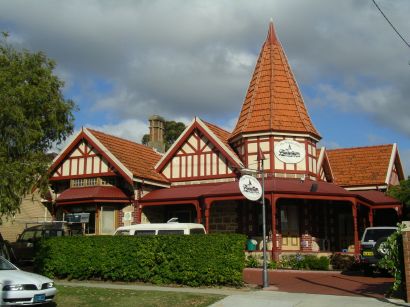
By the time I'd checked in it was perhaps 09:00, still comparatively early. I knew EXACTLY how I wanted to spend my time that day. With food. Having spent three days bushwalking, then three days on the train, then a week in caravan parks then a week in the tiny and food-sparse town of Coral Bay, I was very anxious to cook myself a nice meal again.
And so I did. After a walk up to the supermarket, fruit and vegetable shop and bakery, I was ready to go. I spent a couple of hours in TWH's fine kitchen preparing a massive quantity (perhaps eight litres) of vegetable-barley soup. (I was going to call it "delicious vegetable-barley soup," but even though others said so too, that might sound a bit vain.)
After cooking, I sat out in the back courtyard of the hostel to enjoy the fruits of my labour and a nice read.
In the late afternoon I started chatting with a young(er than me) German fellow named Henning. He was in Australia with a working holiday visa (a scheme that allows guests to legally take on short term employment during a stay of up to a year in the country). Despite having been in the country for three months, he said he was still quite disappointed at having not seen any of the "real Aussie lifestyle." He also needed to make some money soon. Henning hoped to remedy this by working as an au pair for a family in Perth. This plan was not without its problems. Employment agencies would only consider women for such jobs, and he wasn't confident enough in his English to advertise on his own.
So it was that I spent two or three hours sitting out in the courtyard drinking wine and (assistant) writing and editing an advertisement/cover letter for a German man aspiring to be a nanny in Perth, Australia. We were both very pleased with the final product and he'd go on to drop it in mailboxes in affluent suburbs, as well as to post it in schools, kindergartens and churches in the city.
After enjoying a supper of soup and bread, I was happy to have an early night.
Which would contrast tremendously with my next day. It began simply enough. With a walk down through Northbridge, the entertainment district of Perth (it really is spectacular how the bars, nightclubs and restaurants of the city are so concnetrated in this one small district.) My walk carried on through the Central Business District (CBD), most notable for its two lovely pedestrian malls (the abundence of interesting pedestrianized streets are one way in which most Australian cities are clearly superior to Toronto.) My tour ended, or at least changed directions when I reached the riverfront and met Michelle, a girl I knew from Coral Bay, and her new friend Amy. Since my trip had no particular aim, I followed them back through the city, hopping on one of the free buses that runs through Perth's downtown area, then hopping off again and wandering about some more, listening as they talked about clothes, which men were attractive and which women were ugly. Upon reflection, that probably makes them both sound miserable and shallow, quite undeservedly. There were moments of that, but in truth both Amy and especially Michelle were quite fun and interesting. Eventually they headed back to their hostel, and I found myself near mine. I headed in, planning on a quick lunch and then a continuation of my tour.
It didn't quite work out that way. When I returned, Martja was cleaning out all of the unclaimed food from the fridges, and despite the seas of soup I had left, I couldn't pas up the opportunity to cook some more. Two pepper, onion, tomato, ham and cheese omlettes later (all the ingredients were unclaimed food) I was outside having a rather larger mid-day meal than I'd anticipated. As were others. I offered the soup around to whoever wanted any, and even went inside and made another omlette for an Englishwoman who'd just arrived and hadn't gone food shopping yet.
After lunch I decided I really needed to finish off my West Coast 'blog entry and spent the afternoon writing, as well as making CD backups of all my digital photos.
Evening came and I was just finishing up when Renee appeared and asked if anyone wanted to head down to The Mustang (a local bar it seemed...) with The Scottish Girls. Apparently guests of The Witch's Hat had a $100 bar tab to split between them and she could give us a ride there. The Scots had already left, but I quickly finished off my writing, got changed and headed out the door with Henning and a Japanese fellow named Yosu.
We found the Scottish ladies (Susan and... damn, I forget her friend's name) inside, and despite the fact that they'd met a couple of big old Aussie men, we managed to make the bar tab last quite a while. Indeed, between that, the drinks Susan bought me, Henning's turns buying a jug or two, a beer from an English couple who I told about what to do New Zealand and who liked that I was a Liverpool fan, and a Gin! and tonic bought for me by a complete stranger later at night, I managed to last until closing time spending less than $20. A minor miracle.
And I didn't even overdo it when we carried on to Black Betty's afterwards. Despite doing our (undoubtedly silly-ly sozzled) best to sneak in, Henning and I had to wait in line. We met the Scots girls inside, and I stood around not drinking (primarily because I'd already had more than enough) and listening to the band. The band were dressed in gothic fashions, and played all the hard and loud popular songs that I remember from my university days (Rage Against the Machine, Offspring, Marilyn Manson, Greenday... et cetera) I even found my way into the mosh pit, which brought back fond memories of trips to Foufounes Electriques (electric buttcheeks) from my first year at McGill.
Eventually even Black Betty's closed, and despite having lost the rest of my party, I bumped into Susan on the way out. I'm not sure to say if this was fortuitous or what. It at least made the walk back to the hostel memorable. As we wandered back, she said that today (it was now after midnight) was her birthday, and went on to tell one miserable story after another about her life back home. By the time we got back to the park near the hostel, she was sobbing and we had to spend a good half hour on a park bench, her slowly calming and me doing my best to comisserate with and console her. (This primarily consisted of saying vaguely positive things in soothing tones of voice about how right she was but it wasn't that bad and while putting my arma round her shoulders and rocking her back and forth.)
Eventually we were in shape to head to the hostel (indeed, Susan was verging on optimistic by now) and we sat out on the front porch quietly enjoying a couple of betime beers before each heading off to sleep.
The morning of day three in Perth was unsurprising. I spent pretty much all of it in bed. I dragged myself out in time for lunch, and thoroughly enjoyed some of my soup which was (as soups tend to) getting better in the couple of days after it had been made.
After lunch I headed back out into the city, intent on getting to see a bit more of it. My first stop was King's Park, the largest "green" space. (I use quotes because this is semi-arid Western Australia and except for irrigated areas there's little that's really and truly green.) The park was nice enough, though not for the reasons it's supposed to be. The primary attraction of King's Park is supposed to be its vast expanses of bushland within the city. And while they might have been impressive for the middle of Perth, I'd spent two weeks out walking in the REAL bush, so wasn't that impressed. No, the things I liked best about the park were the tennis club (this was the first time I'd ever seen real grass tennis courts [I'd later realize that they're all over Perth]) and the memorial avenues. Along these avenues are great rows of trees, each dedicated to an Australian individual or unit that fought in the world wars. Each plaque explains the sad fate of the meoriand and who was responsible for their memorialization. Though they were only snippets of the stories, they made for fascinating reading.
I wandered back through the park, stopping to look out over Perth itself from the terrace (Perth isn't a very hilly city, so one could get a good view of it from there.) After leaving King's Park, I headed down to the riverside, the other major recreational area in the city. I was a bit disappointed by the waterfront. The Perth bell tower (which houses the old bells from London's St. Martin in the Fields church) is spectacular and pretty, and the small pyramid-shaped conservatory is nice enough, but apart from these, there's really not a lot there. Just some large, severely underutilised grassy spaces. I stopped and laid down in one of these to have a read, and eventually fell asleep. I was awakened by a pair of Aussies asking if I lived there. After a bit of conversation, it became clear that one of them was pleasant and normal enough, but the one who claimed to be both the New South Wales police commissioner, and one of Australia's most wanted criminals was a bit of a disconcerting fellow. To my relief the more stable fellow dragged him away and I departed the park shortly after.
At this point readers might be getting the idea that I didn't think much of Perth. Not so. It was more a case of Perth being a great place to live, but an only moderately interesting place to visit. Perth has a great concentration of beaches and small pretty parks, good public transit, as well as the great nightlife of Northbridge and lovely suburbs. And while it's exactly these sort of things that make a place great to live, the lack of major "attractions" made it nice enough, but not really satisfying to visit. So it is that we have the paradox of Perth being a place I'd gladly spend a year in, but whose most interesting attraction as a visitor was the fellow guests at my hostel.
Upon arriving back at said hostel near suppertime, I found a gathering back out in the courtyard, apparently in honour of Susan's birthday. She was far more cheerful than the previous night, and everyone shared in the delicioudly dense chocolate cake that she blew out the candles on. My evening continued with a dinner of... c'mon, guess... soup. I was still thoroughly enjoying it, but wasn't disappointed that between my meals and gifts to fellow residents it was nearing its end.
Before, throughout and after supper, I'd been drinking red wine. I'd finally bowed to economy and given up on beer. Wine can be so incredibly cheap in Australia that it's hard to drink anything else. Four litre casks (boxes) can be had for eight dollars or so. Admittedly, these taste vile, but even reasonably drinkable casks like the shiraz I had can be bought for less than $20.
After supper I sat and chatted with the Quentin and Beshlie, the English couple next to me, all the while trying to construct a hacky sack from duct tape and rice to replace one kicked over the fence into a neighbour's yard. If I do say so myself, it turned out very well. Since Lacy (the American owner of the lost sack) had given hers a name (Peter), I followed suit and named my newly minted sack Alfred the Great. As the evening continued, I began explaining my interest in medieval British history to some of the crowd, much to the delight of the increasingly inebriated Beshlie.
After a while we had to relocate to the front porch, since the hostel's residental location limits where noisy nighttime activities are allowed. The wine drinking and conversation continued out there, probably for hours, broken only by a walk to the bottle shop with Beshlie to procure more wine and later by her tumbling down the front steps of the hostel into the driveway and her campervan beyond.
It really was astonishing that the was unhurt. It appeared that she did more or less a full somersault before hitting the ground, with glass still in hand, nothing more than a little startled.
Bedtime.
My next day began almost as late, but was clearly more productive. I rose and shortly thereafter was on the suburban train out of Perth. Within twenty minutes I'd arrived at the suburb of Cottesloe, very pretty and the home of Perth's most famous beach. A walk took me to the very pretty beach, where I spent an hour or so wandering about. A bit more walking, and quite a bit of questioning eventually took me to the ground of the Cottesloe Rugby Club, where two of my Toronto Dragons teammates used to play, and where I felt duty bound to make a pilgrimage.
I hurried back to the rail station, anxious to ensure that my time-limted ticket would still be valid for the trip out to Fremantle, probably rhe best known of Perth's suburbs (perhaps it ought to properly be called a city in its own right.)
My plan for Fremantle was to visit a couple of the city's microbreweries and brewpubs, as well as the market. I began by taking the free bus (as I mentioned earlier, public transit in the Perth area is good and cheap or, in the CBD areas, FREE!) both to have a quick tour of the city, and to reach the first of the breweries, Little Creatures. Which I couldn't find. The second, the Gage Road brewery was not only far out of town, but also closed. It was enough to drive a man to drink. Fortunately the Sail and Anchor brewpub was happy to assist. Despite the expense ($7.70 per pint) I thoroughly enjoyed my beers there. The pub itself was spectacular, with a wide array of beautiful bars, interesting lounges and relaxing patios. I sat on outside on the ground floor, sipping away, reading and listening to the hippy-looking street performers across the road who played very good and relaxing music (though you probably wouldn't have believed this if I'd begun by telling you they consisted of a tambourine, three ukeleles, a children's toy piano in the shape of a purple dinosaur and a cello.)
After I'd finished savouring my expensive beers (a very good Redback wheat beer, a good Alpha pale ale, and a great Brass Monkey stout) I wandered through the centre of Fremantle, and enjoyed the tightly packed streets, teeming with Friday evening activity. The bustle of people enjoying al fresco meals, and heading out to the pub for the evening was very pleasant, especially with the warm evening air and pleasant breeze off the ocean. I eventually found my way back to the Fremantle Markets. These were much smaller than the Melbourne and even Adelaide markets, but of a different character. While there were purveyors of food here, the real highlight was the arts, crafts and general knicknacks. I really felt like I ought to buy something, so pretty were most of the wares, but there was nothing that really struck me enough to spend money on and to carry around, so I headed back to the train station sans souveniers, save for some ingredients to cook dinner at night.
Dinner was pasta with fresh sauteed vegetables and pesto (homemade, if a bit coarse due to the lack of a food processor.) I shared this with one more guest, adding yet another to the list of fellow travellers I'd fed in Perth. Despite the fact that it was Friday night, I really couldn't be convinced to have yet another late evening, so I had a (relative only to the past couple) early night.
My final day in Perth was a gloriously relaxed one. I spent the morning lazing about the hostel, making my usual enormous travel day breakfast of French toast with cinammon apples and syrup... mmm... This led to my not really moving until 13:00 when several of the guests I'd become most friendly with over the past few days (Martja, Henning and Kat) invited me to join them for one last day at the beach.
We headed down to Scarborough Beach on a free bus provided by a local pub. The afternoon westerly that seems to blow in over the entire west coast of the country was in full effect, but it was still warm, and down near the sand it was lovely. The four of us spent the last few hours of the day lying around on the beach, I reading and admiring the kitesurfers, the others simply pleasuring in the sun shining down on them.
We headed back to the hostel as the air began to cool, and I enjoyed an evening almost as lazy as the rest of the day. I finished off my pasta from the previous night and did my best to finish off my second cask of wine, but couldn't even come close, especially since I didn't want to drink TOO much before heading to the airport.
The shuttle bus arrived for me at 21:00, shortly after I'd said my goodbyes to all the friends I'd made over the past few days.
Though I was the first of many pickups for the shuttle, and though it took a circuitous route to the airport, I wasn't concerned. This was due to a bit of earlier poor planning on my part. I thought I'd done such a wonderful job in picking only flights that departed at pleasant, reasonable times of the day, like, say, two o'clock in the afternoon. It was only about a week prior to this evening that I'd noticed a fault in my plan. My flight to Singapore wasn't at 13:55. it really WAS at 01:55.
Thus it was that I'd got on the last airport shuttle of the night, which had taken a long time getting there, and STILL had over four hours to kill before my flight left. Departure formalities and security ate up some of this, but I still managed to use 2.75 of the remaining 4 hours on my phone card speaking to friends and family back home before boarding the Singapore Airlines 777 and heading up into the sky away from the continent that had been "home" for the past seven weeks.
So, thanks once again to everyone who made my stay in Australia so fun and so memorable, especially those who gave me a place to stay, or helped me get from one place to another. As you surely know, it wouldn't have been the same, if possible at all without you.
November 29, 2004
When last I wrote, I was just getting off the Indian Pacific train in Perth, preparing to head up the west coast with Grant and Bec, a couple from Victoria, Australia. This was something of a change to my plans.
Western Australia is big. Really big. At 2.5 million square kilometres, its bigger than Canada's largest province (Quebec) by over 65%. The vast majority of this bigness lies to the north of the capital of Perth. Not only is the northern part of the state big, it's also empty, with 1.3 million of the state's 1.8 million inhabitants living in Perth and most of the rest of them to the south of it.
Because of this, I'd decided that I'd have to limit my travel in WA to the southern part of the state. Some of the most interesting parts lie north of Perth, but the distances are just so vast and the points of interest so far apart (and often off of the main roads) that there's no easy way to visit them as an independent traveller. Tours are expensive, as are rental cars (and my experience in SA made me wary of them anyway.) Buses are a possibility, but schedules, and the remote nature of many attractions make using them problematic.
With all of this in mind, Grant and Bec's offer of a spot in their car while they spent a week driving up the coast as they moved to the mining town of Port Hedland was nothing short of miraculous. Not only were they offering me a "free tour" of the west coast, they were inviting a guest along on the first real holiday they'd ever had together. Hooray once again for the kindness of strangers!
With just a bit of rearranging the contents of their car, we soon had my pack and walking stick stowed and were ready to hit the road.
Our first stop wasn't far afield at all: Perth's Scarborough Beach. I'd soon discover that Grant was a big fan of beaches, which, of course, presented no problems for me at all. Despite the fact that we arrived there not long after 10:00 in the morning, the beach was abuzz with activity on this already hot and sunny day. Surfers dotted the water, taking turns sliding in on the sizable but still swimable surf. Bathers frolicked happily and noisily in the water. Sunbathers had already covered a significant chunk of the sand, as did a promotion tent of a surfwear manufacturer livening up the morning with running commentary on the steady flow of bikini clad women who'd come by to pick up free surfing DVDs.
A stroll along the beach featured all this and more. With this display of beautiful weather, wonderful turquoise water and soft white sand, I was already liking WA.
Before long, it was time to hit the road and head north. At this point I took up the navigator's seat and successfully lead us out of Perth and onto the Great Northern Highway. I'd continue my navigational duties for the remainder of the trip, but as became rapidly apparent, there would be little navigating to do.
One of the things that struck me most during this first day's drive was how quickly the settled lands end once one leaves the Perth area. Within half an hour of driving there were few signs of human presence and even fewer sideroads. Within an hour there were virtually none of either.
The countryside in this part of WA was flat and dry. After passing through a semi-arid pine forest, we drove along sparsely vegetated plains. The dominant colours were brown and a sort of brownish-greyish-green. The only agriculture that seemed to be going on was olive groves and one or two vineyards. I would grow use to this, and even more Spartan landscapes in the coming days.
Our first stop was the town of Cervantes (and before you even bother asking, yes, there was a Don Quixote restaurant, a Sancho Panza tour company and a mini bus named Dulcinea as well as, I'm sure, many other references to the great Spanish writer.) Following the signs, we drove straight to the town beach and had a refreshing dip in the Indian Ocean (Grant and Bec were attempting to acclimatise to the WA heat by not using the air conditioning in their car, so it did get a bit sticky sometimes, but I certainly wasn't going to complain.) While there, we also saw the smoke from a nearby bushfire that we'd spotted from the road.
Despite its lovely beach, Cervantes is actually most famous for the national park nearby, and specifically The Pinnacles, a geological formation found within the park.
The Pinnacles are rock spires that rise up out of the sand of the Pinnacles Desert. They range from small, tombstone sized slabs to monoliths four metres high and one or more across. These would be interesting, and worth a look even if there were only a dozen or so. But there are more. Many more. Thousands in fact. The bizarre formations seem to go on almost as far as the eye can see in some spots, ending only at the foot of monstrous sand dunes off in the distance.
A 3km driving track weaves its way in and around the Pinnacles, and takes one through the most spectacular areas. It's almost impossible to appreciate the wonder of the landscape by simple photos. One really needs to see the rocks rising out of the sands, more and more of them, in every direction you turn.
In addition to the majesty of WAs landscape, we were also introduced to some of its fauna. Namely the flies. They were everywhere. As bad, probably worse than in the Flinders Ranges. So prolific are they in arid regions that the constant waving of hands in front of one's face to brush them away has become known as the "Australian Greeting," or "Australian Wave." Thus, while I would have liked to have spent a while walking around The Pinnacles, it wasn't long before we were back on the road and headed north again.
Our second stop, and resting place for the evening was Jurien Bay. This town is a pretty seaside vacation spot and fishing town. Its beach was almost as pretty as the one at Cervantes and also boasted a jetty for fishing off, a fact that pleased Grant immensely. Indeed, people were even fishing off the beach so rich are the seas in the area. Shortly after arrival at the caravan park, Grant and Bec were installed in their cabin and I'd set up my tent (quite understandably, while they were willing to take a strange traveller along in their car, sharing sleeping quarters with one was a bit much, especially on their first holiday together.)
Since WA doesn't use daylight savings time, dusk comes relatively early here. On this particular evening it was accompanied by a spectacular sunset, the sky being coloured by the smoke from the bushfire we'd driven past earlier in the day. In truth, I was happy to get to bed early, having begun the day at sunrise after an uncomfortable sleep in a train seat.
The next morning I woke upnice and early and had time to head down to the beach for a stroll before meeting Bec and Grant back at the caravan park and hitting the road once more. After a quick tour of the town and marina we were on the road once again. A stop just up the road at Green Head found us at yet another beautiful beach, this time in Dynamite Bay. Indeed, it struck me that the entire 500km stretch of coastline north of Perth that we drove these first two days was nothing BUT one beautiful beach backed by huge sand dunes.
Inland things were a little more changable, with the olive groves giving way to grain and hay fields, interspersed with bits of grazing land. The hot dry area we were driving through that day could be called the bread basket of WA, if not the entire country. After a long morning of driving, we came to Geraldton the population centre of the region. Despite the fact that it has only 23 000 people, Geraldton had the feel of a bustling metropolis. 500km north of Perth and much, much farther away from any other large town, Geraldton had the feel of an oasis in the semi-arid plains and hills.
As we pulled up to the caravan park where we'd spend the evening, we saw the sky filled with large kites out above the ocean. Not only was this place a veritable oasis, it was also hosting the Australian kite surfing championships. After unpacking and setting up camp/moving into the cabin, Grant, Bec and I took a drive into town.
On the way in to town, we passed by the commercial harbour area. Geraldton is the port of departure for much of the grain and ore produced in the area, and is also a major crayfish (rock lobster)-ing area. (Indeed, one of the highlights of Bec's trip up the coast was to be a crayfish dinner that evening.)
A short drive later and we were driving along the pretty main street where I took leave of Grant and Bec and I wandered off to explore on my own (at this point I was still very wary of crowding in on their vacation too much and was trying to give them as much space as possible to themselves.) Aside from the town centre and the port, the major attraction of Geraldton is the HMAS Sydney II memorial, a monument to the 645 man crew lost when that light cruiser was lost just off the coast during a battle with the German cruiser Kormoran, which was also sunk and lost all but 80 of her crew.
Once again, the sun started to set early and a walk back along the beach got me back to the caravan park just in time to catch the last of the kite surfing, as well as the sun's last rays lighting the classically designed lighthouse nearby.
The next morning I rose early and headed into town to pick up a new bathing suit (number 3 on this trip.) I arrived back just before Bec and Grant, who were taken to task by the caravan park owner for their late checkout. No matter, we were soon on our way to the east end of town where we had a delightful cool lunch with Margaret, a friend of Grant's mum! And to think that less than 30 hours ago I'd planned on a solitary trip a mere 400km south of Perth!
After lunch we headed out onto the road for the hottest, longest and most isolated day of driving yet. Perhaps 20 minutes after leaving Geraldton, I spotted an advertisement for the Billabong Roadhouse, 110km away. This wasn't just overambitious advertising (as with Wall Drug and South of the Border in the US) but was actually entirely sensible. The Billabong was the nearest place for food, water, fuel... anything more or less, after leaving Geraldton. And I don't just mean on the main road. For the next 110km there was NOTHING out there but bushes and dirt (the farmland had disappeared not far north of Geraldton.)
Upon arriving at the roadhouse we were all hot and tired once more and stopped in for a drink and some air conditioned comfort. We got both, as well as an... interesting... conversation with one of the proprieters. Upon hearing I was a structural engineer he became very excited and proceeded to explain a "commonsense" plan he'd worked out for the betterment of WA:
Ship all of the garbage from Perth, Sydney, Melbourne and Adelaide out into the WA desert and start building a mountain with it. He proposed that the mountain have a square base, 100km on a side and be built up to an elevation of 5000m at which point he figured it would alter weather patterns to start rainfall in the desert and allow it to be used as farmland. I listened as intently as I could, occaisionally giving a small smile/chuckle, or saying something like "well, it's a novel idea." At each response of this sort, the fellow would get quite offended, but continued telling nonetheless.
We eventually extricated ourselves and made it back to the car where I actually gave the idea a bit of thought. Leaving aside the meteorological, hydrological and transportation problems, a conservative estimate of the garbage production of the four cities in question would have them taking about 3000 years to create said mountain. I wish I'd worked this out while we were still there, but no doubt that would have caused still greater offense...
As we continued driving, the country became more and more desolate, prompting Grant to suggest that he suspected the end of the world was "just over that next hill there." As it turned out he was right! As we reached the summit, the car shot out into the inky black nothing of the universal void and we tumbled down, down, down until-- Until I remembered that this was supposed to be a (reasonably) accurate record of my trip and not a work of fiction.
So... Where were we? Ah! At the turn-off on the road up to Denham (130km to the NNW off the North West Coast Highway.) While chances are good none of you readers will have heard of Denham, odds aren't too bad that at least some of you will be familiar with Monkey Mia which lies 28km away, across the peninsula on Shark Bay.
Monkey Mia rose to world prominence in the early 1980s when, entirely unprompted, a few wild dolphins living in Shark Bay started visiting a homesteader there. The woman began tossing bits of fish to the dolphins when they came, and the behaviour continued. Not only this, but the (still entirely free and wild) dolphins started teaching their children to visit Monkey Mia as well. As knowledge of these sociable wild dolphins spread, the place quickly became a tourist attraction in spite of its remote location (about 800km north of Perth on the main highway, then a further 130km on a secondary road) and all of Shark Bay is now a World Heritage Area.
On the way to Denham, having just entered the WHA, Bec took her first turn at the wheel during which she managed to hit a goanna (large carnivorous lizard) that had been sitting in the road. The goanna met its end with a distasteful thump-sploush sound that also sounded the end of Bec's turn at the wheel (in truth it may actually have been Grant and I's teasing afterwards that convinced her to stop, but directly or in-, the goanna was still responsible.)
We arrived at Denham as evening drew in and although I set up my tent almost immediately, it wasn't before going out for a swim in the bay, some 12m or so from my tent site.
The next morning I met up with Grant and Bec and we drove out to Monkey Mia itself. To our good fortune, the dolphins were there for a visit as we arrived!
At one time, interaction with the dolphins was completely unfettered, but now it is controlled by the WA department of Conservation And Land Management. Visitors are only allowed knee deep in the water where the dolphins usually visit (though they're free to swimm in the very nearby beach,) touching the dolphins is not permitted and only a small amount of food is given to the dolphins each day, and then only to the older females who have been visiting for many years.
Despite all this, it was still amazing to get so close to these wild (if habitually homo-phillic) sea mammals. The closest dolphins came within a metre or so of me! After a bit of general socializing, the CALM officers randomly selected a few individuals to feed the visitors. As it turned out, Grant was one of the lucky few, much to the delight and consternation of Bec (delight for obvious reasons and consternation because it was clear that she was the real dolphin lover of the three of us.)
The feeding itself was particularly entertaining because of the other well known beach residents: a flock of pelicans who habitually loiter around and steal the fish meant for the dolphins. For this reason, before the dolphin feeding starts, a warden asks the crowds to part so that the pelicans in the water can see his bucket full of fish, which prompts these raiding avians to follow him inland away from the dolphins to receive their "Danegeld" while the dolphins are ded undisturbed.
After the dolphins headed back out to sea, Bec and Grant headed out on a sailboat cruise in the bay to observe local wildlife, while I opted for a swim off the beach, a walk in the dunes behind the beach and a nice long read. During the dune-walk, I was amazed by the quantity of snake trails I observed. It seemed as the place must be over-run by them, though I didn't see a single live one. This walk also gave me an opportunity to be photographed with a "watch for dilbys" sign. Dilbys are small marsupials with rabbit like ears, though I amused the Grant and Bec by asking if the idea of marsupials with insect wings was meant to be a joke.
Eventually Bec and Grant returned from their cruise. The dolphins hadn't reappeared for a second feed and seemed unlikely to do so, so we headed back to Denham. We spent the afternoon sitting on the porch of their chalet, drinking a few beers, causing riots among a flock of seagulls by feeding them and talking and eventually suppertime rolled around.
My driving hosts also turned into my dinner hosts this evening, treating me to a barbeque of fresh caught fish (they'd been fishing off the dock in town the previous night) and sausages, along with bread and salad. Supper was great, and afterwards we grabbed the remaining beers and headed down to the dock to see what we could do about procuring food for the next day as well.
The water (apparently) wasn't as clear as the previous night, but you could still see the fish as they went for your bait, as well as miscellaneous rays and sea snakes as they cruised by.
Grant and Bec had a pair of rods and a hand line, which I was using. Given how long it had been since I'd been fishing, I didn't fancy my odds. Yet lo and behold, I was the first to get a catch! A striped sea pike, though a small one, only 18cm long or so. That fellow was thrown back, but the next two, also striped sea pike went in the fish bag. My final catch of the day was a monstrous fish of the same species, perhaps 45cm long (they grow to a maximum of 55cm) that (except for a smallish stingray that was thrown back) may have been the largest fish anyone on the jetty caught all night.
Bec and Grant also caught several fish through the evening, so we clearly had a nice meal by not long after sundown when the fish seemed to slow down. Though the fish may have stopped biting, the lights on the jetty came on and squid started appearing in the waters below. A pair of women nearby were catching loads of them with their jigging setup, and even Grant pulled one out with his ordinary rod. As each hit the dock, everyone backed away, for in its desparate struggle for life, each squid would fire a powerful squirt of ink that travelled 3m or more through the air.
The women were actually catching them as bait and had more than they needed, so provided us with two more squid for our seafood buffet, as well as teaching us how to properly clean a squid (apparently they were both chefs and were growing tired of the huge amounts of calamari they'd been eating recently.)
As it got later, Bec headed back to the caravan park while Grant and I stayed behind to clean the fish. Or rather I stayed behind to watch Grant clean the fish and to help tidy up afterwards.
Next morning I continued my habit of getting up with the (very early) sunrise, and was up and packed by 07:00, ready for a seafood breakfast Grant prepared on the barbeque. The fish were good, especially after I discovered how to get the bones out of the many-ribbed pike. If anything, the squid, prepared with salt, lime juice and ground chillis, were even better. And we still had another good sized fish and two squid left!
After breakfast we headed back to the main road, then on up the coast. Our only stop during the drive was at the town of Carnarvon, the last place for several hundred kilometres with a reliable fresh water source. Carnarvon's highlights include a disused (but still impressive) NASA receiving dish, the many fruit plantations (especially bannanas!) nearby, and the old and battered, but still standing, one mile jetty. Grant, Bec and I took a walk out to the end of the jetty, which provided a nice stretch of the legs before getting back in the car and carrying on up the coast towards my northernmost destination, the tiny town of Coral Bay. Just before arriving, we passed 23.5 degrees south, putting us in the tropics.
Coral Bay is some 1200km north of Perth. It is a popular destination for tourists, though it can't accomodate all that many of them, due mostly to a reliable supply of fresh water. Most tapwater in Coral Bay comes from a warm, slightly salty well (or bore as the Aussies call it.) The main reason for Coral Bay's popularity is the nearby Ningaloo Reef.
The Ningaloo is the western cousin to the Great Barrier Reef on Australia's east coast. While not nearly as long ("only" 260km) the Ningaloo's coral is just as spectacular, and it has the dual advantages of beign less touristed and much more accessible. Indeed, at Coral Bay the reef comes almost right up to the beach.
Upon arriving in town, I checked into the Ningaloo Club Backpackers, while Grant and Bec continued with their pattern of staying in chalets on caravan parks. Since Bec hadn't wanted any of the squid or fish, they were all deeded to me and provided three more great meals, including dinner that night.
My first full day in Coral Bay gave me a chance to head down to the aptly-named Paradise Beach to do a bit of snorkelling. Wow! The fish I saw off the beach were every bit as beautiful as any in the South Pacific and the coral was far, far beyond anything I've seen since the Great Barrier 15 years ago. Huge outcrops of stag coral, whose branches never seemed to end, large lumpy brain coral, and gorgeous two-metre-wide rosettes of cabbage coral. Despite the fact that these hard corals lack the bright colours of their softer relatives, the sheer quantity and size of them were stunning.
Almost impressive was the school of fish I swam through on my way back to the beach. There were literally thousands of them. Thousands and thousands, all silver and 15-25cm long. I swam into the school and every one easily slipped past me with no obvious concern. I swam through them for seemingly minutes before turning around. Everywhere I looked I was surrounded by these fish. I eventually found my way back to the beach, but had to head back in again for another look before drying off in the sun and then heading back to the hostel.
Upon arriving back, I settled in for a quiet evening, but it was not to be. I sat down with Alistair, Daniel and Michelle, three roommates of mine who were discussing heading down to the pub. Well, this sounded like fun...
I have no idea how long we spent there, but after the pub closed, we headed to what is, apparently, the late-night party spot in Coral Bay: a courtyard in the outdoor shopping centre near the bakery. We sat there for a bit, and I would have been able to go home happily and topple into bed, but once again, it was not to be. Several other guests at the hostel were there with a four litre box of wine that they were happy to share... Well, this was more or less the end of me.
One of my favourite authors, Paul Quarrington created a character who would "go across the river to Hull and get so drunk he could speak French." This was exactly the state I was in that night. I spent an hour, perhaps more speaking French with a Belgian couple, the drink and the fact that they were Flemish (though still proficient in French) stripping away any embarassment about my poor command of the language. Though we did talk for a long time, so maybe I'm not as bad as I think...
Next morning- Ow. Headache. It'd been a while since I felt like this. I'd meant to be up at 08:00 to go snorkelling with manta rays. I had 13 minutes to get ready and out the doos. Thankfuly I hadn't booked the trip in advance and decided it could wait until the next day and slumped back under the covers. I spent the entire day at the hostel, sitting in the sun, reading and drinking large quantities of water. By the mid afternoon I was actually feeling pretty good again, which was fortunate, given that I had an appointment to keep.
All the way up the coast I'd been promising Bec and Grant that I'd buy them a nice dinner in order to thank them for the ride. Before arriving in Coral Bay I'd been a bit worried that it might be so small it would have no restaurants, but no, it actually had two. I met them at the hotel/pub/restaurant and despite the previous night's experience had a couple of beers with them at their insistence.
We spent the last part of the afternoon and early evening talking, having a few more beverages and then finaly enjoying a lovely dinner of steak and prawns. Since I'd planned on leaving the following afternoon once I'd finished my manta ray snorkelling trip, we also said our goodbyes, took a few commemorative photos and exchanged contact info.
I headed back to the hostel not too late in the evening and stopped for just long enough to have a chat and be sociable with the crowds that were sitting beside the pool before heading off to bed. As I was walking back to the room brushing my teeth, I saw Bec down in the courtyard. Apparently she'd gone out for a walk on the beach and "misplaced" Grant, and was now without a way into their cabin. I headed back out into the cool night with her and, after a short wander had been unable to find Grant. Thankfully he was back at the cabin when we returned there to wait.
At long last I made my way back to bed and slept in preparation for my big day the following morning.
I woke up and couldn't decide what to do. I had planned on departing on a 14:00 bus that afternoon, so that I'd have time to get back down to Perth, then carry on south to explore the southwest of the state. But at the same time, I was enjoying my stay in Coral Bay and really was getting a bit tired of packing my bag and making travel arrangements every day or two. I paced around the lobby of the hostel, unable to decide, especially as the next 14:00 bus left in 3 days, and all the others between now and then were at 03:05 in the morning. Finally, at the suggestion a fellow guest, I flipped a coin. It turned up heads, so I walked up to the front desk and arranged to stay for another few days.
My indecisiveness had taken a while, so it was now time to head out on my snorkelling trip. A pointlessly short busride from the booking office took us to the boat docks, where the eight of us boarded the boat that would take us out to the rays. After safety, gear (in addition to a mask, snorkel and fins, we'd also been given wetsuits to protect against the rare but very unpleasant jellyfish that can be found in the reef) and animal behaviour briefings, we headed out of the town harbour via a circuitous route through the reef. I sat up on the foredeck of the boat, the wind and sun on me a glorious combination.
In about twenty minutes we were floating near the reef's outer edge and before long received a call from the spotter plane. (Yes, they use an airplane to find the rays in the water and direct the boat to them. This is the primary reason that the manta ray interaction trips are so expensive.)
Within a few minutes we were in the water preparing to meet the rays. We'd been lucky in that there were several of them congregated around a cleaning station (a patch of rock or coral where rays and other large fish go in order to be cleaned off by cleaner wrasse, small blue and black striped fish that feed on parasites that plague their large guests.) It was fortunate that we foudn them there, because it meant they'd be relatively stationary. Mantas are fast swimmers, and if you're aiming to follow them around as they move, it can be difficult to keep up.
Once in the water, we spotted a manta gliding through the water in no time. It was a small male, perhaps 2m across (the largest mantas can be up to 6m from "wingtip" to "wingtip.") Black on top, with a white underside, it swam gracefully through the water, flapping its large pectoral fins and appearing almost to fly.
One of the fellow guests dove down towards it as it swam around the cleaning station, an action that had been specifically warned against, and the ray started to swim away. We followed it, but it was all we could do to keep up, and it had disappeared in no time. I was particularly irritated when, after this, the fellow who had probably scared it away warned me to keep my fins below the water when kicking, as they made a lot of noise on the surface and could scare the fish. This was entirely true, but still annoyed me.
Back on the boat, they'd received another call from the plane that there were several more manta rays back at the cleaning station. We all swam back instead of reboarding the boat, and this time found two rays there, gliding about. It was amazing how graceful these huge creatures were (at 3.5m across each pair of females were probably the largest things I'd ever been in the water with.)
They "flew" through the water, once turning deftly as to just avoid hitting one another. As they passed the white underside of their "wingtips" just touched, a scene which was later likened by another guest to the rays high-fiving.
The two rays swam off in different directions, and we followed one for a few minutes. It seemed in no hurry to get anywhere in particular and soon had returned to the cleaning station where we met to additional rays for a total of three. I floated in the water, only occaisionally kicking in order to maintain my spot in the current, all the while staring at the beautiful giants beneath me.
After perhaps 20 minutes of this, the rays departed, once again quicker than we could follow and we reboarded the boat.
Our next stop was still further out at the reef, this time in an area known as the turtle nursery. Green and Loggerhead sea turtles abound here, and we saw dozens. Most were simply dark, vaguely turtle-shaped spots in the water, but several came to the surface to take a look at the boat and to take once of their two or three hourly breaths. The various tour companies on the reef have agreed not to dive or snorkel here to avoid disturbing the turtles, which was a bit diappointing, but entirely understandable.
Our final stop was at a particularly large coral outcrop perhaps 800m off the shore on the way back in. Here we spent perhaps an hour in the water admiring the fish and coral. The coral structures here were even more beautiful, and clearly in better condition than those near the beach. We swam as a group around to the back of the coral outcrop, spying a few blacktip reef sharks and a small sea turtle on the bottom as we went.
The current was particularly strong here, so after a short time admiring them, we swam back through a gap in the outcrop to the comparatively calm front side. While the (still incredible) life here wasn't as impressive as the manta rays, I was still very happy at being able to dive down below the surface to get a closer look.
Eventually, even with the wetsuit, the cool of the water and the effort of swimming caught up with us all and we headed back to the boat which, after an afternoon tea (it included some great [to the point of being memorable] coffee cake) headed back to shore.
I spent the later part of the afternoon in a pattern that would repeat itself over the next few days... I lazed about the hostel, enjoying the warmth and sun, which were tempered by the strong afternoon breeze that appeared every day I was in Coral Bay. I passed the time by reading and watching cricket and, on this day, listening to the Tragically Hip live album that an Australian fan of the bands played on the hostel stereo. I spent the evening sitting outside, playing ping-pong, pool and just chatting with my fellow guests. One or two locals were also present at the open-air bar, including the groundskeeper at one of the caravan parks. Dave (I think his name was) was a former lawyer who now spent much of his free time fighting against a huge resort development just to the north of Coral Bay that would increase the number of visitors by at least fourfold.
The next morning I headed out to the beach and sat in under an overhanging piece of sandstone, reading, listening to music on my mp3 player and revelling in the view of the ocean and reef and in the blissful weather. The afternoon was spent in the exact same fashion, except this time I sat with my new friends and roommates (Daniel, Alistair, Holly, Jo and others) at the end of the pool instead of at the bar, again, talking until the bar closed and it was time for bed. I was beginning to behave like the "stereotypical" backpacker... Which was actually very relaxing, if not entirely the way I liked to think of myself.
The next morning was spent walking out to the "shark nursery" some 2km north of town. In this small, shallow bay, dozens of young blacktip reef sharks
congregate. They've been doing so for almost 20 years now, though no one understands exactly why. Since blacktips (indeed, all reef sharks) are quite docile, it's possible to walk into the knee deep water and get quite close to them indeed. At one point I saw four of them perhaps 10m away following one anothers' tails in a circular shape, just as sharks on television and film behave.
The afternoon and evening were spent exactly the same way as the previous day. This may have not been the "best" use of my time in WA, but it was giving me much needed relaxation.
My final day in Coral Bay was spent with a short walk down to the beach, to admire the beauty of the ocean and reef one final time, and then up the hill for a view out over the town. At the top of the hill I also found the local pet cemetary... Not only were there the usual mix of dogs and cats, but a pair of pet Foster's kangaroos were also buried there.
I returned to the hostel for lunch, just after which the bus arrived. I said slightly hurried goodbyes to all of my newfound friends (save for Holly who was heading back to Perth also) and climbed aboard for the 17 hour trip.
Thankfully Australian long distance buses are very comfortable, with seats that recline far back, and a TV at the front that videos are played on throughout the course of the trip. There's even a small bedroom at the back so that the spare driver can have a rest while his compatriot is in charge of the vehicle. Thus I spent a surprisingly comfortable 17 hours on the road, having a nice dinner with Holly at a roadhouse along the way. During our dinner at the roadhouse, we noted a beauty of the ocean and reef rack of bumper stickers which prove that the stereotypes of Australian men may not be purely fictional... After reboarding the bus, I even managed a nice sleep before arriving in Perth at 07:00 the following morning.
Thanks this time are due, of course, to Grant and Bec. Without them this entry would never even have happened, since I wouldn't have even considered heading up the coast.
Shortly after we met, they'd asked me what I thought of Australian hospitality. Thanks to them, my already high opinion of it has increased imeasurably. Best of luck in Port Hedland guys, as well as with your upcoming wedding, and thank you once more.
Llew, This was one of my favourite entries yet! I think you should try to get a picture of yourself in every entry or so, because I can honestly say that I didn't recognize you in this entry picture. And I'd like to see your transofrmation from week to week.
I'm dropping mom and dad at the airport tomorrow morning; they are very excited to see you. I saw a very funny movie yesterday and it made me think of you- Napoleon Dynamite. Don't be offended when you actually see it; it wasn't the character that reminded me of you, but I think you'll really enjoy it.
Love Moose
Hi Llew,
It was great to chat with you today. I ran upstairs after to check out the latest update on the blog. I can't believe all the incredible things you are doing on this trip. Now you get to have a bit of the "luxury" treatment with mom and dad.....here's a bit of advice that I got from the youngest member of the family (Moose)...."if they offer, don't feel bad, they want to treat you!"
Posted by: Melanie on December 4, 2004 08:27 PMHI! Just finished reading your account of our "epic journey", can't believe you remember it all with such SOBER clarity. Anyway, will direct my family to your site, saves me the trouble! Have a great time on the next leg of your journey. keep in touch.
Bec XX
Hi Llew, I am Bec's mum just checked out your site it was great at least via you I have an insight into Bec and Grants trip.Unfortunately for some reason the pics wouldn't load.Hope you continue to enjoy your trip.
Posted by: Judy on December 11, 2004 01:24 AMNovember 27, 2004
Well... It's been ages since I last wrote, and much has happened, most notably my having moved from the east coast to the west.
The journey to Western Australia started with the overnight train trip from Melbourne to Adelaide. I'd planned on spending a few days in South Australia on the way out west, and especially given its status as a transportation hub, Adelaide made a natural base.
I only spent two days in the city itself. The first of these started out early with a 08:00 arrival on the train from Melbourne. While the interstate train station isn't right in the centre of town, it's not too long a walk, so in no time I'd found a hostel to stay at and had checked in.
By the time I'd got checked in and settled and had lunch, it was already early afternoon. My first stop in Adelaide was the renowned botanical gardens. They weren't at their most spectacular, since not many plants were in bloom, but the gardens were still pleasant and interesting. Of particular note were the exhibition about rice in the "economic botany" pavillion, and the rose gardens. Perhaps the most memorable thing about the gardens wasn't the plants at all, but the profusion of brightly coloured parrots and other bird life that aboubnded in some sections.
By the time my stroll through the gardens was complete it was almost time to head back to the hostel for dinner. I spent a pleasant evening there hanging around with my Irish roomates, even playing a game of Monopoly towards the end of the night (I got my butt kicked, but it was entertaining anyway, since I hadn't played in literally years.)
I was determined that the next day would be a more productive one, and so it was. I headed out int he morning to make inquiries about the next leg of my journey. My plan was to head up the road to Port Augusta and thence another 160km further north to Wilpena, perhaps the most spectacular, and certainly the best known part of Flinders National Park. The only trick would be how to arrange it.
Unfortunately the last-ever bus from Adelaide to Wilpena had gone the day before, so that wouldn't do. I could rent a car in Adelaide and drive up, but that would mean I'd need to return it to Adelaide as well, which would be a waste of time and effort since I could just board the train out to Perth (my next destination) at Port Augusta. Eventually I decided I'd take a bus up to Port Augusta, rent a car there, drive up to Wilpena and then return to Port Augusta to catch the train. It took a while to get this all sorted out, but I was happy once I had it done.
Since I'd just bought a new phone card and had been on the phone a good chunk of the morning with various car rental agencies, I also took the time to phone everyone back home. Once again, half of the day had disappeared before I got ready to see some of the sights of Adelaide.
My first stop was a trip through many of the opal shops in the centre of town. Australia in general, and South Australia in particular is the world capital of these beautiful multi-coloured gems. Pretty much my only memory of Adelaide from my last trip to Australia was spending great swaths of time admiring the stones for sale at many different outlets in town. I gave in ot my obsession and spent a good couple of hours floating from one shop to the next, telling the salespeople that I sadly couldn't afford to buy anything, but I just loved looking.
I eventually tore myself away from the opals (although I had begun entertaining serious thoughts of buying a small loose stone) and headed to the Adelaide Central Market. It's not as big as the Queen Vic in Melbourne, and most of the stalls were closed that day, but I did still manage to do some provisioning for my upcoming trip into the Flinders.
Shopping complete, I headed to the surprisingly large Museum of South Australia, first exploring the Australian Aboriginal galleries (some of the best in the world.) It was very relaxing and interesting just to sit and browse through the online histories of the native people of Australia (and to rest my feet at the same time.) An hour or so later, I headed upstairs to the Australian wildlife exhibits.
Before I new it, the museum was closing, and back to the hostel I went once more. On the way back I caved in and bought a tiny teardrop shaped crystal opal for $30 from one of the shops. I figured that I would be unlikely to find many more souveniers that would be so amll and light and besides I am (as I mentioned earlier) somewhat obsessed by opals.
While the kitchen facitilites at the hostel I was resident in were so-so, they made up for it by providing nightly meals for $5.00. This evening I stuffed myself with lasagna, salad, apple pie and ice cream (as well as filtered water, which, although I almost never drink it elsewhere, was a treat since Adelaide's tap water tastes so unpleasant.)
A kind English lady had loaned me her alarm clock so that I'd be sure to wake up in time for my 08:30 bus to Port Augusta, but it was still a near thing. Having dawdled around the hostel having a leisurely breakfast, I arrived JUST in time to get aboard.
The drive up was pleasant enough, if not spectacularly scenic. The rise of the Flinders Ranges (more a series of semi-arid hills than real mountains) and the occaisional dry, salty lakebed were highlights of the trip up to Port Augusta.
Port Augusta has been much maligned by other Australians, soimetimes being called "Porta Gutter," due to the perception of it as a dirty industrial town rife with petty crime. My (brief) experience of the place upon arriving was rather more pleasant. The central park was lovely, and the staff at the outback information office very helpful and friendly.
Also very pleasant was the woman at the car rental agency (oddly located inside a fish and chips shop.) After only an hour or so in town, having eaten lunch, done some last minute shopping and picked up my car, I hit the road and was on my way into the Outback.
The day was a particularly hot one, even for this region and time of year, getting above 40 celsius at its peak. Just stepping out of the air conditioned comfort of the car was an experience. The blast of heat, the silence of the desert, the hills of the Flinders Ranges rising around me and the immediate swarm of flies was probably perfectly representative of the outback experience, if not 100% comfortable.
The flies were practically the only living things I saw on the drive up, except for the crows feeding on road-killed kangaroos. One of these became roadkill itself, when it was to fixated on its meal to get out of the way of my car as I sped on up the highway.
Upon arriving at Wilpena I paid my park entrance fees, and after much debate about whether I could make it to the campsite before sundown, headed into Wilpena Pound itself. The pound appears to be a giant crater of some kind, but actually is just a natural enclosure formed by the twisting, folding and erosion of a section of the Flinders Ranges.
Since I had the car, I took great pleasure in leaving a fair chunk of my hear there, thus lightening my pack considerably. This was counterbalenced by the 7 litres of water I carried with me, since Wilpena Pound is a semi-arid environment and water probably wouldn't be available anywhere on the trail.
The inside of the pound was considerably more lively, probably due to the shade of the trees that grow there, and the fact that evening was drawing near. Just shortly after departing from the visitors centre I came upon the first notable resident, a fearsome looking, but harmless bearded dragon.
As I walked I also met a large... herd? flock? I'm not sure what the right word is for a group of emus, as well as several kangaroos, gallahs and corellas (these last two are both small cockatoos.) Also accompanying me as I headed further into the pound on the fine walking trail were the ever-present flies.
Since I had planned to walk out by a different route, I took a quick side trip to the Hill homestead, the centre of a wheat farm that operated in the pound in the late 1800's, as well as up to a lookout over the pound floor. I was a bit nervous about spending time doing this, as the sun was falling ever lower, but I didn't think I'd get another chance.
As it turned out I needn't have worried. I arrived at the bush camp site in good time. While the sun had dropped behind the hills that form the pound walls, there was still plenty of daylight left, and the sun continued to light the tops of the hills on the far side of the pound.
I shared the campsite with two fellows from Vermont. One slept in a tent, but the other remained outside on the ground. Not a big deal in terms of the weather (cool and bone dry overnight) but I can't imagine how he could stand the constant buzz of the flies around his face, which only ended after dusk when they were replaced with smaller, biting insects of some sort. I was once again, happy with my purchase of a tent in Tassie.
The next day I woke up just in time to have breakfast with an emu that hung about the campsite, and to say goodbye to the Americans as they headed back out of the pound. After this, I got a nice early start on my day hikes, using the campsite as a base. I hoped I could complete the first one in the morning, then spend the hottest part of the day at resting camp before heading out on a second hike in the afternoon.
My first trip took me to the summit of St. Mary's Peak, the highest point in the Flinders at 1170m. The plant life changed as I followed the trail up out of the shelter of the pound floor. Before long the trees had disappeared entirely and smaller, scrubbier plants had taken over. As the vegetation changed, so did the geology. Or rather, it became more exposed, with the ancient, heavily worn stone of the Flinders showing some of its finest colours as I approached the saddle where the trail up to the peak splits off from the loop back to the town of Wilpena.
The walk up to the summit wasn't easy, but after what I'd already experienced in Tasmania and New Zealand it seemed like a breeze. And even if it had been much more difficult would still have been more than worth it. The cool breeze at the summit was a welcome reward, topped only by the vistas of the Flinders Ranges and Wilpena Pound from above. So perfect was the scene that it almost seemed as though I was looking out over a huge oil painting. I sat at the top for a good long time, sharing the view with two American graduate students who had arrived just before me.
As it turned out I'd spent a bit too long at the summit, because I arrived back at camp just after noon, having spent a good portion of the return trip with the sun glaring and the tempurature steadily rising well up into the 30s. And camp provided little respite. The only reliable source of shelter, my tent, had grown unbearably hot inside, halfway cooking much of the food I'd left there when I departed. I spent a less than entirely comfortable afternoon swatting at flies, sitting under a scraggly gum tree and reading about (of all things) an expedition up the southwest face of Mt. Everest.
Eventually it did cool, and by around 3:30 it seemed reasonable to head out on my second expedition, this time to the Edowie Gorge. This trail was obviously much less used than the St. Mary's Peak one and in places was almost entirely overgrown. I did manage to pick my way through, but lived in constant dread of stumbling into a patch of the wickedly sharp spinifex (I'm told it makes quick work of poor quality hiking boots, and I was wearing sandels!) Passing by my first proper billabong (the Aussie name for a pond in an otherwise dry streambed) I did eventually arrive at the gorge. It had looked incredible from the Peak earlier in the day and it didn't disappoint. It was pretty enough where the marked trail ended, and from that point on just got better and better. A bit of scrambling took me down the face of a (dry) waterfall and across the pond at its base. Although there was no trail past here, I wasn't terribly worried. The vegetation was relatively sparse due to the shade of the gorge and the torrents of water that occaisionally rush down it, and as long as I stayed at the bottom of the gorge it would be more or less impossible to get lost. Perhaps even prettier than the main gorge were the small side gorges slipping off from the main one.
I followed the bottom of the gorge for perhaps 2km, occaisionally needing to scramble down another small waterfall or past a pond or log. As I walked, the gorge kept getting prettier and prettier, with the lowering sun providing perfect lighting for its stunning red and orange rock. The beauty of the gorge was apparent from its floor, but for a truly great view I knew I'd need to get higher up. This led me up the side wall, rising to about half of its height, to above the treetops. Resting on a ledge, I had the full majesty of the water carved chasm laid out in front of me. Just as I was preparing to head back down I caught sight of a wedge tailed eagle (Australia's largest bird of prey) soaring off in the distance.
The walk back to the campsite was cooler, and much more pleasant for it. The breeze had even picked up and served not only to refresh me, but even to keep the flies away (at least a bit.)
The blustery wind carried on through the night, leading to a restless sleep, but still one that had me comfortable and refreshed when I woke at dawn the next morning.
By 07:00 I'd packed up camp and was on the trail. I'd planned on finishing the loop around the pound, but had been warned by others that the portion I hadn't yet walked would be a very steep downhill. Since my knee (which had taken a bit of abuse in Tassie) had begun acting up again on the descent from St. Mary's Peak, I decided to head back the way I'd come.
Not only was the walk back cool because it was so early, but for most of the trip back, the sky looked like it held rain (though this quickly disappeared as my walk continued leaving the usual, clear, hot sky above.) This had me arriving back in Wilpena before 09:00, which gave me plenty of time to phone and inform the railway that I'd be boarding in Port Augusta instead of Adelaide, and to "steal" a shower and hand-wash of my clothing from the campsite near the visitor's centre.
Just before departing, I met with a flerd of emu that were a bit less camera shy than the ones I'd met earlier.
On the way back to Port Augusta, I stopped at Arkaroo Rock, for a walk out to an aboriginal rock art site. It's kind of disappointing that they have to protect the overhanging boulder with a fence, but another nearby site that has been vandalized almost out of existence made it clear that this was necessary. At Arkaroo I also caught a fine view of the outside of Wilpena Pound, and met a relaxed Goanna (a large predatory lizard) that was resting right beside the trail.
The remainder of the drive back to Port Augusta was uneventful, as was my afternoon there. I returned the car, then headed over to the free government run internet terminals. After this I headed up the street, intent on buying some food for the train journey when I was hailed from across the street by Bev, the woman from the car rental agency. I hadn't noticed that my incident with the crow a couple of days earlier had been more serious than I'd thought. It had actually knocked the Toyota logo off the front of the (brand new, curses) car and had cracked the (plastic) front grille. it was clear that the crow was responsible, as some of its feathers and blood were still stuck on the grille right over the area where it was cracked. So it was that the largest single expenditure of my Australian trip ended up being a new grille and logo for a Toyota Corolla station wagon. I could probably have simply walked away without paying, since I'd already returned the car and they hadn't made note of it at the time, but I was quite certain that it was my responsibility, and they WERE very nice people. Sigh. The burdens of a conscience.
After (finally) completing my food shopping, I headed down to the rail station and was somewhat dismayed at what I found: nothing. Not a single soul was there to allow me to exchange my train ticket, as I'd been told I'd have to do. And the Great Southern Railway call centre was closed for the day. Lovely. There was nothing to do but wait, and given that it was now 18:30 and the train was due at 22:50, it was going to be a long one. Thankfully I had lots to read, a bottle of Coopers Stout, and a beautiful sunset to watch.
About 21:30 one person did show up. Although she simply worked at an office in the station, and not for the actual railway she still managed to relieve me by explaining that I'd be issued with a new ticket once I boarded. One less worry.
One more worry came in the form of the pair that arrived around 22:00: two aboriginal guys, one young and one old. Thw younger one was pleasant enough, and it didn't particularly distress me that he was smoking marijuana on the non-smoking train platform. The older guy was another matter. He was clearly very drunk and smelled absolutely horrible. He would occaisionally start yelling, cursing the train ("When is this stupid f**king poxy train going to come?") He'd sit next to me and sing horrible off key country songs. He'd explain at great length where he was going (to Perth to his brother's funeral) and every small detail of how he was getting there. He'd get up and urinate in the corner. When I moved my pack and walking stick he became very threatened and said "If that hits me, it'll come right back there!" while making punching motions and then pointing at me, his finger no more than a couple of centimetres from my eyes. Shortly after this he apologized profusely and even began crying, saying that he just wanted to get home and to his brother's funeral. He even began yelling at the railway worker who showed up to heal with any baggage that needed to be checked.
I was very torn. I dreaded having a two day train trip with this fellow aboard, and sort of hoped that he wouldn't be allowed on. But then again, was it really fair to deny him a space on the train because he was a poor aboriginal alcoholic? He had no other way to get to his brother's funeral and would miss it if he didn't get on this train. Perhaps he would be denied a seat because he smelled so dreadful, or because he was drunk, but then again, given his being a poor aboriginal alcoholic trying to get to his brother's funeral by the cheapest means possible, it was a bit difficult to blame him for these things...
In the end he was allowed aboard and completely surprised me by sitting quietly and pleasantly in his seat for the entire journey. Just goes to show. First impressions aren't everything.
I boarded at the same time as these two men and one woman who'd showed as well: the legendary Indian Pacific (this picture was obviously taken the next day.) Thankfully the train was fairly empty and I had two seats all to myself. Especially given the early start I'd had and the lack of scenery during the night, sleep came easily.
The next morning, I enjoyed an absolutely wonderful shower (on the train!) and settled down in the lounge car to watch the passing of the famous Nullarbor Plain (Nullabor being a roughly Latin word meaning "no trees") plain. The Nullarbor takes some 12 hours to cross by train, with any plants bigger than a large shrub being very rare indeed. Bushes along the sides of the track were separated by perhaps 1000m, and while there was a genuine tree now and again, they were usually separated by 20km or more. Add to this the fact that much of the Nullarbor is crossed on a 478km long stretch of perfectly straight track and you might get the impression that it was rather boring.
Which it wasn't. The crossing wasn't entirely monotonous, with the nature of the (little) vegetation constantly changing, from red sand and scroubby plants, to vast expanses of brown grass, to equally vast expanses of yellowy grass with olive shrubs. And while this may not have made it enthralling, the sheer vastness of the region did. I'd been told that only by travelling through the Nullarbor on land could one appreciate and be awed by it, and I definitely agree.
In addition to the wonder of its emptiness, the tiny, infrequent railway towns were also intriguing. The only one the train stopped at was the tiny settlement of Cook. In better times, Cook had a swimming pool, a golf course, a hotel, a hospital and a "school of the air" (a radio-based long distance education service) but now only the remains of these... remain. The "living" portion of the town is limited to a few buildings for the servicing of trains and a small souvenier shop. I can scarcely imagine being one of the (six perhaps?) inhabitants of the town today.
Eventually the Nullarbor did end, just as the sun was setting, and shortly after we pulled into Kalgoorlie, a 150 year old but still very active and prosperous gold mining town. Famous for its "federation" style architecture, its rough pubs and its brothels, Kalgoorlie is supposeldy the quintisential outback town.
Given that we arrived at night and I passed on the bus tour of the town I really just got to see the town centre, with some of its famous architecture and pubs. It was at one of these where I met Grant and Bec, a couple from Victoria who were moving to Port Hedland in the far north of Western Australia (as well as Amy, a tiny Englishwoman who was also on holiday.)
I sat down with them and we began chatting about our travel plans, trying to drown out the horrible live music going on in the background (it consisted of two southeast Asian women asically singing kareoke. As I said at the time, what else would you expect to find in an Irish pub in Kalgoorlie, Australia but two Southeast Asian women singing Bob Marley?) Everyone else ate dinner (I'd already had mine on the train) and we continued to talk over a few beers.
During our chat, Grant and Bec said that they planned on driving up the coast, and had extra room in their car. I asked if this constituted an invitation, because if it did, I'd be delighted to go with them. So it was that, before re-boarding the train for the last leg of the journey overnight to Perth, I found myself completely revising my plans for WA.
We all woke bright and early the next morning, and before long the train pulled into Perth station right on time. After a quick quarantine inspection (the various Australian states protect their local agriculture by careful regulation of transport of goods between them) I hopped off the train along with me newfound friends.
After a few minutes wait on the platform, Grant and Bec's car was unloaded off the back of the train and we were set to start our long, long journey up the west coast of Australia!
Hi Llew,
KH and I have been making the Thai mango salad regularly since you posted the recipe. Sad you aren't going to be around for Christmas, but I'm sure you, Mom and Dad are going to have a great time in Thailand. Pick up a few more good recipes while you are there!
G'day! Nice of you to mention the Goanna episode and include a pretty revolting photo of myself.Truly appreciated Llew! Anyway, good to read about our Epic Journey, and will direct my family to your site (saves me alot of typing). Was cool to relive our big week. Keep in touch...BEC XX
Posted by: Bec on December 7, 2004 03:27 AMNovember 13, 2004
I woke up (very) early on the Spirit of Tasmania, headed for Melbourne and decided to go for a wander to look for some form of entertainment. Lo and behold, I found an international rugby match (Australia vs. Scotland) showing on the on-board televisions and sat down to watch as the ship approached Melbourne in the ealry hours. Before I knew it the ship had docked and I'd disembarked and collected my pack and trusty walking stick (I couldn't have left it behind, after the 100+km we'd shared together on the Overland in Tassie.)
This left me in (what I later determined to be) the southern part of Meblourne at 07:30 on a Sunday morning.
I actually already had some plans for my stay in Australia's second largest city, but they couldn't be put into place just yet... After an exchenge of e-mails from Sydney and Tasmania, I was to be the guest of Jeff and Allison, a couple I'd met in the Cook Islands. However, due to my rapid departure from Cradle Mountain and then Devonport, I was in Melbourne two days early. And I certainly couldn't go phoning them at this day and hour to inform them of the fact, even if I had had their number.
So I decided to entertain myself by heading into the centre of town. Watching a city come to life on a Sunday morning is an interesting, not to mention relaxing introduction. After asking some directions, a quick tram (streetcar) ride and a pleasant walk around the still almost-silent downtown, I found myself at Federation Square, the heart of the city. I sat on the steps in the square and enjoyed a breakfast of crumbly pita bread and honey (it was almost enough to make me feel like I was back on the trail again) while waiting for the tourist office to open and direct me to somewhere I could access my e-mail and write to Jeff and Allison.
Eventually I did find such a place and wrote them a quick note, as well as looking up their phone number. I decided to sit and enjoy the sunny morning in the square while time passed until I could reasonably give them a call. Eventually 10:00 came, and I tried but it appeared they were out. No matter, I was enjoying the rest, the weather and my book, and resolved to just sit and continue my day of leisure, phoning every few hours until I got ahold of them or until it got dark and I needed to find an alternative place to sleep.
I whiled away a very pleasant morning in this fashion, only breaking it when I took advantage of Melbourne's supremely multicultural character with a walk up to Chinatown where I had a great (and inexpensive) Vietnamese lunch. After lunch I returned to the square, this time adjourning to the covered, open air atrium since it was beginning to rain. The hours continued to pass, but I was content just to continue with my rest and reading until, finally, at 19:00 I popped into a nearby backpackers to arrange a bed for the evening, having failed to reach Jeff (not that I could have expected anything else, having arrived two days early entirely un-announced.)
Later that evening I interuppted my lazing about, reading and movie watching and did eventually get ahold of my prospective host on the phone. Jeff seemed overjoyed to hear from me, and at the fact that I'd arrived early, and we made plans to meet the next afternoon once he'd finished work.
I left my big pack at the hostel (this had been another argument in favour of just sitting around and reading the day before. Despite the fact that I'd grown accustomed to it, I really didn't want to have to lug my bag around as I explored the city) and wandered out into the centre of Melbourne. I spent the morning walking through everal of the covered, but still exposed, shopping arcades or "blocks" that abound in Melbourne's Central Business District. Many of them are wll over 100 years old and have the architecture and decor to prove it. After my short walking tour of the posh shopping area, on a whim I jumped aboard one of the free eighty year old trams that circle the city centre, enjoying the chance to put my feet up.
This was followed by a bit of meandering about the city and a relaxed hour spent at the ticket office in the central train station waiting to arrange my tickets to Adelaide and Perth. One of the great joys of independent travel comes with the fact that you rarely have to worry about time. I spent my hour in the ticket queue relaxing, reading and perusing brochures, while so many of those around me fussed and fretted about the time they were wasting. Indeed, it almost certainly would have been quicker for me to phone the Great Southern Railway for my tickets, but I didn't mind, almost enjoyed the wait at the office.
After my travel arrangements were made, I wandered across the CBD once again, towards the parks that sit on its eastern edge. I had a delightful stroll through these, and especially enjoyed Fitzroy Gardens. While small, the conservatory there is very well maintained and the soft, peaceful music played inside made it a perfect place to sit and finish my book from the previous day. After this, my wanderings took me past a couple of the small cottages on the park grounds, as well as the Fairy Tree, a stump carved and coloured 70 years ago by a Melbourne resident and children's writer and the Model Tudor Village donated to the people of Melbourne in thanks for their support of England during the Second World War.
My urban greenspace wanderings continued down to the Melbourne Olympic Park, home of the famous Melbourne Cricket Ground (the centre of the Aussie Rules Footbal universe,) the Australian Tennis Centre and Rod Laver Arena (the home of the Australian Open tennis championships, where hopefully the graduates of the Tennis Centre head on to play) and then back towards Federation Square along the north bank of the Yarra River.
I still had some time before meeting Jeff and Allison, so spent a relaxed couple of hours wandering through the National Gallery of Victoria and admiring its collection of Australian art. My knowledge is rather limited, but I did still notice some parallels between developments in Australian and Canadian painting at various points throughout their histories. The styles followed similar lines through the years, as did the flowering of national identity and the use of distinctly Australian or Canadian subjects as the countries came into their own.
Finally it was time to meet Jeff and Allison. I waited and waited on the appointed corner, and was just about to make my own way out to their place when the two of them rushed across the street, meeting me with big smiles. Apparently they'd been trying to contact me in some form or other all day to let me know they'd be a bit late, and that they'd made plans for us for the evening. Thankfully I was clean, dry and reasonably well dressed, so the proprieters of the jazz club where we went for dinner didn't mind admitting us, despite the huge backpack that Jeff had refused to let me carry.
Fortunately we'd arrived early, and, despite the ear piercing feedback as they prepared the sound system, Jeff, Al and I were able to do a bit of catching up. This mainly consisted of me talking, talking, and talking some more, though they assured me they were happy to listen to my tales of adventure since we'd parted ways a couple of months earlier in Rarotonga.
After a wonderful supper, and equally wonderful big band performance (the singers in particular were great) we headed back to Jeff's place in Essendon where I was introduced to my room (again! My own room! Hurrah!) before everyone headed off to bed in anticipation (for two out of the three of us anyhow) of an early morning at work.
The next day was a nice mixture of relaxation and activity. In the morning I had a big breakfast, answered e-mails and had a bath. A BATH! The afternoon saw me take a tram into town to explore the Queen Victoria Market.
Some of you may be aware that my favourite places in Toronto include St. Lawrence and Kensington Markets. With this in mind, it was natural that I'd like QVM, but it was even better than I could have imagined. Perhaps three times the size of St. Lawrence Market, the QVM was a dream come true. I started out in the bustling (if smelly) fish and meat area, glorying in the activity all around. I slowly wandered through, then across a laneway to the (like so many things in Melbourne) covered open air fruit and vegetable section.
This is where I REALLY fell in love with the place. Two aisles of stands, perhaps 200m long each, every stand heaped with fresh produce. All around, cries from the vendors "4 dollar mushies! Mushrooms, 4 dollars a kilo!" "Mangoes! Three for two dollars! Eight bucks a box!" "Fresh pineapples here! Beautiful big pineapples! Only two dollars" "Mushrooms! Three eighty now! Three eighty a kilo!"
I was hooked. I needed to do some shopping for the dinner I'd planned on preparing the next night, but that was nowhere near enough. I was in love with the profusion of colours, smells and sounds, and was overwhelmed by the urge to stuff bags (and myself) with kilos and kilos of delicious (and cheap! So cheap!) fruit and vegetables. In the end, I left with all my dinner ingredients, not to mention two huge pineapples, a pint of strawberries and five grapefruit (these last three, which I planned on having for lunch and dinner cost a grand total of six dollars.) As I made my final purchases I started chatting with the lady vendor, bemoaning the price of limes here ($1.20 each! each! Not EVERYTHING was cheap) and talking about my love of markets like this. She related a bit of the market's recent history, explaining that even in the past ten years, it has shrunk considerably from its previous size, mostly due to the advent of large grocery stores. I can't imagine why anyone would rather shop at a sterile (and pricey!) supermarket instead of a wonderful and vibrant place such as this. Nonetheless, many of the areas once occupied by fruit and vegetable sellers have now become sort of a bazaar, with stalls selling all manner of eclectica. There was even one that sold obscure (by Australian standards) sports memoribilia.
After a bit more blissful wandering about, the market started to shut for the day (I should have waited to shop... Prices dropped even further at this point!) and I headed back home on the tram for a relaxed afternoon spent writing my Overland Track weblog entry and gobbling delicious fresh fruit.
I originally planned my next day in Melbourne to be another administrative one, during which I’d change my train ticket to leave on a later date and attempt to get an Indian visa.
The first task was easily accomplished, with Allison and Jeff being overjoyed that they’d get to entertain me for another few days (indeed, it was their exhortions that led to my changing the ticket in the first place.)
After spending a good chunk of the morning sorting out how to actually get there, I eventually figured it out. I borrowed a bicycle (pushbike in the Australian dialect) and helmet from Jeff and Allison and headed out on the 10km ride to the consulate in the suburb of Coburg.
It was fun riding a significant distance on a bike for the first time in years, although I occaisionally found myself struggling with making use of the new muscle groups required (though there was only hill I had to walk the bike up.) The trip was made much more enjoyable and less nervous by the profusion of bike lanes in Melbourne. Even here in the inner suburbs, every street with a significant amount of vehicular traffic had a bike lane.
After some riding through residential and light industrial areas I eventually got to Coburg, and was delighted. Busy Sydney Road was lined on either side by all manner of one and two story retail shops. The cultural diversity of this section of the city was spectacular, with Vietnamese, Greek, Turkish and Lebanese businesses rubbing shoulders. A small pedestrian mall was packed full of people, despite it being 13:30 on a Wednesday afternoon.
I made my way to the Indian consulate waited about 30 minutes to finally speak to someone. Once again, I almost enjoyed waiting in the office, simply because I could do so without concern for other activities. I quickly learned that there wasn’t a hope of my obtaining a visa before departing Melbourne. Not only would it take 5 business days, but the embassy would be closed for the festival of Diwali one of the two business days I had left in the city. Ah well. I’d still spent a wonderful day seeing the city by bike, with the wind blowing through my hair and the sun shining down on me, and had found my way to a vibrant and interesting suburb that I wouldn’t otherwise have seen.
My trip back was by a less direct route (this is my vain way of saying I got slightly lost) as I headed too far down one road, but eventually spotted a familiar tram route and followed it home. The only downside of the experience was the serious abuse that my bum took during the ride. Even now, three days later it’s still a bit sore.
The evening was spent preparing dinner for Jeff (sadly Allison would be away at work for the remaining evenings of the week.) My usual Thai menu was on tap, and Jeff arrived home just as I finished cooking. I was delighted when he wouldn’t stop raving about how wonderful it looked, smelled and tasted. He even spent a little while on the phone with Allison describing the leftovers she had to look forward to!
Jeff and I ate out in the back yard as the sun went down and spent two or three hours savouring our supper and chatting about all manner of subjects, mostly travel. I never seemed to be able to talk to Jeff for more than a few minutes without learning something else surprising and fascinating about him. One of the best traveled people I’ve met, Jeff volunteers lots of time in the Victoria cycling community, has ridden from Vietnam to England by recumbent tricycle and written a book about the experience, cycled across West Africa on a tandem bike and is in the process of selling the (incredibly polished and enthralling) documentary he filmed about the experience. Despite all this he managed to be genuinely interested about my (comparatively modest) travel plans.
The following day was one I'd been waiting for ever since finishing the Overland Track. A day where I did absolutely nothing. I lazed about the house, reading stuff on the 'net, watching a DVD or two and listening to the radio (I've thoroughly enjoyed both NZs National Radio and the ABC radio here in Australia. I'm very fond of CBC Radio One back home, and english language public broadcasters around the world are so similar as to be almost indistinguishable. I'm not certain if it's the tone of voice or the type of stories or what, but it takes about ten seconds for me to pick out a public radio station, whether it be NPR, Deutsche Welle, CBC or ABC.
Anyhow, the rest was just what I required, and I thoroughly enjoyed it.
The following day was another busy one.
The first task was to recover my nightguard (a plastic tooth-cover that keeps me from grinding away my tooth enamel as I sleep.) I'd noticed a few days beforehand that I'd left it ferry over from Tasmania. I'd phoned in and been assured that yes they had it, and it would be no problem to come by any time today to pick it up.
My trip down to the ferry docks took rather longer than I'd planned. The first reason for this was that the trams were seriously delayed and detoured due to a monstrous fire in a paper factory the night before. The second was that I stopped at my beloved Queen Victoria Market again for lunch. While sitting on a bench in the middle of the market's bustle, I enjoyed a nice piece of organic Gouda, two tomatoes, a honeydew melon, 250g of strawberries and a mango. Total price: $4.80.
After lunch I popped over to the Mercat Cross Pub for a beer and a view out over the market from above. Total price of a pint of Cascade Pale Ale: $6.40, or 133% of what my lunch food cost. As I sat, I met John, a Melbourner who spent about nine months a year living and teaching English in China, and who was planning a trip from there to India by land through Burma.
After this I finally made my way to the ferry docks and went up to the inquiries desk to retrieve my nightguard. After a lot of confused looks, searching around the premises and so on, it finally became clear that the people I'd spoken to earlier (and my nightguard) were actually in Devonport, Tasmania. Well, could they just send it over on the boat the next day? "Ermm... No, we're not allowed to do that. We can only mail it to you." After a lot of disappointed noises and quiet politeness they eventually agreed to bend the rules for me and send it on that evening's ship. Whew.
After this odyssey I caught a tram back into the city, then another one to the beach suburb of St. Kilda. It was nice enough, but I certainly wouldn't characterize it (as many people do) as being one of the most interesting parts of Melbourne. The beach was nice, if far too windy to enjoy, but to my mind the most intriguing part was Luna Park, a theme park near the beach that followed the Coney Island mold, having been built in 1912. It wasn't open when I passed by, but even the exterior was fascinating.
My perusal of St. Kilda complete, I headed back to Essendon and met Allison and a very excited Jeff. Did I know what was happening? Had I seen the storm blowing in? The just coming over the horizon was a very well defined thick, black, ominous band of cloud.
Within a few minutes we'd headed out to a large local park to watch a large and powerful storm approach and (hopefully) to experience some of its power first hand. Sadly, the storm was a bit of a dud, and after waiting for a bit we piled in the car again and headed out to rent a video (Super Size Me,) procure some ice cream (great combo that) and spend a quiet evening at home.
The next morning I woke early, as did Jeff and in no time we were out the door on the way to the local FM community radio station (I wish I could give them a plug here, but I've forgotten the frequency and call letters) for the start of the show Jeff hosts. (Did I mention that he never ceases to surprise me?) The three-hour show consists of Jeff and a couple friends (John and Don) commenting on the issues of the day as presented by the local papers, interspersed with some music and a half hour radio play.
Not only was I invited to sit in the studio and listen, but also to actually take part in the show. My contributions consisted of: Trying to fake an Australian Accent, some comments about John Hinckley, Jodie Foster and Ronald Reagan, and the occaisional one-liner related to the news stories they were discussing.
Even if my contributions weren't particularly profound I did have fun, and at least I didn't embarass myself in front of anyone who actually knew me (save for Jeff of course.)
After the radio show, we took a fond final look at the QVM, and a fond first look at the South Melbourne Market (there's ANOTHER ONE!) Though the Queen Vic was definitely my favourite of the two, though the SMM will forever hold a special place in my (and more importantly Jeff's) heart, due to what we found there: An authentic Bavarian pretzel. After first trying them in Germany some three years ago, he'd been on the lookout for these yeasty treats in Melbourne ever since, but to no avail. Until that day. His face lit up, enraptured, as he took his first bite. So excited was Jeff that he phoned Allison to let her know about his discovery.
'Twas a credit to his character that he insisted he'd get more pleasure out of sharing them (he'd bought two) than from eating them both himself. And besides, he could always buy more (as he did when we left the market.)
After our trip through the SMM, we took a walk through the quiet, historic (if verging on run-down) neighbourhood of South Mebourne, before finally making it to the ferry terminal where, lo, my nightguards had actually arrived, wrapped in their rigid plastic case, a seasickness bag, then a paper cover, then a large envelope. Despite all of this packaging, one of them had somehow got broken, but that's why I had a spare to begin with. No worries.
With the evening drawing in, we headed back north to Jeff's parents' place, where we'd spend the early evening babysitting his niece before I caught my overnight train to Melbourne. Jeff's mum, dad, sister and brother-in-law were all headed out to a hippy theme party for the evening, so we had free entertainment as they dressed in preparation for departure. Not only did I get free entertainment, but also cheap books from the church rummage sale or "fete" that had taken place that afternoon! Hurray! I'd actually finished my previous book a few days earlier and had been subsisting on Jeff's fascinating tale of his tricycle trip (he only had the one copy in the house, otherwise I would have taken it with me.)
Finally the time came for departure. I said my goodbyes to Allison, and Jeff and I headed downtown to the train station, only to discover that the train had been delayed by "at least two hours." Not only that, a mobile call from Allison let us know that I'd left my hard won night-guards behind. Back we went.
A couple of hours later, Allison and I re-said our farewells and Jeff and I drove down to the station once more. This time the train was set to go, so after a goodbye hug and exhortions to keep in touch, off (or rather on) I went.
The Overland was a ten hour overnight train trip from Melbourne to Adelaide, the capital of South Australia. Astonishingly (for those not used to the scale of countries like Australia and Canada) this is the SHORTEST of the three train journeys offered by the Great Southern Railway.
Which was fortunate. Since the overland is the shortest, it also receives the oldest, noisiest and least luxurious of the GSRs cars. Not only did this serve to keep me from getting much needed sleep, but the fellow in the seat next to me did his part as well. He was clearly a friendly and well meaning gentleman, but he drove me near mad with his incessant and mind-numbing talk. I was very thankful that I had my earplugs with me. This allowed me to claim I needed to drown out the constant clanking of the cars and tracks (which I really did) and at the same time to drown out his drone as well (he continued talking to the passengers in nearby seats as I slowly drifted off.)
The next morning, I woke and found myself in Adelaide, rested and ready to explore a new and (hopefully) exciting city.
Deepest thanks (of course) to Jeff and Allison. Not only did they give me a place to sleep in Melbourne, they were "hosts" in the true sense of the world, going out of their way to make me comfortable and to ensure I had a good (and just as importantly, relaxing) time in Melbourne. It was (and always is) SOOO nice to have an actual HOME to stay in. It's one of the things that keeps homesickness away and makes travelling all the better.
Upon arriving in Melbourne I'd only known Jeff and Allison for a week or so in the Cook Islands and felt a bit odd calling and staying with such recent "acquaintances." Now both of them are firmly in the "friend" category and I sincerely hope I get to see them again, whether it be in Australia, Canada or wherever in the world we might cross paths.
Hello darling, just dropped by to say hi and make sure that you are not in some third world prison. Sounds like you are having a great time - we miss you very much. Luv Juliana
Posted by: Juliana on November 16, 2004 03:31 AMNovember 10, 2004
As regular readers will know, I make a point of trying to cook a dinner for anyone who has me stay in their home for more than a day or two. The two menus I've prepared so far are an Italian meal and a Thai(ish) one.
At the suggestion of Jeff, one of my hosts in Melbourne, Australia, and since so many other people who've tried them have asked for recipes, I've decided to inc>lude the recipes for the dishes I've made here.
Thai Mango Salad:
Salad
2-3 ripe but firm mangos
1 bunch green (spring) onions
1-2 sweet red peppers (capsicums)
150g small pieces (granulated) unsalted peanuts
2 small carrots, coarsely grated
Dressing
200ml lime juice (perhaps 5 juicy limes)
50ml soy sauce
50ml peanut or other low-flavour vegetable oil
100ml brown sugar
ground chillis to taste
1. Cut mangos and peppers into thin strips 5-10cm long
2. Cut onions diagonally into pieces about 2-3cm long (use just greens if you don't want the salad too oniony)
3. Mix vegetables in a large bowl
4. Throroughly mix all dressing ingredients until sugar is disolved and liquids are well mixed
5. Pour dressing over vegetables and mix salad thoroughly
6. Top salad with peanuts before serving
Tom Yum (Thai Lemongrass Hot and Sour Soup)
"Flavouring" ingredients
3-5 stalks lemongrass
6-8 kaffir lime leaves (or zest from 2-3 limes if unavailable)
2-3 litres vegetable stock (cubes or powder if necessary)
ground chillis to taste
100ml soy sauce
75ml vegetable oil
Soup ingredients
500g small white mushrooms (or larger ones halved/quartered)
200g bean sprouts
1 bunch green (spring) onions (just use the white bits from the salad if you like)
200ml coriander (cilantro) leaves, well washed
300g pre-cooked shrimp or chicken pieces (optional)
Garnish
2 tomatos cut into 6ths or 8ths
1. Split lemongrass lengthwise, then cut into 2cm lengths
1. Saute all solid "Flavouring Ingredients" for 5 minutes or so
2. Add stock (or water and then powder if using instant) and soy sauce
3. Let liquid come to a boil and simmer for 10-15 minutes
4. Strain liquid
5. Add Soup Ingredients then simmer for another 5 minutes
6. Remove from heat
7. Garnish with 2-3 tomato slices when serving
Noodles With Peanut Sauce
Sauce
250g peanut butter
75ml soy sauce
100g brown sugar
200ml water
1 small ginger root, finely chopped
ground chillis to taste
Noodles
200g thick rice noodles
1-2 green peppers (capsicums)
1-2 sweet red or yellow peppers (capsicums)
1 bunch green (spring) onions
2-3 small carrots
1 pkg (about 300g) extra firm tofu
50ml vegetable oil
Garnish
250g bean sprouts
coriander (cilantro) leaves
1. Soak noodles in very hot tap water for 20-30 minutes (until flexible)
2. Mix all sauce ingredients until sugar is dissolved and all others are distributed evenly
3. Cut all remaining noodle ingredients into thin strips
4. Sautee all vegetables for 2-3 minutes
5. Add sauce, mix well, continue sitrring and cooking for 3 minutes
6. Add noodles, continue to mix and cook for 5-7 minutes
7. Add bean sprouts and mix well
8. Serve topped with coriander leaves
You have no idea how happy you have made me since you put your mango salad recipe up. Yum!!!!
Posted by: Christi on November 12, 2004 05:41 PMHey Llew,
Will you please come back and show me in which aisle of the Vic Market you found the lime leaves??? And what tram do I catch again???
For anyone reading this, if Llew is coming anywhere near your part of the world, write him mails, drive the streets searching and put the word out on the street in an effort to make him stay. You were excellent company, and probably still are... :)
It was great to have you stay mate. You're always welcome - we look forward to the next visit!
Cheerio,
Jeff
November 08, 2004
The Overland Track is probably the best known multi-day bushwalk (as the Australians refer to hiking/trekking/tramping) in the country. It winds its way over 78.5km across Tasmania's central plateau, through Cradle Mountain-Lake St. Clair National Park. This park (and indeed the whole western part of Tasmania) encompasses some of the most rugged and unexplored wilderness on the entire continent.
Most people walk the track from north to south, however I'd decided to do it in the opposite direction, since this would have me finishing my walk near Devonport, the location of the ferry docks that I'd be using for my trip back to the mainland.
This being the case, the track started at Lake St. Clair and would finish near Cradle Mountain. (You can find a map of the park here though it doesn't show the hut locations so it won't be too too easy to follow along on.)
The Overland Track has a bit of a reputation... Its weather is known to change very quickly, especially in the unsheltered high altitude areas, and snowstorms can occur at any time of year, even in January or February, the heart of summer. The track is also reputed to be spectacularly muddy (though much of the worst mud had supposedly been boardwalked over) and the walking, while not heavily sloped, is often made difficult by tree roots and rocks on the track. On the positive side, there are huts at regular intervals along the way, very similar to those I'd already experienced in New Zealand.
The first step in starting my walk was to get to Lake St. Clair. As with the trip to Port Arthur, it was too much trouble to get outside of Hobart where it would be possible to hitchhike, so I hopped on the bus.
As it turned out, there were only three other passengers, an Irishman headed past the lake, and two Israelis, one male and one female, who were also planning on walking the track. I learned that their names were Ruthie and Yuvall, and that they too had just met on the bus.
We arrived at Lake St. Clair just before 17:00, too late to start walking, so we went into the cafe to register for the campsite there. THe lady who ran the place was supremely friendly, and even introduced us to the orphaned wallaby and pademelon (an even smaller member of the kangaroo family) joeys that she was taking care of.
Before heading off to bed, Yuvall, Ruthie and I took a walk along the shore of Lake St. Clair. Its rocky, forested shoreline, and the cool mountain wind reminded me of a northern Ontario lake. A.Y. Jackson, anyone?
I'd been debating whether to take the ferry or walk to the end of the lake. The ferry would save 16km of walking and considerable time, but by the end of the evening, I'd enjoyed the company of the Israelis enough that I decided I'd be happier following their lead and walking the whole way.
The next morning early riser Ruthie was the first out on the track, followed by Yuvall, with me a distant third. Before departing I had to attempt to lighten my pack by mailing some items home (the day before in Hobart had been a Sunday, so it wasn't possible to do it then. With its 16kg intial mass, a 2.1kg tent, 8.5kg of food and 2kg of water, it weighed in at a whopping 28.5 kilos. And this was WITHOUT the package I hoped to send home. While there was no post office in the village at Lake St. Clair, there was one in nearby Derwent Bridge, and the lady running the cafe offered to take my package up there and send it off if I'd give her the address. Not only that, but she'd planned on paying for it out of their petty cash, although eventually she agreed to take $5 from me.
With this, and a few inquiries about weather and track conditions at the ranger station done, it was time to start walking. The first part of the track followed near the shore of the lake, although the water itself was only occaisionally visible. Most of the view was of myrtle trees and other Australian vegetation. Within a couple of hours I'd caught up with Yuvall, and we walked together until we both caught up with Ruthie. The three of us stopped for lunch at Echo Point, site of the first hut on the trail, and one of the few spots that actually provided a nice view of the lake. During lunch we had a nice chat with two volunteers from Friends of the Heysen Trail (a 1200km long walking track in South Australia) who encouraged me to do some walking there, and to look them up while I was in Adelaide.
Not long after lunch, Yuvall and I charged off ahead of Ruthie, who was still struggling with her pack a bit. Though she was planning on walking the trail in five days compared to our six, we'd planned on many more side-trips, and so wanted to get a good chunk of walking over with on day 1.
As we approached the end of the lake, the forest thinned and we found ourselves walking along a boardwalk through large tufts of buttongrass as we approached the first regularly used hut on the track, the Narcissus.
We met some fellow walkers there who had just returned from the Pine Valley side-trail, which I'd been considering doing, and a chat with them convinced me that this was a good choice. After waiting a bit longer in hopes that Ruthie would show up so we could say a temporary goodbye (she didn't) Yuvall and I continued on down the track.
As we walked through more marshy buttongrass covered areas, I was startled quite out of my wits by a wallaby standing in the middle of the trail as we turned 'round a corner. My surprise was partly due to the fact that I'd been looking at where I was putting my feet, and partly because we'd seen no other wildlife since leaving Lake St. Clair (not quite true... We did also see two tiger snakes, one on the Lakeside part of the walk, and one on the boardwalk through the buttongrass.)
A bit more walking took us to the intersection of the Overland with the Pine Valley Track. While Yuvall had been considering heading on down the main trail, he eventually decided to accompany me to the Pine Valley Hut.
While the walk to the hut was very pretty, passing through myrtle-dominated temperate rain forest (this reminded me a lot of many New Zealand forests, not least because the Australian myrtle is obviously closely related to NZs beeches) the hike seemed interminable. This was partly due to a lot of tricky sections of trail that pased over and through tree roots, partly because we were constantly rounding corners that looked like they would end with the hut, and partly because we'd already walked over 21km wearing heavy packs, and fatigue was starting to take its toll.
Eventually we did arrive at the hut, and to our surprise, found it quite full. As it turned out, all of the occupants had simply walked in from the ferry dock at the Nrcissus hut, and had been spending a day or two enjoying the (we were pleased to hear) spectacular day walks in the area.
After a quick supper Yuvall and I wasted little time getting to our wonderfully restful and well deserved sleep.
The next morning was gloomy, and while it wasn't actually raining there were low clouds all about and it looked as though it could start any minute. For this reason Yuvall and I decided to forgo the walk up a nearby mountain called the Acropolis (many of the natural feaures in this area received names from Greek mythology) and take an undoubtedly easier and safer walk to a plateau area called The Labyrinth. While it may have been easier than climbing the mountain, the walk up was anything but simple, as it was very steep in parts, and even spent a couple of minutes ascending up a small waterfall.
Even in this damp misty weather, however, we both agreed that the first sight of the labyrinth as we climbed over a ridge was spectacular. The large area is a flattish area of solid rock dotted with stunted trees and occaisional ponds and lakes pooled in the rocky base. All things considered I probably would have preferred to have done this walk in sunny weather, but The Labyrinth was another of those places that didn't suffer much from being seen with the clouds swiriling about.
After a short walk up to a lookout over the area, Yuvall and I headed back up over the ridge then down the far side again to the Pine Valley Hut, taking a short side trip to enjoy the lovely Cephissus Falls.
At the hut, we had a leisurely lunch and drying out session before moving on. During the walk back it had begun drizzling, and during lunch the intensity increased so once lunch was done we walked out into a good solid rain.
If the previous day's walk had been difficult, this (in keeping with the Greek Mythological theme) felt like one of the labours of Hercules. The tree roots had got still more slippery and the pools of mud and water enlarged. When we arrived back at the intersection with the Overland Track itself, a gradual climb up to the ridge was added to the mix.
Despite the that it was a mere 10km in total to the Windy Ridge hut, my planned destination, this actually felt like the hardest day of walking on the entire track. The end of the rain as we got nearer to the hut didn't help, because it just left me feeling hot and weaty under my waterproof gear, and when I stopped to change out of it, the rain started again.
It was with great relief that I finally arrived at the hut, a few minutes after Yuvall. The sight that greeted me was a familiar one (from my day of torrential rain and flooding on the Heaphy in NZ,) clothes hanging from every available location near or above the coal stove, and people enjoying the warmth and dryness of their surroundings. I managed to find a few less than prime drying spots, but as others' posessions dried out and they took them down my locations improved and almost everything did end up drying overnight.
Before hanging our things to dry and putting on some new clothes, Yuvall and I had discussed whether to continue on, as it was only 15:00 or so, but I was adamant that I was NOT walking any further that day. I'm not sure whether it was his first choice, or if he just enjoyed walking with me as a partner, but eventually he decided to stop at Windy Ridge as well. In a pattern that would repeat itself daily over the track, I had shared my trail snack foods with Yuvall thoughout the day, and he in turn provided me with a bit of warmth in my evening meal, which I wouldn't otherwise have had since I hadn't brought a fuel stove.
While the hut was relatively full for the evening, Yuvall and I were the only two going north. This meant that we got to interrogate the whole population of the hut about the track conditions to come. People generally warned us about the mud and climbing to come, but one fellow in particular, a friendly (if a bit brash) Alskan with a long pony tail, seemed to delight in telling horror stories about the track and side trips. Eventually we concluded that we probably had to take his advice with a grain of salt, but it couldn't help but have an effect.
The highlight of the night (and indeed, of any of our nights spent in the huts) came when a woman who worked for a private tour company walked in. One of our hut-mates had helped her out with some work on the nearby private hut, and as a gesture of thanks, she brought over a food package ifor us all that included such wonders as shortbread, brie cheese and a tasty (if peculiarly Australian) treat of chocolate covered licorice.
Condtions the next morning were rather better, when Yuvall and I headed out onto the track at about 9:00. After more walking through Myrtle forest not disimilar to what we'd experienced in the Pine Valley, our first stop was to make a quick side trip to a series of nearby waterfalls.
I'd been expecting pretty little cascades, but these falls went beyond that and turned out to be thundering torrents, perhaps 20m high and 10m wide. Two of the three didn't allow for great views (but were impressive nonetheless) but the final one we visited had a little climb down onto some rocks below the main side-trail where we could see the full majesty of the river tumbling over the rocks above us.
Despite the fact that they involved walking over hilly, less than ideally maintained tracks, the side trips actually felt like rest stops, since we were able to put our packs down at the trail intersection and have a bit of walking without that extra 2X kilos weighing us down.
After we'd enjoyed the short trips to the falls, we re-hoisted our packs and carried on up the trail to the Du Cane gap. At the high point of the gap we found the Du Cane hut. Constructed by one of the early bushwalkers in the area, Paddy Hartnett in the early '30s, the hut is now only used as an emergency shelter. Surrounding the hut was a clear area of alpine meadow that, in places, looked as though it was actually a maintained and manicured garden. Also, the sky was beginning to clear by this point, so we got occaisional glimpses of the cliffs and mountains stretching on upwards from the gap.
After a rest at the Du Cane hut, Yuvall and I headed on down the gap through more rainforest to the next hut, the Kia Ora. We sat here to enjoy lunch and ponder our next move. It was still early in the day, and we could easlily make it to the next hut (the Pelion,) but we weren't so certain if we could get up Mount Ossa, a side trip on the way, in the available time. After considering all our options, including staying at Kia Ora, going to Pelion then backtracking the next day for Mt. Ossa, or trying to squeeze in the side trip that day.
Eventually we decided to head up to the base Pelion Gap, where the side trail started, and, if we arrived by 16:00 or so, to try the ascent that day. We covered the 5km of trail and 300m of climbing fairly quickly, despite the fact that we regularly felt compelled to stop and admire the secenery that the ever-clearer day was presenting to us. The rugged cliffs and mountains surrounding the Pelion Gap were perhaps the prettiest things on the entire track.
As we walked it appeared that everything was coinspiring to ensure that we did climb Mt. Ossa that day. We arrived at the trail intersection at 15:40, and as we'd been walking the last wisps of mist had disappeared from the top of Mt. Ossa (its top is often smothered in cloud, and had been for the entire day up to this point.)
So after a bit of rearrangement to fill up a daypack with food, water, a first aid kit, some rope and warm clothing, off we went. This may sound like a lot of packing for a mere 500m climb up what is, in truth, not a huge mountain, but we'd been warned about Ossa by others on the trail. At 1617m, Ossa is the highest point in Tasmania, and is even more prone to shifts in weather than the rest of the track. In addition, the (reportedly steep) trail up was still snow covered in places, so caution was called for.
After a bit of steep uphill walking, then a sidle around the smaller Mt. Doris we came to the spot where the climb of Ossa started in earnest. The Alskan fellow at Windy Ridge had said that when he reached this point he'd looked up and thought "that can't really be the trail, can it?" but it was. The first portion of the climb takes pretty much the most direct route up the chimney of the mountain. No switchbacks, no sidling around to decrease the grade, this trail goes straight up. And the top 1/3 was covered in snow. Up we went.
If you look at this photo, you may just be able to make out the trail up the chimney as it progresses through the rocks in the centre of the photo, up the mountain and into the smaller right-hand arm of the patch of snow.
When we did eventually reach the first of the snow the going got even harder. I'm aware of how one often overestimates the grade of a climb while on the hill, but I don't think it's a terribly great exaggeration to say it was close to 45 degrees. I was very happy to have my walking stick as we progressed up the hill, kicking a foothold into the snow, taking a step up then View image.
After sidling round the mountain in another patch of snow, eventually we were back on solid ground, and even appeared to be near the summit. Not so. We climbed up over the boulder strewn ridge and saw that we still had a good lot more snow to climb through (though it wasn't nearly as steep.) We pressed on through the snow, which got less and less steep as we climbed, untill we finally arrived at an un-sloped, though boulder and column-covered area of bare rock. A short walk and climb up a pillar from here and we were at the summit itself.
Not only were the views from the summit incredible in every direction, but the knowledge of being the highest thing for 500km or more was something unique in my experience.
As the we sat near the summit (sitting ON it would be tricky) the clouds started moving back in. Between this and the fact that we didn't want to be walking to the next hut in the dark, we started back down the mountain. We'd been told by others that we should bring something with us to slide down the snow on our way back, but had taken this as a joke. It turned out to be no joke at all. As I dscovered after slipping on the descent of the first (not very steep) section of snow-covered hill, the easiest, most fun and probably even safest way to descend through the snowy patches was simply to slide down them.
Even with my rain pants on, I got plenty cold and wet as snow found its way down my boots and around my ankles, so I'm not sure how Yuvall managed it WITHOUT anything to slide on, but somehow or other he did. While standing on the summit may have been wonderful, the most memorable part of the trip up Ossa probably was the laughing, shouting and just general fun of toboganning down the slopes on the way back.
After we made it through the last of the snow, we hurried down, though not without stopping to admire the beautiful views of the mountains once more time. As Yuvall lamented the cold-wetness of his pants on the way down (and I inwardlylamented my cold feet) I told him not to worry, as he might regret it in an hour, he most certainly wouldn't in a week.
After returining to our starting point at the Pelion Gap, we re-packed our bags, then set out at top speed and managed to arrive at the New Pelion Hut before dark. Although the sun may have gone below the mountains, it hadn't even FULLY set yet.
The New Pelion Hut was really quite impressive. It was built in 2001, and has bunks for 60 guests. I also observed that its lacquered pine (and plywood) decor was nicer than that that of some hotels I'd stayed in.
At the Pelion Hut we met Ruthie once more, and were pleased to hear that she wasn't straining quite as much with her pack. Our meeting was brief however, as we all went to sleep early, and she'd already departed by the time we woke the next day.
The following morning, Yuvall and I decided to head off on another side trip, this time up nearby Mount Oakleigh. The first part of the track was relatively flat, but was perhaps the soggiest, sloppiest, muddiest walk I've ever done. Thankfully I'd been warned and had decide to wear shorts and sandals for this side-trip in order to ensure that I had dry boots and pants for the serious walking to come in the afternoon.
Even once we started climbing up a bit into the forest, it remained muddy and wet. Once we started into the steep climbing the mud disappeared, but after we reached the top plateau it got a little wet again. On a positive note, I finally found a well-behaved specimen of a pretty red legged spider that I'd seen all through my walks in Tasmania that was willing to be photographed. The pleasantness of this was short lived, as soon afer, the narrow trail passed tightly between the spiny leaves of several types of alpine shrubs and left my legs rather scratched.
To top it off, while the view from the top was nice enough, cloud had moved in as we'd climbed and covered most of the nicer features that could be seen from the summit. The trip down was perhaps even worse. I headed off ahead of Yuvall and before long realized that I couldn't see the track. I spent a good twenty minutes wandering around the plateau before I finally spotted a cairn and re-joined the trail. At this point I was just anxious to get down the mountain and hurried down the track as quickly as I could. While nothing accutely unpleasant happened, I did start to notice an ache in my right knee as I headed down the hill, doubtless from the pounding it had taken on Mt. Ossa and the rush down the Pelion Gap to the hut the night before.
All seemed right when I made it back to the hut and enjoyed a relaxed lunch before getting back on the trail.
The first bit of walking was flat, but still difficult as we passed through the worst mud we experienced anywhere on the trail. In most spots it was still possible to get past it by stepping on rocks and roots, or just-submerged boards. Throughout this section (and the trail as a whole) my walking stick proved very useful for poking into the mud and seeing where the solid and shallow spots below were.
Another use for the stick was as an aid for my still aching knee. After having walked through the flat and downhill Frog Flats, it was actually a relief when we started on a long, long uphill, undoubtedly the longest climb on the whole track. As long as it was, the gentle uphill was actually very pleasant.
The top of the climb left us on a high moor filled with more buttongrass. The walking wasn't difficult at this point, and was relatively flat, so my knee wasn't causing any trouble, but on the down side, it had been growing steadily cloudier throughout the day.
The walk continued through the moor, with only a stop at a lookout over the valley we'd just climbed out of. It was pretty enough in the clouds, though I'm sure would have been much nicer if the whole of it were visible.
Upon arriving at the lookout, we knew there were only 5km left, but rain was threatening. With this in mind, Yuvall and I headed off as quickly as possible and despite a very steep (although short) climb we finished off those final 5km in just over three quarters of an hour, arriving at the Windermere hut just as a light rain started to fall.
At this point, Yuvall and I were done well over half the track, and so began to enjoy taking the other role in the nightly question and answer periods that went on in the huts: that of the experienced sages.
In addition to recounting our experiences on the track to that point, I also spent the eveining pondering the private tours that cover the track. Groups of 4-8 people pay $300 per person to walk the track on a guided tour, sleeping in private huts with all their food supplied for them (brought in by helicopter) and even such luxuries as wine provided for. The guests on these trips do need to carry packs, but they generally weigh only 6-8kg. Do these people miss out on something? Would I be right there alongside them if I had the money? Do the people on the trips look at the (much larger number of) independent walkers and feel diminished because they aren't working as hard, or do they perhaps feel proud that they're out in the wilderness with such "hardy specimens" as we at all?
While the guide may add to their expeirence with his or her knowledge, I think the hard work involved in the walk, and the rewarding feeling it brings can be almost as important as the walk itself. In addition, the ability to change itinerary as you walk the track, to walk short distances in miserable weather, to press on when you're feeling energetic, to try a previously un-considered side-trip is another great benefit that they may miss out on. Despite all this, I think I have to be happy for them in the end. After all, even the desire for these types of experiences is rare amongst the "package tourist" crowd, much less the willingness to put in six days of good hard work to experience them.
By the next morning the previous night's threatening rain had materialized and was pouring out of the sky. Thankfully the clouds were still relatively high, so there were nice views to be had as we headed out onto the trail, including the one of Lake Windermere that greeted us shortly after we stepped out of the hut.
While this days walking was unpleasant due to the rain, and Yuvall and I were both growing tired, it still didn't feel nearly as bad as the wet walk we had on day two. Doubtless a part of this was the terrain: After a hard climb through a forest shortly after leaving the hut, the remainder of the days trip was relatively flat across still more buttongrass plains, only broken by occaisional dips down into small river valleys. Perhaps more than anywhere else, this section of buttongrass reminded my of the Gouland and McKay Downs on the Heaphy track in New Zealand.
In addition to the flat terrain the knowledge that we had only a short walk that day also helped soothe my mind and body. Indeed, the walk proved to be even shorter than we'd though, finishing a scant two hours after starting. This left Yuvall and I at the Waterfall Valley Hut at 11:00 in the morning. Soon after we arrived the hut had emptied entirely of other walkers, so we had it all to ourselves. On another day we would have been tempted to carry on to the end of the track, but as we'd walked the clouds had lowered and the rain intensified, so there was no question at all of that. I spent the whole afternoon sitting by the gas heater reading as our clothes dried out, reading and listening to the rain on the roof as Yuvall slept away the day in his bunk.
In the late afternoon we were joined by a group of six very friendly Australians, apparently the only ones who had started the track from the north end that day. They were very happy to listen to our stories and advice about the walk, and also invited us to join their card games. We whiled away a blissful warm and dry evening in this fashion as the rain continued outside, even as I drifted off to sleep in my last night in a Tassie hut.
By the morning of my final day on the track, the rain had stopped. It was still cloudy out and visibility wasn't spectacular, but it looked as though it would be a pleasant enough finish to the track.
Before leaving the hut, I tried to finish off the drying of my boots by hanging them up on the inside of the metal cage that surrounded the gas heater. While they did dry out a bit more, my main accomplishment was to melt a small portion of the midsole of my left boot. While I felt bad damaging one of my faithful trail companions, it wasn't that bad, and I'd already admitted to myself that the boots were getting near the end of their life for entirely independent reasons.
With that little adventure behind me, Yuvall and I set out into the clouds for one final, short day of walking.
The morning started with the final tough bit of climbing as we headed up on to the most exposed portion of the trail, the Cradle Cirque. This area can get very unpleasant with rain or snow about, especially coupled with high winds, since the trail spends about 1.5km walking along a ridge top here. Thankfully there was no such unpleasantness as we traversed it and carried on towards the bulk of Cradle Mountain itself.
Although it did rain a little off and on throughout the morning, it wasn't terribly unpleasant and while it did ruin what I'm sure would have been among the track's most beautiful views, I still enjoyed the walk. Since most people start the trip from the north end, and few people like starting a walk in the rain, Yuvall and I had the privlege of seeing this part of the park in a state that few get to appreciate it in. The water flowed down pright white rocks of the track under our feet, and the clouds swirled around, giving us occaisional glimpses of the nearby hidden valleys and mountains.
The afternoon proved just as memorable. I'd given up on climbing Cradle Mountain that day, and had planned on coming back and doing it as a day walk the following one, so when we reached the trail intersection we took a quick look at the small section of the mountain's base that was visible through the clouds and then carried on.
As we paused at the emergency shelter Kitchen Hut shortly afterwards, a couple just starting the trail informed us that the light cloud and drizzle of that day was supposed to turn into heavy rain the following one. Thus it appeared that today would probably be our only chance to climb up Cradle Mountain. With that we set our packs down in the hut and turned around to head up the mountain.
The trip up Cradle Mountain was perhaps the most difficult climbing of the entire walk, and there was no view to speak of. Nonetheless, it was a pleasureable walk. Scrambling, even climbing up the large boulders and rugged rock faces on the way up was a lot of fun, and even the bits of snow we had to walk through were enjoyable, as it occurred to me that back home in Canada my friends and family might well be experiencing something similar.
We did eventually reach the top, and with the lack of much to look at headed back down shortly thereafter. The walk down was (as is often the case) even harder than the climb up, and my knee was complaining again by the time we'd returned to our packs. Thankfully, despite the fact that almost all of the remaining trail was downhill it didn't become too painful at any point.
At the hut, Yuvall and I strapped on our packs and continued to walk through the (now even heavier) cloud, meeting occaisional day walkers along the way. As we passed them I smiled broadly, filled with pride that we were almost done this, the only hike in the park that people referred to simply as "The Walk."
Even the weather seemed to feel some pride in, or at least sympathy for us. As we approacked Marion's Lookout, the cloud ceiling lifted and patches of blue sky were even briefly visible. Not only did this present some beautiful views of the lakes in the valleys below, but it also revealed the Ronny Creek carpark even further below. This was to be our final destination, and just seeing it put a spring in my step and a smile on my face.
As we headed down the VERY steep and rocky trail, I found myself feeling very relieved at having walked the track from south to north, wondering if I could even have made it up these mountains on the first say of walking with a completely full pack. Despite the pain in my knee from the descent, we were soon past the worst of it, and spent the last hour or so of the walk on a pleasant boardwalked trail along beautiful Ronny Creek, admiring its many waterfalls.
While the Overland hadn't been spectacular in the wildlife department, it did give us one pleasant surprise right near the end, in the form of the least timid wombat I'd yet met.
Just a few minutes after that encounter, Yuvall and I reached the car park. It had been a tough walk, probably the most difficult overall that I've ever done, (88.5km with a 20+kg pack on, plus an additional 20 some km of climbing mountains and ridges without the pack) but it had been worth it.
After we'd de-registered our walks, and posed for some photos by the sign-out booth, we hopped on the shuttle bus up to the Cradle Mountain village, eager to enjoy a hot shower, a good meal and a couple of beers.
Upon arriving at the information centre we went inside to find out how to reach the budget accomodation. After chatting with the friendly ranger at the counter for a bit, we were about to leave when, just on a whim, I enquired about the schedule of the bus to Devonport. Contrary to what I'd been told in Hobart, it apparently hadn't started on the summer schedule yet and was only running three times a week. Furthermore, if I didn't grab the one that departed in about ten minutes, I'd be spending three rainy days in the park, which while probably not too unpleasant, would make me late for my rendezvous with my friends in Melbourne. So much for a nice relaxing afternoon. Ah well... I could just as easily spend a couple of days resting in Devonport.
Yuvall and I quickly exchanged addresses and then jumped on our respective buses, mine to Devonport, his back to Hobart.
The drive up to Devonport was pleasant enough, made more entertaining by the constant banter between one of the pair of older ladies on the bus and the driver. They talked almost continuously about the crops or livestock on each piece of land we passed, until, two hours later we arrived at our destination.
A destination that I soon discovered wasn't particularly enthralling. Indeed, I wasn't keen at all on spending three days in this primarily industrial town. After a few quick inquiries, I discovered that there was actually space available on the ferry to Melbourne departing that night, although only in the slightly more expensive business class seats.
After a bit of thought I decided that so long as I could find a place to have a shower, I'd be on that boat (I didn't imagine my fellow passengeres would be too enthralled at having me on there with them in my six days dirty socks, not having showered in just as long.)
After asking at a few hostels in town I finally found on that would let me use their facilities for a nominal charge, and after a joyful reunion with hot water, soap and clean dry clothing, I made my way across to the ferry terminal.
I had no trouble purchasing my ticket and even had a few hours to kill before the boat departed. This gave me enough time to find a nearby bottle shop and wood fired pizza restaurant. From the former I procured four bottles of James Squire Strong Ale, and from the latter the most wonderful pizza I've ever tasted (I'm sure the fact that it was my first non-trail food in six days and my first meal since breakfast had something to do with it, but I liked the pizza so much that I got a second to take on the boat with me.)
At last 7:30 came and I headed on board, checking in my backpack and heading up to my seat. I found it a little odd that a ticket on the ferry was significantly more expensive than a plane ticket across the Bass Strait, and even odder that it was so IN-expensive to take one's car on the ferry once a passeneger ticket has been bought.
Nonetheless, I'd wanted to take the ferry simply for the experience of having done so. That said, it didn't turn out to be much of an experience at all... After exploring the boat briefly (it seemed to be a cross between a cruise ship and a normal, less glamorous ferry boat) I quickly drifted off to sleep, only taking time to enjoy my pizza and two remaining beers (which I had to work very hard to open, given that I'd left my swiss army knife in my checked bag... Eventually I managed by using the coat hook on the inside of the lavatory door.)
I was amazed by how long and well I slept during the 10 hour journey, but before I knew it the boat had docked and I was back on the mainland, ready formy first day in Australia's second largest city, Melbourne...
October 30, 2004
Leaving Sydney proved to be slightly more stressful than I'd planned. Despite a 10:00 flight (an entirely civilized time to be flying) and the fact that the Kostrevskis live a mere 10 minute drive (under normal traffic) from the airport, I still JUST arrived in time to check in. This was due to a combination of a late rise and bad rush-hour traffic.
But in the end all was well. I arrived 28 minutes before the flight was due to depart (not the mandated 30) and even if the flight hadn't been delayed by a half hour or so, I still would have made it on board.
My (very inexpensive) flight was on Virgin Blue, my first experience with any of Richard Branson's airlines, and I liked what I saw. While meals and drinks weren't provided, just as on North American discount airlines, the attitude was entirely different. They made the odd joke over the PA system, chatted with the passengers, and just generally seemed to be having fun while flying.
Hobart's airport was surprisingly small for a state capital, and I had no difficulty finding the shuttle bus into town (the driver actually took the destination of each passenger and dropped us off at the door.)
(If you're keen on following along, you can find a map of the area I travelled during this entry here.)
For no particularly good reason I was in an unpleasant mood upon arriving in Hobart, and spent my afternoon disgruntledly walking around the city centre and doing my food shopping.
The main point of interest in Hobart itself (and while it is a generally nice city, there aren't many) is the wide variety of well preserved architectural styles. After admiring many of these, I started to do some planning for the remainder of my stay in Tassie. This included purchasing a National Parks pass (a great value at $13.50 for two months entry on foot or cycle to all of the parks in the state.) It also included phoning the parks service to see if I REALLY needed a tent and pair of gaiters to walk the Overland Track, which I planned to do later on during my stay. While they suggested that I could get away without the gaiters, they stated very firmly that I absolutely would have to bring a tent, in case the huts were full, or in case I got caught by bad weather.
Thus it was that after 175km of tramping in New Zealand without one, I finally broke down and bought myself a tent. With all my planning and shopping complete, I wandered back to my hostel for supper and sleep.
The next morning found me in a markedly more cheerful mood. I headed back into the city (my hostel was a bit to the north of the town centre) and then on to the Cascade Brewery, just to its west.
The walk to the brewery provided some lovely views of Mount Wellington (1270m) looming above the city.
The brewery itself was also quite impressive. It seemed as though it could have been easily cast in the role of the Elsinore Brewery in the Bob and Doug MacKenzie movie, Strange Brew (for those of you who don't get this reference, please ignore. It'd be too much trouble to explain.)
The brewery tour was also interesting, for a couple of reasons. First of all, the tour took guests through all parts of a large-ish brewing facility, including those that tours don't often go to since they're too busy/dangerous (e.g. the bottling line.) Second, and even more interesting was the fact that the tour also went through the malting facilities. Most breweries purchase their malted barley from a manufacturer, but Cascade actually malts (partially germinates then dries) their own barley on site. This marked the first time I'd actually visited a malting plant, and seen such features as the soaking and germination tanks.
After enjoying a few of their beers in the gardens near the original brewery owner's home (their springfest lager was quite good) I walked headed back to town through the nearby Cascade Gardens, and passed by the Hobart Female Factory. This was my first brush with the convict history of Tasmania. The Female Factory was one of the spots where women prisoners laboured during Tasmania's time as a penal colony (early-mid 19th century.) There wasn't much left of it, but I knew I'd be seeing more of this period of history in a couple of days.
I finished my day with a walk through the Salamanca Market area of Hobart (nice, old buildings, a 7-day fruit and veggie market, even if the main market area was Sundays only) and the port of Hobart. The most interesting thing about the port was perhaps the sculpture honouring the many Antarctic expeditions that have left from the city.
My third day in Hobart took me beyond the brewery location to Mount Wellington. The mountain is crisscrossed by something like 27 different walking tracks, and I planned to make use of this vast parkland (and my newly acquired tent) both for walking and for camping during the night. As I waited for the bus that would take me up to Fern Tree at the start of the walking tracks, I was approached by a scruffy looking fellow with a pack and bedroll who asked me if I planned on camping on the mountain. Since I'd already been told by the tourist office that it was possible, but not technically allowed, I responded non-committally. The fellow cautioned me, saying that there were rangers who went out looking for people camping against regulations, and that unless I went to the distant backside of the mountain, I'd need to set up camp after dark. This made me a little nervous, but then he'd also said that they used helicopters and night vision goggles, and that he'd been chased away from a campsite in Victoria by Australian Naval Intelligence, so I took his warnings with a grain of salt.
I walked about a third of the way up the mountain passing much scrubby eucalypt forest, not to mention a monument to a young man who died in a race up the mountain 101 years ago. At this point I stopped to drop my main pack off at the Rock Cabin (unlike the huts on NZs trails, the cabins on Mount Wellington are very rudimentary structures indeed. enjoy the view out from Sphinx Rock, a cliff looking out over the eucalypt tops and the city of Hobart below. Not only was the view pretty, but the birdsongs were incredible. They sounded like what you'd expect to hear in a tropical rainforest, not a semi-arid mountainside.
With my pack dropped off and lunch eaten, I headed for the summit. The walk took me through more eucalypt forest, then eventually up a steep rocky path above the treeline, through seemingly the only face on the front of the mountain that wasn't guarded by dolerite (an igneous rock) cliffs and fractured columns.
The view from the top of the mountain was more than worth the walk up. It looked out over the whole of the Hobart area, across the mighty Derwent River, and as far away as the east coast. The walk back down was, if anything, better than the walk up (and not just because it was easier.) I wandered through more eucalypt forest, passing through very dry scrubby looking areas, as well as more fertile ones with beautiful wild flowers. The walk down also took me across the base of the Organ Pipes, the highest and most impressive of the dolerite cliffs/columns, where I met a group who had spent the day rock-climbing nearby.
Arriving back at the Rock Cabin, I decided to pick up my pack and move to Sphinx Rock itself. While there was very little room for camping (its fortunate I had a small tent) and almost no soil to put tent pegs into, the sunrise promised to be spectacular, and I was sure I'd be woken early by the symphony of birds I'd heard earlier in the day.
Though there wasn't a cloud in the sky, and the forecast called for fine weather, I spent the whole evening wondering whether I ought to put the fly up. Eventually I tried, couldn't manage it in the dark, and just went to sleep, hoping that the fine weather would hold.
Thankfully it did. The sunrise was every bit as good as I'd hoped, although since I wasn't alone on the Rock, I was a bit nervous about moving out of my campsite back in the bushes, so I missed getting a photo of the best of it. Eventually I did walk out and greet a friendly Tassie who didn't seem at all disturbed by the fact that I'd camped on the mountain. After he departed, I also got a beautiful view of the first unobstructed rays of the sun hitting the Organ Pipes.
After a quick pack and breakfast, I headed down the mountain, intent on striking out for Port Arthur, site of the best-known and largest ruins from the convict era. I'd hoped to hitchhike there, but after inquiring everywhere I could think of about how to get to the edge of the city with no clear answer forthcoming, I eventually decided to take the bus. The 17:00 departure time was a bit inconvenient, but did allow me to visit the Tasmanian Museum and Art Gallery (no photography permitted, but there were some interesting exhibits about the convict times, as well as the now-extinct Thylacine [more commonly known as the Tasmanian Tiger.])
I also had time for a quick visit to the state rhododendron fair before catching the bus headed across the Derwent, then down through the lush green hills and pretty coastline of the Tasman Peninsula.
I arrived in Port Arthur with plenty of time to set up my tent in the motor camp, but not quite enough to walk out to the historic site.
The next morning I woke up early to find the air full of a misty rain. Normally I might have been a bit disappointed by this, but when visiting a place of such past miseries as Port Arthur, I thought it somewhat appropriate. So I was actually a bit disappointed when the rain STOPPED and the skies cleared before I headed out towards the historic site.
Nonetheless, the morning rain did have some positive effect in that it gave a lovely appearance to the plants and flowers along the nature trail leading from the motor camp to the ruins.
The ruins at Port Arthur are actually those of a secondary punishment facility. That is, a place for punishment of convicts who had re-offended in Van Diemen's Land (as Tasmania was known at the time) after being transported there for offences elsewhere in the British Empire. With this in mind, you can likely imagine what a bleak place it was from 1830 to 1877 while prisoners were housed and worked there. Many of the buildings from the settlement had suffered due to bush fires, vandalism, and even sale of their structural materials by the government, but several were still in fine shape.
The $19 student rate admission fee to the grounds seemed a bit pricey, but it was actually a great value, given the size of the place, and the fact that it included a 40 minute introductory guided walking tour and a short boat cruise to the nearby settlement cemetery and boys prison.
I spent the morning taking the walking tour, as well as visiting the ruins of the prison hospital, the military portion of the camp (for most of its history the guards were soldiers,) the well preserved commandant’s house, the paupers quarters (usually occupied by ex-prisoners who could find no place in society after their release) and the cottage occupied by noted Irish patriot William Smith O'Brien. I also wandered around the grounds, and (no doubt in part due to the lovely weather) had great difficulty envisioning this as a place of torment and misery.
The short boat cruise followed (it was nice enough, but not particularly memorable) as did lunch. In the early afternoon, the weather returned to its earlier state, with clouds gathering and rain beginning to fall. This was the perfect atmosphere to visit the main penitentiary barracks (originally built as a flour mill, with the bars on the windows added later) and perhaps the most horrific parts of the settlement: The separate prison and the lunatic asylum.
The separate prison was one of the first places in the world where solitary confinement was used as a form of punishment. It was taken to such extents that no noise of any kind was permitted from the prisoners, and even the guards communicated using only writing and sign language. Even so, the inmates were expected to keep op their labour while being punished in this fashion. Prisoners were even kept segregated in their own tiny boxes in the chapel on Sundays.
Transgression of the separate prison's rules led to an even more solitary state: A punishment sell with 1m thick stone walls, no windows, and four heavy wooden doors between the 2m square cell and the outside. Inmates kept here could not be transferred out into direct daylight afterwards or its intensity would blind them.
Perhaps the only place more depressing than the separate prison was the lunatic asylum. It now houses the Port Arthur museum, so it wasn't really possible to get a full measure of the place. After a visit through the museum, I headed to the well preserved (if not spectacularly interesting) homes of the camp's civilian officers, and then back for a look at the visitor's centre.
The visitor's centre was fairly well done, and included a delightfully personal touch: With admission, I (and all other guests) received a playing card that corresponds to one particular real-life inmate of the settlement (the young fellow here was mine.) As you pass through the exhibits, you learn about your prisoner, from the nature of his offence to his personal characteristics to a typical day in his individual life at Port Arthur. The trip through the visitor's centre concluded with a video documenting the MANY ghost sightings throughout the site. So entertaining was the video that I regretted missing out on the lantern-lit ghost tour of the grounds the previous night.
My final stop before leaving Port Arthur was at the memorial to the most recent victims of the place. Not convicts, but ordinary people who had the misfortune to be visiting Port Arthur at the wrong time: April 28, 1996. It was on this day when a gun-wielding madman shot and killed 35 innocents at the Port Arthur historic site and surrounding areas. This reminder of the continued cruelty of man made me feel all the more lucky to be alive, healthy and travelling the world as I am.
After leaving the sombre atmosphere of Port Arthur in the mid-afternoon, I aimed to hitchhike north 130km or so to the town of Triabunna on the east coast of Tasmania, which is the departure point for the ferry to Maria Island National Park. I met with great success hitching, and save for a food shopping stop in the town of Sorell, had no wait longer than about 10 minutes. As in New Zealand, I had several interesting chats with my drivers. Perhaps most memorable of these was with Peter and her (yes, her) daughter, Jackson, who informed me of the plans of a rich German immigrant to build a replica castle on a small island, to which he'd already built a viaduct without official permission. They, and everyone else I rode with, gave me many wonderful suggestions on how to spend the rest of my time in Tassie.
I arrived in Triabunna nice and early and made my way to The Udda backpackers, and was greeted by its thoroughly inebriated proprietor Don. He'd spent the (Saturday) afternoon at lunch with some family friends, which explained his current state. I couldn't quite gather whether some of his statements and comments were meant to be jokes or were actual rudeness, but I eventually concluded that they had to have been the former.
After a pleasant night at the Udda I was offered a ride to the Maria Island ferry dock by Dirk and Diane, a pair of Germans who were the only other guests at the hostel. I gratefully accepted and rushed out the door, down to the dock and (very early) on to the boat. After dropping off my pack on the ferry I took one more quick trip into town to pick up a bit of extra food for my four day stay on the island.
Maria Island is about 20km long and anywhere from 100m to 10km wide. See a map of the island here.
It's an ideal place for camping, walking and cycling, being very isolated with no shops or motorized vehicles present on the island.
After the 45 minute ferry ride, I joined the day trippers to the island for the walk down to the Painted Cliffs. These small sea cliffs are made of sandstone that has been "painted" by the evaporation of mineral laden fresh water as it runs down them, along with their subsequent erosion by the waves of the Tasman Sea. This process has left a variety of unique and beautiful symmetrical patterns all across the cliff faces.
After the Painted Cliffs, the day trippers all headed back north, but I continued south towards the two campsites near the island's centre. Along the way, I ran into my first native Australian wildlife: A wombat (which scampered away the moment it saw me) and a few wallabies (including one with a joey poking its head out of mom's pouch,), which were much less nervous, along the side of the track.
Three hours of walking later, I found myself at the Encampment Cove campsite. After bidding farewell to the departing group of three (they were the only others at the site when I arrived) I set up my tent and wandered off for a walk around the convict-era ruins of Point Lesseur (Maria Island was, like Port Arthur, a secondary punishment facility during convict times.) The ruins themselves weren't that impressive (the best of them were back near the ferry docks where I planned to return in a few days) but area positively teemed with wildlife. There were many places where it was literally impossible to take a step without walking overtop of marsupial droppings. By the time I returned to my campsite, I'd seen 22 Forester's Kangaroos, 8 Bennett's Wallabies, 2 Red Bellied Pademelons ('roo like animals even smaller than wallabies,) 1 wombat, 1 white breasted sea eagle, and countless kookaburras and other birds.
I spent a wonderful evening alone at the campsite sitting be the campfire, reading, drinking gin and tonics (the extra weight in my pack had been miserable on the walk down but it was worth it then) and shooing away the many possums that came to join me by the fire. Throughout the evening I found myself smiling and even occasionally giggling at the beauty, solitude and just general wonderfulness of my situation.
After all this was over, I climbed into the tent and as I undressed was struck by a horrifying realization. My moneybelt, which contained my passport, plane tickets, a credit card, and a significant amount of American cash was not with me. In my hurry to catch a ride with the Germans, I'd left it at the hostel the night before. Aaaaaaaaahhh!!!
After my initial panic, I realized there was nothing I could do about it that night, being a 3 hour walk and 45 minute ferry ride from the place. This realization calmed me considerably, and I managed to drift off to a fitful sleep where I dreamed about (what else) losing my moneybelt.
The next morning, I retraced my steps to the ferry dock (thankfully there was a phone there.) Yes, Don had found my moneybelt. Yes, he'd picked it up and put it in a secure place. Yes, he'd be happy to hold on to it until I returned from Maria. WHEW! WHAT A RELIEF!
With that horrible scare over with, I was able to enjoy the rest of the day walking up Mount Maria, the tallest point on the island at 709m. The walk took me through more eucalypt forest, but ended above the treeline with a huge field of boulders that required some a good lot of scrambling, verging on rock-climbing at times.
The view out over the island from the top was gorgeous, and allowed me to look out over the south half of the island, my destination for the following day.
The walk down the mountain was a nervous time, for a couple of reasons. First the scramble down the boulders was no easier than up. Second, there were lots of small lizards around. At one point there were over 20 visible to me at once, including the 7 you can see in this one photo. Now those who know me know that I wouldn't normally be bothered by small lizards, and in fact I wasn't in this case. What bothered me was what eats small lizards: snakes. And all three species of snake in Tasmania are venomous. And I was walking in my sandals with no protection from their bites. This being the case, I scanned the trail very, very carefully as I walked, making sure there was no chance I'd accidentally step on one on my way down.
After my long (by the end of the day I'd walked over 37km,) nervous walk back to the (still unoccupied save for me) campsite via the island's inland road, I was looking forward to a big dinner and a campfire. Unfortunately I only got the former. The previous night I'd used the last of my matches, and tonight was relying on a box I'd picked up for free at the hostel in Hobart. I went through the entire box without even being able to light a piece of paper. Grrr. Nonetheless, I went to sleep happy. I'd seen lots more wildlife (I'd stopped counting after the first day,) some beautiful landscapes, and had, of course, dealt with my forgotten document disaster.
The next morning I woke up very stiff from the previous day, but nonetheless I packed up and moved my camp to French's Farm, only 20 minutes away, but still a bit closer to the Ferry Docks where I'd have to walk the next morning. After dealing with this, I headed across the sandy isthmus and to the south half of Maria Island. Despite the cloudy weather, I planned on another long day of walking, visiting first Haunted Bay, then Robey's Farm.
On the isthmus the eucalypts of the rest of the island gave way to smaller, scrubbier trees and thick ground cover. There were birds everywhere, and the sound of the waves crashing was always nearby. The beaches on either side of the isthmus were beautiful as well, with their waters still appearing a gorgeous turquoise even under this day's cloud obscured sunlight.
The walk down to Haunted Bay was much the same as what I'd grown used to on the north half of the island, except for the fact that I saw no non-avian wildlife here. Perhaps it was the weather?
Even without any wildlife to see, Haunted Bay was still quite a sight. A steep-sided inlet at the very south end of the island, the bay is made of pink rock covered by all manner of lichens, with colours ranging from orange to yellow to green. The combined effect of these was very pretty, even in the cloud and rain (which had started more or less as I arrived.)
The walk back from the bay started unpleasantly as I got (very slightly) lost on my way back up to the main trail from the bay itself, and got less and less pleasant as I got damper and damper. The continuing rain convinced me to give up on Robey's Farm and head straight back to French's Farm, this time walking on the west beach of the isthmus rather than on the walking track down its middle.
Upon arriving back at the campsite, I met a pair of older Australians who were the second and third non-ranger people, (and the third and fourth people of any kind) I'd seen since I parted ways with the day trippers at the painted cliffs two days before. The rain stopped not long after my return, but I was tired enough that I couldn't be bothered to do more walking, and I spent the afternoon and early evening reading inside the restored farmhouse, and watching the wildlife that had decided to put in an appearance after all.
The most exciting thing about that evening's animals were the four wombats I saw. To my mind, they're the cutest animals in Australia. Unfortunately, they're also among the shyest. The moment they realize a human is nearby, they scamper/waddle (their mode of locomotion is halfway between these two I think) off into the bush.
As I headed off to bed, the rain started again, and carried on throughout the night. I woke the next morning, cozy and dry with the rain continuing outside my tent, now accompanied by a blustery west wind. Bleah. And I'd have to walk back to the ferry dock through it. Despite all this, a family of kangeroos were still out hopping around as I sat around packing my things inside the farmhouse.
I'd hoped the rain would clear, but by 10:00 it hadn't and I resigned myself to walking in the rain. With that, I packed up and headed out. The walking wasn't too too tough, with only a few spots of yucky mud, but despite my raincoat and pants, I quickly became soaked through (with sweat.) This was all well and good while I was warm from walking, but upon arriving back at Darlington, site of the main historical settlement and the ferry dock, I plunked my pack down inside and unheated building and rapidly started to get cold. This was only helped marginally by lunch and a walk around the historic buildings, and I very quickly became utterly miserable.
The buildings that I walked miserably around ranged in age from about 150 years old (convict era) through to ones from the early 20th century. The later ones were the work of an Italian immigrant who tried to run a huge variety of industries on the island, from vineyards, to silk production, to fruit orchards to cement manufacturing.
One particularly memorable interpretive exhibit was found in the Coffee Palace (from yet another of the island's periods of settlement, as a resort) where fully set tables, complete with artificial food, afforded the guest a place to sit down while a sound and light show described meals eaten on the island at various points in its history.
While I was exploring the ruins, I met the leaders of a school group who informed me that not only was it windy and rainy, it was also rough out at sea. Apparently about 20 of their 30 students had thrown up on the trip over to the island. While I wasn't terribly excited about sharing the ferry back with them, I was happy to discover that they'd made arrangements for the ferry to leave early.
After the (thankfully not SOOO rough) trip back to the mainland, I hurried back to the hostel in Triabunna, looking forward to a nice hot shower, and a seat in front of the wood stove. My only stop was to buy a bottle of wine for Don and Fran to thank them for picking up and looking after my valuables for me.
My night at The Udda was supremely enjoyable. Not only did Don and Fran provide me with their customary fresh biscuits (cookies,) they also gave me a glass of wine. And better still, since there were only two guests at the hostel that night (myself and a Japanese girl named Yoko) they pulled two mattresses out into the lounge so that we could sleep in front of the fire. After my cold and miserable day on the island, this was utter bliss. The only excitement came when a huntsman (spider with a leg-span of about 6cm) appeared from behind the curtains. I gallantly chased it around with the ash-scoop from the fireplace and eventually succeeded in picking it up and carrying it outside. (To be honest, it made me a little nervous too, since huntsmen can inflict painful if not actually dangerous bites.)
The following morning Don drove me out to a good hitchhiking spot (though I could easily have walked, he insisted) and even made me a sign! With all this in mind, I have to say that The Udda in Triabunna is the best backpackers I've seen in Australia yet.
It took a little longer to get a ride this morning on my way to Coles Bay and Freycinet National Park (whose rugged coastline and granite mountains are one of the tourist highlights of Tasmania), perhaps 150km up the coast. Nonetheless, I still didn't wait too long before being picked up by Alistair and Penny. They were an older couple from Sydney who had just come down to Tasmania on a "reconnaissance" mission to sort out a route for a group of overseas guests they'd be taking down on a bushwalking/driving tour of the state. Riding with them was nice because not only were they pleasant and interesting people, but they also made a few stops along the way to check out various accommodation options. This allowed me to see a little more of the countryside than usual when hitching.
Eventually they dropped me off in Swansea, saying that they had to do more extensive research there, but noting that if they saw me waiting at the far side of town when they'd finished, they'd pick me up again. No sooner had I arrived there on foot than Alistair and Penny pulled up again. Not only did they continue on up the main road to the Coles Bay turnoff but, in a decision that I suspect had much to do with my presence, they decided to have lunch in Coles Bay itself, going some 30km out of their way to take me exactly where I was going.
This had me at the entrance to Freycinet Park rather sooner than I'd expected (around 13:00.) As such, I threw on my pack and headed out on to the track straight away rather than spending the night at the YHA hostel in Coles Bay as I'd planned. After my four days on Maria Island, some of which included very long walks (albeit without a heavy pack) I'd decided to forgo the circuit of the whole peninsula, and do a shorter walk over the hill to the famous Wineglass Bay, camping at the far end of the beach there, then walking back across the beach to the isthmus track that would take me over to Hazards Beach on the west side of the peninsula and then back to the start of the track. According to the literature, this should have involved 7-8 hours walking in total (though it turned out to be much less.)
Before starting out on the trail itself, I had a pleasant walk from Coles Bay to the Park Entrance, then along an orangey-sanded beach, and past a series of small inlets at Honeymoon Bay. All the while, I saw the granite mountains known as The Hazards growing ever larger in the background.
The walk over the saddle to Wineglass Bay was a tough 200m climb (tough with a large pack on at least) but it went by quickly enough as I chatted with an Aussie gentleman who was spending a year touring around his home country. So engrossed were we in conversation that we entirely missed the lookout over the bay and so had to walk all the way back up the saddle to see it (though I left my pack down at the beach while we retraced our steps.)
Perhaps even better than the famous view of the day (especially in light of the even better view of it I'd get the next day) were the eroded granite columns and perched boulders that surrounded me at the top of the saddle.
After admiring the view for a bit, I headed back down to the beach, then along its length to the campsite at the far end. As I walked along the beach, I was amazed by the whiteness of the sand and the clarity of the water; usually you expect such things only from tropical islands like the Cooks, but here was a picture perfect beach down around 42 degrees south.
As on Maria island, I was the only person present at the campsite. My only company was a boat anchored out in the bay, and a few very un-shy wallabies (plus little pouched joeys) in the camp. Exactly how un-shy they were became clear in the late afternoon when I walked back to the beach to watch the sunset and returned to camp to find my food bag ripped open and one of their number helping itself to a large block of cheese and some bread.
The park visitor's centre made it clear that they've had a bad problem with people feeding animals at the park, and the resulting lack of fear of humans made it obvious that they weren't exaggerating. I had to go to great pains to chase away the wallabies so I could eat my dinner in peace. The key was to surprise them. Simply yelling or running towards them didn't work. I needed to walk away from the camp for a bit (carrying my food with me of course) then come running back into the clearing making a lot of noise. I felt rather bad about this, since I'd helped contribute to the problem by letting them at my food, as well as because wallabies can contract a fatal disease by eating human foods :(
Eventually I did manage to enjoy my supper and went to sleep with my food hung from a tree a bit away from my tent.
I woke up quite late the next morning (9:30) but the wallabies were still there to harass me during breakfast. During this time, I sorted out the ideal way to get them to go away: Offer them a stick or some other item as though it's food, then throw the stick away. The wallaby will go running after it, reach the landing point, look around for a bit, then set about eating whatever wallaby food happens to be nearby (grass, leaves, whatever.) No one ever said wallabies were the world's smartest animals.
After packing up, the lack of timidness exhibited by the wallabies did allow me to get a couple more good photos, including this incredibly close shot of a little joey venturing out of mom's pouch.
This day's walk took me across the peninsula, then to Hazard's beach. While not as classically spectacular a beach as the one at Wineglass Bay, it does have its own charm. It gets rather fewer visitors, is more sheltered (facing out into Great Oyster Bay, rather than the Tasman Sea) and has a vast array of marine life washed up on its shores.
Though I knew the water would be cold, I still couldn't resist throwing on my swimming suit and heading out into the water for a quick dip. It was a chilly, but still fun couple of minutes before I headed back in to dry off before recommencing my walk.
The walk back to the start of the track took me along Hazards Beach , passing by oysters, starfish, scallops, mussels, sponges and an incredible quantity of kelp. Indeed, I'd been very tempted to grab some soap out of my pack and use one of the washed up sponges for a quick bath when I'd been out swimming.
After what seemed like an interminable walk through the scrubby forest of the peninsula, broken only by a few nice coastal sections, I eventually arrived back at the car park where I enjoyed a late lunch during which I was accosted by even an even more aggressive wallaby. I actually physically pushed this one away from me several times as it stuck its nose into my lunch preparations, but it still took a long time before it got the message that it wasn't welcome. I have to admit, I was amazed at how quickly wallabies had gone from being cute cuddly critters to outright pests.
After lunch I stowed my pack behind a tree and headed up nearby Mount Amos. The walk up was lots of fun, with steep solid granite faces to walk/scramble up, and the occasional wet patch to make my boot bottoms slippery. The route up was very pretty, but the views from the top, both out over the peninsula (Wineglass Bay is the curved white beach on the left-hand side, Hazards Beach the straighter one on the right) and back up towards Coles Bay.
At the top of the hill, I met an Australian couple, as well as two fellow tourists, a kiwi currently living in South Australia and an Israeli. They'd rented a car together, and were planning on heading back to Hobart the next day and offered me a ride with them if I wanted. I gratefully accepted (I'd planned on hitching back to Hobart.) Even though they were planning on doing the same peninsula walk I'd completed earlier in the day before they departed, it would still be nice to have a ride pre-arranged, plus I could serve as a bit of a guide for them on the trail.
The walk down the mountain was almost as tricky as the walk up, but the angle of the sun had changed and in addition to the interesting perched boulders and pink granite I'd seen on the way up, the shine of recently dampened rock faces was also quite pretty.
Upon reaching the bottom I hopped in the car with Carl (the Kiwi) and Amir (the Israeli) for their drive back to a hostel in Bicheno, some 35km distant. We spent a quiet night there, having dinner at the local pub, than heading off to bed.
The next morning, after a while spent searching for Amir's mobile phone (we found it in his backpack after looking for an hour or so) we headed back to Freycinet Park. The walk was very similar to what I'd experienced previously, but I did have a couple of wildlife highlights: On the isthmus track I saw my first Australian snake (it was either a small Tasmanian tiger snake or a large copperhead) or at least the back 2/3 of it as it quickly slithered into the bush at our approach. Later on the trail, I saw my first Echidna, one of only two monotremes (egg-laying mammals) in the world (the other is the platypus.)
With out walk completed, we headed back to the car, and then on to Hobart, this time taking the inland route, through rolling green-brown hills, dotted with eucalypt trees and sheep.
And now here I am back in Hobart, having done a bit of grocery shopping and eaten a monstrous breakfast (french toast with sautéed cinnamon apples and corn flakes) in preparation for the next stage of my Tassie adventure: the famed Overland Track, a 6-day, 82km long walk across the highlands of the Central Plateau. You will, of course, hear all about that soon enough :)
Hi Llew,
KH and I have just been chatting about how nice a camping holiday would be (especially somewhere warm). I love reading about your adventures. We miss you lots, but we're happy you're having such a great time!
Posted by: Mel on November 1, 2004 09:37 PMOctober 17, 2004
My trip to Australia began with arrival in Sydney following the three hour flight from Auckland. First activities after disembarking were short wait to collect my bag and a less short trip through customs and quarantine inspections (Australia is one of only three stops in my itenerary that required a visa in advance, and the country takes serious measures to avoid importation of foreign pests.)
After completing entry formalities, I went to have a seat in the arrivals lounge (my flight had got in a bit early) and had barely sat down when I was met by George, one of my hosts in Sydney, along with his wife Faye, their daughter Kirsten and mother and father Peter and Vlasa. A few years ago while I was dating Faye's sister, Kate, George, Faye and the yet-to-be-born Kirsten had stayed at my house in Toronto for a few weeks, and they were overjoyed to have a chance to return the favour.
After the merely warm weather in Christchurch, the 33 degree blast of heat awaiting me in Sydney came as something of a shock, but no matter. In no time, we'd driven back to the air conditioned comfort of George's parents' in the Sydney suburb of Bexley.
My first day in Sydney was a quiet one. Given my 05:00 start to the day, not to mention the three hour time change, I needed a nap in the afternoon, and between catching up with Faye and George and introductions to the rest of the family, an early bedtime came quite naturally.
The next day was still bright and sunny, but thankfully had cooled considerably from the previous. This was especially fortunate as I planned to spend the day getting myself oriented in the city, doing a bit of exploring on foot and sorting out the rest of my stay here (at least in Sydney if not the whole country.)
The day began with a train ride from Bexley into Sydney proper. I was amazed at how extensive the Sydney rail system is. The trains may not be quite as frequent as subway trains in Toronto, but they're more frequent than the GO commuter trains, and appear to extend just about as far.
Upon arriving at Town Hall station I poked my head aboveground, and started searching for an Australia travel guide, as well as a map of the city. I found the former, but decided to wait to see if I could locate a second-hand one. A brief perusal of the guidebook in the shop, however, led me to the tourist information office in The Rocks where I also found the latter.
Aside from being home to the tourist office, The Rocks is an interesting neighbourhood in its own right. It's Sydney's oldest in a couple of senses. First, it was here where the original party of convicts and their keepers landed, some 216 years ago, and second it's the home of the largest concentration of remaining nineteenth century buildings.
As I wandered through The Rocks, formerly the turf of gangs of ruffians and delinquents, I found my way under the harbour bridge. A fascinating sight in its own right, the approach span that I could see from the mainland was particularly interesting for a structural engineer. The construction methods, if not the overall style of the bridge, reminded me of the Jacques Cartier Bridge in Montreal.
In addition to the underside of the harbour bridge, this location also provided fine views of the Sydney Opera House.
After my wander 'round The Rocks, I headed southwards, passing back through the CBD (Central Business District,) through a few of Sydney’s pedestrian malls and into Chinatown, all the while looking for a used bookshop (to provide my Australia travel guide) and an inexpensive restaurant (to provide my lunch.) I found the first in Chinatown, and enjoyed a big bowl of pho (Vietnamese rice noodle soup) and eventually found the second not too far away.
After dealing with the day's necessities, I took a walk through Hyde Park, Sydney's main urban greenspace, stopping at the ANZAC (Australia New Zealand Army Corps) memorial.
After Hyde Park, I wandered towards a few (closed) charity shops and eventually found myself at the St. Mary's Catholic Cathedral. Aside from the lovely sandstone neo-gothic architecture (love that neo-gothic stuff) and the nearby swimming pools, the most interesting thing about the area was the skateboarders in front (see photo above.) While they actually looked rather less flashy than their North American compatriots, they scored over them in that they actually landed one of their tricks now and again.
As dusk drew in, I wandered back through Hyde Park, enjoying an outdoor exhibition of large-scale photography and stopping to finish my current book. While I sat I was entertained/confounded by hordes of (from where I sat) invisible corvids (crow-like birds) that sounded partway between bleating sheep and talking human infants. These certainly gave me something to ponder as I headed back to Bexley.
My second day was more of the same (id est, walking around the city,) this time taking me from the centre of town to the nearby suburb of Paddington. The famous Paddington Market didn't impress me particularly, nor did the area's flash, fashionable shops, but I did manage to find a new pair of swimming trunks at the St. Vincent De Paul shop nearby (interestingly, it appears that charity shops located near vintage clothing stores raise their prices. Nonetheless, $5 didn't seem too steep, even if the one in the centre of town charged only $3 for shorts.)
I continued my day's wanderings past the Sydney Cricket Grounds, and Aussie Stadium (where they play rugby internationals,) through the suburb of Surry Hills, stopping only to pick up a new pair of sunglasses at a garage sale ($2 for 2 pairs thusfar on my trip... not too bad.)
My walking trip carried me north, up to Kings Cross, Sydney’s "red light district." In truth I wasn't particularly scandalized by it. It was pretty bland compared to the main streets of many cities I've visited (including Toronto.)
My final stop for day two was at the Queen Victoria Building, built in 1898 as a monument to that illustrious monarch. Within the building are several large clocks, the most famous of which displays six clockwork vignettes of the British Monarchy, from Canute ordering the tide to stop coming in through the death of Harold the Saxon to kinighting of Sir Francis Drake.
After a bit more wandering, I eventually found my way back to the train station and Bexley, where I caught a nice sunset out over the Norfolk pines of Sydney's western suburbs. Since I'd already done a bit of grocery shopping while in town, it was fortunate that I'd managed to convince George and Faye to let me make dinner for them. (This time it was Italian rather than Thai. Marinated mushrooms and Pasta primavera con pollo.)
The next day was much less appealing than the previous two. It was drab and rainy, which threw a wrench into my plans of heading over to Bondi Beach. Wrench or not, I headed off to the beach, a mere 20 minute train ride and 20 minute walk away. Even in this miserable weather, there were still plenty of surfers out on the beach. I can only imagine how heavily populated it would be on a sweltering day like I'd experienced on Thursday.
My afternoon was spent wandering along the coastal trail from Bondi to Tamarama to Bronte beaches. Of the lot, the smaller Tamarama looked like the most fun, with crowds of people barbequing and playing volleyball even on this miserable day. (Gotta love using the sunglasses as an impromptu filter for photography.)
Although this day hadn't demonstrated it fully, Australia and Sydney are known for their beach culture. The lovely tans of the residents were brought into some kind of perspective as I walked back to the train station and saw more and still more advertisements for skin cancer clinics and testing services. Maybe working on a tan to fit in with the locals isn't such a good idea after all...
My final full day in Sydney was to be spent with further touristy activities. Sadly the weather didn’t seem to like this plan, and had provided a windy, rainy backdrop for me to work with. Ignoring the meteorological difficulties I began my day with the ferry to the north shore suburb of Manly. This heavily trafficked ferry is supposed to provide some of the best views of the Sydney Harbour Bridge and Opera House, and despite the miserable weather it didn't disappoint.
In addition to the views of well known landmarks, the Manly Ferry treats riders to a view out through the entrance to Sydney Harbour along with the accompanying (at least during blustery days such as this) rolling seas.
Manly itself featured (what would have been in better weather) a lovely beach, as well as lots of outdoor restaurants (once again, not as pleasant due to the weather) and a lovely walk over to nearby Shelley Beach, with a beautiful seawater pool and accompanying sculpture along the way. It was only near the end of the walk to Shelley Beach that I noticed the eco-sculpture garden on the inland side of the beach. The garden features (pewter?) sculptures of the flora and fauna native to the area, appearing one after another every few metres along the trail.
With the conclusion of my brief walking tour of Manly, I headed back towards the city by bus, stopping halfway through for a lunch of Thai green curry (Thai restaurants are even more ubiquitous [can something be MORE ubiquitous than something else? Editor friends?] here than in Toronto.)
The trip back to the city was complicated by the fact that all of the buses return via an expressway and I'd hoped to walk back over the Harbour Bridge. It took quite a bit of wandering in the general direction of the bridge with no real idea of where I actually needed to be going before I eventually found a signed pathway leading me up towards it.
Thankfully the walk across was worth the difficulty finding its start, not to mention the hard windblown rain that dogged me throughout. The views out over the city were wonderful, even on a miserable day such as this, as were the views of the rooftops of The Rocks at the south end of the bridge.
After finding my way down from the heights of the bridge, I made my cold and sodden way to The Lord Nelson Hotel and Brewery, Sydney’s oldest licensed pub, and one of its small number of microbreweries. I spent a pleasant afternoon there drying out, watching highlights of the current Australia-India cricket match and sipping at several of their fine ales.
Eventually I did have to leave the Lord Nelson, but I did manage to make my way to one more brewpub, the James Squire in the tourist-heavy area of Darling Harbour (not nearly so tourist heavy as usual on this yucky Monday night.) After a couple of pints there, I made my way back to Bexley where, after a fine Macedonian dinner provided by Vasa, I sit here writing.
So, before heading out to Tasmania tomorrow morning, big thanks are in order for George, Faye, Vasa, Peter, and of course, Kirsten, the mistress of the house.
Hi Llew! I am tres jealous about the hot weather you are enjoying...we are on our way into winter here. We missed you at Karen and Jim's wedding/bonspiel, but we were thinking of you. Its almost halloween and I may try to carve my pumpkin in a likeness of you as a little reminder of my brother on the other side of the world. HAVE FUN!
Posted by: Melanie on October 25, 2004 09:56 PMGlad to hear all is well with you. Still keeping an eye out periodically on your progress when tribulations at MH permit. Loui
Posted by: Loui Pappas on October 27, 2004 04:09 PMOctober 12, 2004
After my trip down southwards, I began to realize that I didn't have all that much time in New Zealand. Indeed, as I woke up in Te Anau, I noticed that I actually had only four days left before I had to depart the country via Christchurch.
Fortunately I woke well rested, thanks to the wonderful place I was staying, Rosie's Backpacker Homestay. Though they don't have a website, I so enjoyed my stay there that I'm going to include their address and phone number: 23 Tom Plato Drive, Te Anau, New Zealand; +03 249 8341
Rosie and her family were super friendly and even put up with me sitting in the main bedroom typing my previous weblog entry until 23:00 (I actually hadn't realized that anyone slept in the room where the computer was.) Furthermore, Rosie was quite happy to drive me out to a good hitching spot the following morning for my (300km) trip to Dunedin.
Once again, I won't trouble you with details of a full day's hitchhiking (and it was a pretty full day: starting at 10:00 and ending at 6:00) but will just mention a couple of high (or low) lights: Taking forever to get the 20km between the tiny town of Mossburn and the little town of Lumsden (most traffic in these towns turns towards Queenstown rather than going through as I was,) getting a ride at 13:30 on a Sunday afternoon with three very drunk young kiwis and one (what appeared to be) sober driver and being fed beer in the back seat (I later inquired and found out that, yes, it is legal to have open alcohol containers in the car,) and finally going most of the actual distance with a family of five who re-arranged their kids in the back of the mini-van in order to provide room for me and my pack.
All of this brought me to Dunedin, the second largest city on the South Island. Dunedin was, for a period during the Otago gold rush, one of the richest cities in the British Empire, and it shows in its architecture. There are dozens of fine old buildings being used for all manner of pedestrian purposes today.
In addition to its former wealth, Dunedin also boasts (perhaps unsurprisingly) a strong Scots heritage. This is ever-present in the names of streets, pubs and restaurants, not to mention many of the city's tourist attractions (not to mention the statue of Robbie Burns in front of City Hall.)
Since I arrived in Dunedin late, I just wrote a few postcards before retiring.
The next day would be, to many people, a dream day. My first stop was the Speight's Brewery. At this brewery (though not in others where the majority of Speight's is actually produced) they use open vat fermentation, this time in kauri wood vessels. Also interesting is the fact that this is one of only four breweries in the world that operates on a gravity system. All ingredients are brought up to the top of the brewery and then allowed to fall from one floor to the next as the brewing process progresses, meaning that no pumps are required to run the plant.
The tour itself was pleasant enough, with small exhibits about the history of beer in general and Speight’s in particular, as well as their well known advertising campaigns. I was also intrigued to learn that in New Zealand popular brands of beer are often distributed in tankers. Trucks are filled with beer and then deliver it to pubs that have large, refillable beer tanks on the premises.
The tour seemed like a scaled-down version of the Guinness tour in Dublin. The tasting session after the tour was a pleasant surprise. I'd tried the flagship product, Speight's Gold Medal Ale before, and wasn't particularly impressed by it. Fortunately, pretty much all of the other beers produced here were quite enjoyable and certainly got the afternoon (it was about 13:00 by now) off to a nice start.
My next stop was the McDuff's brewery, the smallest of the three in the city. While I couldn't get a tour (they have only two employees and both were very busy at the time) I did sit and chat with the owner for a few minutes, and was invited to try their products. I took a couple of bottles with me and wandered down to the University of Otago campus to enjoy them, the weather and a late lunch.
The University of Otago reminds me quite a bit of McGill. It has many nice old buildings, as well as a few nice modern ones, along with one or two of the un-avoidable slightly less nice 1960s vintage concrete blocks. Also like McGill, the campus is very compact and located right near the centre of town. The university, along with the other tertiary educational institutions in Dunedin play a major role in the city's life, with over 20 000 of its 120 000 residents being students of one sort or another.
After my layabout in the sun on campus, I headed to my first non-brewery industrial facility of the day: The Cadbury's plant. Dunedin is the location of Cadbury's second largest factory in the world, and products manufactured here are exported to Australia, the Middle East, and even to Canada.
My visit started with some interpretive displays about the history of chocolate and a film about the factory, including health and safety precautions for guests. These included wearing not only hair, but also beard covers. The tour itself passed through a variety of areas in the factory, but as we'd caught them between shifts, activity was at a lower than normal level.
The highlight of the tour was supposed to have been a 6 or 7m high waterfall of liquid chocolate at the end of the tour (1000kg of chocolate pour out of the top into re-melting vat below) but for me it was something else. As we were standing around waiting to pass through some keyed doors, a squat lady factory worker walked by. As she passed, our tour-guide, Janet said "And here we have an Oopma Loompa." I couldn't stop laughing for a good five minutes. I'm sure she must make the comment regularly, but she said it in such a casual fashion that it sounded as though it had just occurred to her as she saw this particular plant employee.
After the Cadbury's tour, I walked up to the final of my brewery stops, the Emerson's Brewery. They were even busier than McDuff's, being in the middle of a bottling run, but one of the pair working took a few minutes off to chat with me about their products and to grab me a small glass of their oatmeal stout, fresh out of the bright beer tank. Just from a taste of this one beer, I knew their products were something special.
At the recommendation of the brewery staff, I headed up to the north end of the city to The Inch Bar in order to try the rest of their lineup. On the way I walked through a park where three groups of guys were playing touch rugby. I joined in with one of them for an hour or so, displaying my bare competence and delaying my trip to the bar, but working up a bit of a thirst.
When I finally arrived at The Inch Bar, I found it to be a tiny pub full of character, just the sort I like. While there I tried the Emerson's 1812 IPA (very good, and only available bottle-conditioned) their Old 95 Old English Ale (also quite good) and one more of the Oatmeal Stout. I was disappointed that I couldn't try their other six products, but I knew I had to be up early the next morning.
The reason I had to be up early was the 400km of hitchhiking that awaited me to get up to Christchurch.
Starting out at 09:40 or so, I had no end of difficulty just getting out of the city of Dunedin. Finally I managed, and it only took about 7.5 hours to make it all the way up to Christchurch. Highlights of this trip were the two young fishermen on their three week shore stint (after six weeks on the boat) who took me the last 140km or so, as well as Favien, a Chilean dentist and Neuropsychologist. He's now working primarily as a dentist in order to better support his family of six who immigrated to New Zealand with him, but his explanation of how his neuropsychological work used fractal geometry to find patterns unique to individuals in (at first glance random) problem solving strategies (such as those used in the game Battleship.)
After this very entertaining trip, I arrived in the centre of Christchurch, from where, as arranged, I phoned Deb Rees (you may remember her and her husband Owen from my Heaphy Track entry.) Not only did she and her son Ashley come downtown to pick me up, they had a wonderful dinner waiting for me, along with a wonderfully comfortable bed in (gasp!) my own room.
After a nice evening of catching up on events since we parted ways, looking through Owen's photos of his climbing trip to Nepal, as well as introducing me to their sons (Ashley, who I'd met in the car, and Sean, a student-civil engineer,) everyone eventually headed off to bed.
The following morning, I woke nice and late to an almost empty house. After doing a bit of laundry, and writing and watching The Rugby Channel as it dried, I was ready to head into town to explore Christchurch.
My first stop after hopping off the bus was the centre of the city, Cathedral Square. Christ Church Cathedral (yes, Christ Church, not Christchurch) is a lovely neo-gothic style building with a single 64m tall spire on the left side of the entrance. The square that surrounds it is a focal point for the city in general and its food vendors, buskers and tourists in particular.
Perhaps the most entertaining of these street performers (I won't call him a busker, since he wasn't looking for contributions as far as I could tell) was a well known fellow called The Wizard.
Dressed in a peaked wizard's cap and a flowing black robe, complete with a flowing beard and long grey locks, this fellow really was the embodiment of Merlin or Zosimus. While he may have resembled a wizard, his "act" (if it’s fair to call it that) was closer to Plato. Each day he sets up in the square and while walking around, standing on or resting against his trusty ladder he expounds his views on all manner of subjects to anyone who will listen.
Far from being the local nonsensical raver, The Wizard delivers his "lectures" in a clear, firm voice and while some of his facts may be slightly off, and he occasionally makes fallacious leaps in logic, he always sounds as though he's being entirely reasonable. Nor is he beholden to any (obvious) doctrine or belief system. His opinions on various subjects generally do seem to be entirely his own.
His subject for the session I listened to (or at least listened to forty minutes or so of) was the changes in and failures of relationships between parents and children, and between men and women over the past five thousand years.
After listening to my fill of The Wizard's lecture, I exited the square down Worcester Street. Without realizing it, I wandered off the pedestrian mall (it's not entirely pedestrian. The tourist tram also operates there) and into the Arts Centre. The Arts Centre is a spectacularly cool place. Formerly the site of the University of Canterbury, the neo-gothic buildings now house a wide variety of arts and crafts stores, artisans' workshops, theatres and cafes.
The original use of the buildings makes them almost entirely unsuited for retail use, but this is part of its charm. You can wander through narrow, meandering corridors, both within the buildings and out in the courtyards and passageways that separate them, never really knowing what sort of establishment you'll find around the next corner. The Arts Centre is sort of an "Anti-Shopping Mall."
After exploring the inside of many of the buildings, I headed out into one of the courtyards. Here I paused to admire the continuation of the arts-themed space, in this case exemplified by the sculpture/pool at ground level and the aerial sculpture above. This courtyard was such a pleasant space on such a lovely sunny day that I felt I had no choice but to lay down on the grass and read for a bit.
Before I got through TOO many pages, I figured I ought to carry on my exploration of the city, given that I did only have one day there.
My further wanderings took me towards the huge botanical gardens, but before I could find my way into them, I was sucked in by the Canterbury Museum at their entrance. The museum as a whole was interesting enough, though it couldn't compete with Te Papa in Wellington in the size or presentation departments. Like Te Papa, its four floors contain a variety of New Zealand-centred exhibits. However the place where it really shines is in its Antarctic Department. Christchurch has been a (if not THE) major staging ground for Antarctic exploration and research for close to a hundred years now. Thus it makes sense that its museum has what I imagine must be the greatest collection of artefacts from that region.
There is a reasonable sized section dealing with the natural history of the continent, but what I found most intriguing was the collection of artefacts from its much briefer human history. These range from medals, letters and diaries belonging to such Antarctic luminaries as Robert Scott, Ernest Shackleton and Roald Amunsden, on up to multi-ton vehicles and even buildings that have been used in the Antarctic. Perhaps the most interesting of all of these was a mostly wooden motorized sled used by Roald Amunsden's team in 1912 when they became the first to reach the pole.
After my exploration of the museum, I headed back out for a very brief wander around the botanical gardens. My visit here was cut short by the need to return to Owen and Deb's in time to head out to their indoor netball match, which I had kindly been invited to.
We were the first to arrive at the indoor sporting facility (similar to a scaled down version of The Hangar for those from Toronto) where the game was to be played. I was fascinated to learn that not only were indoor netball and soccer played here, but indoor cricket as well. Played in a netted-in area little larger than a basketball court, play continues off the walls and even ceiling of the court. The speed and hardness of the ball, and the crampedness of the court lead to a very high injury rate amongst its players.
But enough of cricket. I was there to watch netball. Owen and Deb's team-mates (collectively named Footloose) arrived, decked out in their club jerseys, warm-up jackets, kit bags et cetera et cetera et cetera. They almost looked as though they played professionally. I have to admit that despite my first hand knowledge of how experience can triumph over youthful vigour, it was only the professional looking uniforms that suggested Footloose would come out on top against their considerably younger opponents.
Thankfully Owen and a couple of his team-mates were not playing that evening, and so could explain the finer points of this (seemingly) complicated game as it progressed. For those unfamiliar with it, indoor netball is vaguely similar to basketball, except there is no backboard, no shot clock, no dribbling, no out of bounds and players can't make any attempt to directly strip the ball from opponents. This is further complicated by the fact that each of the seven players' movement is restricted to certain sections of the court.
I'm pleased to say that my initial assessment of the matchup (which had been kept to myself, of course) proved to be drastically wrong. The 30 minute match ended with the wily veterans on top by a comfortable 34-19 margin.
After the match the team headed out to their sponsor pub (the source of most of their professional-looking kit) for a few drinks, dinner and a celebration of Owen's birthday (not to mention their victory.) Once again, I was kindly invited along, and treated to a lovely supper and my last (several) New Zealand beers. Many thanks to the whole team for having me along for the evening!
Its fortunate that I had such a full day (not to mention a huge meal and a few beers) because it allowed me to drift off to sleep almost instantly after arriving back at Owen and Deb's. This was necessary in order to wake up in time for my 06:55 flight to Auckland the next morning. (Due to poor planning on my part, I'd had to buy an additional plane ticket to take me from Christchurch to Auckland where I picked up an entirely separate flight on my RTW ticket to Sydney.)
Fortunately I woke up with no trouble, and got packed, only pausing to say farewell to Deb on the way out the door. The wonderful woman got out of bed at 05:30 simply to see me off. Then again, perhaps it was just that Owen had also woken up at that time in order to drive me to the airport, which was thankfully not far from their place.
Waking up that early did have its benefits though: The sunrise at the airport, along with the sun shining on the Marlborough Sounds (near Picton, where I'd arrived in the South Island) were both beautiful farewells to this beautiful country.
So ends my time in New Zealand. Before finally taking my leave, I'll just include a few more general reminiscences that haven't made it into the weblog yet:
-The multitude conversations with Kiwis about similarities between Canada and New Zealand, and especially about our respective relationships with the US and Australia.
-Constantly adding and removing layers of clothing. Sometimes six or more times over the course of an hour.
-Sitting at the side of the road waiting for a ride and admonishing myself for thinking ill of those who didn't stop without a discernable reason. As I said to myself at the time, "you've no idea where they're going, who they are, or anything of the sort. And furthermore, all of these people driving by are, if not individually, then at least collectively your benefactors."
-The feeling that I picked the perfect time to visit New Zealand. The weather wasn't too bad, and the country wasn't yet overrun by tourists/travellers. If I wanted to enjoy my solitude, it was easy, if I wanted to meet people and be social, that was easy too.
-The smell of coal smoke on cold nights all over the south island.
I may add to this list if anything more occurs to me, but for now I bid farewell to both you and to New Zealand.
Many thanks to all in the country, both fellow travellers and especially native kiwis who made my time there as wonderful as it was. And an extra special thanks to Deb and Owen and their sons for being yet another in the ever-growing list of superb hosts that I've been privileged to stay with in New Zealand and around the world.
October 09, 2004
Last you all heard, I was in Greymouth, near the north end of New Zealand's west coast, preparing to head south.
Before departing Greymouth, I had some important business to take care of.
First, I had to re-write my 'blog entry. This was due to the fact that after having spent over three hours on it the previous day, it somehow vanished. This had me in a rather irritable mood. Fortunately, my other business, a tour of the Monteith's brewery cheered me up.
Monteith's has a reputation for being "the beer of the West Coast," though most of it is brewed in Timaru (south of Christchurch on the east coast and in Auckland, on the North Island.)
The Monteith's brewery tour was pretty standard, but did have a couple of interesting features. The first of these was their open vat fermentation tanks. Most breweries keep their fermentation tanks sealed, but these had open tops so that you could see the process in action, and smell the powerful yeasty aroma throughout the building. The second interesting feature was the coal fired boilers. Coal mining has always been a major industry on the West Coast, and the plentiful supply made it a natural choice for warming up the brew kettles, heating the buildings and so forth.
Another part of the tour was the post tasting open bar. After trying a bit of each of their six regular-run beers, we were invited up to the taps for to serve ourselves our favourites for ten minutes. While ten minutes may not sound like a lot, I did manage to enjoy plenty of my favourite, Monteith's Dark.
All of this left me ready to head south. My planned destination was the Fox Glacier, some 240km distant, but I feared that I wouldn't be able to hitchhike my way there leaving at 15:00 as I was.
My fears very nearly came true. I'd hoped that the drizzly weather would have people feeling sorry for me, but it didn't seem to be so. As I waited by the side of a road, I started chatting with the workers who were busy cleaning out the nearby catchbasin. So caught up in our conversation was I that I didn't realize I'd spent about 20 seconds trying to get rides from the cars in a passing funeral parade. (To be fair, it wasn't all my fault. A hearse in NZ is simply a white station wagon, and the cars didn't bear the little flags or signs that identify funeral cars in Canada. Indeed, it was only the catchbasin worker's comments that alerted me.)
After about 30 minutes of waiting, I got my first ride from a Swiss-Kiwi who brought me to the intersection with the Christchurch road. So far, so good. Now at least anyone on the road was headed down the West Coast.
My second ride came from a teacher of kids with behavioural problems, who took me 30km further south to the town of Hokitika. My third took me another 40km south, this time with a very friendly sawmill (another of the West Coast's major industries) worker. I should have known without asking what his profession was, as most of the fingers on his right hand weren't there. I took my leave of him in the tiny former gold-mining town of Ross.
All of this was well and good. I'd been getting lots of rides, but was making slow progress in my journey south, and I was now stuck in a tiny town with only one place to stay. Coupled with the facts that sundown wasn't too far off, and the rain had begun to take itself seriously, prospects didn't look good.
Thankfully my saviour came down the road in the guise of a pickup truck driving kiwi named Allen. Allen was headed to the town of Haast, well beyond my destination to do some whitebaiting. Whitebaiting is a practice peculiar to the West Coast of New Zealand, and involves using guides and fine mesh nets to catch schools of tiny smelt as they swim upstream to spawn. So small are the fish that they're often sold by the litre, and are eaten whole, usually fried into a patty with an egg and flour batter.
Whatever his goals in Haast, I was overjoyed to get picked up by Allen. He kindly stopped a couple of times so that I could better secure the cover on my pack in the back of his truck, he offered me apples from a large bag he had in the cab, and even declined my offer to help pay for his fuel.
During our ride south, we discovered that he knew someone I'd seen on the Heaphy track, a tall, skinny, heavily bearded aging hippie type fellow who had been waited on my his Japanese wife and her friend in the Perry Saddle hut. A small world indeed.
After about two hours drive, Allen let me off at the tiny Fox Glacier village where, though I was happy to have arrived, I spent a desultory night wondering if I'd even be able to see the glacier the following day, much less do any tramping in the surrounding mountains.
The Fox Glacier is one of two almost identical ones (the other being the slightly more touristed Franz Josef, just to the north) that spill out of New Zealand's Southern Alps near Mount Cook (12349 feet high. Thanks Dad!) About halfway down the South Island's West Coast, they are the only glaciers at this latitude that come anywhere near as close to sea level.
As it turned out, my fears were only slightly validated the next morning. The rain had eased up, and low cloud and misty drizzle took turns filling the sky. After a lengthy walk up the main road, then up the glacier access road, I found myself at the start of an actual walking track to the Chalet Lookout. While not the closest approach to the glacier, this point was meant to provide the best views and, more importantly, the first chance to get rid of my main pack at the trailside (I wasn't keen on dropping it off on the side of the road, but in the bush near an infrequently used walking track on a rainy day seemed safe enough to me.)
After crossing the Fox River on a historic suspension bridge, the trail headed uphill towards the glacier. It ran through temperate rain forest, of which I'd already seen plenty. The walk did contain one, or rather two and a half very memorable points, namely the unbridged river crossings that lay between me and the glacier. Both the first single crossing and the second, of two parallel channels, took a lot of thought (to find a route) and courage building (to get over the quickly rushing water below, even if it was only a short hop across) before I could get past.
After all of this, I was pleased to arrive at the viewpoint where I was greeted with a blurry view of the glacier through the rain. Although the view in my photos is blurrier still, I feel like I must include a photo of it since it took so much effort to get to.
After heading back down the trail, collecting my pack and returning to the main road, I found myself with time to spare. I'd took up a hitching spot just after the turnoff to the glacier and just before a single lane bridge so, while virtually everyone slowed down, no one seemed to be stopping for me. I entertained myself (and did something of a public service) by seeing how many sandflies I could kill, and by forming a catalogue of the most and least likely types of vehicles and drivers to get rides from while hitching.
I'm very pleased to say that my rankings were almost immediately invalidated by an Australian and his young son in a rented campervan who stopped and offered me a ride all the way to my destination, the tiny town of Makarora near Mount Aspiring National Park, where I hoped to do some tramping with nice mountain views.
I took a seat at the back of the campervan and did my best to make conversation with the two occupants of the front seats. Luke (the son, perhaps seven) and Will (his father) were on Luke's first trip outside of Australia, and were headed to Wanaka, a larger town about 50km past Makarora.
I spent the ride admiring the mountains as we crossed the Haast Pass (the first REAL mountains I'd seen since arriving in New Zealand,) reading my guidebook and admiring Luke's collection of stones and seashells.
My reading during the drive led me to conclude that Wanaka would actually be a better place enter the park from, so I ended up heading all the way there with Will and Luke.
Wanaka is a gorgeous town, set on the side of a large lake, surrounded on all sides by snow capped peaks. The view from the park in the centre of town would be worth a stop all by itself. Another cool feature of the town is the millennium walkway, a path lined on one side by 2000 ceramic tiles, inscribed with historic events occurring between the years 1 and 2000AD (things are a bit thin early on, but I still did get great enjoyment out of the ones describing medieval British history.)
Aside from those who want to enjoy its beautiful setting, Wanaka is also very popular with skiers and snowboarders who enjoy the many nearby resorts. Which explains the huge numbers of (primarily Japanese) guests at the hostel I stayed at. It was by far the busiest place I've yet stayed at in New Zealand, made all the more memorable by the high proportion of residents with casts, slings and neck braces.
The next morning showed some promise for tramping. The rain had stopped and the skies were trying to clear, so I headed down to the Department of Conservation (DOC) office to get the latest weather update for the park, arrange transport to the trailhead and purchase a ticket to spend the night in a hut.
Unfortunately it was not to be. The DOC office opened more than 25 minutes late, the shuttle buses couldn't get into the park due to flooding of rivers from the previous days' rain, and the skies never did get entirely clear.
On the positive side, it took next to no time to come up with a new plan. When the DOC office finally did open, I went back and talked to the staff there to try and find SOMEWHERE that I could do some walking with nice mountain views. While we were discussing my options, I mentioned that, while I knew it was closed, I would have liked to have walked the Routeburn Track (yet another of the Great Walks) since it had nice alpine scenery AND was a shortcut to Milford Sound (another destination on my list.) To this, the DOC staffwoman replied, "yes, it is a long drive around, but at this time of year there's no wa- Oh! Wait! Yes."
Shortly thereafter, I left the DOC office armed with a promising weather report, a trailguide for the Greenstone and Caples tracks, and an entirely new plan: I would hitch to Queenstown (the next major centre down the road) and thence to Glenorchy, the jumping off point for the Routeburn, as well as the parallel Greenstone and Caples tracks.
I'll spare you all from yet another description of my days' hitchhiking, and just say this: Long waits, two lifts, one bus, thanks to the guy who was going up to Cardrona snowboarding and to the Aussies Anna and Barry.
A couple of notes about the trip:
The tiny town of Cardrona, halfway up a mountain pass from Wanaka, is popular among skiers, and features a lovely (about) 130-year-old hotel/pub.
Queenstown is a large town/small city in a beautiful location. Unfortunately it is also THE centre for "adventure tourism" in a country that's known for it. Adventure tourism includes such activities as parasailing, zorbing (bouncing/rolling down a hill inside two concentric clear plastic spheres), jet boating, and, of course, bungy jumping. (Bungy jumping was invented not far from Queenstown.) This has all been done in a semi-tasteful fashion, but you can't really disguise the fact that the town's overrun by tourists and the accompanying tourist shops, restaurants and services. The final thing I'll say about Queenstown is: Stay just long enough to buy some food and take a quick look around so that you'll know how much nicer Glenorchy is when you get there.
Glenorchy isn't a large town (about 200 residents) and while good for its size, its tourist facilities are still a bit limited. But with a setting and a quiet, unspoilt atmosphere like this, who needs anything else?
I spent the afternoon wandering around a DOC trail and boardwalk to the north of the town and being dazzled by the spectacular views of the mountains and the sound of nothing but the wetland's birds calling.
The walk back to town produced even more lovely views of the town itself, and of the mountains, as the setting sun just behind them lit the clouds just above.
It was at this point when what is certainly the most unexpected moment of my travels occurred. I was standing in the Glenorchy store, chatting with the proprietor (and substitute DOC warden while their office is closed for the winter) when a familiar face walked in. I knew I knew him from somewhere, and said so, but couldn't determine just where. After listing off the places we'd travelled and finding nothing in common, we were about to give up when he said, "just as a wild guess, McGill University?" As it turned out he, Oliver, had studied mechanical engineering at McGill in Montreal from 1995 to 1998, while I had been studying civil engineering at the same time. We didn't know each other terribly well, but well enough to know the same people and to have recognized each other. To add to the coincidence, he was also planning on walking the Caples Track the next day, with two women he'd met at the Glenorchy Hotel.
I spent the evening with him chatting about our recent histories and meeting the two ladies we'd be walking with the next morning.
The morning came and Oliver and I set out, accompanied by Suzy (a young... I'm guessing 18) American from St. George, Utah, and Michelle, perhaps about my age from Navan, Ireland. It looked to be a perfect day for walking, sunny and neither hot nor cold. Before beginning, of course, we had to get to the start of the trail. We'd all planned on hitching to the trailhead, 20 some km away.
While the women got the first ride, Oliver and I still came out best. The ladies took two lifts to get there, meanwhile we beat them by a good 20 minutes thanks to Elizabeth and Thomas, an Australian couple who had retired to NZ. They were driving around in their BMW SUV, exploring the region and figured that the direction we were going was as good as any to explore in.
After a bit of waiting, we were all reunited at the trailhead, ready to start our walk.
The Caples track was the first of my multi-day tramps in New Zealand that wasn't one of the Great Walks. Nonetheless, it is a fairly popular walk. It runs roughly parallel to the Routeburn and Greenstone tracks nearby, and is often combined with one of them to make a circuit. We, however were walking this one alone, to its far end at The Divide, a mere 28km from Milford Sound, another area of great natural beauty, and probably the South Island's top tourist draw. While 28km may sound like a fair distance in New Zealand, it must be judged in comparison to the almost 400km drive necessary to get from Glenorchy to Milford by road.
The start of the track came as a very pleasant surprise. Not only was it a relatively pleasant walk (it's rated as a "moderate" tramp, as compared to the "easy" Tasman and Heaphy) but the sights were right up there with any I'd yet seen in NZ. Passing along the floor of the glacial Caples Valley, sometimes on meadow flats, sometimes just inside the edge of the forest, this first section of the track would be a superb day walk.
After a couple of hours walking, we all stopped for a leisurely lunch and read in a clearing in the forest. While lazing about here, we were joined by an Englishman named David who walked with us for the rest of the track.
Shortly after this, we came upon our first crossing of the Caples, almost before noticing it. This was because it had briefly disappeared from the valley floor and dipped into a very deep, narrow gorge. The angle of the sun and the position of the rocks were such that the river seemed, almost eerily, to be lit from below.
Carrying on past the gorge and the Mid Caples Hut that followed it, we were treated to still more beautiful views of the valley, river and mountains, as well as of the bright orange-red lichens that thrived on the rocks along the track.
Eventually we arrived at our resting place for the night, the Upper Caples Hut. While it was beautiful outside by the river, the sandflies were so vicious that we all headed inside after only token efforts to enjoy the outdoors.
Due to a warning that there had been outbreaks of bedbugs at huts in the area (though this was unlikely hear due to the plastic covered mattresses) I spent the evening on my air mattress on the floor.
The next morning saw a thick layer of frost on the ground outside, but still hardly a cloud in the sky. All five of our group headed off onto the track at various times in the morning, and walked together on and off throughout the course of the morning. The first few minutes of the trip were a climb up through the trees that really got the heart pumping, but then the track settled down to a leisurely walk through the beech forest that I'd become so familiar with. The only real impediment to progress was the occasional loss of the (generally well marked) track, followed by a bit of work to find the proper route.
All of this changed mid-morning, when the track took a quick turn upwards, and started to climb rapidly towards its peak, McKellar Saddle, at 945m, some 500m above our starting point. Throughout this section, I was hardly able to enjoy the prettiness of the Caples River, growing ever smaller and faster as it neared its source.
While I like to think I'm in reasonable shape, the walk up to the saddle, especially the last bit near the tree-line verged on exhausting. With the vegetation slowly changing around me, the trees becoming thinner and more stunted, I pushed on ahead of the others, intent on getting it over with as soon as possible.
Upon reaching the top, I had to pause to regain my breath, eat a quick lunch and to look out over the lovely sub-alpine wetland, ponds and mountains that formed the landscape of the saddle itself.
As it turned out, I'd needed the rest. Despite heading downhill after the saddle, the walking got no easier. The track went down at what seemed an impossibly steep angle, through mud, tree roots and slippery exposed rocks. Each step required careful bracing and thought. The walk down was almost as taxing as the walk up. Finally the track reached the bottom, near Lake McKellar but not before a few tricky stream crossings over slippery, flexible, logs. After this seemingly purgatorial hike, the clearing in the brush that lead to the grassy flats at the end of the lake looked like the gates of paradise opening up.
Thankfully, the track regained its sense of moderation after this, and it was only an easy hour’s walk to the Lake Howden Hut near the end of the track, and at its intersection with the Routeburn. At this point, I bid adieu to my walking companions, who arrived at the hut not to long after I did. We sat inside, saying our goodbyes as I left my recently stream-washed clothes outside to dry and be attacked by still more sandflies.
The rest of the group carried on to the very end of the track at The Divide, intent on hitching into Te Anau or Milford this evening, while I planned on one more night on the track. After their departure, I occupied the rest of the afternoon with a walk up to 174m high Earland Falls on a portion of the Routeburn that wasn't snow-covered. While the whole of the track was lovely, the Falls, at the end of my walk were definitely the highlight and probably provided me with my favourite self portrait thus far.
After rushing down the hill, stopping only to pick up a handful of snow from the trackside, I picked up my pack again at the Howden Hut and carried on to the Divide.
Despite the fact that The Divide, at 532m (the lowest crossing of the Southern Alps) is 176m LOWER than the Howden Hut, the walk started with a tough uphill section. I hadn't counted on this, and after three, albeit packless, hours on the Routeburn AND a full day on the Caples, it was no fun at all. After what seemed like an eternity (but was, in fact, only 15 minutes,) the track finally reached the top and wound its way down to The Divide, some 45 minutes beyond.
I spent the night in the shelter at the divide. While it was really meant as only a day shelter, it kept any (non-existent as it turned out) rain off, and with a therma-rest and a -7C sleeping bag this was more than enough. To my surprise, I had company. Or at least I think I did. Two men with Scottish accents appeared after I'd crawled into my sleeping bag, and set up their own little camp under the shelter. But given that they arrived after dark and left as I was only semi conscious the next morning, it's possible I just imagined them...
The next morning I woke, packed and waited. Waited for the 09:15 bus that I'd arranged to pick me up from The Divide to take me on to my cruise in Milford Sound. At 09:45 I'd just given up on it, and was getting into a car I'd flagged down when the bus pulled up. The driver was very apologetic and explained that their office staff obviously didn't know how long each section of the drive was supposed to take.
We proceeded down the road, making a few stops to admire the most rugged mountains I'd seen in NZ (anywhere?), as well as to look back at the entrance of the 1200m long un-lined Homer Tunnel after we'd driven through it. The tunnel slopes down at 10% grade throughout its length, was unpaved until 12 years ago, and unlighted until 5 months ago.
We also stopped to take a look at my first Kea. Curious fellows, these olive green coloured birds are the world's only alpine parrot, and have been known to tear apart shoes, convertible car tops, and pretty much anything else that interests them as well as (if you can believe it) to occasionally kill sheep.
After about 40 minutes of driving, we reached our goal: Milford Sound itself. More properly called a fjord than a sound (they spell it "fiord" everywhere in NZ, but I like the look of it better with a "j") Milford's beauty is consistently raved about by pretty much everyone who visits. And despite its remoteness, it gets a LOT of visitors. Over 400,000 a year. So popular are cruises and flights through the sound that there is discussion of building a monorail from Glenorchy, through the Greenstone Valley to ease access.
But there's usually a reason why places get so many visitors, and especially when they're as remote as the Sound, that reason is usually because they really are true wonders.
As Milford Sound is. It's hard enough to fully appreciate the grandeur of the place with the human eye while you're actually present, much less by looking at photos and reading a description by a not-so-superbly-gifted writer.
But I'll try. The scale of the place is almost impossible to fathom. A gigantic water filled natural amphitheatre, Milford Sound is surrounded on three sides by peaks hundreds of metres high, and impenetrable waters sink a further 300 metres below the surface. Aircraft, large boats, even waterfalls 150m or more high are simply dwarfed by the immensity of the mountains, rising straight up out of the sea and then towering above. To give a tiny idea of its scale, try to find the boat (a sizeable vessel with room for several hundred passengers) in this picture.
The Sound is dominated by hanging valleys, whose entrances lie hundreds of metres above the water, by huge cliffs, five hundred metres and more high, and most especially by Mitre Peak, a 1600m tall mountain near the end of the sound whose triangular peak forms perhaps the most famous view anywhere in New Zealand.
As remarkable as Milford Sound is, it was remarkable that I got to see it in such beautiful sunny weather. As it was explained to me, 6 hours without rain is unusual in this part of the country, much less the 60 or so I'd experienced over the past few days. The place averages over 6000mm of rain a year, so it was incredible that I'd caught it in this condition. However, while the views are wonderfully clear on a day like this one, I did miss out on seeing the torrents of water that cascade down the walls of the Sound during rainy times... Ah well, I guess I'll have to go back.
After cruising the Sound for a couple of hours, it was time to head for Te Anau, the last town on the road access to Milford. On the way back, we took a quick stop at The Chasm, a spot where soft bedrock has been eroded by a river into a deep, narrow gorge containing all manner of bizarre and beautiful formations, including one that looks spookily like a stylized human face.
The day ended with a trip to our bus-driver/tour guide's venison farm to feed, take photos and otherwise cavort with his (pet) deer and sheep.
Whew. It's been an exhausting few days, especially since I seem to be coming down with a bit of a cold.
Since there's no obvious individual to thank this time, I'll send out my gratitude to the New Zealand Department of Conservation. They're responsible for the maintenance, access to and upkeep of pretty much all of what I've enjoyed most in New Zealand.
One more NZ entry to come!
October 03, 2004
Arriving in Takaka following my tramp on the Abel Tasman Coast Track, I figured I deserved a bit of rest before starting out on the Heaphy, a longer and (reputedly) slightly harder track.
My rest took the form of two and a half days exploring the town and resting, reading and writing at Annie's Nirvana Lodge (the hostel I was staying at.) The first afternoon I fell asleep very early after a bit of reading (you may recall that I got up just after 05:00 for my last day on the Abel Tasman.)
The morning of the second day was spent wandering around the (small) town. Takaka is a nice little town, populated by an interesting mix of rich retired farmers, aging hippies, foreign chefs, masseuses, and all manner of other interesting characters. This being the case, it has things you wouldn't necessarily expect of a town of 1300, such as an organic food store, yoga studio and so on. All in all, Takaka was a lovely place to spend a few days.
The afternoon and evening of day 2 were spent inside reading since it had begun to rain. In the evening, I sat outside enjoying a couple of well deserved beers and got chatting with Sabina and Caleb, a couple from Austin, Texas. Around midnight, they were getting tired of being inside (having spent the whole day there) and since they had a car we headed out to the nearest beach. Our trip to the seaside ended abruptly when the rain switched modes from heavy drizzle to torrential downpour and we headed back to the hostel and bed.
The next morning brought still more rain. Despite this, I was feeling well rested enough to want to start out on my next walk. Caleb and Sabina had a few days with no plans before heading back to Picton and the North Island, and had offered to drive me to the trailhead. Only one thing could stand in our way: more water.
There are three (uaually) small streams that must be forded on the road to the trailhead, and unfortunately after a day and a half of rain they weren't in their usual small state. We approached the first ford, and things weren't looking good. I got out and took off my boots so that I could wade into the stream and see exactly how deep it was. I got less than 1/3 of the way across before it had reached knee level. It MIGHT have been possible to cross this ford in a nice big four wheel drive vehicle with good ground clearance. In a rented Toyota Corolla? No.
Thus it was that we turned around and headed back to Takaka, where Caleb and Sabina dropped me back at our hostel before departing themselves for Nelson. I ended up spending the rest of the rain soaked day reading and hoping that the weather forecast, which called for fine weather the following day would be right for once.
As it turned out, the forecast WAS correct. Not only that, but two others from the hostel were headed for the start of the Heaphy track, thus saving me from paying a double fare for the bus trip out there (many infrequently used routes require a minimum number of passengers, or at least a minimum number of fares paid before the bus will run.)
After a lovely drive through the Golden Bay region countryside, which included some lovely views of the mountains I'd soon be climbing, we arrived at the start of the track.
The Heaphy, like the Abel Tasman is one of New Zealand's nine Great Walks. It is a total of 82km long, and runs from near Collingwood in the northeast to Karamea in the southwest. It's possible to walk the track in anything from three to six days, and I planned to do it in a nice slow five.
One main determining factor in how long it takes to walk the track is the number of huts available. Most well used tracks in New Zealand have some form of enclosed, often heated shelter on the path, eliminating the necessity of carrying a tent. The Heaphy is no exception (most of its huts even boast gas cookers) with the distance between the huts ranging from 8 to 17.5km.
Perhaps the track's greatest claim to fame is that it has the widest vairety of scenery of any of the Great Walks (or perhaps of any of the walks period) in New Zealand, winding it's way through four completely different ecosystems.
With all this in my head, I looked forward to getting started. Accompanying me on at least the first bit of the walk would be Deb and Owen, a forty-ish couple from Christchurch who had shared the bus with me on the way in.
The first day on the track is perhaps the most difficult, a 17.5km walk from the start to the Perry Saddle Hut. Almost all of this walk is uphill, though thankfully most of the track has a gentle grade.
After a short pause to take some ceremonial photos at the start of the track, we were off. The climb to Perry Saddle winds up the granite mountains through stands of native beech forest (the New Zealand beeches are only VERY distant relatives of those found elsewhere) which have a ground cover of moss, ferns and lichen. Especially after the recent rains, small waterfalls and shallow little streams running across the track were a common sight.
Deb, Owen and I spent a very pleasant morning walking, chatting and enjoying the scenery, before stopping for lunch at the Arore shelter where we enjoyed a lunch with a spectacular view of the road we'd driven in on, as well as the rest of the Golden Bay region. After lunch we continued upwards until finally we reached Flanagan's Corner, the highest point on the track at 910m. A short side trail led a bit further up to a lookout that provided wonderful panoramic views of the snow capped peaks surrounding us.
After Flanagan's Corner, the trail descended a bit to Perry Saddle and the hut of the same name. We arrived at about 15:00, allowing time for Owen, myself and an Englishman named Tom who arrived shortly after to climb up to the summit of nearby Mount Perry. The walk to the top took us through the first of the tussock covered downs we'd see on the trip, as well as scrubby forest full of alpine cabbage trees and other large shrubs. As we approached the top, the vegetation thinned out leaving only low growing shrubs and, in some spots, nothing at all growing on the loose rock slopes.
The walk up was tougher than the main track, given that it was unmaintianed and poorly marked, but the views from the top were well worth it. In one direction was a lovely view of the green valley we'd entered the park through. In another the red and gold colour of the downs through spread off into the distance and in one more were lofty peaks still higher than Mount Perry whose summits were still covered in snow. Although our resting spot at the summit wasn't the highest around, it still had enough altitude to allow a few small flakes of snow to fall as we sat resting and admiring the view.
We returned from the peak to find a warm fire going and the hut rather more full than when we'd left. I spent this evening cooking supper and meeting the group who (as it turned out) would be my walking partners for the rest of the trip.
The next morning dawned early, but not bright. For once the New Zealand weather forecasters had got it right. It was miserable and rainy. I'd originally planned on a short walk to the Saxon Hut that day, and the weather looked as though it was consipiring to ensure I followed through. Despite this, I'd so enjoyed my walk with Deb and Owen the day before that I decided to follow them to the McKay hut, 24km away, which would make this the longest walk of the trip.
The start of the day took us out into the rain and into the first of the tussock and speargrass covered Gouland Downs. At first sight, the downs look very flat but they are criscrossed by numerous streams and rivers that cut deep into the ground and must have made finding the original path through this area difficult.
The morning also brought us to the first of the track's swing bridges. These are small suspension bridges made up of steel cable and a few flat bars to act as separators/footrests. After crossing this bridge we made it to one of the Heaphy Track's better known and odder spots: the boot pole. Over the years, hikers have tied their old, well loved (or perhaps loathed) pairs of hiking boots to this 3m tall pole, some 20km away from the nearest roadway. While hiking boots still predominate, the collection has expanded to include running shoes, the odd dress shoe, and even a roller blade.
Shortly after the boot pole, we found ourselves at the Gouland Downs Hut where we took shelter from the rain and enjoyed our morning tea. After this we headed back into the downs and the wet, making for the Saxon Hut where we planned a stop for lunch.
If there was ever a day where a hot lunch was required, this was it. Thankfully the Saxon Hut had gas cookers, so I was able to enjoy my instant noodles cooked rather than dry. By the end of our lunch, pretty much all of my hut-mates from the previous evening were crammed into the smallish Saxon Hut. One by one, they started disappearing back out onto the track, hoping that perhaps the afternoon would bring some respite from the rain.
Sadly, these hopes were in vain. Indeed, far from stopping, the rain worsened after lunch. What was once a hard drizzle turned into a genuine deluge. With this in mind I gave up on any pleasant ideas of walking with a group and took off into the rain at top speed, intent on warming up my chilly self (the stop for lunch, while pleasant, did have its downside) and on finishing the day's walk and getting indoors as soon as possible.
After a short trip through a small section of beech forest the trail emerged into yet more tussock covered downs, this time the MacKay Downs. This area, normally a damp to wet-land, had certainly felt the full impact of the rain. Small trickles that were ordinarily a quick hop across had turned into wide creeks with no way around that didn't lead to wet feet, areas of the pathway, usually just muddy had turned into small streams, small streams had turned into raging torrents. In several spots it became necessary to wade through the risen water. I'd just reached one of these when Em and Gertrud (two kiwis from the Perry Saddle Hut) caught up with me. Gertrud kindly offered to take a picture of me standing on the bridge over Monument Creek. While not perfectly clear, the fact that I'm standing on a bridge and am STILL almost knee deep in water, was well as the sogginess of the photo generally, give some idea of how miserable a day this was for walking.
By now my rain pants, rain coat and pack cover had more or less given up on trying to keep me dry, which was actually rather liberating. Freed from trying to keep from being completely soaked, I was able to thoroughly enjoy wading across waist deep streams, stepping on drainage boxes (which normally carried the full volume of flow) halfway across so that the water didn't get up above my pack, tromping through muddy, sludgy sections of track and just generally playing in the rain.
I'd originally rationalized my impoliteness at running off ahead of the others by saying to myself that I could arrive early at the hut and get the fire going for them and boil up some water for hot drinks. To my pleasure it turned out I wasn't the first one there and it was ME who was greeted with these delights. Throughout the afternoon the others showed up and space at ceiling height slowly filled up with clothing and packs as people tried to dry out their sodden gear.
Despite the continuing misery outside, everyone managed to pass a fairly cheerful evening comiserating, chatting and cooking dinner. Their cheeriness, or at least amusement was aided by watching me cook. My meals on the track were invariably simple and not for fans of fine cuisine. Breakfast was two packets of instant oatmeal with a chopped apple and nuts; lunch, some trail mix (or scroggin as the kiwis call it,) instant noodles (sometimes cooked, sometimes dry;) supper was barley, lentil and split pea soup (this required that I start soaking the ingredients as soon as we arrived at the hut, and they were still usually a bit crunchy come suppertime,) with bread. All of this was, of course, supplemented with large quantities of water and chocolate.
After supper, everyone headed off to bed, praying for better weather the following day.
To our surprise, these prayers were answered. The next morning dawned bright and clear. While it was still a bit windy and cool, there was hardly a cloud in the sky.
On such a lovely day as this, there was no need to run off ahead of everyone, and the nine of us that had spent the past couple of nights together headed out onto the track as a group. Our morning's walk took us through the third of the Heaphy's ecosystems, a native podocarp (vaguely pine-like trees native to NZ) forest. The trail wound its way through the trees, past moss and fern covered forest floor, over tannin stained streams until finally we arrived at the Lewis Hut on the shore of the confluence of the Lewis and Heaphy rivers.
After a quick lunch, I crossed over the Lewis and the Heaphy, by ford and swing bridge respectively. Throughout the afternoon (and indeed for the whole rest of the trip) Gertrud continually produced a wide variety of snacks from her pack, kindly insisting that everyone in the party partake. Her walking partner, Em, served as something of a tour guide, answering any questions we might have on the flora and geology of our surroundings.
In addition to the company, the scenery of the afternoon's walk was lovely, having changed almost entirely after the crossing of the Heaphy. The followed along the banks of the Heaphy, winding its way through forest dominated by Nikau palms, crossing still more beautiful tannin stained creeks and giving occaiasional lovely views out over the river as it wandered its way to the sea.
Eventually we did arrive at the Heaphy Hut, sitting at the mouth of the river, and were greeted by the incredible power of the Tasman Sea smashing its way onto land. Waves crashed over the wide, sandy beach almost continuously roaring and foaming as they did. Such was the power of the surf that waves pushed their way well past the mouth up into the Heaphy River itself. The upper reaches of the beach were covered in driftwood, some logs being almost a metre in diameter that had been tossed up by the even more powerful waves generated during the areas frequent storms. Also fascinating was the large quantity of sea foam that built up along the high water mark. For those who are interested (I was) sea foam develops in areas where the water has a high concentration of organics to provide viscosity and powerful surf to create the foaming effect.
After a walk along the beach to admire all of these, and a pause to enjoy the sunset, I spent a pleasant evening playing a bridge-like card game with Deb, Owen and Ruth. Throughout the evening I also pondered my course of action for the coming day. While I had paid for one more night on the track, and could probably spend one more night at the Heaphy Hut, enjoying the coastline during the day, I'd been so enjoying walking with the same people for the past few days that I was considering finishing the track with them in the morning. Eventually I resolved to do nothing, and come to a decision upon waking.
The next morning, before I'd even thought about it, I'd already jammed my sleeping bag into its compression sack. I took this to be a subconscious vote for carrying on with the walk.
Before heading out onto the trail one last time, we all paused for a group photo. (From Left to Right. Back Row: Tom, York, England; Gertrud, Nelson, NZ; Me, Toronto, Canada; Owen, Christchurch, NZ; Ruth, York, England; Anna, Cologne, Germany; Em, Nelson, NZ; Elanor, Brandon (MB), Canada; Deb, Christchurch, NZ)
The scenery on this last day of the walk had changed again. This time the main attraction was the pounding Tasman surf, and its associated beaches, rocks and bluffs.
The fury of the waves even on this, a fine day with low wind, was incredible. The air was never without the constant roar of the breakers as they smashed into the beaches and the rocks. Huge expanses of shore and shallow water were covered with vast and ever changing white water.
Another particularly memorable moment from the morning was the sight of a New Zealand fur seal just offshore. The seal was bobbing about in a mixture of foaming sea and craggy rock that no human would have survived thirty seconds in, but here was this little animal swimming, popping in and out of the water, diving, and just generally playing in the crashing waves. You can just make out its head as it pokes above the roiling white water here.
Throughout the morning, various portions of the group had walked along the beaches, while others stayed to the main track. Thus it was that I found myself alone, headed on to a section of coastline strewn with large rocks and boulders. I'd figured it wouldn't be long until I reached the next beach where it would be possible to rejoin the track and the rest of the group. Unfortunately, I'd picked an inopportune section to try the coastal route. I ended up scrambling over the rocks (which were of just the right size to be very hard on the feet) for about an hour. My walk also included crossing a sizeable river, whose boulder-strewn mouth allowed me to hop my way across.
Eventually I did reach another beach and headed up onto the main track, certain that my slow progress over the rocks had left me well behind the rest of the group. I took off down the trail, even running in some spots, intent on catching up with them. It was only after an hour or so of this frantic pace, having seen no signs of them in the mud, and having met two pairs of hikers going the opposite direction who hadn't seen them, that I realized I might well be ahead of THEM.
As it turned out, I was correct. They'd paused morning tea and to wait for me at the swing bridge upstream of that boulder strewn section of river, thinking that there was no other way across and that I was bound to meet them there.
After forty minutes sitting at the side of the trail, eating lunch, reading and enjoying still more of the spectacular coastline, I was eventually rejoined by the rest of the party.
As it turned out, this was just in time for the final climb up and over the Kohaihai bluffs to the trail's end at the Kohaihai river.
As each member of our party arrived at the track's end, he or she took great pleasure in setting their pack down and taking off their boots, knowing that no more serious walking remained. We all sat on the lawn at the Kohaihai campground to enjoy one final lunch together before heading off our separate ways.
I really couldn't have asked for more from the Heaphy Track. It provided wonderful, ever changing scenery, a challenging (mostly due to the second day) but still fun walk, and, just as important as either of these, wonderful company.
But despite being done the walk, I wasn't out of the woods yet. I still had to find my way back from the trail's end to at least the nearby town of Karamea. While all of my tramping partners with cars at this end of the track were already full up with passangers, I still managed to get a ride into Karamea with Ruth and Tom, who were spending one night there before heading out on the Wangapeka track. I'd originally planned on staying with them at the Karamea Holiday Park, but as we rode into town I realized that it was still fairly early and the weather was nice, and my chances of hitching a ride down to Wesport probably weren't going to get much better.
Much to my surprise, shortly after setting out looking for a ride, I was picked up by Em, Getrud and Anna. They'd just dropped off Owen and Deb at the Karamea airport for a flight back to Takaka, and all of a sudden had room for another passenger.
The ride to Westport was lovely, with lots of twists, turns, mountain scenery and glimpses of beautiful coastline. Throughout the trip Em continued (at my prompting) with her tour guiding. Before hitting Westport, we stopped for a coffee break which Gertrud thankfully paid for (since I had no cash at this point) in the tiny town of Granity.
Finally we arrived, and I bid farewell once more to the last of my tramping partners. At this point I found myself in Westport with a few hours to kill before bedtime. Since my two default activities on were walking and brewery tours and I'd done a lot of walking recently, it was only natural that I headed to the Miner's Brewery. The fellow working there was wonderfully friendly and showed my around their (small) facility, and gave me a taste of each of their five beers. I even picked up a two litre bottle of their Baracuda Pilsner to enjoy with dinner.
Dinner turned out to be a steak burger and a HUGE plate of chips from a local fish 'n chips shop, which left me barely able to move. Nonetheless, I did manage to head down to Bailie's Pub (it was Saturday night after all, and I had just finished a good hard walk) with an Irsh couple Clive and Ruth. We spent the evening drinking, talking and watching the members of the local rugby club get into fights with one another.
The following morning was another beautiful one, and no sooner had I arrived at the edge of town and stuck out my thumb than I was picked up by Vic, a fellow civil engineer on his way to Greymouth (the main city on the west coast 100km south of Westport.)
I spent the better part of the day in Paparoa National Park. The majority of my time there was spent on a lovely daywalk (yes, more walking. It was actually a great relief, and very pleasant to go walking with no pack on and safe in the knowledge that I'd be done within a few hours.)
The walk went up the Pororari River gorge, past some spectacular limestone cliffs, then over a ridge to the Punakaiki river, also situated in a beautiful valley with pretty, but less imposing cliffs on either side. The trail over the ridge between the rivers passed through some lovely light and airy beech forest. Ironically, despite having just walked the much longer Heaphy track in pouring rain, the toughest river crossing i had was of the Punakaiki near the end of this quiet day walk. A bit unprepared, I actually had to strip down to my underwear to avoid all my clothes being soaked in the waist deep, fast running water. So fast was the current that even without a pack, it still took some real effort to stay upright on the way across.
After returning to the visitors' centre, I headed across the road to the highlight of Paparoa Park, the pancake rocks and blowholes.
The pancake rocks are located on a prominent headland and consist of a series of layered limestone pillars, arches and islets. Despite all the wodnerful coastal scenery I've seen in NZ, this was probably the most spectacular, at least from close up.
While it was high tide, the blowholes (limestone caves where waves enter, forcing air and water spray up through holes in the rock above) weren't performing at their best since the sea was so calm. Nonetheless, the various surge pools and crashing waves were still an impressive sight. In addition, while at the pancake rocks, I was entertained by some of the stupidest animals the world has ever produced.
After the short walk to the blowholes, I sat down for a late lunch and debated my options for the rest of the day. While I'd hoped to explore some small glowworm caves nearby, I eventually concluded that I ought to start looking for a ride if I hoped to make it to Greymouth by sundown.
Thankfully I was picked up almost as soon as I set down my pack, this time by a Westport woman named Shannon with her two sons, Bill (perhaps three years old,) and Stan (still a baby) with whom I shared the back seat.
The drive to Greymouth produced even more wonderful scenery for me to admire, and a chance for Stan to grab, twist, pull, drool on, and othwerise play with my hand.
Which leaves me here, in Greymouth. Tomorrow I plan on seeing a few of the town's sights, then heading further down the west coast.
Thanks are due once again, this time to all of my tramping companions on the Heaphy, as well as those who gave me rides on my way south, and of course, to you all for continuing to read.
Talk to you again soon!
September 27, 2004
I arrived at the Wellington train station nice and early for the 09:05 shuttle bus to the Interislander ferry docks for my trip to Picton on the South Island. It was around 09:15 that I started to get a bit worried about being at the docks in time for the 09:30 sailing. Thankfully, a woman showed up a few minutes later and informed us that while the 09:30 Interislander had been cancelled, our tickets would be taken on the faster (a 2:15 trip rather than 3:30) Lynx ferry, leaving at the same time.
This, of course, meant that we had to hurry over to the nearby Lynx ferry terminal, but it all worked out okay in the end. The boat sailed away from the dock right on time, and out into the Cook Strait. It was supposedly a fairly calm day, but this didn't help about 10% of the passengers who got seasick anyway. Fortunately I wasn't among them.
The crossing of the strait wasn't particularly exciting. The 120 vehicle, 760 passenger ferry was well equipped with the sorts of things you expect to find on such boats (video arcades, cafes, small shops) though it was a bit short on outdoor viewing decks. This was a shame really, as the crowds made it hard to enjoy and get photos of our passage through Queen Charlotte Sound as we approached our destination.
All the same, just over two hours later I was on dry land again, in the town of Picton and ready to start exploring the South Island.
Since my first choice of hostel in Picton was full (the first time I've seen a full hostel in NZ since arriving) I headed out to number two, The Sequoia Lodge.
After checking in, I set down my pack and headed up the road with the intent of buying some groceries. Halfway there it occurred to me that I might as well enjoy some of the short walks around Picton, even if I had left my backpack and water bottles at the hostel.
Thus it was that I started walking through the Victoria Domain, a good sized park extending out onto a peninsula called The Snout. The walk out The Snout included a long and unpleasant period of picking my way through a patch of gorse as I climbed through bush over the ridge of the peninsula in an attempt to find a different trail. Gorse has lovely yellow flowers, but its lovliness ends there. An introduced plant that has taken over swaths of New Zealand's hillsides, it is covered in nasty spines that grow harder and sharper with age.
In any case, I eventually did find the trail I was looking for and enjoyed the three hour or so round trip, during which I met a group of international students (Canadian, French, German, Swiss) visiting from Auckland, enjoyed some nice overlooks out into Queen Charlotte Sound, and once again proved either that New Zealand's track brochure makers are very conservative in their time allowances or I'm in reasonably good shape.
Towards the end of my walk (I did eventually make it to the grocery store albeit in a very roundabout way) I saw a group of kids, probably ranging from 16-19 playing touch rugby in the park across from my hostel. Despite not having drank any water since the morning, and despite having just spent over three hours walking through hills at a quick pace, I ran inside, dropped off my stuff and headed over to join them. I spent a good hour out running around barefoot in the park, attempting to prove (with moderate success) that Canadians can be competent rugby players too.
After the game wrapped up and the kids went their own ways, I headed back to the hostel to enjoy the evening, as well as the free soup and bread put on by the owners every night(!) They were both super tasty, especially the soup. This, combined with the general friendly and helpful-ness of the owners combined to make The Sequoia Lodge my favourite place I've stayed in NZ thus far.
The next morning was beautiful and sunny. A good thing, since I planned to do my first hitchhiking in New Zealand that day, heading from Picton up to Motueka, the main town near the south end of Abel Tasman National Park. To my pleasant surprise, it didn't take long at all to pick up a ride from a friendly Croatian-Kiwi vetrinary assistant with a car that smelled like dogs. My kind driver was headed to Blenheim, the next town on the fastest (if not most direct) route to Motueka. She went out of her way a bit to drop me off on the far side of Blenheim, just before the speed limit changed from 50 to 100. During the 20 minute trip she'd informed me that the hitchhiking in Blenheim was often described as "the most difficult in New Zealand," perhaps due to the prevalance of expensive baches (and cars) in the area, known for its sun, vineyards, as well as easy access from the rest of the country.
As it turned out I didn't need to worry. About 10 minutes later, a friendly Englishman named Nick pulled over his campervan and told me he'd be quite happy to give me a ride all the way to Motueka, so long as I didn't mind stopping in a couple of spots on the way to rest, relax and/or see the sights. No problem!
Our first stop was in a lovely little gorge for morning tea. We sat by the river chatting and enjoying a snack before heading on to Nelson, the second (or perhaps very close third depending on who you listen to) largest city on the South Island. In Nelson Nick and I went our separate ways for an hour and a half, each planning to explore the city before meeting up again at his van. My explorations took me up to the Nelson Cathedral, an interesting building, started in the 1930's, but not fully completed until 1958, giving it an interesting combination of architectural styles, including a lovely latticed stone bell tower.
I popped inside the cathedral to have a look and discovered that I'd arrived in time to catch the last few minutes of a free organ concert (part of National Organ Week apparently.) After enjoying the remainder of the music, I had a walk around the inside of the cathedral, enjoying the architecture and stained glass before heading back down the steps to town and grabbing a few more groceries, after which I met Nick for the last leg of our trip to Motueka.
Following a quick stop for gas and oil (which I was, of course, more than happy to contribute to the cost of) we headed up through the hills and to Motueka. Nick dropped me off near the centre of town and after our goodbyes were said, and he headed on up the road.
Motueka was to be my jumping off point for the Abel Tasman Coast Track, one of New Zealand's Great Walks. The Great Walks are a series of multi-day hiking (or "tramping" as the Kiwis say) tracks, generally running through national parks or other public lands. They're well marked and maintained, and like many tramping tracks in the country have huts with bunks, heaters and sometimes cooking facilities (no cookers on the Coast Track though) spaced a days walk or less apart. The Coast Track runs from Marahau, just north of Motueka to Wainui Bay, some 51km up the coast in a generally northerly direction. The track is known for its lovely coastal scenery, including many golden sand beaches and beautiful turquoise water. In the summer it's very heavily travelled by a wide variety of people including families.
While many people walk about 85% of the track to Totaranui and return to Marahau by water taxi or sea kayak, my plan was to walk the full length of the track in three days, arriving at the far end in time to hitch a ride to Takaka, the nearest large town to that end of the track.
I'd originally planned on staying in Motueka until I could find someone to walk the track with, but a quick trip to the visitors centre convinced me otherwise. They informed me that the track was SO well marked, travelled and maintained that I'd be fine walking it on my own.
The next morning, I packed all of my stuff up, managing to fit my daypack and a good store of food in my main backpack with little trouble, and headed to the visitors centre nice and early to catch a bus to the trailhead. Fortunately I met a James and Andy there, a couple of British fellows in a campervan who were headed to the park entrance for a short walk and sea kayak home.
After leaving my (most recent) benefactors to get fitted for their kayaks, life jackets and so on, I headed out to the start of the trail. If you'd like to follow along my route, a map of the track can be found here.
My first day was to be the hardest, or at least longest, of them all, taking me from the trailhead at Marahau to the Bark Bay hut, 21km distant. The walk started off with a small hill, and spent most of its time in the forest just away from and above the actual coast. While the land has been logged, the slowly regenrating forest is still lovely with bridged crossings of beautiful streams, micro-forests of vigorous lichens, waterfalls and a variety of native trees and birds.
Eventually the forest gave way, allowing for the first views of some of the park's beautiful beaches. Shortly after this point I stopped for some water and to put a bandaid on what felt like it might be the precursor to a blister. As I prepared to get up, a crowd of about 7 people passed by on the trail. As it turned out they'd been travelling together on a Kiwi Experience bus. Kiwi Experience (along with Feejee and Oz Experience) provides relatively independent but still guided tours of the islands. Their main market is backpackers, primarily young ones, and perhaps beacause of this, they have a bit of a mixed reputation. Kiwi Experience travellers are stereotyped as being loud wild drunks, indeed, my friend Margot from Auckland called the Kiwi Experience Tour "The Green Shag Bus." While this group of mixed nationalities fit the target market to a tee, I enjoyed walking with them for an hour or two, as well as having lunch with them by the shore before pushing on ahead.
A bit more walking and the trail headed down to Torrent Bay, site of another beautiful beach, as well as a small community of baches in place since before the park was founded. After the walk through the village the trail climbed up, giving a nice view back over the bay and the community.
By this point, my day's walk was more than half complete, and I was looking forward to reaching the Falls River, the largest in the park and a sign that I would be very close indeed to the end. At the Falls, the trail takes a long turn inland before finally crossing the river and gorge via a suspension bridge.
As I approached Bark Bay, I passed by a couple of side trips that, while they looked nice, I didn't want to bother doing with my pack on. So I'd planned to walk to the hut, drop of my pack and return later. It didn't occur to me until I'd almost reached the hut that there was no particular reason I couldn't have just dropped my pack on the trail and done the side trips, picking it up on my return. Duh. In any case, knowing that I'd be back later allowed me to freely push on at flank speed towards the Bark Bay. My only quick stop on the way was to say hello and explain my side trip plans to an American girl sitting blissfully in the sun on a rock by the trail overlooking Bark Bay.
I was overjoyed to arrive at the hut and rid myself of my pack, which had been weighing heavily on me all day. After claiming a bunk at the hut and changing into my sandals, I headed back out onto the trail to return to the side trips.
I must admit, it gave me great pleasure to meet the first of my Kiwi Experience companions from earlier about 20 minutes away from the hut as I walked back towards the Falls River Mouth and the South Head Overlook. The river mouth was a tough walk down a muddy hill, and I'm quite happy I didn't have ny pack on for it. The overlook provided some lovely views out over the headlands and bays that I'd spent the day walking along. After enjoying these briefly, I headed quickly back towards the hut to make sure I arrived before sundown.
The evening was a fairly quiet one, as might be expected in a place where the sun sets at 18:00 and there's no electricity. Nonetheless, I did manage to chat a bit with my fellow hut denizens, a German Couple, the seven Kiwi Experiencers, two Irish girls, a Kiwi family of five, and the lone American I'd met on the trail.
I also managed to "cook" some dinner (cook in quotes since I didn't bring a campstove and my dinner consisted of dry instant noodles, cheese and chocolate) and do a bit of reading by the light of the gas stove and a couple of candles.
The next morning I got my first taste of another feature of the track: sandflies. Small biting flies, they are very persistent and very irritating. While the bumps from their bites do last a long time, I'm happy to say they don't itch (me) for long. Others, unfortunately, have a much worse time of it, with big bumps that itch for days being raised by each bite. The one (small) silver lining in the sandfly situation is that they're a bit slow and they're SO persistant that once they've landed it's very easy to swat them, so at least you get some satisfaction despite the bites.
This was planned to be my lightest day of walking. Due to the fact that the Awaroa Estuary can only be crossed two hours either side of low tide, even if I'd wanted to go further, I was limited to about four hours of walking that day.
As I walked along, stopping regularly to enjoy the views and lovely beaches I continued running into the people I'd stayed with the night before. Stopping at one beach, the site of a 1920s granite quarry (most of the bedrock on the Abel Tasman Coast is granite, which gives the area its lovely golden sand beaches) I ran into the American girl again. We lounged on the beach for a while, alternately talking and just enjoying the sun, sand and sound of the waves. After a nice long rest at the beach we headed on and spent the rest of the morning and early afternoon walking at a similar pace, occaisionally chatting a bit more at stops for water, rest or just enjoying the view. During all this, I learned that her name was Adrienne, and she was about halfway in to a six month visit to New Zealand from St. Louis, though she'd lived in many other places over the US in the past. After some more nice slow walking, we got close to Awaroa Bay, and made a penultimate stop at a point above which had a lovely lookout over the locale.
It became apparent shortly after arriving at Awaroa that the Department of Conservation folks were pretty serious about the tidal crossing restrictions. While I had arrived at low tide, the change in water depth was apparent by the fact that a number of boats were sitting on dry land in the estuary. While it was definitely possible to cross the estuary at the time when I arrived, there wouldn't be near enough time to reach the next hut, so I had a nice excuse to end the day's walk at Awaroa.
With this in mind, I once again dumped my pack off at the lodge, had a brief lunch and then joined Adrienne for a walk over to the Awaroa Lodge, a hotel and restaurant located just off the Awaroa Bay beach, not far from the hut.
After spending three and two days respectively on the trail and sleeping in unlit huts the lodge seemed almost surreal. Not accessible by road, the place still managed to have a beautiful outdoor patio, not to mention a wide array of delicious smelling food, a lengthy wine list, draught beer, and even a wood burning fireplace surrounded by leather furniture.
Adrienne and I lazed away the next hour or two sitting on the patio, each enjoying a cold Monteith's Black and even having our photo taken by a friendly South African named Pierre who would also be joining us at the hut the next day. As we whiled away the afternoon we discussed our plans for the remainder of the track. Adrienne explained that she'd planned on walking to the Whariwharangi hut the next day, spending the night there, then backtracking to Totaranui where she'd pick up a watertaxi back to Marahau before driving up to near Takaka (my planned destination), and also that if I was around then she'd be happy to give me a ride up there. While this wasn't exactly my plan, and would mean speniding one more day on the track, I eventually decided to accept her kind offer, since I'd enjoyed walking with her that day and was enjoying the track more generally.
As sunset drew in, we decided to head back to the hut for the evening. We knew full well that there was a small tidal stream to cross on the way back, but didn't realize that it was small only in comparison to the main Awaroa Estuary crossing. After pausing to take a few photos of the setting sun, we headed out into the stream. As the water reached up to our knees, then waists, then higher, that we'd underestimated the depth of this crossing.
Fortunately, the water didn't get much deeper than chest height, and all of my important items (camera, passport, plane tickets, wallet) were either waterproof, sealed in ziploc bags or carried in my hands above the water. UN-fortunately, after arriving on the far side, Adrienne realized that she'd left her camera on the sand before we'd set out. Thus she had to do two MORE crossings of the stream with the tide coming further and further in. Her final crossing back must have taken place pretty much right at high tide. At least her misery allowed me to get a good picture of the crossing.
Arriving at the hut shivering and cold, we were happy to discover that the kiwi family and the Irish girls from the night before had arrived after us and started up the wood stove, so it didn't take too long for us to warm up again.
This evening was a decidedly more sociable one. The Kiwi family taught all of us a card game (virtually identical to the game Asshole for those of you familiar with it) and we spent a good couple of hours after dinner playing and talking before heading off to bed.
The next day was my favourite on the track. It started late given that, once again, all the residents of the Awaroa hut heading north had to wait for the tide to drop and the estuary to become crossable. Two boys headed out at perhaps 10:45 and we watched them anxiously as they passed through the waist deep water. Adrienne and I weren't particularly keen on getting wet again after the previous evening, so we waited until almost noon before heading across. By that time, the water was barely more than ankle deep.
The trip to the next rest point, Totaranui, was quick, with just a short climb up and down a hill, a walk along a beach, scramble over some rocks (not part of the trail, but more fun and probably quicker than the hill we would've climbed otherwise) and walk along another beach. Following this, we were very happy to arrive. Totaranui is the last point on the trail served by water taxis, and is also a road end, so it's very common for people to end the walk there. This was the case with virtually all of our tramping companions. Not Adrienne and I, though. After dumping our garbage (we'd had to carry it for the length of the trail up to now), refilling our water (the filtered water supply at Awaroa hadn't been working, and although I had purification drops, it was still nice to get clean water out of a tap) and making a phone call or two, we carried on.
The part of the trail between Totaranui and Wharwharangi was quite different from what we'd walked up to this point. The trail was dominated by gorse and bracken, rather than regenerating native forest, and there were many fewer people. Indeed, from the time we left Totaranui, we didn't see a single soul on the track.
This section of the trail also spent much more time on or close to the beach than the rest of the track. These beaches were completely deserted and had beautiful sand bracketed by lovely rocky sections at either end.
After walking along two wonderful beaches, there was some debate about whether we had time for the side trip to Separation point (we decided we didn't) Adrienne and I arrived at the Whariwharangi hut just before sundown. This hut was different than all the others in that it was a historical (160 years old as I recall) farm house rather than a newer purpose-constructed building. Inside it was very cosy, and we discovered that a lighter and some candles had even been left, along with the large supply of firewood found at all of the wood-heated huts. We had just enough time to light a fire in the wood stove and set some water out to boil before heading down to the beach to watch the sun set.
We arrived just in time, and had to walk to the far end of the beach to catch the last of the sun's rays. The sun setting behind the 50km or so long Farewell Spit in the distance was a very pretty sight, as was its last rays shining down onto the Whariwharangi beach.
Adrienne and I sat on our chunk of driftwood for some time after the sun had sunk below the horizon, admiring the changing colours of the sky. We were just about to head back to the hut when I spotted a fin popping up and out of the surf. It was a dolphin! And not just A dolphin, but a pretty sizeable pod of them, swimming very near shore. Indeed, at times some of them were swimming in the waves as they rose up towards shore, then racing out further as the waves receded, before they were stuck on land. The 20 or so dolphins bobbed playfully in and out of the water, with some further out leaping entirely clear of it. We sat and watched most of the pod go by, entranced, before Adrienne suggested we go in for a swim with them. I wasn't wearing to many clothes and was stripped down to swim-worthy layers in no time, but I was too much of a wimp to venture in alone. Unfortunately Adrienne was rather more heavily layered, and by the time she was disrobed, the very last of the pod was just passing it by. So it was that we piled our clothes back on and made our chilly, dark way back to the hut. Though the moon was bright, it was fortunate Adrienne had brought a flashlight, otherwise it would've been a very tricky trip. Sadly the sun had already gone down too far to get any good pictures of the dolphins :(
Upon arriving back at the hut, we found two other people had appeared, still making for a very quiet evening. Adrienne "prepared" some lentil soup for dinner, and we feasted on that, along with cheese and crackers and big chunks of chocolate. It's actually quite unkind of me to put the word prepared in quotes. The wood stove really just wasn't warm enough, and despite any faults it may have had (my overdoing it with the chilli peppers a bit after she invited me to season it being one) it was still the only even vaguely warm food I'd had in days.
After dinner and a talk with the English couple we were sharing the 19 bunk hut with, it was off to bed so that we could get up as early as possible in hopes of seeing the sunrise at Separation Point on the way back to Totaranui.
I woke at 5:20 or so, thinking I'd done rather well. As it turned out, Adrienne had already been up for almost an hour, and despite my exhortions the previous evening hadn't wanted to wake me. Nonetheless we were packed in a flash, and although we didn't make it out to the point itself in time for sunrise, we did stop to watch it from the top of the peninsula, and were rewarded for our early (by my stabdards alone, not hers) rise by a lovely view of the first rays of dawn shining out over the Cook Strait.
After sunrise, we carried on down the track to the trail leading to the very end of the point. We dumped our packs off and headed on down the road. The point was also beautiful, providing some lovely (and very secure, don't worry mom) seats on the cliff edges to sit and watch a rocky sections New Zealand Fur Seal breeding colony on one side, and the beach at Mutton Cove on the other.
As nice as sitting in the first light of morning at the point was, we eventually had to pick up our feet, since we had a three hour walk ahead of us, and an 11:00 water taxi to catch at Totaranui.
The walk was similar to the day before (unsurprising, since it was over the exact same stretch of trail) and with only a couple more stops to enjoy the unspoiled golden beaches, we arrived back at Totaranui in plenty of time.
We sat around on the beach at Totaranui, perhaps the most golden of them all, and after watching the disembarking passengers, hefted our packs onto our backs for one last time before boarding the boat ourselves.
The water taxi ride back was much more than simple transport. It was wonderful to see all of the coastal sights we'd passed on foot from a different angle. The beaches were just as pretty from the sea, and we got a good look at the granite cliffs that were impossible to see from shore. In addition, the friendly driver took us by another seal colony on Tonga Island, and, after stopping to pick up a group of sea kayakers, spent another several minutes cruising around a large pod of dolphins. While even more dolphins were visible this time, and it was probably the same pod we'd seen the previous night, they still couldn't quite top the previous night's sight of the marine mammals so close to shore in the lit by the sun's dying embers.
The final bit of water taxi entertainment occurred on our arrival back at Marahau. Rather than let us walk back to the parking lot over the bay at low tide, the boat itself was hauled up onto a trailer and we remained in our seats as it was pulled back over the roads by a tractor.
With the day still fairly young, following a quick face wash and some re-packing we hopped into Adrienne's car for the trip north. We paused in Motueka to do some grocery shopping, and noted that while it's a bad idea to shop on an empty stomach, it's an even worse idea to shop on an empty stomach not having had any hot or even entirely REAL food for four or more days. Eventually after a good long time spent in the supermarket, we headed on.
The drive through the mountain road from Motueka to Takaka was as pretty as any I've yet seen in New Zealand, and we stopped a couple of times, first for a great picnic lunch. Our picnic site looked out over the national park. The view made the already wonderful meal of pesto bread, olive oil, sardines, tomatoes, cheese and beer all the better. Our second stop was just past some spectacular cliffs to admire (or perhaps marvel at the foolishness of) some paragliders, and enjoy the view out over the valley where Takaka is situated.
Eventually we did reach Takaka, and Adrienne and I parted ways. While we both planned to walk the Heaphy Track next, she was headed up further north to Collingwood to do stay and work at a farm for a while, and I needed to get started on the track within a couple of days in hopes of catching as much of the South Island as possible thereafter.
So... Here I sit in Takaka, after an aborted attempt to reach the Heaphy track today (I'll tell you about that next time)
I'll conclude this entry with my usual thanks, this time to Adrienne for making the Abel Tasman Coast Track, which was already a spectacular walk, even better.
September 20, 2004
Waking up in Auckland once again, I was well rested for the two or three hour drive down to Rotorua (and further on to points east and south.)
Since New Zealand lies on border between the Australasian and Pacific tectonic plates, there's plenty of geological activity here, ranging from mountainbuilding, to earthquakes, to volcanoes, to hot springs end geysers. Rotorua is the spot in New Zealand with the highest concentration of geothermal activity of this last type, and though I'd been there before many years ago, I was looking forward to returning.
I headed out from the Darragh's place into ominous looking weather. It wasn't raining yet, but despite the spectacular changability of New Zealand skies, it seemed certain that it would before too long.
My premonition was proved correct when a light drizzle started coming down some fifteen minutes outside the city, and I once again got to make use of the car's so-so windshield wipers (I'd been consistently mistaking the lever controlling them for that of the turn signal over the past several days.)
As I cruised along SH1, one of, if not the busiest roads in NZ, I spotted a fellow in a sheepskin coat thumbing a ride. As explained earlier, I'd vowed to pick up pretty much anyone I saw hitching, since I have much of it in my future once I hit the South Island. As such, I was happy to pull over and pick the fellow up. He turned out to be a mature university student headed back to Hamilton after visiting friends in Auckland for the weekend. Hamilton was less than an hours drive away, but nonetheless we had a nice chat about post-secondary education, politics and parallels between the situations of Canadian native peoples and New Zealand's Maori (all of these have been popular conversation topics with a wide range of people down here.)
Before too long we reached Hamilton and I dropped the fellow off near his residence. The rain had stopped by now, but it threatened to return. This being the case, I took advantage of the stop to get out for a quick walk in a large Hamilton park. The walk took me along the Waikato River, New Zealand's longest as it wound its course through the city.
After my quick walk I hopped back in the car and continued south towards Rotorua. Sure enough, the rain continued, and didn't look to stop. Indeed, it turned into the hardest and lengthiest fall I'd experienced since arriving in the country. Despite the moisture which might have helped absorb some of the scent, the smell of sulphur hung heavy in the air of Rotorua, an ever-present reminder of the nearby geothermal activity.
The continuing rainstorm was a double-edged sword. It did limit what I could do with the afternoon in terms of visiting the geothermal areas near the city after my arrival, but it did allow me to take full advantage of the Funky Green Voyager, the great hostel where I was staying.
Thus it was that I spent the afternoon finishing off my Northland 'blog entry, making my first phone calls home since my departure and cooking up a big pot of borscht (Eastern European beet and cabbage soup with vinegar. Very tasty and cheap to make.) The large quantity of borscht was a big positive: It provided lunches and dinners for me for three days, and offering it to strangers was a good quick way of making friends.
With one of these, an English fellow named Michael, I managed my first games of backgammon while travelling. While he wasn't a particularly experienced player, I made the common (for me) error of suggesting moves and correcting his mistakes, thus leading to his 5-4 victory in a nine point match. (That's explanation for how I lost and I'm sticking to it.)
The rain continued all afternoon and evening and thus led to an early bedtime, which set me up nicely for what proved to be a very full following day.
I woke up was delighted to find that the weather had broken in the night and the sun was shining. After breakfast I headed straight for Kuirau Park, the major public space in Rotorua. Even here, hot springs abound, and signs constantly remind the park goer not to stray into cordoned off areas, lest they crack through the fragile crust of the ground and into the steaming waters below.
While Kuirau park was nice, it had nothing on the Wai-O-Tapu thermal area, my next destination. A two hour walk takes the visitor to all of the highlights of the area, ranging from hot springs, to mudpots (pools of steaming, bubbling mud) and huge numbers of fumaroles (steam vents) and craters formed in areas where the acidic steam had eaten away at the earth for long enough to cause a collapse.
I've been spoiled for most geothermal areas in my time by having visited Yellowstone National Park in the US, but I still thoroughly enjoyed the walk around Wai-O-Tapu, and even my geothermally-jaded self managed to me impressed by a couple of features, most especially the sulphur coated waterfall, a brilliant yellow-green hot spring and the trees covered with an orange sulphur loving lichen.
One more quick stop on the way out took me to some mudpots that were far more viscous (and thus noisy and thus impressive) than the ones inside the main area of Wai-O-Tapu.
Heading out from the thermal area, I initially headed back towards Rotorua, planning to stop and bathe in some hot springs on the way back, but was still debating heading further south still. The reason for this was something I'd seen in the course of my walk around Wai-O-Tapu: The Wairakei Geothermal Generating Station. I consulted my Lonely Planet travel guide and discovered that tours were offered of the station. For an engineer such as myself this became a no-brainer. I turned the car around and headed for Taupo, the home of Wairakei, some 70km further south.
On arriving, I was disappointed to discover that tours of the generating station had not been offered for over two years, but I still thoroughly enjoyed the drive through the station's pressurized steam piping up to a lookout that provided views over the full steamfield. In this area, boreholes have been drilled deep into the ground and pipes inserted. draw up super-hot groundwater which, released of the water and earth pressure above, turns to highly pressurized steam. This steam, in turn is piped to a central station where it is used to turn turbines that provide electricity, just in a conventional coal or gas fired thermal generating station.
I was a bit disappointed to have missed out on the turbines themselves and other parts of the station that would have undoubtedly been included in a tour, but was pleased that I was now afforded time to visit Craters of the Moon, another nearby geothermal area. Aside from having some interesting fumaroles, some more mudpots, and spectacular general scenery, Craters of the Moon also has an interesting story. It came into being when the Wairekei Station started power production. The activation of the plant lowered the water table, thus destroying a spectacularly active geyser field some kilometres away. In doing so, however, it released the pressure from some nearer-by groundwater, thus allowing it to begin boiling vigorously. This boiling produced steam that cracked open the ground above creating Craters of the Moon.
After heading out from CotM, I drove north again, headed for Rotorua, with one stop en route to bathe in Kerosene Creek, a stream that flows through a geothermal area and has several hot springs feeding directly into it. While the water was merely tepid, rather than even warm or hot, it was a lot warmer than any other natural water I'd felt in New Zealand, and quite comfortable to bathe in. Further, the waterfall that created a comfortably deep bathing pool provided a spectacular visual and aural backdrop.
Pausing only to help some kiwis push their car back onto the road (they'd driven down in order to get a bit closer to the river and had got stuck) I put on my swimsuit and headed out into the water. Just for a dip, mind you, not an actual swim since putting ones head below water can allow amoeba that thrive in the warm water to infiltrate through the nose or ears, leading to amoebic meningitis.
As I climbed out and dried off, the rain returned, leading to a miserable drive home, but a perfect night for doing something like baking banana oat bran muffins, which I did. (Another great way to make friends in a hostel.)
The next morning I woke up very early, thanks to the loan of an alarm clock from the three Swiss folks I shared a dorm with. This early rise was to allow me to make it to Wharanake in time to catch a tour boat headed to White Island, New Zealand's most active volcano. Despite my best efforts, I arrived about 10 minutes late for the 8:30 departure, but thankfully I wasn't the only one and they'd waited for us.
The ride out to the island was an entertaining trip 49km out into the genuinely blue water and 2m swells of the Bay of Plenty. Entertaining too was the trip from the main boat to the island itself on a small inflatable. Just prior to this trip, everyone was issued a hardhat and gas mask, just in case an eruption occurred while we were there.
Much more than entertaining was the walk around the island itself. Indeed, it was awe-inspiring. The views of the steep sided crater walls with steam billowing in the background were truly other-worldly, thanks in no small part due to the complete lack of life (save for a few small scraps of algae) in the interior of the island. Also very impressive were some of the individual features of the volcano. The sulphur crystals forming around some of the steam vents were amazing, as was the lake at the centre of the main crater. In addition to a surface temperature of 60 degrees Celsius (which gets much hotter as you descend) This lake apparently has a pH of 0.98, making it slightly more acidic than human stomach acid.
As the tour continued, we walked up to high points in the crater and were assaulted not only by the sulphurous stench of the island, but by windblown water droplets from some streams running on the surface of the island. Very high in dissolved metals and quite acidic, these droplets stung my eyes and I had to turn away from the impressive sights of the island seen from a high point within the crater.
Towards the end of the tour, we walked past the remains of the most recent sulphur mining venture on the island (one other was dismantled, and another was destroyed by a landslide.)
The thing that impressed me most about the island is how quickly and constantly it is changing. Landslides and eruptions cause regular (monthly in the case of landslides, once every few years in the case of eruptions) changes in the island's landscape. In addition, events below surface cause changes as well, including the formation of the acid lake which, over the three years has filled up all but 6m of the previously 126m deep main crater.
After the tour of White Island I headed out to the East Cape. This (very approximately) 10000 square kilometre portion at the easternmost edge of the North Island has a population of under 7000, almost all of which is Maori.
As I headed out onto the cape, I spotted a Maori kid (kind of distressing that I'm old enough to think of 22 year olds as kids) looking for a ride in my direction. In keeping with my policy, I picked him up and Phillip (the hitcher) and I had a fine trip out on to the cape and into the evening. I dropped him off in his home town, and drove on into the dark, wanting to make a good start on the long trip around the cape so that I could slow down and enjoy it over the next couple of days.
As it turned out, I drove right through the tiny town where I'd planned on staying. Instead of doubling back, I decided to park the car in what seemed to be the lot near a public beach and sleep there for the night. Despite the car's small size, it made for a comfortable one person bunkroom with the back seats folded down.
I woke with the sunrise in the early morning and was treated to the sight of a pretty (if somewhat kelp-y) beach in a medium sized bay. According to my East Cape guidebook, this beach, Ouraiti, was safe for swimming, so I put on my suit and ran into the surf for my morning bath. While I was happy to have done it, I wouldn't be keen on trying again... The water was COLD. So cold in fact, that the soap wouldn't lather in it, and I had to warm it against my body to get it to work.
After my morning ablutions, I continued my trip around the cape, this day taking time to turn off at almost every small road that headed for the coast. I was rewarded for this by finding many small, secluded bays that looked as if they’d been unvisited for months or even years. For all I know, maybe they were.
As the day continued, I took the 20km side trip off the main road to the East Cape itself, the easternmost point on mainland New Zealand. Despite its even more isolated location, the East Cape didn't feel quite as desolate as Cape Reinga but it did, nonetheless afford some lovely views out over East Island and on out into the far reaches of the South Pacific.
After the cape proper, human habitation picks up a bit, and while the towns were still small they were more frequent. Thus, in place of side trips to tiny isolated bays, my afternoon saw me taking side trips to tiny, isolated towns, located on (not always tiny) isolated bays.
My favourite of these was probably Waipiro Bay. Formerly a prosperous port town, its population has plummeted over the years, but it still bears the landmarks of its former self, including disused buildings of many types, a beautiful old church and three historical Marae.
Carrying along the coastal road, I came to Tolaga Bay, a settlement of some size. Tolaga Bay is known for the spectacular sandstone cliffs at its edges, as well as it's very long (660m all told) wharf.
I'd actually planned on spending 2.5 days on the East Cape, but by sundown I found myself at Gisborne, a large town at its south-western end. After sunset, I drove about another 80km past Gisborne to the town of Wairoa, where I planned to spend the night. Unfortunately I couldn't find any of the three hostels in my books, and the only place I could see to stay was a sketchy looking hotel above a tavern.
Thus it was that I made the decision to head north towards Te Urewera National Park, where I could spend another night in the car in a nice rural setting and could also spend the extra day I'd gained by traversing the East Cape faster than planned.
Driving through what looked to be huge sandstone cliffs, or perhaps even sand dunes, I eventually pulled into a turnout by a river where I spent the night.
Once again, I was wakened by the sunrise and found myself in yet another beautiful place. My resting spot turned out to be in a hilly area (the roadside slopes were sandstone rather than sand as it turned out) with cattle and sheep grazing peacefully nearby (I'll forgive anyone if they can't resist making smart-aleck comment that this describes pretty much the entire country.)
Another forty minutes of driving produced some wonderful early morning views out over lake Waikaremoana and led me to the park visitor's centre. At the centre, I asked about the possibility of walks in the area, and it was suggested that given my available time (5-7 hours) I should either walk up to the first of the huts on the Waikaremoana Track Great Walk, or do the whole of the smaller (5-6 hour) Ruapani Circuit. I opted for the latter and was pleased to find that I had company in the form of two sisters from Munich, Germany (Katrin and Kirsten) who were heading out onto the trail at the same time as me.
The Ruapani Circuit begins with a steep climb up through dense temperate forest, passing numerous small wetlands before reaching Lake Ruapani itself, whose shoreline the trail follows for the last 1.5 hours of its length. In fact, the trail wasn't that dissimilar from what one might find in parts of Ontario.
The beech forest, while lacking the huge Kauris of the northland woods, was nonetheless impressive. Ferns, mosses and fungi abounded, along with the large red beech and smaller white beech trees (these latter actually look a lot like birches.) The trail wasn't terribly difficult, but it was quite muddy in spots, and the path was often blocked by fallen trees that made walking much more difficult. Aside from making navigation tougher, the dead trees played host to huge numbers of other plants. Perhaps the most illustrative example of how fertile they were was a group of with tiny mushrooms growing on top of a large lichen which in turn is surrounded by moss, all growing on the remains of a red beech.
At the conclusion of the walk, it was time to start the drive to Napier, my stop for the next evening. Napier is a fascinating town, primarily for its architecture. Located right in the middle of Hawke Bay, it was near the epicentre of 7.8 Richter earthquake in 1931, which, along with the resulting fires, destroyed virtually all of the town's business district. Despite being in the middle of the Great Depression, Napier's residents still managed to rebuild pretty much the entire downtown in less than two years. This of course means that almost all of the buildings in the centre of town are in styles popular in 1932 and '33: Spanish Mission (modelled after Spanish Mission houses in California and Mexico) and Art Deco, or some combination thereof. Thus it is Napier has been called "The world's most Art Deco city."
I arrived in Napier just before sundown, and despite dome difficulties finding it, made my way to the hostel there in time to enjoy the free beer provided to each guest between 7:00 and 8:00pm.
The following morning began with a walking tour of the business district to see absorb the architecture. While it's not possible to get the full impact of the place without seeing a full streetscape of Art Deco and Spanish Mission style buildings, some of the individual buildings are still interesting in their own right. This interestingness extends to the hostel I was staying at, the Criterion. Formerly a large hotel, it was constructed at the same time as the whole rest of the town, which certainly makes it the most architecturally interesting hostel I've ever stayed in.
My afternoon in Napier was occupied with one of may favourite New Zealand pastimes: watching rugby. I headed out to McLean Park (an easy walk from town) to watch the Hawke's Bay Magpies take on Manawatu in a National Provincial Championship division 2 match.
I caught the second half of their 'B' sides playing and this actually resembled rugby as I know it back in Canada. The two teams were probably not too far removed from ORU 'A' standard back home. The 'A' sides, or one of them at least, was another matter entirely. Hawke's Bay has been the perennial NPC division 2 champion, and has won 37 of these matches in a row now, having not lost a game at this level in over four years. Unfortunately, they've also lost every one of the matches that would gain them promotion to the first division over this time as well. All of this was explained to me by a kiwi man, there with his brother, daughter, niece and nephew for a family outing. So entertaining was chatting with him that I almost lost track of the game. After the match he explained that he'd be happy to have me sleep at their place, save for the fact that they weren't headed home after the game. For this reason especially, it grieves me that I never even found out his name (though I did manage to get that his very playful and friendly daughter was named Tabitha.)
After the game, I took one more quick walk around the town to rid myself of the vestiges of the four beers I'd had over the past three hours, and then hopped in the car to head for Dannevirk, a town 100km away or about 1/3 of the way to Wellington, my next day's destination.
I'm not quite sure what to say about the hostel in Dannevirk. In some respects it was quite unpleasant. The fact that it shares a building with long term, low budget housing makes the staff seem quite paranoid about theft, to the point that all of the dishes and pots for the backpackers' section are locked up in a separate room. In addition to this, the building, formerly housing for the staff at a now closed hospital was a bit dingy, while still being interesting. Despite these faults, it still had spectacularly friendly staff, cable TV, private rooms and very comfortable beds.
After spending my night in this mixed bag, I headed on through Dannevirk (a town originally settled by Norwegians that is quite proud of its Scandinavian heritage) and down SH2 to Wellington. The drive was pleasant enough, with good weather most of the way. The only three things worthy of note were a series of wind turbines on a hill overlooking the city of Palmerston North, a brief but nasty hail storm I passed through, and the second kiwi crossing sign I've seen since arriving in NZ. Since they seem to be fairly rare and everyone seems to come home with a photo of one, I decided I had to stop for a picture too.
After three hours of driving, with several stops along the way, I eventually arrived in Wellington, New Zealand's second largest city and capital. I dropped off my rental car in the suburb of Lower Hutt. A half hour bus ride and some difficult navigation around downtown later, I found myself at the home of Chris, half of a couple I'd met in Fiji who very kindly offered to put me up if I was ever in Wellington. I was rather later than I'd said I would be when I'd written him a few days earlier, but I was nonetheless welcomed into Chris' flat immediately upon arrival.
Since this was Sunday afternoon, and likely the only time he'd get to play host, we headed up to the top of Mount Victoria to admire the view over Wellington and so he could give me the lay of the land.
After the invigorating walk up and back down, we met Waverly, the second half of my hosting couple for a quick drink at an Irish pub before heading back to Chris' to turn in for the evening. Chris shares his flat with an incredible six others, but there's more than enough room for all. It occupies the whole first floor of his building, and was formerly a cafeteria for workers in a factory next door. This gives it a superb big open living space, along with bedrooms for all and a great kitchen behind a bar-like structure. It was an wonderfully comfortable place to spend a night.
The next morning (Monday), I woke and booked my ticket on the ferry across to the South Island for 09:30 Tuesday, then headed out to explore the City of Wellington.
My first stop was Te Papa, New Zealand's national museum. And what a museum it is. It's large, but not huge in size, and does a wonderful job of encapsulating almost every aspect of the country in its five floors. The first floor covers New Zealand's natural history, including its very active geology, as well as its flora and fauna, with emphasis on the many species endemic to the islands, and the plight of these species in the face of introduced competitors. The third floor houses temporary exhibits (the one on now deals with the early exploration of Antarctica.) The third floor explores the people of New Zealand, with large sections devoted to the history of the Maori and the history of relations between the Maori and Europeans. This floor also contains exhibits dealing individually with each of the major immigrant communities that make up the New Zealand of today. The fourth and fifth floors house collections of New Zealand art, ranging from items dating back to before the country's founding to contemporary pieces. Sadly, no photography was permitted inside the museum, so I can't show you any pictures of this amazing place.
After Te Papa, I took the opportunity to admire the building from the outside, and to pop next door to the Wellington Brewing Company. Here I had what are unquestionably the best beers I've tried since leaving Toronto. The brewpubs I'd been to in Auckland were okay, but nothing special, as were the major New Zealand brews, but the WBC redeemed the country beer wise in one fell swoop. Particularly good was their Sassy Red Best Bitter.
After my beer tasting, I headed up the street to the Wellington Civic Square. This place confirmed what I was already beginning to suspect: I really like Wellington. I think in my one day here, I've already added it to the relatively short list of cities in the world where I'd be happy living. The Civic Centre impressed me both with its appearance and its contents. The central library inside was incredibly well stocked with books and A/V materials of all kinds, not to mention a great smelling cafeteria-restaurant. The outside was a really neat blend of architectural styles. Often this blending of old and new, traditional and modern works very poorly. Not so, here. The buildings all complement one another and make a wonderful focal point for the city.
After leaving the Civic Centre, I made my way to another place where old and new architecture also sit side by side, though this time with not as much success: New Zealand's parliament buildings. The 19th century legislative house and parliamentary library are lovely. The executive offices right next door housed in "the beehive" (so named because it's shaped like one) are less-so, but are still intriguing. The three of them together could at best be described as... well... interesting.
I didn't get to see the inside of the beehive, since it's a very high security area, but did manage a tour of the other two buildings. The tour guide was very very knowledgeable about not only his own parliament, but of others around the world. To the point of being able to draw parallels between the 1908 fire in New Zealand's parliament and the 1912 fire in Canada's, as well as between many other features of the Canadian, Australian and New Zealand parliamentary systems (I'm sure he could have done the same for the British system, but there were no Brits present on the tour.) The buildings generally looked quite similar to Canada's House of Commons, if a bit smaller (New Zealand has only 120 MPs, and virtually all of their offices are housed in other buildings.) One interesting feature was the modification work that was done in 1992. Structural upgrades were made to allow it to withstand earthquakes, and a new atrium area was added which, while clearly different from the gothic style of the rest of the building, still fit very nicely.
Sadly, parliament was another place in Wellington where photography was not permitted, but I did manage to sneak a picture in one secluded part of the building.
After parliament, my day was winding down, but I did still manage a quick jaunt up to the main park in the Wellington, which houses the botanical gardens, as well as the top terminal for the city's well known cable car. A quick ride down on the cable car later, and I found myself here, in an internet cafe not far from Chris' flat.
With the end of this day, so ends my journey on the North Island. Tomorrow morning I head up to the wharf to catch a ferry to Picton, the gateway to the South Island. Everyone always says that the South is the more attractive of the two islands. I can only hope!
In the meantime, I take my leave of you, and also thank Chris and Waverly (as well as all of Chris' flatmates) once more for being such kind hosts, especially given that I hadn't even met them three weeks ago!
Talk to you all again from the South Island!
Hi Llew, the pictures are fantastic. Question: when my tevas get wet, the velcro doesn't stick, so how are you managing? Take care.
Posted by: Daniel on September 21, 2004 12:10 PMGlad to hear you didn't get arrested sneaking that great shot in the Wellington parliment building!!!
Posted by: Christi on September 25, 2004 04:56 PMhi Llew,
Sounds like an amazing time so far. You must be sulfered out at this point, so its nice you've moved on from the geotheramal areas. I approve of you moving to Wellington on a temporary basis....that way we can come to visit :)
Posted by: Melanie on September 26, 2004 07:01 PMYou will notice that Melanie said TEMPORARY. It would be a nice place to visit.
Posted by: nancy on September 28, 2004 08:55 PMSeptember 12, 2004
After taking my leave of the wonderful Darragh family (thanks to them yet again for their kind hospitality) I went to pick up my rental car, which turned out to be a 1995 Toyota Starlet.
It isn't pretty, but it runs well and is an unlikely target for breakins :)
After picking up some maps and going through all of the rental formailities, I set out into the rush-hour traffic of Auckland to try driving on the left side of the road for the first time ever. Talk about a trial by fire!
I soon discovered that it comes very naturally, and after being on the road for ten minutes or less, I felt as though I'd been doing it all my life. Which is fortunate, because I had a lot of driving to do.
The first few days of my trip were to be sent in New Zealand's Northland, the thin peninsula north of Auckland that forms the top end of the country. (If you want to follow along with my travels on a map, rather than just reading place names, there's a nice map of the Northland here.)
Destination number one in my tour of the Northland was Waipoua forest, the largest remaining tract of native Kauri forest in the country. In order to get there, I needed to drive north out of Auckland, then west to the west coast of the peninsula, then north again into the woods...
The road out of Auckland quickly lost its urban character, and changed from motorway bordered by buildings and billboards into a (still well maintained) two lane highway with many twists, turns and hills, surrounded by light forest comprised of pine, giant ferns and the occaiaional palm tree.
I left the main highway at the small town of Brynderwyn, headed for the Kauri coast. At this point the roads smoothed out a bit, as I drove through flat farmland, mostly used for growing kummara (a type of sweet potato.) As soon as I'd got used to driving on the nice flat roads, however, I ran into the west coast and things got a bit bumpy again.
The scenery was beautiful as I passed into the forested areas, and got even better at my first stop, the Trounson Kauri Park. The 500 some hectare park was a gift from James Trounson, a former logger who sold it to the New Zealand government at a bargain price in order to help preserve the few remaining Kauri forests. After a quick lunch, I took a walk along the loop trail in the trounson forest, and saw my first mature kauris. In addition, I also saw my first signs of kiwi... Not as good as a bird itself, or even the sound of one, but not bad all the same :)

After my walk through the Trounson Park, I headed off for the main attraction, the much larger Waipoua forest, home to most of the largest remaining kauri trees. My first stop in Waipoua was at the forest lookout, a former forest fire lookout, since retired and left for tourist use. The view of the forest with the mature kauris poking their heads up above the canopy, and the ocean in the background was lovely.
After enjoying the view from the lookout, I headed to the Waipoua Forest visitors centre, where I planned to stay for the night. I was directed to the camp area, where I could find my cabin. The cabins were, for my purposes at least, a great deal. Eight New Zealand Dollars got you a (small, maybe 2m by 3m) private room with electricity, but without heat or bedding.
After getting settled in my cabin, I went for a quick walk in the nearby forest. given the amount of time I had left before sunset, the park ranger suggested a walk to see some young (150 years old or so) kauri trees nearby. The track was a loop that went across the river (if you look closely at the middle of the photo, you can see the ford I used... The water wasn't too deep or fast, but it was COOOLD on my bare feet) then across the main highway, and up a hill to the trees, as well as to a view out across the river, then back to the visitors centre along the entrance road. While the kauris were nice, the most memorable plants I saw were somewhat smaller (a tree fern unfolding its new stalks) and much smaller (two beautiful little red mushrooms, perhaps 5cm high. And yes, I know that mushrooms aren't plants, but I like the way that sounded.)
After my walk was complete, I set out to make dinner, only to discover that while there was a communal kitchen with electric hotplates at the campsite, there were no implements, save for a lone teakettle. Thankfully the lid to it could be removed, and I had a fine supper of boiled carrots and potatoes, with an apple for desert.
The next morning dawned bright and sunny, and though I got going a bit late (oddly, I've started going to bed and getting up rather earlier since I left home, so now 9:30 constitutes late) since I'd forgotten to open the curtains in the cabin so I'd be awakend by sunrise. My first stop of the day was the Waipoua Forest's main attraction: The Kauri Walks. These short trails take the visitor to a large stand of Kauri, including the first, second and seventh largest kauri trees in the world (which means they rank fairly high on the list of the largest trees of any kind) as well as four good sized trees growing side by side, known as the four sisters.
I actually think the second largest tree, named Te Matua Ngahere "The Father of the Forest" was the most impressive. It isn't as tall as the larger Tane Mahuta "God of the Forest," nor is it's volume as great, but its girth (its trunk is 5.2m in diameter) is far greater. The trail also takes one past a good sized kauri stump, still in place, where I was happy to sit and have a rest (okay, okay, I didn't really rest there. It was too damp and mossy to be comfortable. I just wanted my picture taken sitting on it.)
After the walk through the big trees, I headed still further north, towards Cape Reinga and the Aupouri peninsula, the tip of which is New Zealand's northernmost point.
The drive was an exhausting one, what with more of the twisting, hilly roads, but also with still more of the beautiful hilly pastoral countryside that New Zealand's famous for.
I had a few nice breaks in the drive, the first coming just north of the exit of the forest, where I took a lovely walk in the Waiotemarama gorge. Sadly I didn't have time to do the full walk, since I had to catch a ferry, but I did manage to get to its highlight, the a 20m high waterfall.
The second break from driving came when I caught the ferry across Hokianga Harbour, from the tiny town of Rawene. It was shortly after this point that I received visual evidence confirming one of my thoughts about New Zealand driving. It's not that New Zealand drivers are insane (as had been suggested to me by several people in Auckland) it's just that they all drive at or slightly above the posted speed limit, whatever that happens to be. Now normally (in North America at least) this would be quite reasonable. In New Zealand, however, there are a few sort of "blanket" speed limits: 50km/h in urban areas, 70km/h through small towns/suburbs and 100km/h everywhere else. These seem to be applied with no thought to the actual nature of the road. Whether driving on a straight, flat section of six lane divided highway, or a hilly, twisting mountain road that may or may not be paved, the speed limit is still... You guessed it, 100km/h. Evidence supporting this is found here.
Worries about speed limits aside, the trip north continued to be uneventful (if a drive with such beautiful forest and hills throughout can properly be called uneventful.) My second to last stop before heading up to Cape Reinga was in Kaitata, right near the base of the Aupouri Peninsula. Here I filled up with gas (prices here are around 1.20 per litre, so roughly 15% greater than in Canada after currency conversions) and headed north for the 100km drive up the peninsula. On the way up, I passed The Ancient Kauri Kingdom, a workshop where furniture and other items are made from 40,000 year old preserved Kauri trees that have been pulled up out of the while it is being farmed. The largest of these ancient Kauris was turned into a staircase that leads up to the second floor of the shop. My final stop on the way north was a quick one near the beginning of Ninety Mile Beach. While the beach isn't quite 90 miles, it gets pretty close, covering almost the full length of the western side of the 116km long peninsula. Many people drive up the damp, hard packed sand of the beach to Cape Reinga, but my rental car agreement prohibited beach driving, so I had to stick to the road.
Speaking of prohibitions in my rental car agreement, it was only after arriving at Cape Reinga that I realized I wasn't supposed to have taken my car on the final 20km of unpaved road that led to the Cape. I'd sort of suspected that this might be the case, but I didn't have the agreement handy, and the fellow at the agency had told me I could walk the portion of the road that was "very rough" and prohibited, so when I arrived at the beginning of the 20km unpaved section, I presumed he couldn't have meant the whole of it. (To save you from the stress of worrying about me destroying and having to pay for the car while you read the next few paragraphs, I'll let you know now that I got to the Cape and back just fine. Indeed, a road I'd driven on earlier in the day was far worse.)
So... We'd just arrived at Cape Reinga, New Zealand's Second Northernmost Point. Yes, second. The inaccessible North Cape just to the east is actually a bit further north, but Cape Reinga really OUGHT to be the northernmost, just beacause of the way it looks.
One thing that really impresses me about driving as a visitor to New Zealand is the quality of the signage. Virtually every tourist attraction one would find in a guidebook, whether major or minor, along with many many hotels, hostels and restaurants is well and clearly marked, with lots of advance warning, then another sign at the actual exit from the main road, then another sign at the first turn, then another one at the actual entrance to the facility. Where this falls down, however, is that they often fail to include important information like "the trail from the car park to Cape Reinga is closed for the next month while upgrade it." Since there was no construction work going on at the time (indeed, I was the only one at the cape when I arrived, some 2 hours before sunset), and since it was clear there was no danger from or to the partially completed works I headed down the short path anyway.
And was amply rewarded. The Cape Reinga lighthouse really does look like the last human construction for thousands of kilometres. The maori believe that the cape itself is the place where the spirits of the dead leave the Earth, and it fits this image as well (the actual location of departure is down the roots of a pohutukawa tree that you can just see near the end of the cape in the photo below.) With the waves crashing together at this meeting place of the Pacific Ocean and Tasman Sea, along with the precipitous drop to the water and rocks below, Cape Reinga really does feel like the End of the Earth. The weather helped to create this impression too. While an awful lot of scenic areas are at their best under sunny skies, or at least with just a few clouds around, the drab, windy day on the Cape was just right I think.
As I was returning up the trail, a Maori family arrived in the car park and headed down themselves. Before they left, I mentioned that I planned to take a quick hike down the coastal walkway, the trail that follows the coast south from Cape Reinga to the North end of Ninety Mile Beach. As I turned around after my thoroughly enjoyable 45 minute walk, with the last of the sun dipping below the horizon, I realized I should have told them I didn't plan to go TOO far, and that I had a flashlight with me in case I didn't get back before twilight had faded into night. This led to my calling the Department of Conservation when I arrived at my hostel for the night, just to make sure no one was out looking me.
As I settled into my bed in the hostel (a wonderfully quiet place on a working dairy farm well off the main road... Myself and an Israeli who arrived shortly before were the first guests in four days) I started planning for the next day. I wished I could have taken a walk on the big coastal dunes (some of which are very large indeed, and others of which are made of white sand) at the north end of Ninety Mile Beach, but wasn't too keen on driving the 79km (including that "treacherous" last 20) north again.
In the morning, I decided that I'd have to miss out on the dunes, but that I did have time to visit Rarawa Beach, a beautiful white silica sand beach on the east coast of the peninsula (the sand at Rarawa is so soft and fine it feels almost like flour in your hands) as well as another section of Ninety Mile Beach. The wind on the beaches was incredible, and led to all kinds of amazing sand drifts and intersting features on the dunes near the back of the cbeach.
After my walks along the beach, as well as up a small hill to get a look at NMB from the above, I headed south towards the Bay of Islands (BOI), purportedly home to some of New Zealand's finest coastal scenery.
Much of the drive was similar to what I'd experienced on previous days, but the side road that led out to Whangaroa and Matauri Bay was special. Despite the generally cloudy weather, the views from the high points on the drive were truly spectacular. Any one of the three or four of them would have been worth the drive, and the walk along the shorline, surrounded by crashing waves and rugged volcanic coastline was, if anything, even better.
Eventually, despite my desire to stop every five minutes and admire the views, take photos and so on, I made it back on to the main road and headed towards Pahia, at the heart of the BOI. Along the way, I stopped at a couple of roadside stands to pick up some locally grown fruits and vegetables. This is another one of the joys of having a car in New Zealand. Fruits and vegetables are often still a bit pricey here in supermarkets, but by stopping at these little stands, I managed to pick up a HUGE bag of delicious (if not pretty) oranges and a good sized head of broccoli for four and one dollars respectively. The stands are usually unattended, and just have the produce left out for prospective customers to pick through and pay for by dropping their coins into a nearby can.
After making my food purchases, I carried on towards Pahia and, at long last, managed to pick up my first hitchhiker. Since I plan to do a fair bit of hitching when I hit the South Island, I'd vowed when I left Auckland that I'd pick up pretty much anyone looking for a ride. I'd heard there weren't all that many hitchers in the Northland winter, but was still surprised it'd taken this long. As it turned out, the fellow, a Maori named Hori, only needed a ride to the next town, some 5 minutes away, but I was happy to have someone to talk to (radio reception isn't super in New Zealand, and the quiet rattle of the extra brake light was getting a bit annoying.)
Eventually I reached Pahia, and before even finding a place to stay, made my way to the Waitangi Treaty Grounds. It was here, in Waitangi, just across the river of the same name from Pahia that the Maori and British signed a treaty whereby the British guaranteed the Maori their land and fisheries and agreed to have the British as their "protectors" from other European nations. This treaty formed the platform on which New Zealand became an independent state in 1840.
Aside from the spot where the treaty was signed (marked by a flagstaff bearing the New Zealand, United Maori Tribes and British Flags) the grounds also include the house belonging to James Busby (the first British Resident in New Zealand, one of the principal arcchitects of the Treaty) where the documents were drawn up, a Maori meeting house or Whare, and one of the largest existing Maori war canoes, named Ngatokimatawhaorua. Both of these last two were constructed in 1940 to mark the country's 100th anniversary.
With dusk approaching, I headed to my hostel to sleep for the night, as well as to cook a dinner with the tasty produce I'd bought earlier (a spicy stir fried mixture of broccoli and carrots with lots of orange zest and juice.)
The next day I'd planned to take another quick visit to the Treaty Grounds to enjoy a walk along the coastline of the bay, as well as to check out the renowned coastal scenery of the region.
The coastal walk was nice, but the real highlight of my second visit to Waitiangi was watching a group of boys all belonging to the same Marae (very roughly, a Marae is a meeting place for Maori communities, and usually includes a meeting house and an open space in front, among other features.) All the boys of the Marae, young and old, had been building and learning how to properly handle their own waka (canoe) and had come here to take a look at and pay their respects to the mother of them all. They did this by performing a haka (Maori for "dance," though it's often used to refer to war dances) in beside Ngatokimatawhaorua in its shelter.
After my visit to Waitiangi, it quickly became apparent, that either the lauded scenery of the BOI didn't exist, or was only accessible by boat. Given the spectacular stuff I'd seen earlier, and the fact that I had another (supposedly similar) scenic drive later in the day, I wasn't TOO disappointed. I left Pahia and took a car ferry across the bay to the town of Russell, the departure point for the abovenoted drive. Before setting out, however, I took a walk up Flagstaff Hill, the site of a flagstaff (imagine that) that had been chopped down by a Maori chief three times as a symbol of his resistance to the British presence in the islands. This action precipitated fierce fighting between the British and some of the Maori tribes in this region.
Flagstaff Hill also provided a view out over the Bay of Islands that, while nice, didn't come close to what I'd seen the day before. Or, as it turned out, later that day. The views on the coastal drive from Russell back to the main highway were almost as good as those of the day before, and the walks around the little bays (as well as the weather) were superior. Once again, I found myself wanting to stop every five minutes, especially when I kept passing backpackers (hostels) in beautiful, isolated settings along the way.
Eventually I did make it back to the main road, and continued south towards Whangerei. As I was getting close, I noticed a rugby pitch with some coloured jerseys on it... With a bit of backtracking, I found my way to the Hikurangi sports park. I arrived in time to catch the last few minutes of a kids (probably about 10 years old) game. I was so enthralled by the spectacle, I didn't even remember to take any pictures. Jim, my coach from back home, would have been jealous if he'd seen these kids play. Eighteen, even many twenty-some year olds in Canada don't play as sound a game of rugby as these children (boys and girls both) did. They never threw the ball away in contact, always remained in their proper positions on the field, very regularly worked hard to present the ball well for their teammates after being tackled, and virtually never over-committed to their rucks and mauls well.
While I didn't get any photos of the game itself, I did manage to catch the Hikurangi team doing their haka after the match.
I also managed to have a post-game chat with a few of the club members and learned that this game was the final event in a two day old-boys (35 and up) tournament. I'd wished I got to see more of the games, but was still happy to have been part of the post-tournament celebration, and to have seen the inside of their club house, one that would make almost any Ontario team green with envy.
After many stops, I finally did get to Whangarei, where I took a quick drive through town before heading to the pretty Whangarei Falls. A volunteer at the car park also told me how to get to the Abby Caves. I'd planned to take a (very careful) trip into these undeveloped caverns on my own, but had had little luck finding them on any maps.
When I arrived at the cave site, I followed a well marked trail down to the entrance of the first of the three, the Organ Cave. This entrance had a small river flowing into it, and since I had no rubber boots, I gave it a miss. The second cave, middle cave, looked a bit more inviting. I slowly went in, with only my hand (or more accurately mouth)-held flashlight, doing my best to keep my feet dry by working my way along the sides of the walls.
I'd vowed to not go far beyond where I could see the light of the entrance, so I didn't go very far in, but it was, nonetheless impressive. Most of the cave formations (stalactites, stalagmites and other ornaments made by the slow dripping of water with minerals in solution) had, sadly, been damaged or stopped from growing by previous explorers, but there were, nonetheless, some pretty, untouched small stalactites high up on the ceiling above.
Also up on the ceiling were a New Zealand peculiarity: Glow Worms. Glow worms are actually insect (moth I think?) larvae, and exhibit a green bioluminescence that makes for a vrey pretty sight when there are many around and you turn off your light.
I was sitting on a small ledge just above the wet cave floor, admiring the cave's scenery when I heard another set of footsteps on its way towards me. As it turned out, it was Steve, a Kiwi from Whangarei who was exploring the caves for his second time, and knew a bit more about them. With his company, knowledge and maps of the caves, I felt much more comfortable heading deeper in. I led the way through a small passage that Steve hadn't explored yet, but we suspected led to another exit to the cave. As it turned out it did. It was a little mucky, and my boots got a bit wet, but it was well worth it, both for the fun of squeezing along the passages, and for the close-up views of some glow worms it provided. Later I went back and went through the full (300m or so) length of Middle Cave, including a safe but tough climb out at the far end.
Steve and I also ventured a short way into Ivy Cave, which featured a small underground waterfall, and several different vertical levels (we didn't make it far into these, as they required some real rock-climbing type work which we weren't equipped to tackle safely.)
Eventually Steve and I parted ways, and I ended this, probably my fullest day so far in New Zealand with the two-hour drive from Whangarei back to Auckland where I was kindly received yet again by the Darraghs. A load of laundry (I'd made a real mess of my clothes in the cave) and a bite to eat later I headed off to sleep in preparation for the next step in my North Island journey the following morning: A trip to the geothermal areas of Rotorua.
P.S. I note now that I've gone kind of nuts with the photos on this installment. Not to mention the text. Given that this entry covers only four days, I may have to do something about this...
That intratree staircase is my favourite picture so far, Llew.
And I assume you realise that you have the makings of a book here? :)
Posted by: Ewan on September 13, 2004 11:52 AMAloha Llew,
Been enjoying your travels. For the most spectacular scenery, wait until you get to the South Island. I have so many favorites, but particularly, Glenorchy outside of Queeenstown - not just a stompng ground for Lord of the Rings creatures, but also the Routeburn Track. Nearby, Lake Wanaka area for scenic flights and jetboat rides. I am jealous!
Lake Wanaka details FYI. Makarora is starting point for incredible journey. 3 seater flight thru mountains & glaciers - literally dropped off in middle of field in a valley squeezed between towering mountains- ford a stream & follow the babbling brook thru wildflowers to pick up point for jet boat ride back. Awesome!
Posted by: Lynn on September 13, 2004 06:23 PMWhoops! Forgot about the difference in seasons. I was thinking summertime.
Posted by: Lynn on September 14, 2004 04:18 AMI think Ewan is right, Llew, you just might have to make this a book when you get back home.
Hope the next leg goes well.
Jonathan
Posted by: Jonathan on September 19, 2004 08:30 PMSeptember 07, 2004
Only one week in New Zealand, and already I’m wondering if 5.5 will be enough.
I think that this time I can dispense with the location of and general information about my current location. I’m sure the basics about New Zealand are pretty well known to most of you, and if they aren’t, then you can find ‘em out easily enough.
Auckland has, thusfar, been wonderful, due in no small part to my excellent hosts.
I arrived in Auckland from Fiji at about 18:45 on Friday September 3 (my birthday as it so happens), and took the bus downtown to meet my friend Margot. For those of you who don’t know her, Margot is a kiwi friend of mine who spent two years living in Toronto. After the standard hellos, hugs, etc., Margot produced two quarter bottles of champagne, in honour of my 29th, and we headed off to the ferry terminal.
A hop, a skip, a half bottle of champagne and a ferry ride later, we were back in Devonport, the “suburb” of Auckland where Margot’s family home is located.
I’m beginning to think that prospective hosts must be reading my weblog and trying to outdo one another. This is about the only explanation I can come up with for the wonderfulness of my treatment in Auckland.
After arriving at the Devonport ferry terminal on Friday night, we were met by Margot’s mom, Barbara (originally from Ottawa) who drove us back to their place. Apparently the birthday celebrations hadn’t ended with the champagne. There was a chocolate cake, complete with candle, waiting for me, along with several Export Gold (a good Auckland beer) and a number of other guests, including Margot's father Greg and all of her brothers and sisters, ready to join in the festivities. The evening didn’t get too wild and rowdy, but nonetheless the boys vs. girls game of Cranium did produce a lot of laughs, and the lengthy discussions of Canadian and New Zealand current events, politics, and about our families lasted well on into the evening.
Next (Saturday) morning was time to go meet my second set of hosts in Auckland, Arrum, Allan, Warwick and Rob, friends of Greg, one of my teammates from the Toronto Dragons RFC back in Canada. And no ordinary meeting was this to be. We were going to attend the New Zealand rugby National Provincial Championship match between Auckland and North Harbour. Not only did this look to be a very high quality match, it was also a big rivalry, pitting the teams from Central Auckland and the northern suburbs of the city against one another.
We arrived at Eden Park quite early, well in time to relax in the fancy (I felt rather underdressed) club level, enjoy a few beverages and watch the second 15s match. In addition, I was treated to a thoroughly enjoyable lunch of butter chicken and rice. All this courtesy of Arrum and , I suppose, his employer, Mitsubishi New Zealand.
At 2:25 or so, we took our seats, and shortly thereafter the match got started. It was incredible to be watching a rugby match in this kind of surrounding. Before this day, the biggest rugby crowd I’d ever been a part of was perhaps 4500 or so for a Canada vs. Scotland match at Fletcher’s Fields in Markham. Despite the fact that Eden Park was only about half full, this probably better than quadrupled that total. Not only was the atmosphere great, but so was the calibre of the players on the field. About half of the All Blacks starting lineup was on the field for one team or the other this game. Indeed, the Auckland back line alone featured such famous names as Carlos Spencer, Mils Muliaina, Joe Rocokoko and Doug Howlett.
I really had no idea which side I should be cheering for, given that I was staying on the North Shore, but my hosts were supporting Auckland. In the end I just cheered for entertaining play. It’s fortunate I wasn’t cheering for GOOD play, because much of that seemed to be lacking. Auckland scored a try about six seconds in (and no, I’m not exaggerating) off a very sloppy take by North Harbour on the kickoff. While the actual quality of play didn’t improve too much, the game was wonderfully entertaining, with lots of try scoring and back and forth play throughout the match. Despite the game’s messiness, the individual talent was always evident and there was still a nice close finish. The final result: 34-32 for North Harbour. This was, apparently, historic, as North Harbour had never beat Auckland before. Though the actual result meant little to me, I can’t think of many better ways to spend a Saturday afternoon than watching top class rugby at somewhere like Eden Park.
After the match, the fellows took me on a driving tour of three of Auckland’s fifty or so volcanic cones. These cones dot the landscape throughout the city, providing most of the city’s parkland, as well as some great views from the top. Many of Auckland's volcanoes were the sites of Maori (the native people New Zealand) Pas, or fortified villages.
With dusk and poor weather arriving (more on Auckland weather to come) we concluded our tour and finished the evening with a pizza dinner at the Kiwi Music Bar in downtown Auckland, after which I returned to Devonport to meet Margot and to continue my night on the town.
The two of us headed out from her place to the high (main) street of Devonport. She’d warned me that it would be quiet, despite being a Saturday night, but even so I was a bit unprepared for a bit how quiet it was. During the day, Devonport is bustling with plenty of patrons visiting the local shops, cafes, galleries and so on. At night it was a different story, for although there were a fair number of people about, it seemed that they were pretty much all just concluding their dinners at local restaurants and heading home. Despite this, Margot and I managed to visit and indeed close (i.e. be the last customers of) three public houses in her home neighbourhood before heading back home for the night. This was exactly what was needed for our catching up, if not for to wake me up early the next morning.
Sunday dawned bright and early, and despite my expectations to the contrary, I even made it out of bed at a decent hour. After a wonderful big breakfast (despite my best efforts in the past, probably the best breakfast I’ve had since leaving home) I headed out for a walk with Greg and Barbara, who make a point of taking an “urban walk” around Auckland every weekend, with their friends Roger and Hope. We left Margot at home to deal with some errands. As we left the house it started to rain, and I at least began to think it might not be the best day for a walk. No need to fear. As I’ve noted earlier, Auckland weather is more than a little bit changeable. In the five minute drive down to the ferry docks, the rain had stopped and didn’t reappear again all day.
At the ferry dock, we met Roger and Hope and set out for a walk along the various beaches and bays in the eastern part of Auckland.
During the walk it was easy to see why Auckland is known as “The City of Sails,” as we passed hundreds of sailboats, both docked and on the water. And this is just the very beginning of spring here, so I’m sure that in the summer there are still more to be seen. We continued walking and eventually ran into Roger and Hope’s daughter Kristy (apologies if I spelled it incorrectly) and her friend Sandra. They wandered along with us until we reached the ice cream store at the end, where everyone enjoyed a well deserved treat (mine was blackberry frozen yogurt and passionfruit ice cream. Mmmm….)
At this point Greg and Barbara realized that they needed to hurry home to start on the Father’s Day dinner (Father’s Day in New Zealand [as well as in the islands I’ve visited thusfar] falls on the first Sunday in September.) The dinner was great, and a fine example of New Zealand fare, including roast lamb and kumara (a kind of sweet potato.)
After dinner, Greg, Barbra, Margot and I managed to fit in a few hands of bridge before bed. It’s been a LONG time since I played, so I’m sure I was a more than a little rusty, but it was still fun.
I’d already decided that at least a day and a half of my time in Auckland would have to be devoted to sorting out the rest of my New Zealand trip, and I figured that getting this out of the way would be a good thing. Thus, Monday was spent doing shopping, obtaining timetables and generally making plans for the remainder of my time in New Zealand. By the end of the day, I’d picked up pretty much everything I needed, sorted out a general route around the country, as well as what type of transportation I’d use and picked out which of the Great Walks I would be doing. (The Great Walks are federally maintained trails with hut type shelters about a day’s walk apart. Many of the shelters even have cooking facilities and heat provided!) My choice of walks was actually dictated mostly by the weather since many of the far southern and alpine tracks won’t be passable until after I’m gone.
My other bit of planning on Monday was preparing to make dinner for my hosts. I was pleased to discover that all the ingredients I needed were readily available at the local grocery stores. My shopping experience here made it even clearer why imported fruits and vegetables are so expensive in the South Pacific islands… While not nearly as bad here, many things are still a bit pricy compared to back home. No matter. I arrived back in Devonport and set to work in the kitchen. I made a terrible mess of the place, but out of it came a delicious (if I do say so myself) meal of Thai mango salad, lemongrass soup and Singapore noodles.
Everyone had to be up early for work on Tuesday, so we said an early goodnight, not too long after dinner.
Tuesday morning I did my best to drag myself out of bed for an early start, but just couldn’t manage it. I’d been hoping to catch the 9:25 ferry to Rangitoto, an island out in Auckland’s northern harbour. Though I didn’t get up in time for the early ferry, this gave me some time to explore Devonport. I walked up Mount Victoria, yet another one of the volcanoes. The walk wasn’t too tough, and the great views of the city from the top were well worth the effort.
After spending a while on top of Mount Victoria, I headed over to Rangitoto. Rangitoto is Auckland’s newest volcano, having emerged as a new island from the sea less than 600 years ago. Indeed, photographs remain showing the island with almost no vegetation on its slopes. Today there is still a lack of food and water, but vegetation covers most of the island and birds and a few other animals live there. The harsh conditions lead to some interesting flora and fauna, with epiphytes growing right on the ground, and mountainous species appearing more or less at sea level.
The ferry ride to Rangitoto took about 15 minutes, and immediately after arrival, I started the climb up to the summit. I was hurrying up, because the trail guide said the climb was one hour each way, and I only had three hours, but still wanted to eat lunch at the top and explore the lava tube near the summit as well. Despite my rush, I couldn’t help but stop to take a few photos of the lava flows that hadn’t yet been covered with new vegetation. Also memorable were the two ladies, clearly over 60 who, if I hadn’t been hurrying, would probably have been taking about the same pace as I was. As it turned out I needn’t have rushed quite so much, as I arrived at the top in just over half an hour (others in good shape had taken similar times, so I suspect that this trail was signed conservatively to stop people from missing the last ferry of the day on their way back down.)
Just as I was reaching the summit, I passed a large group of schoolchildren (maybe 70 in all) who were headed over to the far side of the island to camp. As I walked by, I heard familiar cries of “are we there yet?” and “how much farther?” I arrived at the top in the midst of them, and though they were noisy, they were still almost entertaining enough to distract from the great viewsof Auckland and the harbour. Also while at the summit, I met three other older hikers Lindsay, Shiu and James, from Edmonton, Sydney (Australia) and California respectively. I’d brought a flashlight, and so had Lindasy, so we all tramped down to the entrance of the lava tube. It was a fairly short one, but was still neat to walk through, especially at the parts where small gaps in the roof allowed vegetation to grow around and down into the tube.
After the walk in the cave, the four of us headed back down to the ferry wharf, with me taking a slight detour to visit the Kidney Fern Glen, a low lying area that had attracted many water-loving plants.
Before catching the ferry back to Devonport, I had a few more minutes to walk amongst the 1930s vintage cottages or “baches” on the island. The cottages started out as simple camping structures, but as time passed, they grew into actual buildings, complete with generators, water supplies and outhouses. The people held on to their camping permits, even after new ones were no longer being issued, and developed a community on the island, to the extent of building a swimming pool, boat ramps and holding fancy dress balls. Given that this was all taking place on public land, there was much disagreement about what was to be done. Eventually it was decided that, while the baches were illegal, in recognition of their longtime residency on the island, and their contributions to its maintenance (though not for the introduction of non-native plant species in their flower gardens) the bach owners would be given lifetime leases on their lands. Virtually all of them are gone now, and many of the baches have been demolished or deteriorated on their own, but a few still remain.
After a quick walk around the baches, I hopped back on the ferry, and returned to Devonport, where I spent the rest of the afternoon at North Head, yet another volcano, and one of strategic importance. With a commanding view of the entrance to Auckland harbour, North Head was originally the site of a Maori Pa, and later was used by New Zealand’s armed forces as a location for gun batteries and searchlights. Its military career began in the 1890s when it was feared that Russia might wish to expand its empire in the southern hemisphere, and continued through the first and second world wars.
While the views from North Head gun batteries were (like those from pretty much all of the other volcanoes) quite impressive, the real highlight was walking around in the tunnels that had been dug into the mountain to connect the various points of the base. While many of them were gated shut, many more were open to the public. Thankfully I still had my flashlight from the lava tubes, because they were unlit and while it might have been possible to maneuver around them without a light, it was much more enjoyable to be able to walk through them and explore each and every little corner.
One particularly interesting features of the base were the "hiding" guns, artillery pieces mounted in sunken pits that were raised up to be fired, then lowered back into the safety of the pit by the guns recoil so they could be reloaded out of sight of enemy ships. Another intriguing feature was the control point for the minefield. The mines in question were placed throughout Auckland harbour, and were not controlled (as modern mines are) by pressure or magnetism, but by wire from the hilltop. If the observers on North Head had spotted an enemy ship entering the harbour, they would wait until it passed nearby a mine, then detonate it by remote control, hopefully sinking or damaging the ship.
My afternoon at North Head ended watching the sun set behind Mount Victoria, after which I headed back to Margot’s to wait for a call from Greg’s friends.
The rest of the evening was spent at dinner with Arrum, Alan, Warwick and Rob. They’d made reservations at a steakhouse whose local notoriety is well deserved: You go into the place, order drinks and pick out food from the salad bar, then walk up and pick the actual piece of meat you’d like cooked for you. Included were huge sirloins and scotch tips, as well as absolutely monstrous rump steaks. After absolutely stuffing ourselves at dinner, we went next door to Shakespeare’s brewpub and enjoyed several of their brewed-on-location beers while playing a few games of pool. The night ended with a ride back to the ferry docks. I just managed to catch the last ferry back, and sat next to and talked with an engineer from the New Zealand navy who I’d seen earlier in the night hopping on to a private boat at the ferry dock.
A quick walk from the ferry and I was home, ready to tumble into bed and enjoy my last full day in Auckland.
Today, Wednesday, passed by fairly quickly. The whole of the morning and the early afternoon was spent sitting in the house, writing this entry, booking a rental car for my trip around the north island and doing other administrative duties.
Later in the afternoon I met Margot downtown for a brief trip around the Viaduct, the area of Auckland where New Zealand's recent Americas Cup title defence took place. The whole area of the harbour had been redone for this, and it certainly showed, with flashy restaurants and bars everywhere.
After this, we met Margot's friends Chloe and Mel at the Belgian beer cafe, where I continued my brewer's tour of Auckland with a fine trappist ale, and some fine conversation, including a brief summary of Chloe's recent trip to the south island.
Finally, me evening ended with some time spent in a pretty random pub called The Fiddler, where I spent a couple of hours drinking beers and discussing rugby with two Welsh guys here on a working holiday visa.
So, here I am, back at Margot's, having bought some food for my upcoming trip north, and needing to do some packing before going to pick up a rental car at 08:00 tomorrow.
Before signing off I must once again thank Margot, Barb and Greg along with Arrum, Allan, Warwick and Rob for the tremendous time they've shown me in Auckland, and for the spectacular welcome I've received in New Zealand. Cheers to you all.
September 03, 2004
This entry begins not with my arrival in Fiji, but with the few hours remaining before my departure from the Cook Islands...
In this time, I managed to head to town, try some of the renowned local ice cream (one scoop of lime, one of coconut) and walk the 2km or so to the airport, arriving WAY early for my flight.
While waiting, I met Sylvie and Serge, a couple from Montreal who were actually the first Canadians I'd met NOT from BC. We talked for some time and discovered that we were following parallel routes for quite a while and promised to keep in touch en route.
I also had a chance to say farewell to Catherine, Vicky and Helen, three wonderful English ladies with whom I spent a good chunk of my last week in the Cooks.
But enough about the Cook Islands... This entry's main subject is Fiji.
I can't provide as detailed a summary of Fiji as I could of the Cooks, since I researched rather less.
The main Island of Viti Levu is a volcanic island, much bigger than Rarotonga, with a diameter of very roughly 70km. The population of Fiji is close to 1 million, 70% or more of which live on Viti Levu. The most significant ethnic populations in Fiji are native Fijians (a Melanisian people, different from the Polynesians of the Cooks) and Indians who were brought to the islands by the British as labourers.
Race relations seem to be a significant issue on the islands. While most of the people I met seemed quite happy to live side by side with all the other residents, there must be something important at work here, as the representation of the two main ethnic groups in the government was one of the main issues leading to the 2000 military coup in Fiji.
Anyhow, enough background. Or if not enough, all I can provide. On to the story of my time in Fiji.
I'd only booked 6 days in Fiji, since I'd been there long ago with my parents, and figured I'd just take a quick trip to remind myself of the islands.
In the Cooks I'd heard stories of miserable weather over the past few weeks in Fiji, which was odd, since this is supposed to be the dry season there.
In keeping with the rumours, it was cloudy on Viti Levu when I arrived in Nadi (pronounced Nandi.) Due to the wonders of the international date line, my three hour flight had left Rarotonga on August 27, and arrived on August 29 at 02:00am. I'd originally planned on sleeping in the airport and waking up fresh and bright to start planning my time here. (Yeah, right. Has anyone in history EVER woken up fresh and bright after a night sleeping in an airport?) Instead, I just followed Serge and Sylvie to the Nadi Bay Hotel, a place I'd read of and that seemed nice enough.
It was indeed nice enough. I almost felt guilty about paying the (inexpensive by Canadian if not Nadi stanadards) $24 for an air conditioned dormitory room, since I only slept there for 5 hours and didn't get to use any of the facilities. The reason I didn't get to use any of the facilities was that I (fortunately) woke up early and discovered that about my only way to get out of Nadi today (Sunday, when very few buses run) was to arrange for a trip somewhere else and hop on a shuttle that left between 8:00 and 8:30 depending on where I was going.
Based on a reccomendation from someone in Rarotonga, I decided on Nananu I Ra (pronounced Nah-Nah-Nu Ee Rah) Island. It's a small (5km long or so) island just off the North coast of Viti Levu. Virtually everyone says that visitors to Fiji MUST get off of Viti Levu, and after having spent so much on a flight to Aitutaki, I figured this was about as far afield (or asea I suppose) as I would get.
It turned out to be a fairly nice choice. The mini-bus ride to Ellington Wharf (where the boats to Nananu I Ra Island leave from) took about 2.5 hours. This was lengthened by a stop to buy groceries (some things were a bit expensive, but many were quite cheap, especially after the Cooks) and shortened by our driver's... let's say energetic view of his profession. It seems that mini-bus drivers are the only ones in the islands who don't run on "Fiji Time" (a Fijian expression which basically means "relax. Things will get done eventually. What's the big hurry?) The sights along the way were nice, but given that they were the exact same on the way home I'll save the description for then.
After arrival at Ellington Wharf, we took a 10 minute boat ride (quite a fast ride on quite a small boat) across the Nananu I Ra Passage to the Island itself. While I must admit the weather had left me feeling a bit grumpy, the sight of the Nananu Lodge (shown here from above, a few days later in better weather) cheered me immensely. Sitting on its own secluded beach, with hammocks and beachside bungalows greeting the visitor, it looked like a perfect getaway spot.
I actually have little to say about my 4 days on Nananu I Ra. Thankfully the weather improved, with the rain stopping on the second day, and the clouds clearing away entirely thereafter. The island was peaceful and idyllic, but there really wasn't a heck of a lot to do. Supposedly the SCUBA diving is nice (I suspect I'm one of a select few people who still insist that SCUBA be used as an acronym) but I don't dive. The snorkelling would have been nice, but Nananu I Ra is buffeted by almost constant 60km/h or greater winds. (Apparently Nananu I Ra is a world-class location for windsurfing and kiteboarding.)
The highlight of my stay was a walk to the far end of the island. This took perhaps 3.5 hours return. The walk itself was interesting enough, and made it clear that many parts of Fiji, especially away from the hills are actually semi-arid. On the walk I also saw some beautiful, extremely relaxed horses grazing on the long grass that covered most of the hilltops (is it just me, or are ALL the domestic animals on South Pacific islands supremely relaxed?)
The highlight of the walk, however, was the views. Looking down on the beaches, ocean, reef and coastal forest was great. The small size of the island made it possible to see all of these at once, along with the mountains off in the distance on the mainland.
I must admit, that after the walk, I found myself spending a lot of time sitting in hammocks reading, all the while keeping half an eye on the palms above, worrying that a wind-loosened coconut might fall and brain me. (Apparently more people are killed by coconuts than by sharks in the Fiji islands. I'm sure that this has more to do with the rarity of shark fatalities than the frequency of coconut ones, but it still gave me pause.)
One other highlight of my stay on Nananu I Ra was the evening spent drinking Kava with the hotel/hostel/resort (what do you call a place with 2 private beaches, but dormitory rooms and cold water showers?) staff. Kava is a traditional Fijian drink made by grinding the root of a highland plant, then straining water through the resulting powder. Traditionally it was only drank by native Fijian Chiefs. Kava has historically been used in many ceremonies, and there are a series of actions that properly accompany its consumption: The greeting of "Bula" when a bowl is presented to one, a single handclap by the recipient to show respect for the one presenting the kava, then the triple clap from the rest of the group to show respect for the drinker, as well as others I'm sure I missed out on.
Kava's effects are very subtle, but they can creep up on you. The first bowl or two produces a tingling or numbness in the mouth and lips. Subsequent bowls make you feel relaxed and peaceful. Consuming large quantities almost ensures you of a very sound night's sleep and a late, but very refreshed rise the following day.
With the aid of the kava, my book and the conversation of my fellow guests, time passed on Nananu I Ra, and eventually I had to catch the boat back to the mainland. The wind had picked up a lot since my arrival, and the trip back was almost an amusement park ride, with water being splashed everywhere, and the boat sometimes becoming briefly airborne before slapping back down on the waves.
Eventually we arrived back on dry land, and hopped back on he mini-bus for a return to Nadi. The ride back provided some great views of the mountainous interior of Viti Levu, as well as the numerous sugar cane fields that dot the island. Since my last trip here, I'd forgotten how important sugar is to Fiji. Sugar cane farming and processing is a big business, and it shows. Cane fields cover huge tracts of the island, trucks heavily laden with sugar cane dominate the main roads, and much of the land is crisscrossed by cane train tracks. The cane trains are small gauge railway trains that run through the fields, delivering sugar cane for processing.
Upon arrival back in Nadi, I ran into Sylvie and Serge, the couple from Montreal, again and after introducing them to Joelle, yet another French Montrealer I'd met, I headed to bed.
Thursday, my second last day in Fiji, was time to explore Nadi town proper with Hedd and Hayley, a Welshmen and Englishwoman respectively who were staying in my dorm.
I'd heard a lot of disheartening things about Nadi being awash in crime and drugs, or at the very best pushy salespeople. As it turned out, it had been misrepresented. While not spectacularly beautiful or modern, Nadi was not without its charms. It was bustling with tourists exploring and shopping, and ordinary Fijians going about their lives, whether in the city's places of worship (Hindu temples and Mosques were both clearly visible) in the shops on the main street, or in the fruit market. (I was amazed when I turned the corner and saw the fruit market and was struck by rememberances of it from years and years ago.)
The day was somewhat hampered by my need to save Fijian dollars for the departure tax. I'd been told it was $20FJD, so I'd been carefully guarding a twenty dollar bill in anticipation of it. Just to be sure, I ducked into a travel agency to check, and was informed that it was, in fact $30FJD. This was actually something of a relief, for while I would have to pay to withdraw more Fijian currency I could at least spend some and enjoy a nice Indian meal, instead of subsisting on a package of cherry cookies and five seriously under-ripe mangoes, as I'd previously planned.
After our meal, Hayley and I walked back to the Nadi Bay, and spent a pleasant late afternoon chatting with other guests and reading before she headed off to the airport, and I headed off to bed for my final night in Fiji.
The next day was going to be tricky. I'd taken out a further $20FJD, leaving me with the departure tax plus seventy some cents in Fijian currency. Unfortnately, I hadn't planned on how I'd get to the airport. I'd hoped that there would be a local bus, which would almost certainly cost less than seventy cents. Unfortunately it was not so.
Just as I was preparing to walk to the airport, I was offered a spot in a taxi with an English (via Malaysia and Hong Kong) medical student who was going to re-arrange her flight to the Solomon Islands where she was going to volunteer at a hospital. Chalk another one up to the kindness of strangers.
I'll end the story of my stay in Fiji with a wonderful bit of irony: After all my fussing over the departure tax it turned out that I'd been gravely misled by my fellow travellers, the hotel staff and the travel agent. I found out at the airport that it was already included in the price of my ticket.
I'd originally feared that this entry might have been ever so slightly short on actual "travelogue" but it appears not to have been. All the same, I do have some more general observations about travel that have been forming in my mind whilst in Fiji that I'd like to add:
1. I feel a bit... guilty almost... about how little I actually DID in Fiji. I pretty much just sat around on a small resort type island and then saw the second largest city on the main island. I feel like I really missed out on getting to know and understand the country a little better. I actually feel like I learned a lot more about Fiji by reading the Fiji Times on the flight to Auckland than I did by actually visiting the country.
When one has a good long time in a place (as I do in New Zealand, Australia, Southeast Asia... Indeed, pretty much everywhere but Fiji) it's all well and good to spend three or four days getting to know one's way around, but if you really do have only 6 days, maybe taking a tour is the best way of seeing and learning something about a place.
2. I really have to learn to spend money. In Fiji I was so focussed on staying below budget that I may have missed out on some opportunities to see a bit more of Viti Levu... I could have hired taxis (that were cheap by Canadian standards) to take me places a bit farther afield, but the omnipresent figure of Mammon on my shoulder wouldn't allow it. If I don't brush him off sooner or later I'll arrive home much richer in cash but poorer in experience, which is much of the point of this trip.
3. I've begun to develop a strong distaste for that small group of people who seem to regard travelling as a fashion show. Not necessarily people who bring lots of clothes, or a few conveniences of home. Fair enough, some people don't want to do laundry every day and don't plan on trekking a lot, so can manage with heavy bags. Indeed, I've already met many wonderful people who fit into the above group.
No, The ones who trouble me are those who have bags full of designer clothes, who spend most of their days seeming to pose for fellow travellers, whether lounging by the hotel pool or on tours in small villages.
They seem to be represented equally, or perhaps even greater in the backpacking commnuity than they are in the tourist crowd. I hope I'm not judging them unfairly, but as I say, they're already growing irritating.
As much as I hate to end on a negative note, I'll leave off here, thanking you all for continuing to read (especially those of you who I haven't met in person yet.) I'll "speak" to you all again from New Zealand.
With your mother looking after your finances, you really can spend money. Our adventures in Peru don't match yours, but we had a great time and are back safe and sound.
Love, Dad
Posted by: Dad on September 3, 2004 02:53 PMHi Llew. HAPPY BIRTHDAY. Sounds like an incredible adventure. KH and I are still trying to figure out a way to hook up with you on your travels. Love Mel and Ka-Hung
Posted by: Mel and K-dog on September 3, 2004 07:10 PMAugust 27, 2004
Kia Orana once again from the Cook Islands. (Kia Orana is the local greeting/farewell in the Cooks [similar to the Hawaiian "aloha"] and translates to "may you live long.")
Since I last wrote, I've been to Aitutaki, another of the Cook Islands, and spent a couple more days in Rarotonga. As with my previous experiences in the Cooks, everything has been pretty uniformly wonderful.
Aitutaki is, like Rarotonga, volcanic in it's origin, but coral has had an even greater part in its growth. Indeed, save for a few 100m peaks in the centre, horseshoe shaped Aitutaki is almost a perfect coral atoll. The island is about 7km long, with a huge (15km x 12km) lagoon of beautiful turquoise water surrounding it. Dotted throughout the lagoon are many small uninhabited islands or motus.
The flight to Aitutaki was very quick (about 40 minutes on a 33 seat prop plane) but was, nonetheless an interesting experience, beginning with checking my bag. I stopped in at the airport at about 9:30 am hoping, I suspected in vain, that I could check my backpack for the 15:30 flight, allowing me to wander around town for a bit before departure. To my pleasant surprise, the Air Rarotonga staff had no problem with this. The baggage check wasn't the only way this trip differed from the usual airport experience. The waiting area consisted of six thatched-roof sun shades, some wooden benches, and little else. When boarding time was announced, everyone simply picked up their hand luggage, walked through a gate in the chain link fence and out onto the airport tarmac and climbed aboard the (seemingly brand new) Saab 340, with not even the vaguest pretense of security checks.
Less than an hour after this, I was on the ground in Aitutaki. Since my phone card had run out as I was finishing up booking my accomodations, I hadn't arranged for an airport transfer, but was unconcerned, since it was only about a 2km walk from the airport to Josie's Beach Lodge, where I was staying.
Things went ever so slightly amiss at this point, when I happily accepted a ride from an Australian in a pickup truck who said he was headed that way. It took a few minutes to gain my sense of direction, but before long I'd discerned that we weren't headed the way I needed to. It was at this point that I realized Josie had a lodge in town, as well as the one on the beach. The driver kindly drove most of the way back to the airport and pointed me in the proper direction.
The walk was less than entirely pleasant, with my pant bottoms, shoes and sometimes even feet quickly becoming covered in small burr-like plant seeds, the main difference being that these had much sharper spikes. After picking them all off and learning to walk on the edge of the road rather than just off it, I carried on. And then it started raining. It would be unreasonable to complain TOO much about this, given that it was a warm day, and only a moderately heavy rain, but I did begin to feel a little bit discouraged.
I was getting close to my destination when a teenaged island girl rode by on her scooter in the opposite direction, stopped, turned around and positively insisted that she give me a ride to my destination.
So. At long last I'd arrived at Josie's, and after being introduced to the managers, who lived on site, retired to the luxury of my own private room.
The rest of the afternoon was spent wandering around my corner of Aitutaki. It was incredible how beautiful the area was, and how the lagoon water retained it's turquoise colour even on this, a miserable cloudy day.
Since the rain and cloud continued, I retired to bed shortly after my walk, in hopes of waking early for a very full day on Tuesday.
And what a full day it turned out to be. The day dawned with the final traces of Monday's rainclouds being swept out of the sky, and the weather shaping up for a gorgeous day. Nice weather aside, my personal Tuesday began in a very unpleasant and embarassing way, with a walk along the beach where I sat down and attempted to husk a coconut to eat for breakfast. I was about 80% done when my knife slipped and left me with a rather nasty cut on the top of my right index finger. Before it even started bleeding, I'd popped it into my mouth, but I knew it wasn't just a little scratch. Further examination revealed it to be (in my admittedly untrained eyes) just on the borderline of what would require stitches. Since the nearest hospital was some 9km away by road, I decided to make do with a large fabric bandage and plenty of antiseptic. (Some 40 hours later I gave it another thorough cleaning and super-glued the wound shut, in hopes of making the inevitable scar a little smaller. It now seems to be healing just fine, so no need to worry about my health anyone.)
With this unpleasantness behind me, I walked across a short bridge near my accomodation to a small island that held an exlcusive resort, as well as the docks for two of the three lagoon cruises on the island. I was somewhat skeptical about paying the NZ$55 for the cruise, but eventually decided that I would.
As I waited by the boat for the crew to arrive (they were operating on "island time" it seems) I was approached by what appeared to be a local woman, who asked if I was from Canada. As it turned out, she was born in the Cooks, but now lives in Burnaby, BC, and was on Aitutaki visiting her sister, who owns the boat that I was planning to take the cruise on. Shortly thereafter, her sister, as well as many other of her relatives arrived. After I was introduced to every one of them, they set about making preparations for departure. This surprised me a little, since there were a sum total of 3 cruisers on a boat that looked to hold at least 40. Not to worry... Shortly thereafter many more appeared, mostly those over from Rarotonga on a day trip, bringing the total to about 20.
With the crew, the family of the boat owner and all the cruisers aboard, we headed out into the lagoon. I can hardly do justice to the beauty of the Aitutaki lagoon. As the boat got further and further from the shore of the main island, I often found myself scarcely believing that what I was seing could be real. The incredible vastness and simple blueness of the water was dazzling. This combined with the expanses of white sand and small forested islands to give vistas like few, if any, others on earth.
I won't even try to properly introduce any of the 50 or 60 pictures I took of the lagoon and islands, as it wouldn't be possible. I found myself constantly wondering how many pictures of blue water, white sand and green trees I needed, but just couldn't resist taking more out of sheer awe at the sight of it. Here are just a few of them:
Aitutaki Lagoon 1
Aitutaki Lagoon 2
Aitutaki Lagoon 3
In addition to the simple wonder of viewing the lagoon, the cruise also included stops at several of the Motus in the lagoon and a chance to snorkel near the outer reef.
The snorkelling by itself wasn't that incredible, but the experience of standing waist deep in the water, surrounded by turquoise-ness with the nearest land being probably kilometers distant was amazing.
The stops on the islands were similarly impressive, though the first one furthered by embarassment at my coconut husking injury that morning; with the cruisers all gathered round, one of the crew members husked and opened a coconut in about 30 seconds using nothing more than a slightly pointed (rounded almost) stick, and proceeded to make coconut cream using little more hardware.
Aside from this, the motus were uniformly wonderful. At one stop I walked about 350m through knee deep water to a large pure white sandbar that I had all to myself. In addition, I swam a short distance across a channel to have another island all to myself for a short spell. It was little different than all the other small islands in the lagoon, but being the only person on it was a really neat feeling.
Yet another great part of the cruise was lunch. Sandwiched between snorkelling and the last island visit, it consisted of barbecued tuna and a wide variety of island food, ranging from breadfruit, to banannas to a wonderful baked dish consisting of arrowroot, coconut cream and turmeric for colour. I absolutely stuffed myself. Indeed, this superb lunch was the only meal I ate in my 1.5 days on Aitutaki.
The final addition to the cruise, and possibly even the most memorable part of all was happening in the rearmost seats in the boat. Throuhgout the cruise, my friend from Burnaby and all her relatives from Aitutaki sat talking, laughing and most importantly singing and playing. The music was almost constant. It consisted of a mixture of English and Maori songs played on a guitar and two traditional instruments resembling mandolins. All of the islanders on the boat sang along, and as the cruise continued and they drank more and more, the musinc and laughter got continually louder, as did the applause from the rest of us on the boat. As we headed back for the mainland, I was invited to come and sit with them (I think partly because I was smiling so broadly at their antics, and partly because of my geographic connection.) For the last half hour of the cruise, I sat and talked and laughed with them, singing along when I could and smiling so much that my cheeks hurt by the time we arrived home.
With lots more smiles, several handshakes and a couple of big hugs, I bid my companions farewell, and headed out to explore the rest of Aitutaki for the evening.
This exploration consisted of a walk along the beach to town, covering almost all of the island's length. Thankfully one of the boat crew offered me a ride on her scooter to the airport (about the quarter point of my planned walk) so I was able to arrive in town just before sunset, walking past the local rugby pitch on the way in. While waiting the last few minutes, I walked around the (small) town. Small as it is, it appears to have both a downtown and an uptown. After exploring the town a bit, I sat and watched the local kids playing a soccer match pitting the boys against the girls. I have no idea who won, but everyone seemed happy at its conclusion.
Following the sunset, I walked bak the way I had come, quickly becoming surrounded by the darkness. It was a long walk back, but it was made much easier and more interesting by the incredible stars and moon in the sky. I was constantly amazed by the sharpness of the shadow that the moonlight cast on the white sand of the beach.
Finally, about 3.5 hours after sunset I arrived back in my own neighbourhood and headed over to a nearby Island Night with John and Claire, a young English Couple also staying at Josie's. An island night consists of traditional music and dancing, often accompanied by a meal of island food. The dancing of the young men and women was amazing, as was the intensity of the music. (Traditional Cook Islands music consists primarily of drumming, but also includes various stringed instruments.)
The trip home was an eventful one, with Claire having drank far too much, and the pair having lost their key. I did my best to help, but had to get to bed, especially as I'd lost my watch while snorkelling, and had to be up early to walk to the airport and catch a 9:10 flight the next morning.
As it turned out, I woke up early. Very early. About 4:00 in fact. At this point, I was very hesistant to go back to sleep, being almost certain that I'd not wake up in time. So I read for a couple of hours and then went for one final walk on the beaches of Aitutaki to watch the sunrise.
After my walk and a bit of packing, I headed out to Aitutaki "International" airport, and was in plenty of time for my flight, due mostly to yet another scooter ride from a friendly local gentleman.
After my very full day in Aitutaki, I felt deserved in a day of rest back on Rarotonga. Indeed, as it turned out both Wednesday and Thursday were spent lounging around the hostel, enjoying the sun, reading and little else.
Which brings us to today, Friday. This evening I'll be leaving for Fiji, and despite the fact that it's a wonderful destination itself, it will be sad to leave the Cook Islands behind. It's very possible that I'll never return here, but I hope not. The Cooks are some of the most beautiful places I've ever been, and their people among the most friendly I've ever met.
Before departure, I'll just make note of a few more Cook Islands memories that haven't made it into the weblog yet, but I must keep a reminder of:
-Roosters. They're everywhere, and begin crowing at about 3:30am and stop around noon. Indeed, at the top of the cross island walk, about 3km away from the nearest road or settlement, we found a rooster and a hen waiting for us.
-The amazing halo that appeared around the moon one night. I've no idea what caused it, but it appeared to be a perfect ring of clouds centred on the moon, taking up perhaps a 15 degree arc in the sky.
-The dogs. The Cook Islands has the most relaxed dogs I've ever met. They rarely bark, and never run. Perhaps it's just too hot? Also, by their shape it appears that a lot of them have some daschund in their family trees.
-The cat. A skinny cat constantly floated around the Rarotonga Backpackers, begging for food, killing mice and jumping up on peoples laps. It was very friendly, but was hated nonetheless by Paul and especially Rebecca, since between throwing up, urinating and eating garbage, it made a horrible mess of the hostel kitchen when left alone there.
-The "kids." In my hostel dorm, we had the two oldest (myself and a Brit named Catharine, at 28 and 29 respectively), and the two youngest (two 19 year old Englishmen) dorm residents in the hostel (there were older folks in the private rooms and bungalows.) The youngsters' first night there also happened to be one of their birthdays. Given this, they went out and drank a very large amount of alcohol. I ended up switching dorm beds with someone so I could spend the night looking after the birthday boy, constantly rolling him back over on to his side so when he threw up (which he did) he wouldn't choke. While all this was going on, three youthful Scots were outside, running around naked, shouting and jumping in and out of the pool. Just in case anyone develops a poor view of the hostel as a result of this story, I'll add that this was an isolated incident. The place was otherwise quite peaceful at night. Save for the roar of the ocean and the inescapable roosters.
-The price of food. Some things are reasonably priced compared to Canada, for instance cheese is perhaps a little less expensive than at home. Most things however, especially fruits and vegetables, and ESPECIALLY imported ones are outrageously expensive. For example, cauliflower is on sale for NZ$9.65 a kilo. Potatoes are normally priced at around NZ$5 a kilo. I still managed to cook myself fairly inexpensive, tasty meals, but it wasn't easy.
Finally, if anyone's interested in visiting the Cook Islands (and I'd HIGHLY recommend it if you can) I found their official tourism website to be very helpful. And I'll once again plug Rarotonga Backpackers since Paul and Rebecca were such wonderful and friendly hosts.
Llew...
Attended Sherif and Kim's wedding last night. Good time had by all (Welsh in attendance - Chris and Zeinab Adair, Andrew and Lorraine, myself, Gasparek, Rob Jeffery (wedding party) and of course Sherif!)
Glad to hear the trip is going well!
Safe journey.
David
Llew, we've been reading your posts from the beginning and are so enjoying your trip. We are a little envious and are planning our own trip in the future. If ever in Southern California, USA feel free to drop on in.
Posted by: Glenn & Maria on August 28, 2004 03:43 PMLlewy, didn't realize you've left on your trip. Should've let me know when you were in Baltimore, I'm just a hop and a skip away in Philly. Anyway, sounds like you're having a great time, I'm so jealous. Let me know if you hit Malaysia, I'll see if I can hook you up with some of my relatives there. Also, maybe I can join you in your European leg next year. Best of luck and keep us posted on your adventures!
John
Posted by: John Chia on August 30, 2004 12:08 PMAugust 23, 2004
Well, I've been here in the Cook Islands for a week now, but am finally getting around to writing my first entry about the place.
And what a place! I've been staying on the main island of Rarotonga since my arrival at 6:15am last Monday, and it has been wonderful in just about every way.
Rarotonga is a sort of "hybrid" island. It was originally formed by volcaninc activity, leading to some significant peaks (up to about 650m high) but has since been expanded by the growth of coral around it, which provides it with calm seas due to the barrier reef that almost completely surrounds the island, as well as some lovely white sand beaches.
The Cook Islands themselves are a sort of semi-independent state. The local government runs pretty much everything that deals with the islands themselves, while New Zealand takes care of foreign policy, defence and so forth.
(The few extra photos that I couldn't add when my camera batteries ran out have now been added)
After a miserable layover in LA, a long flight, and a quick late-night stop in Tahiti, I found myself at the Rarotonga airport at 6:00am. Thankfully everything went according to plan and Paul from Rarotonga Backpackers' was there to pick me up. After a quick drive down the road, I went straight to bed to get a couple more hours sleep.
Waking up at about 9:00, I felt quite refreshed and ready to explore the island. My exploration began with a 10km bus ride into Avarua (the main and indeed, only, town on Rarotonga.) The town itself is fairly small, but still has pretty much everything one could need: Two grocery stores, at least three banks (two with ATMs [my card works here. Hurrah!]) a couple of "general store type places, which sell everything from clothing and shoes to major appliances, as well as miscellaneous stores of use to both locals and tourists.
After a quick walk from one end of the Main Street to the other and back, I hopped back on the bus and returned to the hostel. The public transport system in Rarotonga is simple to navigate; there are only two roads on Rarotonga of any length, the main road, which circles the island near the shore, and the inland road which circles most of the island about 300m inland from it. This means that there are only two bus routes as well: one running clockwise around the main road, and one running anti-clockwise. Each comes once an hour, with varying times of operation.
The remainder of Monday was spent making lunch and lazing around the deck of the hostel near the pool, reading, watching the beautiful sunset, and then sitting in the hostel common room watching a DVD or playing cards. Indeed, I've been doing an awful lot of that, so if I don't mention having done something at a given time, odds are pretty good that that was what I was up to.
Tuesday morning was time for some more island exploring. This time, it was a walk along the inland road near the hostel. The inland road is lined with many fewer hotels, hostels etc., and many more farms, houses and schools. Indeed, it was while walking past one of these that I met a group of island kids on their way home. As happens the world over, a bigger brother was ill-treating his little brother who didn't seem to want to go home, and was dragging, kicking and carrying him the whole way. I walked along with the whole group, which actually consisted of children from just two extended families (everyone was a brother, sister or cousin of someone else.) While walking, we talked about their school, their teachers, our families and their (and my) favourite movies. Finally we arrived at their homes, where they were overjoyed to be photographed, and to look at the photos on the tiny LCD on my camera before heading inside to their families. On the way back, I also photographed some of the beautiful wildflowers (in this case a hibiscus) that line the roadsides on the Rarotonga.
Wednesday saw me trying one of many walking trails on the island. I was accompanied on the hike by Jeff and Elle (Jeff is perhaps the most well-travelled person I've ever met) as well as Damien and Tara, two Australian couples staying at the hostel. The Raemaru track is perhaps 2km long each way, and takes about 2.5 hours return. The walk up the hill is a little bit slippery, and winds through the hillside tropical forests that make up most of Rarotonga's interior. Once you approach the top, the walk gets a bit tougher. Indeed, for a short period it is no longer a walk at all, but something of a rock-climb, where one must pull oneself up using ropes, chains and handles that have been thoughtfully attached to the rock of Raemaru.
Unfortunately the view from the top wasn't all it could be, since low clouds blocked much of it. All the same, the little snatches we saw through the clouds were still gorgeous.
Thursday was another more ambitious walking day, this time on the cross-island track, accompanied by Kate, a (soon to be) university student from Bristol. The trail starts at the end of one road heading inland, and climbs up a ridge to the peak of one of the more spectacular mountains on the island: The Needle, which is a 30m (by my guess) tall spire of rock.
The walk up the ridge is amazing, with tree roots forming almost a natural stairway (this was fortunate because it had rained Wednesday evening, and even the small sections of muddy slope we had to ascend unaided were NOT easy.) The beauty of the walk up is, if anything, surpassed by the sights at the top. Wonderful close-ups of The Needle, and incredible views of the surrounding mountains and the slopes leading down to the beaches and coral reef are to be had from here.
As it turned out, Kate and I didn't climb ALL the way up The Needle. We were willing to follow along the ropes and chains, similar to those on the Raemaru Track, but when we arrived at a somewhat rickety ladder, followed by a very steep rope-aided climb, all with a 60m (or more) sheer drop beneath, we reached the limits of our bravery.
Heading back down the mountainsides was yet another wonderful experience. After a (by relative measure only) unexciting walk down through more forest, we came to a river, which leads through the forest into an area called "Fernland." There's good reason for this, as this part of the forest is dominated by giant ferns, along with tangles of huge vines, and more, smaller ferns covering the ground. The trail follows along the river, skipping back and forth across it before finally emerging and rejoining actual road at Wigmore's Waterfall. The fall itself is nice enough, though not really spectacular. It's real appeal lies in the pool at the bottom. It's a superb swimming spot. Indeed, when we arrived, five local kids were swimming and diving off the 13m high rocks into the pool (2.5m deep maybe below.) I wasn't quite as brave as they, but still convinced myself to jump into the pool from about half that height.
Friday was another day spent with Kate, this time snorkelling. Jeff and Elle, the Australian couple I'd done the Raemaru track with earlier, had been "willed" some snorkelling equipment by another couple who'd stayed at the hostel. They repaid this good deed by passing it on to Kate and I when they departed. Thus we hopped on Kate's motor-scooter and rode to Muri Beach, perhaps the most beautiful beach and definitely the best snorkelling spot on the island.
I've been a bit spoiled by having gone snorkelling in many of the worlds best spots (the Great Barrier Reef, Cabo San Lucas in Mexico, the Galapagos Islands) but nonetheless, Muri Beach didn't disappoint. There were loads of fish, swimming around, all in incredibly clear but shallow water. I also swam far out towards the reef (maybe 800m) to where there were some glass bottomed boats taking people out on a snorkelling tour. Surprisingly, while the coral was nicer out that far, there were actually fewer fish.
The swim back in was easier than heading out, but nonetheless a 1500m swim without fins was enough to have me sitting on the beach writing postcards for most of the rest of the afternoon.
Saturday was an "administration" day, which I spent preparing my last 'blog entry for my stop in Vancouver, as well as picking up a few more groceries in anticipation of everything being closed on Sunday.
The reason that almost all businesses are closed on Sundays can be found in the Cook Islands religious (Christian) fervour. About 60% of the islands' residents are protestant, 30% are Catholic, and almost all of the remainder belong to some other Christian church, whether Mormon or Seventh Day Adventist (the presence of these folks on the island is convenient, as it means that there are at least a FEW shops open on Sundays.)
In addition to being well attended, the Cooks' church services also have a reputation for being very beautiful, with wonderful singing in both English and Cook Islands Maori. With this in mind, myself and several other hostel residents headed to the Cook Islands Christian Church, about 1km from our accomodations, for the 10:00 service.
The singing was, indeed beautiful, even when (as was usually the case) I couldn't understand a word of it. It seemed that not only the church choir, but evryone on the island must have been born with near perfect pitch and the voices of the lovliest of birds. Not only was the service impressive, but the parishioners invite all their guests to a hall next door afterwards for a home-made lunch. This is, as they explained, their way of thanking the tourists whose donations provide the majority of funding for the church, as well as providing (along with foreign aid) the main basis of island economy.
The remainder of Sunday was another lazy day with yet another gorgeous sunset...
Which brings us to today, Monday. I've packed up my bags, headed to the airport and checked them in anticipation of my flight to Aitutaki, the second most important of the Cooks, also reputed to be one of the (if not the) most beautiful islands in the South Pacific.
Are there any triathlons organized on the Cook Islands? I've always wanted to try one with an ocean swim and this sounds like a paradise.
Posted by: nancy on August 23, 2004 09:33 PMAugust 20, 2004
Well... This entry is a bit belated, given that I'm posting it after I've already been in the Cook Islands for 5 days, but nonetheless, the remainder of my stay in Vancouver clearly needs documenting.
When we last "spoke" as I recall, Juliana and I had just returned home on a Wednesday night from seeing the Corb Lund Band at the Railway Club. So. On to a pleasant, if physically taxing Thursday.
(Still Not Many Photos... Genius that I am, I deleted most of the Vancouver photos [Juliana still has them on her computer and is going to burn a CD, so they're not lost for good.])
I woke up at a reasonable hour (for once) and decided to leave Juliana alone for a bit (she'd already explained that, as much as her vacation was meant to allow her to spend time with me, there were at least a couple of other things that needed doing.)
Thus I made my preparations to head out to Grouse Mountain (a ski resort north of the city, and one of the higher peaks nearby.)
It was a very long ride on transit to the base of the mountain, one that included trolley buses, ordinary buses, as well as a "Seabus" a regularly scheduled passenger ferry that comes every 1/2 hour and crosses from downtown to North Vancouver.
Once at the mountain, I poked around a bit and found the trailhead for The Grouse Grind, a 3km trail that has close to a 1000m vertical and leads up to the top of the mountain. I was very entertained by the profusion of warning signs, telling people to climb at their own risk, bring adequate water, consider their level of fitness before climbing and on and on and on. These signs appeared not only at the start, but also along the path on the way up.
With all this in mind (though not deeply in mind... I've been on MUCH harder walks than this) I started out. The trail winds through some beautiful forest, and occaisionally allows for a nice view of the city through the trees as well. There were many others doing the climb as well, ranging from families with children, on up to individuals who were clearly going purely for speed (there are punch clocks at the top and bottom where you can insert an individualized "key" and have your "Grind times" recorded.
In the end, I enjoyed the walk, but perhaps I was a bit too focussed on proving to myself that I was in good shape for my upcoming (much longer) treks in New Zealand and Australia. I made the climb in 61 minutes, comfortably below the 90-120 that the trail guide suggested as normal.
The top of the mountain afforded a great panorama of Vancouver, and also hosted a lumberjack show, many huge woodcarvings, and a nature trail through the forest.
After spending an hour or two at the top of the mountain, I was ready to head down. I'd originally planned on walking down, but eventually decided to take the cable car, since it was getting late and I'd already planned to make dinner for Juliana and Alex that night.
The next day, Friday was an overall lazy one. I spent the morning/early afternoon around the house with Juliana finally leaving for about 2 hours to do laundry. Upon my return, Juliana and I began to prepare for the small party she'd planned (partially in my honour) that night at her house.
All went well at the party that night, and a good time was had by all, including pretty much every person I know who currently lives in Vancouver. I don't know if it's a testament to the goodness of the party, or just that I'm writing this a week later, but I can't seem to come up with any good stories about it...
(I absolutely love the ellipsis. My favourite piece of punctuation without question, even if I my use of it isn't always strictly correct.)
On to Saturday. The late morning and afternoon of Saturday was spent at Wreck Beach, this time with not only Juliana and Alex but a huge crew of other people including Dan Furst, Alexei, Alexei's girlfriend (apologies, your name escapes me at the moment), as well as Meghan and Graham, two friends of Juliana's from Toronto who I'm also acquainted with.
It was another gorgeous day at Wreck Beach, made somewhat more interesting (if not more fun) by one of the regular police inspections. There's something a bit incongruous about four fully clothed police officers (bulletproof vests and all) walking along a beautiful sandy beach through a sea of (mostly) topless and nude sunbathers and swimmers. (me swimming at Wreck Beach)
After a bit more frisbee playing, swimming and lounging in the sun, it was time for me to depart the beach in order to meet up with Cindy, Nick and Steve (see A Visit to Montreal,) friends of mine from Montreal who also just happened to be in Vancouver at this time.
We had dinner at an all-you-can-eat sushi and Korean barbeque restaurant, and all left stuffed full of food. This left us in a position to do nothing any more active than to spend the rest of the evening sitting around on a (different) beach with the Montreal crowd and some friends of theirs from Vancouver. We lounged around on the beach until late into the night, talking, joking and just generally soaking up the last bits of the Vancouver atmosphere we could on this, our final evening in the city.
Eventually we decamped from our original beach spot and headed downtown to get nearer to the Montreal group's hostel and to grab some late night food. After our feeding was completed we headed to (yet another) beach to sit around for a few more hours and say our goodbyes. As it turned out, we discovered that our flights were at similar times, and decided to head to the airport later that morning (not much later though. It was, by this time, about 3:30, and we had to leave at 9:00.)
I ended the evening with a walk home to Kitsilano with one of my friends of a friend, Courtney, who also lives there, and who entertained me with her conversation and pleasant company, and who amazed me by her ability to make the long walk in terribly uncomfortable looking shoes with half the sand in Vancouver in them.
Upon arriving back at Alex and Juliana's I discovered I'd failed a bit in my planning. It was now approaching 5:00am, and my hosts were long asleep. I had the choice of being a thoroughly ungracious guest and waking them up at this ungodly hour, or of finding somewhere comfortable to sleep on my own. I opted for the latter, and after a quick refill of my water bottle, made myself a comfortable bed on the back porch. (In retrospect I should have known that they wouldn't have minded being woken. These were, as I've mentioned earlier, another in the streak of spectacularly kind and understanding hosts that I've experienced on my trip thus far.)
I was awakened around 7:00 or so by Alex opening up the back door and inviting me in. After a short nap in somewhat more comfortable surroundings, I woke up and started to pack. 9:00 came FAR too soon, and I was barely able to get everything ready by the time my companions for the airport trip arrived. I felt rather guilty about not giving Alex and Juliana a better, longer goodbye, but I was keeping my ride waiting, and so after a couple of quick hugs, handshakes etc., ran out the door.
We arrived at the airport with little time to spare for Cindy, Nick and Steve to catch their Montreal flight, especially with Steve wanting to include a 2 metre long birch walking stick he'd picked up while hiking on Vancouver Island as part of his checked luggage. Thankfully they did make their flight, leaving me to check in for mine and get to the departure gate with time leftover (enough time, in fact, for me to spend the last of my Canadian money on a ridiculously expensive airport lunch. Normally I can't bear to pay airport prices for things, but since I wouldn't be needing my Canadian cash again soon, it didn't sting quite so much this time.)
So. With a full belly, and very fond memories of North America in my head, I was ready for the next big step of my journey... A 20 odd hour trek (including a 5+ hour a stopover in Los Angeles) to the Cook Islands.
I'll write again soon from the Cooks, with the story of my first week (or so) here. Until then, I'd just like to thank Juliana and Alex once more for being such super hosts (rave reviews to both of them. Rave Reviews!) and to thank all of you once more for reading.
August 13, 2004
I’m something of a beer fan. In fact, as has already been stated elsewhere, brewery tours are one of my default activities (id est, the things that I plan to do if I don’t have anything in particular planned) for this trip.
With these facts in mind, I thought it would be fun to keep a list of all the local or regional beers I try over my travels (by local/regional I generally mean things I haven't seen or tried in Toronto.) I suppose I really ought to take tasting notes too, but
a) I’m not sophisticated enough to put my observations into words.
and
b) I’m just too lazy.
I’ll keep adding to this list throughout the trip, so if you’re a beer fan yourself, or are just vaguely interested, keep checking back to this entry.
Atlanta, Georgia
Plank Road Brewery, Southpaw Light Lager
Baltimore, Maryland
Dogfish Head Brewery, IPA
Vancouver, British Columbia
Granville Island Brewery, Amber Ale
Granville Island Brewery, Heffeweisse
Granville Island Brewery, Cypress Honey Lager
Granville Island Brewery, Maple Cream Ale
Granville Island Brewery, English Bay Pale Ale
Granville Island Brewery, Pilsner
Yaletown Brewing Company, IPA
Yaletown Brewing Company, Raspberry Wheat Beer
Okanagan Springs Brewery, 1516 Bavarian Lager
Tree Brewery, Hophead IPA
Nelson Brewing Company, Paddywhack IPA
Cook Islands
Vaka Cooks Lager
Paul and Rebecca (of Rarotonga Backpackers') hombrew
Fiji
Fiji Bitter
New Zealand
Auckland Export Gold
Tu'i
Monteith's Original Ale
Monteith's Celtic Red
Monteith's Pilsener
Auckland Dark
Wellington Brewing Company Lion Brown
Wellington Brewing Company Wicked Blonde Lager
Wellington Brewing Company Sassy Red Best Bitter
Wellington Brewing Company Vice Weissbier
Wellington Brewing Company Sultry Dark Porter
Wellington Brewing Company 6XB Extra Bitter
Monteith's Dark
Monteith's Radler
Speight's Gold Medal Ale
Speight's Dark
Speight's Distinction Ale
Speight's Plisener
Speight's Porter
Speight's Pale Ale
McDuff's Brewery (Dunedin) Dark Ale
McDuff's Brewery (Dunedin) Black Diamond
McDuff's Brewery (Dunedin) Wheat Beer
Emerson's 1812 IPA
Emerson's Old 95 Old English Ale
Emerson's Oatmeal Stout
Australia
Nelson Hotel Nelson's Blood Porter
Nelson Hotel Trafalgar Pale Ale
Nelson Hotel Old Admiral Strong Ale
James Squire IPA
James Squire Strongarm Ale
Cascade Brewery Premium Lager
Cascade Brewery Springfest Lager
Cascade Brewery Stout
James Boags Lager
Swan Draught
Emu Bitter
Sail & Anchor Brewpub Redback Weissbeer
Sail & Anchor Brewpub Brass Monkey Stout
Alpha Pale Ale
Singapore
Tiger
Thailand
Singha Lager
Chang Lager
Leo Lager
Thai Beer
Amarit Lager
Singha Export
Cambodia
Angkor Beer
Crown Lager
Jade Lager
Anchor Lager
Bayon Beer
Laos
Beer Lao
Yuan Lager (Chinese)
Nepal
Everest Lager
Bhutan
Golden Eagle (Brewed in India, but only for sale in Bhutan)
India
Sandpiper Lager
Kingfisher Lager
Netherlands
Warsteiner
Hoeggarden
Palm
Bavaria Pilsner (very cheap Dutch lager)
Grolsch
Wickse Wit
Albrecht Heijn Wit
Kwelchouffe
Belgium
Hoeggarden
Cantillon Geuze
Cantillon Framboise
Cantillon Kriek
Sounds like you're having a great time. Do they still make cider at Okanagan Springs? I haven't the sweet stuff at the LCBO in ages. Take care.
Posted by: Daniel on August 17, 2004 01:42 PMOnce again, I’ve proved very lucky in having gracious hospitable hosts waiting for me at a destination. After a long day spent in airports and airplanes, I arrived in Vancouver at 10:30 on a Sunday night. The gracious, hospitable hosts in question, Juliana and Alex were there to pick me up at the airport. After the quick drive out to their place, we went out for dinner and a beverage or two at a nearby pub, turning in relatively soon thereafter.
As evidence of what a great friend she is, Juliana not only set me up in her very comfortable new apartment, but also took a week’s vacation so she’d be able to properly entertain while I was in town. Thus we were able to head down to Wreck Beach on Monday afternoon. Wreck Beach is probably pretty much my favourite place in Vancouver. It’s a clothing-optional beach pretty much right in the middle of the UBC campus. Despite its proximity to the university, it still manages to be very secluded, due to the band of forest, and high cliffs (more than 300 steps down. And up) separating them. In addition to being a gorgeous beach (very soft dark brown sand, great swimming, lots of space on the sand) Wreck Beach may well be the most laid back place in North America. Everyone is incredibly friendly, and there’s a constant stream of disrobed vendors walking around offering cold beer, soft drinks and marijuana cookies for sale (this is BC after all.)
Juliana and I hung out on the beach for a while, alternately swimming in the cool water and drying off under the sun. Later in the afternoon, Alex finished work and joined us at the beach. We enjoyed several of the cold beverages we brought with us, then took off into the water to play Frisbee. Perhaps the most memorable part of the game was the appearance of Mermaid Girl. She looked to be maybe 15 or so, had long dark blonde hair and swum in and about us through most of our game. Her easy swimming style made her resemble a dolphin, or (as you may have guessed) a mermaid. This resemblance was compounded when we tossed the Frisbee her way and she held it in her hands, staring as though perplexed by it. Eventually, she swam away, never having said a single word throughout the 20 minutes or half hour she was around us. There was some debate afterwards as to whether she was possessed of a very odd/unique personality, was somehow mentally disturbed, or was just very stoned.
It was going to be hard to top the day at the beach, but we gave it our best shot on Tuesday. Waking up late, Juliana and I headed to Granville Island (*trivia fact* Granville Island is not actually an island) to participate in the Granville Island Brewery tour. (As I may have mentioned to some of you, my “default” activities on this trip are hiking and brewery tours.)
The tour was pretty standard. Though I kind of hate to admit it, once you’ve been on one brewery tour, you’ve been on them all. After the tour, we retired to the tap room to enjoy some samples (four apiece.) Juliana claims that I “commanded” the table with my travel story, and by virtue of this command, managed to wrest an extra 11 sample glasses from fellow tour members. Myself, I just think that some of them didn’t like the samples.
Finishing all of these samples left us sitting at the taproom table for some time. In fact we were two of the last three people at the table. The third, as we found after chatting with her for a bit, was Juliet, an environmental biology professor from San Francisco, who also owns a condo in Vancouver. Juliet very kindly offered to drive us to our next destination if we would wait for her to get some pie from the Granville Island Market. We happily agreed, only to find the market had just closed. So, after some valiant attempts to find our way in, we eventually gave up and headed down to the Yaletown Brewing Company, to meet my friend from Toronto, Dan Furst and his host Alexei.
It was entirely a coincidence that Dan and I were in Vancouver at the same time, but we did our best to make the most of it. Dan is at the end of a tour of the West Coast, in which he’s traveled by train from San Diego to Vancouver. In addition to Dan and Alexei, we were joined by Alex, Juliet, and Juliet’s real estate agent, an older (than us anyway) lady with a raucous, but entertaining nature.
After a pleasant few hours at the YBC (they have a cask conditioned IPA on tap there, which is, in my mind beer heaven) we decamped to take a look at Juliet’s condo. Dan is considering moving to Vancouver and since Juliet rents it out when she’s back in San Francisco, this might have been a convenient match. As it turned out, Juliet’s apartment, while utterly gorgeous (it’s quite new, full of hardwood, with floor to ceiling windows that look out on the harbour, Stanley Park, and Grouse Mountain) was far beyond Dan’s price range.
At this point, Dan and Alexei headed home, in respect of Dan’s job interview the following morningm while the rest of us moved on to a small, local bar near Juliet’s. Tuesday night was “acoustic jam night” and I took full advantage of the music by dragging Juliana out on the dance floor for the Violent Femmes “Blister in the Sun.” (Juliet, Alex and Juliana at said bar)
Juliet also had to be up relatively early, so we headed home before it got too too late.
Wednesday began with my first solo trip on Vancouver’s public transit (as with Atlanta and Baltimore, a simple and enjoyable experience.) I was headed out to meet Dan Furst in Gastown, (an old part of Vancouver that’s been designated as a historic area) where we joined up with a free walking tour. After the tour, Dan headed back to North Vancouver, and I hung around downtown, waiting for Juliana to come and join me. In the meantime, I explored downtown on my own, and had some of the best one-dollar pizza ever. Eventually I settled down at our proposed meeting place, The Railway Club, which is one of my favourite bars in the world. I head there every time I’m in Vancouver. It’s very reminiscent of the Horseshoe Tavern in Toronto, with somewhat nicer décor. everyone there is supremely friendly (they actually have a courtesy phone on the bar that patrons are invited to use-with a two minute time limit) and they book lots of great bands of the exact sort I like. Indeed, this was the exact point of Juliana and I’s trip to the place. The Corb Lund Band were playing there that night, and I’d been hoping to catch them in Toronto for ages, and so jumped at the chance to see them at a place I’m so fond of. (CLB are an Alt-country band, and Corb is a great songwriter. Check out their website.)
Juliana eventually did show up, well before the band started, and we sat around enjoying a few beers while waiting for the show to begin. A few beers, as well as a couple of shots. Juliana claimed that if we drank them then, it would remove the temptation of doing so later in the evening. As it turned out, this was probably not a good idea. About ¾ of the way through the show, I’d gone inside to get a closer view of the band, leaving Juliana out on the patio. 15 minutes or so later, I was informed by a fellow we’d been talking to earlier that she was somewhat "over-refreshed" at the bar outside…
We quickly made good our departure, took a taxi home and went straight to bed.
On that note, I think I'll go straight to bed myself. Rest assured that there'll be more from Vancouver to come.
Pace yourself Llew.
It was great to meet you in Vancouver and now I'm excited to be able to watch your world tour blogged from the coziness of my temporary home.
Take care!
Cara
- Juliana & Alex's friend
P.S. We were at Wreck today and a wooden catamaran-type boat was very close to shore. We could have taken it over, but due to an ill-timed very chilly nipply biting wave, I accidentally named us the "Pirates of Oh God Cold." That's not a title condusive to pillaging, so we laid on the beach instead. Oh - the Coast Guard also showed up in a hover craft.
Posted by: Cara on August 16, 2004 04:36 AMAugust 09, 2004
Greetings one and all from the world boardgaming championships in Baltimore, Maryland. As some of you are aware, I have a tradition of coming down here every year, with a roommate of mine from McGill, Nick Benedict.
Another tradition of ours regarding WBC is the food: We aim to prepare all the food we eat each year in our room. In addition, this food has to fit the theme that we’ve decided on for the year. Further, the food is ideally prepared with complicated, ideally single purpose appliances. For example, three years ago we chose a theme of “sushi,” so most of the food we ate was sushi prepared in our room, using the rice steamer, bamboo mat etc. that we’d brought with us. Other appliances have included an electric sandwich maker, a hotplate and frying pan (for omlettes), and a waffle iron.
This year’s theme is grilled foods. Since both of us were flying into Baltimore (Nick used to live nearish, and I drove down from New Jersey last year) we couldn’t bring much with us. Thus we had to go and pick up a charcoal grill at the Wal Mart near our hotel. I was astonished to discover that it cost less than $10US.
We also needed to go and buy food. To get a weeks worth of food back to our room, we requested that we be allowed to borrow a shopping cart. To our great consternation, we were “pulled over” by a Maryland State Trooper as we were pulling (or rather pushing) into the hotel driveway. Thankfully he believed that we had permission to borrow the cart and let us continue on our way after some stern words about being sure to return it.
I suppose technically we aren’t following our in-room-cooking rule quite perfectly, since we’re cooking on the little patio just outside our room, but our room prepared food includes:
Grilled fish and veggie burgers.
Corn on the cob (soaked in water, then cooked on the grill.)
Grilled vegetables.
Perogies
And so on… Doing all this (and disposing of the remains) makes a bit of a mess of the room, so we always need to keep the “Do Not Disturb” sign on the door, and spend a few hours on the last day tidying up the room so that it’s fit to be tidied by the actual cleaning staff.
As for the actual gaming, it hasn’t been going spectacularly well. After two games of Kremlin, and one of Britannia (I finished first and fifth in these events respectively last year) I’ve yet to get a win. The other games I’ve tried have been similarly disappointing.
A few days later...
Things have improved a little since my last report. In terms of actually winning things, it’s only been a marginal improvement. I managed to win a Kremlin heat, and, if I do say so myself, it was a brilliant victory. (for those of you unfamiliar with/uninterested in Kremlin, skip to the next paragraph.) It was a 6 player game, where I was playing a long-game strategy, and it seemed no one was going to get 3 waves. Through trickery, clever use of cards, and smart work in the add influence phase, I managed to end up with a 10+ Party Chief, a 10+ KGB head, a 7 Foreign minister and an 8 Defence minister. Though the party chief was too old to get out of bed and wave reliably, he was young enough to sit in the Sanitorium for the last three turns and wait for the game to end. In fact, with the use of the “treatment by a specialist” card, the party chief took over the post at 81 with 2 crosses on him, and ended the game in perfect health at 84.
I haven’t managed to win a game of Britannia, but have had a lot of fun playing in the tournament. In addition, this year the developer of the game came to WBC. Earlier today, I had the good fortune to playtest Britannia 2.0, a revision of the game he’s working on to improve its balance, historical accuracy and playability with 2 players. (I actually managed to win that one too!)
Cooking continues to be a lot of fun, but we still haven’t had the shrimp skewers (!) or salmon steaks (!!) They’ve been stored in our bathtub on ice in the meantime.
Anyhow, this’ll probably be the last I get to write from WBC, so I’ll conclude by saying it’s been great fun coming here, playing games, using the hotel room in ways that the management would probably not expect and getting to hang around with Nick again.
Talk to you from Vancouver!
Here’s a few photos of WBC, just to give you a general flavour:
The Hotel Room (before)
The Hotel Room (with shopping cart)
The Hotel Bathroom (after)
The Barbecue with grilled vegetables
One of the two big gaming halls at WEBC
Playing Britannia (clockwise from Left, Richard Jones, Lewis Pulsipher (the inventor of Britannia, who's just watching,) David Yoon, Ewan McNay. (David and Ewan were two of this year's Britannia finalists)
Since the main theme of this entry was food, do you think you couldsend me your okra soup recipe when you have the time? I had a craving for it the other day. I hope you are still having fun Mr. Former world Champion
Posted by: Christi on August 10, 2004 01:22 PMOuch! Well, I didn't win anything this year either. Advance agreement to kill Nick next year?
I love the bathroom pic. I do wonder how you managed for personal hygiene... ;)
Posted by: Ewan on August 11, 2004 02:18 PMHmmmmm, food and fun...have you tried doing ribs on this little makeshift kitchen you have? Let me know, Llew, if it's successfull...I've been trying to find a way to cook ribs while on the road...
Cheers,
Kdog
Posted by: Kahung on August 12, 2004 09:43 AMAugust 03, 2004
It's been an eventful few days since I last wrote.
The story begins on the morning of Friday, July 30. I woke up fairly late (again) and went to try and change my flights in and out of Baltimore. To my pleasant surprise, it was a breeze. Everything the folks at the Adventure Travel Company had confirmed about my Star Alliance RTW ticket proved to be true.
I just phoned up United Airlines, and they happily adjusted the dates and times of my flights at no cost. It's nice to have done this once, so in future I'll be able to alter my schedule with confidence.
It wasn't long after I'd made my arrangements that Sean came home from work, nice and early, to get started with preparations for a weekend of camping. We loaded up his car, headed off to buy groceries and a few camping supplies and by 15:00 or so we were on the road, headed for the hills north of Atlanta.
It took about an hour to drive to the campsite, a free site in a National Forest near a US Army Rangers training ground, right by the edge of the Etowah River. We got unpacked and claimed our spots in anticipation of the other guys from MH arriving, then set out exploring the area around the campsite, Sean on his bike, and me by walking. I headed off on what appeared to be a trail leading up into the hills. Though the trail quickly vanished, I continued on through the woods, knowing that despite the rugged terrain, there were still a number of roads and rivers around that would lead me back to our campsite. After trudging up and down three steep hills and crossing a couple of tiny creeks, I found my way back to the entrance road to the camp, which followed the river. Remembering many fun afternoons spent with my family walking through the Credit River near Toronto, I decided to walk back to camp through the river. The water was beautiful and cool, and the river was never too deep or fast to walk through.
Despite my knowledge of the nearby 1.5 lane gravel road, the river seemed very isolated. To my surprise I saw a (very large) great blue heron sitting by the river in the woods, and also scared a drinking fawn into scampering away into the woods.
Eventually Sean and I met up at our camp, and made a quick dinner before the arrival of the others.
Everyone else (Billy, "Ronnie," and Chris "The Rookie" from MH Atlanta) showed up around 20:45. (incidentally everyone on the camping trip was Canadian except for Billy, who's from Buffalo, and so is about as close as you can get) After their arrival, we set up our tents, and built a campfire with the three pieces of dry wood we'd brought. Much to our astonishment, we managed to stretch the fire out late into the night by using dead wood from around the campsite (this despite the rain that had come down earlier in the day.)
We passed a wondeful night sitting around the campfire, drinking Southpaw Light beer (pretty good for it's dirt cheap price) playing the guitar and singing along.
The next day began with Billy preparing a great breakfast of bacon and eggs, served on tortillas. We ate to our hearts content, and then started planning for the day. We'd decided on heading out to go tubing (riding inner tubes down a river) but unfortuantely it started to rain. This led to a sedate morning spent sitting under the tarp, playing cards and working on bikes.
Finally the weather cleared and we headed down to the tubing launch place. Unfortunately the proprietors informed us that we couldn't bring our cooler along, and (according to Sean at least [and I'm inclined to believe him]) that's at least half the fun. However, the guy at the tubing place told us of a good spot to go swimming, which, with a few unintentional detours, we found our way to.
Here's a photo of Sean and Chris riding in the back of the pickup (in true Georgia style) on the way to tubing. You can also catch a tiny sliver of Billy's head. Not only was he our cook all weekend, he was also the driver, God Bless the man.
The swimming hole, which was well down the Etowah River from our campsite, proved to be every bit as good as we'd been told. We had a great afternoon there, wading around in the water, jumping into the river off a rope swing, splashing around, enjoying a few beverages (though many of these ended up being sprayed at or spouted on to one another rather than actually drunk) and sunning ourselves on the rocks out in the middle of the river upstream from the swimming hole. In fact, the place was so great that Chris "The Rookie" identified one small piece of it (a nice smooth, warm rock out in the middle of the river where you could dip your feet in the water and still lay out in the sun) as The Best Place in Georgia.
On the way back to the campsite, around 18:00, we stopped and picked up a few additional supplies. Chris "The Rookie" and I went in to shop, and made the (as it was later proved to be) mistake of getting 48 beers instead of 24 or 36 along with the additional food.
At camp that night, Billy prepared a spectacular dinner of corn, steaks and beans, and we settled in for another night of talk and music around the campfire. One by one, folks started drifting out to their tents, or off to sleep in their chairs, leaving only Chris and I around to finish the beer that we'd bought earlier. We sort of felt it was our responsibility to do so, since we were the ones that bought it. It turned out to be something of a marathon, ending at perhaps 4:30 or 5:00 in the morning, but in the end we were successful (if you can call it that.)
This “success” ended up leading to a rather abbreviated day on Sunday, with the two of us waking up just in time to head home, and then only pausing to help make dinner before heading to bed upon arrival back in Atlanta.
Monday was an altogether more adventurous day, with me waking up (by my recent standards) early, and heading into Atlanta proper. I had little trouble navigating the public transit system on the way downtown, but that didn't prevent me from being nervous about my ability to find my way back.
My tour of the city's sights began with a walk around the downtown core of the city, wherein I walked past what (if my memory serves) was, until fairly recently, the tallest hotel in the world. The first portion of the walking tour ended at the Atlanta Centennial Olympic park. The park is a beautiful public area, right in the heart of downtown Atlanta, overlooked by the CNN Center.
Aside from numerous monuments, statues, concert venues and so forth, the Olympic Park also has a beautiful fountain in the shape of the Olympic rings, where dozens and dozens of local kids come to play during hot days.
Just before leaving the park, I hear drumming coming from far off, and decided to investigate its source. It turned out to be the Eastwick Commandos Drill Squad. They ranged in age from about 6 up to 16, and included marchers (who verged on being dancers at times) and all manner of different types of drummers. Two of their smallest members are pictured here.
After watching the drill squad's performance, I carried on with my tour, walking past the CNN centre, and several of the city's sports venues before ending up at the World of Coca Cola. Coke was, of course, invented in Atlanta, and it's tough to find a spot in the city where you aren't reminded of it. At the WOCC, you have NO danger of forgetting. The place is full of historic items, advertisements, equipment and pretty much anything else you can think of from the company's 100 odd year history. The tour ends with a chance to try beverages produced by the company around the world ranging from the familiar (Coke, Cherry Coke, Sprite etc.) to the odd, but tasty (a Chinese apple flavoured pop) to the downright unpalatable (an Italian non-alcoholic apertif.)
In a successful attempt to get back to Sean and Jenn's before rush hour started, I concluded my tour of the City at this point and hopped back on MARTA. Despite my earlier trepidation, I not only got back, but found a quicker route to go by.
On the way home, I stopped to pick up ingredients to prepare a dinner that would be my way of thanking Sean and Jenn for being such spectacularly good hosts. They were both happy to help out with prep work in the kitchen, and although it took a while, everything unfolded according to plan. My former schoolmate Shylesh came over and we all enjoyed a wonderful Thai style supper of hot and sour shrimp and mushroom soup, mango salad, and noodles with peanut sauce and basil.
Feeling fully sated, everyone finally said their goodnights (and goodbyes, since odds are Sean and Jenn will be gone for work by the time I'm up and about tomorrow) and here I am writing my final entry from Atlanta.
I'll just conclude by thanking Sean and Jenn once more. You guys were amazing hosts, and were so generous and hospitable that if I manage to find people even one tenth as nice as you over the rest of my trip, I'll be in very good shape.
Talk to you all again from the World Boardgaming Championships in Baltimore.
P.S. Is it just me, or are these entries getting longer and longer? I suspect that’ll change once I’m somewhere with less readily available internet access. Anyone think they're TOO long? Don't be shy... Please let me know if you do.
P.P.S. Also, one more photo from back home: My sister Christi, my sister Melanie and my mom at the Kingston Triathlon where they competed as a team and kicked some major butt. Congratulations guys!
Not too verbose. I hope you wore your aquasocks in the creek.
Posted by: Len on August 5, 2004 03:49 PMwhen do have time for vacation with all the time spend writing?
Posted by: JP on August 6, 2004 09:19 AMOhhhh, that corn, beans, and steak feast sounded absoulutely faaannntastic! Since you're in the South, however, any comments on the BBQ ribs?
Enjoying the posts...wish I was there...
Kman
Posted by: Kahung on August 6, 2004 06:10 PMPretty cool, Llew. If one can judge a man by his friends and family, you seem to be doing pretty well. And I'm writing this *before* reading the WBC entry, just in case of any abuse there :-).
Posted by: Ewan on August 11, 2004 02:13 PMYou went down south and didn't have any grits?
I told you Atlanta was a great place
Posted by: Charlie on August 14, 2004 11:55 PMJuly 30, 2004
After a late night packing, I somehow managed to get up early to say goodbye to my dad and sister before my mom drove me to the airport for my flight to Atlanta, where I planned to stay with a couple of friends: my former co-worker Sean and his wife Jen.
Sean moved from Morrison Hershfield's Toronto office down to our Atlanta office some four years ago now, and I've been promising him I'd visit soon ever since. At long last I got to keep my promise (albeit a bit late.)
The flight to Atlanta was uneventful, and arrival went smoothly. I collected my bag and got on the first of the many public transit systems that I'll be using during my trip: Atlanta's MARTA. Travelling from one end of the line to almost the other took about 45 minutes, at which point I called up a former schoolmate from McGill, Shylesh, to come pick me up and take me down to the MH office. (I was shocked to discover that calls from a payphone down here cost $0.50 [that's 160% more than back home if you're counting.])
Anyhow, I met up with Sean at the MH office and shortly thereafter found myself at his house, enjoying a barbecue with Sean, Jenn and Shylesh, along with several other guys from MH Atlanta: Chris, "Ronnie," Billy, and Chris (yeah, another one.)
As the barbecue wrapped up, ideas for the rest of the evening started being kicked around, with a consensus being reached shortly: poker. I think it's fair to say that Sean's a poker fanatic, and we used to play regularly back in Toronto. It was a fun evening, though I did end up losing about $15. Thankfully, most of that was returned by the (incredibly) good graces of Ronnie, who's considering a RTW trip of his own, and understood the plight of the impoverished traveler (even if that impoverishment is entirely his own fault.)
Much to my astonishment, the game went on until about 3:00am. (As I asked Jenn the next day, "you let him behave like this on school nights?!") The next morning I had the good fortune of being able to sleep in until almost 13:00, but the poor working stiffs (i.e. everyone else) had to be up, about and at least semi-lucid by 8:30 or so. It's a great credit to them that they put themselves through that pain solely in order to show me a good time on my first night in Atlanta.
After my late rise, I went out for a walk around Sean and Jenn's, and discovered the Ford Island section of the Chattahoochee River National Recreation Area. I whiled away a pleasant afternoon covering almost every inch of walking trails in the park, wandering through the forest and along the banks of the river. It was hard to believe that such a beautiful natural area was located a 5-minute walk from a residential subdivision.
Upon arriving home, Jenn informed me that Sean had been offered some tickets to see the musical Camelot, starring Robert Goulet (I hadn't previously realized that he'd made his name playing Lancelot in the same show some 40 years ago) at the Fox Theatre. After a shower and a quick dinner, we hopped in the car and drove downtown. The theatre really is a stunning building. It was built in 1929, and seats over 4,000. The Fox has a vaguely Egyptian theme, with a few minarets on the outside and lots impressive ornamentation and prints indoors. As entertaining as the show was, I still think the building itself remained the highlight for me.
So. I've had a full couple of days already in Atlanta, thoroughly enjoying Sean and Jenn's super hospitality, and this only promises to continue. Sean and the lads from MH and I are going camping in the Georgia hills starting this evening, and I've no doubt we'll get the weekend off to an entertaining start.
As usual, thanks for reading along... Hopefully I'll have a chance to make at least one more entry from Atlanta, while I still have easy internet access.
July 28, 2004
At long, long last it’s finally starting to hit me. After tomorrow morning I won’t see most of my family, my house, my friends, and pretty much anything else that’s part of home for a full year.
I think all the rushing around and making final arrangements today in preparation for departing tomorrow was what finally succeeded in drilling it into my head.
The day was a long one, beginning with a 10km run with my mom and sister, progressing through my second trial-pack of my bag (in order to reassure myself once more that everything fits comfortably, and that I haven’t forgotten anything,) getting US cash and travelers cheques at the bank, scrambling to find a couple of lost items, failing to find two of them, running down to Mountain Equipment Co-Op to do some last minute shopping, coming home to have a last dinner with my parents and sister, phoning other family to say last goodbyes, going to my house to say goodbye to the Jason, Carole and Kate and to move out a last few things, then coming back to my mom and dad's, going through my financial stuff with my mom and finally finishing off with PACKING late into the night.
(Yes, I’m fully aware that that was a horrendous run-on sentence, but I think it’s rather appropriate.)
The final pack began at around 22:00 Tuesday, and is now complete, just before 2:30 Wednesday.
The first task, and a time consuming one, was to complete that sacred rite of the Canadian traveler: sewing the maple leaf patch onto my new(ish) pack.
(Photo of me exercising my near-non-existant tailoring skills.)
Packing continued with yet another check through the items strewn on the living room floor to ensure nothing was missing. Finally, I started loading stuff into the bag.
By the time it was all done, I had more or less all my worldly goods for the next year stuffed into a 55L (3300cubic in) backpack weighing in at almost exactly 13.5kg (30lb) (including everything in my daypack, but not including the clothes I’ll be wearing tomorrow and my money belt and neck pouch.) All things considered, I’m content with this. From the start I said I would aim to limit my pack to 25lb, with the knowledge that I’d probably miss, but that this target would keep my under 30lb, which was my “real” goal. There’s a bit of extra space for souveniers, food during treks or what have you, but not so much that I’ll be tempted to fill it beyond my capacity to carry.
A lot of people are curious to know what all I’ll be bringing along, so in part to satisfy their curiosity, and in part to check ONE MORE TIME that I’ve not missed anything, here’s a list:
CLOTHING
-2 pairs synthetic convertible (zip-off) pants
-2 t-shirts
-1 thin long sleeved collared shirt
-6 pairs underwear
-3 pairs socks
-1 bathing suit/shorts
-1 thin but warm cashmere sweater
-1 fleece pullover
-1 gore-tex jacket from MEC (most expensive piece of clothing I’ve ever bought, but worth every penny.)
-1 pair hiking boots
-1 pair sandals
-1 wide brimmed hat
BAGS ETC.
-55L Serratus Ibex 55 backpack (while a travel pack might have been nicer in town, I plan on doing enough trekking to make a real backpack worthwhile.)
-17L MEC daypack
-Neck pouch for smaller amounts of cash, day to day items that I’d like to keep semi-secure
-Waist money belt for passport, plane tickets, reserve cash, other super-important stuff
-large mesh laundry bag to surround backpack at airports and keep straps from getting caught.
TOILETRIES/MEDICINE
-Small first aid kit
-Small bottles, soap + shampoo
-1 bottle multivitamins
-1 bottle SPF 30 sunscreen
-Tooth brush/paste/floss
-razor + 6 extra blades
-chap stik
-Polysporin
-anti-malarial drugs
-emergency anti-biotic
-Immodium
-Deoderant
-DEET insect repellant
-aspirin
-2 night guards to protect my teeth while sleeping because I grind them so much
“OUTDOOR” TYPE STUFF
- -7 Celsius (20 Fahrenheit) down sleeping bag (rolls up pretty small, but I might have to pick up a compression sack for it at some point.)
-Thermarest air mattress
-2 1L Nalgene water bottles
-20 matches in a film canister
-120ml water purification drops
-smallish Swiss army knife
ELECTRONIC/ELECTRIC ITEMS
-Small waterproof flashlight
-Pentax Optio33WR digital camera and USB cable
-Iriver IHP120 hard drive mp3 player (20Gb… Lots and lots of music, plus room for temporary picture storage) USB cable and charger
-10 rechargable AA batteries
-Plug adapters for most of the world
-Small calculator for currency conversions etc.
MISCELLANEOUS
-1 combination lock
-1/8” steel cable looped at ends for locking my pack to stuff
-1 cheap digital watch (minus band)
-9m (30’) of 6.5mm (¼”) nylon rope
-See-thru garbage bags
-Heavy duty Ziploc bags
-universal (flat) sink plug (for doing laundry in sinks)
-2 books (the Deptford Trilogy by Robertson Davies and The Robber Bride by Margaret Atwood, hopefully to be traded in once they’re done)
-1 old and pretty beat up hand towel. A towel is about the most massively useful thing an interstellar hitchhiker (or world traveler) can have.
Whew. That sounds like a lot of stuff… I’m pretty happy with everything I’ve chosen. Virtually everyone who goes on this kind of trip seems to discover that there are at least one or two things that they’ve forgotten, and that there are a couple of things they wish they’d left behind. I suppose we’ll just have to wait and see what mine are.
So. I think it’s about bedtime, since, although my flight doesn't leave 'til 13:30 I have to get up early to say goodbye to my sister and dad before they disappear for work. Thanks to you all for reading along thus far. Next time you hear from me will be from Atlanta, and the adventure will have begun.
P.S. Humour for the day: Before I left, a few people at work were entertaining the idea of taking bets as to where on this trip I'd meet my future wife and where she'd end up being from. While I don't have any plans on marrying anyone while away (or shortly thereafter) I was probably most fond of (or entertained by at least) the suggestion that she'd be an Icelandic girl I met in Thailand.
Thanks for stoppping by last night to say goodbye. Jay got home 5 minutes after you left and was disappointed to have missed you. I hope your journey is one of real excitement for you. We want you to know that your kind words about trusting us is completely misplaced. The in-ground pool we are having put in next week is going to look fabulous. By the way, Jay and I give you permission to use our names in any future journal entries... "the tenants" By the way the sink is leaking, can you come back now to fix it? Ha! Ha! Also, we think she'll be a lass from down under. Say hello to Matlock for us while you're in Atlanta and have a great time on your trip.
Signed,
The tenants... Jay and Carole to you.
Hey "Captain" Llew, wow I'm impressed you had all this time to document the lead up to the Llew Bardecki World Tour. I guess you were too wiped to do that Sunday afternoon at the Bow and Arrow after the late night before. I'm greatly amused at your assertion you wouldn't play rugby before leaving. Sounds like you were trying to persuade yourself. I'll keep checking in on your trip. You should post your tour dates. When you mentioned your stops earlier, I was a little surprised to hear Ulaan Baatar was not one of them. I guess the Golden Horde is another trip.
I'm interested to hear about Baltimore as I've become obsessed in the past year with watching re-runs of Homicide: Life on the Streets.
I'll see you next year, we'll get "drunk as f**K!" once again.
July 23, 2004
One part of travelling that is somewhat less fun than others is saying goodbyes. To friends, family, and even just to home…
Thus, before leaving, I’ve embarked on a whirlwind tour of southern Ontario to visit all of my relatives that I won’t see for a year or more. I’ve tried to spend lots of time with my friends in Toronto. I've had the good fortune to live with my mom and dad and youngest sister again for a few weeks. I’ve taken a trip up to Montreal to say farewell to my friends there. I’ve arranged to go watch my rugby club play one more game (though, as much as I love the sport and the guys I play with, I am NOT going to play in that game, four days before my departure. Doing so would be inviting a torn hamstring or dislocated shoulder or something equally unpleasant.)
In addition to all the people I need to say goodbye to, I also need to say goodbye to Toronto. This city has been home for 24 years, and there are parts of it I’ll miss almost as much as the people I’m leaving here. Here are some of the things I’ve done over the last few weeks to make the parting from home as painless, and the memories of it as sweet as possible (by the way, for anyone reading NOT from Toronto, this, in my mind, is a great list of things to do here in the summer):
-Take a walk from mid to down-town stopping at each of my favourite pubs along the way (the Granite Brewery, the Blue Meany, the Bow and Arrow, the Rebel House, the Cloak and Dagger, C’est What) and enjoying a pint of a wonderful local brew at each.
-Go for a picnic on Toronto Island and a swim in Lake Ontario
-Take a walk along the trails that follow the Don River down to the lake
-Watch a movie at the Bloor Cinema and another at the Harbourfront Outdoor Film Festival
-Go for a walk along the Beltline Trail
-See a concert at the Horseshoe Tavern
-Spend an afternoon shopping for bread, fruits, vegetables, meat, cheese and other good stuff in Kensington Market
-Go for Chinese food at 3:00am (or later) at Kom Jug Yuen
-Spend a late night/early morning at the (in)famous Matador
-Take in CanStage’s Dream in High Park (as well as walking around and having a picnic in the park.)
I’m sure there’s more that I’ve missed, but that’ll do for now anyway.
In addition to all the farewells at home, there are even goodbyes to say after I’ve started travelling. The first three weeks of my trip will be spent visiting good friends who’ve moved on to elsewhere in North America. But they shall be fodder for another entry.
In the meantime, I have to pack, and you folks can enjoy some photos of my friends and family taken during my last few weeks at home. I’ll miss you all, so make sure to keep in touch!
A visit with the Kleins
Aunt Irene, Uncle Dave, Cousins Andrew (in the frame), Ian and Laura.
Daphne, Susan and I and our picnic before the show at the Dream in High Park
Photo of my last game with the Toronto Dragons RFC.
My sister and brother-in-law Melanie and Ka-Hung came to visit from Kingston, Ontario.
Mom, Dad, sister Christi and I on the night before my departure.
P.S. Apologies to all those who don't have pictures here... doesn't mean I won't miss you, just that I'm dumb and forgot to bring my camera when I was visiting you.)
P.P.S. Against my MUCH better judgement I did end up playing in the rugby game on the 24th. Now that I know I got out of it in one piece, I'm very happy I played.
Where the heck am I??????? Moose is angry!!!
Posted by: Christi on July 27, 2004 10:13 PMOkay, moose not so angry anymore. I am pleased to see that I have made it onto your picture gallery.
Posted by: Christi on July 29, 2004 09:59 PMJuly 18, 2004
This entry is being prepared a bit after the fact, but I still thought I ought to include a brief summary of the first bit of travel that’s at least vaguely connected to my worldwide wanderings: A visit to Montréal, Québec in order to say last goodbyes to my friends there. (In fact, as has been explained to a few people, the real reason for my visit there was to sate an overwhelming craving for Boréale Rousse, a beer from Quebec that I enjoyed a lot of during my days at McGill, and is unavailable in Ontario.)
It’s been claimed that every cigarette a person smokes takes a minute of his or her life. In turn, I’ve always said that every weekend I spend in Montréal takes a year off mine. No, not because I smoke 525 600 cigarettes over the course of the weekend (as many of you know I’ve never smoked a cigarette in my life. Not one.) but just because of the general level of debauchery and exhaustion that comes with it.
The trip to Montréal was scheduled for the weekend of July 1, back when I was still working. Very conveniently, the Thursday was Canada Day, a holiday, and I had Friday off due to my company’s summer hours policy.
After a long night at my house, moving stuff out, cleaning up etc., I went back to my mom and dad’s (where I’ll be living from now until departure), packed up a backpack and ate breakfast, finishing just in time to head downtown to the bus terminal to catch the 7:30am bus to Montreal.
This entry was originally shaping up to be monstrously long, but I just deleted a whole bunch of stuff that, while entertaining to me, would likely have bored the pants off most readers. So. My weekend in Montreal in brief:
-Met Bill, Mike, Joanne, Ian, at Café Olimpico, watched Euro2004 semis.
-Gruelling day, moving the 4 above noted people between 5:30pm and 5:00am. Evening ends with a memorable discussion of Bryan Adams’ assassination by his Sikh bodyguards (I think you kind of had to be there for that one. But I did learn a great new German word: “antiwitze.” As it was explained to me by Mike, it means “anti-joke,” a joke that contains no humour whatsoever [not even bad humour] but somehow, by virtue of its very un-funniness, becomes funny.)
-Day spent watching “the Office” and reacquainting self with Boréal, Cuban via Nova Scotian rum, horrid melon liqueur.
-Evening spent with Bill, Cloelle, Cindy, Nick and Steve at Brutopia. Enjoyed some of Brutopia’s wonderful IPA. Bill completely forgets his encounter with the body paint wearing lesbian and her friends. Probably because of the shots they bought him. I make some poor guy feel very uncomfortable by insisting that he dance with me to the live band (this after his female companion refused a similar invitation.) Very nice to see my old friends again, and I hope some, if not all of you come visit sometime during my travels.
-Day spent waking up late, lounging around the house, doing little of note.
-Evening spent at a barbeque, then at a very cool party. A “jam” party, where many of the guests were musicians, and took turns using the instruments and equipment set up on the rooftop patio of the hosts. Foreign Affairs Minister Bill Graham was there. Well, not really, but someone that looked a lot like him was. People kept stealing our beer.
-Next morning spent sleeping. Afternoon spent watching the Euro2004 final at Café Olimpico.
-Buy a dozen bagels at Fairmount for everyone in Toronto, head home on a very full 5:00 express train.
All in all, it was a wonderful pre-vacation. I’m very happy I got a chance to catch up with all my old friends in Montreal, not to mention a chance to revisit my former home city.
My next couple entries will probably be about visiting my friends and relatives around Southern Ontario, last minute tasks in Toronto and packing.
July 14, 2004
Hello! (For those of you who don’t know me already) I’m Llew. Welcome to my travel ‘blog. By checking out this page periodically you’ll be able to follow me on my (roughly) year long trip round the world. For an approximate schedule of the trip, and to learn a bit more about me, check out the entry entitled The Man and The Plan.
I’m aiming to make updates to this ‘blog throughout the trip at a rate of (about) one a week. Included will be diary type entries, documenting where I’ve been, what I’ve seen and done, and who I’ve met recently, as well as digital photos taken during my travels.
You can navigate around either by following the entries in chronological order, or by picking out a category of entry that interests you from the list on the left of the screen.
You’ll also be able to make comments on pretty much any of the entries. Just keep in mind that more or less anyone will be able to read them (including all my relatives and any strangers who are reading.) So… While you’re encouraged to make comments galore, if there’s anything you don’t want the whole world reading, just e-mail it to me at llewtravel at yahoo dot ca
Sooo… Enjoy my travel ‘blog, have fun following along, and PLEASE PLEASE PLEASE don’t hesitate to let me know about things to do or eat, or places to stay, or people to meet, or just anything at all about the places I’ll be visiting!
July 08, 2004
My name's Llew (short for Llewellyn) Bardecki, and I'm eagerly anticipating my departure on an upcoming year-long Round The World trip. To this point I've spent most of my life (24 of 28 years) living in Toronto, Canada with the remainder spent 600km away in Montreal studying civil engineering.
I've already travelled quite a bit, having been to every continent except Asia and Antarctica, but a lot of that was with my family when I was young, so my "independent" type travel experience is pretty limited (this will, of course, soon be rectified in a big way.)
Currently the plan is to stay in hostels, trekking huts and other inexpensive accommodations interspersed with visits to friends. Planning to this point has been pretty limited, save for working out some destinations and a rough schedule. My idea is to spend my time doing whatever strikes my fancy at a given moment, or is recommended by the heaps of fellow travelers and natives I hope to meet :)
At the start of the trip my itinerary looks like this:
28 Jul to 3 Aug: Atlanta, USA
3 Aug to 9 Aug: Baltimore, USA
9 Aug to 15 Aug: Vancouver, Canada
16 Aug to 27 Aug: Cook Islands
29 Aug to 3 Sep: Fiji
3 Sep to 14 Oct: New Zealand
14 Oct to 5 Dec: Australia (overland from Sydney to Perth, with lots of time in Tasmania and WA since I haven't been there before.)
5 Dec to 8 Dec: Singapore
8 Dec to 22 Feb: Travelling around Southeast Asia (Thailand, Laos, Cambodia, perhaps Malaysia or Vietnam) by land
22 Feb to 20 Mar: Nepal
20 Mar to 30 Mar: India
(Dates get a little fuzzy from here on in)
30 Mar to 30 April: Middle East, hopefully Iran provided it's not in the middle of major turmoil at that point.
30 April to 25 July: Europe, mostly the east, but with a good chunk of time in the Netherlands and Wales to visit friends.
Whew. It looks awfully long and involved written down like that, but I'm sure the year will fly right by. The only way to find out for sure is to hit the road...
With a Round The World plane ticket in hand, a leave of absence from work, the addresses of a few friends scattered around the planet, a 15kg or so backpack and little else I'm ready to go! :)
Llew... Blog looks great.. I'm sending you the email address of a G/F who just left India after 5 or 6 months of travelling. She did a short part of Everest in Nepal and then did a whole lot of India. Hopefully Barb can help you out if you need it.
barb_engeland@hotmail.com
Enjoy yourself and I'll see ya when you get back!
Conroy
Posted by: David Conroy on July 15, 2004 12:19 AMI'm Barb - the girl mentioned by David. Just got back 2 weeks ago from Nepal, India and a little of Thailand. Let me know if you need an insiders advise on India or Nepal. I'm jealous. Have a great time!