Argentina (8)
Bolivia (6)
Brazil (6)
Buenos Aires (5)
Chile (5)
China (6)
Ecuador (1)
Peru (1)
Uruguay (3)
* Making the most of Macau
* Hong Kong Holidays
* Collecting Culture
* Siberia ain't so bad
* Dumb and Dumber do China
* Last Call for Espanhol
* A Frosty Reception
* Road wearied in Samba central
* ...And now for something completely different
* Travels through the heartland
* Too much fun and too much sun
* Beach Bumming 101
* Land of 1000 Dances
* River of Dreams
* Leaving Chaos
* It ain´t Lodi, but I´m still stuck
* Attacked by bees, harrassed by monkeys, and left for dead in the Amazonian rainforest
* Welcome to Bedrock
* Bolivian Byways
November 17, 2005
As a track and field fan, I was thrilled to have a valid excuse to make my way over to Macau and watch some high caliber athletes giving it their all. My uncle and I began packing our gear for the trip to Macau to watch the track and field portion of the East Asia Games. The East Asia Games are like a mini-Olympics held for the nine countries of Eastern Asia, here deemed to include: China, Japan, North and South Korea, Mongolia, Macau, Hong Kong, Taiwan, and (of all places) Guam. There are a number of different sports included, but the only one of interest to me was the track and field. Unfortunately, this was a spur of the moment decision (more or less) and we had no hotel reservations. Luckily, we had a back-up plan if the youth hostels were full, so we bundled up some stuff and loaded onto the one-hour ferry.
I have to admit yet again to a bout of ignorance about this section of the world. I knew there was an island nation called Macau, but I didn't know it was within an hour of HK, only recently released by Portuguese rule (1999), or connected to its knew rulers (China) by a relatively short bridge. The things you learn in pursuit of sport. In fact, the major feature between HK and Macau (other than a handful of small to medium-sized islands) is the mouth of a river coming from the mainland. After crossing this in our hovercraft/ferry, we disembarked to the welcoming and all to familiar Portuguese signs. I have to admit that I enjoyed being surrounded by signs in Cantonese and Portuguese as it reminded me both how much and how little I'd learned in my two month stint in Brazil.
Making our way through the bustling streets of Macau was very different from HK. Casinos are the major industry of the island with pawn shops and prostitution nipping on its heels. Where HK has banned street hawking without a license, effectively killing the streetlife you find in every other Chinese city, it is alive and well in Macau, though somehow it is subdued and not at all aggressive. The laid back Portuguese attitude seems to have seeped in here and blended nicely. We hopped a bus to the youth hostel, conveniently located at the far tip of the far island, out of touch of all signs of humanity, and were informed that it was booked full of folks associated with the East Asia Games. The desk clerk seemed to think we were bonkers for not knowing that beforehand. Luckily, we came packing a tent, and as might be expected of a hostel in the middle of nowhere, a campground was not far afield. Regrettably, though the campground was abandoned and free of charge, the campsites were no more comfortable than sleeping on a parking lot. Hard-packed dirt underlaid by cement. A pleasant home for three nights. At least we had ice-cold showers.
On the true bright side, a fantastically tasty Portuguese restaurant was just outside the campground, as well as a row of street vendors who grilled up skewers of squid and corn-on-the-cob nightly. Our first night, we opted for Portuguese and got pumped up for the coming day on a diet of olives, sausage, fresh salad, grilled sardines, and delicious wine. I can live with roughing it for a few nights. As is so often the case, the first night on the hard ground was the worst, made worse by the fact that we failed to provide any ventilation. I almost drowned in my own sweat.
On the following morning, we grabbed a breakfast of coffee and french toast (is this really China?) before settling in for a day of track and field. I've never been to an international track meet, with the exception of the '96 Olympics, so I didn't know what to expect in terms of crowds. What I got was hundreds upon hundreds of school children being marched in to fill the stands around the fifteen or twenty other attendees. I'm confident they were devout fans to the last. The events were entertaining, and I enjoyed following the multiple events transpiring simultaneously. As my uncle pointed out, TV does a very poor job presenting track-and-field because it neglects the field events which take up a lot of time and are typically back and forth battles of one-upmanship. On TV, we often see only the top one or two attempts and nothing more. He sees this and doesn't even own a TV. Hmm.
The Chinese dominated almost all the events with ease, though the Japanese and Koreans would give them a battle here and there to keep in interesting. It's obvious the Chinese are doing more than just throwing together a bunch of buildings in preparation for the Olympics. Their athletes will be ready as well.
At the lunch break, I snuck away and investigated the old section of Taipa, with its narrow market streets and shaded colonial style buildings (circa 1902).
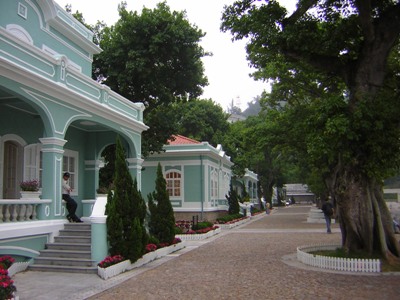
Taipa is the southern island of Macau where the track and field was being held. After the antiquity the mainland had to offer, it felt a bit weak, but the little pockets of western architecture really jump out at you when surrounded by more traditional Chinese buildings. The churches in particular stand out as out-of-place after the distinctly Chinese temples of the rest of the country. Returning to our campsite in the evening, we decided to grab a squid skewer and a beer on the beach before supper.
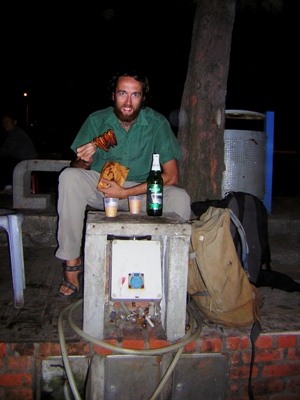
The squid was hot and spicy, and left my mouth tingling even after I'd guzzled the last of my beer. We elected for another night of Portuguese, and had Portuguese rice (mixed with a salted fish) and salted fish steaks, yet again with that tasty wine. I have nothing against Chinese food, in fact its fantastic when well made, but I am clearly a Westerner at heart (and particularly stomach).
After dinner, we spent the evening watching a rat dart along the edge of a rockline and trying to avoid waves, presumably while searching the collecting garbage for food. It made for quality entertainment and put off the unavoidable hardpacked beds which awaited our bruised hipbones.
The following day was the highlight of the track-and-field for my uncle and for all of China, but for different reasons. My uncle was excited about the race-walking competition, and the country was excited about their national hero, 110-meter hurdler Liu Xiang. It seems Mr. Liu is second only to Yao Ming in terms of popularity and recognition as a sports figure. He is the current world and Olympic hurdles champion and, if memory serves, is the first and only Chinese Olympian to win a sprinting event. The stands had considerably less schoolkids and more spectators for his event than on the previous day. His every movement was televised on the big screen and cheered by the crowds. I've seen his races on TV in the mainland previously, and he makes a point to change shirts on the track and give the girls hearts a flutter. Meanwhile, the cameramen, sensing an opportunity for exposure, will zoom in every time he happens to bend over. Quite the spectacle. Needless to say, he had no problem with his race, much to the delight of all present, and spent ages waving to the crowd and chatting with the press.
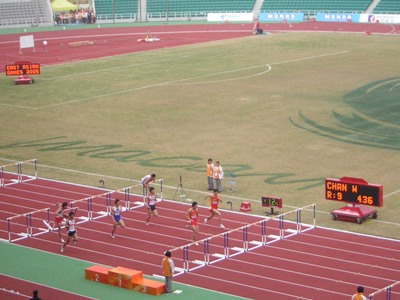
I think he was glad that this was his last race of the season, because he certainly looked to be getting tired of all the fuss. Or maybe he just wasn't used to playing to such an empty house.
After his race, the stands pretty much emptied out and I enjoyed the end of the morning session before joining my uncle and some of his HK race-walking friends (who had been out on the streets watching the race) for lunch. Then it was back to the stands for another round of events in the afternoon. Yet again we were joined by crowds of young students to try and get some bodies in the stands. It seems that track and field wasn't the top priority of most folks on a Tuesday afternoon (or any afternoon for that matter) in the backwaters of Macau. After the race, we decided to hike back to our campsite. Because we were simply sleeping in the middle of city park, there was no security, and each morning we would pack our things into our backpacks and head off to the stadium. Security was trying to look tight so they would always pretend to poke through our stuff before sending us on our way. Interestingly enough, they never asked for our tickets. Anyway, because of this, the hike back was a nice bit of exercise, and we stopped off in the town of Coloane (the nearest community to our campsite) for a couple of beers and another relaxed dinner before hitching a lift the last stretch of the way back to our site. The rat was still making the rounds so we kept our eyes peeled for him while watching the waves roll in and eventually rolling ourselves off to bed.
Wednesday morning was our last, and upon packing up we bid a fond farewell to our campsite and the rat, wherever he may be, before busing off to town to watch the half marathon from the road. It was a hot sunny day to be grinding out 13 miles, and I felt sorry for the folks, but it was a fun race to watch. At the lunch break, I snuck off yet again to go investigate the downtown portion of Macau proper, which I'd only seen briefly on our arrival as we made our way to the southern island. With a bit more time to check it out, I noticed that the dichotomy of so many Chinese cities was present here as well, with the monuments to money and affluence represented by the towering skyline and kitschy casinos overshadowing a huge area of urban slums and poverty. Such is the way of so many cities I suppose, but for some reason it is really evident in the urban planning (or lack thereof) of so many cities here.
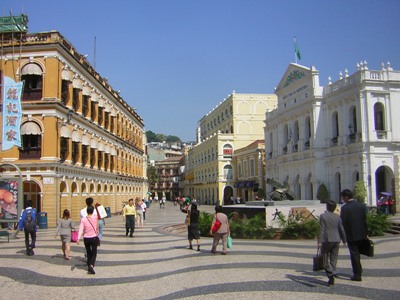
On the plus side, Macau is leveraging its unique history of Portuguese occupation to draw in the Chinese tourists from the mainland who may be unfamiliar with the appearance of traditional Western architecture. A very nice area of older Portuguese buildings is preserved in the center of town and has been turned into a tourist haven. Despite the price-gouging and hefty crowds, the area is very pleasant and the spectacle of all this western architecture in a Chinese town still strikes an odd chord.
We returned to the track in the afternoon and caught the last few events before heading off to the ferry terminal. We grabbed a stellar Italian meal across the road before climbing back into the ferry and making our way over to HK. All in all Macau, definitely made the grade.