Argentina (8)
Bolivia (6)
Brazil (6)
Buenos Aires (5)
Chile (5)
China (4)
Ecuador (1)
Peru (1)
Uruguay (3)
* Collecting Culture
* Siberia ain't so bad
* Dumb and Dumber do China
* Last Call for Espanhol
* A Frosty Reception
* Road wearied in Samba central
* ...And now for something completely different
* Travels through the heartland
* Too much fun and too much sun
* Beach Bumming 101
* Land of 1000 Dances
* River of Dreams
* Leaving Chaos
* It ain´t Lodi, but I´m still stuck
* Attacked by bees, harrassed by monkeys, and left for dead in the Amazonian rainforest
* Welcome to Bedrock
* Bolivian Byways
* Five Fortunate Fools
* Chile? You ain´t seen nothing yet
November 10, 2005
There's a geographical bottleneck in China between the Northeast and the rest of the country. In the center of this bottleneck lies Beijing, and it is nearly impossible to pass from one side to the other without going through, kind of like a black hole. Since I was passing through anyway, I figured I'd stay a day or two to make sure I knew where I was going next. I settled on a route starting just east of Beijing and working it's way south. The first stop was Datong.
Datong is a quaint little town of 3 million people just south of the Great Wall (a much less impressive Great Wall than those in my previous pictures) which boasts a collection of tourist sites within close driving distance. It had been a week since my trip to Wudalian Chi, but my success with the tout gave me undue courage, and upon exiting the train station I followed the first guy who could offer me a room at the price I wanted. Naturally, he wanted me to take a tour as well. Unfortunately, I continue to get involved in these things without really reasearching beforehand. This time it didn't work out well as I ended up paying about 10 times more than I could have gotten away with on local buses. Ah well.
The following morning I went to seek out some breakfast before heading out and was accosted in the alley by my hotel by a fellow who knew a bit of English and worked at the corner restaurant. He offered me breakfast and I accepted. My presence (a western face) seemed pretty novel and everyone repeatedly came up and inquired where I was from. I paid for my tasty bowl of handmade noodles and on the way out bid goodbye to the six cooks who were outside cooking up the various breakfast dishes. They were all good-natured and I realized I would probably be back for breakfast the following day.
The crown jewel of Datong tourism is the Cloud Ridge Caves, a collection of over 30 caves carved out of a cliff-face and intricately decorated with carvings of Buddhist religious images. I'd gone in not knowing what to expect and was really blown away. The two main caves had carved stone buddhas standing over 40 feet tall and on the walls and ceiling of the caves which enclosed them were thousands of tiny, intricate carvings of mini buddhas and figures.
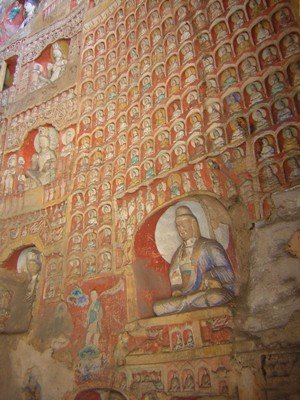
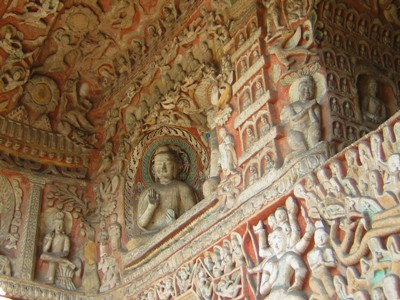
The years of work and dedication to create just one of these caves was mind-boggling, but to create the entire array would have taken an army of Michelangelos. The postcard image of the spot was one of the smaller caves which had crumbled away around it's Buddha and left it exposed for all to see.
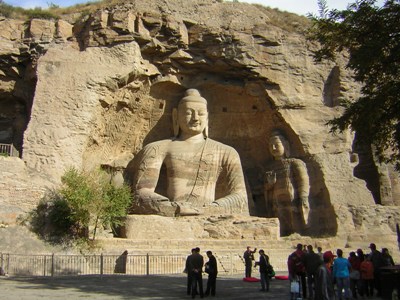
It's hard to get a sense of scale inside the caves, but considering it is a smaller version, you get the feel for the size of the undertaking. Really impressive.
The other sites I visited in Datong were reasonably (and comparitvely) unimpressive. Another dragon wall, another temple, both less well-preserved than other sites I'd seen. Just to add insult to injury, my over priced tour dropped me back at my hotel by lunchtime, much to the joy of my new friends at the restaurant. They spotted me a mile off and started beckoning. They asked again where I was from and unabashedly started to exclaim over and over "We want American money!" I give them credit for cutting right to the point. All the cooks on the street were pointing to whatever dish they were cooking and imploring me to eat, but I passed on to find some diversity and walk the town. Unfortunately, there was nothing impressive to behold and Datong looked like a worn-down place. They were in need of whatever tourist money they could get. Returning in the evening I was greeted by the same welcome, "Give us American money!" I couldn't resist and went in for a bite. My eight-year-old waiter continued with the same line repeating "American money" over and over to me, which was strange since he had a devious twnkle to his eye and giggled every time I said money. I suspect it had a different meaning in Mandarin.
After Datong, I continued down the line to Wutai Shan, a village surrounded on all sides by mountain ridges and populated by dozens of Buddhist temples dotting the surrounding hillside.
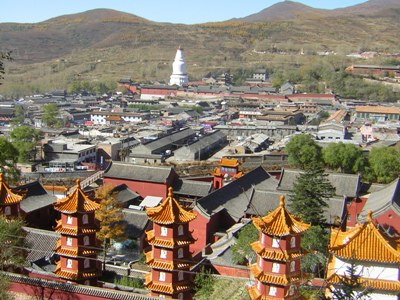
The abundance of temples was most distressing as it had brought an unhealthy explosion of tourist vendors to accompany the unavoidable explosion of tourists who came to visit and worship. I made my way up the main mountain via a course of torturous concrete steps directly up the side. On the way up I passed plenty of beggars, but also a number of monks-in-training who were working their way up step by step, touching heir forehead to each progressive step as they went. Painful. Whilst wandering among the varioius temples, I happened by one where a young fellow beckoned me in to let me know his temple was open to the public. I decided to have a look around and another young guy (not so young, quite close in age to me) approached me and began asking questions in fairly good English. We struck up a conversation and he showed me around the temple.
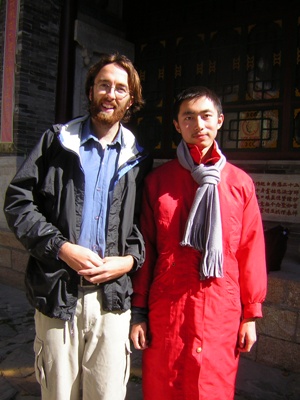
His mother came out and follwed us around with tireless attention. I was concerned I would get the guy in trouble by monoplizing his time, but he was in no hurry and I was learning tons about life in the temple, so we kept at it. Eventually a gong rang and his mother scurried off. I was told it was lunchtime so I made my way to the exit. His mother returned and insited I stay for lunch. At this point I was truly torn. While lunch with the monks of a Buddhist temple is a once-in-a-lifetime chance, at the same time I didn't want to eat a portion of what could be a very slim supply of their daily rations. I begged off and said it would be best if I left, but when they insisted repeatedly and seemed insulted at my consistent refusal, I gave in (quite happily). Lunch was a solemn occaision and I was trying to hide my giddy smile. We made our way into the temple, where the head monk was seated on an elevated platform in the center, with low benches to either side from which the other monks ate. We took up a place on the last row and started to work on some pretty tasty food. About midway through my meal, the monks started to pray (I didn't know what to do, but since my host kept eating, so did I). At the end of the prayer, the head honcho, got up and left, and most of the others filed out after him. I wrapped up my meal and made my way out as well. It was an unbelievable experience to be invited in and see the real deal.
The rest of the afternoon, I spent wandering around the town chatting with my new friend about all sorts of things. Ignorance is one of my more endearing and enduring traits, and it is at its strongest in relation to cultural awareness. I know very little about Buddhism, but found it odd that my host was complaining at various points about his cell phone bill and how he only infrequently gets to play Warcraft at the internet cafe. I think the walls of traditional Buddhism are slowly starting to crumble, though the poor guys working their way up the concrete steps my tend to disagree.
From Wutai Shan, I made my way further south and west to the tourist mecca of Xi'an. People who know anything about China typically know about Xi'an because it boasts the biggest tourist attraction outside of Beijing and the Great Wall. The Army of Terracotta Warriors was one of the few locations I had recommended to me prior to leaving on my trip. I had spoken to dozens of people along the way who had made the journey through Xi'an and had actually heard somewhat mixed reviews about this massive collection of handmade soldiers. Located outside the town, at a still expanding archaeological excavation is this collection of three large buildings, each of which encloses a separate underground vault. In each is a collection of terracotta warriors made to protect emperor Qin, buried nearby, in his afterlife.
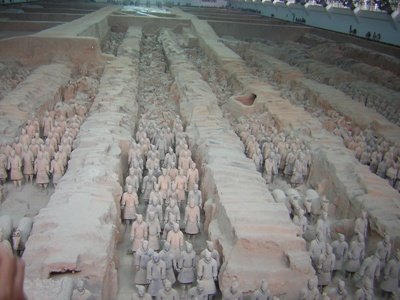
Different ranks of warriors are in different proportion at each of the three sites. The largest (over 6000 warriors so far) is composed mainly of infantrymen, archers, and a few chariots.
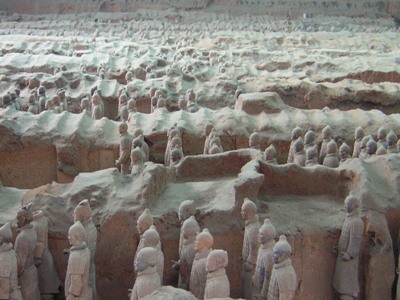
The smallest is mainly upper-ranking officers. The mid-sized site (around 1000) has more archers and chariots and a number of mid-ranking officials. The detail of the warriors (varying expressions, intricate armor and detail on the chariots) is truly impressive considering they were hand-made 2000 years ago and buried, never intended to be seen by the human eye (it is thought the designers were killed and sealed in the vaults as well). The major criticism I'd heard is that the site is a bit like walking through a garage and looking down on the lines of warriors. Having been prepared for this, though, I accepted it for the grandeur of the work and dedication of the artisans, and in this light, The Army deserves its place as a tourist must-see.
From Xi'an, I made my way southeast to Lushan, another mountain village with a slightly more recent and somewhat less distinguished history (in my mind). It was built in the 19th century as an escape from the heat of the lowlands and became a meeting-ground of the communist leaders as they set the course of the revolution. Now, it is a highlight for scores of Chinese tourists to see Chairman Mao's residence on the mountain and soak up the history and scenery. Supposedly, there are fantastic views, but Lushan is reknowned for its cloudy weather and poor visibility most of the year.
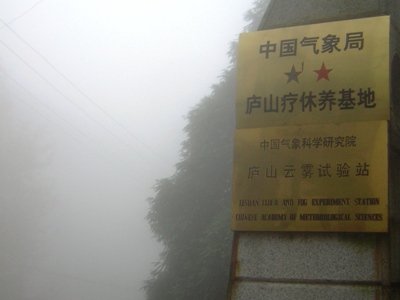
I lucked out on arriving on a fairly clear day and spent an afternoon walking in the hills, which had an alpine feel to them. I found out the following day I had been foolish wasting the clear day on a walk in the woods. The fog had set in so thick that as I descended the stairs in my hotel I thought a fire was burning in the lobby. The mist had snuck in the door and up the stairs, still thick enough to clearly be seen. In the streets, there were maybe ten feet of visibility and in the hillside, descriptive placques detailing breathtaking rock formations and impressive gorges were wasted on me. I got soaked to the bone by the rainstorms that came and went and missed out on all of the promised scenery. A highlight of the park is a three stage waterfall which looks mighty impressive on their tourist pamphlets, but I never caught a glimpse. I did manage to take away one souvenir, though, a nasty cold I developed walking around in the rain.
My whirlwind tour of some of the sights in the eastern portion of the country was done, and I returned to Hong Kong to pow-wow with my uncle for a few days and pick up some visas for the next leg of my journey, whatever that might be.
Yes, the bulk of the beard is gone. The primary reason was fear of death upon seeing my family while in the states, but it was becoming a real hassle to keep vermin out. Also, I knew I'd have troubles blending seamlessly into my surroundings in China with such a beard (Confucious or no). Now I'm able to walk about unnoticed.
I won't even begin to talk about the state of my chin. I'm glad I didn't shave it all off or I'm fairly certain I'd be able to see to the bone.
Posted by: Luvnlife_sa on November 10, 2005 10:16 PMHi Shawn, For a traveler on a budget I'd recommend heading to India. For $10 a day that country is an absolutely crazy place to visit.
Colin; colin.smugmug.com