Argentina (8)
Bolivia (6)
Brazil (6)
Buenos Aires (5)
Chile (5)
Ecuador (1)
Peru (1)
Uruguay (3)
* A Frosty Reception
* Road wearied in Samba central
* ...And now for something completely different
* Travels through the heartland
* Too much fun and too much sun
* Beach Bumming 101
* Land of 1000 Dances
* River of Dreams
* Leaving Chaos
* It ain´t Lodi, but I´m still stuck
* Attacked by bees, harrassed by monkeys, and left for dead in the Amazonian rainforest
* Welcome to Bedrock
* Bolivian Byways
* Five Fortunate Fools
* Chile? You ain´t seen nothing yet
* Train, train, go away
* Living life in the lake district
* Rocking on the ocean
* Kinda chilly in Chile
September 25, 2005
Puno, which lies at well over 3500 meters on the banks of Lake Titicaca, is one heck of a cold place. The days are quite pleasant in the sunshine, but coming from Brazil's endless summer, the sub-zero evenings had an unwelcome bite, even when piled with numerous alpaca blankets. Still it was a pleasant enough place to begin my tour of the heart of the Inca empire, which at one time stretched down the majority of the South American coast from Ecuador into Chile and Argentina. The center was in Cusco, a town further up the road, but the legend of the birth of the Inca tribe focused on an island in the center of Lake Titicaca, and as such, it seemed as good a place as any to get started. My first day in Puno, I elected to visit some nearby ruins at a site called Sillustani.
Sillustani was actually a pre-Inca burial ground which, as with many things pre-Inca, was absorbed by the Incas when they took over. I became much less impressed with the Incas in my wanderings. As far as I could tell, the best thing they did was govern and abuse. Aside from that, they were just fancy masons, woo-hoo. Anyhow, Silllustani is a hill top covered in burial towers spanning hundreds of years worth of rulers.
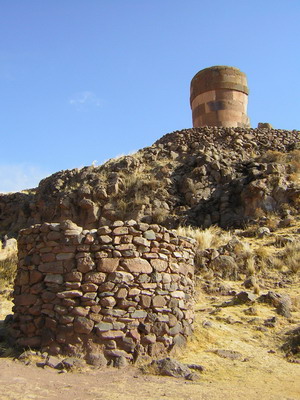
Each tower is tapered down from a dome top, and sort of resembles a child's sippy-cup. Well, at least the few that are still semi-whole look like that. Many have given way to old age and lightning. These massive tombs all surround a tiny little rock igloo of bones huddled in the base, which is interesting because they got pretty tall.
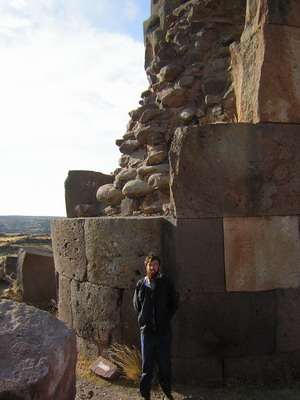
It was sort of a somber intro to Inca culture, but since the Incas ended poorly anyway, I guess it doesn't really matter where one starts.
From Puno, I decided to make one more excursion in the southern portion of the country before heading to Cusco. I spent a day wandering the Colca Canyon at nearby Arequipa. Colca is the second deepest canyon in the world (the deepest is not far away, but a real pain to get to) and makes for an impressive sight. The attraction which draws dozens of tour-buses every morning (and unfortunately was enticing enough to get me out of bed at 4AM) is the opportunity to come face-to-face with massive condors cruising on the air currents as the sun heats up the canyon air.
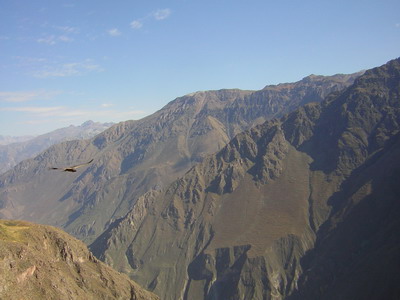
The condors had a wingspan upwards of 9 feet and made an impressive woosh as they cruised a couple of feet overhead. Luckily, by about 9:30 most of the tourists split and the canyon was left quiet and serene. I spent the morning walking along and admiring the terraced texture of the hillsides before piling into a bus for the harrowing return trip to Puno.
Peru, I've come to realize, knows how to take advantage of what they have. I feel confident that should Bolivia manage to hold onto a government for more than two years at a time, they too could build a tourist industry able to harrass and extort gringos from around the world with the fervor of the Peruvians. Unfortunately, the success of Peru has lead to extremely inflated prices for all the major attractions. Cusco is the granddaddy of them all, and the "can't miss tourist train" from Puno to Cusco is a reasonably overpriced but relaxing way to get there (to be fair, the tourist buses are equally overpriced). I took the 18-hour train which gets into the heart of the Andes just in time for sunset and disembarked in the self-proclaimed "Gringo Capital of the World". Walking around Cusco, Peru is extremely disorienting and will leave you feeling you've taken a train to Europe, as white faces and european accents are the norm (at least in the areas of town where white faces are meant to visit). From this little town, the Incas ruled one of the largest empires of all time. The remnants of this can be seen in a few rock walls in some back alleys and a few Starbucks in more prominent locations. Okay, maybe I'm being a little harsh, but there is a definite phony feel to the place.
To get out of town, I elected to take a walking tour of some of the major ruins in the surrounding area. The nearest, Saqsaywaman, was a mountaintop fortress (which is actually believed to be a temple) composed of huge stone walls and a sprawling design which afforded some great views of the city and was impressive in the number and size of the stones which were used to construct it.
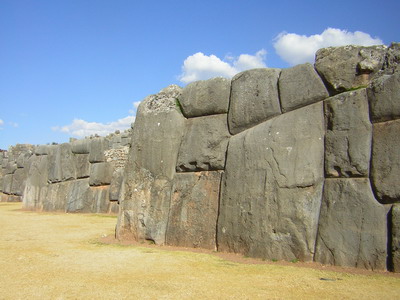
Just down the road, there is Qenqo, another temple, though this one was carved out of a rock wall and contained a system of caves running underneath the complex. Next was the more remote fortress (this one actually was a fortress) of Pucapucara with a panoramic view of the surrounding valley and even more really big rocks.
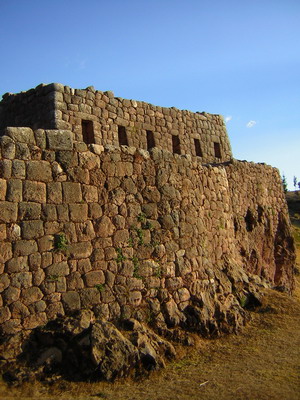
Finally, the sacred fountain of Tambomachay, a temple built around a natural spring which still runs exactly as designed 600 years ago.
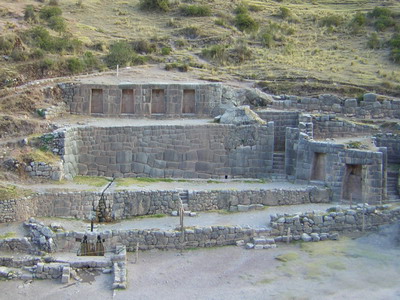
Supposedly, you are supposed to wash in the water or drink it or something, but I abstained. There was almost certainly a lot more to each of these sites, but I didn't feel like springing for a guide. Whoops. At least I got some good exercise, and picked up a set of Inca vs. Spaniard chess pieces to boot. (Unfortunately, the marble chess board I sent home from Brazil didn't survive the trip, but I'll worry about that when the time comes).
Feeling I'd set the stage properly, I set out for the major draw of Peru, Macchu Picchu. The lost city of Machu Pichu sits on a mountaintop, a few hours from Cusco by train, but based on the cost of tickets to get there, you'd think it was in Venezuela. I'd be kicked out of the "Crazy Travelers Club" though if I claimed to have made a circuit of South America and left out Machu Pichu, so I thought happy thoughts and bought a ticket. To save some cost, I left from a town slightly down the line from Cusco, which afforded me the opportunity to visit the final and most impressive ruin of the area, Ollantaytambo a city-like structure built into yet another hillside, with irrigation canals, temples, and a stadium fit for an opera.
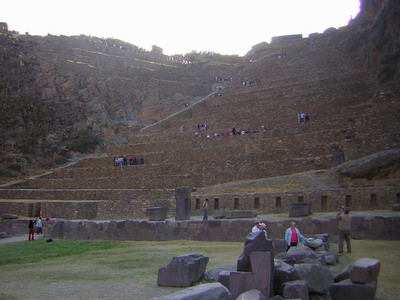
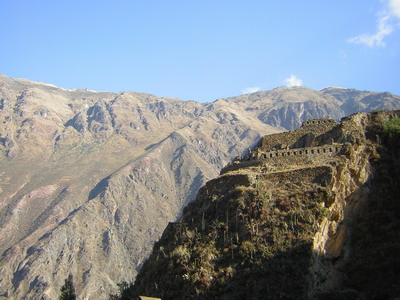
All that behind me, I headed off...well sort of. I neglected to double-check the dates of my travel and the train office had sold me a ticket for the following day. Luckily, they reserved a seat for this sort of thing and I was able to head out, but it meant I had one extra day in Machu Pichu. Not to confuse anyone, but Machu Pichu technically refers to two different places, one is the Inca city and the other is the Peruvian town thriving on the opportunity to exploit the Inca city (this one used to be known as Agua Calientes until they realized the fiscal potential of the alternative). So, one more disappointing train ride later (the train ran from 8PM to 11PM), I followed a woman through the streets of Machu Pichu to an uncomfortable bed in an uncomfortable hotel. Relatively cheap, though.
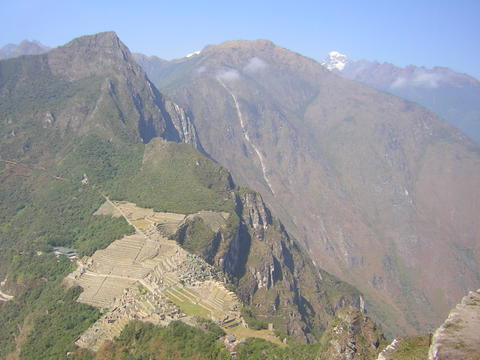
The following day I decided not to go to the Inca city as I knew it cost a lot and I didn't want to ruin my second day with an excursion that couldn't match up. Instead I hiked along an old Inca trail near the town up a mountain with a great view of the area (including a distant glimpse of Machu Pichu itself). I really enjoyed the hike, as there were very few people out, and the trail itself was taken directly from an Indiana Jones flick. There was no flat, only up or down and the majority of the elevation change was covered on rickety wooden ladders constructed of the branches of surrounding trees lashed together.
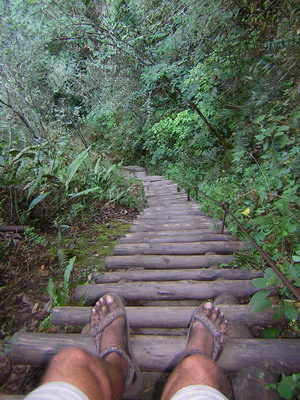
Many of these were so long you couldn't see the top from the bottom. I never wanted my leather hat more. It did leave me a bit tuckered out, though.
Finally the time had arrived to see what all the fuss was about. I got up at 5AM to start tackling the long climb up to Machu Pichu. Sometimes I really hate having a guidebook because it makes suggestions like "There's nothing better than watching the sunrise over Machu Pichu". There is something better...sleep. Okay, that's not true but waking up at 5AM and sweating your butt off climbing a hill just so you can sit on that same butt and freeze it off while you wait with throngs of buzzing tourists just to see the sun crest on some big rocks set up by a bunch of short guys who sweat their butts off climbing the same hill (only with big rocks) isn't necessarily the best way to spend a vacation. Then again, if I wasn't so cheap I would have taken a bus to the top.
Despite my bickering, Machu Pichu itself is a fantastic sight and the sunlight piercing down through the mist on a late winter morning does make for an impressive moment.
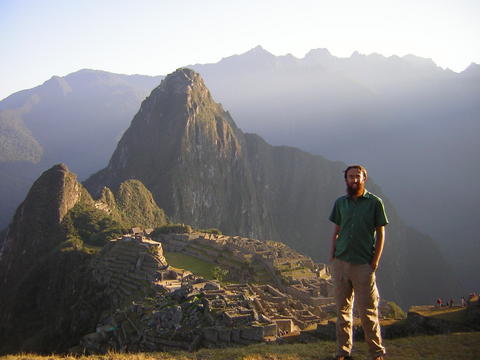
While there was no solitude to be had, the number of folks there on this particular morning paled in comparison to the number who would be arriving by the bus-full a few hours later. The early start allowed us to see the city before it was completely jammed by the "I'm with stupid" crowd. Wandering through the more or less complete city was a real treat and you got the sense that with a thatched roof or two, the place could be back in business.
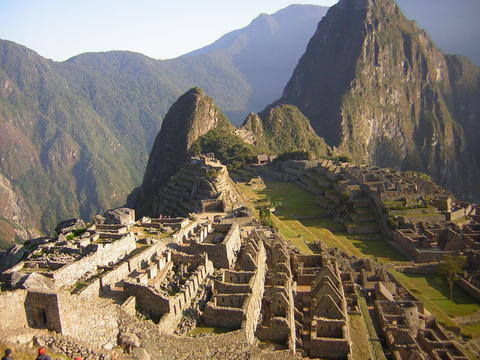
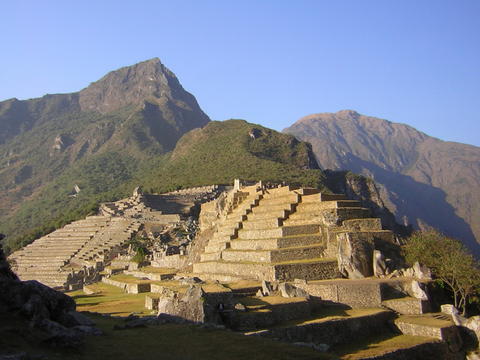
Again, I avoided the expense of a guide and took pictures of stuff that intrigued me. I'll have to read about it somewhere to understand all the implications. I hiked around the site and got some aerial views from hilltops which flanked the city (each was scattered with ruins as well) before heading back down for my overpriced return train.
Now that I'd fulfilled my Inca fantasies, I headed to the north of Peru to see some of the pre-Inca ruins around the city of Trujillo. While the accomplishments of the Incas in constructing mountain-top cities out of stone are impressive, the precursors of the Incas who made their living in the deserts of the north had some pretty awesome constructions of their own. The first of these is Chan Chan, the world's largest adobe city. This walled wonder had intricate friezes, burial chambers, and even a swimming pool all enclosed by 12-foot adobe walls.
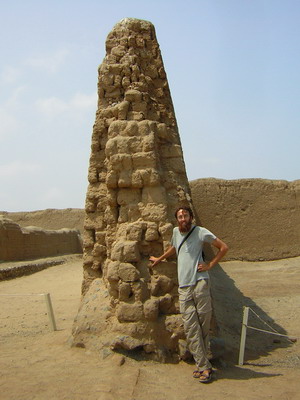
All made entirely by hand since there was only dirt as a building material. That it has withstood the blasting of the desert for 700 years with some semblance of the designs found within still intact is an impressive testament.
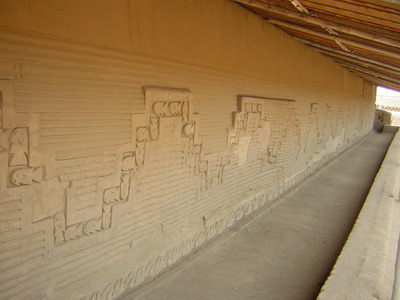
I challenge you to find me a better adobe city in the Peruvian rainforest.
While Chan Chan was impressive, I was really blown away by the Moche Pyramids, just a few miles south of Trujillo. These two pyramid structures were built by the Moches for ritual purposes and are still in the process of being dug out of the desert. The larger structure, temple of the sun, is thought to have been the largest manmade structure in the Western Hemisphere pre-Columbus.
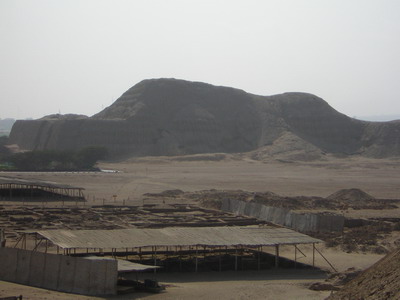
The smaller of the two, the temple of the moon, is open to tourists and you can walk through to see what is being unearthed. The quality of the structure after all these years (1000 +) is fantastic, with the colors of the art still clearly visible on both the exterior and interior walls.
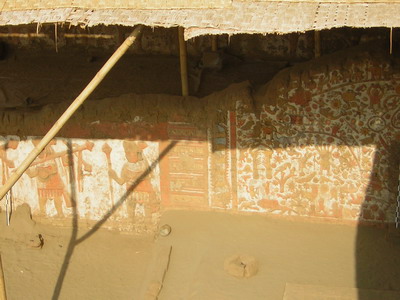
No reconstruction has taken place, so it rightlly seems very authentic. The structure is seven levels (each representing a different era) and each succeeding level is built upon and completely encloses the preceding level, thus they are all well preserved.
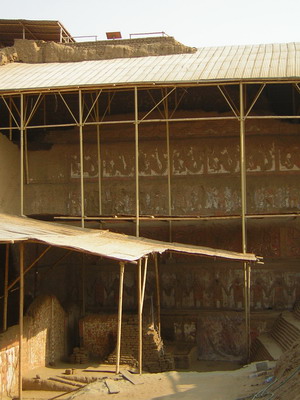
I would be amazed if this site does not rival Cusco once both pyramids have been unearthed (still many years away).
Wrapping up in Trujillo, I decided to call it quits in Peru in the interest of time. There were still a couple of sites in Ecuador I wanted to see, and and my flight home was getting closer, so I hopped a bus north.