* Land of 1000 Dances
* River of Dreams
* Leaving Chaos
* It ain´t Lodi, but I´m still stuck
* Attacked by bees, harrassed by monkeys, and left for dead in the Amazonian rainforest
* Welcome to Bedrock
* Bolivian Byways
* Five Fortunate Fools
* Chile? You ain´t seen nothing yet
* Train, train, go away
* Living life in the lake district
* Rocking on the ocean
* Kinda chilly in Chile
* Bottom of the world, Ma!!
* Glaciers and Mountains and Lakes, Oh My!
* Crime and Punishment (well, crime at least)
* Wet Pants in a Wetland
* Which hemisphere is this??
* High times in the deep south
March 25, 2005
My trip to the Ibera Wetlands was terrific, but as with most of my trips, it wasn´t without it´s difficulties. The most trying of which was the bus to Carlos Pellegrini (the town from which I explored the wetlands). It was a minibus with terrible shocks, that took us down a horrid, bumpy road in the hottest part of the day. Luckily, we only broke down once, and since I was genuinely tired (having gotten about eight hours of sleep total over the past couple nights in buses) I was able to sleep very fitfully through most of the trip.
The town itself was extremely tranquil, with sandy streets and very few inhabitants. It would be a perfect beach town to hang out in for a couple of days and split time between sunning and swimming. At least if the lake there weren´t swarming with alligators, nine-foot anacondas, and piranhas. Other than that, though, perfect. I spent a good deal of time lounging in a hammock, reading Robinson Crusoe.
I was thrilled to find a guide to the flora and fauna in the wetlands at the local ranger station. Armed with it, I took a walk through some of the wetland around the town (the entire Ibera wetland covers many thousands of acres) and was able, using my encyclopedic knowledge of biological identification, to ID such things as "Pretty purple flower on vine"
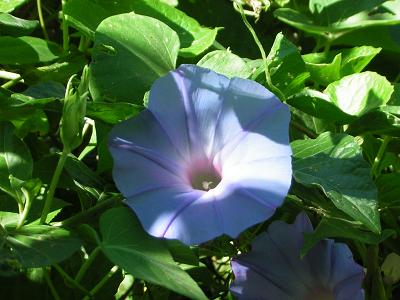
and the famous Argentina "Red-faced bird on post".
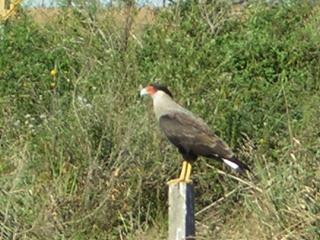
In case you´re wondering, it takes months, or even years of practice to gain this level of skill in identification.
Somewhat unimpressed with my walking about, I decided to take a guided tour to see a bit more of the wildlife. It was a very interesting boat trip through the park just before sunset. We managed to track down a number of alligators, some of which I volunteered to pose with, being a fearless adventurer.
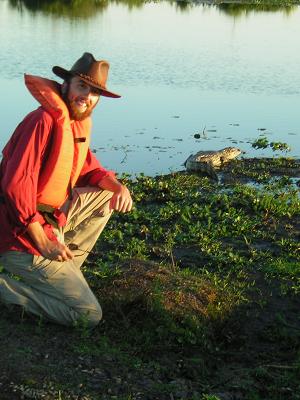
Don´t mind the life jacket. Most fearless adventurers, such as myself, wear those simply to keep themselves afloat in dangerous waters so they are able to fight piranhas even after their lower appendages have been eaten.
Speaking of floating, the ground I´m on in the above photo is actually just a clump of vegetation that has grown together, and is floating in the lake. There are a number of these cruising randomly about and many are large enough to support trees and shrubs as well. They feel sort of like a trampoline to walk on and jiggle a good deal when you jump up and down on them.
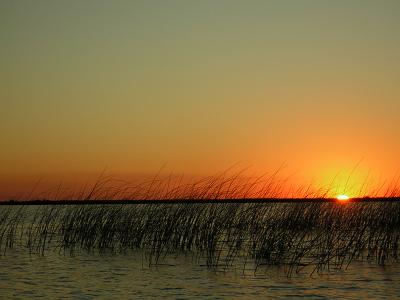
The tour was great fun, and naturally, at the end I managed to snap a couple nice shots of the sun setting over the lagoon.
The following day, based on my courage during the boat trip, I endeavoured to try something a bit more dangerous. I´d always been fascinated by piranhas, and as a student of nature, I felt it was my duty to take a closer look. As a result, I got outfitted for an excursion to go piranha hunting. Many people might have seen me on the street and mistakenly presumed I was going "fishing", as I was carrying a four foot piece of bamboow with a length of monofilament attached, but part of the art of piranha hunting, as I had learned, was to look like a simple fisherman. This way the piranha thinks it has the upper hand and doesn´t become suspicious by the presence of kevlar and machine guns which a man possessed by fear might feel necessary to take along. The key component in my excursion, of course, was my sandwich bag full of bloody beef. Irresistible to the piranha.
I found a patch of ground thoroughly overrun by mosquitoes, devoid of shade, and in an area not touched by wind. This seemed like the type of spot no one would ever want to frequent for any purpose, much less recreation, and therefore would be a good haunt for my prey. I set up here and began chumming the waters. For those of you unfamiliar with the terminology of piranha hunting, "chumming the waters" is a very detailed process. First, you put pieces of bloody beef on a hook at the end of your fishing line and toss these into the water in an action reminiscent of a fisherman casting a line. Next, you wait about twenty minutes in a very tense pose, watching for any movement in the line. Naturally, since you are merely "chumming the waters", and have not begun actually hunting, this is merely putting on a show for the piranhas, convincing them you are simply a fisherman. After 20 minutes, you pull in the line and look on in mock disgust at your now empty hook, pretending to wonder how your bloody beef was removed without your notice. This process needs to be repeated somewhere between three and ten times before the waters have been, as we piranha hunters call it, chummed. Only now does the true hunting begin.
It´s important to find the perfect hunk of beef for the hunting process, one so overrun by grizzle that neither man nor fish could remove it from the hook. Luckily, I had set aside just such a piece for my hunting, and at this point I knew it was time to begin the actual hunting process, having used the rest of my beef to adequately chum the waters.
I tossed my grizzle bait into the perfect spot at the base of patch of weeds in the water. After a couple of minutes, I noticed the line start to shake a bit and gave a bit of a tug back. I was, of course, aware that such a light tug would be insufficient to set the hook in piranha´s mouth, but wanted to tease him into thinking I was just this foolish. Luckily it worked, and my bait came flying out of the water at me more or less intact, except for a small bite taken out of one side. Having lured my prey out of hiding, I now had the upper hand and carefully placed the bait back in the same location by thoroughly thrashing the water with my entire pole. This was to scare away any "normal" fish that might have been in the area and mistaken me for a fisherman as well. After a bit of waiting (patience is the name of the game in piranha hunting), my prey came back with renewed vigor and took a good hold of the bait yanking hard on the line. To entice the piranha to do this I had been acting distracted, with with one hand gingerly holding the pole while the other swatted at mosquitoes. Once the fish fell for my ruse, I uttered a triumphant cheer (something along the lines of "Holy sh!t") and regained a grip of my rapidly retreating pole to give it a healthy tug and set the hook. I shy away from describing the battle that ensued as Herculean, but I think Hemingway would have been proud. I was able to haul the prey out of the water.
Most good fish stories end without proof of the battle. Not so, here, as I managed to take a self portrait. You can clearly see the look of exhaustion on both our faces, but I think you´ll agree the piranha looks a bit worse for the battle.

A successful piranha hunter, such as myself, would be foolish to think that the battle was over, simply because the prey is caught. This was not a lesson I was taught the easy way, unfortuntely. I had been using a hook of approximately the same thickness as an extension cord (for fear the piranha might bite through it to save itself), and with my prey in hand I relaized it was time to extricate said hook. No matter how I posed this proposition to my piranha, he always responded the same, with a look of anger and a rather violent thrashing of teeth. My disguise as a fisherman was so well thought out, that I was now without kevlar or a gun of some sort to save me from loosing my favorite half of my favorite finger. I assumed that if I left the piranha out of the water long enough, it would die and I could remove the hook with only a high probability of some sort of cut, not the certainty thereof. Unfortunately, as this stroke of genius came to me, I was shaken from my euphoria by a stroke of a different sort. The rather noisy stroke of a fast approaching alligator, no doubt eager to take advantage of a slightly dry piranha.
The absolute calm necessary of the piranha hunter allowed me to absorb this new development without loosing my cool. I recited the piranha hunter´s mantra (difficult to translate into English, but something along the lines of ¨Dammit, an alligator, let go of that hook you stupid fish!!! My finger, dammit!!! Oh God, just let me survive and I´ll never hurt another creature!! Why is it´s mouth open!!! Holy crap, it´s bigger than my car! /%@#€¬$!·!%&"). The mantra is meant to maintain the calm inherent in our beings. After my recital, I saw much more clearly my situation. Luckily for me, so did the piranha. I´d forgotten they don´t see well out of the water, but as the alligator was fairly close now and comprable in size to a Buick, it had apparently managed to spot it and seemed willing to help me rid it of the hook. Working quickly but cautiously, we eased the hook out its mouth (I may have helped a bit by pinning him between two rocks, screaming, crying, and yanking on the line), and as a reward for its bravery and assistance I ceremoniously threw it directly at the alligator as I began the necessary ritual of completing the hunt. This, of course, entails grabbing everything you have with you (except any valuables, which are best left there to remind you later to return and witness the location of your bravery) and deftly half-hurdling any barriers between you and a speedy escape. The half hurdle is a little used tactic that involves getting halfway over a barrier before hooking it with your trailing leg. This sets you on the other side much more rapidly, and allows you to rest on the ground momentarily before continuing your journey home. It is important, though, to be careful for sharp objects such as fish hooks coverd in bloody beef grizzle.
In closing, I highly recommend the Ibera wetlands for anyone interested in getting to know the flora and fauna of Northern Argentina, and as a great place to practice the above mentioned piranha hunting. Just be sure to bring a change of pants. It´s dirty work.