
December 10, 2005
After my first near miss, I made sure to get off my bus in the right location this time around. From Qiaotou, I was headed into the Tiger Leaping Gorge, a fantastic, deep gorge in the north of Yunan province, very close to Tibet. In the village, I purchased an entry ticket to the nature reserve within which the gorge lies. From here, I started searching out the entry to the "high trail" through the gorge as the low trail essentially follows a newly constructed road which shepherds through tour groups who don't have the time or desire to complete the two day hike. I had spoken with an Australian woman in Lijiang who had completed the hike, and she said the first hour or two were uphill, then the hike was not strenuous as it progressed through the gorge. Unfortunately, I didn't ask her about the entrance. After one false start down a creekbed, I found a paved stone path leading straight up the hill. Knowing the Chinese idea of wilderness adventure, I assumed I'd found the trail and started up at a quick clip.
After a hefty walk, I came into an opening where a small village in the hills had cleared some land for their agricultural terraces and offered some great views of the Five Fingers Mountain (a 5500 meter, five-peaked behemoth which serves as the backdrop of the entire gorge hike) looming behind thier community. After a quick break to slug some water, I continued through the village, where some painted arrows eventually led me to a house with the following painted on the door, "Knock on my door and you can have lunch with me. Afterwards I will show you the correct trail." Two things went through my head on seeing this. First, that some sneaky local had figured out a way to weasel a lunch out of hikers by leading them astray with false arrows. Second, that the "correct" trail must be the largest one leading out of the village. No other possibilities really occurred to me at the time, but I sure wasn't going to reward this fellow for leading me on a goose chase, and started off through the village on my own. As luck would have it, there was no one anywhere in the village, and arriving on the far side, I picked what seemed a heavily traveled trail continuing up the mountain. After another half-hour or so of hard walking, I collapsed by the trail to assess my situation. I'd been walking uphill for a couple of hours and was exhausted, but didn't seem to be getting very close to any sort of gorge. My good sense had inspired me to leave my guide book in Lijiang to save weight, and I had no map of the trail whatsoever, so I was left with only one course of action. On I pushed.
After another half hour or so, I came out at a second village in the hills, just as fantastically located as the first. For some reason, this town really depressed me because I'd been walking so hard, for so long and here was this whole community with the trail as their only connection to the world below. Color me naieve. Sauntering through town I got some really amazed looks, which was a bit off-putting considering 20-30,000 hikers come through here every year. I expected to see a few people selling water or something, but all I got was blank stares and whispers. As I headed out of town after a local woman, some guys called after me and implied I was going the wrong direction. When one fellow asked me for my map, I told him I didn't have one (perhaps a bit more smugly than I should). He indicated approximately where I should be going and offered to show me the way, but I could tell that he was quite busy digging in what looked like a water line, and didn't want to take him away from it. Also, I didn't much feel like having a guide the rest of the way. Addmittedly, the trail to this point had been reasonably poorly marked, but most of the way it seemed fairly obvious which way to go. I set out in the correct direction with a hearty thanks to my guides.
The trail out of town had been used pretty heavily by livestock recently, which seemed reasonable if folks have been riding horses through the gorge. A bit down the trail, though, I discovered that in fact the usage was from loggers dragging trees using oxen. Again, it seemed strange to have folks doing this on such a heavily used trail, but who was I to argue. Shortly after leaving town my trail ended in much larger trail which I took to be the appropriate Tiger Leaping Gorge Trail, and was very relieved to have a nice view across the way. My relief was tempered, though, by the realization that I was still a hell of a long way away from the gorge. The hike was meant to be about 20 kilometers, and I guessed I had walked well over 10 already. Hmmm.
Following this new trail around for a while, it started getting smaller and smaller. Trees and weeds were growing into the trail, the way was significantly less clear. Eventually, it degenerated into what appeared to be little more than animal trails, entirely covered by fallen leaves and pine needles. When my trail started going straight downhill, I knew that I was in trouble yet again. Based on my one good look at the countryside, though, I knew I needed to continue going around at approximately the same elevation to get into the gorge. I did what you should never do and left the trail. Eventually I popped out in an opening which had been fairly recently logged and could see a powerline far below me, leading up hill. I decided my best bet was to drop down and follow the powerline. Eventually, it should lead to one of the many guesthouses which are supposedly all along the trail (I had yet to see one). On my way down, though, I was saved yet again by a clear, well-worn trail leading in the right direction. I set off at a quick clip since it looked like at most two more hours of sunlight.
This trail went fairly clear for a while before splitting up in a number of directions. I followed one which seemed most likely (and well traveled) and stopped in what looked like a newly built cave house. I looked sort of like a fort I would have built as a child. Here I was confronted face-to-face with the realization which had been knawing at my mind for hours. I was well and truly lost. Seeing a newly built cave house did not just cause this to dawn on me, however, it was the gun-wielding owner who came stomping out to inspect this crazy-looking foreigner who just happened to walk into his home. In my limited experience, I've found gun-wielding locals to be a sign of bad things to come. Not surprisingly, this fellow didn't speak English, but I guess he knew basically what I needed. I doubted I was the first hiker to get lost in this direction, especially since the trail was frequently fracturing into four or five directions and for my money all but impossible to follow. He took me out to yet another seemingly well-traveled trail (I was relieved to have wandered off only a short distance) then he started to pantomime that I was meant to go over the ridge and drop down below. This wasn't good news to me as I was fully exhausted. After walking for about five hours, most of those uphill, I'd drunk most of my water and had not eaten much at all. Still, if he said it was the way, I had no reason to doubt and started off.
About ten minutes later, this trail too had degraded to nothing and the old guy started to whoop and wail like crazy far behind me. I was genuinely worried I had been roped into some strange "Hunt the white-devil" game and began looking around with a wild eye. Instead it seemed he was just calling in his goats. They were the cause of all the trails through the woods which were impossible to follow. After twenty minutes tracking dead-ends, I took stock. I had at most one hour of sunlight, some matches, a pocketknife and some clothes. I was not looking forward to a night in the woods, and was thinking of crashing with the crazy goat herder in his horridly porous accomodations. In a feat of possible stupidity, I tried one last trail, and it started to go straight up. Using the adrenaline produced by the thought of a night with Jiang the Man Hunter, I managed to scramble up the mountain. At the top, just as the guy had implied, the trail went straight down. I started half-jogging down, knowing that I was far from out of the woods, quite literally. After a bit, the trail started to peter out. I saw a rockslide and climbed out on it to get a look. Down below me a ways, I saw what was, in my eyes, a superhighway. The type of trail which truly could handle the number of people who supposedly did the reckless trip in which I was currently embroiled. There was no doubt I was staring at the actual trail...now I just had to get there. Climbing down the rather unsteady rockpile, I picked my way down and joyously was delivered onto the trail which was strewn with arrows and advertisements on the rocks for all of the guesthouses. After a harrowing six hours of backcountry hiking, I had managed to get back to the actual trail.
I shot down the trail as the sun was setting and throwing a gorgeous red hue on Five Fingers Mountain, and found a guesthouse just as dusk was ending. In the guesthouse were two other hikers, one of whom was an Israeli who I had met on my first train trip from Hong Kong to Beijing, over two months earlier! Its a small world. After comparing stories, it turns out the paved trail I had started out on was not the right trail after all. I hadn't taken a single step on the Tiger Leaping Gorge Trail the entire day, until I dropped down from the ridge. They were jealous of my adventure, but I gave an involuntary shudder at how close I'd been to disaster.
The following morning we finished the hike together (the guesthouse was only about three hours down the actual trail) in a few hours and I hopped a ride back to Lijiang. It had been an eventful couple of days since I'd left, and I was glad to be heading north to Chengdu the following day to start my long slog westward. The coldness awaits.
December 08, 2005
I arrived in Lijiang reasonably late at night and set about trying to track down a place to sleep. Nestled close to Tibet, Lijiang was a reasonably inaccessible, relaxed town until a new highway connected it to the world a few years ago. Now, it is yet another bustling city like any other, except that it has managed to retain an authentic "old town" center. This is where I was headed to find a hostel. Walking around, I soon realized that the authentic center was just another grab at the extensive travel bucks of native Chinese tourists. Even at 9 PM, there were tour groups wandering around, following the flag of their leader and snapping the most innane and pointless photos. The architecture of the center was, admittedly, old in appearance, and created a very pleasant atmosphere to wander around in, but the souvenir shops, bars, and hotels which inhabited all the old buildings teamed with the teeming masses tempered the coziness of the town.
Dragging myself out of bed the next morning, I did get a chance to see the sunrise lighting up Lijiang's most attractive feature. The 5500 meter Yulong mountain which towers in the distance. Before anyone gets the impression I was becoming a hardcore traveller, let me mention that because all of China is in one time zone, the sun rises pretty late in the morning.
On my rest day in Lijiang, I decided to hike through the city park which has a good size hill settled in the middle, from which you can grab a great view of both Yulong mountain, and the surrounding countryside. I walked that way, and found a nice cement path with toured around a scenic little pond at the foot of the hill. Leading up from this path were an endless array of tiny footpaths through the woods. I picked one at random and started up. Naturally, my path ended a few yards up the hill at a big pile of garbage. From there on, I bushwhacked, climbed, crawled, and scraped my way up the hill to an old abandoned pagoda sitting on the top which afforded some great views. I ran into a pair of American girls up there who told me if I had actually gone in through the entrance, I would have paid 60 yuan ($7.50) but would have had a paved path to follow. Armed with that information, I picked my way back down the hill the way I came. It was more interesting that way.
On the following day, I made my way towards the "can't miss adventure of Yunnan Province" according to the Lonely Planet guide, the Tiger Leaping Gorge hike. This is a 20 kilometer hike through a deep river gorge at the base of a magnificent ridgeline. It is supposedly tackled by 20-30,000 people every year, and I was looking forward to it. I hopped a bus from Lijiang to the starting point, a town called Qiaotou, but managed to miss my stop. I was fretting over whether to hop out and catch the next bus back or just see where my current bus was headed. In the end, I opted for the latter and three hours later was let off in a town deemed by the Chinese government as "Shangri-la". Most people might think Shangri-la would be a mountain town in Tibet, but according to the scholarly deciphering of the name done by Chinese nationals, that is not the case.
Shangri-la, or Zhongdian as it is properly called, didn't strike me as any sort of paradise, but I decided to give it a chance, and it did grow on me. It also had an old town, but unlike Lijiang's, it was not yet overrun by tourists and the style of all the buildings was Tibetan as opposed to Chinese. The town is very close to Tibet (as close as I'll be getting) and the food, temples, buildings, and people all are Tibetan in origin. After buzzing through the old town, I happened up a little hill in the middle of town and came to a charming Tibetan Buddhist temple. The temple itself was pleasant, but the real surprise was around the corner where a massive golden tower had been constructed. It had to be eight to ten stories tall, and I was trying to get a good picture when a local man beckoned me over to the base. He pointed me to the handrail and mimicked that I should help him push. Not being one to disappoint, I set to it and realized that this wasn't a tower, but was a truly massive prayer wheel. It was all the two of us could do to get it started spinning, but once it got going, I made a couple turns with the old guy, murmured some prayers for myself not to get frostbite on any of my favorite body parts, and set off to another part of town. When I left, the old guy was trying to keep the momentum and deep in concentration on his own frostbite preventions.
On the backside of town was a much more substantial hill which I decided I could tackle before I lost the sunlight. Unfortunately, Zhongdian is located at a hefty 3200 meters elevation and the wind is very cold. I didn't feel like being outside without any sunshine to take the sting out of it. I hustled up an old animal trail and came to a pagoda located right in the pass between the two hills. It was strewn with prayer flags and had a terrific view of the town. I ssurried up the smaller hill to the top and found a couple more prayer sites, also draped in dozens of flags and pounded by hefty winds. That was enough adventure for me, and I hustled down to warm up with a cup of tea and some yak meat in one of the local establishments.
On the following morning, I scrapped myself out of bed, piled on all the clothes I could find, and boarded a bus back to Qiaotou. Hopefully, this time I would make it.
December 01, 2005
I arrived in Kunming, the capital of Yunnan Province, after a 12 hour train ride from Nanning. Kunming is situated at about 1800 meters, just north of a massive lake and only a few hours away from the Vietnamese border. Most western travelers who make it there are either going to or from southeast Asia. In that, I was an exception. I had planned to come in, visit the "Stone Forest" a couple hours away, and begin the long slow trek northwards. Arriving at my hostel, though, I was pleasantly surprised to find a very inviting and relaxing place, right in the heart of the city. On my first day in town, I walked around a bit and discovered that in fact, there is almost nothing to entice tourists. Instead, I spent my time swapping travel tales in the hostel over cheap beer and free pool.
Feeling a bit guilty for my laziness, I did make it to Shilin (the "Stone Forest") the following day. Guidebooks warn of the tendency for buses out there to stop frequently at tourist traps on the way. Unfortunately, there was very little way for me to do anything about this, and sure enough, my little minibus stopped at a jade factory, a Buddhist temple, and a restaurant all in the span of what should have been an hour and a half trip. Three hours later, hello Shilin.
Shilin is one of a number of extremely large fields of limestone which have been weatered away to produce areas of spires, caves and ponds. From afar, they look like nature's own stonehenge, taken to the extreme. Up close, they are a fascinating wander through hidden nooks and crannies, and up limestone peaks. As with so many attractions in China, Shilin has been thoroughly built up, effectively destroying the feeling of natural serenity that should have been present. Anyone unfortunate enough to wander into the main tourist pathways would find themselves surrounded by hordes of chinese tour groups snapping photos and herding along like an unstoppable river of humanity. Luckily, the area is large enough to provide plenty of trails which the tour groups don't hit, and following these, I was able to while away the afternoon climbing the ridges and sinking into the valleys of the area. It was a pleasant, if not great, experience, and it had potential to be much better with either less tourist traffic or a lower entrance fee.
The following morning, I managed to scrape myself out of bed (cheap plum wine and enough Spanish tourists to give me a chance to practice make for a bad combination) in time to catch the last bus north to the Himalayan town Lijiang. It was a great trip, nine hours through rice paddies, eventually leading into the first of many massive ridgelines. As night fell, the popping of my ears and the chill in the air signaled my return to high elevations. Good times await.
November 25, 2005
After spending a month as a vegetable in Hong Kong, I was a bit worried that my travel instincts might be a bit dull. Unfortunately, I was right. Heading out of HK, I was catching a ferry into the mainland, supposedly to a city named Zhaoqing. When the ferry arrived, I bustled out of the terminal to try and find the bus station and continue further to the town of Wuzhou. Unfortunately, somewhere along the line I'd missed the announcement that the ferry was stopping further downriver and a free bus would be provided to take people on to Zhaoqing. Oops. Gaoming (the town I was wandering around aimlessly) proved to be pretty sterile and uninteresting, so I hopped the next bus out to Zhaoqing. I arrived too late to push on to Wuzhou, but I was lucky to meet a local girl who was attending university in Zhaoqing. We chatted about the area and she offered to check on the status of buses the following day to Yangshou (my ultimate destination). Our conversation drifted to the topic of travel and she admitted that she'd never left her province, but wanted to head to Hong Kong soon to see the new Disneyland. Her ultimate goal was to make it to Canada some day but first to stop in America...to go to Disneyland. Well, at least she was of a single mindset.
Thanks to her help, I found out that there was a bus first thing in the morning direct to Yangshou. My next goal was to find a place to sleep. Zhaoqing has a nice park in the city which is a mountainous island in the middle of a lake. In the center of this park is a cheap hostel for grungy backpacker types. I started to make my way across the land bridge to the island but was stopped by the entrance to the park, or more specifically the 50 yuan entrance fee. The guard pointed out that to get to the hostel was a much longer way around. By this stage it was dark and I was frustrated so I sprung for a cab. Arriving at the hostel, I was turned away (full) and spent the next three hours or so wandering around looking for cheap accomodation. At about 10:00 I relented and shelled out far too much money for a room and collapsed in bed, frustrated by a pretty bad first day back on the road.
I awoke the following morning an hour late after turning off my alarm. Because I'd spent so much on the hotel room, I needed to get money before hopping the bus and naturally, couldn't find an ATM until about 5 minutes after the bus for Yangshou left. Have I really been doing this for nine months? Instead, I fell back on my original plan and hopped a bus to Wuzhou, and from there directly north to Yangshou. The countryside here in the south of the country is fantastic. Tremendous fields of rice paddies spread out around the tiny towns scattered throughout the area. As the bus approached Yangshou, the view began to be punctuated by karst peaks poking up from the fields in the distance.
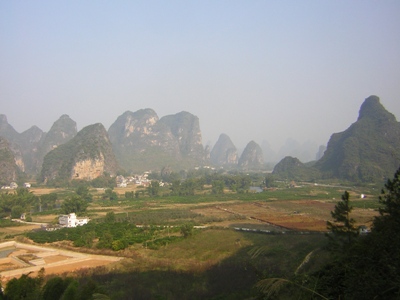
Most likely due to pollution, these distant peaks were shrouded in a haze and appeared all the more mystical. This feature of the landscape is the source of the tourism industry around Yangshou, and rightly so. It gives the feeling that you are travelling through a chinese painting. The town itself is wound around four of these peaks rising up from the backdoors of hotels and restaurants on the outskirts of town.
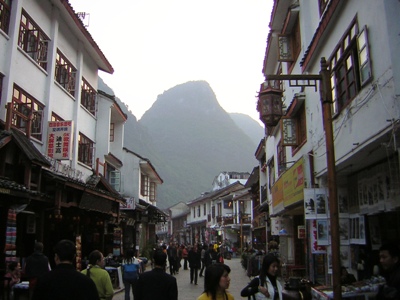
I managed to get an overpriced room in a hotel far away from the center and set out the next day to see the area. One of the main attractions south of town is an eroded peak known as moon hill, which has a great view from the top. It is a 7 kilometer walk south through the rice paddies and hills of the area. Aside from the streams of trucks, tractors, motorcycles and buses zooming by, belching out noxious fumes, and honking thier impossibly loud horns, it was a great walk. As I arrived at the base of the hill, a woman approached me trying to sell me water. I foolishly told her I would buy some later (not true) and she followed me up the hill. My training in the hills of Hong Kong came in handy and I was able to leave her behind. Okay, she was an old lady carrying a cooler full of beverages, but it was still a victory in my book. She still found me at the top and continued her sales pitch. After a brief break beneath the stalactite laden "moon" formation in the hill, I started up to the actual peak where I soaked up a great view of the countryside, ate some lunch and traded travel tales with some German girls out enjoying the day as well.
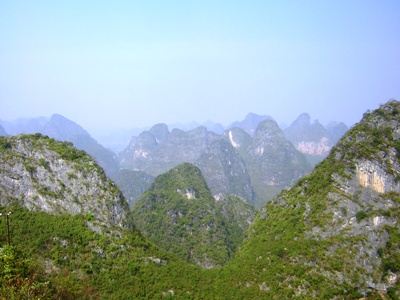
On leaving the peak, I was determined to drop my water lady (she was waiting below to follow me down) and took a very small trail off to the side, which I hoped led somewhere productive. Following this trail, I realized it had not been used for quite a while. This was evidenced by the proliferation of bamboo, weeds, and rose bushes currently choking the trail. Wild rose is among the worst things to find blocking your trail (up there with angered grizzly bears, bengal tigers, and rabid water sellers), but I wasn't going to be dissuaded and made my way forward with a minimum of swearing. In one of my true feats of foresight, I was wearing shorts and a T-shirt, but thankfully had on shoes as opposed to sandals. It was very slow going and painful, but the views were good, there was no crowd, and it appeared to be headed the right way. Sure enough, after a couple hours of picking my way along, I plopped out dirty, bloody, and smiling on a road just down from the entrance to the hill. I showed that water lady.
The second major attraction of Yangshou, after the scenery, is that it is a full-on backpacker town, complete with bars and western restaurants. Normally, this wouldn't be a good thing, but in this instance, it meant I could track down a nice happy hour to salve my wounds and watch a free English movie while scarfing down pizza. It was a nice way to finish a couple of rocky days.
I set about the next stage of my trip the following day. It was time to head to the far southwest of China, Yunnan Province, where I could enter the foothills of the Himalayas, and get a taste of Tibet without having to shell out the exorbitant fees necessary to actually enter Tibet. Next stop, Nanning.
November 20, 2005
After a great trip to Macau, I returned to HK to go about getting a visa for my next stop. Originally, I had planned on taking the Trans-Mongolian train to Moscow, but at the suggestion of my uncle, I set my sights on a more ambitious overland trip through Kazakhstan and across the Caspian Sea to Azerbaijan and on into Turkey. With the teeth of winter starting to make their presence evident, this seemed the least intelligent route I could plot, and was therefore the one I selected. Now I just had to get across the border.
Luckily, there is a Kazakh embassy in Hong Kong, and I spent the weekend compiling papers and copies of papers to make my assault. I did find time to get lost in the hills of Hong Kong on one particularly hot and sunny day. In an attempt to climb "Castle Peak", I was forced (i.e. chose) to trespass on government property, trasnverse a fenced-in four lane highway, and bushwhack cross country through some unsavory tropical vegetation before coming to the rarely used trail to the peak. It was rarely used for good purpose as it chose a rather direct route straight to the top, but the view was very pleasant.
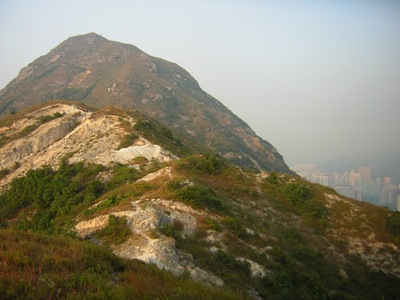
My antics had drained me of my water and wasted all the sunlight, though, so I didn't stick around and follwed the paved, normal person trail back down to the base where a disclaimer at the trailhead absolved the government from injury or illness incurred on the "strenuous" approved route.
First thing Monday morning (okay, 2PM Monday afternoon), I checked out the Kazakh Consulate, only to discover business hours were from 10 AM to 1PM. To make the best of my efforts, I sauntered around downtown and wasted time until the first in a free nightly series of Latin American films being offered nearby. I ended up attending four of them and they were all pretty good, though to be honest I just relished the opportunity to practice my Spanish.
First thing Tuesday morning, I borrowed a shirt from my uncle and headed to the Consulate with a swagger in my step. The consul turned me away with glee, pointing out I'd used the wrong form (I'd downloaded one from the Beijing consulate webpage thinking they would be the same) and adding very quixotically that I could find the appropriate form and the necessary document requirements on their webpage. On further review, the link to the document on their webpage didn't work and all the requirements listed didn't apply to me as I wasn't an HK resident. I was beginning to suspect that the Kazakhs didn't get a lot of tourist business through HK, and that they were pretty happy to keep it that way.
Much of the rest of the week was spent waiting on further word from the consulate about the form, watching Spanish-language movies, and generally milking my aunt and uncle of their hard-earned money. By the end of the week I had determined to either discover a back-door into Kazakhstan or return to my original plans of taking the train north. The weekend provided me with some more excitement and another glimpse into the athletic scene of HK.
A 100K trail race was being run from one end of the city to the other, and was finishing basically at our backdoor. The race was a team competition, and all four members of the team had to cover the distance from start to finish in order to count as official finishers. My uncle knew two of the teams competing so we decided to go out and watch the misery in action. We headed out at 5 AM to make sure not to miss them (they had started at 11 AM the previous day in horrendous, hot, sunny weather), and sure enough, just as the sun came up, one of the teams came shooting by, looking in very high spirits considering they'd just covered around 55 miles and were still going. We cheered them on and awaited the second group, who made an appearance a short while later. Since they were headed our way, we thought it would be a good idea to follow them to the finish and cheer them as we went. I hadn't planned for this, unfortunately, and was wearing a pair of sandals. This normally wouldn't be a problem, but the finish was still 6 miles away. Not one to complain, I hoofed along behind and did my best not to pass out as we zoomed along rocky, narrow trails to the finish. After jogging the last 10K, I had the utmost respect for all the teams who managed to get across the line.
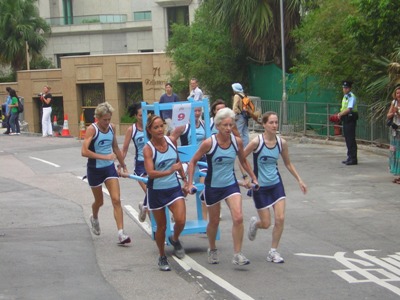
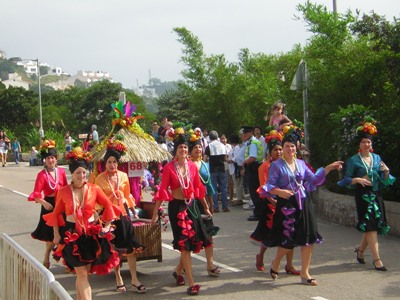
The following day, I was pretty whooped, but there was another race to attend, and this one featured my aunt. This race was another team affair, but the object was for each team to carry a sedan chair over a 1.2 mile course. Six runners carry the chair at once, and a couple of alternates wait in the wings to swoop in and relieve the tired carriers. The all male teams additionally have to carry a person in the chair. Its a charity event, so very few teams really go all out to win the race, and there are plenty of prizes for teams with unique decorations and celebrations. It was a really fun affair, made more so by the fact that my aunt's team won (they were racing competitively).
Personally, I liked the team of all belly dancers who were in no hurry and would stop frequenty to do a little dance number for the onlookers.
Nothing like the spirit of competition to get the juices flowing.
Following such an eventful weekend, I was all set to apply for a Russian visa (a horrendous process in and of itself), but was coerced to give the Kazakh website one more shot. Wouldn't you know that they'd ignored my personal request but at least updated their website. I now had the required form (though very little idea what "additional requirements" might be asked of me) and was once again set to do battle with the testy Kazakh. I was glad to make it in to see the consul again (at least I hadn't been placed on any Interpol lists) and he accepted my application, but informed me with a tired air that I needed to write a letter detailing my specific travel plans and dates. Hmmm, what I did on my Kazakh vacation, by Shawn Baker. Well, since I had almost no idea what I would be doing, or how long it would take, I perused the Lonely Planet for some place names, polished it up to sound like I had paid reservations everywhere and faxed off a copy. Let's hope its not set in stone. I don't think I can actually spend three days staring at rusting ships in the middle of the Gobi Desert in winter.
While waiting to hear if I'd made the grade and was Kazakh worthy, my uncle and I took to the hills one final time for a bit of fresh air and bug bites. As I knew that one way or another I'd be heading north shortly, I was trying to soak up as much of this mild autumn as I could. The following day, I checked to see if I had sent up any red flags with my talk of capitalist recruitment and anti-establishmentarianism. To my sincere surprise, I not only got approved, my visa was already ready and waiting and would cost me 1/5 of what I would have paid at the embassy in Washington. That Kazakh was a good guy all along.
Visa in hand, I was now prepared to head off into Southern China to make my way to the border. First, I needed to party hardy and say goodbye to Hong Kong, not to mention try to thank my aunt and uncle for their hospitality which was truly above and beyond the call of duty. Honestly, who wants a repulsive, hairy, smelly backpacker flopped in their house for a month. Family relations have their limits. Over the weekend, I had the opportunity to grab a last meal with some of my uncle's race-walking team, whom I'd spent a fair bit of time with.
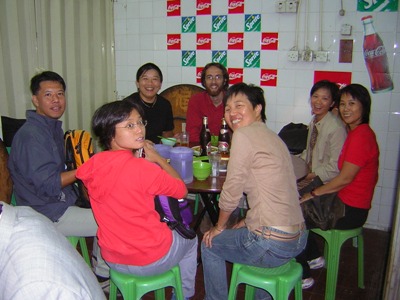
It was yet another fantastic Chinese meal, which I would soon be dreaming of as I returned to my point-and-pray method of food ordering. Having seen my aunt compete once on the trip, I got the opportunity to see my uncle go through a time trial as well.
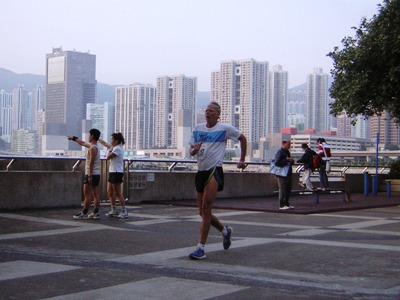
20-kilometers on a chilly seaside boardwalk as a tune-up for an upcoming race.
Knowing that I was heading into the great unknown, and not knowing when I would next see my aunt and uncle, we decided to put together a grand Thanksgiving feast on the night before my departure. As my uncle is Canadian and my aunt is British, and they've been in Hong Kong for over 20 years, Thanksgiving isn't a family tradition, but when the chips were down, they pulled together nicely.
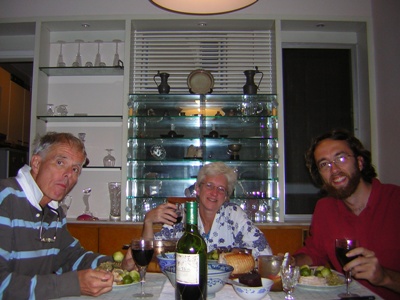
Turkey with gravy, stuffing, cranberry sauce, potatoes, brussel sprouts, and chocolate pudding cake with ice cream (my contribution). A fantastic send-off for the holiday season, and I'm sure a bit of a celebration of having their condo back to themselves. With that, I'm off again into the Mandarin nation to see what troubles I can find.
November 17, 2005
As a track and field fan, I was thrilled to have a valid excuse to make my way over to Macau and watch some high caliber athletes giving it their all. My uncle and I began packing our gear for the trip to Macau to watch the track and field portion of the East Asia Games. The East Asia Games are like a mini-Olympics held for the nine countries of Eastern Asia, here deemed to include: China, Japan, North and South Korea, Mongolia, Macau, Hong Kong, Taiwan, and (of all places) Guam. There are a number of different sports included, but the only one of interest to me was the track and field. Unfortunately, this was a spur of the moment decision (more or less) and we had no hotel reservations. Luckily, we had a back-up plan if the youth hostels were full, so we bundled up some stuff and loaded onto the one-hour ferry.
I have to admit yet again to a bout of ignorance about this section of the world. I knew there was an island nation called Macau, but I didn't know it was within an hour of HK, only recently released by Portuguese rule (1999), or connected to its knew rulers (China) by a relatively short bridge. The things you learn in pursuit of sport. In fact, the major feature between HK and Macau (other than a handful of small to medium-sized islands) is the mouth of a river coming from the mainland. After crossing this in our hovercraft/ferry, we disembarked to the welcoming and all to familiar Portuguese signs. I have to admit that I enjoyed being surrounded by signs in Cantonese and Portuguese as it reminded me both how much and how little I'd learned in my two month stint in Brazil.
Making our way through the bustling streets of Macau was very different from HK. Casinos are the major industry of the island with pawn shops and prostitution nipping on its heels. Where HK has banned street hawking without a license, effectively killing the streetlife you find in every other Chinese city, it is alive and well in Macau, though somehow it is subdued and not at all aggressive. The laid back Portuguese attitude seems to have seeped in here and blended nicely. We hopped a bus to the youth hostel, conveniently located at the far tip of the far island, out of touch of all signs of humanity, and were informed that it was booked full of folks associated with the East Asia Games. The desk clerk seemed to think we were bonkers for not knowing that beforehand. Luckily, we came packing a tent, and as might be expected of a hostel in the middle of nowhere, a campground was not far afield. Regrettably, though the campground was abandoned and free of charge, the campsites were no more comfortable than sleeping on a parking lot. Hard-packed dirt underlaid by cement. A pleasant home for three nights. At least we had ice-cold showers.
On the true bright side, a fantastically tasty Portuguese restaurant was just outside the campground, as well as a row of street vendors who grilled up skewers of squid and corn-on-the-cob nightly. Our first night, we opted for Portuguese and got pumped up for the coming day on a diet of olives, sausage, fresh salad, grilled sardines, and delicious wine. I can live with roughing it for a few nights. As is so often the case, the first night on the hard ground was the worst, made worse by the fact that we failed to provide any ventilation. I almost drowned in my own sweat.
On the following morning, we grabbed a breakfast of coffee and french toast (is this really China?) before settling in for a day of track and field. I've never been to an international track meet, with the exception of the '96 Olympics, so I didn't know what to expect in terms of crowds. What I got was hundreds upon hundreds of school children being marched in to fill the stands around the fifteen or twenty other attendees. I'm confident they were devout fans to the last. The events were entertaining, and I enjoyed following the multiple events transpiring simultaneously. As my uncle pointed out, TV does a very poor job presenting track-and-field because it neglects the field events which take up a lot of time and are typically back and forth battles of one-upmanship. On TV, we often see only the top one or two attempts and nothing more. He sees this and doesn't even own a TV. Hmm.
The Chinese dominated almost all the events with ease, though the Japanese and Koreans would give them a battle here and there to keep in interesting. It's obvious the Chinese are doing more than just throwing together a bunch of buildings in preparation for the Olympics. Their athletes will be ready as well.
At the lunch break, I snuck away and investigated the old section of Taipa, with its narrow market streets and shaded colonial style buildings (circa 1902).
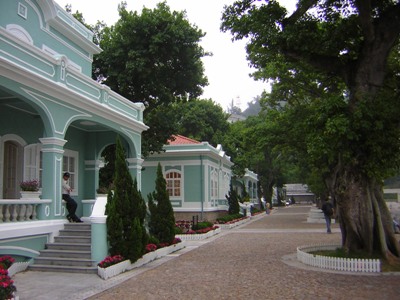
Taipa is the southern island of Macau where the track and field was being held. After the antiquity the mainland had to offer, it felt a bit weak, but the little pockets of western architecture really jump out at you when surrounded by more traditional Chinese buildings. The churches in particular stand out as out-of-place after the distinctly Chinese temples of the rest of the country. Returning to our campsite in the evening, we decided to grab a squid skewer and a beer on the beach before supper.
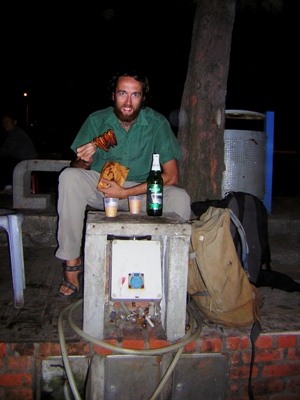
The squid was hot and spicy, and left my mouth tingling even after I'd guzzled the last of my beer. We elected for another night of Portuguese, and had Portuguese rice (mixed with a salted fish) and salted fish steaks, yet again with that tasty wine. I have nothing against Chinese food, in fact its fantastic when well made, but I am clearly a Westerner at heart (and particularly stomach).
After dinner, we spent the evening watching a rat dart along the edge of a rockline and trying to avoid waves, presumably while searching the collecting garbage for food. It made for quality entertainment and put off the unavoidable hardpacked beds which awaited our bruised hipbones.
The following day was the highlight of the track-and-field for my uncle and for all of China, but for different reasons. My uncle was excited about the race-walking competition, and the country was excited about their national hero, 110-meter hurdler Liu Xiang. It seems Mr. Liu is second only to Yao Ming in terms of popularity and recognition as a sports figure. He is the current world and Olympic hurdles champion and, if memory serves, is the first and only Chinese Olympian to win a sprinting event. The stands had considerably less schoolkids and more spectators for his event than on the previous day. His every movement was televised on the big screen and cheered by the crowds. I've seen his races on TV in the mainland previously, and he makes a point to change shirts on the track and give the girls hearts a flutter. Meanwhile, the cameramen, sensing an opportunity for exposure, will zoom in every time he happens to bend over. Quite the spectacle. Needless to say, he had no problem with his race, much to the delight of all present, and spent ages waving to the crowd and chatting with the press.
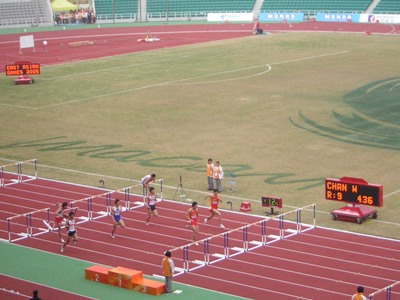
I think he was glad that this was his last race of the season, because he certainly looked to be getting tired of all the fuss. Or maybe he just wasn't used to playing to such an empty house.
After his race, the stands pretty much emptied out and I enjoyed the end of the morning session before joining my uncle and some of his HK race-walking friends (who had been out on the streets watching the race) for lunch. Then it was back to the stands for another round of events in the afternoon. Yet again we were joined by crowds of young students to try and get some bodies in the stands. It seems that track and field wasn't the top priority of most folks on a Tuesday afternoon (or any afternoon for that matter) in the backwaters of Macau. After the race, we decided to hike back to our campsite. Because we were simply sleeping in the middle of city park, there was no security, and each morning we would pack our things into our backpacks and head off to the stadium. Security was trying to look tight so they would always pretend to poke through our stuff before sending us on our way. Interestingly enough, they never asked for our tickets. Anyway, because of this, the hike back was a nice bit of exercise, and we stopped off in the town of Coloane (the nearest community to our campsite) for a couple of beers and another relaxed dinner before hitching a lift the last stretch of the way back to our site. The rat was still making the rounds so we kept our eyes peeled for him while watching the waves roll in and eventually rolling ourselves off to bed.
Wednesday morning was our last, and upon packing up we bid a fond farewell to our campsite and the rat, wherever he may be, before busing off to town to watch the half marathon from the road. It was a hot sunny day to be grinding out 13 miles, and I felt sorry for the folks, but it was a fun race to watch. At the lunch break, I snuck off yet again to go investigate the downtown portion of Macau proper, which I'd only seen briefly on our arrival as we made our way to the southern island. With a bit more time to check it out, I noticed that the dichotomy of so many Chinese cities was present here as well, with the monuments to money and affluence represented by the towering skyline and kitschy casinos overshadowing a huge area of urban slums and poverty. Such is the way of so many cities I suppose, but for some reason it is really evident in the urban planning (or lack thereof) of so many cities here.
On the plus side, Macau is leveraging its unique history of Portuguese occupation to draw in the Chinese tourists from the mainland who may be unfamiliar with the appearance of traditional Western architecture. A very nice area of older Portuguese buildings is preserved in the center of town and has been turned into a tourist haven. Despite the price-gouging and hefty crowds, the area is very pleasant and the spectacle of all this western architecture in a Chinese town still strikes an odd chord.
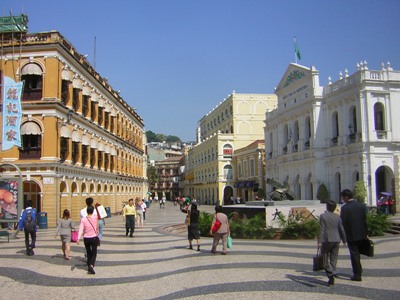
We returned to the track in the afternoon and caught the last few events before heading off to the ferry terminal. We grabbed a stellar Italian meal across the road before climbing back into the ferry and making our way over to HK. All in all Macau, definitely made the grade.
I returned to Hong Kong with two purposes: One, to enjoy a bit more time with my aunt and uncle who I see so infrequently, and two, to figure out where I was going after China and procure the appropriate visas. On my return, I was informed that the following week an international track meet was being held in Macau, which I was interested in attending. This effectively ended my bid to get visas and get going quickly, as I would need my passport to get to Macau. Thus, I set about relaxing and enjoying the less hectic pleasures of HK.
On my last visit, with Mike, we'd been in a hurry to tick off as many tourist hotspots as possible in our short time here. This time around, I had no agenda whatsoever, and set about ruining the productivity of my uncle, who works out of his house. Our first few days were spent in hiking about the barren hills of HK near his apartment. Though I can claim a few years of youth on my uncle, he is a well trained athlete (race walking is his discipline) and chasing him over hills rapidly wore me to a sweating, gasping mass. Nonetheless, I learned a good deal about the history and culture of the city which I would never have guessed. As it turns out in its dire need to keep its ever growing population watered, HK has installed a comprehensive system of catchments to collect all the rainfall in the hills around the city. By city ordinance, no one can build or live above the catchment line. As a result, an extensive wilderness is literally right outside the doors of the millions of city residents.
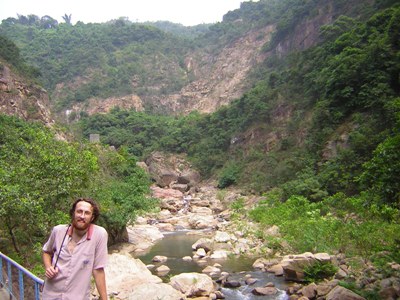
Like running the Adirondacks through the heart of Long Island and keeping them uninhabited. It helps to explain the proliferation of towering apartment complexes crowded in the valleys. Regrettably, a need for firewood during the second World War and poor management subsequently has left them devoid of all but shrubs and grasses, which makes for very hot hiking in the blazing tropical sun. Luckily, a clean shower, comfortable bed, and cold beer were waiting after every walk. A guy could get used to this travel thing.
Months ago, when gazing into my travel crystal ball, I foresaw myself wrapping up my trip in September, somewhere in Germany. That means Oktoberfest. Some good budgeting and some unexpected financial breaks have given me a few more months, and I don't regret missing Oktoberfest for a second. On scanning the local HK newsmagazine, though, I see that Germany has traveled to me, and a two week Oktoberfest celebration takes place each year at the end of October right in the heart of the city. Not one to to turn a blind eye on a lucky streak, I headed over with my uncle to see what all the fuss was about.
I've seen a few Oktoberfests in the States, and they pale in comparison to Munich, I'm sure. Nonetheless, the mood is always festive, and HK managed to maintain the standard. As the oompah band got started, I was a bit worried that the Chinese corporate groups who made up the majority of our Wednesday night crowd were going to be sticks in the mud. The upbeat polkas and waltzes were getting almost no response from the crowd, though I couldn't say much as I was glued to my seat by a pile of sausages, sauerkraut, and beer. When the chicken dance made its debut, though, I could stand by the sidelines no longer (I'm sure a liter of beer helped with my decision). It seems this Oktoberfest and 7th Inning Stretch standard hasn't seeped into the corporate culture of HK just yet, and so on the first run through, I found myself alone in the open-air beer hall flapping my arms and wiggling my butt to the open-mouthed horror of the suit and tie crowd around me (I think my uncle was a bit shocked as well). For a man who has braved a Brazilian nudist beach and the "Land of Fire" at the ends of the earth, though, it made little difference. By the end of the night, my repeated chicken dancing had brought on a few equally bleary-eyed recruits, and even earned me a free beer from an adjoining table. In fact, shortly after the first chicken dance, the band got fully into the act and had the whole dance hall singing "Ein Prost" and dancing in conga lines. The crowning moment for me, though, was when my second liter of beer kicked in and I managed to drag a local out on the dance floor for some swing, some hustle and even a polka (very brief, but it happened). What a night.
That weekend also marked the start of HK's Latin Fiesta. Having recently come from a Latin American area, I kept my eyes peeled for interesting events. The kick-off celebration was a series of bands and dancers from a variety of countries offering their traditional forms of enterainment, and since it was free of charge, I went to check it out. It certainly didn't draw a Woodstock sized crowd, but there was a fair enough turnout, and some of the acts were quite entertaining. I was not surprised that time and reflection had failed to endear the traditional Andean music (played by a group of Peruvians) to me any more than when it was piped into every bus and taxi in the region. I did feel some sympathy for the front man, whose repeated attempts to get the crowd clapping and active failed because he only spoke Spanish and Quechua. The Brazilian samba and forro still got me shaking my hips like nobody's business. The tango music sent me back to Buenos Aires (still my favorite city of the trip) but the dancing of the local HK Tango club, while good, lacked the spirit and romanticisim of the Argentenians. By far the best act of the group, though, was a full mixed band, with each member dressed in the stereotypical outfit of one of the countries (one of the ladies was dressed as Carmen Miranda, complete with the fruit headress), and they played music from each country, from tango to samba to mariachi. It was good atmosphere and great fun.
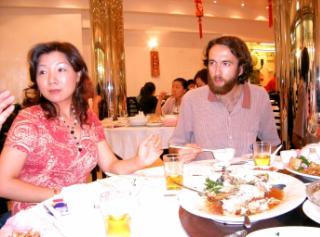
This is not to say that I spent my time in HK soaking up cultures from around the globe while overlooking the cultural treasures of the lively city at my doorstep. In fact, one of the highlights of my stay occurred the night of the Latin Fiesta as my aunt and uncle invited me to a dinner with some of their friends. We headed down to the seafront and sauntered through a massive seafood market with all varieties of sea creature you could imagine and a hefty grouping of those you couldn't. In true Chinese style, we were to select a number of different fish to be sent to the restaurant of our choice (in our case, the restaurant of our fish dealer) and prepared in the manner of our choosing. Luckily, we were in the company of two ladies who lived in this area and knew exactly what they were doing. We walked out among the tanks (all the seafood is still alive and kicking in saltwater tanks out front) and began picking our lot.
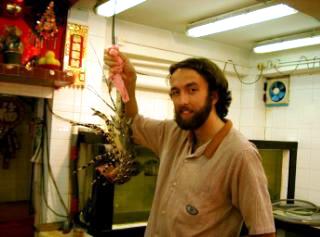
I would later learn what we picked (the entire transaction was conducted in Cantonese of course): spicy prawns, cuttlefish sashimi, clams on the halfshell, lobster, and of course, baked fish (which I was unable to identify). The whole meal was fantastic and I thoroughly enjoyed the roundtable eating style, getting to know some of the locals, and of course, the food.
The following morning, we got up early and headed out to a local race to cheer on teams as they ran a long cross-country relay race. Before my trip began, I fancied myself a bit of a runner, and at times I really miss it. Seeing all these folks having a grand old time (including one of the ladies we'd eaten with the previous evening) had me wishing I had a pair of shoes to strap on and join in the fun. Oh well, plenty of time for that once the backpack is stored away for a while. In a bout of wishful thinking and an attempt to extend the trip a bit more, I even applied for a job in HK. I had been struggling with decisions about where to go next and figured a job would solve all that. It never materialized, but at least I gave it a shot.
November 10, 2005
There's a geographical bottleneck in China between the Northeast and the rest of the country. In the center of this bottleneck lies Beijing, and it is nearly impossible to pass from one side to the other without going through, kind of like a black hole. Since I was passing through anyway, I figured I'd stay a day or two to make sure I knew where I was going next. I settled on a route starting just east of Beijing and working it's way south. The first stop was Datong.
Datong is a quaint little town of 3 million people just south of the Great Wall (a much less impressive Great Wall than those in my previous pictures) which boasts a collection of tourist sites within close driving distance. It had been a week since my trip to Wudalian Chi, but my success with the tout gave me undue courage, and upon exiting the train station I followed the first guy who could offer me a room at the price I wanted. Naturally, he wanted me to take a tour as well. Unfortunately, I continue to get involved in these things without really reasearching beforehand. This time it didn't work out well as I ended up paying about 10 times more than I could have gotten away with on local buses. Ah well.
The following morning I went to seek out some breakfast before heading out and was accosted in the alley by my hotel by a fellow who knew a bit of English and worked at the corner restaurant. He offered me breakfast and I accepted. My presence (a western face) seemed pretty novel and everyone repeatedly came up and inquired where I was from. I paid for my tasty bowl of handmade noodles and on the way out bid goodbye to the six cooks who were outside cooking up the various breakfast dishes. They were all good-natured and I realized I would probably be back for breakfast the following day.
The crown jewel of Datong tourism is the Cloud Ridge Caves, a collection of over 30 caves carved out of a cliff-face and intricately decorated with carvings of Buddhist religious images. I'd gone in not knowing what to expect and was really blown away. The two main caves had carved stone buddhas standing over 40 feet tall and on the walls and ceiling of the caves which enclosed them were thousands of tiny, intricate carvings of mini buddhas and figures.
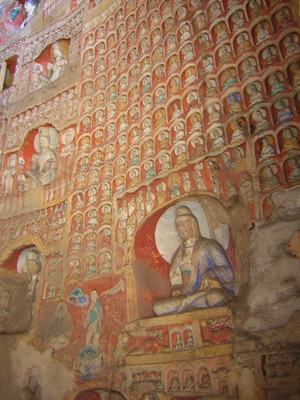
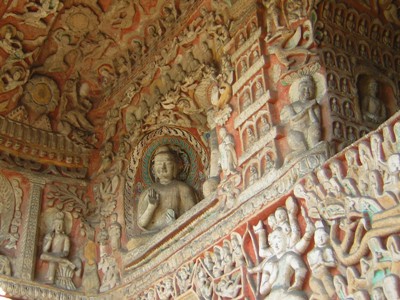
The years of work and dedication to create just one of these caves was mind-boggling, but to create the entire array would have taken an army of Michelangelos. The postcard image of the spot was one of the smaller caves which had crumbled away around it's Buddha and left it exposed for all to see.
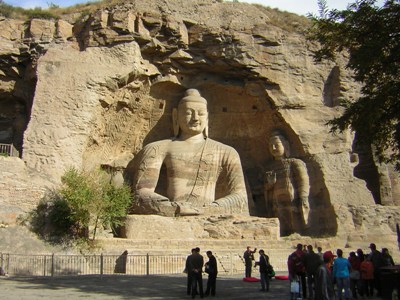
It's hard to get a sense of scale inside the caves, but considering it is a smaller version, you get the feel for the size of the undertaking. Really impressive.
The other sites I visited in Datong were reasonably (and comparitvely) unimpressive. Another dragon wall, another temple, both less well-preserved than other sites I'd seen. Just to add insult to injury, my over priced tour dropped me back at my hotel by lunchtime, much to the joy of my new friends at the restaurant. They spotted me a mile off and started beckoning. They asked again where I was from and unabashedly started to exclaim over and over "We want American money!" I give them credit for cutting right to the point. All the cooks on the street were pointing to whatever dish they were cooking and imploring me to eat, but I passed on to find some diversity and walk the town. Unfortunately, there was nothing impressive to behold and Datong looked like a worn-down place. They were in need of whatever tourist money they could get. Returning in the evening I was greeted by the same welcome, "Give us American money!" I couldn't resist and went in for a bite. My eight-year-old waiter continued with the same line repeating "American money" over and over to me, which was strange since he had a devious twnkle to his eye and giggled every time I said money. I suspect it had a different meaning in Mandarin.
After Datong, I continued down the line to Wutai Shan, a village surrounded on all sides by mountain ridges and populated by dozens of Buddhist temples dotting the surrounding hillside.
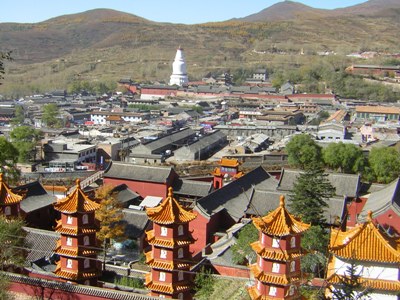
The abundance of temples was most distressing as it had brought an unhealthy explosion of tourist vendors to accompany the unavoidable explosion of tourists who came to visit and worship. I made my way up the main mountain via a course of torturous concrete steps directly up the side. On the way up I passed plenty of beggars, but also a number of monks-in-training who were working their way up step by step, touching heir forehead to each progressive step as they went. Painful. Whilst wandering among the varioius temples, I happened by one where a young fellow beckoned me in to let me know his temple was open to the public. I decided to have a look around and another young guy (not so young, quite close in age to me) approached me and began asking questions in fairly good English. We struck up a conversation and he showed me around the temple.
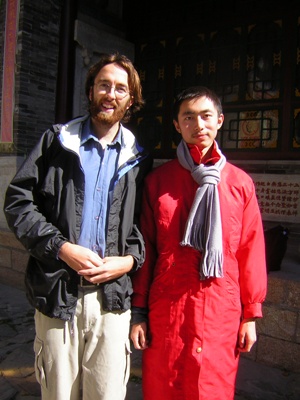
His mother came out and follwed us around with tireless attention. I was concerned I would get the guy in trouble by monoplizing his time, but he was in no hurry and I was learning tons about life in the temple, so we kept at it. Eventually a gong rang and his mother scurried off. I was told it was lunchtime so I made my way to the exit. His mother returned and insited I stay for lunch. At this point I was truly torn. While lunch with the monks of a Buddhist temple is a once-in-a-lifetime chance, at the same time I didn't want to eat a portion of what could be a very slim supply of their daily rations. I begged off and said it would be best if I left, but when they insisted repeatedly and seemed insulted at my consistent refusal, I gave in (quite happily). Lunch was a solemn occaision and I was trying to hide my giddy smile. We made our way into the temple, where the head monk was seated on an elevated platform in the center, with low benches to either side from which the other monks ate. We took up a place on the last row and started to work on some pretty tasty food. About midway through my meal, the monks started to pray (I didn't know what to do, but since my host kept eating, so did I). At the end of the prayer, the head honcho, got up and left, and most of the others filed out after him. I wrapped up my meal and made my way out as well. It was an unbelievable experience to be invited in and see the real deal.
The rest of the afternoon, I spent wandering around the town chatting with my new friend about all sorts of things. Ignorance is one of my more endearing and enduring traits, and it is at its strongest in relation to cultural awareness. I know very little about Buddhism, but found it odd that my host was complaining at various points about his cell phone bill and how he only infrequently gets to play Warcraft at the internet cafe. I think the walls of traditional Buddhism are slowly starting to crumble, though the poor guys working their way up the concrete steps my tend to disagree.
From Wutai Shan, I made my way further south and west to the tourist mecca of Xi'an. People who know anything about China typically know about Xi'an because it boasts the biggest tourist attraction outside of Beijing and the Great Wall. The Army of Terracotta Warriors was one of the few locations I had recommended to me prior to leaving on my trip. I had spoken to dozens of people along the way who had made the journey through Xi'an and had actually heard somewhat mixed reviews about this massive collection of handmade soldiers. Located outside the town, at a still expanding archaeological excavation is this collection of three large buildings, each of which encloses a separate underground vault. In each is a collection of terracotta warriors made to protect emperor Qin, buried nearby, in his afterlife.
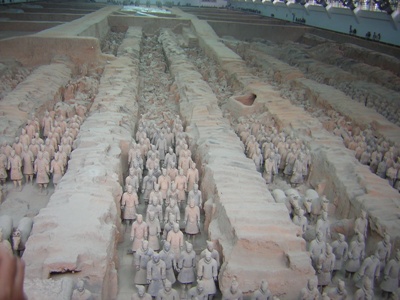
Different ranks of warriors are in different proportion at each of the three sites. The largest (over 6000 warriors so far) is composed mainly of infantrymen, archers, and a few chariots.
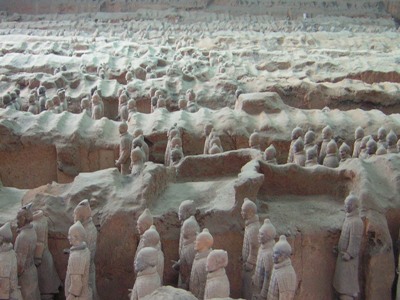
The smallest is mainly upper-ranking officers. The mid-sized site (around 1000) has more archers and chariots and a number of mid-ranking officials. The detail of the warriors (varying expressions, intricate armor and detail on the chariots) is truly impressive considering they were hand-made 2000 years ago and buried, never intended to be seen by the human eye (it is thought the designers were killed and sealed in the vaults as well). The major criticism I'd heard is that the site is a bit like walking through a garage and looking down on the lines of warriors. Having been prepared for this, though, I accepted it for the grandeur of the work and dedication of the artisans, and in this light, The Army deserves its place as a tourist must-see.
From Xi'an, I made my way southeast to Lushan, another mountain village with a slightly more recent and somewhat less distinguished history (in my mind). It was built in the 19th century as an escape from the heat of the lowlands and became a meeting-ground of the communist leaders as they set the course of the revolution. Now, it is a highlight for scores of Chinese tourists to see Chairman Mao's residence on the mountain and soak up the history and scenery. Supposedly, there are fantastic views, but Lushan is reknowned for its cloudy weather and poor visibility most of the year.
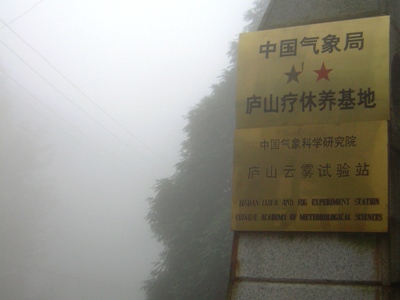
I lucked out on arriving on a fairly clear day and spent an afternoon walking in the hills, which had an alpine feel to them. I found out the following day I had been foolish wasting the clear day on a walk in the woods. The fog had set in so thick that as I descended the stairs in my hotel I thought a fire was burning in the lobby. The mist had snuck in the door and up the stairs, still thick enough to clearly be seen. In the streets, there were maybe ten feet of visibility and in the hillside, descriptive placques detailing breathtaking rock formations and impressive gorges were wasted on me. I got soaked to the bone by the rainstorms that came and went and missed out on all of the promised scenery. A highlight of the park is a three stage waterfall which looks mighty impressive on their tourist pamphlets, but I never caught a glimpse. I did manage to take away one souvenir, though, a nasty cold I developed walking around in the rain.
My whirlwind tour of some of the sights in the eastern portion of the country was done, and I returned to Hong Kong to pow-wow with my uncle for a few days and pick up some visas for the next leg of my journey, whatever that might be.
Due to a bit of bad planning and some horrid traffic surrounding the National Day celebrations, Mike missed his train to HK and was forced to shift his flight to Beijing. It cost a bit of money, but at least he didn't have to worry about the hassle of getting transport out of Beijing during the largest weekend of travel in the country (like being stuck in NYC on Thanksgiving and needing to get to Miami). It also meant we had an extra day to goof around in the city before I was officially left to my own devices. We hit the hutongs (small, cramped inner-city neighborhoods which are said to be the last few remnants of traditional Beijing). Beijing's rush for modernity has been a death knell for most of the traditional areas of the city (at least those without historic landmark classification) and the smattering of hutongs wedged between massive four and six lane roads and towering skyscrapers are slowly losing their grasp on this last link as well. Wandering through one, we came to the entrance to the "Underground City", a long network of tunnels under the city built to evacuate the heads of the government should disaster strike. Our tour was a real letdown as the folks running the show were clearly trying to become a tourist attraction, but still had some work to do. Everything was draped in camouflage, including our tour guide, which was strange since the tunnels were underground. There wasn't much to see, except signs indicating where facilities once were ("Here was the gymnasium for old people. If we were forced to live in the tunnels, equipment would be here for old people to maintian their health"). After our tour, we decided to give one last shot at a wild send-off party (our last effort being a hopeless failure). We had a much better go of it this time around, starting early and continuing late, and the beer flowed like beer. As is often the case when you're drunk and trying to spend off any superfluous foreign dough before returning home, we decided it would be a good time to check out the seedier side of Beijing.
Walking around, the street girls were pretty bold in their come-ons. They'd saunter up, get in step with you and offer a massage. If you said no, they would cut through their poor attempt at subtelty and straight out offer sex. No time for sweet talking. As we stumbled along, we happened on a massage parlor still kicking at 1AM. Thinking it was a good idea, we waddled in to test the theory that Beijing massage parlors were covers for houses of ill repute. It should be noted first, that this was purely research for my loyal readers (more like a sting operation than idle curiosity), and second that we were likely reeking of alcohol. Being high-rollers for the night, we chose the cheapest massage on the menu (half-hour foot massage) and followed our guides back to the room which had a TV, a foot bath...and two massage beds. Hmmm. Well, we'd come this far, so we sat back and relaxed to the gentle musings of the Chinese period soap opera as our feet soaked in a painfully hot mixture of oils and spices. Then began the grueling half-hour foot massage, which on my side was sort of like having the soles of your feet pounded by a ball-peen hammer. Mike's theory is that because I was passing out, it was the only way to keep me conscious. To be fair, it's a valid argument. When my misery was over (penance perhaps), the masseuse arose and left. No offers for further services, no happy ending. Just a massage. It was a crappy myth anyway.
The following morning, Mike made his way successfully to the airport and home, while I hobbled around the hostel on tender tootsies and made arrangements to go to the far northeast. A twelve hour train took me, the following day, to the remote provine of Heilongjiang, north of Mongolia and North Korea, and bordered to the north by Russia. Chinese Siberia. At this point I had only been in two of the three largest cities China had to offer, and hadn't yet been to the "countryside". Therefore, my images of quaint peasant villages and subsistence agriculture were still intact. I'd envisioned getting off the train at a backwater station and haggling for a yak's wool jacket to fend off the driving snow and biting wind. I was therefore quite shocked when I unloaded in downtown Haerbin, a city of 9 million people complete with skyscrapers, flashing jumbotron advertisings, and hordes of traffic. My naivete still surprises me. I wasn't stopping in Haerbin, just passing through on my way to Wudalian Chi, a remote village close to the Russian border nestled amongst active volcanic peaks. The bus trip to Wudalian Chi did offer glimpses of the China I expected to find, as we weaved among tiny villages and zoomed past folks carrying produce on shoulder poles, with yellowing poplars lining the road and adding to the ambience.
Unfortunately, the nine-hour journey dropped me in the parking lot of a hotel in this tiny town late at night and with a cold wind blowing down from Russia. Somehow it was only at this point that I realized I didn't know the language, had no idea where I was going, and wasn't really sure how to get there. Luckily, capitalism saved the day as a young lady sauntered up and started jabbering at me. To my credit, I'd been trying to learn a few basic phrases, and I used them all here to get her to realize I didn't know what she was saying. Previous experience led me to believe she was trying to sell me something, and I just hoped it was a room for the night. Indicating that was what I wanted she led the way to a run down hotel well off the road (the "center" of Wudalian Chi is an intersection with streetlights lighting one of the roads. There are two or three upscale hotels visible and little else). She told me the room was only 15 yuan per night (less than $2), and then the other shoe dropped. She wanted me to take a tour with her the following day. I had a vague idea of what I wanted to see, and a much better idea of what I wanted to pay. I did my best to make this clear and we came to an understanding.
The following morning I piled into a minivan with a bunch of Chinese tourists and away we went, with our guide babbling in Mandarin. We arrived at the first stop, and it wasn't one I had wanted to see (i.e. I didn't want to pay the entrance fee) so they made the rounds and I froze in the van. Upon returning, one of the women showed her true colors and asked in broken but passable English why I hadn't gone along. I related a somewhat overblown but truthful accounting of my travels and the need to stay on a budget. Upon telling this budget (and making it sound like going over-budget was risking starvation and abandonment), she exclaimed and explained to the tour guide who gulped and put on a pained look. After a heated argument, it was explained that I could pay significantly less than I was currently paying (which was already over my daily budget) and go to all of the sights on the tour. I felt sort of bad, since my budget wasn't really all that tight, but accepted. When we stopped for breakfast, guilt overcame me as everyone chipped in, sliding me portions of food from their plates. I desperately tried to turn it down, but they'd have none of it. I literally couldn't eat it all (which is a bold statement for me) and slipped a couple of boiled eggs into my pocket for later.
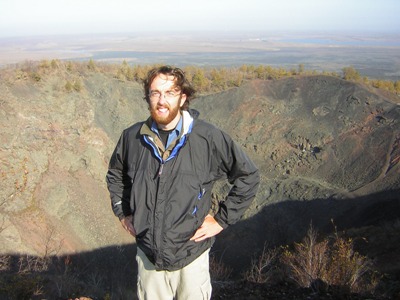
The rest of the day, we travelled around looking at unique features of the volcanic landscape. We visited massive lava fields (while the volcanoes are still seismically active, none have erupted in many decades), a volcanic peak topped by a large crater, numerous natural springs with horrid mineral water which possessed healing powers attested to by their horrid flavor, and natural caves which maintain constant temperatures below freezing.
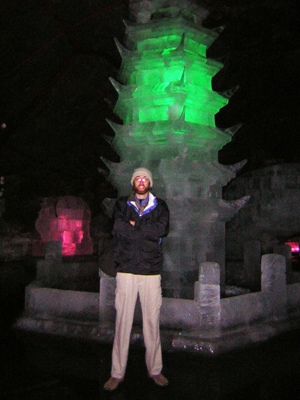
In these caves, they've build numerous ice sculptures to entertain goofy tourists who show up year round and aren't content with just the natural beauty of the caves. The ice sculptures were top on my list of things to see.
The whole area was fantastic, and I was arriving just at the peak of fall color, so the parks were really gorgeous.
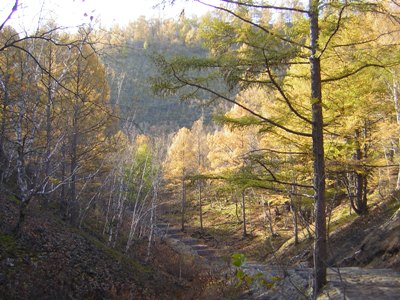
Except for a few Russian tourists, I didn't see any other western faces and certainly didn't hear any English outside our tourbus. I could get to like Siberia, at least in the fall.
The following morning, I trundled back into the bus for Haerbin and booked a train south to Shenyang, a nowhere city of a couple million people about halfway back to Beijing. I'd never really thought about it, but with 1.1 billion people, China would naturally have a ton of massive cities, and it does. Most of them I've just never heard of. As a result, as I've been planning my trip, the only places on the map (and frequently in the guidebook) are ridiculously large. Shenyang didn't have much to offer, though they did have a nice, open city park where locals came out to fly kites so high I was scared for passing airplanes.
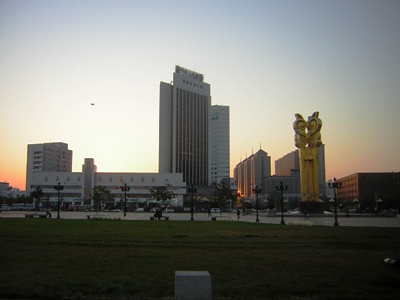
Additionally, they have one of the few old relics of Mancurian architecture, in the form of a walled palace for the Emperor of the Manchurian empire. It was very similar (though smaller in scale) to the Forbidden City in Beijing (where the emperor moved after Shenyang). I'd like to go into great detail here about the divison of China through history and the difference between Manchurian rule and the Hans and the Mongolians, but to be honest, most of it would be inaccurate, so I'll leave it to wiser folks. The only architectural difference I could see (and that was only because it was explained on a sign) was that one of the buildings was octagonal. Otherwise it looked pretty similar, though still impressive.
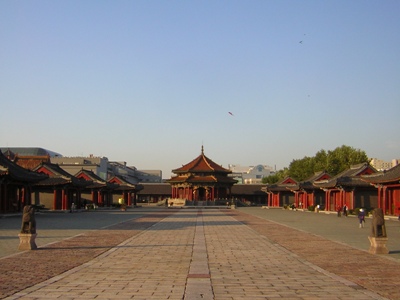
What really kept me in Shenyang as long as I was there (two nights) was I found a hotel room for about US$8 which provided me with a free computer with internet access in my room. My $2 room in Wudalian Chi not only lacked a private bathroom, but there was no shower in the whole hotel. I was moving up in the world. After my stint in Sheyang, I headed back to Beijing to plot my course southward.
October 16, 2005
Just as Miami was a good place for me to reaquaint myself with life in the states due to its bilingual culture, Hong Kong was a good place to ease my transition to China. As a former British stronghold, and current international business center, English is extremely common in all but the most remote corners of town. In addition, I arrived to the hospitality and fluency of my Uncle whose 20+ years in China would serve as a useful shield to full-fledged immersion right off the bat. As I mentioned, I was starting my China leg of the journey with Mike, a former roommate who had a couple of weeks off work and no better way to waste them. We made it to my uncle's condo in the outskirts of Hong Kong and sat down with map and guidebook to plot out or time in HK.
The plan was to apply for visas for the Mainland from HK and waste the couple of days necessary to issue them by hopping around the sites of the city. Our first day found us wide-eyed and a bit weary (the time difference is exactly 12 hours ahead of the East Coast), but we managed to accomplish a few notable tasks. The first of these was getting a late enough start that lunch was the first order of business in the city. We walked around until a local-looking establishment came into view, sauntered in, and took a seat. Needless to say, even in HK, two very tall and hairy westerners made for quite a sight. The locals had an english translated menu and we were able to order easily enough. We set to work with our chopsticks (I had an easier time of it with sweet and sour pork than Mike with fried rice) and looked around to realize we were the only two using chopsticks. Touche HK!
After lunch we put in our visa applications and crossed the bay from the island containing downtown HK proper to the touristy downtown of Kowloon. Hong Kong itself is a massive city and much of the growth of the city has been vertical. High-rise apartment buildings tower around the outskirts of the city like bristles on a hairbrush. The downtown area meanwhile, is populated by a number of architecturally intriguing structures which makes for a nice skyline.
In Kowloon, we decided to visit the museum of art and start trying to soak up some Chinese culture. Ceramics, scroll paintings, and carved objects (from jade to bone) dominated the exhibit with some really stunning examples of the artistic ability of one of the longest continuous civilizations in the world. Good stuff. Next we sauntered up the main street of Kowloon and tracked down a Buddhist temple nestled in a park in the heart of the city. Passing up the opportunity to pay homage with money and incense, we snapped some photos and headed on our way. We called it a successful mission and set out for happy hour and dinner before heading back to the condo and crashing for the night.
The following day we got up a bit earlier and tracked down train tickets to Beijing for Saturday (two days later). It turned out to be a heck of an ordeal as we didn't have sufficient money and couldn't find a bank. We spent most of the day searching out various train stations and banks, but it got us familiar with more of the city. We also got to watch the sunset over Kowloon from the opposite side of the bay. With so many people, smog is a real issue, but the scenery was nice nonetheless.
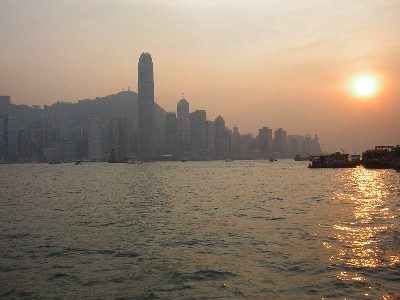
Our final full day in HK, we set out to on our most ambitious day. After a morning swim, we headed to the opposite side of HK Island, to the town of Stanley, where a massive open-air market draws hoards of tourists to spend their money. Mike snagged some gifts, but I abstained in the interest of budget and backpack space. We returned to the city (the ride to/from Stanley is a hair-raising trip along a narrow road in a double-decker city bus), grabbed our visas and went to the top of Victoria Peak for a peek at the city from on high.
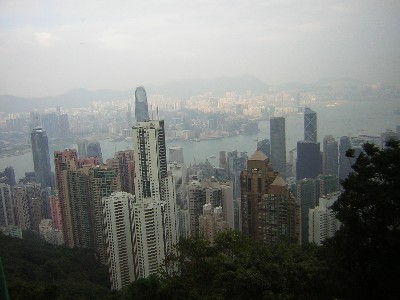
After a beer perched on the edge of the mountain, we went down to join my uncle and his teammates for a genuine Chinese meal. The main event was watching Mike and I use chopsticks. Always glad to entertain.
The time had come, at this stage, to forsake the English soaked comfort of HK for the mainland, and the following afternoon we boarded the 24-hour train to Beijing. Train travel is the most comfortable and easiest form of travel for getting around the third biggest country in the world. For puny foreigners, there are two classes of sleeper berths, hard (six to a cabin) or soft (four to a cabin with a door). There is also hard seat which is kind of like riding in a dining car the whole way. We elected for hard sleeper, me with an upper bed (read: no head room, no view, and air-con blowing directly on you) and mike with a middle bed (more head room but me stepping on him to go to the bathroom). The trip was uneventful and Mike said the scenery was nice. We had brought along instant noodles (boiling water is provided) and cookies for food. I have to admit, we still weren't throwing ourselves completely into the fire, as my aunt was in Beijing on our arrival and graciously agreed to shepherd us from the train station to a hotel (and restaurant) for our first evening.
All this assistance was particularly helpful as the train station arrival area is devoid of anything, and getting a map to Beijing would have been a real pain, much less figuring out where we were or where we were going. Doable, but a pain. We used our free pass to the city to track down a youth hostel for the remainder of our stay (we were staying in Beijing until Mike had to return), grabbed a nice dinner, swapped stories (I don't get to catch up with my relatives in China too often) and called it a night.
Beijing has a wealth of tourist sites, and it made for a difficult task to see all we wanted in our short time in the city. The first day, we attacked the biggest (and easiest) fish...The Forbidden City.
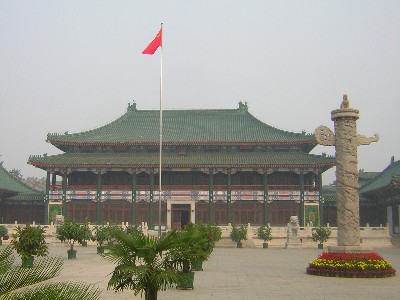
This was the Emperor's walled palace in the middle of the city, complete with concubine quarters, official's quarters, and a quarter arcade. Okay, maybe not, but it had almost everything (including a Starbucks, which I'm pretty sure was added later). I'd seen photos of the place, but they don't do justice to the scale of the project. It is a massive array of buildings, gardens, plazas, etc. and recieves enough visitors that you'd think the emperor was still living there.
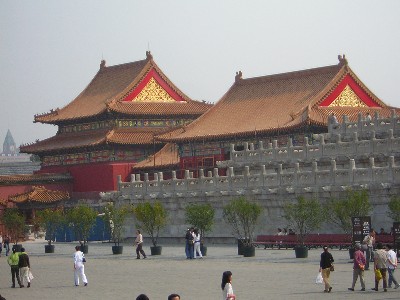
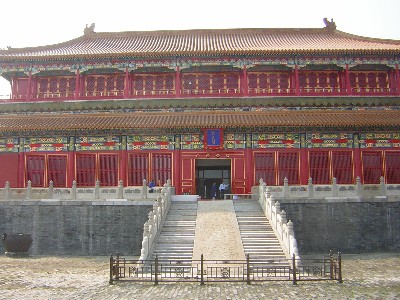
As it turned out, we were visiting during China's one-week fall vacation, so we had lots of company everywhere we went, but in the most populated country in the world, that's not entirely unexpected. After five hours wandering through the myriad buildings of the Forbidden City, we exited through the main gates (we came in the back way) to the impressive sight of Tianamen Square, and the all-seeing eyes of Chairman Mao watching our every move. Regrettably Tianmen was roped off for some reason or another, and we weren't able to wander around, but the size of the plaza was impressive nonetheless.
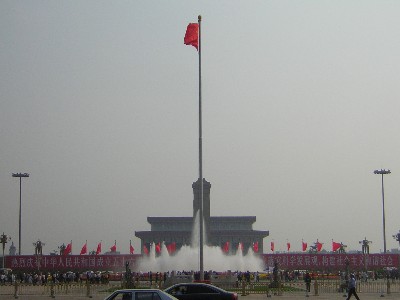
Whilst wandering around in the streets of Beijing or in any of the many tourist intensive areas, you get the feeling you are in a bad Seinfeld rerun (as if such a thing existed) and all your Chinese Uncle Leo's are chasing after you yelling "Hello!" It appears to be the only English the vast majority of Chinese know, and the use it with no discretion to draw the attention of rich westerners. Whilst walking by an art shop, a hearty "Hello!" drew our eye and we sauntered in to spy the wares of the dealer who knew some numbers in English and "Thank You". By the end of it, we were fully loaded down with scrolls galore and a pocketful of business cards to give to our equally dim-witted rich western friends. It was certainly not the first or last time we were gouged unwittingly, but for the artwork we picked up, we didn't feel the least bit cheated.
The day was a success thus far, so we pushed our luck and went to a nearby park which was supposed to have a nice overlook of the Forbidden City (good photo spot). Unfortunately, the main draws of the park were closed, either for reconstruction or due to the late hour. At present, Beijing is getting a major facelift for the Olympics, and new buildings are sprouting up on almost every block. All of the tourist attractions had evidence of refurbishing. Luckily, the Forbidden City was only being worked on at the fringes on our visit, but Beihan Park nearby had its major tourist card, a massive dagoba (think pagoda) in the center of a pond, completely wrapped in scaffolding and green netting. As it turns out, we had the wrong park as well, there was no view of the Forbidden City. There was, however, a nice walking trail around the pond, lined by aspens and willows, and a wall of glazed ceramic dragons. Very nice.
With that we called it a day and headed to our new digs in the hostel (actually a converted upscale hotel which was pretty posh, though a little light on bathroom facilities). We were riding high from our success in a foreign land, and elected to make the following day a big one, tackling a few temples, including the massive and impressive Temple of Heaven. In the morning, before heading out, we discovered the wonder of steamed pork dumplings at a local establishment. They were served with a bowl of starchy water, which could have served for washing your hands. Unsure whether it was for consumption or not, I drank mine and Mike left his. One of us was probably right. Then it was off to the Temple of heaven, a massive park-like area in the south of the city with numerous religious structures scattered throughout. I have to admit, I can't give a lot of commentary on this one. The entrance fee included a couple of the structures (all of which were closed for construction), but the others required additional payments, and my budget was yelling at me to keep my spending under control. We looked over fences at the sights and wandered the grounds for a while. There were some local performers singing and playing traditional instruments, none of whom were looking for donations, just out enjoying the day. Despite the lack of open sites, it was a nice, relaxing place. We caught the subway from there to the Lama temple in the north of the city. The Lama temple is a lamaist Buddhist (the Buddhism practiced in Tibet) temple with some nice restored structures, numerous shrines devoted to every iteration of enlightenment, knowledge and well-being you could possibly imagine.
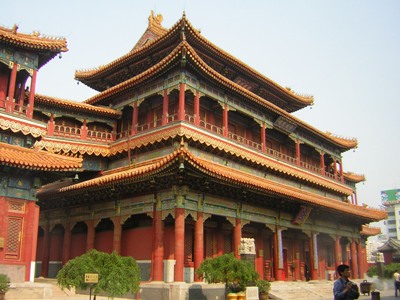
Plenty of gift shops were scattered throughout as well, in case you wanted a Buddha keychain to show your devotion to humility and sacrifice. The final stop of the day was the Confucian temple located close by. It was extremely run down, but was starting to get some of the ubiquitious scaffolding wrapped around its buildings to spruce it up a bit. As Confucianism isn't really a religion, the temple was sort of a shrine to learning and the most interesting thing they had was a warehouse of stone tablets engraved with some of the most important Confucian texts.
That night we met back up with my aunt to grab some authentic-ish Beijing culture. First, the requisite meal of Peking duck, an affair in itself. A full duck is carved up and brought to your table (they can do it at your table, but we didn't want to look like tourists, and we forgot to ask) along with some mini tortillas, a bit of sweet sauce (you might call it duck sauce, but it wasn't what you'd envision as such) and some greens. You wrap up a few pieces of duck with some greens and sauce in the tortillas and eat it up. Goood! To finish things off, they bring you a soup made from the duck remains, which you drink down steaming hot. After duck, we headed out to catch some Beijing opera. We thought we had an authentic theatre picked out and located, but when push came to shove, we ducked into a tea house (opened in the '90's but based on a very old teahouse in Shanghai) which had a selection of various types of entertainment (music, improv, gymnastics, and opera) played out over an hour and a half of tea and snacks. It all worked out well, and made for a very nice evening.
The following day was meant to be Mike's last full day in Beijing, so we decided to go see arguably the most impressive site China has to offer, the Great Wall. We returned to our dumpling restaurant for some more delicious dumplings, but decided we'd pass on the starch water and try for a bowl of one of the other soupy substances available. Upon arrival, I pointed at the first boiling pot I saw, Mike pointed at the dumplings, and we sat down ready for a treat. The dumplings were as good as ever. Unfortunately, the thing I pointed to was atrocious. It had the consistency of sneeze-snot, the flavor of salty beef, and was full of various types of beef fat and organs. I identified liver, intestines and kidney, but most of it I tried to swallow without tasting. Where are the Wheaties when you need them?
We made our way out the Great Wall with a nice Swiss woman we met at the bus station. Not knowing exactly what the deal was, we asked for transport to the site of the wall, and our driver nodded his affirmation. We were, therefore, a bit surprised when the bus stopped in the station and cut off at the end of the line. Our driver pantomimed we should just wait a minute. We followed him out to a beat-up van, which he implored us to enter. Since there were three of us and one of him, we did. We drove for a while and our driver faithfully delivered us to the wall, asked us for some more money and told us to be back in a few hours. We weren't thrilled with the deal, but since it wasn't a huge amount, we paid up and started our assent. On the way up the wall, we had to avoid some avid Uncle Leo's with waving Mao pocketwatches and "I Climbed the Great Wall" T-shirts, but once secured behind the entrance gate, it was smooth climbing. Our section of wall was neither the least nor most visited site, and since the weather was okay, but a bit misty, the crowds were extremely light. Most of the wall has crumbled over the years into a state of disrepair, and in places is just a mound distinguishable from the surrounding scenery, but not much else. In the tourist areas, however, effort has been made to keep the wall as it was, more or less, and at our site, the wall was clearly visible snaking its way along the ridgetops well into the distance (at least as far as our eyes could see in the mist).
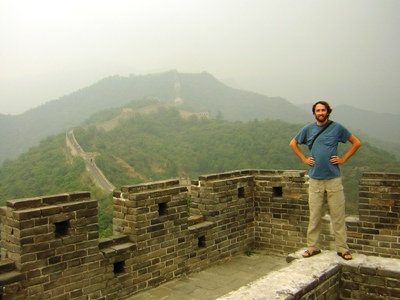
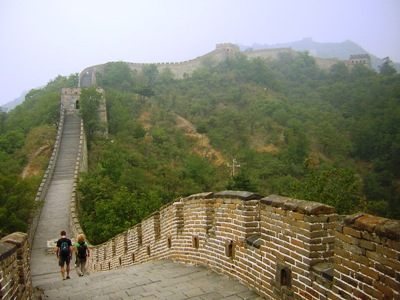
We spent our few hours climbing and descending the roling undulations of the wall along the ridgeline before relieving our driver form his vigil. The only somewhat shocking and moderately distatesteful aspect of the site (aside from the Uncle Leos and their garbage of course) were the skilifts bookending the wall and the rail-mounted sleds available to slide down the hill from the top. I realize the ski-lifts were there to make the wall accessible to all (though at times walking on the wall was more difficult than any part of the walk up), but the sleds were a carnival attraction that sort of milked the authenticity out of our rebuilt shell of a once great barrier. Maybe it was just me, though, because I think Mike would have ridden it if he'd been alone.
Our return trip was uneventful, and Mike and I made a horrid attempt of toasting his last evening in Beijing by eating Indian food and drinking two beers in a empty rooftop dance club. We woke each other up enough to realize the time had come to call it a night and headed back to the hostel. The following day I once again faced the prospect of solo decision-making and solo idiocy. What could be more fun in a Communist country?