*2. ok, here it goes... (6)
*3. SPAIN (5)
*4. DUBLIN (10)
*5. EUROPE (Sam & Dan) (13)
*6. IRELAND (5)
*7. New Years 2004-05 (1)
* HOGMANAY!!
* Xmas House party
* 04' work xmas party
* QUOTES FROM WORK
* the VAULT - visit #2
* English and Irish SLANG
* Connection2 - WORK
* the VAULT
* 'Over the Top' - Celtic Tours
* Saint Patrick
* Christ Church Cathedral
* QUOTES
* Dublin
* London
* Paris
* Zurich
* Lucerne
* Milan
* Rome
December 07, 2004
Celtic Tour
http://overthetoptours.com/default.htm
Friday
---------------------------
Man this was an AMAZING tour! our guide had so much knowledge of the Celtic history of Ireland, he was really good, and he explained it so well! the way he was speaking was a bit dull but he knew a lot and was so good I even wrote notes!
The day was so cold...man, my toes were freezing off! there were 8 of us on the tour, I made freinds with a couple of people from aus, full yobos haha and one lad from melbourne...interesting people....
ANYWAY, onto interesting stuff (in my eyes anyway)...
Some interesting facts:
* Dublin founded by Normandy Vikings over 1000 years ago
* "Celts" comes from the Greek word "Celtoid" meaninh strange/wierd, refers to the first time the Greeks saw the Celts.
* The Celts didnt live in Dublin because they believed the Gods had abandoned that area. Their belief is that their gods lived in nature and that is why they always wanted to be surrounded by nature, and at that time, the Dublin area was just swamp land and bogs, so in their thoughts the gods werent living there so they shouldnt as well
* The Celts created their dwellings about 45mins away from Dublin and traded with the Vikings around the Dublin area
* The Celts are originally from Switzerland and Austria
* Ireland had Celtic Civilisation for over 2000 years, the rest of Europe had Celtic civilisation for only 600 years
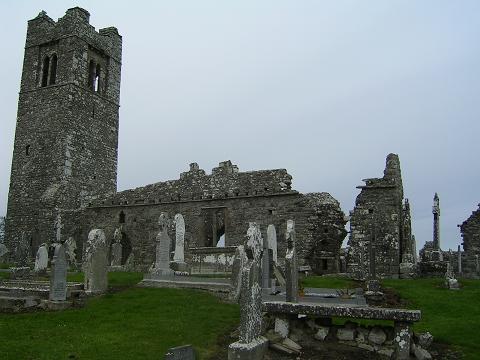
Slane Abbey
* In the year 800BC the Greek civilisation was the biggest in Europe. While they had mathematicians, huge buildings and other technologies of the time, the rest of Europe was in the bronze age, some in the Stone Age
* The Celts thought the Greeks were so powerful and wanted to be up to their standards. They learnt Iron Age from them becoming all powerful
* After gaining this knowledge from the Greeks, they conquered northern Europe between 750BC - 600BC
They also dominated the Romans at one stage in 350BC. They surrounded them and decided to steal their women and make fools of them...but not kill them, this was the biggest mistake the Celts could have made because when the Celts left the Romans womenless and penniless, after a while, the Romans grew powerful and waited and strengthened their armies and then invaded the Celts years later and wiped out the whole civilisation
* Places in Ireland dont have names - its a description like the indias i.e "he who runs with wolves" for ireland, an example is "the lake next to the hill" (the words have lost their meaning, they just write it out as it sounds)
FIRST INVASION
* The first English to invade Ireland spoke French
* Henry the 8ths family (Tudor) invaded Ireland to destroy Celtic Ireland
In 1603 they conquered Ireland and it was controlled by the English
* The English pushed the Irish to the South to the swamp lands and took over the land
* The northern parts of Ireland were advertised for free by Henry the 8th and the poor farmers from England sailed over to Ireland and took over the farmlands which are now part of Northern Ireland, UK. There is still a gap between the 2 parts of Ireland
FOURKNOCKS
Tomb Mound
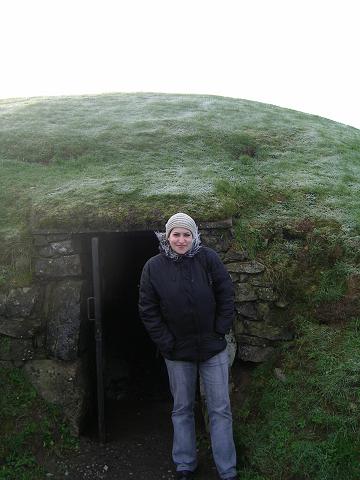
This Tomb mound is 5000 years old, older than the pyramids in Egypt
The monks in Ireland took advantage of their power and country folk would build them the mounds and they would praise the gods and bury the bodies of their people
There were some interesting carvings on the walls inside done by hand by early farmers. These farmers would have been chosen to do such a job and would have felt so privilaged to have been chosen
MONASTERBOICE
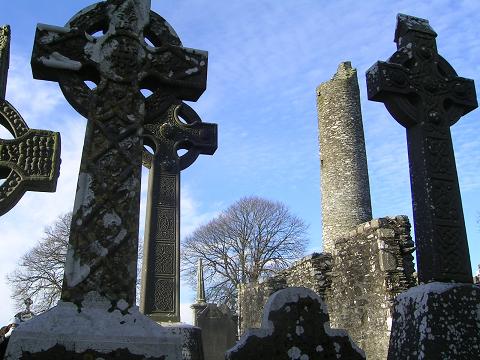
The Celtic crosses left behind are the best! these are from 926BC they are 1000 years old
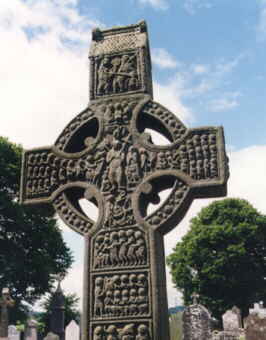
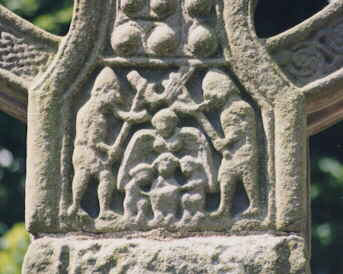
The crosses are used as a picture book of the Bible
The monastery here would have been built from wood and straw
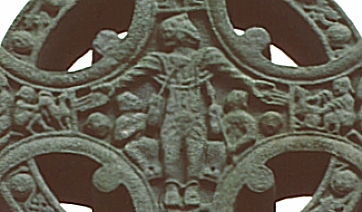
Detail on cross (taken from http://www.bluffton.edu/~sullivanm/monaster/monaster1.html)
Christ's ankles are bound and his feet, with obvious nails, rest on a foot rest. The spearbearer and spongebearer occupy the curves of the intersection of the arms and shaft. The heads on each side may represent the two thieves. The right arm represents the kiss of Judas and the arrest of Christ while the left depicts the mocking of Christ.
Two small scenes on each side of Christ are rare--the milking and the shearing of sheep. These relate to Early Christian depictions of Christ as the Good Shepherd. The milking scene relates to "the mystical milk of Paradise with which he feeds the Christian soul" and the shearing to the "unprotesting submission of the Suffering Servant who, as a sheep in the hands of the shearer is dumb"
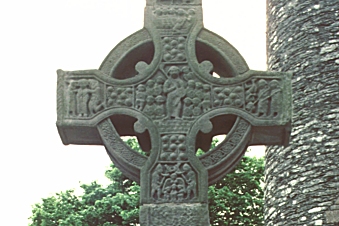
Christ is armed with sword, shield, and spear and stands with a group of armed men (the apostles?). Below this scene the story of the Hebrews in the furnace is depicted. The three Hebrews are protected under the wings of the angel while the stokers of the furnace stand on each side. This story emphasizes God's powers of deliverance and symbolizes the resurrection of Christ
Celtic Christianity
* They had no idea of heaven/hell
*suddenly Christianity comes about and they are all angry/scared, people would be killed if they were found trying to convert people
* No one knew where heaven was!
- the Celts would go to small independent monasteries and offer money to them to "make freinds" with Jesus and to fogrive them for being bad people
- monks took advantage of this and decided to make a business out of it!
- some havent even read the Bible!
- they manipulated and dominated the Celts
* Not all Monks were like this though, poor Monks would dedicate their life to Jesus
* The Celts are similar to the aborigines. They worship nature and sungods 600BC - 400BC
* Celtic Christianity accepted Jesus and still believed in their gods
Dark Age
* Dark Ages - burning of History books, mathematical books and other important documentation all over Europe
* People went to Ireland and bought as many books as they could. Monks from Ireland copied all the books by hand over and over again and they REEDUCATED Europeans after the Dark Age was over
Apparently, the Monarchy decided to scratch it from history because Ireland wasnt important enough
* The Romans never came to Ireland
read a book called "How the Irish saved civilisation" - gotta look this one up
Church of England
Henry the 8th established the Church of England because he threw out the Pope of Rome because he wouldnt let him "return" his wife who couldnt give birth. Now the Queen is head of the Church and incharge of all monasteries
Hill of Tara
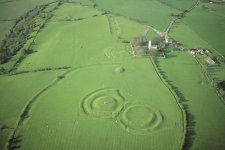
This was such an interesting site...there was not much there but knowing that this was the main seat of the kings of Ireland and where all the important events took place, sorta makes you think how utterly lucky you are standing there amongst the pellets of sheep poo...
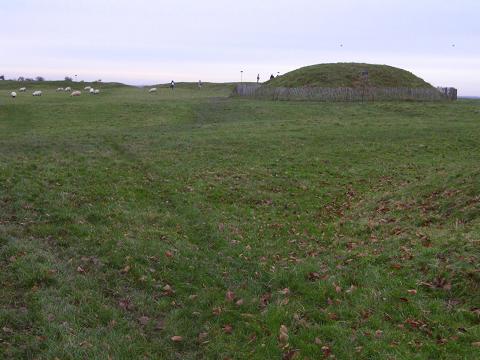
Though best known as the seat of the High Kings of Ireland, the Hill of Tara has been an important site since the late Stone Age when a passage-tomb was constructed there. Tara was at the height of its power as a political and religious centre in the early centuries after Christ.
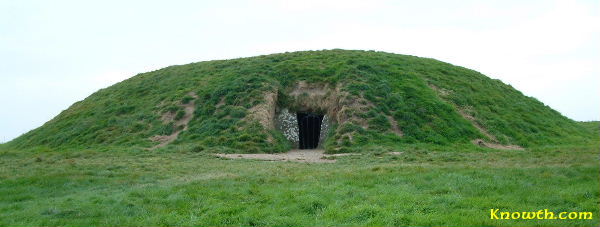
The standing stone known as the Lia Fáil, though erected on the King's Seat or Forrad around 1824, was originally sufficiently close to the Mound of the Hostages passage tomb that the two were traditionally considered to be an ensemble. This stone may once have stood in front of the entrance to the passage and, like the two pillar-shaped stones that stand in front of both the eastern and western tombs at Knowth, it too may be contemporary with the tomb and belong to a tradition of erecting standing stones around or in passage tombs.
The Lia Fáil or Stone of Destiny which stands about one metre in height is considered by some to have been a fertility symbol.
According to legend on the inauguration of a worthy high king the stone would roar its approval.
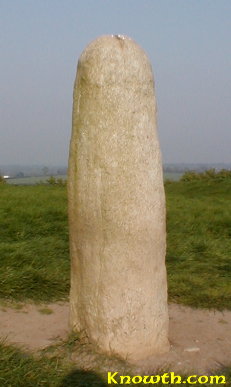
* Pagan monks would do magical ceremonies to the King. The King would hug the "stone of Destiny" transforming him into god like figure. He would be a human form of the nature beneath their feet "In the name of Tara......."
* Not a monarchy, Kings ruled at the time. They were always fighting for power against each other, whoever is the most powerful chief in the most powerful tribe would be ruler of the Hill of Tara
There are 4 main magnetic fields that flow under the ground through the Hill of Tara. Magnetic fields are what animals follow when they migrate
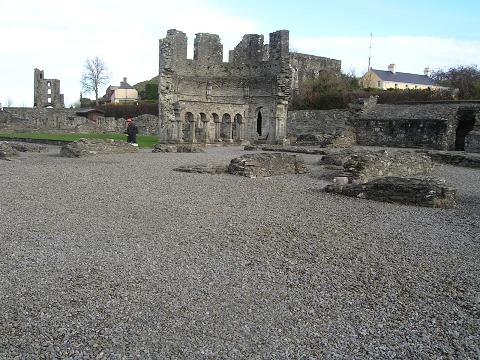
Kylemore Abbey
BATTLE OF THE BOYNE
1690 - Battle between the English and the Irish
(Ireland becoming protestant for the next 300 years)
----------------------------------------------------
(Following taken from the web http://nyny.essortment.com/battleofthebo_rrzj.htm)
The battle of the Boyne took place in July, 1690. It was an unusual battle for a number of reasons, not least because it actually took place on July 1st, but because of the changeover from the Julian to the Gregorian calendar the day is now commemorated on the 12th of July.
Background
Towards the 17th century there were two claimants for the English throne - William and James. James was a Catholic, William was a Dutch Protestant married to James’ sister. (William of Orange was actually married to James's daughter, Mary. William was the son of James's sister, also named Mary.)
William III claimed the throne of Great Britain in 1689. This also gave him a claim to the title of King of Ireland. However, James II still had control of many parts of Ireland. In July of that year James tried unsuccessfully to capture Derry. Later that year William sent 16,000 men to the North of Ireland, but they didn't engage in any battles. In June of 1690, William came to Ireland to take command.
The battle for the supremacy of the English throne was also a battle to determine the status quo throughout Europe. The southern Irish supported James, believing that he might be more lenient with Catholic Ireland than William. The northern Irish, being largely Protestant, backed William. This religious divide was seen throughout Europe, with English, Belgian and French Catholics backing James and their Protestant fellow-countrymen backing William. William also had the support of a large Dutch contingent, and some Swiss, Swedish and Finnish mercenaries.
The Battle
The two armies met at the Boyne river, near Drogheda. James and his mainly Irish army of about 26,000 were on the south bank, William and his followers, about 36,000 in all, on the north.
The battle began in the early morning. General Schomberg led some 7,500 soldiers westwards, away from the battlefield, intending to attack further up the river and come upon James from the rear. However, this move was primarily a decoy, and James took the bait. He sent a large part of his army, including his most seasoned troops, to attack Schomberg’s men. Schomberg crossed the Boyne and marched North, tracked by the opposing soldiers. However, neither side attacked the other because there was marshy ground separating them.
In the meantime, William brought his main army from behind a hill and made a head-on attack across the Boyne using experienced Dutch soldiers. He also led his cavalry in person.
James himself did not lead his troops, withdrawing instead to a hilltop well away from the scene of the battle. It is widely believed that this difference in leadership styles played a large part in the swift victory of the Williamite forces. The Irish cavalry fought desperately to save the day but they had been outmaneuvered and were never able to recover the ground lost due to being deployed by James against the decoy created by Schomberg.
Within a few hours it was clear that the Williamites would win and James retreated hastily towards Dublin. There are several stories told about his actions on the day. One story tells of Sarsfield, an Irish General in the Jacobite army who was jeered by an opposing General following the defeat. He is reputed to have said: "Change Kings and we'll fight you again!” Another story tells of King James complaining as he reached Dublin that the Irish troops ran away. A woman who lost several relations in the battle apparently replied "Congratulations, You majesty, on winning the race!”
The battle of the Boyne was a decisive European battle, one of the biggest battles of its time. The defeat of James left the throne of England, and with it control of Ireland, to William. The repercussions of this victory were felt right across Europe and persist in Ireland to the present day. On July 12th every year in Northern Ireland tens of thousands of "Orangemen", so called because they commemorate William of Orange, march in celebration of the great victory at the battle of the Boyne.
THE RIFT BETWEEN NORTH IRELAND & THE REPUBLIC
Northern Irelanders celebrate being protestant and to commemorate the success of William of Orange they have yearly parades wearing tophats and coats and an orange sash across their chests, this is supposed to signify that they are noble Englishmen
The Irish people ask why they need to parade like that on their lands
English reply with that "we are proud Englishmen" and Irish say "well celerate on your side of the land" English reply with "we can do whatever we want where ever we want because we are English" and this is how the conflict between the north and south Ireland began...
The past 2 years are the only years where someone hasnt been killed in one of these fights
To this day, there is unrest between the 2 parts of Ireland those who are the protestant and those the Catholics