* A Summer in Europe
* A Summer in Europe
* A Summer in Europe
* A Summer in Europe
July 21, 2004
Beautiful and Brave
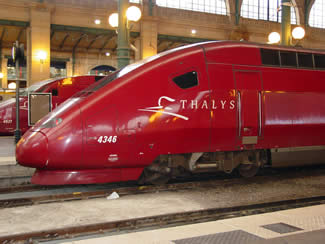
Thalys Train
Wednesday, July 21, 2004 -
We arise early this morning to check out and move on to
The train ride to Paris, Gare d'Austerlitz, is quick, slightly over an
hour. We get very confused trying to find a taxi and wait at the drop off
point for a while until we figure it out. The taxi driver we eventually
capture can best be described as surly. My French is poor so I tend to
assume I'm not understood but I have to ask him three times before he will acknowledge
that he understands where we want to go. When we get to Gare du Nord, he
refuses to accept my €10 note because it has a bank stamp on it. I
catch myself wishing I had a counterfeit note with no bank stamp on it to give
him.
What is it about Parisian taxi drivers?
The train station is chaotic as are most European train stations. We
manage to find a seat at one of the cafés and figure out how to order
coffee and rolls. Pam gets hooked into a long phone conversation with one
of her associates in
We board our Thalys train to
We arrive at Midi Station
in
At Bruges, when we get off the
train, we try to find an elevator rather than trying to wrestle our bags down
stairs. Because she stores her garment bag inside her duffel Pam's bag is
as large as a small city and equally as unwieldy going up and down
stairs. We find an elevator that deposits us in a service corridor with
no directional signs and about a thousand stored bicycles. After
wandering around for a while, we stumble out a swinging door and find ourselves
in the main terminal. Acting as if we knew where we were going all along,
we nonchalantly head for the taxi queue and ask the driver to take us to our
hotel, The
Grand Oude Burg.
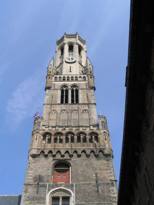
No
In addition they have a €10 an hour terminal in the lobby which doesn't
work very well. I had hoped to access my e-mail while Pam attacked hers
but I could not make the connection to my
I head for the bar, order a beer, and get into a friendly discussion with the
bartender and his friend about Lance
Armstrong and the Tour de
France which is being shown on the T.V. set in the bar. Surprising as
it may be to non-fans of bicycle racing, Lance is not universally admired, in
spite of his miraculous recovery from testicular cancer and having captured
five Tour de France titles in a row. Real fans think, since he only races
in the Tour de France, he has an unfair advantage over all the other
riders. I try to explain that he is just doing what most Americans would
do, that is go for the main prize while not worrying about all the little
prizes. I use the example of the play-off system in so many sports, both
American and European, where there is only one winner and many losers.
They don't buy it but we have fun arguing about it anyway.
Pam shows up and on the bartender's recommendation we go to a nearby Flemish
restaurant, Shtilderhuis. We have delightful
dinner. I try the onion soup and a Flemish rabbit stew which is
great. Afterwards we walk to the market square where there is a large
concert going on in honor of Belgium's National
Day. The music, however, is rap, Flemish or French rap, I can't tell
which. After listening and watching for a while, I consider joining the
ranks of those who oppose the cultural invasion of
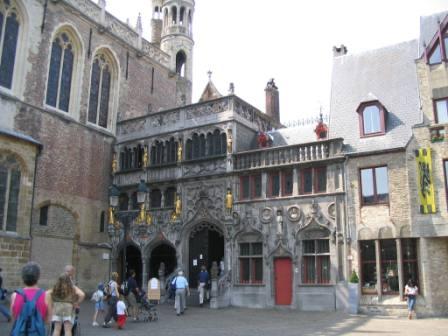
Thursday,
After a great breakfast, we decide to explore
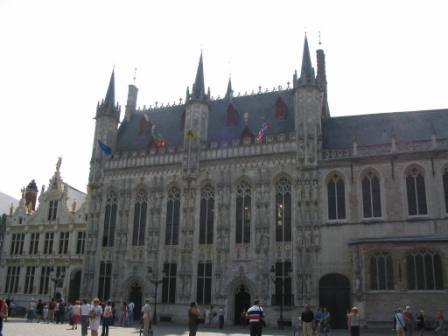
We visit City Hall which dates back
to the 15th century when
After a quick stop at the
Our next stop is the Church
of Our Lady, which contains Michelangelo's Madonna and the tombs of Charles
the Bold and his daughter Mary. As you can see from the pictures, it is a
beautiful church. Pam has the time and energy to visit the choir but I'm
fading fast so we decide to visit the local Half Moon Brewery for a
tour.
The tour is fun but a little disappointing because they no longer brew beer at
this location. There is, however, a lot of historical information to
absorb. It is obvious the Belgians take their beer seriously. At
the end of the tour we are having our complimentary beer when we meet a
delightful couple, Mike and Brenda, from
Together, the four of us head for the Beguinage.
Now a Benedictine convent, it was at one time a place where religiously
inclined women who did not want to be nuns, could live away from the rest of
society. It is certainly a peaceful spot with a beautiful garden
surrounded by living quarters and a small chapel. I am surprised to see a
nun wearing a habit. I rarely see nuns wearing habits, except in the
Philippines. We leave Mike and Brenda practicing their French with a
couple they meet and we walk to a nearby park that has a canal running through it.
I'm exhausted but Pam wants to walk much farther than I do. She takes off
and I find a grassy spot next to the canal under a tree where I can contemplate
my declining level of fitness.
When Pam returns, we walk back to our hotel. I'm tempted to take a horse
drawn carriage but I resist the temptation and instead we hike back. As
soon as we arrive, Pam checks her e-mails and I hit the bar for a beer and more
discussion about Lance Armstrong and the Tour de France.
An hour later we choose a restaurant on Simon
Stevin Square for dinner. I believe it is actually named the Simon
Stevin restaurant. The outdoor venue is across the street from the
restaurant proper. The food is great but the service is not so
good. I guess if I have to choose between the two, I'll take the
food.
We have an after dinner drink at our hotel and even more discussion about Lance
Armstrong before I finally, totally run out of steam, ascend to our room and
pass out.
Friday, July 23, 2004 -
Ypres and
This is our day to visit the WW I
battlefields in the Ypres
Salient. We walk to the pick-up point for the tour.
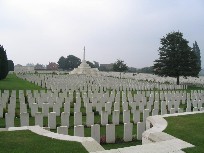
Our first stop is the Tyne
Cot Cemetery. It got its name because members of a British regiment
from
We visit the New
Zealand Memorial at Gravenstafel where many New Zealanders died in the Third Battle of Ypres
sometimes called Passchendaele. Many Kiwis and Aussies, to say
nothing of Canadians, Indians, Pakistanis, Africans, and other soldiers from
the far reaches of the empire died in this 10 or 15 square mile area. It
was a slaughter house. I have a great deal of trouble understanding how
men could have faced the terrors of not only the German guns but also drowning
in the swampy bog, they were fighting in. The thought of it reminds me of
a scene from The Bridge On the
River Kwai, when, after the bridge is blown up, the camp doctor wanders
down the river bed uttering the words "Madness, madness,
madness." over and over.
We next visit Hellfire
Corner which every soldier had to pass on his way to the front and which
the Germans had zeroed in on with their artillery. One of the most
interesting facts is that approximately 3 tons of unexploded ammunition is dug
up by farmers and others every year. There is a Belgian Army unit that
does nothing but collect this ammo and dispose of it. There are pick-up
points along the roads where the farmers leave the shells to be picked up
weekly, I believe. As we drove around the area we could see shells in the
cement containers provided for them.
We stop for lunch at the Hooge
Crater Museum. It is a small but very well done museum with a
small cafeteria: well worth the 30 minutes it takes to browse through it.
After lunch we visit Hill 60 where
the British spent over 18 months building tunnels in which to place 19 huge
mines which would then be detonated just before a planned attack. The
mines were indeed exploded and Hill 60 taken in the Battle of Messines.
We climb up the hill and see that the craters from the explosion are still
there as well as German bunkers and other artifacts from 80 years ago. By
this time we are getting confused as to what happened when and so we buy a
small study guide to try to fix the chronology in our minds. It's titled
simply
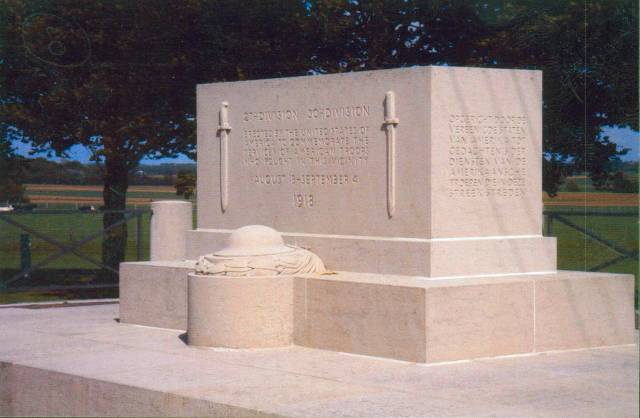
We visit an American
Memorial near Mt.
Kemmel. Evidently a few American National Guard
units were assigned to the Ypres Salient, poor bastards. Calling
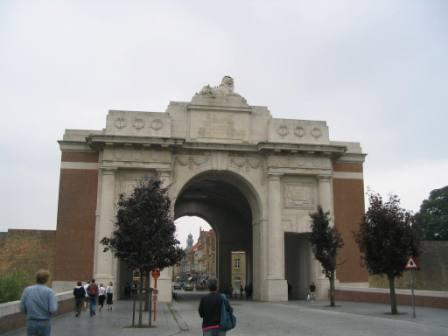
Menin Gate Memorial,
In the mid-afternoon we go to
We also explore the town itself and I am really impressed with the care and
detail that was brought to rebuilding
Our last stop is The
Essex Farm Cemetery where Lt.
Col. John McCrae, a Canadian Doctor worked at a medical dressing station
during the Second Battle of Ypres in 1915. He is best remembered
for his poem, "In Flanders Fields," written during the lulls between
batches of arriving casualties. The dugouts he worked in are still
preserved. There are paper and plastic poppies everywhere we visit as
they have become the symbol of remembrance of those who died so needlessly in
the so-called "Great War." It's time to head back to
I have an interesting conversation with
After a short nap, Pam and I head for dinner at the Breydel de Connick
Restaurant on Beder Strasse. This is one of the better known restaurants
in