Journey To The Centre Of The Earth
The Carnivalesque
Caves and Canyons
Lefkada, and Quite a Lot About Goats
A Disquisition on Hellenic Philosophy and Drinking Shots
Madwoman, monks, crazy Corfu rain
Santa Claus Is Coming To Preveza
Citrus, Newtown, Philosophical Musings
Cataclysmic Chaos. And Bondage.
Free radicals
Here we go...
Barney Jeffries
February 18, 2004
Shortly after St Valentine’s Day (and what did he do? I must research my saints more. Not least because I need to find out when St Barnabas’ day is. Namedays here are more important than birthdays, so I’d be gutted to miss mine. Have to have a search for a saints website. www.saintsfc.co.uk is great, but not quite the thing in this case. Anyway…)
The car we hire in Preveza turns out to be the selfsame Suzuki I was driving on Lefkada on Tuesday. Small world, or at least, small part of Greece. They’ve fixed the CD player though. We’re planning to head north, up to the Zagoria region in the mountains beyond Ioannina. We’re apprehensive, since the weather – so much for Bird Season – has gone mental.
Preveza has turned freezing cold with piercing arctic winds. But it’s about the only part of Greece where it hasn’t snowed. There’s been a fresh fall up on the Lefkada peaks where we were the other day, and on our other horizon mountains. But it’s other, surprising parts of the country where it’s really hit hard. There are pictures on TV of abandoned, snowed-in cars on the main Athens – Larissa highway, storms on Crete, heavy snow on Chios.
It’s a mixture of relief and disappointment, then, as we make our way up through Epirus on clear roads, the only snow to be seen high on the mountainsides. First stop on this little holiday is Perama, a village on the lakeside just beyond Ioannina. The sight here, as half-a-hundred road signs will not fail to remind you, is the Cave – Greece’s second largest.
It was discovered during WW2, by locals looking for a hiding place from the Nazis. There’s a kilometre-long walkway through the hillside, with steep steps and narrow passageways opening out into two vast chambers. The deeper you get, the more spectacular the formations become. In one hall, a cluster of stalagmites seem a crowd of people assembling for some great meeting. Others tower like fairytale castles atop Rhineland cliffs.
The couple who first explored the cave gave names to some of the most striking formations, which the attendant – we’re getting our own private tour – points out to us. Some of them are brilliantly apt: the harmonium, the bottles, the cacti, the Leaning Tower of Pisa and a remarkable sphinx. There’s great variation, in colour, shape, size and texture, from one place to the next. No idea why.
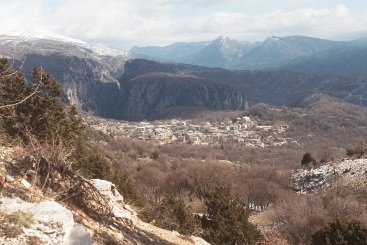
Back in daylight, we head north along a wide, green plane, before turning off up a hair-raising zigzag road into the Zagoria. Our destination is Monodendri, about 30km from Ioannina, one of the villages of the region known as the Zagarohoria. The houses here are built from the grey slate of the surrounding hillside, and they blend seamlessly into the landscape – camouflaged, almost. Although it’s clearly expensive to get your roof re-slated, and so a fair few of the older ones are covered in corrugated iron instead. Not so attractive, obviously, but it’s quite refreshing – the place still feels real and lived-in, not chocolate-box prettified.
These villages, which are become increasingly popular with tourists but retain a remote, slightly otherworldly feel. Monodendri is one of the more developed – there’s a lot of hotels and tavernas, although few are open at this time of year. More are being built. Thankfully – and unusually for Greece – they seem to have got the idea that people are attracted to the old slate houses, and the new stuff is being built – or clad, anyway – in the same style.
(Unfinished concrete buildings are an ugly rash all over the Greek landscape, scarring practically every vista. At the risk of sounding like a prissy English person, this country seriously needs some planning laws. Actually, I think they have them – they’re just rarely applied. An MP recently got sacked for supporting an illegal timeshare development in his Halkidiki constituency. Not for taking bribes from the developers – that’s normal enough. His particular crime was forging MP’s signatures to push his bill through parliament.)
Monodendri means ‘single tree’ which is a lie, but probably refers to the large plane tree in the village square. In the summer, this must be a lovely shady place for a long drink, but today is definitely a day for brandy and hot chocolate huddled beside a roaring log fire, and luckily one of the cafes off the square provides just that. The place we eat, however, is freezing. There is a fire, but the village’s other tourists – a pair of French guys – occupy the table beside it, and at our end of the room we can see our breath in the air as we eat our pittes and fried potatoes. Pie and chips. Traditional zagoria dish, actually.
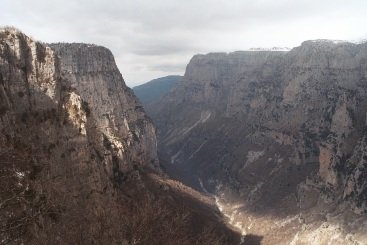
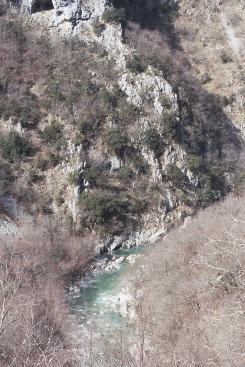
Breakfast is even colder, and there’s a whisper of snow in the air. We follow the path from Monodendri down to the Vikos Gorge. A sign tells us that, according to the 1997 Guinness Book of Records, this is the deepest canyon in the world. In 1997, anyway. At any rate, it’s nearly an hour’s walk down to the bottom, and a stunning view of the rearing rock walls, the green stream half-frozen. There’s icy snow on the path, though, and we decide (with some reluctance, on my part anyway) that we’re not kitted out for the seven hour hike up the gorge.
Instead, we climb back to the car, and drive then walk to the Oxia viewpoint, which is purportedly the best place to see the gorge in all its glory. Ye gods. I have a reasonable head for heights, but I’m near paralysed by vertigo as we stand on the edge of a sheer thousand metre drop. If anyone’s looking for a place to commit suicide, I’d recommend this highly.
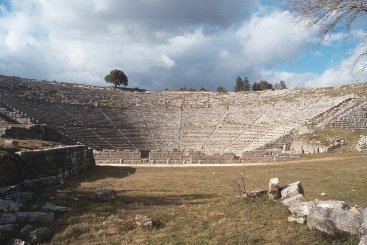
Later, we drive back through Ioannina and along another terrifying mountain road to ancient Dodoni. This is the site of the oldest oracle of the ancient world, with remains from Bronze Age (2600BC) to early Christian times. The oracle – dedicated to Zeus – based its message on the rustling of leaves in a sacred oak tree and the flight of the pigeons that nested there. Open to interpretation, that. Most of the site is just ruins which don’t mean much to the layman. But there’s the glorious exception of a well-preserved ancient amphitheatre, where plays are still performed in the summer. And the setting, in a wide valley ringed by tall mountains, is something special, even by the standards of other great ancient sites. The sun is out, and we have the place entirely to ourselves.
Back in Ioannina, we and the rest of the world have coffee by the lakeside. The benches and railings by the water are covered in icicles. The Tex-Mex restaurant, Poco Loco (see earlier entry) seems more incongruous then ever. Ioannina apparently has the second highest car-to-people ration in Europe, after Milan. It’s grown from a town to a city with no thought to planning. Parking is next to impossible, especially for one who still has an English mentality.
On a street in Preveza recently, I saw my first triple-parked car.
Category: