Journey To The Centre Of The Earth
The Carnivalesque
Caves and Canyons
Lefkada, and Quite a Lot About Goats
A Disquisition on Hellenic Philosophy and Drinking Shots
Madwoman, monks, crazy Corfu rain
Santa Claus Is Coming To Preveza
Citrus, Newtown, Philosophical Musings
Cataclysmic Chaos. And Bondage.
Free radicals
Here we go...
Barney Jeffries
February 11, 2004
The Feast Of Saint Haralambos (February 10th – you knew that)
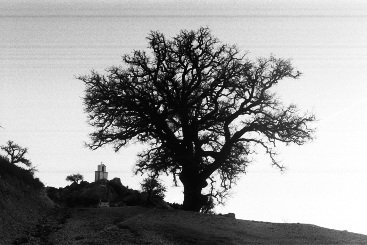
Greeks like their public holidays. Any excuse for a day off work and general eating, drinking and merriment instead – and good for them, I say. Today is a holiday in Preveza alone, celebrating the feast of our local patron saint, Agios Haralambos. Can’t tell you much about him, I’m afraid. As far as I know, he didn’t perform any miracles today. But the Greek flags were out on the streets and the schools were off, so we took the opportunity to spend a day on Lefkada.
Lefkada is the island on our southwest horizon, where the sun goes. Some days it’s clear enough to see roads and houses, other times it evaporates into a haze, and sometimes the clouds collect on its peaks, and then Lefkada disappears altogether into rain.
It’s only just a proper island. It used to be joined to the mainland by an isthmus (love that word!) until the 8th century BC, when they dug a canal. These days, there’s a short causeway and tiny ferry-bridge joining it to the mainland. All of which means that we can get there by bus in half an hour.
Lefkada Town is smaller than Preveza, but too populous to shut down for the winter: there’s an air of bustle, and a few brave (or English) souls are even sitting at outdoor café tables. The weather has finally heeded the continuing gripes in this blog and has got its act together – the last week or so has been lovely, although locals in their heavy winter coats cast funny looks at me in a T-shirt. Apparently this spell of warm weather is an annual fixture dating back to myth – Demeter planting her seeds, and some mythological bird (sorry, this is third-hand information) laying her eggs – ‘Bird Season’, it’s called.
Lefkada has suffered badly from earthquakes – there was one this summer that made the English papers. The upper storeys of the buildings in town are made of corrugated iron or sheet metal as an earthquake defence. They’re oddly attractive: shanty-town-chic, maybe. The lampposts are decorated, pre-carnival, with scary clowns, Ronald Macdonald’s embittered cousins.
A lagoon and the narrow channel to the mainland provide a sheltered anchorage, and even at this time of year there’s a fair few yachts in the marina. Hiring a yacht would be perfect, but we have to make do with a car. Question: what on earth do the people in the car hire places (and there’s at least three in Lefkada Town) do all day in the winter? Is it really worth staying open in the occasional hope that a group of English teachers will turn up and earn you 25 euros?
Rachel doesn’t drive, and John and Melanie don’t have their licenses, so I’m stuck with the driving. Which is fine, even on crazy island-mountain roads, although the necessity of looking at the road rather than the view can become a tad tedious. Because once we leave town and zig-zag up the hills, through olive groves and cypress trees, we open up some stupendous views. Lefkada itself is gloriously green – the silver shade of the olives, the dark firs, the lurid absinthe of the spring grass. The first crocuses are out, and a frosting of what I believe botanists call Daisies, Only Bigger.
[And we have a black-and-white film in the camera. You'll just have to take my word for it.]
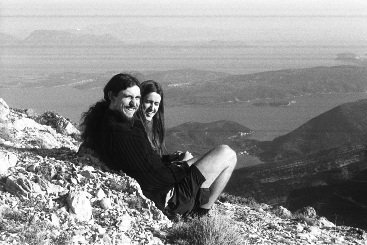
The island dips in the centre, creating a sort of secret vale with a reservoir in the centre and villages perched (BUZZ! Travel-writing cliché!) around the rim. We continue climbing till we’re up above the tree line, onto a plateau. The flatter parts of the stony ground have been cultivated: there are neat little ploughed fields, and Real Live Peasants working the land. One old woman clad all in widow’s black is tilling a field by hand. It’s a world away from EU subsidies, East Anglian sugar beet barons and intensive agribusiness. Good luck to her.
We park the car where the road winds out, near the top of one of the island’s twin peaks – an elevation of about 1200m, higher than anywhere in England – and take a stroll round the plateau. The sun’s out, but it’s chilly up here – there’s even a few patches of old snow on the ground.
The views are quite magnificent. We can see miles up the coast from Preveza, with the island of Paxi clearly visible to the north, and the faintest outline of Corfu hazy on the horizon. The Ambracian Gulf and the flat land to the east gives way to rearing mountains. The channel between Lefkada and the mainland holds a miniature archipelago of bottle-green islets stretched out like a map beneath us: we can look right down on Ari Onnassis’ private island, Skorpios. South of Lefkada are hump-backed Ithaki and, beyond, Kefalonia. To the west, nothing but the gorgeous turquoise of the Ionian.
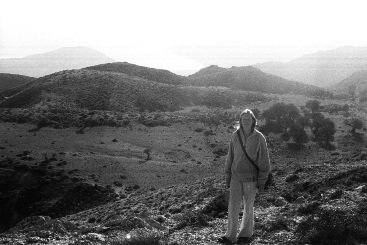
It’s a strange landscape up here, with ridges of jagged rock bent back by ancient earthquakes, with sage bushes and scrubby shrubs, and incongruous hollows of flat, grassy ground which would be perfect places to pitch a tent. The grey-white rock is layered and full of holes: I’m only moderately surprised when I find a fossilised ammonite. Still, I wish I had a clearer knowledge of geology. Igneous, sedimentary and metamorphic – that’s all I remember from school.
Our drive back down involves a hairy stretch of unpaved road, slipping down most of the way with my foot on the brake and looking out for falling rocks. When we do reach paved road, we find ourselves following a herd of sheep. Or more precisely, a herd of sheep and two goats. There’s a biblical passage, I believe, about Jesus separating the sheep and the goats at the day of judgement. There’s no need: the goats will go off of their own accord eventually, probably to climb onto a roof or go and chew someone’s washing. I think it’s meant to be the sheep that go to heaven, but I’m with the goats: there’s another parable in there, about doing your own thing and not blindly following the herd.
We see working donkeys, too, or probably mules, as we drive back down to a civilisation which isn’t quite 21st century. Don’t feel too sorry for the donkeys though: I almost drive off the road in surprise when we pass a van coming the other way and there’s a donkey staring out the windscreen at me. It’s standing in the back, leaning over the front seat beside the driver. I suppose people used to get similar shocks when they saw my family transporting our goat around in the back of the Ford Escort.
More goat stuff, while we’re at it. One of the most stunning of the superb beaches on Lefkada’s dramatic west coast is Porto Katsiki. The tour brochure we read proudly proclaims: ‘Once you see this beautiful beach you will realise that it’s not called the Bay of the White Goat for nothing.’ Indeed.
The sheltered east coast has deep inlets and glassy water, but is less enticing than the west, and more developed: there’s an almost unbroken chain of shut-up resorts all the way back to Lefkada Town, although it’s much more low-key than Corfu and the like. Spot a car rental firm called Abacus (slogan: ‘You can count on us’).
This week is the last for eating meat before Lent, culminating on Smokey Thursday, when everyone eats at the Psistarias (spit-grill tavernas). After that, there’s no meat for the pious till Easter. Then everyone feasts on entrail soup and – are you beginning to sense a theme? – grilled goat.
Category: