Journey To The Centre Of The Earth
The Carnivalesque
Caves and Canyons
Lefkada, and Quite a Lot About Goats
A Disquisition on Hellenic Philosophy and Drinking Shots
Madwoman, monks, crazy Corfu rain
Santa Claus Is Coming To Preveza
Citrus, Newtown, Philosophical Musings
Cataclysmic Chaos. And Bondage.
Free radicals
Here we go...
Barney Jeffries
January 21, 2004
January, middle of – back after Christmas in the U.K. (May talk about that later, may not. Don’t hold your breath)
Corfu for the weekend. Spending too long in Preveza probably doesn’t do great things for one’s sanity, and we need to make the most of our time in Greece, so, along with Sharon and Rupert, we hire a Micra and head north up the coast, past shut-down beech resorts, barren, craggy hills and flat green planes to Igoumenitsa. This is the last port, and the last town of any size, before Albania, taking a lot of freight for Italy, and it’s growing at an alarming rate. Hideous concrete wall of a place, but luckily we don’t have long to wait for a ferry.
In Corfu Town, we finally find the Hotel Hermes. It was while searching for this budget hotel on our first trip to the island that Rachel and I first encountered the Strange Old Man with whom we stayed… but since I’m trying to sell that story to some other travel publications at the moment, I won’t say any more. It’s fine (an improvement on the Old Man’s shack) and ye gods, it has a shower curtain – an extraordinary innovation for Greece. Still, there’s a part of me in conflict with the budget traveller which longs for hotels of big white beds, fluffy towels and satellite TV.
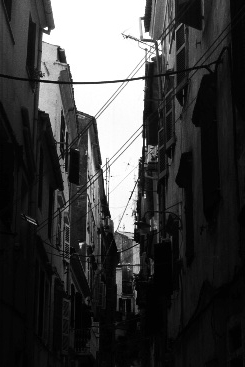
The streets of Kerkyra look strange at this time of year, the tourist shops shut down and the pavement tables deserted. Disorientating – we look for the centre of town as we remember it, and can’t find it. Not a complaint, this: we appreciate the beauty of the buildings more than ever. The washing stretched out to dry across the narrow streets of the old Jewish quarter, the dilapidated Venetian houses, the elegance of the cafés along the Liston arcade, the strange anomaly of the British influence: the cricket ground and the bandstand in the park. It’s a great town.
We have another wander in daylight the next morning, with elderly locals out strolling in their Sunday best; take a look around the fine old fortress and the mosaics in its museum. On our way back through the back streets, we’re accosted by an American madwoman. She’s wearing a bizarre mauve felt sack-dress, ski goggles, flowers in her hair, and is pushing around what could possibly be all her worldly goods in an old push chair. What need worldly goods? The Lord provides for her. She’s here writing a book about the promises God has made in the Bible (she’s counted over two hundred); she loves Greece, principally because kids learn the Bible in school. The Last Days are approaching, we’re informed; Jesus wants us, but Satan wants us too. And incidentally, the Bible also tells us how to get mildew out of mauve felt dresses, although she doesn’t provide the reference. “Time is love,” she tells us, thanking us for ours. We leave with her blessing, relieved to get away.
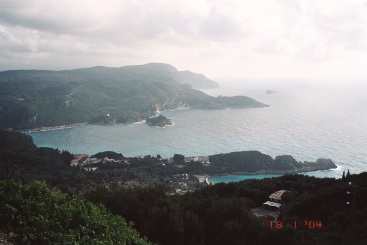
Off in the car then to the west coast, to Paleokastritsa, possibly the most beautiful point on possibly the most beautiful island in Greece. It’s overdeveloped, though not so horrendously as some parts of Corfu, but is a ghost town now, completely shut up. Seeing the beaches empty, you can almost imagine how gorgeous it once was here: rearing cliffs, emerald hills, and sparkling arced coves of white sand with the water that unique Ionian blue: I’m not going to bother with ‘azure’, ‘turquoise’, ‘iridescent’ or any of the other inadequate attempts to describe it. The sea here retains a blueness even under grey clouds; when the sun comes out, it’s transfigured into something magic.
We walk up to the monastery, and chat to a couple of monks outside their vegetable garden. We start off in Greek, but they quickly switch into excellent English. One of them studied chemical engineering in Birmingham back in the 70s. He says he found Birmingham very dull – he used to go London or Brighton for the weekends. Now, it doesn’t say much for a city if a monk found it dull… then again, I’m told the clubbing scene in Birmingham has really come on in the last few years. They’ve got a lovely garden, and quite a menagerie of peacocks, turkeys, chickens and Muscovy ducks. Being a monk here must be a pretty good life, I reckon. We’re invited for coffee later, if we’re still around, but right now they have to go and pray.
Reluctantly, we decide we need to make a move. We drive up to Lakones, a pretty old village high on the hillside overlooking the bay, and have lunch in a restaurant which has stupendous views and overpriced food, but does boast the major advantage of actually being open. We get a lot of strange looks from locals of all ages; English people are a rare sight at this time of year.
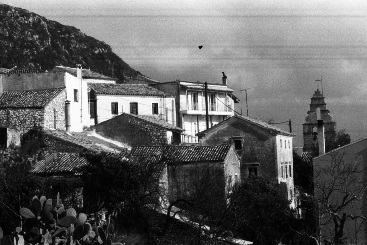
Up more crazy winding hill roads to the ruined fortress of Agios Angelos, a Byzantine ruin on top of a towering rocky outcrop, hundreds of metres above the sea. An impenetrable fortress – at least to us, since we find the gate locked. Another of the downsides of travel out of season – but the views are amazing.
Then on to Pelekas, where a view-point gives a fantastic 360 degree panorama of the whole island, and the ominous clouds which are building below us. Some lucky bastards are paragliding off the hillside, swooping and hovering above the sea. At the Sunset Restaurant, we insist on sitting outside in the cold, to the consternation of the waitress and the Greek customers. We even order iced frappes. It’s been a fine day, but the sunset is disappointing. Still, a sun-sized hole opens up in the cloud for just long enough.
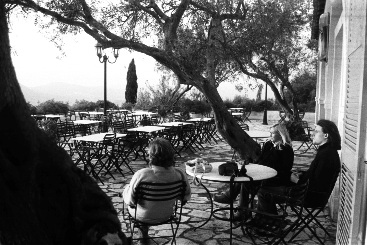
Back in Kerkyra, the clouds finally open. Corfu, lush and green, receives more rainfall than anywhere else in Greece, and seems inordinately proud of the fact. Just like every other time we’ve been, there’s a tremendous rain storm. We watch the downpour for a few minutes from underneath a shop awning, before making a splashing dash for Goody’s. Typically, as soon as we’re inside Greece’s number one fastfood restaurant, the rain stops.
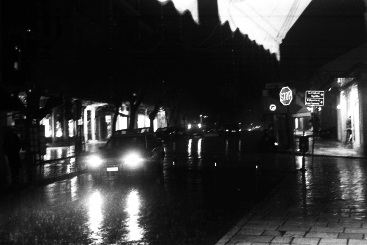
We get back to Igoumenitsa at around half-nine. It’s dark, and the steep, winding roads are still wet, so I drive at a reasonable speed, and consequently get overtaken by several lorries. This is humiliating to the driver’s ego, but I don’t have any great desire to become another statistic and another roadside shrine. To any Greeks concerned about their country having the highest road fatalities in Europe, I offer this advice: stop driving like maniacs!
The car doesn’t have to go back till Monday lunchtime, so we have the added joy of a trip to the Lidl superstore: ah, the glorious freedom of private transport!
Category: