June 05, 2004
Whit Monday
OK, that was meant to be a short break, not two months. Things have moved on a little, not least in that I’m no longer in Preveza or, indeed, Greece. This blog is subtitled ‘A Winter In Preveza’, and since even England is grudgingly accepting that it’s about time summer began, it’s about time for this blog to end. First, let me rewind a few weeks which seem far longer and return to Nafplio. We’ll talk about that, then anything else that comes to mind, and then maybe I’ll finally get round to adding some photos to this site, and then we’ll leave it out in cyberspace, to be seen, perhaps, like the light of a star, years later.
So. Here’s a tip for high-flying metropolitan twenty-or-thirtysomething couples: if you’re thinking of a Greek city break, forget Athens, and Thessaloniki isn’t easy to fly to, and head for Nafplio. (Fly to Athens and hire a car – it’s less than two hours’ drive). Nafplio is hardly a city, but it was the first capital of independent Greece, and as a result has some fine old neo-classical civic buildings, wide parks, a marble-paved central square… it’s the most elegant town in Greece by several light-years.
The Venetians controlled the port for centuries, which shows in the tall buildings and narrow alleyways. They were determined to hold onto it, building fortresses all over the place: one sits on an island guarding the mouth of the harbour, another sits on top of a towering rock, 999 steps above the town. The old town is extensive and almost entirely free of ugliness; touristy, yes, but in a bearable way. Sitting outside a café in the town square with a beer or a breakfast, watching kids playing football, couples strolling, friends and extended families meeting, is an enduring pleasure. More cafes line the seafront. There’s a surprisingly well-maintained path skirting around the bottom of the fortress to a small beach, which makes a good stroll.
If you don’t like strolling and sitting around in cafes, Nafplio probably isn’t for you. Nor Greece, come to that. All the same, it’s a great base for exploring the area. There’s a beautiful beach a few miles out of town (we do swim, but it’s freezing) and pleasingly pastoral scenery, all rolling hills, orange and olive groves and wild flowers. There’s also a lot of ancient sites worth seeing: we don’t visit Ancient Tiryns, but its huge walls are an imposing sight from the road – massive boulders, and 20m thick in places.
Epidavros Theatre is stunning – it seats 15,000, and its famous acoustics are no myth. We don’t have a pin, but you can hear a coin drop from the back row. The theatre was part of a sanctuary to Asklepius, god of healing – drama therapy. There is something clam and reviving about the setting, and the theatre, as usual, unfurls a magnificent vista. Last time I was here, a group of English sixth-form girls sang an a cappella version of ‘The Sound of Silence’, which was gorgeous – no repeat of that, although Cheryl gives us the first few lines of ‘All the world’s a stage…’ Maybe not the most original choice, but can you think of a better one?
Mycenae is an altogether different site. While the ancient Greeks of Epidavros and the Parthenon seem directly connected with us, the Mycenaeans feel as remote as the people who built Stonehenge – and I think they’re roughly contemporary, although the Mycenaean civilization was far more advanced than Bronze Age Britain. It’s partly that Plato, Sophocles and Pericles belong to recorded history, whereas Agamemnon and co are names out of myth. Which, of course, makes it all the more remarkable to see his palace and possible tomb – discovered pretty much as described by Homer.
The Lion Gate is, Cheryl tells us, the oldest piece of ornamental architecture is Europe. The walls around it, like those of Tiryns, are made up of massive blocks of stone – constructed by the Cyclops, apparently (and I’d like to hear a better explanation). The Treasury of Atreus is equally impressive – a vast tomb under the hill, its brick walls tapering to a point – they hadn’t quite discovered the idea of arches. Its called, for its shape, a beehive tomb, and is full of bees, who presumably consider it a wonderful home. Swarming, also, with school parties.
Over the far side of the site, things are less obviously striking, and so less visited. And because of that, it’s a lot more satisfying, as you take in the landscape, the flat plane (of a retreated sea?) below, the hills behind, wild flowers and birdsong, goat bells in the distance – and a palace built 4500 years ago for a king, whatever a king is for. [Wonder if it features in the film of Troy?] Round this side, you’ll also find the ‘Secret Cistern’, where several hundred steps wind down into the rock. I make my way down until it’s too dark to see a thing, then feel my way a bit further, before getting scared and turning back. Take a torch.
One last thing about Nafplio: if you go, please take a spray can to deface the Far-Right-scumbag graffiti which scars a few too many walls around here.
Well. That trip ended, we returned to Preveza, and soon were back in England – just, of course, as the warm weather had truly arrived. I may add some bits and pieces to this in the future. If you’re ever going to Prezeza, drop me a line, and send it my love.
View/Add Comments (0) | Category:
April 15, 2004
Late March
Long time no blog – have been busy with a play and – ye gods! – paid work, as in, like, for money. Since I last wrote, spring has come, gone, returned with a vengeance, then absentmindedly wandered off again – all very confusing, but better, apparently, than England. Preveza is gorgeous when the sun’s out – the tables take over the pavements, the light glows off the still waters of the gulf, everything slows. Greece as a whole just works better in summer (all the construction workers suddenly start working too – they’re digging up streets, painting things, even – optimistically, or perhaps as a joke – creating zebra crossings). A barbecue on our rooftop was a highlight: halloumi [not helium, whatever the spellchecker thinks, nor thallium] cheese and vegetable kebabs; swordfish steak, sardines and shrimp. (Or shrimps? Fish or fishes? Oh the joys of conversation with EFL teachers…)
Anyway…
Last Thursday was Greek Independence Day and yet another national holiday. Sadly, we had to do without another day of watching school children marching out-of-step and waving flags, as we were meeting Rachel’s mum from the airport.
Six a.m. is not a civilised time to get out of bed, particularly when normal rising time is about 11, but it’s a pretty journey as the sun is rising. The hillsides are yellow with wildflowers, and trees blossom in white and startling magenta. Some of the fields are so green you could almost mistake them for England.
The journey down to Antirio takes us through Vonitsa – a small town across the straits from here, with a fine Crusader castle – and along the lake-like coast of the gulf to Amfilochia, an appealing hideaway tucked under the hills at the end of a long inlet. The morning sun has given way to torrential rain as the road heads through a long, fertile vale with high green hills on either side, to the agricultural town of Agrinio. Passing through a towering gorge – partly blasted by the Germans during the war – we skirt past the lagoons of Mesalongi, where Byron died and part of him (his heart?) is buried.
We’ve seen two signs en route telling us that the Antirio-Rio ferry is open. The third one is more circumspect, saying ‘Antirio Open Antirio Closed’ – which has the advantage of never being wrong, though is also never right. When we get there, it’s closed of course. A narrow channel between two mountains opening out onto the sea, it’s an obvious wind trip. Hurry up and finish that bridge! (The Olympic flame, which is being lit at ancient Olympia this very day, is due to pass over the newly-opened bridge in early August. Though they’re making progress, they may yet have to employ a long jumper to run that leg).
So we have to take the slow though pretty route along the north of the gulf of Corinth, via Nafpaktos with its fortified harbour, through an endless olive grove (the largest in Greece, apparently) and up into the hills near Delphi. Annoying, this: Delphi is our intended destination for this evening – but there’s a small matter of five hours and 400km to pick Cheryl up from Athens airport. We climb half way up Mount Parnassus, then down to Thiva – ancient Thebes – where we join one of Greece’s very few motorways as far as the choked-up concrete sprawl which is Athens. Corinth, Delphi, Mount Parnassus, Thebes – a lot of mythological baggage for one journey.
Cheryl’s flight is on time; we’re not, having got lost on the Athens ring road. It’s a sunny day again now as we turn around and drive back to Delphi. We decide to spend the night in Arachova, a trendy skiing village a few kilometres east of Delphi. Arachova’s an attractive place built on a steep hillside in the shadow of Parnassus, stopping abruptly on the edge of sheer cliffs. The air is sweet with the honey-smell of almond blossom and noisy with bees and birds (a feature of this trip, the birds in particular – they’re busy shagging at the moment, and making quite a noise about it). Like Metsovo, Arachova sells itself hard, with rugs, wooden handicrafts, smoked meats and cheeses competing with the fashionable skiwear. Pasta appears to be another local speciality. Having driven 700km today though, I’m only really interested in sleeping.
To Delphi next morning, mercifully before too many coach parties arrive. If your interest in Greece is archaeological rather than [is there an adjective ‘pertaining to beaches’? Liminal, maybe?] then you should definitely visit out of season – far fewer people, not too hot for the considerable amount of walking required, and, at this time of year, it’s beautiful with the flowers and the blossom, and the snow-capped peaks in the distance.
Zeus released a pair of eagles from either end of the universe, and Delphi is where they met. It’s not a bad site for the centre of the world: two massive rocks rear up above, a deep wooded valley is spread out below. There is something magical about the place – those ancient Greeks certainly knew how to choose a sacred site.
In its heyday, Delphi must have been quite extraordinary. The treasures and spoils of war that used to line the marble-paved Sacred Way – gifts of thanks to the Oracle – have long been looted, but there’s enough left here for the imagination to work on: a few pillars of the Temple of Apollo, the Omphalos (the navel of the earth – the rock where the priestess sat, high on munching poisonous laurel leaves), a well-preserved theatre, the ancient stadium where the Pythian Games, as important as the Olympics, were held every four years. Further down the mountainside is the separate sanctuary of Athena, with the round tholos that you see on all the postcards. All the while you’re taken in by the scenery, left in no doubt that gods live on mountaintops.
We stop for lunch in the modern village of Delphi, about a mile from the site. It’s a great location, snow-capped Mount Parnassus behind, a glimpse of the sea beyond the acres of olives far below. Winding down to the sea, we follow the coast road west again, making a detour to Galaxidi. This serene little town sits on the end of a promontory looking back towards Delphi, a church tower peeking above the red roofs. It was wealthy once through ship-building, and there are a lot of tall, old houses of solid stone – and a refreshing lack of half-built concrete towerblocks. Cafes and fish tavernas line the sheltered seafront. It has an island atmosphere – something like Hydra or Paxi. Some Greeks come on holiday here, but remarkably it doesn’t seem to have been ferreted out by the upmarket ‘unspoilt Greece’ holiday companies, despite having beaches and Delphi nearby. So let’s keep it to ourselves, OK?
[To digress: Preveza still has a fair number of these old houses, the Venetian and neo-classical mansions. But with some exceptions, people don’t want to live in them. Many stand derelict, tumbledown – and rather than be restored, they’re more likely to be knocked down and something concrete built instead. Someone explained that this is because they’re unsafe in earthquakes, of which Preveza gets a few (we’ve felt maybe four or five little shakes – the longest one lasting about ten seconds, making the light bulb swing and your insides wobble). I don’t know. I think it’s fair to say that Greeks have less of an attachment to aesthetics than the English – despite inventing the word. Maybe it’s not fair to say that – I can imagine howls of disapproval and arguments that the English are all Philistines. But they do seem to have a higher tolerance of unsightliness here. And they probably don’t have a word for unsightliness. Earthquakes or not, those old houses would be the expensive des-res places if they were in the UK. We, after all, are a nation of barn conversions. Near to my home village in Wiltshire, an old converted barn recently burnt to the ground. The owners built a brand new barn conversion.]
Leaving Galaxidi, we carry on coastwards to Agios Nikolaos, where the map and a couple of road signs tell us there’s another ferry across the Gulf of Corinth. It’s a longer crossing than the Rio one – about three-quarters of an hour – but cuts out a good deal of driving. Agios Nikolaos is an unlikely place, making Antirio seem like Dover. But a ferry there is, ploughing its way back and forth between here and Egio, a much larger town on the Peloponnese. We make the crossing at sunset, though there’s no sun now, just a gloomy gloaming mist over the now-calm water.
Driving in Greece has generally been fine, and you learn to deal with the fact that the majority of other drivers are complete psychopaths. The Patras-Corinth highway, however, is not good for the nerves, particularly at night. It’s one of the country’s biggest and busiest roads, but is only dual carriageway in a few places. This is mad. With the tiniest amount of work, it could be a nice, sane dual carriageway all along. Instead, it’s a strange system of wide hard shoulders, and lines down the middle which are sometimes dotted, sometimes solid, and invariably ignored. The general system seems to be to position yourself somewhere between the lane and the hard shoulder, until some lunatic hares up behind you flashing his lights, at which you pull over as far to the right as you can, while they overtake you. As they do so, they normally have to stray into the oncoming carriageway, so those cars also pull over into the hard shoulder to make room. Unless someone also happens to be overtaking in the other direction. In which case there’s a high-speed head-on collision and a multiple pile-up. Remarkably, this doesn’t actually happen while we’re on the road, despite the continual overtaking on blind bends and the brows of hills – of which there are many. Whoever the Greek god or Orthodox patron saint of crazy drivers is surely has their work cut out.
Well, we make it safely to Nafplio, but this entry is getting long and there’s a lot left to say so I think I’ll break it here.
View/Add Comments (0) | Category:
February 27, 2004
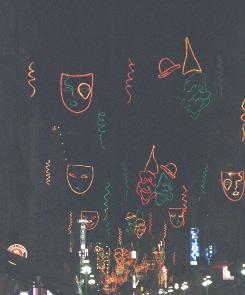
Carnival - now Lent. Late February, then.
Maybe it’s being a Protestant country – whatever, the pre-Lent carnival in England amounts to little more than a few pancakes. It’s a different story in Greece, where the shops have been full for the last few weeks with masks and costumes, kids throwing bangers everywhere and a general air of excitement and celebration. Smokey Thursday, two weeks ago, was scary – it’s a sort of Hallowe’en night, where kids in costume go around setting off fireworks and hitting strangers with baseball bats and the like. We barricaded ourselves into the internet café, since EFL teachers’ already limited disciplinary powers clearly wouldn’t have been much protection.
Preveza’s main carnival day was the following Thursday, consisting of a long, long, long parade along the seafront of school kids (and a few communists) in colourful costumes – kind of like Oxi day, but with better visuals, and the military music replaced by loud, Latin-tinged pop blaring out of the speakers. It’s amazing how many times one can hear ‘Mambo Number Five’ in one weekend, not to mention the eternally ludicrous Boney M. Ra Ra Rasputin. It was a shame how he carried on, indeed. Perhaps this is actually intended to drive listeners a little insane, thus creating the requisite liminal, ludic mindset in which carnivalesque communitas thrives. Or perhaps I spent too long at university studying carnival from a post-Bakhtinian cultural materialist perspective.
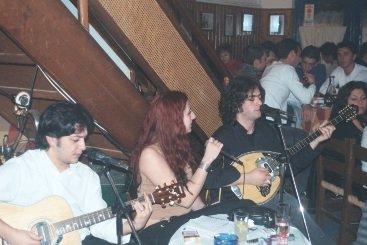
Literally every single person in Preveza is at the carnival, including, luckily, the burglars, if such there are. Pretty much all of them go out to dinner afterwards, too. A long time before we’re able to squeeze into Kaixis, six of us round a two-person upstairs table. Kaixis isn’t a favourite taverna – the food’s not great, and Sharon in particular objects to the over-friendliness of Tasos the proprietor – although he does seem to have got the message by now, and still sends us free wine. They often have live music though, which makes for a great atmosphere (carnivalesque communitas etc.). Tonight, two young guys and a gal are singing and playing guitar and bouzouki, and everyone else in the taverna (a young, studenty crowd – in fact, I think we’re about the oldest in there) singing along. More drinking among the Greeks than normal – carnival license – so not too long before people in fancy dress are dancing on the tables. There’s also the dangerous-looking capering the Greek men do: one man kneels on the ground, clapping, while his friend makes slow, bobbing movements, occasionally flailing out with wild kicks and jumps. They also dance with arms round each other’s shoulders. Greeks in general and young Greek men in particular are much more physically affectionate with their friends than the English. Interestingly, they also apparently believe that all English men are gay. (Despite the fact that nobody from my drama course has come to visit yet.)
Greece’s biggest and best carnival, though, takes place in Patra – the country’s unlovely third largest city, about three hours’ bus ride from here on the NW coast of the Peloponnese. Accommodation is impossible to come by over the last weekend of the carnival, so we decide to head down on Saturday, simply do without sleep and get the first bus back Sunday morning.
The streets are thronged with people, the cafes spilling out onto the pavements. Stalls on the streets sell feather boas, big felt hats, whistles. Loads of whistles. There’s a constant shrilling in the air, like a referees’ rave. More music and Boney M pumping out of outside speakers. A lot of people in big hats, masks or full fancy dress.
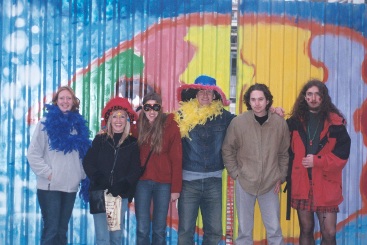
As for us: I have a fantastic parrot hat, which I’m wearing all the time, though mainly to keep warm – there’s a bitter wind. As it’s so cold, Rachel barely wears the beautiful batik peacock costume she’s been spending the last week making, and buys a feather boa to keep warm instead. Sharon and Craig have hats which wouldn’t look out of place at Ascot. Melanie has a mask and a blue wig, while John surpasses us all with a tartan miniskirt and tights, and a lot of make-up. Jody goes for a minimalist approach, with glittery nail varnish on one finger. We blend in pretty well.
I read somewhere that the Patras carnival is the largest non-commercial carnival in the world. It’s certainly hard to imagine a similar-scale event in Britain without scores of sponsors and ways to lose your money. Here, a certain snack-food company are giving out trial-size packets of their new black pepper flavour crisps (and very nice they are too) and a certain mobile phone giant has a tent where people are playing twister, and giving out helium balloons. That’s about it.
There’s little in the way of organised stuff going on. Turns out the big parade is actually tomorrow (I watch the highlights on TV – looks pretty impressive, with giant floats, George Bush effigies – the works). The one organised event tonight is a salsa band from New York, playing on a stage by the docks. There’s about 15 of them in all, and they’re excellent – we, at least, are dancing, although the bottle of vodka and orange probably helps. That and the absinthe.
After that, it’s bars, clubs and walking the streets for a while. By about half-three we’re hungry: everywhere’s still open, and we’re able to have an excellent sit-down meal of freshly-made pizza, gnocchi and pasta. The espressos that follow aren’t enough of a pick-me-up to make me want to go out dancing – stronger stimulants would be required by this point – although plenty of people still are: 5am and people are still arriving at clubs, not leaving. We find a café that isn’t charging an entrance fee, and sit there zoning out for a couple of hours as it starts to get light. A chill-out place would be good: instead, we get Fat Boy Slim and occasional bursts of heavy metal, which seems to suit most of the crowd.
There’s a surreal feel to the early morning streets. Stragglers stagger past, still fancy-dressed. Street sweepers are out already, cleaning up litter of streamers and fag butts and deflated balloons. Café owners hose the spilled beer off the pavements even as the dancing continues inside.
We get a bus to Rio, which isn’t as exciting as it sounds, since Rio in this case isn’t the Brazilian carnival capital but the small town on the Gulf of Corinth from where we need to catch a ferry over to the other side of the narrow stretch of water. They’re building a suspension bridge here, and very impressive and elegant it is too, although at the moment it doesn’t quite meet in the middle. It’s something they’ve been planning for about a hundred years (honestly – no exaggeration) and building for the last seven, at a cost of about 700 million euros, most of which has presumably been embezzled. Like many construction projects in Greece, it’ll be finished by the Olympics, honest.
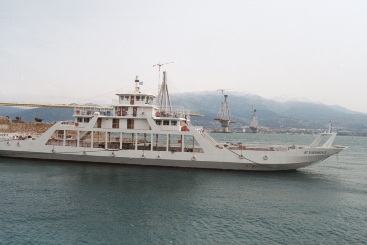
In the meantime though, a fleet of rusty car ferries plough to and fro. Except when it’s windy. Like today. Damn. So instead of a ten minute ferry ride and a couple of hours on the coach and being home in bed by midday, we’re faced with the prospect of having to go back to Patra to catch a bus to Athens (three hours) and then take another bus from Athens which would have to go the long, windy mountain route across to Preveza and should get us in at midnight if we’re lucky. It’s extremely frustrating to be defeated by a strip of water only about a mile across. The Greek car drivers clearly share this frustration, periodically honking their horns, as if this will somehow calm the sea. Some people are blowing their carnival whistles too.
Just as we’re about to get on the bus, though, they send out a first ferry, and when it doesn’t sink, they finally start sailing again. With cars facing every which way, and everybody determined to be on the first ferry across, it’s going to be mayhem. Luckily, as foot passengers, we’re able to sneak on the first boat across. Which isn’t such a great thing, as it just means longer to wait in Antirio, on the other side of the gulf, a village which is little more than a car park, and which will presumably die, unmourned, when the bridge opens.
We’re assured there will be a bus to Preveza at 3pm. Obviously, we don’t hold too much faith in this information: you should take all information you’re given in Greece with a pinch of salt, especially when it has to do with public transport. Partly, Greek people, some of them, would rather tell you what you want to hear than give you bad news. Partly they just don’t have a clue. Anyway, by half four no buses have arrived at all. Eventually, though, they start coming across on the ferries. We strain to read their destinations as the ferries dock. The first one is going to Ioannina. The second one is going to Ioannina. Bloody hell, so is the third.
It begins to take on the quality of a frustrating dream. You’re stuck in a limbo town. You have to get a bus. One by one, boats turn up, carrying buses. And it’s never the bus you need. We try to get on a couple which are at least going in the right direction, but are turfed off by the driver, who tells us the one from Preveza is just behind, two minutes, on the next ferry. Which it isn’t. Maybe because we haven’t slept at all, and because this wind is bloody freezing, this is getting almost unbearably infuriating.
Eventually, we catch a bus to Lefkada, and get off at Vonitsa, the next town to us on the Ambracian Gulf, where we’re finally told that, no, there are no buses coming to Preveza at all.
Good luck with the Olympics…
View/Add Comments (0) | Category:
February 18, 2004
Shortly after St Valentine’s Day (and what did he do? I must research my saints more. Not least because I need to find out when St Barnabas’ day is. Namedays here are more important than birthdays, so I’d be gutted to miss mine. Have to have a search for a saints website. www.saintsfc.co.uk is great, but not quite the thing in this case. Anyway…)
The car we hire in Preveza turns out to be the selfsame Suzuki I was driving on Lefkada on Tuesday. Small world, or at least, small part of Greece. They’ve fixed the CD player though. We’re planning to head north, up to the Zagoria region in the mountains beyond Ioannina. We’re apprehensive, since the weather – so much for Bird Season – has gone mental.
Preveza has turned freezing cold with piercing arctic winds. But it’s about the only part of Greece where it hasn’t snowed. There’s been a fresh fall up on the Lefkada peaks where we were the other day, and on our other horizon mountains. But it’s other, surprising parts of the country where it’s really hit hard. There are pictures on TV of abandoned, snowed-in cars on the main Athens – Larissa highway, storms on Crete, heavy snow on Chios.
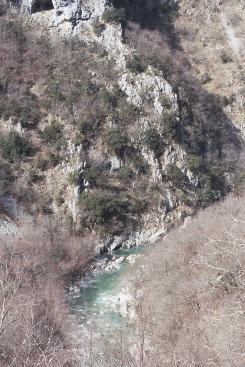
It’s a mixture of relief and disappointment, then, as we make our way up through Epirus on clear roads, the only snow to be seen high on the mountainsides. First stop on this little holiday is Perama, a village on the lakeside just beyond Ioannina. The sight here, as half-a-hundred road signs will not fail to remind you, is the Cave – Greece’s second largest.
It was discovered during WW2, by locals looking for a hiding place from the Nazis. There’s a kilometre-long walkway through the hillside, with steep steps and narrow passageways opening out into two vast chambers. The deeper you get, the more spectacular the formations become. In one hall, a cluster of stalagmites seem a crowd of people assembling for some great meeting. Others tower like fairytale castles atop Rhineland cliffs.
The couple who first explored the cave gave names to some of the most striking formations, which the attendant – we’re getting our own private tour – points out to us. Some of them are brilliantly apt: the harmonium, the bottles, the cacti, the Leaning Tower of Pisa and a remarkable sphinx. There’s great variation, in colour, shape, size and texture, from one place to the next. No idea why.
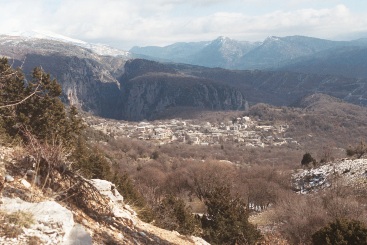
Back in daylight, we head north along a wide, green plane, before turning off up a hair-raising zigzag road into the Zagoria. Our destination is Monodendri, about 30km from Ioannina, one of the villages of the region known as the Zagarohoria. The houses here are built from the grey slate of the surrounding hillside, and they blend seamlessly into the landscape – camouflaged, almost. Although it’s clearly expensive to get your roof re-slated, and so a fair few of the older ones are covered in corrugated iron instead. Not so attractive, obviously, but it’s quite refreshing – the place still feels real and lived-in, not chocolate-box prettified.
These villages, which are become increasingly popular with tourists but retain a remote, slightly otherworldly feel. Monodendri is one of the more developed – there’s a lot of hotels and tavernas, although few are open at this time of year. More are being built. Thankfully – and unusually for Greece – they seem to have got the idea that people are attracted to the old slate houses, and the new stuff is being built – or clad, anyway – in the same style.
(Unfinished concrete buildings are an ugly rash all over the Greek landscape, scarring practically every vista. At the risk of sounding like a prissy English person, this country seriously needs some planning laws. Actually, I think they have them – they’re just rarely applied. An MP recently got sacked for supporting an illegal timeshare development in his Halkidiki constituency. Not for taking bribes from the developers – that’s normal enough. His particular crime was forging MP’s signatures to push his bill through parliament.)
Monodendri means ‘single tree’ which is a lie, but probably refers to the large plane tree in the village square. In the summer, this must be a lovely shady place for a long drink, but today is definitely a day for brandy and hot chocolate huddled beside a roaring log fire, and luckily one of the cafes off the square provides just that. The place we eat, however, is freezing. There is a fire, but the village’s other tourists – a pair of French guys – occupy the table beside it, and at our end of the room we can see our breath in the air as we eat our pittes and fried potatoes. Pie and chips. Traditional zagoria dish, actually.
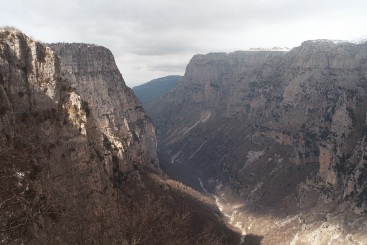
Breakfast is even colder, and there’s a whisper of snow in the air. We follow the path from Monodendri down to the Vikos Gorge. A sign tells us that, according to the 1997 Guinness Book of Records, this is the deepest canyon in the world. In 1997, anyway. At any rate, it’s nearly an hour’s walk down to the bottom, and a stunning view of the rearing rock walls, the green stream half-frozen. There’s icy snow on the path, though, and we decide (with some reluctance, on my part anyway) that we’re not kitted out for the seven hour hike up the gorge.
Instead, we climb back to the car, and drive then walk to the Oxia viewpoint, which is purportedly the best place to see the gorge in all its glory. Ye gods. I have a reasonable head for heights, but I’m near paralysed by vertigo as we stand on the edge of a sheer thousand metre drop. If anyone’s looking for a place to commit suicide, I’d recommend this highly.
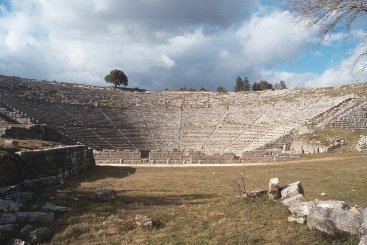
Later, we drive back through Ioannina and along another terrifying mountain road to ancient Dodoni. This is the site of the oldest oracle of the ancient world, with remains from Bronze Age (2600BC) to early Christian times. The oracle – dedicated to Zeus – based its message on the rustling of leaves in a sacred oak tree and the flight of the pigeons that nested there. Open to interpretation, that. Most of the site is just ruins which don’t mean much to the layman. But there’s the glorious exception of a well-preserved ancient amphitheatre, where plays are still performed in the summer. And the setting, in a wide valley ringed by tall mountains, is something special, even by the standards of other great ancient sites. The sun is out, and we have the place entirely to ourselves.
Back in Ioannina, we and the rest of the world have coffee by the lakeside. The benches and railings by the water are covered in icicles. The Tex-Mex restaurant, Poco Loco (see earlier entry) seems more incongruous then ever. Ioannina apparently has the second highest car-to-people ration in Europe, after Milan. It’s grown from a town to a city with no thought to planning. Parking is next to impossible, especially for one who still has an English mentality.
On a street in Preveza recently, I saw my first triple-parked car.
View/Add Comments (0) | Category:
February 11, 2004
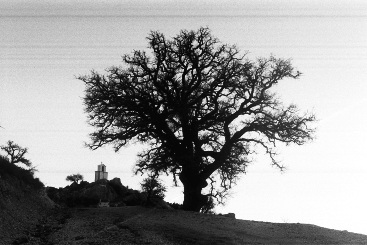
The Feast Of Saint Haralambos (February 10th – you knew that)
Greeks like their public holidays. Any excuse for a day off work and general eating, drinking and merriment instead – and good for them, I say. Today is a holiday in Preveza alone, celebrating the feast of our local patron saint, Agios Haralambos. Can’t tell you much about him, I’m afraid. As far as I know, he didn’t perform any miracles today. But the Greek flags were out on the streets and the schools were off, so we took the opportunity to spend a day on Lefkada.
Lefkada is the island on our southwest horizon, where the sun goes. Some days it’s clear enough to see roads and houses, other times it evaporates into a haze, and sometimes the clouds collect on its peaks, and then Lefkada disappears altogether into rain.
It’s only just a proper island. It used to be joined to the mainland by an isthmus (love that word!) until the 8th century BC, when they dug a canal. These days, there’s a short causeway and tiny ferry-bridge joining it to the mainland. All of which means that we can get there by bus in half an hour.
Lefkada Town is smaller than Preveza, but too populous to shut down for the winter: there’s an air of bustle, and a few brave (or English) souls are even sitting at outdoor café tables. The weather has finally heeded the continuing gripes in this blog and has got its act together – the last week or so has been lovely, although locals in their heavy winter coats cast funny looks at me in a T-shirt. Apparently this spell of warm weather is an annual fixture dating back to myth – Demeter planting her seeds, and some mythological bird (sorry, this is third-hand information) laying her eggs – ‘Bird Season’, it’s called.
Lefkada has suffered badly from earthquakes – there was one this summer that made the English papers. The upper storeys of the buildings in town are made of corrugated iron or sheet metal as an earthquake defence. They’re oddly attractive: shanty-town-chic, maybe. The lampposts are decorated, pre-carnival, with scary clowns, Ronald Macdonald’s embittered cousins.
A lagoon and the narrow channel to the mainland provide a sheltered anchorage, and even at this time of year there’s a fair few yachts in the marina. Hiring a yacht would be perfect, but we have to make do with a car. Question: what on earth do the people in the car hire places (and there’s at least three in Lefkada Town) do all day in the winter? Is it really worth staying open in the occasional hope that a group of English teachers will turn up and earn you 25 euros?
Rachel doesn’t drive, and John and Melanie don’t have their licenses, so I’m stuck with the driving. Which is fine, even on crazy island-mountain roads, although the necessity of looking at the road rather than the view can become a tad tedious. Because once we leave town and zig-zag up the hills, through olive groves and cypress trees, we open up some stupendous views. Lefkada itself is gloriously green – the silver shade of the olives, the dark firs, the lurid absinthe of the spring grass. The first crocuses are out, and a frosting of what I believe botanists call Daisies, Only Bigger.
[And we have a black-and-white film in the camera. You'll just have to take my word for it.]
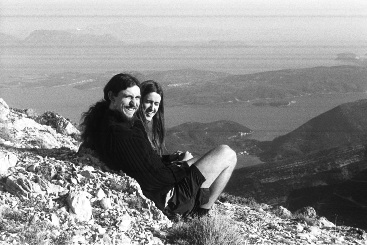
The island dips in the centre, creating a sort of secret vale with a reservoir in the centre and villages perched (BUZZ! Travel-writing cliché!) around the rim. We continue climbing till we’re up above the tree line, onto a plateau. The flatter parts of the stony ground have been cultivated: there are neat little ploughed fields, and Real Live Peasants working the land. One old woman clad all in widow’s black is tilling a field by hand. It’s a world away from EU subsidies, East Anglian sugar beet barons and intensive agribusiness. Good luck to her.
We park the car where the road winds out, near the top of one of the island’s twin peaks – an elevation of about 1200m, higher than anywhere in England – and take a stroll round the plateau. The sun’s out, but it’s chilly up here – there’s even a few patches of old snow on the ground.
The views are quite magnificent. We can see miles up the coast from Preveza, with the island of Paxi clearly visible to the north, and the faintest outline of Corfu hazy on the horizon. The Ambracian Gulf and the flat land to the east gives way to rearing mountains. The channel between Lefkada and the mainland holds a miniature archipelago of bottle-green islets stretched out like a map beneath us: we can look right down on Ari Onnassis’ private island, Skorpios. South of Lefkada are hump-backed Ithaki and, beyond, Kefalonia. To the west, nothing but the gorgeous turquoise of the Ionian.
It’s a strange landscape up here, with ridges of jagged rock bent back by ancient earthquakes, with sage bushes and scrubby shrubs, and incongruous hollows of flat, grassy ground which would be perfect places to pitch a tent. The grey-white rock is layered and full of holes: I’m only moderately surprised when I find a fossilised ammonite. Still, I wish I had a clearer knowledge of geology. Igneous, sedimentary and metamorphic – that’s all I remember from school.
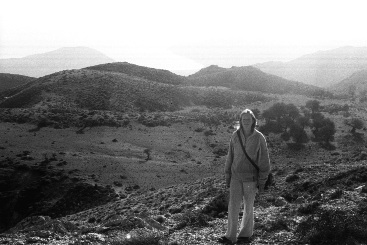
Our drive back down involves a hairy stretch of unpaved road, slipping down most of the way with my foot on the brake and looking out for falling rocks. When we do reach paved road, we find ourselves following a herd of sheep. Or more precisely, a herd of sheep and two goats. There’s a biblical passage, I believe, about Jesus separating the sheep and the goats at the day of judgement. There’s no need: the goats will go off of their own accord eventually, probably to climb onto a roof or go and chew someone’s washing. I think it’s meant to be the sheep that go to heaven, but I’m with the goats: there’s another parable in there, about doing your own thing and not blindly following the herd.
We see working donkeys, too, or probably mules, as we drive back down to a civilisation which isn’t quite 21st century. Don’t feel too sorry for the donkeys though: I almost drive off the road in surprise when we pass a van coming the other way and there’s a donkey staring out the windscreen at me. It’s standing in the back, leaning over the front seat beside the driver. I suppose people used to get similar shocks when they saw my family transporting our goat around in the back of the Ford Escort.
More goat stuff, while we’re at it. One of the most stunning of the superb beaches on Lefkada’s dramatic west coast is Porto Katsiki. The tour brochure we read proudly proclaims: ‘Once you see this beautiful beach you will realise that it’s not called the Bay of the White Goat for nothing.’ Indeed.
The sheltered east coast has deep inlets and glassy water, but is less enticing than the west, and more developed: there’s an almost unbroken chain of shut-up resorts all the way back to Lefkada Town, although it’s much more low-key than Corfu and the like. Spot a car rental firm called Abacus (slogan: ‘You can count on us’).
This week is the last for eating meat before Lent, culminating on Smokey Thursday, when everyone eats at the Psistarias (spit-grill tavernas). After that, there’s no meat for the pious till Easter. Then everyone feasts on entrail soup and – are you beginning to sense a theme? – grilled goat.
View/Add Comments (0) | Category:
January 27, 2004
Late January
To the best of my knowledge, nobody has yet come up with a better philosophy of life than "Eat, Drink and Be Merry." So this is what we do with our Saturday nights, and Preveza is a surprisingly good place to do it. Better in summer, maybe (what isn't?) when the taverna tables with the checked tablecloths and the wicker chairs spill out into the narrow lanes behind the seafront, and you're never quite sure which door your food is going to appear from. Then the whole town seems to be sitting down to the same banquet.
Back then, we could barely tell the different places apart; we can now. They all serve pretty much the same standard Greek fare, but the quality varies considerably - although everywhere it's likely to be of a higher standard than in any of the surrounding Ionian resorts. In the admittedly unlikely event that you, reader, are looking for somewhere to eat in Preveza, then head for the sign of ‘ ’.
[Well goddamn, my carefully-spelled-out Greek has just come up as a collection of random goobledegook. So much for this cut-and-paste technology. Transliterating, then, look for To Rembetiko Steko. Rembetika is a form of Greek folk music, from Asia Minor via the 1920s population exchange and hashish dens, and now often played live on guitars and bazoukis in the tavernas and bars around here of a Friday and Saturday night, although not, strangely, in the taverna in question. Dunno what Steko means.]
This is the best taverna in Preveza - the fact that you'll find it packed to the rafters on even a Monday night should tell you all you need to know. Inside it's a single pine-panelled room, half a dozen tables squashed in along each side and another row down the middle. There's a haze of cigarette smoke and a babble of chatter from the mostly young clientele. In the centre of the room is a massive stone fireplace and log fire - reason enough in itself to come here at the moment.
[Sorry to harp so Englishly on about the weather, but it bears repeating: it is freezing here. Lefkada is capped with snow now, and I'm only surprised we haven't had any down here yet - certainly it's been cold enough for the puddles on the seafront to freeze. Here in our apartment, where the two malfunctioning radiators have been intelligently placed on the outside walls, we wear three or four thick jumpers, woolly hats, and spend as much time as possible underneath the duvet and heavy blanket. Honestly, this is no exaggeration. Swimming in the sea seems a lifetime ago.]
So, we turn up around half ten. Greeks eat late: ten or eleven is normal, and since Rachel doesn't finish work till 10pm we've adapted to this routine easily enough. The taverna is packed, as it normally is from nine till midnight - but the owner, who knows us now, says one table has just paid up so should be leaving soon. After a few minutes' wait, he suggests we go for a short walk. By the time we return, they're just on their way out the door.
We hungrily claim the table, and the owner brings us each a shot of tziporo. Being English, we down these - cultural faux pas. The Greek way, he explains with good-natured disapproval, is to take shots a small sip at a time. Which is all very well, but this is tziporo - the distilled-from-leftover-grape-stalks firewater somewhat akin to meths but lacking a little of the finesse (actually, I quite like the stuff). Before we've had a chance to order our usual little-red-tin-jug of cheap white wine, one is sent over by Kostas - Rachel's boss' son - who's at a table in the corner. One of Rachel's colleagues is here too, as well as some students.
Only tourists ask to see the menu. We order a selection of our usual favourites: saganaki (fried cheese), tyrokafteri (spicy cheese dip), politiki (coleslaw with attitude), patatakeftedhes (fried potato cakes) and homemade chips. Greeks are familiar with vegetarians from the influx of British tourists, but still don't get the idea at all and simply don't believe that it's possible for anyone to survive on a meatless diet. So it's completely by mistake that they've developed a fantastic vegetarian cuisine - I-ve actually put on weight out here, which is something I never do. Anyway, the carnivores order meatballs me saltsa - with the sauce. A nod and a wink to the waiter, who understands - the sauce is famous around here.
Food comes at random intervals; plates are placed in the middle of the table and shared. Eat till your full, take a pause, then eat some more. Despite the demand for tables in here, there's no attempt to hurry you along - they wouldn't even think of it. A meal should last a minimum of two hours, may be three or four. A fair amount of wine gets consumed in this time, obviously - we're slowing down these days, but have yet to master the Greek art of making one drink last two hours.
When the plates are finally cleared away, it's time for dessert. This always comes on the house - a slice of sesame-rich halva, apple with cinnamon and honey. Probably another jug of wine on the house too.
When it comes to paying the bill, our evening's entertainment amounts to about eight euros each - the price of two pints and a packet of crisps back in England.
Sip your tziporo in a toast to To Rembetiko Steko: Eat, Drink and Be Merry - the rest of you philosophers should have spent more time in tavernas.
View/Add Comments (0) | Category:
January 21, 2004
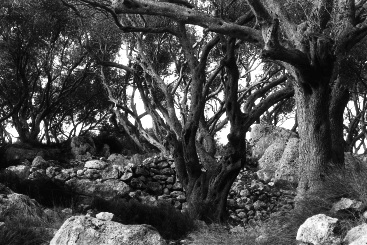
January, middle of – back after Christmas in the U.K. (May talk about that later, may not. Don’t hold your breath)
Corfu for the weekend. Spending too long in Preveza probably doesn’t do great things for one’s sanity, and we need to make the most of our time in Greece, so, along with Sharon and Rupert, we hire a Micra and head north up the coast, past shut-down beech resorts, barren, craggy hills and flat green planes to Igoumenitsa. This is the last port, and the last town of any size, before Albania, taking a lot of freight for Italy, and it’s growing at an alarming rate. Hideous concrete wall of a place, but luckily we don’t have long to wait for a ferry.
In Corfu Town, we finally find the Hotel Hermes. It was while searching for this budget hotel on our first trip to the island that Rachel and I first encountered the Strange Old Man with whom we stayed… but since I’m trying to sell that story to some other travel publications at the moment, I won’t say any more. It’s fine (an improvement on the Old Man’s shack) and ye gods, it has a shower curtain – an extraordinary innovation for Greece. Still, there’s a part of me in conflict with the budget traveller which longs for hotels of big white beds, fluffy towels and satellite TV.
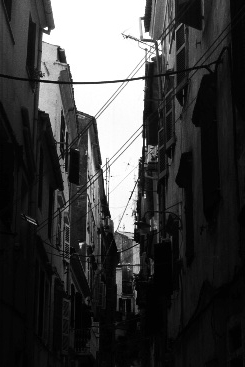
The streets of Kerkyra look strange at this time of year, the tourist shops shut down and the pavement tables deserted. Disorientating – we look for the centre of town as we remember it, and can’t find it. Not a complaint, this: we appreciate the beauty of the buildings more than ever. The washing stretched out to dry across the narrow streets of the old Jewish quarter, the dilapidated Venetian houses, the elegance of the cafés along the Liston arcade, the strange anomaly of the British influence: the cricket ground and the bandstand in the park. It’s a great town.
We have another wander in daylight the next morning, with elderly locals out strolling in their Sunday best; take a look around the fine old fortress and the mosaics in its museum. On our way back through the back streets, we’re accosted by an American madwoman. She’s wearing a bizarre mauve felt sack-dress, ski goggles, flowers in her hair, and is pushing around what could possibly be all her worldly goods in an old push chair. What need worldly goods? The Lord provides for her. She’s here writing a book about the promises God has made in the Bible (she’s counted over two hundred); she loves Greece, principally because kids learn the Bible in school. The Last Days are approaching, we’re informed; Jesus wants us, but Satan wants us too. And incidentally, the Bible also tells us how to get mildew out of mauve felt dresses, although she doesn’t provide the reference. “Time is love,” she tells us, thanking us for ours. We leave with her blessing, relieved to get away.
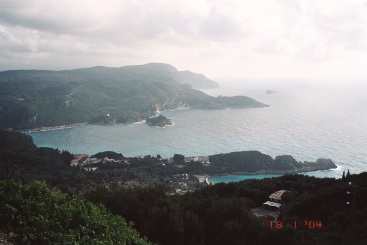
Off in the car then to the west coast, to Paleokastritsa, possibly the most beautiful point on possibly the most beautiful island in Greece. It’s overdeveloped, though not so horrendously as some parts of Corfu, but is a ghost town now, completely shut up. Seeing the beaches empty, you can almost imagine how gorgeous it once was here: rearing cliffs, emerald hills, and sparkling arced coves of white sand with the water that unique Ionian blue: I’m not going to bother with ‘azure’, ‘turquoise’, ‘iridescent’ or any of the other inadequate attempts to describe it. The sea here retains a blueness even under grey clouds; when the sun comes out, it’s transfigured into something magic.
We walk up to the monastery, and chat to a couple of monks outside their vegetable garden. We start off in Greek, but they quickly switch into excellent English. One of them studied chemical engineering in Birmingham back in the 70s. He says he found Birmingham very dull – he used to go London or Brighton for the weekends. Now, it doesn’t say much for a city if a monk found it dull… then again, I’m told the clubbing scene in Birmingham has really come on in the last few years. They’ve got a lovely garden, and quite a menagerie of peacocks, turkeys, chickens and Muscovy ducks. Being a monk here must be a pretty good life, I reckon. We’re invited for coffee later, if we’re still around, but right now they have to go and pray.
Reluctantly, we decide we need to make a move. We drive up to Lakones, a pretty old village high on the hillside overlooking the bay, and have lunch in a restaurant which has stupendous views and overpriced food, but does boast the major advantage of actually being open. We get a lot of strange looks from locals of all ages; English people are a rare sight at this time of year.
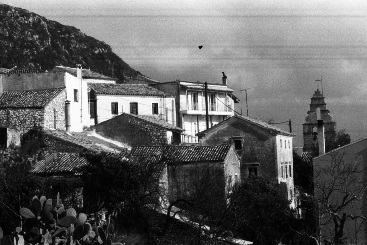
Up more crazy winding hill roads to the ruined fortress of Agios Angelos, a Byzantine ruin on top of a towering rocky outcrop, hundreds of metres above the sea. An impenetrable fortress – at least to us, since we find the gate locked. Another of the downsides of travel out of season – but the views are amazing.
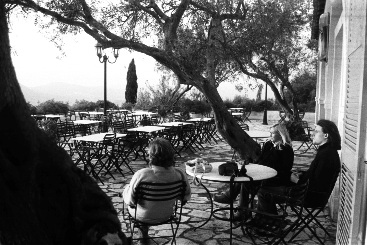
Then on to Pelekas, where a view-point gives a fantastic 360 degree panorama of the whole island, and the ominous clouds which are building below us. Some lucky bastards are paragliding off the hillside, swooping and hovering above the sea. At the Sunset Restaurant, we insist on sitting outside in the cold, to the consternation of the waitress and the Greek customers. We even order iced frappes. It’s been a fine day, but the sunset is disappointing. Still, a sun-sized hole opens up in the cloud for just long enough.
Back in Kerkyra, the clouds finally open. Corfu, lush and green, receives more rainfall than anywhere else in Greece, and seems inordinately proud of the fact. Just like every other time we’ve been, there’s a tremendous rain storm. We watch the downpour for a few minutes from underneath a shop awning, before making a splashing dash for Goody’s. Typically, as soon as we’re inside Greece’s number one fastfood restaurant, the rain stops.
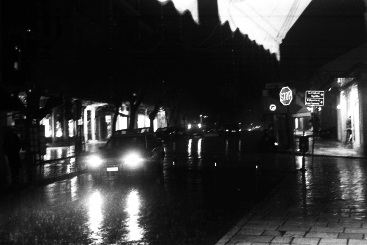
We get back to Igoumenitsa at around half-nine. It’s dark, and the steep, winding roads are still wet, so I drive at a reasonable speed, and consequently get overtaken by several lorries. This is humiliating to the driver’s ego, but I don’t have any great desire to become another statistic and another roadside shrine. To any Greeks concerned about their country having the highest road fatalities in Europe, I offer this advice: stop driving like maniacs!
The car doesn’t have to go back till Monday lunchtime, so we have the added joy of a trip to the Lidl superstore: ah, the glorious freedom of private transport!
View/Add Comments (0) | Category:
January 12, 2004
Christmas Time
Two thousand years after the birth of Christ, the Greeks have discovered Christmas. Oh, sure, they've always had the religious holiday, but in the Orthodox calendar it ranks some way below Easter, and the general feasting and jollity that go with it are much more low-key. Preveza may get bloody cold, but winter in Greece doesn't have that feeling of frozen, dark endlessness that you get in northern climes, so I suppose the winter solstice, Yuletide and all that never had the same importance. Obviously I haven't actually done a comparative study of ancient pagan holidays, but this seems a reasonable theory to me.
Tradition, Christian or pre-Christian, is no match for global capitalism, however. Christmas as the Feast of Consumerism is taking off big time now. This is, I think, a new development: four years ago, when I lived in Thessaloniki, things were very different. There were a few Christmas trees, some municipal decorations - boats seemed to be a popular motif -, the occasional apartment with lights around the window, a sprinkling of tinsel in the larger shops: that was about it.
Here, this year, you'd think they'd just invented electricity. Every lamppost, every balcony, every window twinkles with coloured light-bulbs. Sometimes, as in the strings of lights hung along the seafront promenade, it's beautiful: in other places, it's an epileptic's nightmare. We've succumbed ourselves and bought - for one euro - a set of 100 miniature music lights: "Bulbs twinkle with every note magically!" Obviously, since we have no desire to drive ourselves insane within 24 hours, we've switched the "music device" to off. Others, crazier, or deafer, haven't: the house across the street beeps an unending chorus of infuriating Christmas songs. To make matters worse, they've been abridged, so that if they were sung, rather than beeped, the sequence would go something like this:
We wish you a merry Christmas we wish you a merry and a happy new year jingle bells jingle bells jingle all the way fun is to ride on a one horse open sleigh biddle bee beep biddle bee beep [can't identify this bit: it sounds similar to The Sans Day Carol, but this seem unlikely] Santa Claus is coming to town we wish you a merry...
Santa Claus has indeed come to town: a disturbingly fat specimen swings his hips to "Jingle Bell Rock" - over and over andoverandover - outside one of the shops in the bazaar. There's another parachuting down the side of Rachel's school. Few chimneys here - not sure how the bloke gets into the apartments.
Along the high street, speakers attached to lampposts play carols or Christmas songs, mostly American. The closest to anything Greek is, I suppose, George Michael singing "Last Christmas". Meanwhile, the shops are full of more kitsch ornaments than you can shake a fairy wand at, and the TV seems to show nothing but adverts for children's toys (usually, the TV merely shows nothing but adverts, with occasional brief movie breaks. It makes you long for the BBC, or even ITV.) The PlayMobil castle, I have to admit, looks pretty fantastic.
Surely there must be some Greeks, besides the November 17th terrorists, who resent having this festival of consumption, with all its foreign trappings, thrust upon them: for the most part, though, people seem to be embracing it like a drunken snog under the mistletoe at the end of the office party - with about as much regard for good taste. They'll probably regret it in the morning.
As for indigenous Greek Christmas traditions: they do lovely honey and nut cookies. There are fresh satsumas and walnuts. And there's also the mandatory 10% seasonal bonus most taxi drivers and tavernas add to your bill.
Despite all this, I don't feel very Christmassy myself. (I was expecting a red squiggly line under "Christmassy", but no, apparently the folks at Microsoft understand the concept.) Contrast with last year, when we were in Nuremberg at this time. The Germans do Christmas brilliantly - the Christkindsmarkt, Gluhwein, Lebkucken, freezing bleakmidwinter weather, snow on steep roofs, frozen canals and Tannenbaume and "Stille Nacht" and a good old fashioned St Nicholas who hasn't yet fully mutated into the Coca Cola version... Now, that's Christmas...
I haven't seen many turkeys in Greece, but Rachel's boss keeps ostritches.
View/Add Comments (0) | Category:
January 09, 2004
December, Definitely Winter
The TV is showing blizzards in the north and warning of force ten gales; the mountains are capped in snow, there are white horses on the usually calm waters of the Gulf and the windows shudder in the wind. And it's citrus season. Even though satsumas are your traditional bottom-of-Christmas-stocking fruit, there's something incongruous about seeing the trees in town laden with bright lemons, oranges, grapefruit and mandarins at this time of year. These are juicy, refreshing, colourful fruits and you should have them in summer, dammit! Someone screwed up there.
(Quick digression: in Greek, as in every other language I know of, the words for orange the fruit and orange the colour are the same. I imagine the colour came first, so presumably every society had this conversation: 'What shall we call these orange things?' 'Er, oranges?' 'Bingo!' It's like those towns you get called 'Newtown', which must have been founded by the most deadeningly unoriginal people. I've only visited one Newtown, in mid-Wales, and it was quite possibly the worst place I have ever been to (and this is coming from someone who once lived in Peterborough). We were only there for half an hour to stop off at the supermarket, and five years later it's still seared on my memory. I can't say why, exactly - just something in the atmosphere, the legacy, I suppose, of those idiot founding fathers who couldn't come up with a proper name. Avoid the place, and, I suggest, all other Newtowns. And if anyone knows a language where 'orange' and 'orange' are different, please let me know.)
There are trees in the streets, and everybody has some in their garden (or, more usually, in the patch of wasteland surrounding their apartment block. This ain't suburbia as we know it). This means they practically give the stuff away in the grocer's. There's too much for anyone's purposes. Fruit falls from the trees and rots in the gutter. I no longer feel guilty about scrumping the odd lemon.
Lemons are best when they're still green - the fragrance of a fresh lemon is something wonderful, transforming a glass of water or a gin and tonic. They're a big ingredient in Greek cuisine - fish, fried cheese, cabbage, salad, all are served with a lemon on the side. If you leave them on the tree, they grow gangrenous and swell to the size of large oranges. I'm not sure what they taste like then.
Grapefruits are known in Greek by the English name, which seems puzzling. Did the Greeks not have their own word? Maybe they were just known as 'Off-yellows' or something (the word 'yellow' in Greek is citron. Do I have the basis of a thesis here?) And what's the connection between grapefruit and the fruit, grape? Whatever, they grow huge, and I think the people who park their cars under grapefruit trees are unwise.
The exciting news is that, to cope with the citrus supply, I bought a juicer this week, and we've been enjoying freshly-squeezed orange juice and homemade lemonade, which is lovely, but would be so much more appropriate in the summer. As I remember, the citrus season lasts until spring, stopping just as the weather starts getting hot. (I'm being unfar on the weather, actually. Before it started snowing, it was gorgeous. I was sunbathing on the roof and walking round in a T-shirt. Getting strange looks from the locals in their winter coats, admittedly.)
It's not a great juicer, in fact it's the cheapest one there was, but it works, after a fashion. This is one of the problems of living the itinerant life we do (the fact that we have next to no money is separate issue). Every item we acquire pushes us a little further over the 20 kilo baggage allowance into which we must squeeze our lives at the end of the year. So we buy the cheapest juicer, to go with the cheapest stereo (which is fine for Bonnie Prince Billy but doesn't do justice to the Flaming Lips) and the cheapest frappe maker (which manages to create a layer of bubbles on top of your coffee, but hardly the solid froth-you-can-stand-your-straw-up-in which a good frappe demands).
It's a natural instinct, I think, to want to make a nest, to carve out your own territory (and then fill it with elegant stainless-steel juicers and expensive stereo equipment). There's a struggle in all of us between our wanderlust and the craving for settled security; between wanting to explore every corner of the world and wanting to find that corner we can call our own, our home; between playing the field and geographical monogamy.
Living like this, for a few months in different places, is a good compromise. You get deeper into a place, you live with it, it's not just another stop on the tour. Your pictures have stories and people and feelings behind them, they're not just the backdrop to your MTV video existence.
On the other hand, like all compromises, it's not quite satisfying; it's neither one thing nor the other. The attachments you form are transitory, you're not putting any deep roots down, and you don't have your whole CD collection with you. Yet you soon fall into routines, day-to-day dullnesses. The speed with which human beings adjust to new experiences is incredible, and a little sad.
I have to remind myself from time to time: look, there are snow-capped mountains on the horizon. There are orange trees growing in the streets. You don't get that in Newtown.
View/Add Comments (0) | Category:
Early December
"It's a Greek word, miss!"
This is the refrain which Rachel hears constantly from her students, particularly the higher level ones. Interesting lexicological (Greek word, if it is a word) phenomenon (Greek word): the more sophisticated (Greek word), exotic (Greek word) or idiosyncratic (Greek word) the glossary (Greek word) is, the easier it becomes for Greek students to extrapolate (Greek - you get the idea. Idea's a Greek word, too). There are, apparently, 45,279 Greek words in the English language (count for yourself if you don't believe me).
The problem is that in many cases the English word has come to mean something subtly different. I need an esoteric diskdrive for my laptop would be a strange request; nobody in Britain is likely to refer to Wembley as the ethnic stadium. Rachel's students remain unimpressed when she tries to explain these differences: to them, the English is just plain wrong. The implication is clear enough: 'Look, we had Aristotle, Sophocles and the Parthenon while you were still living in mud huts and grunting. We know best. And while we're at it, you messed up the alphabet as well.'
So, I already know a lot of Greek. Suppose I'm invited out to the theatre: I could specify whether I wanted to see a euphoric, chaotic comedy, a sophisticated psychological drama, a cataclysmic, cathartic cosmic tragedy, or even some misogynistic pornography. Which is all very well, but not much help in the bakers when I'm trying to say 'that loaf there, please, no, not that one, the one next to it, the long thin one, yes.' Or if I'm attempting to make small talk, say, "Panathinaikos were unlucky against Man Utd last night.' I suppose I could say it was a catastrophe for Panathinaikos. Or that the result was a travesty. Except that wouldn't be a good idea, since travesty in Greek refers to cross-dressing.
Surprisingly, cross-dressing is one subject which isn't addressed in the latest Lonely Planet Greek phrasebook. It covers pretty much everything else, all the tourist essentials from 'What is your name?' to 'I'm on the methadone programme.' Favourite section, though, has to be the one on dating. This begins with the phrases that every girl who spends much time around Greek men is going to need, such as 'Leave me alone,' 'I'm not attracted to you,' 'Stop that!'
However, things progress, as they sometimes must, since there are thousands of English women married to Greek men. We soon reach the In The Bedroom section. Here, in Greek script and helpful English transliteration, we learn such gems as 'I love your bum', 'Tie me up,' and 'Let's do it again!'
It's not that these aren't all extremely useful phrases. The question is, do you optimistically learn the phrases beforehand? Or do you make sure that, even in the most intimate situations, you have your trusty Lonely Planet handy, so that at the height of passion you can look up the appropriate phrase? And doesn't this rather ruin the moment?
I couldn't comment on the In The Bedroom section, but generally efforts to speak Greek are warmly appreciated, although they're more than likely to reply in superior English. A few weekends ago we went to the village of Vassiliki on our nearby island, Lefkada, where, bizarrely, the replies came in Czech. For whatever reason, Vassiliki seems to be the number one destination for Czech tour companies, so all the menus and signs are covered in strange squiggly accents. All the locals involved in the tourist trade appear to speak the language fluently.
It's in dealing with tourists, of course, that learning English has its most obvious application. Tourism is easily Greece's biggest industry, and (little Czech enclaves notwithstanding) English remains the international tourist language. But these days, an English qualification is a prerequisite for pretty much any decent job - even if the job itself doesn't require any language skills, English ability is seen as an indication of a good education.
A lot of Rachel's students admit that they're learning English only so they can get a good job. This means the onus is on teaching them to pass exams - not quite the same thing as teaching them English. Speaking is about learning set phrases by rote, rather than facilitating communication. When it comes to having a conversation with an English speaker, the waiter in the tourist resort with no formal training is often in a better position than the student who's been attending the frontesteria for years, repeating sentences parrot-fashion.
The waiter is probably more fluent when it comes to the In The Bedroom section, too.
View/Add Comments (0) | Category: