


The Hanging Glaciers of Mt. Tronador
Tuesday, January 26th, 2010After crossing the Chile-Argentine border for the eighth time, we returned once more to Bariloche and began preparing for our fourth and final multi-day Patagonian trek: the Paso de las Nubes (roughly: ‘Cloud Pass’), which we turned from a two-day trek into a four-day trek by adding some side trips. Fortunately, there were barely any clouds in sight, the trail was quite easy (though boggy in parts) and the scenery was, as we’ve come to expect, quite spectacular. The highlights are below:
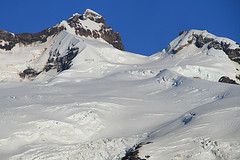 Mt. Tronador: The entire trek is essentially an ode to Mt. Tronador (Mt. Thunderer, named for the sounds its glaciers make, both in Spanish and previously in local languages), which is easily the highest in the region at 3554m and completely dominates the area. The triple-peaked mountain is shared between Argentina and Chile (though it seems most of the good stuff is on the Argentine side), is covered in snow year-round, and all of the glaciers we saw hung from its slopes. Our best views of the mountain itself were on the first and last days, though the most impressive glaciers were on the second and third days.
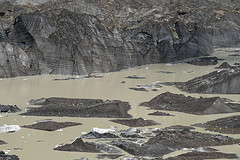 Ventisquero Negro: We spent the first day admiring the peak of Tronador and jostling with the hordes of domestic tourists at the Ventisquero Negro (‘Black Glacier’), which owes 99% of its popularity to the fact that you can drive to it. (Naturally, we walked.) It was actually quite interesting to see how many people come to see this glacier when, as it turns out, there are two more nearby that are infinitely more spectacular yet barely visited because you have to hike to them. As for the black (actually brown) glacier itself, I dislike dirty glaciers as much as the next guy, but this one was so dirty that it was almost pretty in a way considering the incredible contrast between the stark brownness of it and the pristine whiteness of the Glacier Manso directly above it.
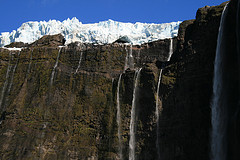 Glaciar Castaño Overo: The highlight of Day 2, and the entire trek, was the hanging Glaciar Castaño Overo, which we had completely to ourselves and was one of the most beautiful sights in this beautiful country. Emerging from a forest about 1¼ hours from the main trail, we suddenly arrived at the base of a sheer cliff with almost a dozen waterfalls streaming down it. At the top of the cliff stood the pristine glacier contrasted against the deep blue sky to complete the gorgeous scene (and give me a new desktop background). We found a nice rock to sit on, got out our breakfast of crackers and dulce de leche, and sat there by ourselves for some time, quite mesmerised.
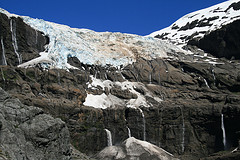 Glaciar Frías: On Day 3, we waded through bogs, climbed to the Paso de las Nubes itself (one of the easiest passes we’ll ever reach), and then went steeply downhill through forest on the other side, eventually emerging on a rocky outcrop near the valley floor to find another spectacular view ahead of us: the Glaciar Frías. While not quite as beautiful as Castaño Overo owing to some dirtiness on one side of the glacier, it was a grander and more imposing scene, with more of the glacier revealed, mountains rising from either side of it, and waterfalls tumbling further down. We once again had perfect weather and, spending the night at a well-situated campsite within view of the glacier, we were able to admire it for most of the day and then see first light hit it the next morning.
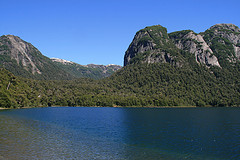 Cruce de Lagos: We managed, virtually by complete accident, to stumble across one of the main tourist attractions of the Lakes District: a bus and boat tour that ferries tourists (mostly Brazilians) from Puerto Montt in Chile to Bariloche. After two days of seeing hardly any people (on the second and third nights there were only three other tents at the campsites), we reached the end of the trail at Lago Frías to find a boatload of tourists awaiting their next cruise. We bought tickets for the two boats and two buses remaining (which cost, between us, a very steep 380 pesos – US$100 – and amazingly all the money we had on us totalled 380.75 pesos, just enough to scrape by) and joined the tour – the only way to get back to Bariloche other than to walk all the way back to the start of the trail and take a bus. Both the boat rides on Lago Frías and Lago Nahuel Huapi were quite beautiful and despite the culture shock of emerging from a peaceful trail to suddenly find ourselves in the thick of high-end tourism, it was a lovely way to end the trek.
The next day, we completed our circumnavigation of Argentina by taking a bus all the way back to Buenos Aires, where we started this trip in early October. Now we just have time to duck into Uruguay for a couple of days before I head to Vancouver on Thursday.
 Nick
Nick